‹ The Preface Underweysung der Messung
Dürer · 1525 · Peltzer 1908 · trans. ARMISTICE

Underweysung der Messung

instruction in measurement with compass and straightedge — Dürer, 1525

The first geometry written in German for working artists, now set with an English translation beside each facsimile page: how to draw the spiral and the conic section, the regular polygons and the tilings, the column and the constructed letter, the five solids and their unfolded nets — and, at the close, the famous machines for seizing perspective. The page sits to the left; the translation reads on the right, with Dürer's own German a click away. Compass in one hand, straightedge in the other.

Dürer, Underweysung der Messung — leaf 7
Title page · leaf 7

Albrecht Dürer's

Manual of Measurement

Somewhat abridged and adapted to more modern usage, edited and provided with an afterword by Alfred Peltzer

At the instigation of, and with a foreword by, Hans Thoma

Süddeutsche Monatshefte G. m. b. H., Munich 1908

Original — Peltzer 1908

Albrecht Dürers

Unterweisung der Messung

Um Einiges gekürzt und neuerem Sprachgebrauch angepaßt, herausgegeben sowie mit einem Nachwort versehen von Alfred Peltzer

Auf Veranlassung und mit einem Vorwort von Hans Thoma

Süddeutsche Monatshefte G. m. b. H. München 1908

Dürer, Underweysung der Messung — leaf 8
Figure leaf: blank / printer's leaf preceding the foreword (raw contains only the 'Digitized by Google' stamp). · leaf 8
Dürer, Underweysung der Messung — leaf 9
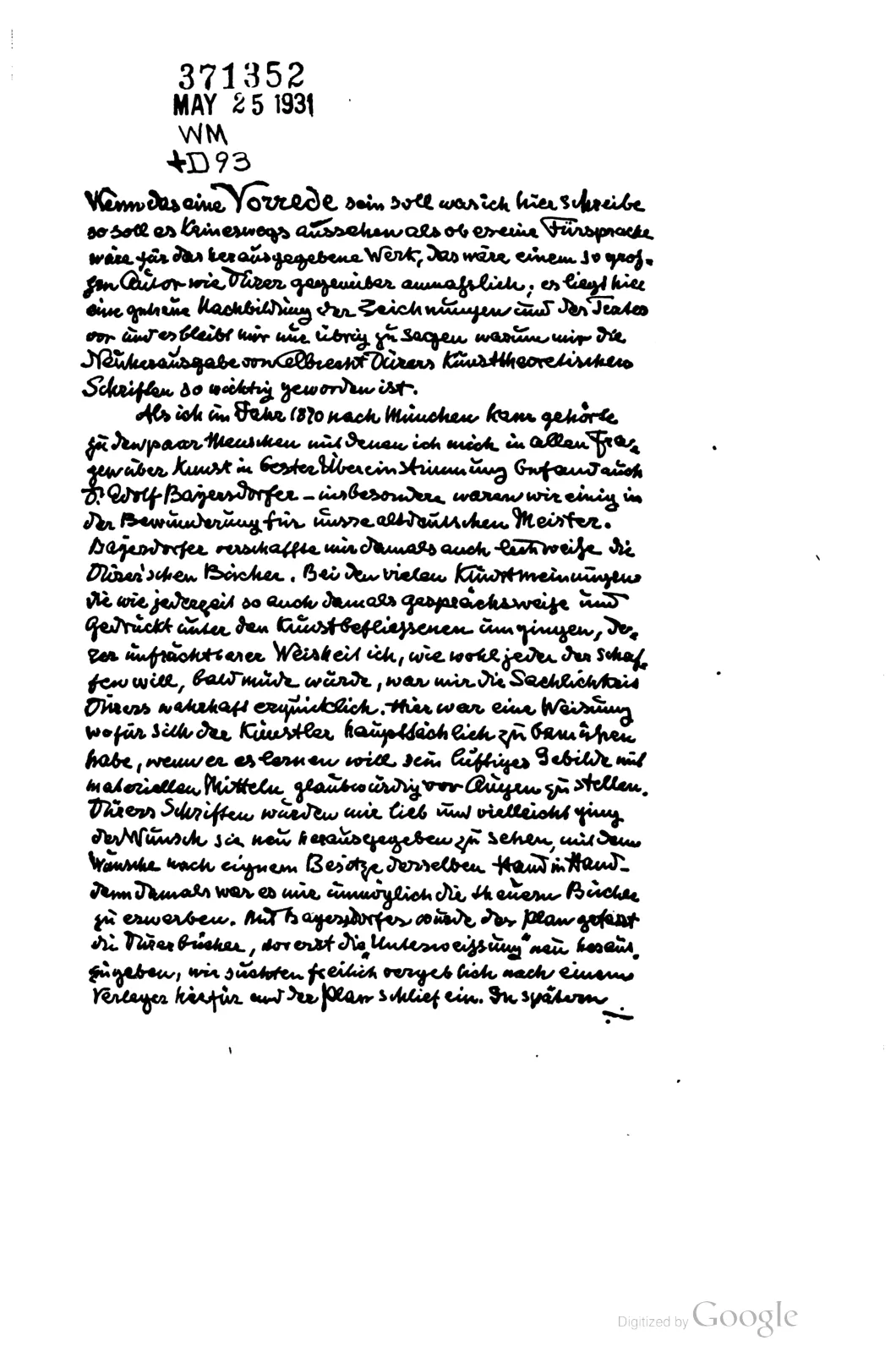
Hans Thoma — Vorwort (foreword), in the painter's hand · leaf 9

If what I write here is to be a preface, it should by no means look as though it were a plea on behalf of the published work. That would be presumptuous toward so great an author as Dürer; what lies before us here is a faithful reproduction of the drawings and the text, and it only remains for me to say why the new edition of Albrecht Dürer's art-theoretical writings has become so important to me.

When I came to Munich in the year 1870, among the few people with whom I found myself in the best of agreement on every question concerning art was also Dr. Adolf Bayersdorfer — we were of one mind especially in our admiration for our old German masters. It was Bayersdorfer who first put the Dürer books into my hands back then. Amid the many opinions on art that circulated then as always among the art-minded, both in conversation and in print — barren wisdom of which I, like anyone who wants to create, soon grew weary — Dürer's matter-of-factness was truly refreshing to me. Here was a guide as to what the artist should chiefly strive for, if he wishes to learn how to set his airy vision convincingly before the eye by material means.

Dürer's writings became dear to me, and perhaps the wish to see them published anew went hand in hand with the wish to own them myself — for at that time it was impossible for me to acquire the costly books. Together with Bayersdorfer the plan was formed to bring out the Dürer books anew, first of all the Underweysung; but we searched in vain for a publisher, and the plan fell dormant. In later

Original — Peltzer 1908

Wenn das eine Vorrede sein soll was ich hier schreibe, so soll es keineswegs aussehen als ob es eine Fürsprache wäre für das herausgegebene Werk. Das wäre einem so großen Autor wie Dürer gegenüber anmaßlich; es liegt hier eine getreue Nachbildung der Zeichnungen und des Textes vor und es bleibt mir nur übrig zu sagen warum mir die Neuherausgabe von Albrecht Dürers Kunsttheoretischen Schriften so wichtig geworden ist.

Als ich im Jahr 1870 nach München kam gehörte zu den paar Menschen mit denen ich mich in allen Fragen über Kunst in bester Übereinstimmung befand auch Dr. Adolf Bayersdorfer — insbesondere waren wir einig in der Bewunderung für unsere altdeutschen Meister. Bayersdorfer verschaffte mir damals auch erstweise die Dürer'schen Bücher. Bei den vielen Kunstmeinungen die wie jederzeit so auch damals gesprächsweise und gedruckt unter den kunstbeflissenen umgingen, der über unfruchtbarer Weisheit ich, wie wohl jeder der schaffen will, bald müde würde, war mir die Sachlichkeit Dürers wahrhaft erquicklich. Hier war eine Weisung wofür sich der Künstler hauptsächlich zu bemühen habe, wenn er es lernen will sein luftiges Gebilde mit materiellen Mitteln glaubwürdig vor Augen zu stellen.

Dürers Schriften wurden mir lieb und vielleicht ging der Wunsch sie neu herausgegeben zu sehen, mit dem Wunsche nach eignem Besitze derselben Hand in Hand — denn damals war es mir unmöglich die teuern Bücher zu erwerben. Mit Bayersdorfer wurde der Plan gefaßt die Dürerbücher, vor erst die Unterweisung, neu heraus zugeben, wir suchten freilich vergeblich nach einem Verleger hierfür und der Plan schlief ein. In späteren

Dürer, Underweysung der Messung — leaf 10
Hans Thoma — Vorwort (foreword), in the painter's hand · leaf 10

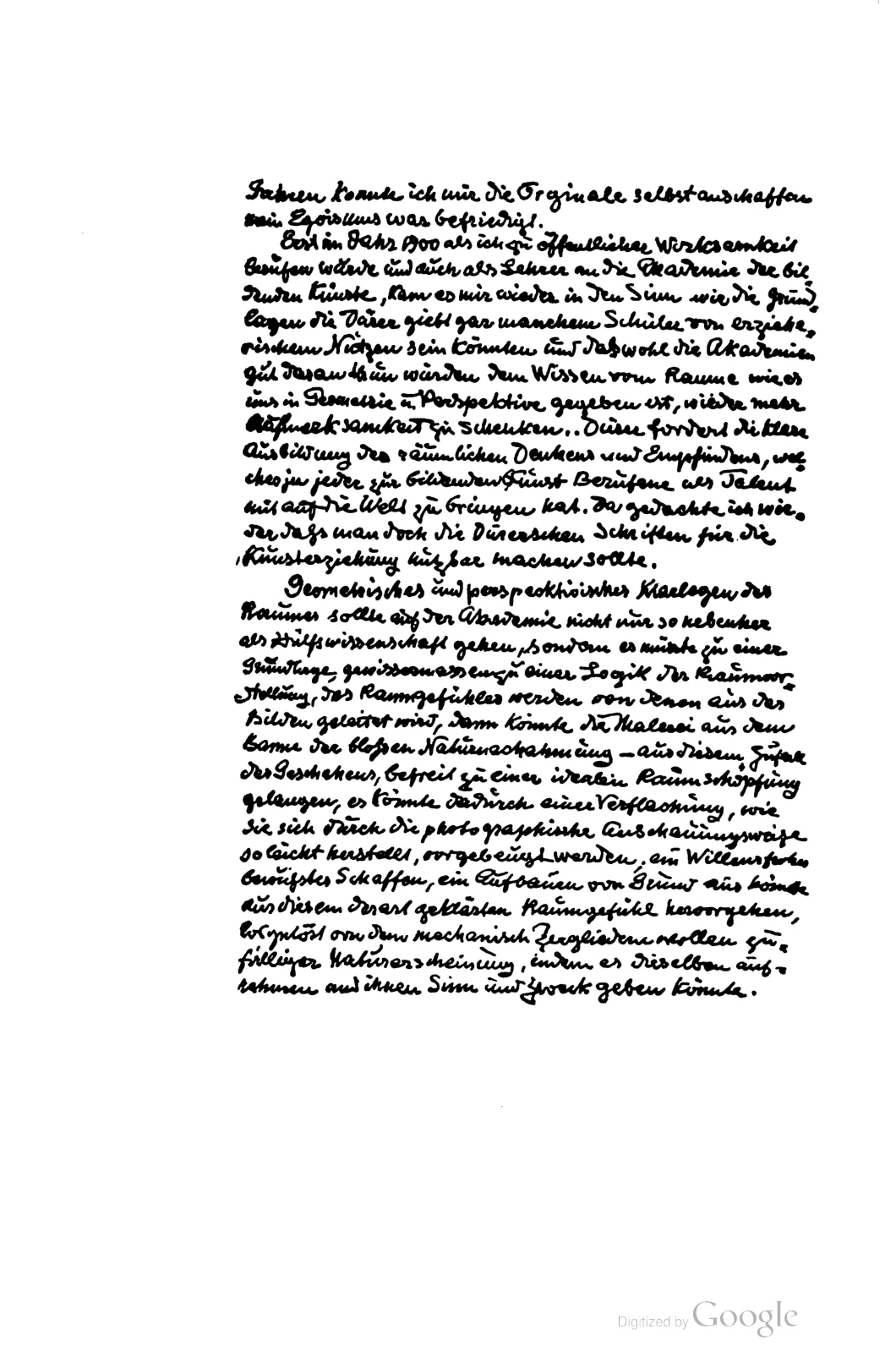
years I was able to procure the originals for myself, and my self-interest was satisfied.

It was only in the year 1900, when I was called to a sphere of public activity and also as a teacher to the Academy of Fine Arts, that it came to my mind again how the foundations Dürer gives could be of educational use to many a pupil, and that the academies would do well to pay more attention once again to the knowledge of space as it is given to us in geometry and perspective. Dürer demands the clear cultivation of spatial thinking and feeling, since everyone called to the visual arts must bring it into the world with him as a talent. So I thought once more that Dürer's writings really ought to be made useful for the education of artists.

The geometric and perspectival clarifying of space should not run merely as an auxiliary science on the side at the academy, but ought to become a foundation — a kind of logic of spatial representation, of the sense of space — from which the picture is guided; then painting could be freed from the spell of mere imitation of nature, from that accident of happenstance, and arrive at a free creation of space. By this means one could guard against the flattening that the photographic way of seeing so easily produces; a willed, firm, conscious making, a building up from the ground, could proceed from such a clarified sense of space, detached from the mechanically dissecting fullness of accidental natural appearance, in that the artist could take it up and give it sense and purpose.

Original — Peltzer 1908

Jahren konnte ich mir die Originale selbst anschaffen und mein Egoismus war befriedigt.

Erst im Jahr 1900 als ich zu öffentlichem Wirkensamkreis berufen wurde und auch als Lehrer an die Akademie der bildenden Künste, kam es mir wieder in den Sinn wie die Grundlagen die Dürer giebt gar manchem Schüler von erzieherischem Nutzen sein könnten und daß wohl die Akademien gut daran thun würden den Wissen vom Raume wie es uns in Geometrie und Perspektive gegeben ist, wieder mehr Aufmerksamkeit zu schenken. Dürer fordert die klare Ausbildung des räumlichen Denkens und Empfindens, weil es ja jeder zur bildenden Kunst Berufene als Talent mit auf die Welt zu bringen hat. Da gedachte ich wieder, daß man doch die Dürer'schen Schriften für die Künstlererziehung nützbar machen sollte.

Geometrisches und perspektivisches Klarlegen des Raumes sollte auf der Akademie nicht nur so nebenher als Hilfswissenschaft gehen, sondern es müßte zu einer Grundlage, gewissermaßen zu einer Logik der Raumvorstellung, des Raumgefühles werden von denen aus die Bilder geleitet wird, dann könnte die Malerei aus dem Banne der bloßen Naturnachahmung — aus diesem Zufall des Geschehens, befreit zu einer freien Raumschöpfung gelangen, es könnte dadurch einer Verflachung, wie sie sich durch die photographische Anschauungsweise so leicht herstellt, vorgebeugt werden, ein Willens festes bewußtes Schaffen, ein Aufbauen von Grund aus könnte aus diesem derart geklärten Raumgefühle hervorgehen, losgelöst von dem mechanisch zergliedernden vollen zufälliger Naturerscheinung, indem er dieselben aufnehmen und ihnen Sinn und Zweck geben könnte.

Dürer, Underweysung der Messung — leaf 11
Hans Thoma — Vorwort (foreword), in the painter's hand · leaf 11

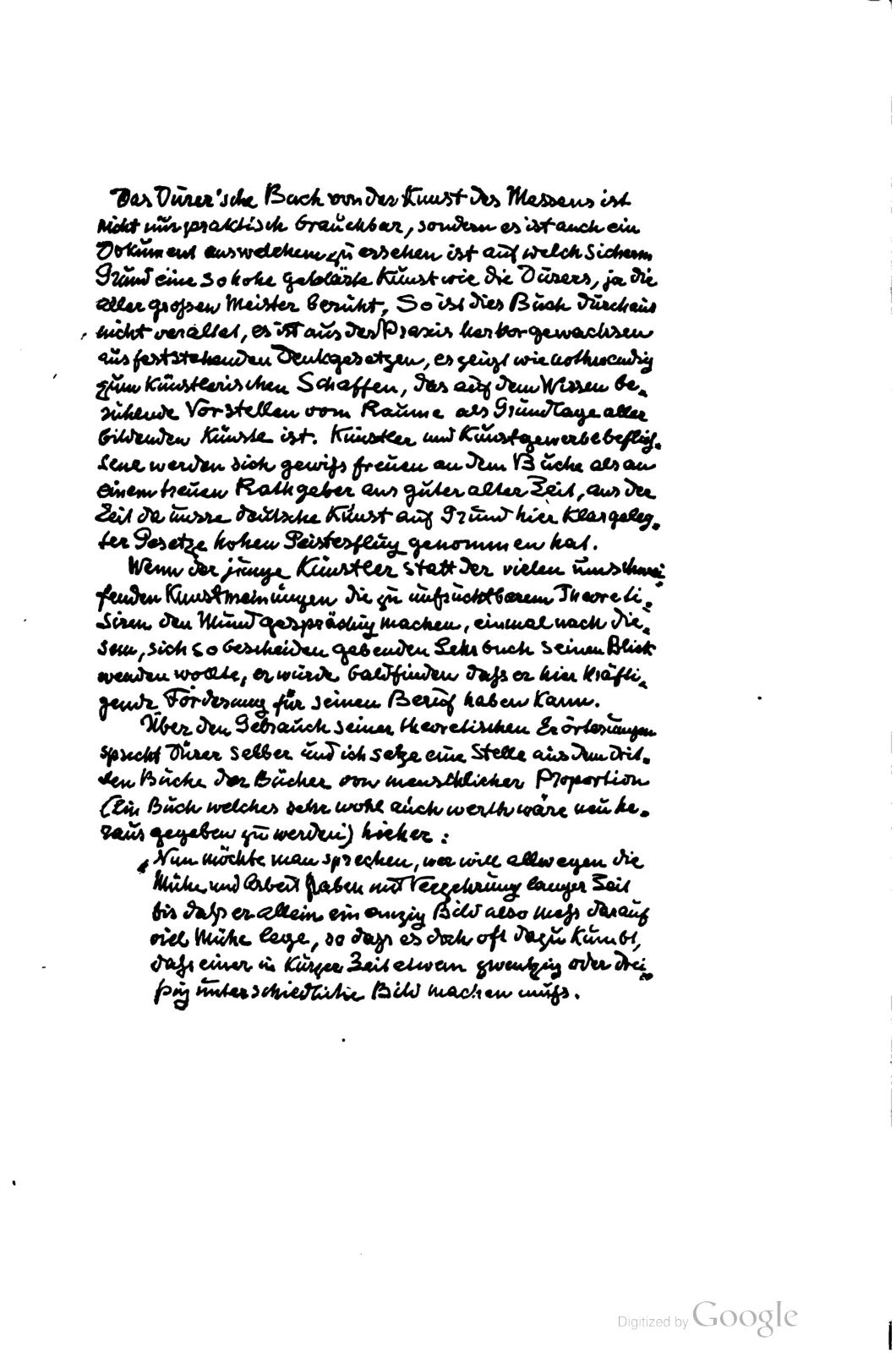
Dürer's book on the art of measuring is not only of practical use; it is also a document from which one can see on what sure ground so high and purified an art as Dürer's — indeed as that of all the great masters — rests. Thus this book is by no means outdated; it has grown out of practice, out of firmly established laws of thought, and it shows how necessary to artistic creation is the knowledge-based conception of space as the foundation of all the visual arts. Artists and those devoted to the applied arts will surely take pleasure in this book as in a faithful counselor from good old times — from the time when our German art took its high masterly flight on the basis of the laws here set forth.

If the young artist, instead of the many buzzing opinions on art that make the mouth talkative in barren theorizing, would for once turn his gaze to this so modestly presented textbook, he would soon find that he can gain strengthening support for his vocation here.

On the use of his theoretical discussions Dürer himself speaks, and I set down here a passage from the third book of the Books on Human Proportion (a book that would be very well worth being published anew):

"Now one might say: who will always go to the trouble and labor and the consumption of long time until he lays out a single image alone with so much effort — when it often comes to this, that someone in less time must make some twenty or thirty quite different images.

Original — Peltzer 1908

Das Dürer'sche Buch von der Kunst des Messens ist nicht nur praktisch brauchbar, sondern es ist auch ein Dokument aus welchem zu ersehen ist auf welch sicherm Grund eine so hohe geläuterte Kunst wie die Dürers, ja die aller großen Meister beruht. So ist dies Buch durchaus nicht veraltet, es ist aus der Praxis hervorgewachsen aus feststehenden Denkgesetzen, es zeigt wie nothwendig zum künstlerischen Schaffen, das auf dem Wissen beruhende Vorstellen vom Raume als Grundlage aller bildenden Künste ist. Künstler und Kunstgewerbebeflissene werden sich gewiß freuen an dem Buche als an einem treuen Rathgeber aus guter alter Zeit, aus der Zeit da unsere deutsche Kunst auf Grund hier klargelegter Gesetze hohen Meisterflug genommen hat.

Wenn der junge Künstler statt der vielen umschwirrenden Kunstmeinungen die in unfruchtbarem Theoretisieren den Mund gesprächig machen, einmal nach diesem, sich so bescheiden gebenden Lehrbuch seinen Blick wenden wollte, er würde bald finden daß er hier kräftigende Förderung für seinen Beruf haben kann.

Über den Gebrauch seiner theoretischen Erörterungen spricht Dürer selber und ich setze eine Stelle aus dem dritten Buche der Bücher von menschlicher Proportion (ein Buch welches sehr wohl auch werth wäre neu herausgegeben zu werden) hieher:

„Nun möchte man sprechen, wer will allwegen die Mühe und Arbeit haben und Verzehrung langer Zeit bis daß er allein ein einzig Bild also mit so viel Mühe lege, so daß es doch oft dazu kömbt, daß einer in kürzer Zeit etwan zwanzig oder drei gar unterschiedliche Bild machen muß.

Dürer, Underweysung der Messung — leaf 12
Hans Thoma — Vorwort (foreword), in the painter's hand · leaf 12

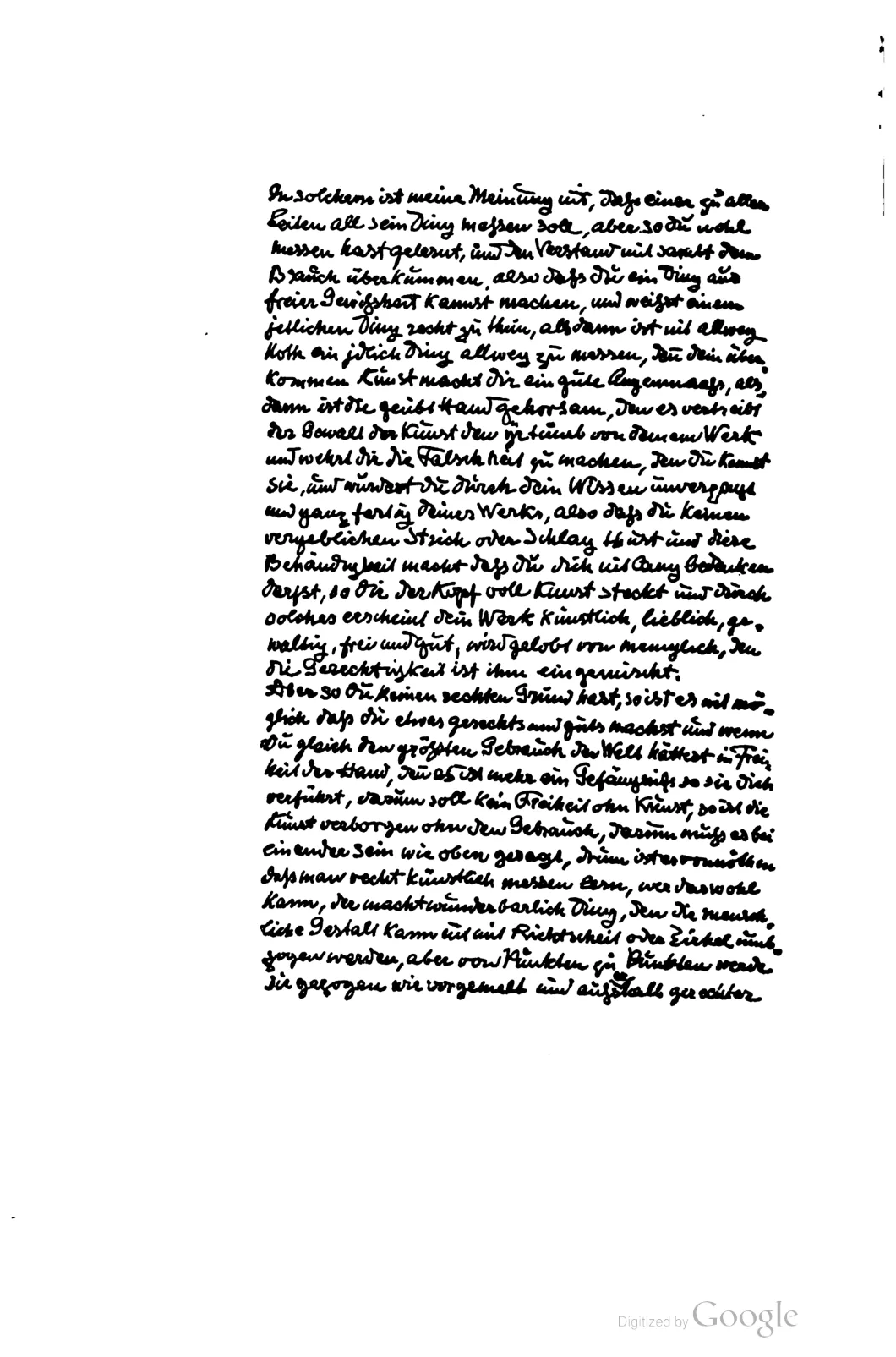
In this my opinion is not that one should measure all his work in all its parts; but once you have learned to measure well, and have acquired understanding together with number through practice, so that you can make a thing out of free certainty and know how to do right by each thing, then it is not always necessary to measure every thing always — for the art you have acquired gives you a good eye, and so the practiced hand is obedient. And the power of art governs the use of a work and guards you from making what is false, for you know it, and through your knowledge you become unfailing and wholly accomplished in your work, so that you make no wasted stroke or cut; and this dexterity means that you need not deliberate long, when your head is full of art. By such means your work appears artful, lovely, powerful, free and good, and is praised by all, for rightness is mingled into it.

But if you have no proper foundation, it is not possible for you to make anything right and good — even if you possessed the greatest practice in the world in freedom of hand, which is rather a prison if it leads you astray. Therefore there should be no freedom without art, just as art is hidden without practice; therefore the two must go together, as said above. Hence it is needful that one can measure rightly and artfully; whoever can do this well makes wondrous things — for the human figure cannot be circumscribed with straightedge or compass, but is drawn from point to little point as foreshown, and beyond right measure

Original — Peltzer 1908

In solchem ist meine Meinung nit, daß einer zu allen Teilen all sein Ding messen soll, aber so du wohl messen hast gelernt, und den Verstand mit zahl dem Brauch überkommen, also daß du ein Ding aus freier Gewißheit kannst machen, und weißt einem jeglichen Ding recht zu thun, alsdann ist nit allweg Noth ein jeglich Ding allweg zu messen, denn dein überkommen Kunst macht dir ein gute Augenmaß, also, denn ist die geübt Hand gehorsam. Und es verstellt der Gewalt der Kunst den Gebrauch von einem Werk und wehrt dir die Falsch hat zu machen, denn du kennst sie, und wirdest die durch dein Wissen unvergeblich und ganz fertig deines Werks, also daß du keinen vergeblichen Strich oder Schlag thust und diese Behendigkeit macht daß du dich nit lang bedenken darfst, so du der Kopf voll Kunst steckt und durch solches erscheint dein Werk künstlich, lieblich, gewaltig, frei und gut, wird gelobt von menniglich, denn die Gerechtigkeit ist ihm eingemischt.

Aber so du keinen rechten Grund hast, so ist es nit möglich daß du etwas gerechts und guts machest und wenn du gleich den größten Gebrauch der Welt hättest in Freikeit der Hand, der also mehr ein Gefängnis so sie dich verführt, darum soll kein Freikeit ohn Kunst sein, so ist die Kunst verborgen ohn den Gebrauch, darum muß es bei einander sein wie oben gesagt, drum ist es vonnöthen daß man recht künstlich messen kann, wer das wohl kann, der macht wunderbarlich Ding, denn die menschliche Gestalt kann nit mit Richtscheit oder Zirkel umbzogen werden, aber von Punkten zu Pünktlein werden sie gezogen wie vorgemalt und außerhalb gerechter

Dürer, Underweysung der Messung — leaf 13
Hans Thoma — Vorwort (foreword), in the painter's hand · leaf 13

measure no one can make anything good!"

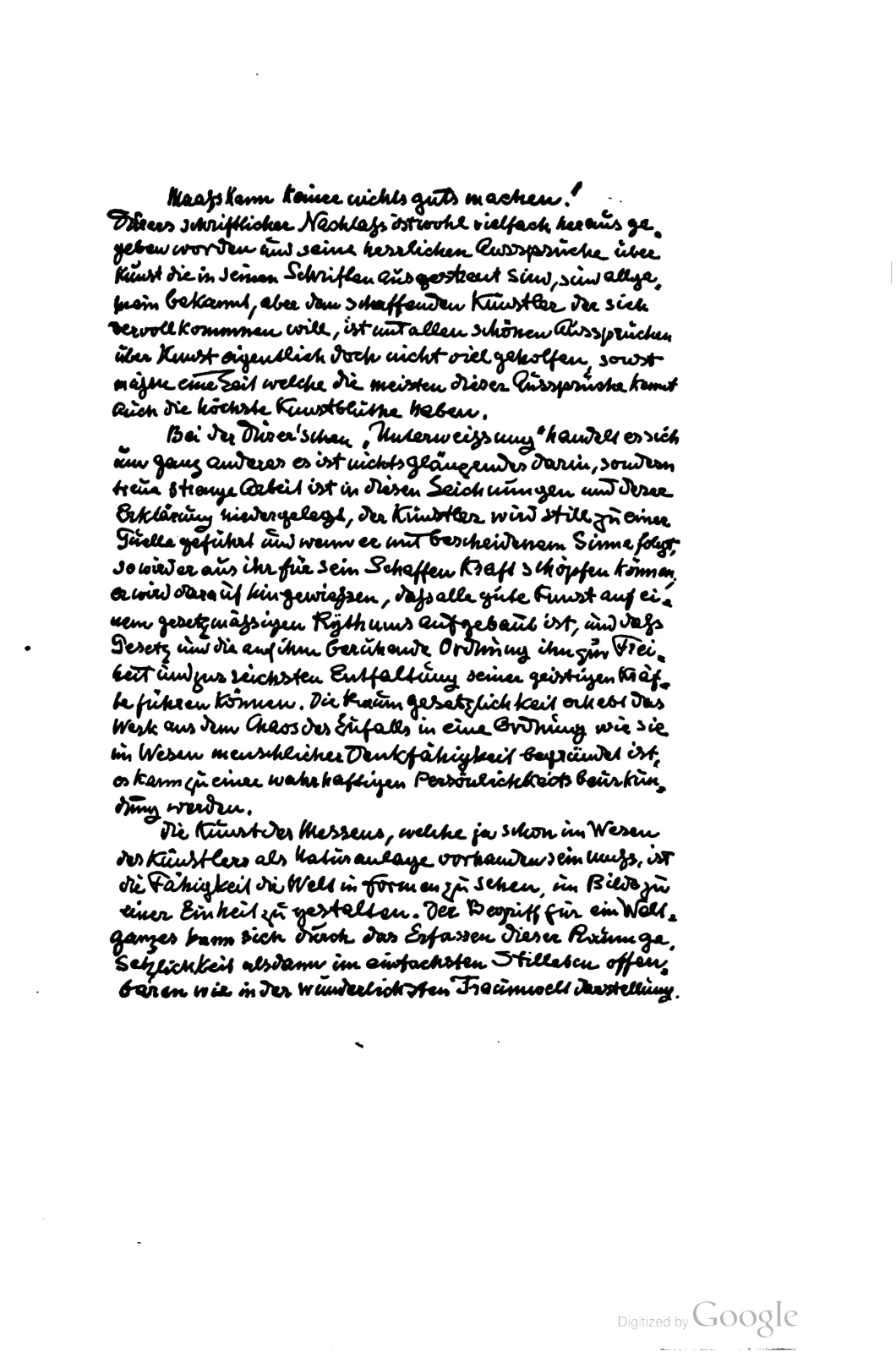
Dürer's literary remains have indeed been published many times over, and his magnificent sayings on art that are scattered through his writings are now generally known; but the creating artist who wishes to perfect himself is, in truth, not much helped by all the fine sayings about art — otherwise an age that knows most of these sayings would also possess the highest flowering of art.

With Dürer's "Underweysung" it is a matter of something quite different: there is nothing glittering in it, but rather faithful, rigorous work is laid down in these drawings and their explanation. The artist is led quietly to a wellspring, and if he follows with a modest spirit, he will be able to draw strength from it for his own creation. He is shown that all good art is built upon a lawful rhythm, and that law, and the order founded upon it, can lead him to freedom and to the richest unfolding of his spiritual powers. That which is barely lawful redeems the work out of the chaos of chance into an order such as is grounded in the very nature of human capacity for thought; it can become a truly personal act.

The art of measuring — which must indeed already be present in the artist's nature as a native disposition — is the ability to see the world in forms, to shape it into a unity in the picture. The concept of a world-whole can then, through the grasping of this spatial lawfulness, reveal itself in the simplest still life as in the most fantastical dreamworld depiction.

Original — Peltzer 1908

Maaß kann keiner nichts guts machen!"

Dürers schriftlicher Nachlaß ist wohl vielfach herausgegeben worden und seine herrlichen Aussprüche über Kunst die in seinen Schriften ausgestreut sind, sind nun allgemein bekannt, aber dem schaffenden Künstler der sich vervollkommnen will, ist mit allen schönen Aussprüchen über Kunst eigentlich doch nicht viel geholfen, sonst müßte eine Zeit welche die meisten dieser Aussprüche kennt auch die höchste Kunstblüte haben.

Bei der Dürer'schen „Unterweisung" handelt es sich um ganz anderes, es ist nichts gläuzendes darin, sondern treue strenge Arbeit ist in diesen Zeichnungen und deren Erklärung niedergelegt, der Künstler wird still zu einer Quelle geführt und wenn er mit bescheidenem Sinne folgt, so wird er aus ihr für sein Schaffen Kraft schöpfen können, er wird darauf hingewiesen, daß alle gute Kunst auf einem gesetzmäßigen Rhythmus aufgebaut ist, und daß Gesetz und die auf ihm beruhende Ordnung ihm zur Freiheit und zur reichsten Entfaltung seiner geistigen Kräfte führen können. Die kaum gesetzlich erlöst das Werk aus dem Chaos des Zufalls in eine Ordnung wie sie im Wesen menschlicher Denkfähigkeit begründet ist, es kann zu einer wahrhaftigen Persönlichkeitsbethätigung werden.

Die Kunst des Messens, welche ja schon im Wesen des Künstlers als Naturanlage vorhanden sein muß, ist die Fähigkeit die Welt in Formen zu sehen, im Bilde zu einer Einheit zu gestalten. Der Begriff für ein Weltganzes kann sich durch das Erfassen dieser Raumgesetzlichkeit alsdann im einfachsten Stilleben offenbaren wie in der wunderlichsten Traumwelt Darstellung.

Dürer, Underweysung der Messung — leaf 14
Hans Thoma — Vorwort (foreword), in the painter's hand · leaf 14

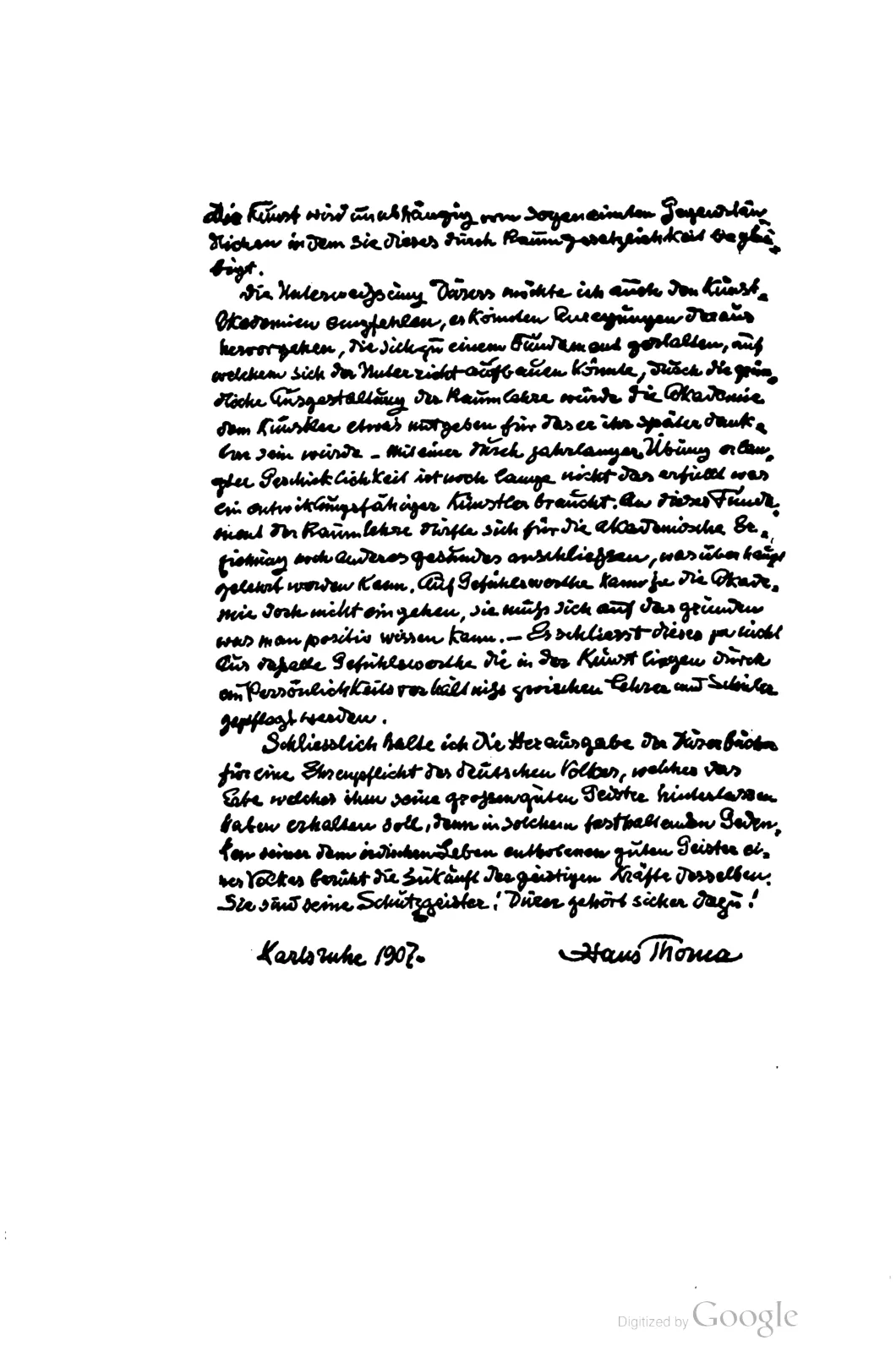
Art becomes independent of the particular individual object by authenticating that object through spatial lawfulness.

Dürer's Unterweisung I should like to recommend to the art academies as well; impulses could arise from it that shape themselves into a ground upon which instruction could be built. Through a thorough development of the doctrine of space the academy would give the artist something for which he would later be grateful to it — for years of practice and mere dexterity are still far from being all that an artist capable of development needs. To these foundations of the doctrine of space, for academic education, still other formative matter could be joined — whatever can be taught at all. Upon values of feeling the academy cannot, after all, enter; it must ground itself on what one can positively know. — This does not, of course, exclude the real values of feeling that are planted into artistic creation through a personal relationship between teacher and pupil.

Finally, I hold the publication of the Dürer books to be a duty of honor for the German people, which should preserve the inheritance that its great good spirits have left to it; for in such living-on soil a people's good spirits, lifted out of earthly life, consciously [shape] the future of its spiritual powers. They are its guardian spirits! Dürer surely belongs among them!

Karlsruhe 1907. Hans Thoma

Original — Peltzer 1908

Die Kunst wird unabhängig vom jeweils einzelnen Gegenständlichen indem sie dieses durch Raumgesetzlichkeit begläubigt.

Die Unterweisung Dürers möchte ich auch den Kunstakademien empfehlen, es könnten Anregungen daraus hervorgehen, die sich zu einem Grunde aus gestalten, auf welchem sich der Unterricht aufbauen könnte. Durch die gründliche Ausgestaltung der Raumlehre würde die Akademie dem Künstler etwas mitgeben für das er ihr später dankbar sein würde — mit einer Jahrelangen Übung und einer gerade Geschicklichkeit ist noch lange nicht das erfüllt was ein entwicklungsfähiger Künstler braucht. An diese Fundamente der Raumlehre dürfte sich für die akademische Erziehung noch anderes gestaltendes anschließen, was überhaupt gelehrt werden kann. Auf Gefühlswerte kann ja die Akademie doch nicht eingehen, sie muß sich auf das gründen was man positiv wissen kann. — Es schließt dieses ja nicht die reelle Gefühlswerte aus die in das Kunstschaffen durch ein Persönlichkeitsverhältnis zwischen Lehrer und Schüler gepflanzt werden.

Schließlich halte ich die Herausgabe der Dürerbücher für eine Ehrenpflicht der deutschen Völker, welches das Erbe welches ihm seine großen guten Geister hinterlassen haben erhalten soll, denn in solchen fortlebenden Boden, kann einer dem irdischen Leben enthobenen guten Geister einer Völker bewußt die Zukunft des geistigen Kräfte desselben. Sie sind seine Schutzgeister! Dürer gehört sicher dazu!

Karlsruhe 1907. Hans Thoma

Dürer, Underweysung der Messung — leaf 15
Figure leaf: blank / printer's leaf (raw contains only the 'Digitized by Google' stamp). · leaf 15
Dürer, Underweysung der Messung — leaf 16
Figure leaf: blank / printer's leaf (raw contains only the 'Digitized by Google' stamp). · leaf 16
Dürer, Underweysung der Messung — leaf 17
Hans Thoma — Vorwort (foreword) · leaf 17

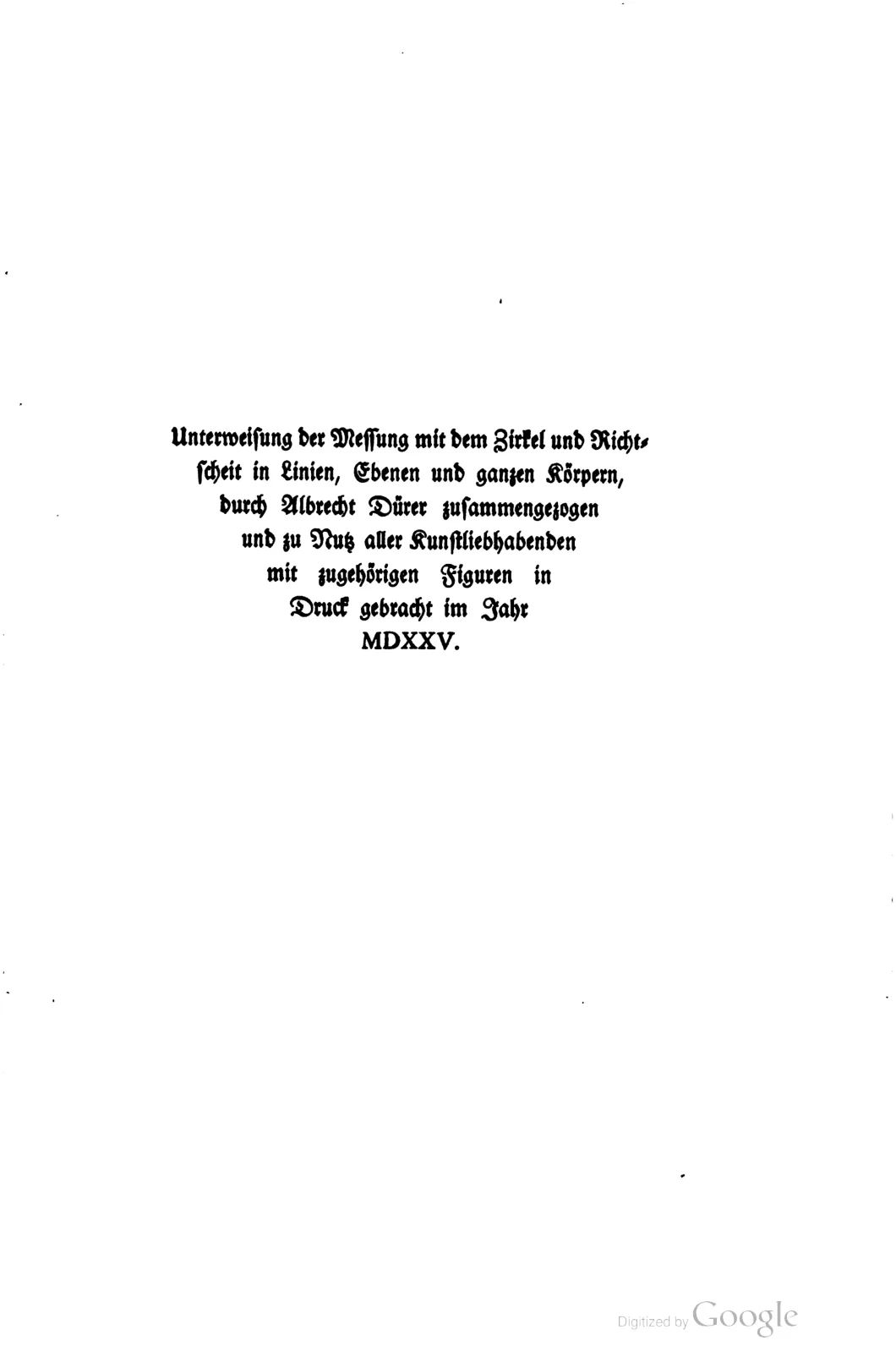
Manual of Measurement with Compass and Straightedge, in Lines, Planes, and Whole Solids, drawn together by Albrecht Dürer and, for the benefit of all who love the art, brought into print with the accompanying figures in the year 1525.

Original — Peltzer 1908

Unterweisung der Messung mit dem Zirkel und Richtscheit in Linien, Ebenen und ganzen Körpern, durch Albrecht Dürer zusammengezogen und zu Nutz aller Kunstliebhabenden mit zugehörigen Figuren in Druck gebracht im Jahr MDXXV.

Dürer, Underweysung der Messung — leaf 18
Figure leaf: blank / printer's leaf preceding the dedication (raw contains only the 'Digitized by Google' stamp). · leaf 18
Dürer, Underweysung der Messung — leaf 19
Dürer's dedication to Pirckheimer · leaf 19

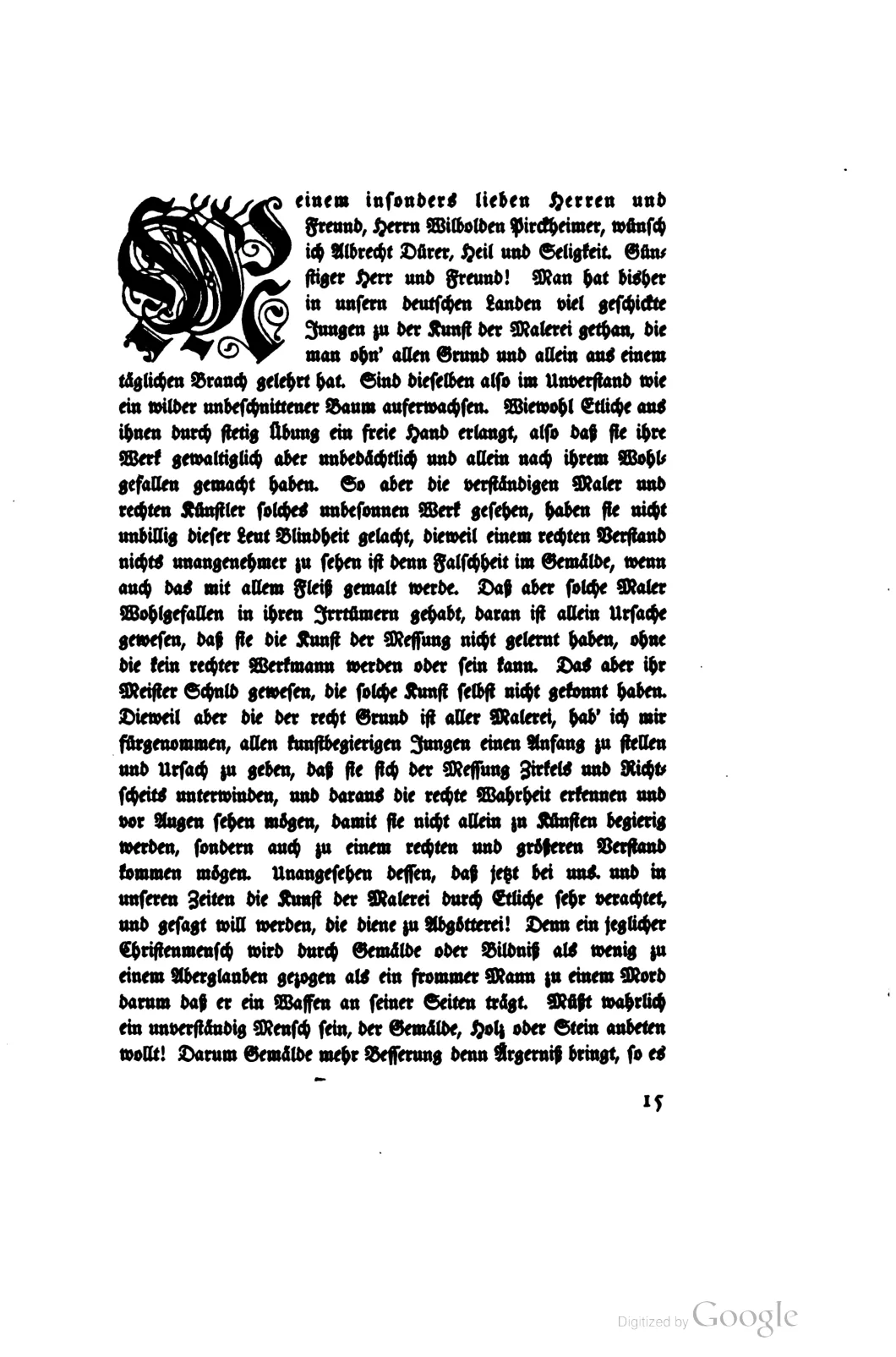
To an especially dear lord and friend, Herr Wilibald Pirckheimer, I, Albrecht Dürer, wish health and salvation. Gracious lord and friend!

Until now, in our German lands, many gifted young men have been set to the art of painting, but were taught without any grounding, out of nothing but daily habit. And so they grew up in ignorance, like a wild, unpruned tree. True, some among them, through constant practice, gained a free hand, so that they made their works powerfully — but heedlessly, and only as their own fancy pleased them.

Yet when the discerning painters and true artists saw such ill-considered work, they laughed, not unjustly, at these people's blindness; for to a sound understanding nothing is more unpleasant to behold than falseness in a painting, however diligently it may have been painted.

That such painters took pleasure in their own errors had but one cause: they had not learned the art of measurement, without which no one can become or be a true craftsman. And the fault lay with their masters, who themselves did not know this art.

But because measurement is the true foundation of all painting, I have resolved to set a beginning before all young men eager for the art, and to give them cause to take up the measurement of compass and straightedge, and from it to recognize and see before their own eyes the true rightness of things — so that they may not only grow eager for the arts, but also come to a right and greater understanding.

This I do regardless of the fact that nowadays, here among us and in our times, the art of painting is much despised by some, who would have it said that it serves idolatry. For every Christian is no more drawn to superstition by a painting or an image than a pious man is drawn to murder because he wears a weapon at his side. He would have to be a truly senseless man who would worship a painting, wood, or stone! And so a painting brings more betterment than offense, so long as it

Original — Peltzer 1908

Einem insonders lieben Herren und Freund, Herrn Wilbolden Pirckheimer, wünsch ich Albrecht Dürer Heil und Seligkeit. Günstiger Herr und Freund!

Man hat bisher in unsern deutschen Landen viel geschickte Jungen zu der Kunst der Malerei gethan, die man ohn allen Grund und allein aus einem täglichen Brauch gelehrt hat. Sind dieselben also im Unverstand wie ein wilder unbeschnittener Baum aufgewachsen. Wiewohl Etliche aus ihnen durch stetig Übung ein freie Hand erlangt, also daß sie ihre Werk gewaltiglich, aber unbedachtlich und allein nach ihrem Wohlgefallen gemacht haben.

So aber die verständigen Maler und rechten Künstler solches unbesonnen Werk gesehen, haben sie nicht unbillig dieser Leut Blindheit gelacht, dieweil einem rechten Verstand nichts unangenehmer zu sehen ist denn Falschheit im Gemälde, wenn auch das mit allem Fleiß gemalt werde.

Daß aber solche Maler Wohlgefallen in ihren Irrtümern gehabt, daran ist allein Ursache gewesen, daß sie die Kunst der Messung nicht gelernt haben, ohne die kein rechter Werkmann werden oder sein kann. Das aber ihr Meister Schuld gewesen, die solche Kunst selbst nicht gekonnt haben.

Dieweil aber die der recht Grund ist aller Malerei, hab ich mir fürgenommen, allen kunstbegierigen Jungen einen Anfang zu stellen und Ursach zu geben, daß sie sich der Messung Zirkels und Richtscheits unterwinden, und daraus die rechte Wahrheit erkennen und vor Augen sehen mögen, damit sie nicht allein zu Künsten begierig werden, sondern auch zu einem rechten und größeren Verstand kommen mögen.

Unangesehen dessen, daß jetzt bei uns und in unseren Zeiten die Kunst der Malerei durch Etliche sehr verachtet, und gesagt will werden, die diene zu Abgötterei! Denn ein jeglicher Christenmensch wird durch Gemälde oder Bildnis als wenig zu einem Aberglauben gezogen als ein frommer Mann zu einem Mord darum, daß er ein Waffen an seiner Seiten trägt. Müßt wahrlich ein unverständig Mensch sein, der Gemälde, Holz oder Stein anbeten wollt! Darum Gemälde mehr Besserung denn Ärgernis bringt, so es

Dürer, Underweysung der Messung — leaf 20
Dürer's dedication to Pirckheimer · leaf 20

has been brought to a good end. For the arts are very easily lost, and only with difficulty and over a long time are they found again. And so [the true artists] are driven to make use of this teaching of mine. Yet I know well that whoever takes it up will not only gain a thorough beginning from it, but, through daily use, will come to a greater understanding, will search further, and will discover much more besides than I now set down.

And because I know, gracious lord and friend, that you are a lover of all art, I have dedicated this little book to you out of special affection and friendly goodwill — not because I imagine I have shown you anything great or excellent by it, but so that you may understand and weigh from it my favorable and good will: that, even though my work may be of no particular profit to you, my heart would nonetheless be ever ready to repay you, in equal measure, for the regard and love you bear toward me.

Original — Peltzer 1908

gebracht ist worden. Denn gar leichtiglich verlieren sich die Künste, schwerlich und durch lange Zeit werden sie wieder erfunden. Demnach [sind die rechten Künstler] gezwungen, sich dieser meiner Lehr zu brauchen. Ich weiß aber wohl, wer sich der untersteht, wird nicht allein einen gründlichen Anfang daraus fassen, sondern durch den täglichen Gebrauch zu einem größeren Verstand kommen, weiter suchen und gar noch viel mehr, denn ich jetzt anzeige, dazu erfinden.

Dieweil ich aber, günstiger Herr und Freund, weiß, daß Ihr ein Liebhaber aller Kunst seid, hab ich Euch dieses Büchlein aus sonderer Zuneigung und freundlichem Willen zugeschrieben; nicht darum, daß ich vermeinte, ich hätt Euch was Großes oder Fürtreffliches damit bewiesen. Sondern daß Ihr daraus meinen geneigten und guten Willen verstehen und ermessen möcht, — ob ich Euch gleichwohl mit meinem Wirken nicht besonders ersprießlich sein mag — daß dennoch mein Gemüt allzeit bereit wäre, Euch Eure Kunst und Lieb, so Ihr zu mir tragt, mit gleicher Vergeltung zu bezahlen.

Dürer, Underweysung der Messung — leaf 21
Bk I: the first elements — point, line, plane, body · leaf 21

The most acute Euclid composed the foundation of geometry. Whoever well understands it has no need at all of the things written hereafter; for these are written only for the young, and for those who otherwise have no one to instruct them faithfully.

At the outset it is necessary, if one would teach the young to measure, that they know what the ground is from which one measures, and how measuring is done there — be it a newly devised thing or one already made.

Three kinds of thing are to be measured. First, a length that is neither broad nor thick. Next, a length that has a breadth. Third, a length that has a breadth and a thickness. The beginning and end of all these things are points. But a point is such a thing as has neither size, length, breadth, nor thickness; and yet it is the beginning and end of all bodily things that one can make, or that we may conceive in our senses — as those who are highly versed in this art well know.

And therefore no point fills a space, for it is indivisible. And yet in our mind and thought it may be set at any end or place. For with my mind I may cast a point high into the air or let it fall into the depths, where with my body I cannot reach. But so that the young may become understanding in useful work, I will set the point before them as a painted one, with a dab of the pen, and write the word "point" beside it, so that the point be marked: point.

Now when this point is drawn from its first beginning to another end, it is called a line. And this line is a length without any thickness or breadth, and may be drawn as long as one wishes. This line I will lay out here with a straight stroke of the pen, and write the name "line" upon it: line — so that the invisible line may be understood in the mind through the straight mark. For in such a way the inner understanding must be shown in the outward work. Therefore I will also draw, alongside, all the things I describe in this little book, so that my demonstration may

Original — Peltzer 1908

Der allerscharfsinnigste Euklides hat den Grund der Geometria zusammengesetzt. Wer denselben wohl versteht, der bedarf dieser hernach geschriebenen Ding gar nicht; denn sie sind allein den Jungen und denen, so sonst niemand haben, der sie treulich unterweist, geschrieben.

Im Anfang thut not, so man die Jungen messen will lehren, daß sie wissen, was der Grund sei, daraus man mißt, und wie da gemessen wird, — es sei ein neuerdachtes oder ein schon vorgemachtes Ding.

Dreierlei Ding sind zu messen. Erstlich eine Länge, die weder breit noch dick ist. Danach eine Länge, die eine Breite hat. Zum Dritten eine Länge, die eine Breite und eine Dicke hat. Dieser aller Dinge Anfang und Ende sind Punkte. Aber ein Punkt ist ein solch Ding, das weder Größe, Länge, Breite noch Dicke hat; und ist doch Anfang und Ende aller leiblichen Dinge, die man machen kann oder die wir in unseren Sinnen erdenken mögen; wie denn das die Hochverständigen dieser Kunst wohl wissen.

Und darum erfüllt kein Punkt einen Raum; denn er ist unteilbar. Und doch mag er in unserem Sinn und Gedanken an alle End oder Ort gesetzt werden. Denn ich mag mit dem Sinn einen Punkt hoch in die Luft werfen oder in die Tiefen fallen lassen, dahin ich doch mit dem Leib nicht reichen kann. Aber damit die Jungen verständig in brauchbarer Arbeit werden, will ich ihnen den Punkt als einen gemalten mit einem Tupf einer Feder dahinsetzen und das Wort Punkt dabei schreiben, damit der Punkt bezeichnet werde: Punkt.

Wenn nun dieser Punkt von seinem ersten Anfang an ein ander End gezogen wird, so heißt es eine Linie. Und diese Linie ist eine Länge ohne alle Dicke und Breite und mag gezogen werden so lang man will. Diese Linie will ich mit einem geraden Strich hier mit der Feder aufreißen und den Namen Linie darauf schreiben: Linie, auf daß die unsichtbare Linie durch den geraden Riß im Gemüt verstanden werde. Denn durch solche Weise muß der innerlich Verstand im äußeren Werk angezeigt werden. Darum will ich alle Ding, die ich in diesem Büchlein beschreibe, auch daneben aufreißen, auf daß mein Darthun die

Dürer, Underweysung der Messung — leaf 22
Bk I: the first elements — point, line, plane, body · leaf 22

the young the better grasp it for their imagination.

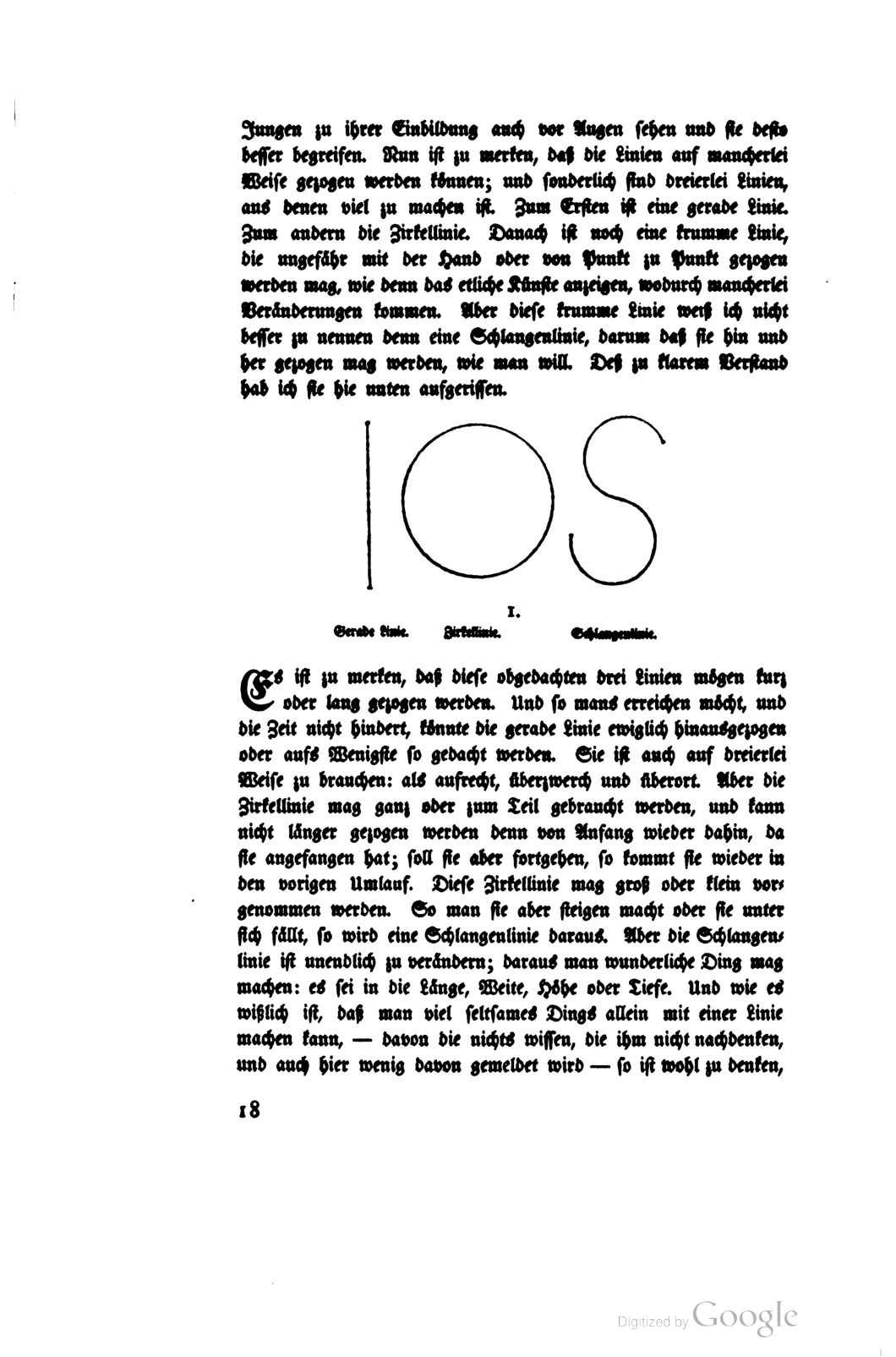
Now it is to be noted that lines can be drawn in many ways; and in particular there are three kinds of line, out of which much is to be made. First is the straight line. Second, the circular line. Then there is yet a curved line, which may be drawn freehand, roughly, or from point to point, as several arts show, whereby manifold variations arise. But this curved line I know of no better name to give than a serpentine line, because it may be drawn this way and that, as one pleases. For clear understanding of it I have laid it out here below.

It is to be noted that these three aforesaid lines may be drawn short or long. And if one could attain it, and time did not hinder, the straight line could be drawn out everlastingly, or at the least so conceived. It is also to be used in three ways: as upright (vertical), transverse (horizontal), and diagonal. But the circular line may be used whole or in part, and cannot be drawn longer than from its beginning back again to where it began; should it go on, however, it comes round again into its former circuit. This circular line may be undertaken large or small. But if one makes it rise or lets it fall beneath itself, a serpentine line arises from it. And the serpentine line can be varied without end; from it one may make wondrous things — be it in length, width, height, or depth. And since it is known that one can make many strange things with a single line alone — of which those know nothing who do not ponder it, and of which little is reported here too — so it may well be considered

Original — Peltzer 1908

Jungen zu ihrer Einbildung auch besser begreifen.

Nun ist zu merken, daß die Linien auf mancherlei Weise gezogen werden können; und sonderlich sind dreierlei Linien, aus denen viel zu machen ist. Zum Ersten ist die gerade Linie. Zum andern die Zirkellinie. Danach ist noch eine krumme Linie, die ungefähr mit der Hand oder von Punkt zu Punkt gezogen werden mag, wie denn das etliche Künste anzeigen, wodurch mancherlei Veränderungen kommen. Aber diese krumme Linie weiß ich nicht besser zu nennen denn eine Schlangenlinie, darum daß sie hin und her gezogen mag werden, wie man will. Deß zu klarem Verstand hab ich sie hie unten aufgerissen.

Es ist zu merken, daß diese obgedachten drei Linien mögen kurz oder lang gezogen werden. Und so mans erreichen möcht, und die Zeit nicht hindert, könnte die gerade Linie ewiglich hinausgezogen oder aufs Wenigste so gedacht werden. Sie ist auch auf dreierlei Weise zu brauchen: als aufrecht, überzwerch und überort. Aber die Zirkellinie mag ganz oder zum Teil gebraucht werden, und kann nicht länger gezogen werden denn von Anfang wieder dahin, da sie angefangen hat; soll sie aber fortgehen, so kommt sie wieder in den vorigen Umlauf. Diese Zirkellinie mag groß oder klein vorgenommen werden. So man sie aber steigen macht oder sie unter sich fällt, so wird eine Schlangenlinie daraus. Aber die Schlangenlinie ist unendlich zu verändern; daraus man wunderliche Ding mag machen: es sei in die Länge, Weite, Höhe oder Tiefe. Und wie es wißlich ist, daß man viel seltsames Dings allein mit einer Linie machen kann, — davon die nichts wissen, die ihm nicht nachdenken, und auch hier wenig davon gemeldet wird — so ist wohl zu denken,

Dürer, Underweysung der Messung — leaf 23
Bk I: the first elements — point, line, plane, body · leaf 23

what may be accomplished with two, three, or many lines. And especially when the three kinds of line are used together with all their incidents. For there are many lines to be made which cannot be drawn without the help of other lines.

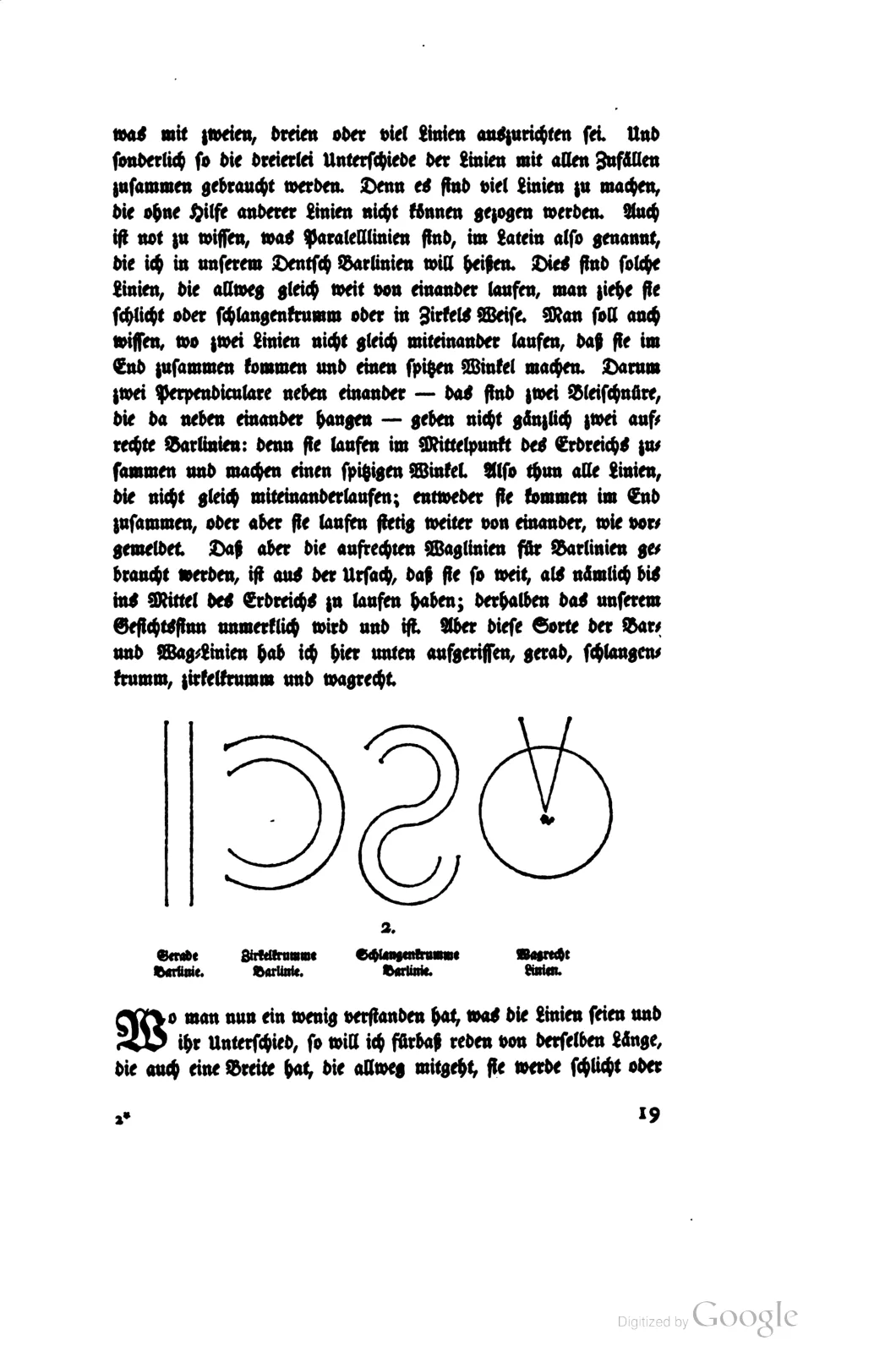
It is also necessary to know what parallel lines are — so called in Latin — which in our German I will call "par-lines." These are such lines as always run equally far apart from one another, whether one draws them plain, serpentine-curved, or in the manner of a circle. One should also know that where two lines do not run evenly with one another, they come together at the end and make an acute angle. Therefore two perpendiculars beside one another — these being two plumb-lines that hang side by side — do not give quite two upright par-lines: for they run together at the center of the earth and make an acute angle. So do all lines that do not run evenly with one another; either they come together at the end, or else they run ever further apart, as said before. But that the upright level-lines are used as par-lines is for this reason: that they have so far to run — namely, all the way to the center of the earth — that this becomes and is imperceptible to our sense of sight. Now this sort of par- and level-lines I have laid out here below: straight, serpentine-curved, circle-curved, and level.

Now that one has understood a little what lines are and their distinction, I will speak further of that same length which also has a breadth, which always accompanies it, whether it be drawn plain or

Original — Peltzer 1908

was mit zweien, dreien oder viel Linien auszurichten sei. Und sonderlich so die dreierlei Unterschiede der Linien mit allen Zufällen zusammen gebraucht werden. Denn es sind viel Linien zu machen, die ohne Hilfe anderer Linien nicht können gezogen werden.

Auch ist not zu wissen, was Paralelllinien sind, im Latein also genannt, die ich in unserem Deutsch Parlinien will heißen. Dies sind solche Linien, die allweg gleich weit von einander laufen, man ziehe sie schlicht oder schlangenkrumm oder in Zirkels Weise. Man soll auch wissen, wo zwei Linien nicht gleich miteinander laufen, daß sie im End zusammen kommen und einen spitzen Winkel machen. Darum zwei Perpendiculare neben einander — das sind zwei Bleischnüre, die da neben einander hangen — geben nicht gänzlich zwei aufrechte Parlinien: denn sie laufen im Mittelpunkt des Erdreichs zusammen und machen einen spitzigen Winkel. Also thun alle Linien, die nicht gleich miteinander laufen; entweder sie kommen im End zusammen, oder aber sie laufen stetig weiter von einander, wie vorgemeldet. Daß aber die aufrechten Waglinien für Parlinien gebraucht werden, ist aus der Ursach, daß sie so weit, als nämlich bis ins Mittel des Erdreichs zu laufen haben; derhalben das unserem Gesichtssinn unmerklich wird und ist. Aber diese Sorte der Par- und Waglinien hab ich hier unten aufgerissen, gerad, schlangenkrumm, zirkelkrumm und wagrecht.

Wenn man nun ein wenig verstanden hat, was die Linien seien und ihr Unterschied, so will ich fürbaß reden von derselben Länge, die auch eine Breite hat, die allweg mitgeht, sie werde schlicht oder

Dürer, Underweysung der Messung — leaf 24
Bk I: the spiral lines (Schneckenlinien) · leaf 24

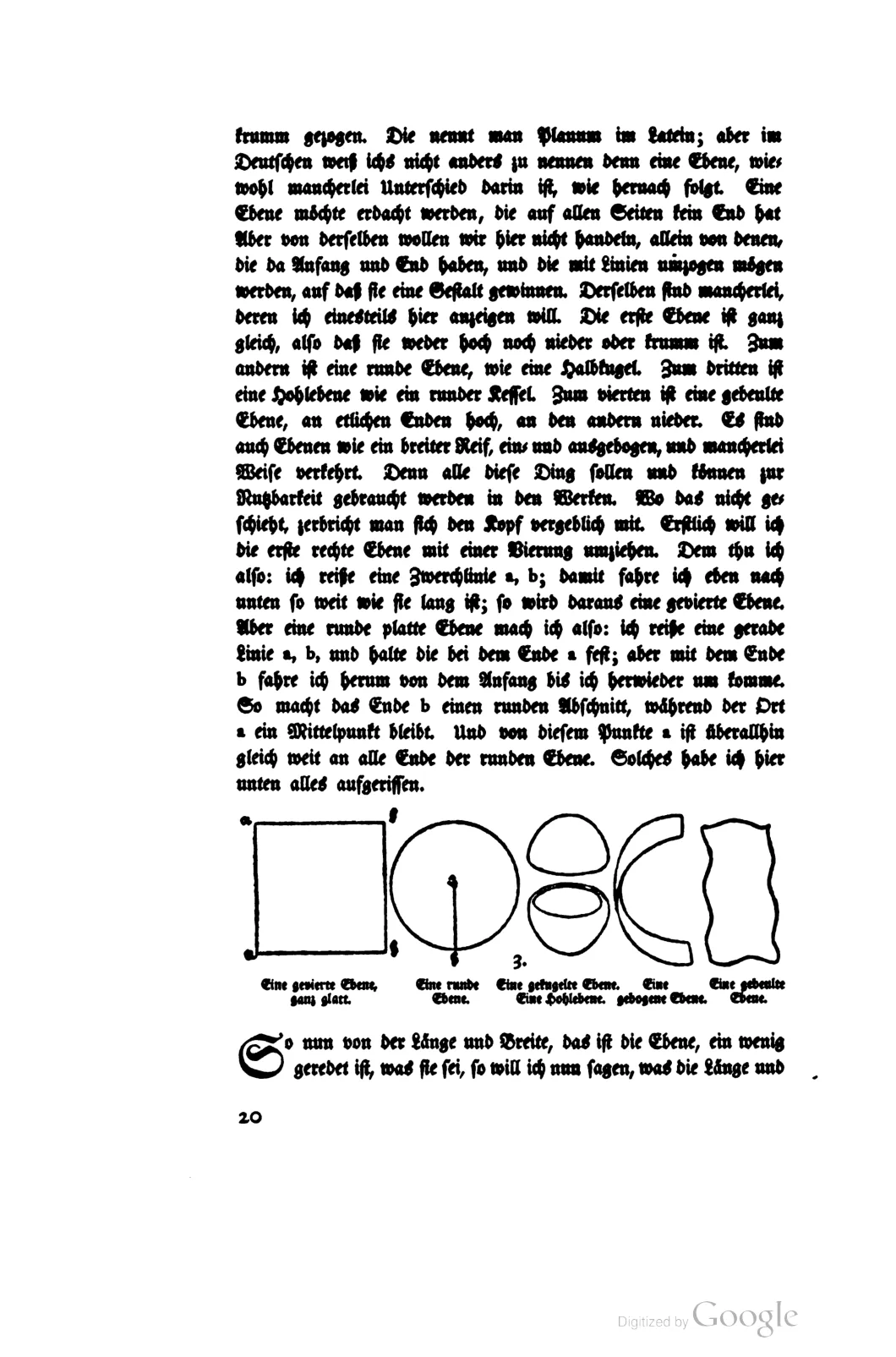
indeed has manifold distinction within it, as follows hereafter. A plane might be conceived that has no end on any side. But of that one we will not treat here, only of those that have a beginning and an end, and that may be enclosed with lines so that they gain a content. Of these there are several kinds, some of which I will show here. The first plane is wholly even, so that it is neither high nor low nor curved. Second, a plane that is high at some ends and low at others. There are also planes like a broad hoop, bowed in and out, and warped in various ways. For all these things should and can be put to useful purpose in works. Where that does not happen, one racks one's brain over them in vain.

First I will enclose the first true plane with a square. This I do thus: I draw a cross-line a, b; with it I proceed straight downward as far as it is long; thus there arises a squared plane.

But a round flat plane I make thus: I draw a straight line a, b, and hold it fast at the end a; but with the end b I sweep around from the start until I come round again. So the end b makes a round shape, while the place a remains a center point. And from this point a it is equally far in every direction to all the ends of the round plane. All this I have laid out here below.

Now that something has been said of length and breadth — that is, the plane — and what it is, I will now say what length and

Original — Peltzer 1908

wohl mancherlei Unterschied darin ist, wie hernach folgt. Eine Ebene möchte erdacht werden, die auf allen Seiten kein End hat. Aber von derselben wollen wir hier nicht handeln, allein von denen, die da Anfang und End haben, und die mit Linien umzogen mögen werden, auf daß sie eine Gehalt gewinnen. Deren sind mancherlei, deren ich einesteils hier anzeigen will. Die erste Ebene ist ganz gleich, also daß sie weder hoch noch nieder oder krumm ist. Zum andern eine Ebene, an etlichen Enden hoch, an den andern nieder. Es sind auch Ebenen wie ein breiter Reif, ein- und ausgebogen, und mancherlei Weise verkehrt. Denn alle diese Ding sollen und können zur Nutzbarkeit gebraucht werden in den Werken. Wo das nicht geschieht, zerbricht man sich den Kopf vergeblich damit.

Erstlich will ich die erste rechte Ebene mit einer Vierung umziehen. Dem thu ich also: ich reiße eine Zwerchlinie a, b; damit fahre ich eben nach unten so weit wie sie lang ist; so wird daraus eine gevierte Ebene.

Aber eine runde platte Ebene mach ich also: ich reiße eine gerade Linie a, b, und halte die bei dem Ende a fest; aber mit dem Ende b fahre ich herum von dem Anfang bis ich herwieder umkomme. So macht das Ende b einen runden Abschnitt, während der Ort a ein Mittelpunkt bleibt. Und von diesem Punkte a ist überallhin gleich weit an alle Ende der runden Ebene. Solches habe ich hier unten alles aufgerissen.

Nun von der Länge und Breite, das ist die Ebene, ein wenig geredet ist, was sie sei, so will ich nun sagen, was die Länge und

Dürer, Underweysung der Messung — leaf 25
Bk I: the spiral lines (Schneckenlinien) · leaf 25

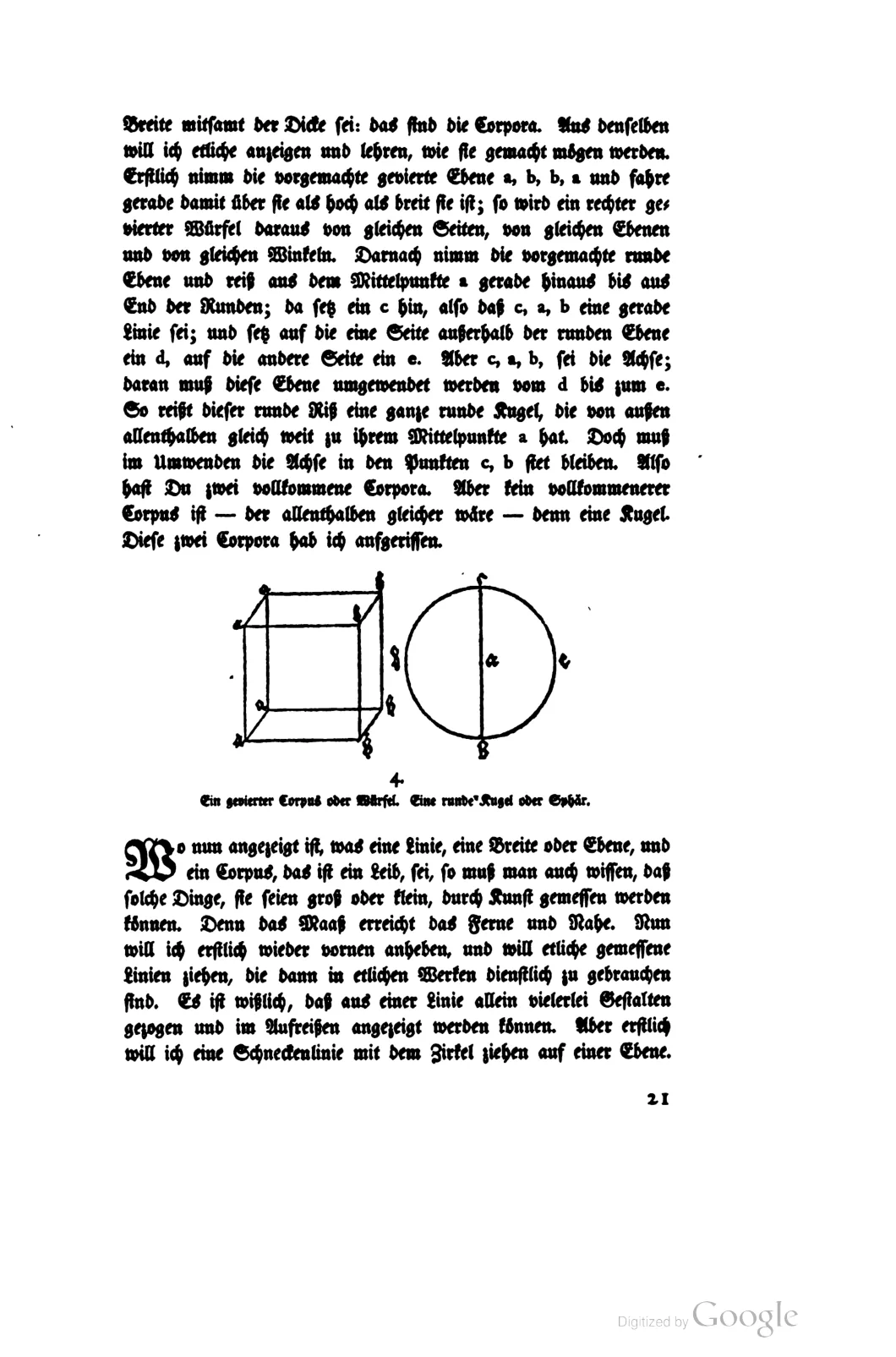
breadth together with thickness are: these are the solids (corpora). Of these I will show a few and teach how they may be made.

First take the squared plane already made, a, b, b, a, and proceed straight up over it as high as it is broad; thus there arises a true squared cube of equal sides, of equal faces, and of equal angles.

Then take the round plane already made and draw out straight from the center a to the end of the round; there set a c, so that c, a, b be a straight line; and set on the one side, outside the round plane, a d, and on the other side an e. But let c, a, b be the axis; about it this plane must be turned over from d to e. Thus this round mark traces a whole round ball (sphere), which on the outside is everywhere equally far to its center a. Yet in the turning the axis must stay fixed in the points c, b. Thus you have two perfect solids. But there is no more perfect solid — one that would be everywhere more equal — than a sphere. These two solids I have laid out.

Now that it has been shown what a line, a breadth or plane, and a solid — that is, a body — are, one must also know that such things, be they large or small, can be measured by art. For measure reaches the far and the near. Now I will first begin again at the front, and will draw a few measured lines that are then serviceable in certain works. It is known that out of a single line alone many shapes can be drawn and shown in the laying-out. But first I will draw a spiral line with the compass upon a plane.

Original — Peltzer 1908

Breite mitsamt der Dicke sei: das sind die Corpora. Aus denselben will ich etliche anzeigen und lehren, wie sie gemacht mögen werden.

Erstlich nimm die vorgemachte gevierte Ebene a, b, b, a und fahre gerade damit über sie als hoch als breit sie ist; so wird ein rechter gevierter Würfel daraus von gleichen Seiten, von gleichen Ebenen und von gleichen Winkeln.

Darnach nimm die vorgemachte runde Ebene und reiß aus dem Mittelpunkte a gerade hinaus bis aus End der Runden; da setz ein c hin, also daß c, a, b eine gerade Linie sei; und setz auf die eine Seite außerhalb der runden Ebene ein d, auf die andere Seite ein e. Aber c, a, b sei die Achse; daran muß diese Ebene umgewendet werden vom d bis zum e. So reißt dieser runde Riß eine ganze runde Kugel, die von außen allenthalben gleich weit zu ihrem Mittelpunkte a hat. Doch muß im Umwenden die Achse in den Punkten c, b stet bleiben. Also hast Du zwei vollkommene Corpora. Aber kein vollkommenerer Corpus ist — der allenthalben gleicher wäre — denn eine Kugel. Diese zwei Corpora hab ich aufgerissen.

So nun angezeigt ist, was eine Linie, eine Breite oder Ebene, und ein Corpus, das ist ein Leib, sei, so muß man auch wissen, daß solche Dinge, sie seien groß oder klein, durch Kunst gemessen werden können. Denn das Maaß erreicht das Ferne und Nahe. Nun will ich erstlich wieder vornen anheben, und will etliche gemessene Linien ziehen, die dann in etlichen Werken dienstlich zu gebrauchen sind. Es ist wißlich, daß aus einer Linie allein vielerlei Gestalten gezogen und im Aufreißen angezeigt werden können. Aber erstlich will ich eine Schneckenlinie mit dem Zirkel ziehen auf einer Ebene.

Dürer, Underweysung der Messung — leaf 26
Bk I: the spiral lines (Schneckenlinien) · leaf 26

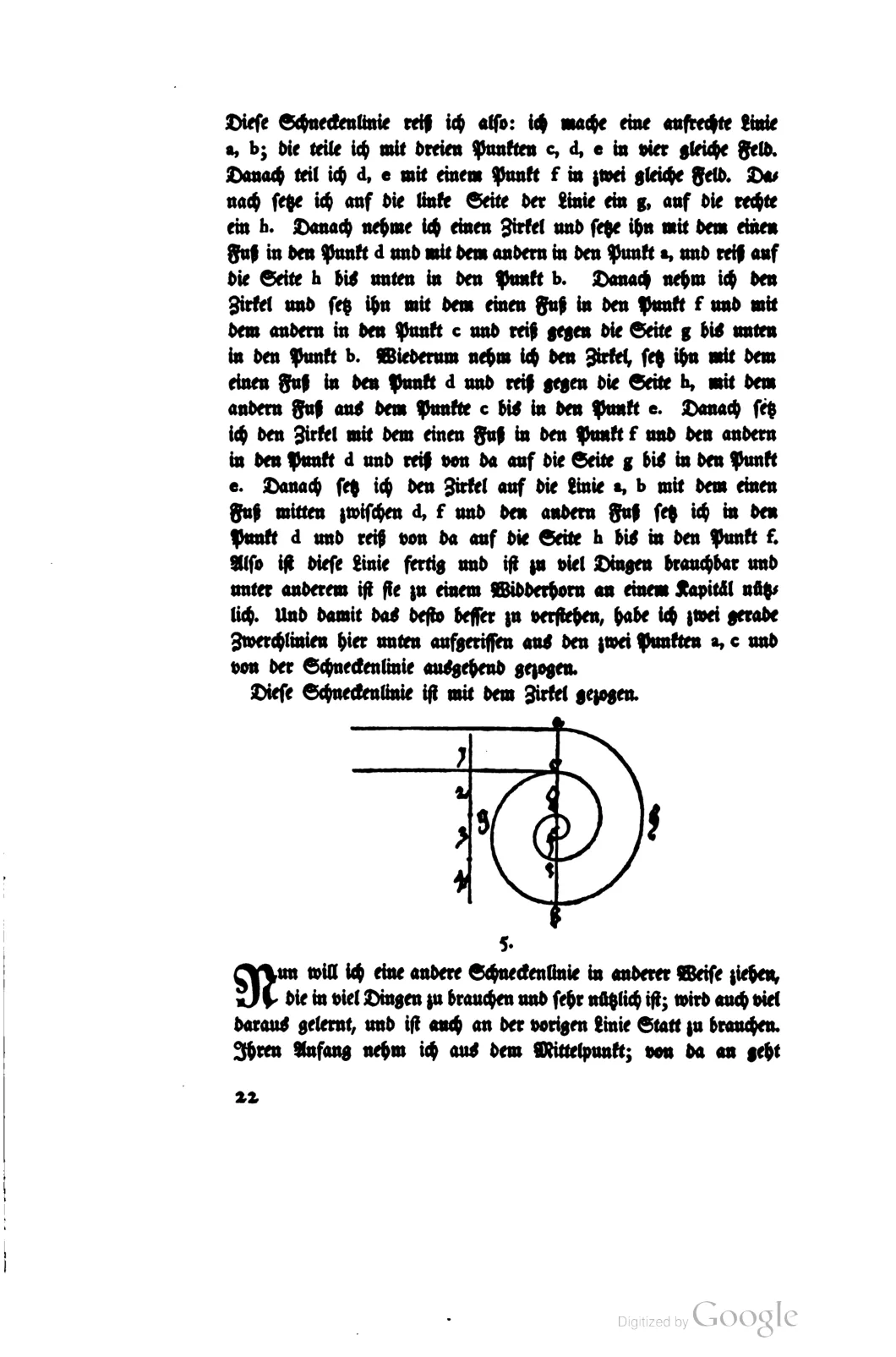
This spiral line I draw thus: I make an upright line a, b; this I divide with three points c, d, e into four equal fields. Then I divide d, e with a point f into two equal fields. Then I set on the left side of the line a g, and on the right an h. Then I take a compass and set it with the one foot in the point d and with the other in the point a, and draw toward the side h down to the point b at the bottom. Then I take the compass and set it with the one foot in the point f and with the other in the point c, and draw toward the side g down to the point d. Again I take the compass, set it with the one foot in the point d and draw toward the side h, with the other foot out of the point c to the point e. Then I set the compass with the one foot in the point f and the other in the point d, and draw from there toward the side g to the point e. Then I set the compass on the line a, b with the one foot midway between d, f, and the other foot I set in the point d, and draw from there toward the side h to the point f.

Thus this line is finished, and it is useful for many things; among others it serves for a ram's horn on a capital. And so that this be the better understood, I have laid out here below two straight cross-lines drawn out from the two points a, c and proceeding from the spiral line. This spiral line is drawn with the compass.

Now I will draw another spiral line in a different way, which is to be used in many things and is very useful; much is also learned from it, and it can be used in place of the former line too. Its beginning I take from the center; from there onward runs

Original — Peltzer 1908

Diese Schneckenlinie reiß ich also: ich mache eine aufrechte Linie a, b; die teile ich mit dreien Punkten c, d, e in vier gleiche Feld. Danach teil ich d, e mit einem Punkt f in zwei gleiche Feld. Danach setze ich auf die linke Seite der Linie ein g, auf die rechte ein h. Danach nehme ich einen Zirkel und setze ihn mit dem einen Fuß in den Punkt d und mit dem andern in den Punkt a, und reiß auf die Seite h bis unten in den Punkt b. Danach nehm ich den Zirkel und setz ihn mit dem einen Fuß in den Punkt f und mit dem andern in den Punkt c und reiß gegen die Seite g bis unten in den Punkt d. Wiederum nehm ich den Zirkel, setz ihn mit dem einen Fuß in den Punkt d und reiß gegen die Seite h, mit dem andern Fuß aus dem Punkte c bis in den Punkt e. Danach setz ich den Zirkel mit dem einen Fuß in den Punkt f und den andern in den Punkt d und reiß von da auf die Seite g bis in den Punkt e. Danach setz ich den Zirkel auf die Linie a, b mit dem einen Fuß mitten zwischen d, f und den andern Fuß setz ich in den Punkt d und reiß von da auf die Seite h bis in den Punkt f.

Also ist diese Linie fertig und ist zu viel Dingen brauchbar und unter anderem ist sie zu einem Widderhorn an einem Kapitäl nützlich. Und damit das desto besser zu verstehen, habe ich zwei gerade Zwerchlinien hier unten aufgerissen aus den zwei Punkten a, c und von der Schneckenlinie ausgehend gezogen. Diese Schneckenlinie ist mit dem Zirkel gezogen.

Nun will ich eine andere Schneckenlinie in anderer Weise ziehen, die in viel Dingen zu brauchen und sehr nützlich ist; wird auch viel daraus gelernt, und ist auch an der vorigen Linie Statt zu brauchen. Ihren Anfang nehm ich aus dem Mittelpunkt; von da an geht

Dürer, Underweysung der Messung — leaf 27
Bk I: the spiral lines (Schneckenlinien) · leaf 27

its length out into the distances as far as one wishes; yet its field between the windings of the line always stays equally wide between them — only not in the first circuit. But this spiral line I make thus.

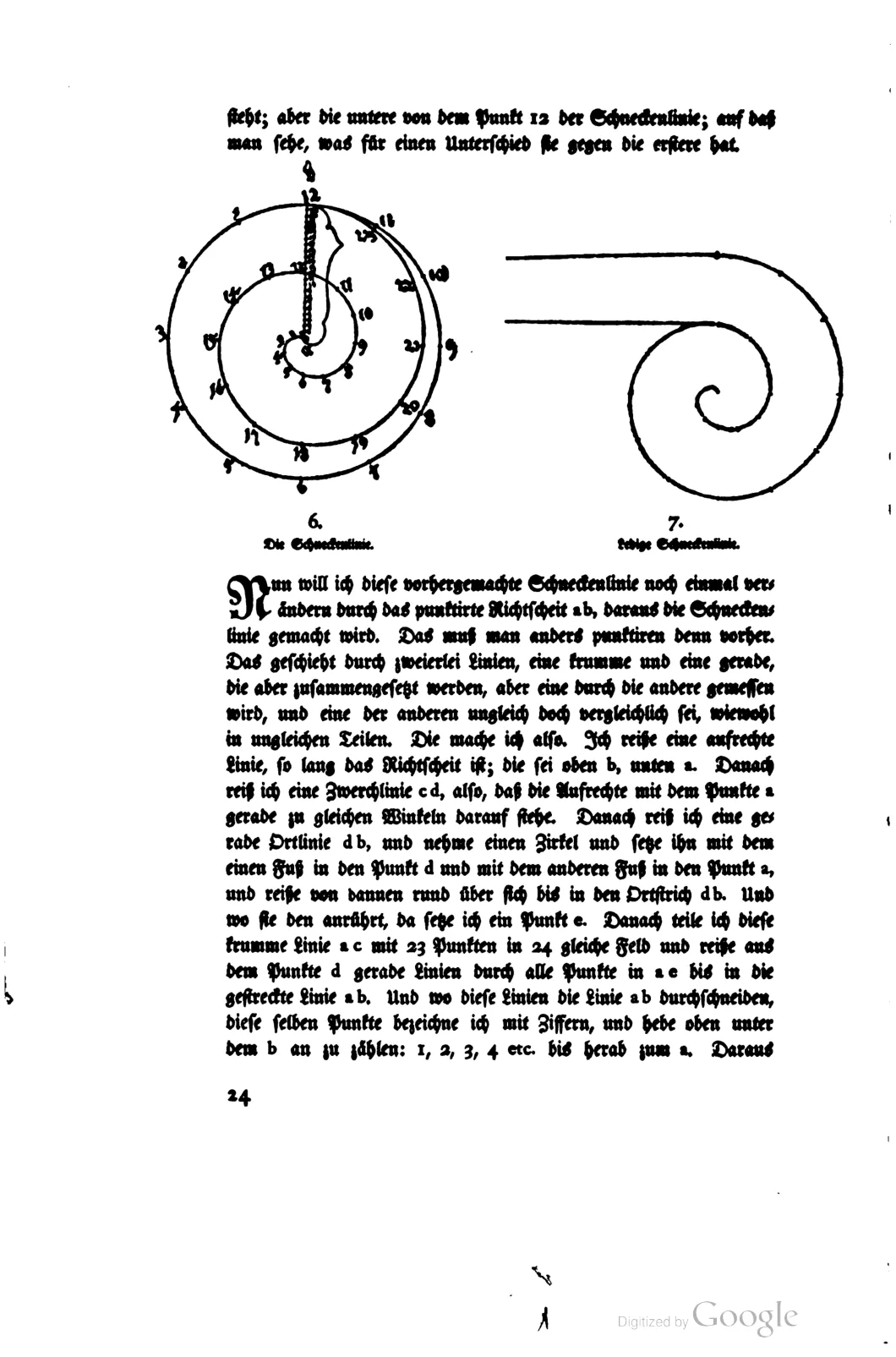
I set a point a and draw a circle about it as wide as I wish the spiral line to run. And I divide this round line with 12 points into 12 equal fields. Then I draw from the center a a straight line upward to the round mark; let its end be b; yet at that same point I also set 12, and begin counting the division of the points of the round mark toward the left hand 1, 2, 3, etc., all the way round to 12. But the straight line a, b I divide with 23 points into 24 equal fields, and begin counting at a: 1, 2, 3, etc. Then I take a straight straightedge and prick the points of the line a, b just mentioned upon it and mark it with their numerals, and lay it with the lower number — with the one end a upon the center a, and with the end b upon the circle at the point 1; and wherever the straightedge then points with its point 1, there I likewise set a point 1. Thus I go round the ring to all the numbers on the circle, and always let the straightedge stay fixed at the center a. So the points of the straightedge will indicate all the points of the spiral line through the number where one is to set them. Therefore mind the number well, and you cannot go astray. But if the line runs twofold over itself, and the circle now stands at 12 while the revolving straightedge stands at 23, then take care that the numbers of the straightedge proceed in order; for to the number 1 comes 13; to 2, 14; to 3, 15; to 4, 16; to 5, 17, etc. One may also draw this line manifold over itself; whoever needs it, let him increase the numbers on the straightedge with the points, and leave the points on the circle unchanged.

This spiral line is laid out here with all the numerals. But if one would rightly see and use this spiral line, one must take away the circular line and the dotted straightedge with all their numerals, by which the spiral line was made, and leave the spiral line alone with its points standing free. And as they are to be drawn, so I have laid them out twice hereafter. And in particular, to the bare spiral line I have added two extended lines drawn transversely toward the left hand, at equal angles; the upper one from the point 12, where the b

Original — Peltzer 1908

ihre Länge in die Weiten so fern man will; doch bleibt ihr Feld zwischen der Überlegung der Linie allweg gleich weit dazwischen; allein im ersten Umlauf nicht. Aber diese Schneckenlinie mach ich also.

Ich setz einen Punkt a und reiß einen Zirkelriß darum so weit ich die Schneckenlinie will laufen lassen. Und teile diese runde Linie mit 12 Punkten in 12 gleiche Feld. Danach reiß ich aus dem Centro a eine gerade Linie über sich bis an den runden Riß; deren Ende sei b; doch setz ich an denselben Punkt auch 12 und hebe die Teilung der Punkte des runden Riß an zu zählen gegen die linke Hand 1, 2, 3 etc. bis herum auf die 12. Aber die gerade Linie a, b teil ich mit 23 Punkten in 24 gleiche Feld und heb am a an zu zählen 1, 2, 3 etc. Danach nehm ich ein gerad Richtscheit und stech die Punkte der jetzt gemeldeten Linie a, b darauf und bezeichne es mit ihren Ziffern, und leg dasselbe bei der minderen Zahl mit dem einen Ort a auf das Centrum a, und mit dem Ort b auf den Zirkelriß auf den Punkt 1; und wo dann das Richtscheit mit seinem Punkt 1 hinzeigt, da setz ich auch einen Punkt 1. Also fahr ich im Ring herum zu allen Zahlen im Zirkelriß und laß allweg das Richtscheit im Centro a stet bleiben. So werden die Punkte des Richtscheit alle Punkte der Schneckenlinie anzeigen durch die Zahl, wo man sie hinsetzen soll. Darum merk eben auf die Zahl, so kannst Du nicht irre werden. Aber so die Linie zweifach übereinander läuft, und im Zirkelriß nun 12 steht aber im umlaufenden Richtscheit 23, so hab Acht, daß die Zahlen des Richtscheits ordentlich vorgehen; denn zu der Zahl 1 kommt 13, auf 2, 14; 3, 15; 4, 16; 5, 17 etc. Man mag auch diese Linie vielfältig übereinander ziehen; wer dessen bedarf, der mehre die Zahlen im Richtscheit mit den Punkten und laß die Punkte im Zirkelriß unverändert.

Diese Schneckenlinie ist hiebei also aufgerissen mit allen Ziffern. So man aber diese Schneckenlinie recht sehen und brauchen will, muß man die Zirkellinie und das punktiert Richtscheit mit allen ihren Ziffern forttun, womit die Schneckenlinie gemacht worden ist, und allein die Schneckenlinie mit ihren Punkten bleiben und ledig stehen lassen. Und wie sie gezogen werden sollen, also hab ich sie zweimal hienach aufgerissen. Und sonderlich hab ich zu der ledigen Schneckenlinie zwei gestreckte Linien gethan und überzwerch gezogen gegen die linke Hand, zu gleichen Winkeln; die obere aus dem Punkt 12, da das b

Dürer, Underweysung der Messung — leaf 28
Bk I: the spiral lines (Schneckenlinien) · leaf 28

stands; but the lower one from the point 12 of the spiral line — so that one may see what difference it has against the first.

Now I will once more alter this spiral line already made, by means of the dotted straightedge a, b out of which the spiral line is made. This one must dot differently than before. It is done by two kinds of line, a curved and a straight, which however are combined, but the one is measured by the other, and the one is unequal yet comparable to the other, although in unequal parts. This I make thus.

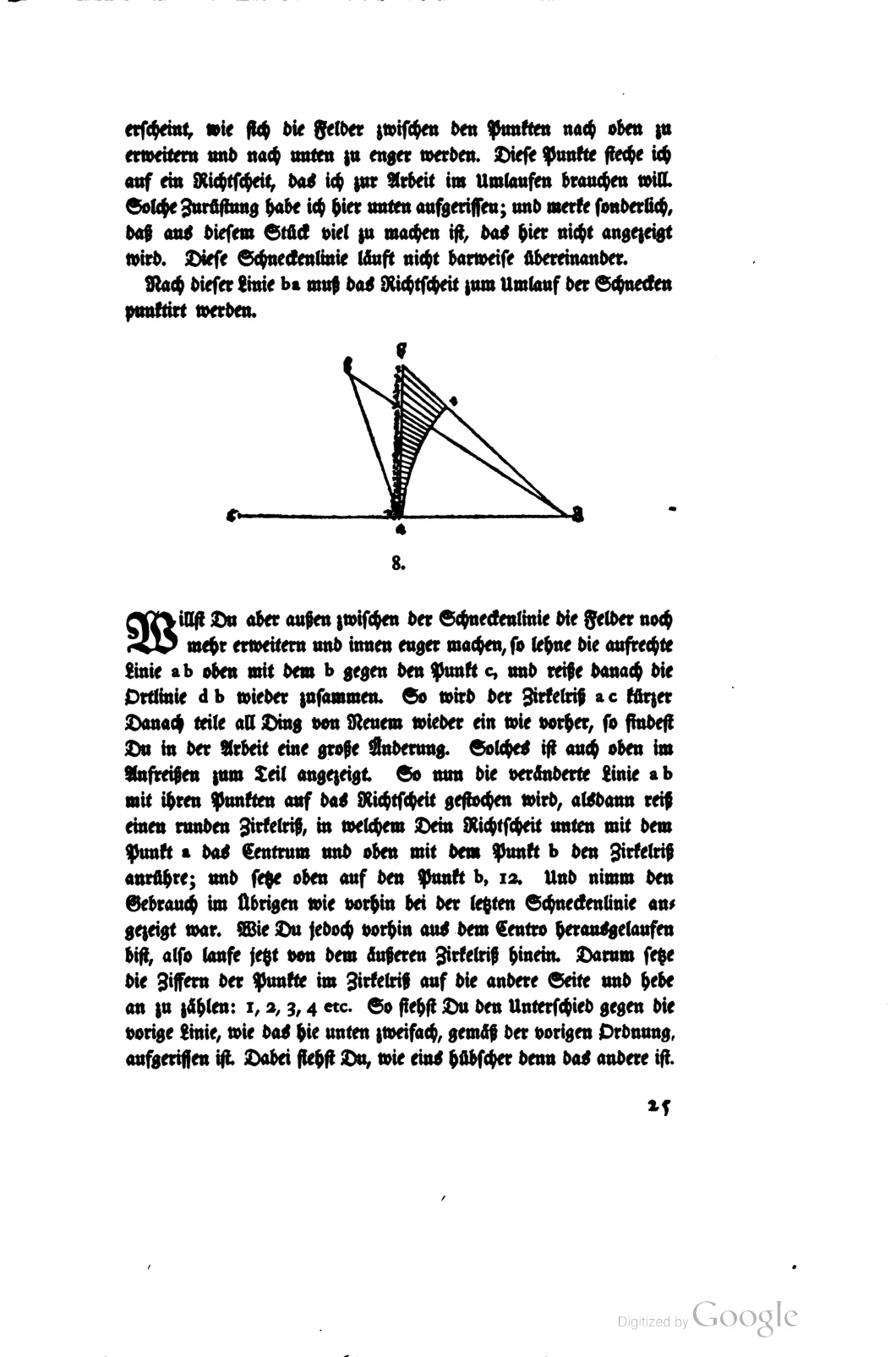
I draw an upright line as long as the straightedge is; let it be b above, a below. Then I draw a cross-line c, d, so that the upright stands upon it squarely at equal angles with the point a. Then I draw a straight diagonal line d, b, and take a compass and set it with the one foot in the point d and with the other foot in the point a, and draw from there round, upward, to the diagonal stroke d, b. And where it touches it, there I set a point e. Then I divide this curved line a, e with 23 points into 24 equal fields, and draw from the point d straight lines through all the points in a, e up to the extended line a, b. And where these lines cut the line a, b, these same points I mark with numerals, and begin counting at the top below the b: 1, 2, 3, 4, etc., down to a. From this

Original — Peltzer 1908

steht; aber die untere von dem Punkt 12 der Schneckenlinie; auf daß man sehe, was für einen Unterschied sie gegen die erstere hat.

Nun will ich diese vorhergemachte Schneckenlinie noch einmal verändern durch das punktierte Richtscheit ab, daraus die Schneckenlinie gemacht wird. Das muß man anders punktieren denn vorher. Das geschieht durch zweierlei Linien, eine krumme und eine gerade, die aber zusammengesetzt werden, aber eine durch die andere gemessen wird, und eine der anderen ungleich doch vergleichlich sei, wiewohl in ungleichen Teilen. Die mache ich also.

Ich reiße eine aufrechte Linie, so lang das Richtscheit ist; die sei oben b, unten a. Danach reiß ich eine Zwerchlinie c, d, also, daß die Aufrechte mit dem Punkte a gerade zu gleichen Winkeln darauf stehe. Danach reiß ich eine gerade Ortlinie d, b, und nehme einen Zirkel und setze ihn mit dem einen Fuß in den Punkt d und mit dem anderen Fuß in den Punkt a, und reiße von dannen rund über sich bis in den Ortstrich d, b. Und wo sie den anrührt, da setze ich ein Punkt e. Danach teile ich diese krumme Linie a, e mit 23 Punkten in 24 gleiche Feld und reiße aus dem Punkte d gerade Linien durch alle Punkte in a, e bis in die gestreckte Linie a, b. Und wo diese Linien die Linie a, b durchschneiden, diese selben Punkte bezeichne ich mit Ziffern, und hebe oben unter dem b an zu zählen: 1, 2, 3, 4 etc. bis herab zum a. Daraus

Dürer, Underweysung der Messung — leaf 29
Bk I: the spiral lines (Schneckenlinien) · leaf 29

it appears how the fields between the points widen toward the top and grow narrower toward the bottom. These points I prick upon a straightedge, which I will use for the work in revolving. Such preparation I have laid out here below; and note especially that out of this piece much is to be made that is not shown here. This spiral line does not run parallel over itself. According to this line b, a the straightedge must be dotted for the revolving of the spiral.

But if you would widen the fields between the spiral line still more on the outside and make them narrower within, then incline the upright line a, b at the top with the b toward the point c, and then draw the diagonal line d, b together again. Thus the arc a, c becomes shorter. Then divide everything anew as before, and you will find a great change in the work. This too is partly shown above in the laying-out.

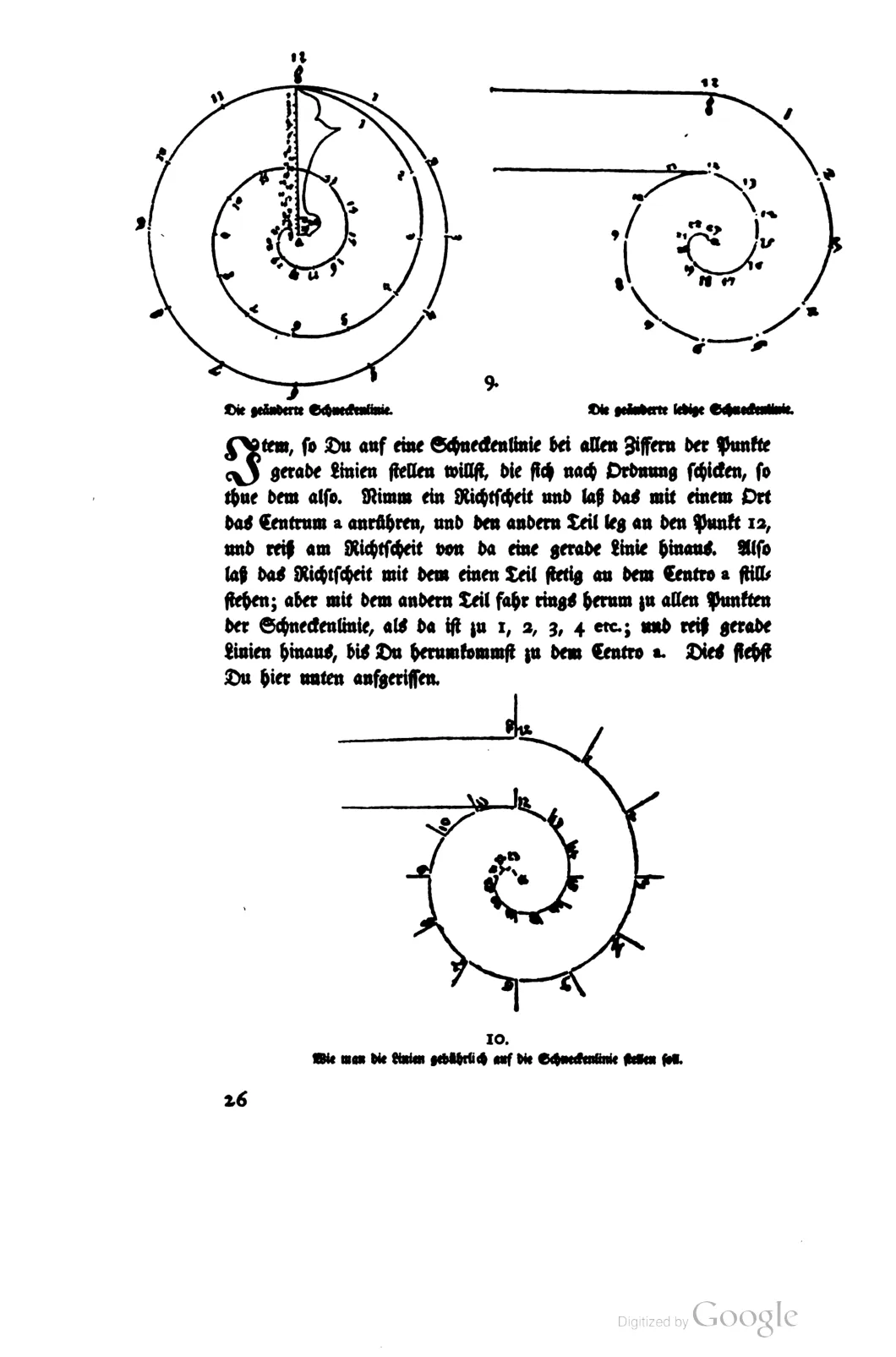
Now when the altered line a, b with its points is pricked upon the straightedge, then draw a round circle in which your straightedge touches the center below with the point a and the circle above with the point b; and set above, at the point b, 12. And take the use otherwise as was shown before with the last spiral line. But whereas before you ran out from the center, now run inward from the outer circle instead. Therefore set the numerals of the points on the circle on the other side, and begin counting: 1, 2, 3, 4, etc. Thus you see the difference against the previous line, as it is laid out here below twofold, according to the previous order. Thereby you see how one is handsomer than the other.

Original — Peltzer 1908

erscheint, wie sich die Felder zwischen den Punkten nach oben zu erweitern und nach unten zu enger werden. Diese Punkte steche ich auf ein Richtscheit, das ich zur Arbeit im Umlaufen brauchen will. Solche Zurüstung habe ich hier unten aufgerissen; und merke sonderlich, daß aus diesem Stück viel zu machen ist, das hier nicht angezeigt wird. Diese Schneckenlinie läuft nicht parweise übereinander. Nach dieser Linie b, a muß das Richtscheit zum Umlauf der Schnecken punktiert werden.

Willst Du aber außen zwischen der Schneckenlinie die Felder noch mehr erweitern und innen enger machen, so lehne die aufrechte Linie a, b oben mit dem b gegen den Punkt c, und reiße danach die Ortlinie d, b wieder zusammen. So wird der Zirkelriß a, c kürzer. Danach teile all Ding von Neuem wieder ein wie vorher, so findest Du in der Arbeit eine große Änderung. Solches ist auch oben im Aufreißen zum Teil angezeigt.

So nun die veränderte Linie a, b mit ihren Punkten auf das Richtscheit gestochen wird, alsdann reiß einen runden Zirkelriß, in welchem Dein Richtscheit unten mit dem Punkt a das Centrum und oben mit dem Punkt b den Zirkelriß anrühre; und setze oben auf den Punkt b 12. Und nimm den Gebrauch im Übrigen wie vorhin bei der letzten Schneckenlinie angezeigt war. Wie Du jedoch vorhin aus dem Centro herausgelaufen bist, also laufe jetzt von dem äußeren Zirkelriß hinein. Darum setze die Ziffern der Punkte im Zirkelriß auf die andere Seite und hebe an zu zählen: 1, 2, 3, 4 etc. So siehst Du den Unterschied gegen die vorige Linie, wie das hie unten zweifach, gemäß der vorigen Ordnung, aufgerissen ist. Dabei siehst Du, wie eins hübscher denn das andere ist.

Dürer, Underweysung der Messung — leaf 30
Bk I: the spiral lines (Schneckenlinien) · leaf 30

Item, if you would set straight lines upon a spiral line at all the numerals of the points, lines that fall into order, then do thus. Take a straightedge and let it touch the center a with one end, and lay the other part against the point 12, and draw a straight line out along the straightedge from there. Thus let the straightedge stand still with the one part continually at the center a; but with the other part sweep all the way round to all the points of the spiral line — namely to 1, 2, 3, 4, etc. — and draw straight lines out, until you come round again to the center a. This you see laid out here below.

How one should properly set the lines upon the spiral line.

Original — Peltzer 1908

Item, so Du auf eine Schneckenlinie bei allen Ziffern der Punkte gerade Linien stellen willst, die sich nach Ordnung schicken, so thue dem also. Nimm ein Richtscheit und laß das mit einem Ort das Centrum a anrühren, und den andern Teil leg an den Punkt 12, und reiß am Richtscheit von da eine gerade Linie hinaus. Also laß das Richtscheit mit dem einen Teil stetig auf dem Centro a stillstehen; aber mit dem andern Teil fahr rings herum zu allen Punkten der Schneckenlinie, als da ist zu 1, 2, 3, 4 etc.; und reiß gerade Linien hinaus, bis Du herumkommst zu dem Centro a. Dies siehst Du hier unten aufgerissen.

Wie man die Linien gebührlich auf der Schneckenlinie stellen soll.

Dürer, Underweysung der Messung — leaf 31
Bk I: the spiral lines (Schneckenlinien) · leaf 31

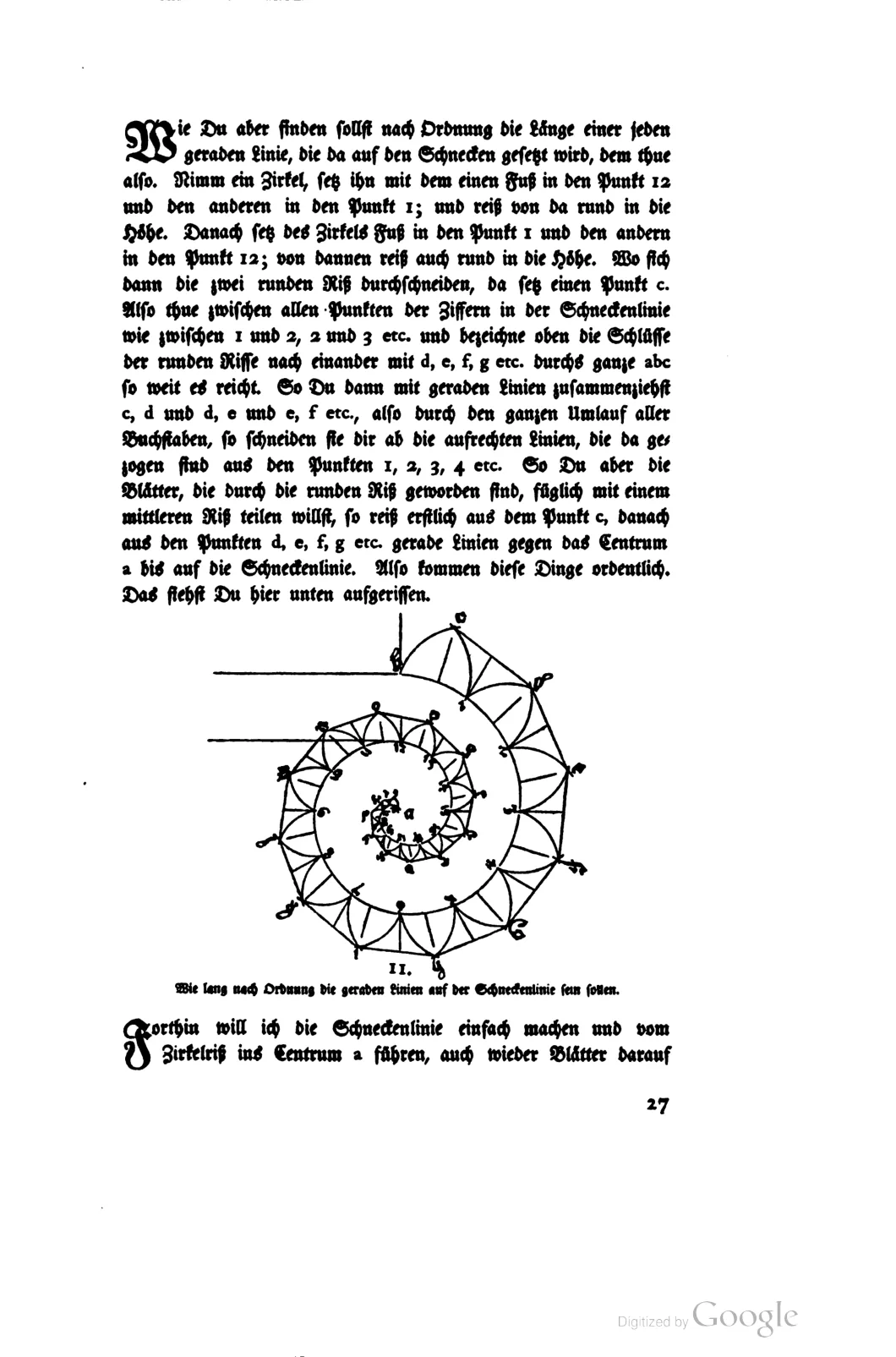
But if you are to find, in order, the length of each straight line that is set upon the spiral, then do thus. Take a compass, set it with the one foot in the point 12 and the other in the point 1; and draw from there round, upward. Then set the compass's foot in the point 1 and the other in the point 12; from there likewise draw round, upward. Where the two round marks then cut each other, set a point c. Do so between all the points of the numerals in the spiral line, as between 1 and 2, 2 and 3, etc., and mark the closings of the round marks above, one after another, with d, e, f, g, etc., through the whole alphabet as far as it reaches.

Then when you draw together with straight lines c, d and d, e and e, f, etc., thus through the whole course of all the letters, they cut off for you the upright lines that are drawn from the points 1, 2, 3, 4, etc. But if you would fittingly divide the leaves that have arisen through the round marks with a middle mark, then draw first from the point c, then from the points d, e, f, g, etc., straight lines toward the center a down to the spiral line. Thus these things come out in order. This you see laid out here below.

How long, in order, the straight lines upon the spiral line should be.

Henceforth I will make the spiral line single and lead it from the circle into the center a, and again set leaves upon it

Original — Peltzer 1908

Willst Du aber finden sollst nach Ordnung die Länge einer jeden geraden Linie, die da auf den Schnecken gesetzt wird, dem thue also. Nimm ein Zirkel, setz ihn mit dem einen Fuß in den Punkt 12 und den anderen in den Punkt 1; und reiß von da rund in die Höhe. Danach setz des Zirkels Fuß in den Punkt 1 und den andern in den Punkt 12; von dannen reiß auch rund in die Höhe. Wo sich dann die zwei runden Riß durchschneiden, da setz einen Punkt c. Also thue zwischen allen Punkten der Ziffern in der Schneckenlinie wie zwischen 1 und 2, 2 und 3 etc. und bezeichne oben die Schlüsse der runden Risse nach einander mit d, e, f, g etc. durchs ganze abc so weit es reicht.

So Du dann mit geraden Linien zusammenziehst c, d und d, e und e, f etc., also durch den ganzen Umlauf aller Buchstaben, so schneiden sie dir ab die aufrechten Linien, die da gezogen sind aus den Punkten 1, 2, 3, 4 etc. So Du aber die Blätter, die durch die runden Riß geworden sind, füglich mit einem mittleren Riß teilen willst, so reiß erstlich aus dem Punkt c, danach aus den Punkten d, e, f, g etc. gerade Linien gegen das Centrum a bis auf die Schneckenlinie. Also kommen diese Dinge ordentlich. Das siehst Du hier unten aufgerissen.

Wie lang nach Ordnung die geraden Linien auf der Schneckenlinie sein sollen.

Fort hin will ich die Schneckenlinie einfach machen und vom Zirkelriß ins Centrum a führen, auch wieder Blätter darauf

Dürer, Underweysung der Messung — leaf 32
Bk I: the spiral lines (Schneckenlinien) · leaf 32

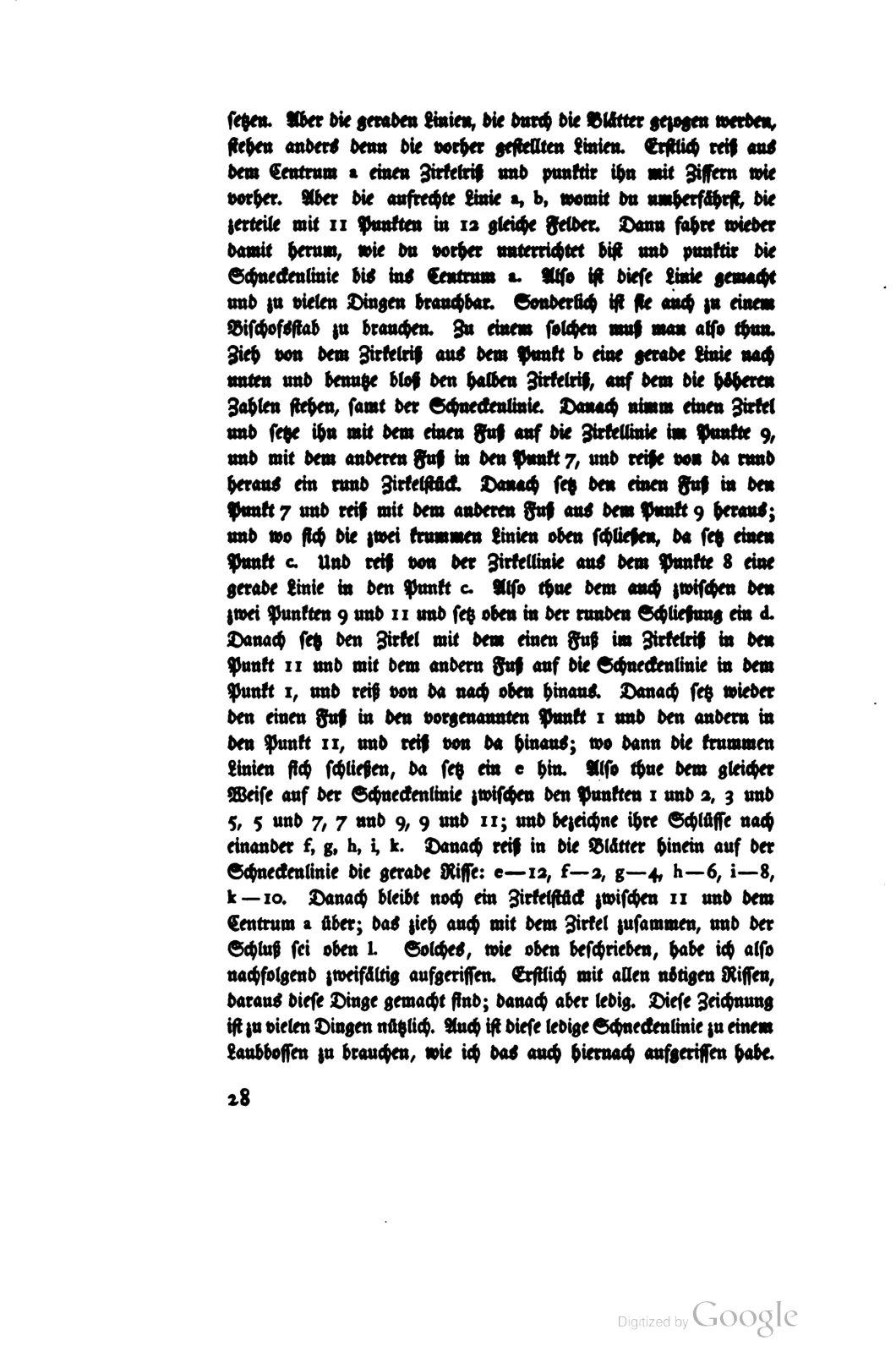
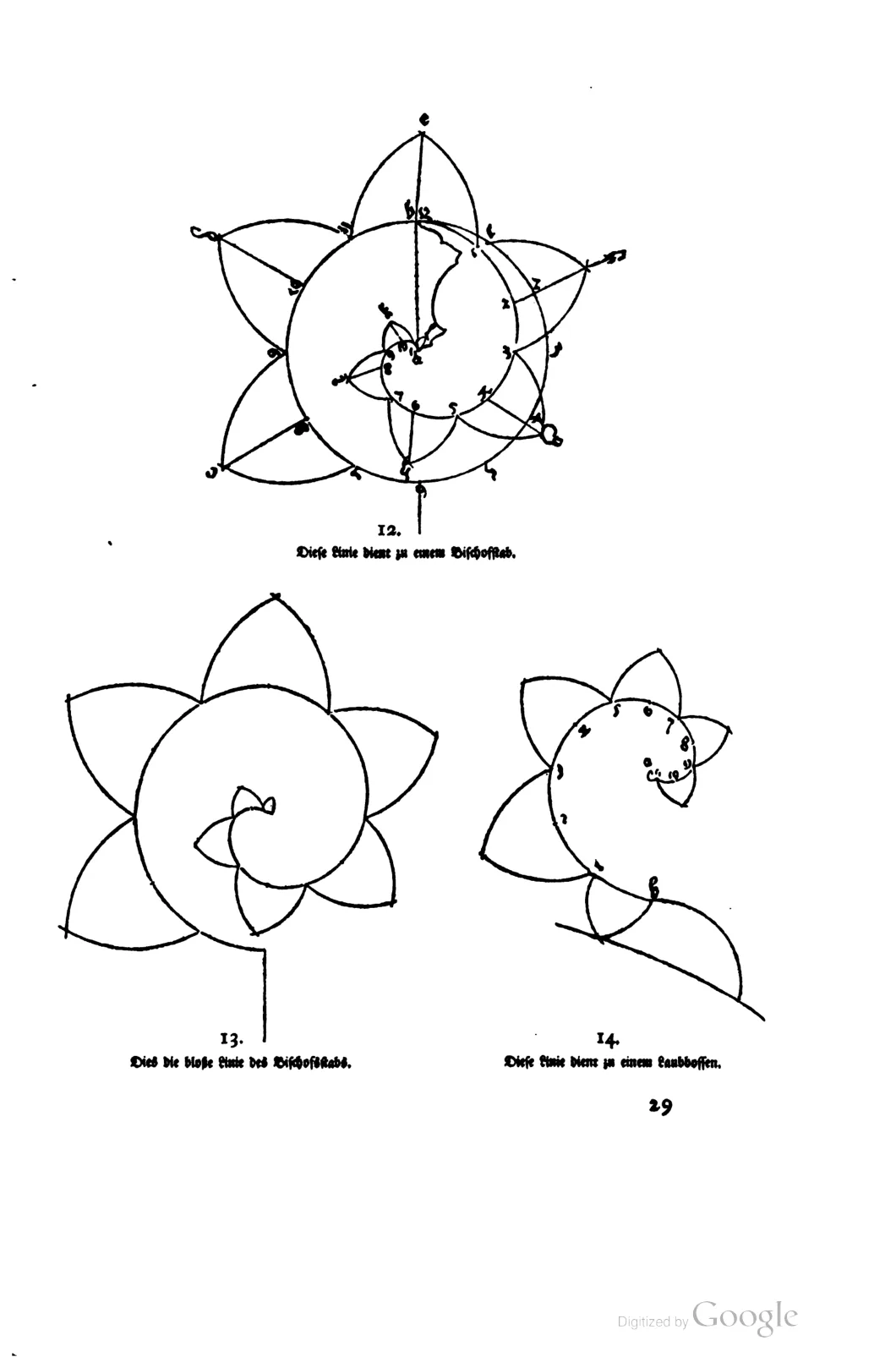
upon it. But the straight lines that are drawn through the leaves stand differently than the lines set before. First draw from the center a a circle and dot it with numerals as before. But the upright line a, b with which you sweep around, divide that with 11 points into 12 equal fields. Then sweep around with it again, as you were instructed before, and dot the spiral line down into the center a. Thus this line is made and is useful for many things. In particular it serves also for a bishop's staff (crozier). For such a one this must be done.

Draw from the circle at the point b a straight line downward, and use only the half of the circle on which the higher numbers stand, together with the spiral line. Then take a compass and set it with the one foot on the circular line at the point 9, and draw from there round, outward, a round arc-piece. Then [set the foot] out from the point 9; [and where it closes,] there set a point 1, and draw from there upward, outward. Then set the one foot again in the aforesaid point 1 and the other in the point 11, and draw out from there; where the curved lines then close, there set an e. Do likewise on the spiral line between the points 1 and 2, 3 and 5, 5 and 7, 7 and 9, 9 and 11; and mark their closings one after another f, g, h, i, k. Then draw into the leaves on the spiral line the straight marks: e—12, f—2, g—4, h—6, i—8, k—10. Then there still remains an arc-piece between 11 and the center a; draw that together with the compass too, and let its closing be 1 above.

This, as described above, I have laid out twice hereafter. First with all the necessary marks out of which these things are made; and then bare. This drawing is useful for many things. This bare spiral line also serves for a foliage-boss (leafwork ornament), as I have likewise laid out hereafter.

Original — Peltzer 1908

setzen. Aber die geraden Linien, die durch die Blätter gezogen werden, stehen anders denn die vorher gestellten Linien. Erstlich reiß aus dem Centrum a einen Zirkelriß und punktier ihn mit Ziffern wie vorher. Aber die aufrechte Linie a, b, womit du umherfährst, die zerteile mit 11 Punkten in 12 gleiche Felder. Dann fahre wieder damit herum, wie du vorher unterrichtet bist, und punktier die Schneckenlinie bis ins Centrum a. Also ist diese Linie gemacht und zu vielen Dingen brauchbar. Sonderlich ist sie auch zu einem Bischofsstab zu brauchen. Zu einem solchen muß man also thun.

Zieh von dem Zirkelriß aus dem Punkt b eine gerade Linie nach unten und benutze bloß den halben Zirkelriß, auf dem die höheren Zahlen stehen, samt der Schneckenlinie. Danach nimm einen Zirkel und setze ihn mit dem einen Fuß auf die Zirkellinie im Punkte 9, und reiße von da rund heraus ein rund Zirkelstück. Danach [setz den Fuß] aus dem Punkt 9 heraus; [und wo es sich schließt,] da setz einen Punkt 1, und reiß von da nach oben hinaus. Danach setz wieder den einen Fuß in den vorgenannten Punkt 1 und den andern in den Punkt 11, und reiß von da hinaus; wo dann die krummen Linien sich schließen, da setz ein e hin. Also thue dem gleicher Weise auf der Schneckenlinie zwischen den Punkten 1 und 2, 3 und 5, 5 und 7, 7 und 9, 9 und 11; und bezeichne ihre Schlüsse nach einander f, g, h, i, k. Danach reiß in die Blätter hinein auf der Schneckenlinie die geraden Risse: e—12, f—2, g—4, h—6, i—8, k—10. Danach bleibt noch ein Zirkelstück zwischen 11 und dem Centrum a über; das zieh auch mit dem Zirkel zusammen, und der Schluß sei oben 1.

Solches, wie oben beschrieben, habe ich also nachfolgend zweifältig aufgerissen. Erstlich mit allen nötigen Rissen, daraus diese Dinge gemacht sind; danach aber ledig. Diese Zeichnung ist zu vielen Dingen nützlich. Auch ist diese ledige Schneckenlinie zu einem Laubbossen zu brauchen, wie ich das auch hiernach aufgerissen habe.

Dürer, Underweysung der Messung — leaf 33
Figure leaf: full woodcut of the bare crozier (bishop's-staff) spiral line. OCR caption reads 'Dies die bloße Linie des Bischofsstabs' ('This is the bare line of the bishop's staff'). · leaf 33
Dürer, Underweysung der Messung — leaf 34
Bk I: the spiral lines (Schneckenlinien) · leaf 34

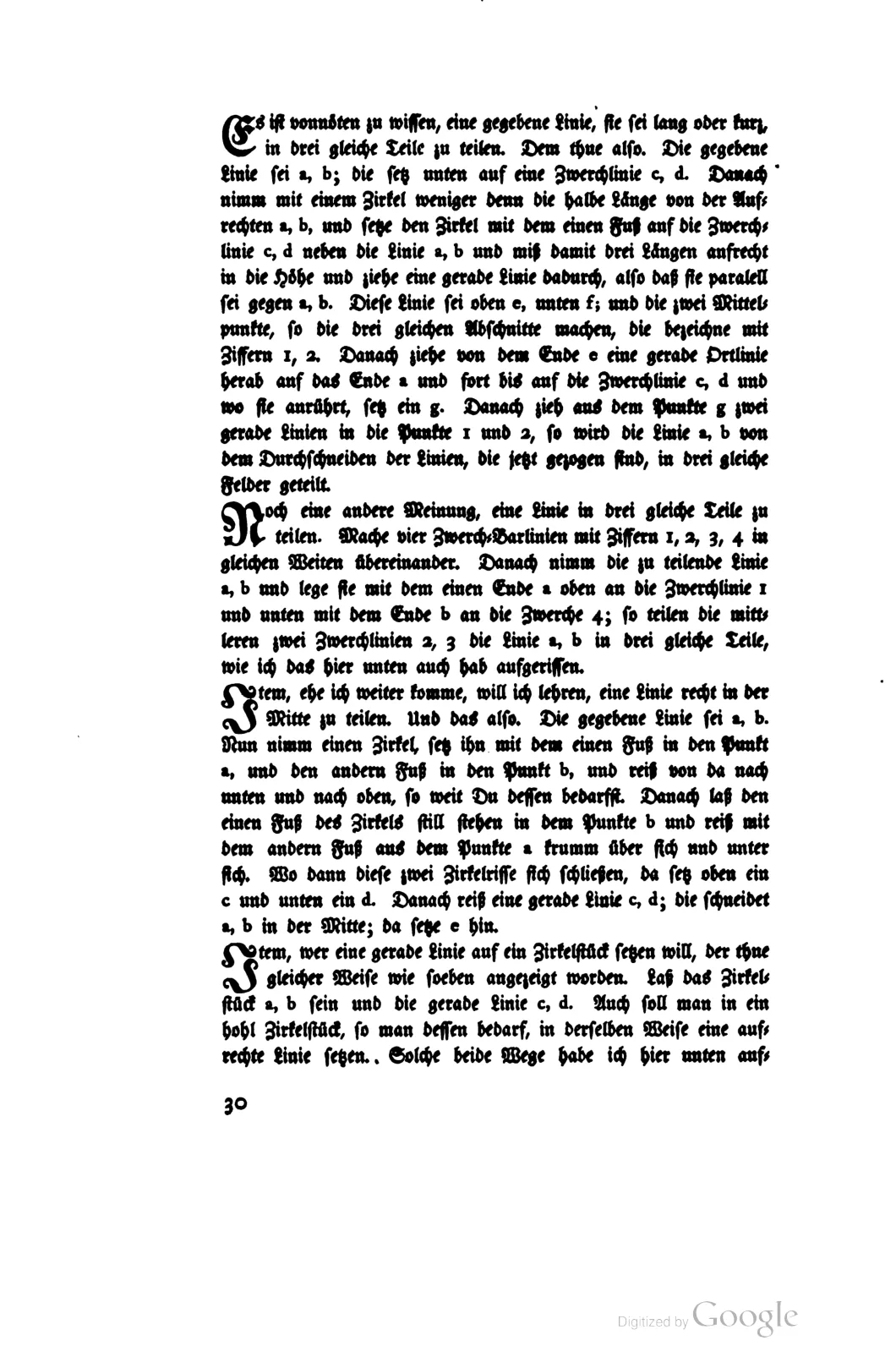
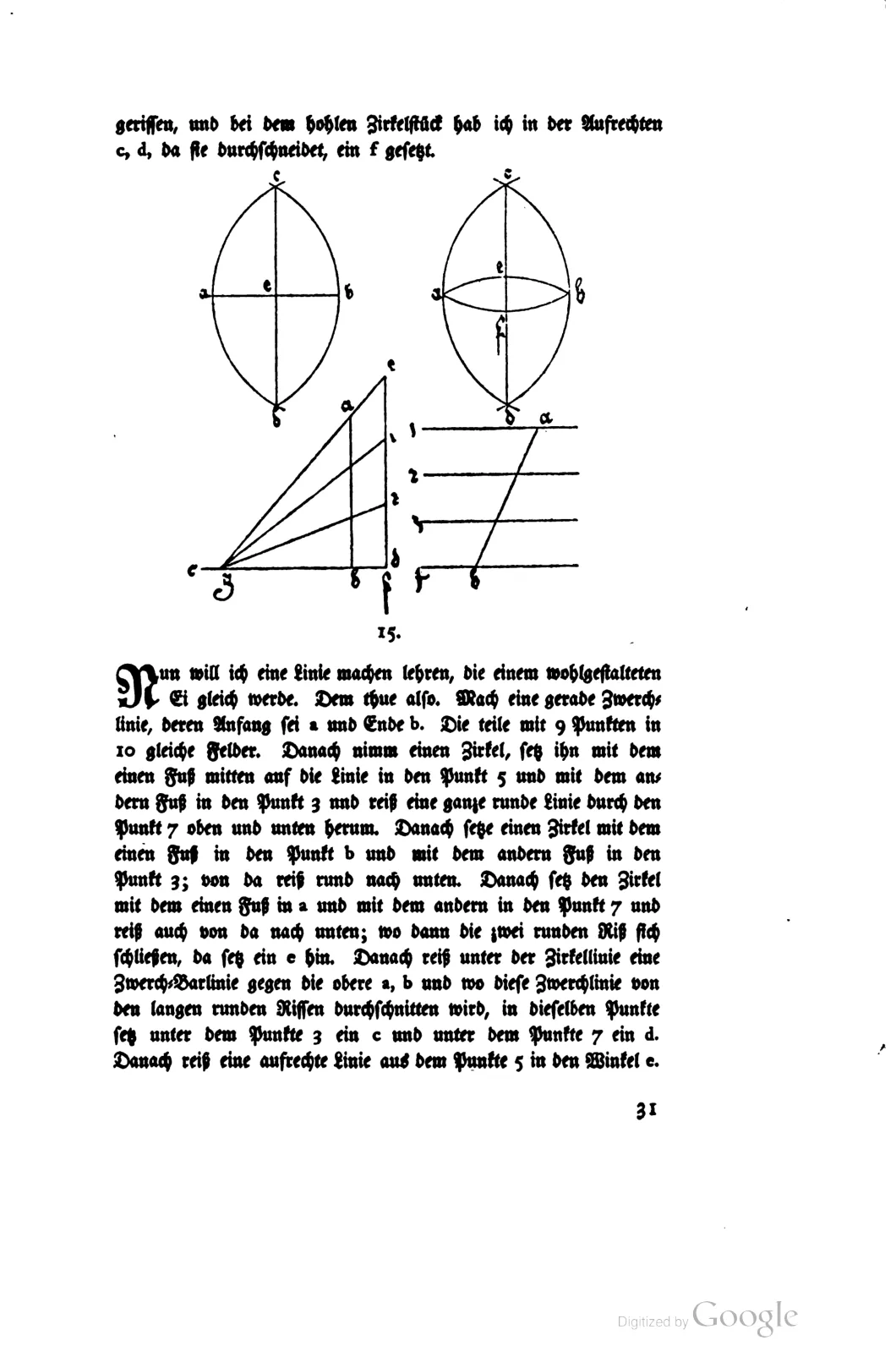
It is necessary to know how to divide a given line, be it long or short, into three equal parts. Do thus. Let the given line be a, b; set it below upon a cross-line c, d. Then take with a compass less than half the length of the upright a, b, and set the compass with the one foot on the cross-line c, d beside the line a, b, and measure off with it three lengths upright into the height, and draw a straight line through them, so that it be parallel to a, b. Let this line be e above, f below; and the two middle points that make the three equal segments, mark with the numerals 1, 2. Then draw from the end e a straight diagonal line down to the end a and on to the cross-line c, d, and where it touches, set a g. Then draw from the point g two straight lines to the points 1 and 2; thus the line a, b is divided into three equal fields by the intersecting of the lines now drawn.

Yet another notion for dividing a line into three equal parts. Make four transverse par-lines with the numerals 1, 2, 3, 4 at equal distances over one another. Then take the line a, b to be divided and lay it with the one end a above against the cross-line 1 and below with the end b against the cross-line 4; thus the two middle cross-lines 2, 3 divide the line a, b into three equal parts, as I have likewise laid out here below.

Item, before I go further, I will teach how to divide a line exactly in the middle. And thus. Let the given line be a, b. Now take a compass, set it with the one foot in the point a and the other foot in the point b, and draw from there downward and upward, as far as you need. Then let the one foot of the compass stand still in the point b and draw with the other foot out of the point a, curving above and below. Where these two compass-marks then close, there set above a c and below a d. Then draw a straight line c, d; it cuts a, b in the middle; there set an e.

Item, whoever would set a straight line upon an arc-piece, let him do likewise as just shown. Let the arc-piece be a, b and the straight line c, d. One should also, in a hollow arc-piece, when one needs it, set an upright line in the same way. Both these ways I have laid out here below,

Original — Peltzer 1908

Es ist vonnöten zu wissen, eine gegebene Linie, sie sei lang oder kurz, in drei gleiche Teile zu teilen. Dem thue also. Die gegebene Linie sei a, b; die setz unten auf eine Zwerchlinie c, d. Danach nimm mit einem Zirkel weniger denn die halbe Länge von der Aufrechten a, b, und setze den Zirkel mit dem einen Fuß auf die Zwerchlinie c, d neben die Linie a, b und miß damit drei Längen aufrecht in die Höhe und ziehe eine gerade Linie dadurch, also daß sie paralell sei gegen a, b. Diese Linie sei oben e, unten f; und die zwei Mittelpunkte, so die drei gleichen Abschnitte machen, die bezeichne mit Ziffern 1, 2. Danach ziehe von dem Ende e eine gerade Ortlinie herab auf das Ende a und fort bis auf die Zwerchlinie c, d und wo sie anrührt, setz ein g. Danach zieh aus dem Punkte g zwei gerade Linien in die Punkte 1 und 2, so wird die Linie a, b von dem Durchschneiden der Linien, die jetzt gezogen sind, in drei gleiche Felder geteilt.

Noch eine andere Meinung, eine Linie in drei gleiche Teile zu teilen. Mache vier Zwerch-Parlinien mit Ziffern 1, 2, 3, 4 in gleichen Weiten übereinander. Danach nimm die zu teilende Linie a, b und lege sie mit dem einen Ende a oben an die Zwerchlinie 1 und unten mit dem Ende b an die Zwerche 4; so teilen die mittleren zwei Zwerchlinien 2, 3 die Linie a, b in drei gleiche Teile, wie ich das hier unten auch hab aufgerissen.

Item, ehe ich weiter komme, will ich lehren, eine Linie recht in der Mitte zu teilen. Und das also. Die gegebene Linie sei a, b. Nun nimm einen Zirkel, setz ihn mit dem einen Fuß in den Punkt a, und den andern Fuß in den Punkt b, und reiß von da nach unten und nach oben, so weit Du dessen bedarfst. Danach laß den einen Fuß des Zirkels still stehen in dem Punkte b und reiß mit dem andern Fuß aus dem Punkte a krumm über sich und unter sich. Wo dann diese zwei Zirkelrisse sich schließen, da setz oben ein c und unten ein d. Danach reiß eine gerade Linie c, d; die schneidet a, b in der Mitte; da setze e hin.

Item, wer eine gerade Linie auf ein Zirkelstück setzen will, der thue gleicher Weise wie soeben angezeigt worden. Laß das Zirkelstück a, b sein und die gerade Linie c, d. Auch soll man in ein hohl Zirkelstück, so man dessen bedarf, in derselben Weise eine aufrechte Linie setzen. Solche beide Wege habe ich hier unten auf-

Dürer, Underweysung der Messung — leaf 35
Bk I: the spiral lines (Schneckenlinien) · leaf 35

and at the hollow arc-piece I have set, in the upright c, d where it cuts through, an f.

Now I will teach how to make a line that comes out like a well-shaped egg. Do thus. Make a straight cross-line, whose beginning is a and end b. Divide it with 9 points into 10 equal fields. Then take a compass, set it with the one foot midway on the line at the point 5 and with the other foot at the point 3, and draw a whole round line through the point 7, around above and below. Then set a compass with the one foot in the point 1 and with the other foot in the point 3; from there draw round, downward. Then set the compass with the one foot in a and with the other in the point 7 and draw likewise from there downward; where the two round marks then close, there set an e. Then draw, beneath the circular line, a transverse par-line parallel to the upper a, b, and where this cross-line is cut by the long round marks, in those same points set, beneath the point 3 a c and beneath the point 7 a d. Then draw an upright line from the point 5 into the vertex e.

Original — Peltzer 1908

gerissen, und bei dem hohlen Zirkelstück hab ich in der Aufrechten c, d, da sie durchschneidet, ein f gesetzt.

Nun will ich eine Linie machen lehren, die einem wohlgestalteten Ei gleich werde. Dem thue also. Mach eine gerade Zwerchlinie, deren Anfang sei a und Ende b. Die teile mit 9 Punkten in 10 gleiche Felder. Danach nimm einen Zirkel, setz ihn mit dem einen Fuß mitten auf die Linie in den Punkt 5 und mit dem andern Fuß in den Punkt 3 und reiß eine ganze runde Linie durch den Punkt 7 oben und unten herum. Danach setze einen Zirkel mit dem einen Fuß in den Punkt 1 und mit dem andern Fuß in den Punkt 3; von da reiß rund nach unten. Danach setz den Zirkel mit dem einen Fuß in a und mit dem andern in den Punkt 7 und reiß auch von da nach unten; wo dann die zwei runden Riß sich schließen, da setz ein e hin. Danach reiß unter der Zirkellinie eine Zwerch-Parlinie gegen die obere a, b und wo diese Zwerchlinie von den langen runden Rissen durchschnitten wird, in dieselben Punkte setz unter dem Punkte 3 ein c und unter dem Punkte 7 ein d. Danach reiß eine aufrechte Linie aus dem Punkte 5 in den Winkel e.

Dürer, Underweysung der Messung — leaf 36
Bk I: the spiral lines (Schneckenlinien) · leaf 36

And where it cuts the cross-line c, d, there set an o. Then divide the arc-piece between 3 and 10 with a point f in the middle. Then divide the other arc-piece between 10 and 7 likewise with a point g in the middle. And then set a compass with the one foot in the point f and the other in the point d, and draw downward through the upright e. Then set the compass with the one foot on the other side in the point g and the other in the point c and draw from there downward; where these two curved lines then close upon the upright e, there set an h. Then divide h, 10 with a point i into two equal fields, and set the compass with the one foot in the point i and the other into the circular line c, h, as short as you can reach it. And then draw round about up to the other mark h, d. Thus this egg-line is made, as it is then laid out here below, with all the necessary lines and also without them, bare.

It will be necessary that one know how to find an arc-piece's center or midpoint. This is done just by the way in which, as already shown before, one sets an upright line upon an arc-piece. Do thus. Let the given arc-piece be a, b. Now take a compass and set it with the one foot in the point a, and the other set a little way into the arc-piece, and draw a round mark above and below, as far as you need. Then take the compass and set it with the one foot in the point where your curved mark has crossed within the arc-piece, and draw with the other foot out of the point

Original — Peltzer 1908

Und wo sie die Zwerchlinie c, d durchschneidet, da setz o hin. Danach teile das Zirkelstück zwischen 3 und 10 mit einem Punkte f in der Mitte. Danach teile das andere Zirkelstück zwischen 10 und 7 auch mit einem Punkte g in der Mitte. Und dann setz einen Zirkel mit dem einen Fuß in den Punkt f und dem anderen in den Punkt d, und reiß nach unten durch die Aufrechte e. Danach setze den Zirkel mit dem einen Fuß auf die andere Seite in den Punkt g und den andern in den Punkt c und reiß von da nach unten; wo sich dann diese zwei krummen Linien schließen an der Aufrechten e, da setz ein h. Danach teile h, 10 mit einem Punkte i in zwei gleiche Felder und setz den Zirkel mit dem einen Fuß in den Punkt i und dem anderen in die Zirkellinie c, h so kurz du sie erreichen magst. Und reiß dann rund herum bis zu dem anderen Riß h, d. Also ist diese Eierlinie gemacht, wie sie dann hier unten mit allen nötigen Linien und auch ohne die, bloß aufgerissen ist.

Es wird vonnöten sein, daß man weiß, einem Zirkelstück sein Centrum oder Mittelpunkt zu finden. Das macht man gleich durch den Weg, wie man, so vorher schon angezeigt, eine aufrechte Linie auf ein Zirkelstück setzt. Thue dem also. Das gegebene Zirkelstück sei a, b. Nun nimm einen Zirkel und setz ihn mit dem einen Fuß in den Punkt a, und den anderen setz ein wenig ins Zirkelstück hinein und reiß einen runden Riß nach oben und nach unten, so weit du dessen bedarfst. Danach nimm den Zirkel und setz ihn mit dem einen Fuß in den Punkt, den dein krummer Riß im Zirkelstück gemacht hat, und reiß mit dem andern Fuß aus dem Punkte

Dürer, Underweysung der Messung — leaf 37
Bk I: the spiral lines (Schneckenlinien) · leaf 37

round, above and below. Where the two round marks then close above and below, there draw a straight line through and complete it downward, as far as you need. Do likewise on the side b; thus the two straight lines will close across each other below, where the center is found; there set a c. Thus the center of this arc-piece is found, as I have laid out below.

It is useful to know, when three points are set unevenly, how one may readily, when one needs it, enclose them within a circle. Do this thus. Let the three points be a, b, c. Draw them together with two straight lines, a, b and b, c. Then do likewise as shown earlier in the 15th figure — namely, find the middle of both lines and let the two straight lines, which divide the two given lines in the middle, cross each other downward. Then take a compass and set it with the one foot in the point d and the other in the point a, and draw from it a whole circle; thus the circle touches the three points a, b, c, as I have laid out here.

Original — Peltzer 1908

rund über sich und unter sich. Wo sich dann die zwei runden Risse oben und unten schließen, da ziehe eine gerade Linie durch und vollende sie nach unten, so weit du deren bedarfst. Also thue auch auf der Seite b; so werden sich die zwei geraden Linien unten, da sich das Centrum findet, durcheinander schließen; dahin setz ein c. Also ist das Centrum zu diesem Zirkelstück gefunden, wie ich das unten aufgerissen habe.

Es ist nützlich zu wissen, so drei Punkte ungleich gestellt werden, daß man sie behend, so man dessen bedarf, in einen Zirkel einfassen kann. Dies mache also. Die drei Punkte seien a, b, c. Die zieh mit zwei geraden Linien zusammen, a, b und b, c. Danach thue gleicher Weise wie früher in der 15. Figur angezeigt ist, nämlich suche die Mitte beider Linien und lasse die zwei geraden Linien, welche die beiden gegebenen Linien in der Mitte teilen, nach unten sich durcheinanderstreichen. Danach nimm einen Zirkel und setz den mit dem einen Fuß in den Punkt d und den anderen in den Punkt a und reiß daraus einen ganzen Zirkelriß, so rührt der Zirkel die drei Punkte a, b, c, wie ich das hierbei aufgerissen habe.

Dürer, Underweysung der Messung — leaf 38
Bk I: the spiral lines (Schneckenlinien) · leaf 38

Hereafter I will teach how to make a serviceable line that bends a particular way. First make a cross-line c, d; divide it with 9 points into 10 equal fields, and upon the midpoint 5 set an upright line at right angles to it; let it be a above, b below. Divide this line a, b with 19 points into 20 equal fields and begin counting from the bottom, 1, 2, 3, etc. Then take a straightedge and prick off the length c, d upon it and mark the ends of this length upon it e, f. With this length all the points of the curve that one wishes to make here are indicated.

Then take a portion out of b, d [and divide] it into three equal parts; with one third lengthen the given portion. Take a compass, open it as wide as the lengthened portion is, and hold it, [and] measure thus with it: set it with the one [foot] in the point d and with the other [draw] a round arc-piece upward. Then [take] the former length e, f that you pricked upon your straightedge, and lay it with the end e against the upright line a, b [at the] point 1; and lay the other end f [against the] arc-piece, so that it touches. There set [an]other point 1. Then lay your straightedge anew with the one end e against a, b at the point 2, and then set [the compass] with the one foot in the newly made point 1, and with the other foot draw an [arc-]piece upward as before. Where the aforesaid line then touches the curve with the end f, there set a point 2. Do so on through all the numbers, as high as you can come.

Then draw this line in its curvedness from point to point through its numbers. This line I have drawn out twice hereafter; also with a shorter line e, g. These come closer together at the top of the curve than at the bottom. This is laid out alongside thus.

Original — Peltzer 1908

Hiernach will ich aber eine gebräuchliche Linie lehren zu machen, die sich einen besonderen Weg biegt. Erstlich mach eine Zwerchlinie c, d; die teil mit 9 Punkten in 10 gleiche Felder und auf den Mittelpunkt 5 stelle eine aufrechte Linie rechtwinklig darauf; die sei oben a, unten b. Diese Linie a, b teile mit 19 Punkten in 20 gleiche Felder und hebe von unten an zu zählen 1, 2, 3 etc. Danach nimm ein Richtscheit und steche die Länge c, d darauf ab und bezeichne die Enden dieser Länge darauf e, f. Mit dieser Länge werden alle Punkte der Krummen angezeigt, die man hier machen will.

Danach nimm einen Teil aus b, d [und teile] ihn in drei gleiche Teile; mit einem Dritteil verlängere den gegebenen Teil. Nimm einen Zirkel, thue ihn auf, so weit der verlängerte Teil ist, und halte ihn, [und] miß also damit: setz ihn mit dem einen [Fuß] in den Punkt d und mit dem andern [reiß] ein rundes Zirkelstück nach oben. Danach [nimm] die vorige Länge e, f, die du auf dein [Richt]scheit gestochen hast, und leg sie mit dem Ende e an die aufrechte Linie a, b [in den] Punkt 1; und das andere Ende f leg [an das] Zirkelstück, daß es anrühre. Daselbst setz [einen] anderen Punkt 1. Danach leg dein Richtscheit von Neuem mit dem einen Ende e an a, b in den Punkt 2, und setze danach [den Zirkel] mit dem einen Fuß in den neu gemachten Punkt 1, und mit dem andern Fuß reiß ein [Zirkel]stück nach oben wie vorhin. Wo dann die vorgedachte Linie mit dem Ende f die krumme anrührt, da setze einen Punkt 2. Also thue weiter durch alle Zahlen, so hoch du kommen magst.

Danach zieh diese Linie in ihrer Krummheit von Punkt zu Punkt durch ihre Zahlen. Diese Linie habe ich hiernach zweifach aufgezogen; auch mit einer kürzeren Linie e, g. Die kommen oben in der Krümme näher zusammen denn unten. Dies ist beifolgend also aufgerissen.

Dürer, Underweysung der Messung — leaf 39
Bk I: the conic sections — ellipse, parabola, hyperbola · leaf 39

There it has been shown that one can make three kinds of cut through a cone, which differ from one another and which do not have a circular line equal to the foot (base) of the cone. Otherwise one may indeed cut the cone through in the middle so that the upper part is again shaped like a cone; but of that no account is taken here. But the other three cuts each make a particular line. These lines I will teach how to lay out.

The first cut the scholars call the ellipse: it cuts the cone obliquely and takes nothing away from the foot of the cone. This oblique cut may be taken higher on one side, lower on the other, so that one side is nearer and the other farther from the foot. The second cut makes, in the laying-out, a par-line (a line parallel) with the side of the cone a, b: the scholars call it the parabola. The third cut is, in the laying-out, an upright par-line to the line that is drawn upward from the center of the cone's foot to the cone's apex a: this they call the hyperbola.

The names of these three cuts I do not know how to say in German; but we will give them names by which one can recognize them. The ellipse I will call an egg-line, because it is almost like an egg. The parabola let it be called a burning-line, because if one makes a mirror from it, it kindles fire. But the hyperbola I will call a fork-line.

Now, when I would lay out the egg-line, the ellipse, I must first lay out the cone and show the cut within it, and likewise make the ground (plan) beneath it. This I do thus. Let the cone's apex be a above and the foot below b, c, d, e. Now I draw from a an upright line down; and let the oblique cut through the cone be f above, g below. This cut f, g I divide with 11 points into 12 fields and begin the numbers under the f. Beneath this cone I draw its ground; then a becomes a center and b, c, d, e the circular line. Now when from all the points upright lines fall down into the ground, these lines from f, g and the numbers that are between cut the circle, where I likewise mark them with their letters and numerals. When that is done, then I take a compass and set it in the cone with the one foot on the upright line from a at the height of the oblique cut f, g of the point 1; and at this height I set the compass with

Original — Peltzer 1908

Da haben angezeigt, daß man dreierlei Schnitt durch einen Kegel thun kann, die da von einander verschieden sind und die da mit dem Fuß des Kegels nicht eine gleiche Zirkellinie haben. Sonst mag man ja den Kegel in der Mitte so durchschneiden, daß der obere Teil wieder geformt wie ein Kegel wird. Deß acht man hier nicht. Aber die anderen drei Schnitte machen jeglicher eine besondere Linie. Diese Linien will ich aufreißen lehren.

Den ersten Schnitt heißen die Gelehrten Elipsis: der schneidet den Kegel schräg ab und nimmt dem Fuß des Kegels nichts weg. Dieser schräge Schnitt kann an einer Seite höher, an der anderen niedriger genommen werden, also daß eine Seite näher und die andere weiter zum Fuß hat. Der andere Schnitt macht im Aufreißen eine Parlinie mit der Seite des Kegels a, b: die Gelehrten nennen ihn Parabola. Der dritte Schnitt ist im Aufreißen eine aufrechte Parlinie zu der Linie, die da aus dem Centrum des Kegelsfußes nach oben gezogen wird in des Kegels Spitze a: den nennen sie Hyperbola.

Dieser drei Schnitte Namen weiß ich auf Deutsch nicht zu sagen; wir wollen ihnen aber Namen geben, dabei man sie erkennen kann. Die Elipsis will ich eine Eierlinie nennen, darum daß sie schier einem Ei gleich ist. Die Parabola sei genannt eine Brennlinie, darum so man aus ihr einen Spiegel macht, so zündet der an. Aber die Hyperbola will ich eine Gabellinie nennen.

Nun so ich aufreißen will die Eierlinie Elipsis, muß ich zuvor den Kegel aufreißen und den Schnitt darin anzeigen, desgleichen den Grund darunter machen. Dem thue ich also. Des Kegels Spitze sei oben a und der Fuß unten b, c, d, e. Nun reiß ich aus dem a eine aufrechte Linie herab; und der schräge Schnitt durch den Kegel sei oben f, unten g. Diesen Schnitt f, g teil ich mit 11 Punkten in 12 Felder und heb die Zahlen unter dem f an. Unter diesem Kegel reiß ich seinen Grund; dann wird das a ein Centrum und b, c, d, e die Zirkellinie. So nun aus allen Punkten aufrechte Linien herabfallen in den Grund, so durchschneiden diese Linien von f, g und den Zahlen, die dazwischen sind, den Zirkelriß, wo ich sie auch mit ihren Buchstaben und Ziffern bezeichne. So das gemacht ist, alsdann nehme ich einen Zirkel und setze ihn im Kegel mit dem einen Fuß in die aufrechte Linie von a in der Höhe des schrägen Schnittes f, g des Punktes 1; und in dieser Höhe setze ich den Zirkel mit

Dürer, Underweysung der Messung — leaf 40
Bk I: the conic sections — ellipse, parabola, hyperbola · leaf 40

the other foot out to the line a, d; and keep this width with the compass and carry it into the ground drawn below, and set the one foot of the compass in the center a; and the other foot I set on the line 1 drawn down, and draw round, outward, toward d, back again to the line 1. Then I set the compass again with the one foot in the cone on the upright line a at the height of the point 2 of the cut f, g, and the other foot I set on the line a, d and carry the same width again into the ground, and set the compass's one foot in the center a and the other foot on the straight line 2, and draw from there round, toward d, back again onto the straight line 2. Thus

Original — Peltzer 1908

dem anderen Fuß heraus an die Linie a, d; und behalte diese Weite mit dem Zirkel und trage sie in den unten aufgezeichneten Grund und setze den einen Fuß des Zirkels in das Centrum a; und den anderen Fuß setz ich auf die heruntergezogene Linie 1 und reiße rund hinaus gegen d zu bis wieder zu der Linie 1. Danach setze ich den Zirkel wieder mit dem einen Fuß in den Kegel auf die aufrechte Linie a in der Höhe des Punktes 2 des Schnittes f, g, und den anderen Fuß setze ich in die Linie a, d und trage dieselbe Weite wieder in den Grund und setze des Zirkels einen Fuß ins Centrum a und den anderen Fuß auf die gerade Linie 2, und reiß von da rund gegen d zu bis wieder auf die gerade Linie 2. Also

Dürer, Underweysung der Messung — leaf 41
Bk I: the conic sections — ellipse, parabola, hyperbola · leaf 41

I carry on like this up to 4. Then I turn the compass at the number 5, with one foot on the line a, b, and carry it down, and in the ground-plan I draw all around, out from the centre a, from the line 5 drawn down toward d, until I come back again to this line 5. In this way I work through all the numbers, carrying everything from the upper cone down into the ground-plan.

Then out of this ground-plan I make the bare line of the ellipse as follows: alongside, I draw upright the length of the section f, g, just as it has been divided by its 11 points into 12 equal fields; and through all the points I draw 11 cross-lines.

Then I take from the ground-plan the breadth along the straight line 1, as far as the compass cuts it off, and carry it over to the section f, g, set it on the line 1, and mark the breadth off with points on both sides. In this way I work through all the numbers. Once these points have been made all the way around, I then draw the egg-line — the ellipse — from point to point, just as I have laid it out here. (Dürer calls the ellipse the "egg-line," Eierlinie.)

The parabola is to be made in the same way as the ellipse. First I draw the cone a, b, c, d, e, and in it the upright line a, and I cut the parabola from the top downward right through the foot of the cone, so that this section is a line parallel to the side a, b of the cone; and let this section be f at the top, g, h at the bottom. Then I divide f, g, h with 11 points into 12 equal fields, and draw cross-lines through all the points in f, g, h. And those that stand on the side toward a, d — these cross-lines I draw from the upright a to the cone's line or side a, d. But those that stand on the other side I draw from the upright a to the side-line of the cone a, b. Then I make the base of the cone beneath the cone, whose centre is a and whose circular line is b, c, d, e. Then from all the numbered points and from f, g, h I let straight lines drop down out of the cone through the round base, and mark them again there with their numbers, just as was shown earlier in the base of the egg-line, the ellipse.

Then I set the compass with one foot in the base, at the centre a, and the other foot on the straight line 1, and I draw outward toward d all the way around until I come back to the line 1. I do this on all the numbered lines, until I reach g, h. Thus one sees at once, before one's eyes, the parabola's section in the flattened-down base.

When all this is finished, I then draw the line of the parabola

Original — Peltzer 1908

thue ich fort bis auf 4. Danach wende ich den Zirkel bei der Zahl 5 mit dem einen Fuß auf die Linie a, b, und trage das herab und reiße im Grund rund herum aus dem Centrum a von der heruntergezogenen Linie 5 gegen d zu bis wieder zu dieser Linie 5. Also thue ich durch die ganzen Zahlen, trage alle Dinge aus dem oberen Kegel in den Grund.

Danach mach ich aus diesem Grund die bloße Linie Ellipsis also: ich reiße nebenan die Länge des Schnittes f, g aufrecht; wie sie dann mit ihren 11 Punkten in 12 gleiche Felder geteilt ist; und reiß durch alle Punkte 11 Zwerchbarlinien.

Danach nehme ich die Breite aus dem Grund auf der geraden Linie 1 so weit sie der Zirkel abschneidet, und trage sie zu dem Schnitt f, g, setze sie auf die Linie 1 und punktier die Breite zu beiden Seiten. Also thue ich durch die ganzen Zahlen. So dann diese Punkte rings herum gemacht sind, alsdann zieh ich die Eierlinie Ellipsis von Punkt zu Punkt, wie ich solches hierbei aufgerissen habe.

Die Parabola ist gleicher Weise zu machen als die Ellipsis. Ich reiß erstlich den Kegel a, b, c, d, e und darin die aufrechte Linie a und schneid das Parabel von oben herab bis durch des Kegels Fuß, so daß dieser Schnitt eine Barlinie sei gegen des Kegels Seite a, b; und dieser Schnitt sei oben f, unten g, h. Danach teile ich f, g, h mit 11 Punkten in 12 gleiche Felder und reiß Zwerchlinien durch alle Punkte in f, g, h. Und die, so auf der Seiten stehen gegen a, d, dieselben Zwerchlinien zieh ich von der Aufrechten a an des Kegels Linie oder Seite a, d. Aber die an der andern Seiten stehen, die zieh ich von der Aufrechten a an die Seitenlinie des Kegels a, b. Danach mach ich den Grund des Kegels unter dem Kegel, dessen Centrum a und Zirkellinie b, c, d, e ist. Danach laß ich aus allen Zifferpunkten und von f, g, h gerade Linien aus dem Kegel herabfallen durch den runden Grund und bezeichne sie in demselben wieder mit ihren Ziffern, gleicher Weise wie das vorher im Grund der Eierlinie Ellipsis angezeigt war.

Dann setz ich den Zirkel mit dem einen Fuß im Grund ins Centrum a und den andern Fuß auf die gerade Linie 1, und reiß gegen d zu rund hinaus bis wieder zu der Linie 1. Das thue ich auf allen bezifferten Linien, bis daß ich gar zu g, h komme. So sieht man von Stund an vor Augen des Parabels Schnitt im niedergedrückten Grund.

So das alles fertig ist, so reiß ich die Linie des Parabels

Dürer, Underweysung der Messung — leaf 42
Bk I: the conic sections — ellipse, parabola, hyperbola · leaf 42

— or the burning-line — out of this base, as follows: I draw a cross-line and set up on it, upright, the height of the parabola within the cone, f, g, h. Then I take from the base the breadth g, h and set it on the cross-line, so that the upright f stands in the middle, and I mark these two points as g, h. Then I run 11 lines through all the points of the upright f, as many as I need, and I carry over from the base all the breadths of all the straight lines that are cut off by the compass-arc, over to the upright f, and mark them with points on both sides, so that the upright f always remains in the middle. Then I draw the burning-line — the parabola — from point to point, just as I have laid it out here. (Dürer calls the parabola the "burning-line," Brennlinie, because of its focal property.)

Original — Peltzer 1908

oder Brennlinie aus diesem Grund also: ich reiß eine Zwerchlinie, stelle darauf aufrecht die Höhe des Parabels im Kegel f, g, h. Danach nehme ich aus dem Grunde die Breite g, h und stell sie auf die Zwerchlinie, also, daß die Aufrechte f in der Mitte steh, und bezeichne diese zwei Punkte mit g, h. Danach fahre ich mit 11 Linien durch alle Punkte der Aufrechten f, so weit ich deren bedarf, und trage aus dem Grunde alle Breiten von allen geraden Linien, die durch den Zirkelriß abgeschnitten sind, zu der Aufrechten f und punktir sie zu beiden Seiten, so daß die Aufrechte f allweg in der Mitte bleibe. Alsdann zieh ich die Brennlinie Parabola von Punkt zu Punkt, wie ich das hierbei aufgerissen habe.

Dürer, Underweysung der Messung — leaf 43
Bk I: the conic sections — ellipse, parabola, hyperbola · leaf 43

But if you wish to make a burning-mirror out of the parabola, or burning-line, as was described above, then make the cone from which you intend to cut the parabola with its apex no higher than its foot is broad below — that is, so that the cone is a right-angled triangle. If you then cut a parabola into it and take that same line and make a hollow mirror from it, and trim it off a little at the front, then it burns strongly at the point 22, where the rays of the sun that are cast into it and break out again all come together. To understand this, you must first note that everything that appears in a mirror breaks out again just as it falls in; and yet it is seen within at the present place where it is outside. For this reason the left becomes right, and turned about —

Original — Peltzer 1908

So du aber aus dem Parabel oder Brennlinie, wie sie vorhin gemeldet, einen Anzünde-Spiegel machen willst, so mache den Kegel, daraus du das Parabel schneiden willst, mit seiner Spitze nicht höher denn so breit unten sein Fuß ist, oder daß der Kegel ein rechter Triangel sei. So du dann ein Parabel darein schneidest und dieselbe Linie nimmst und einen hohlen Spiegel daraus machst, so schneide ihn vorn ein wenig ab, so brennt er stark in dem Punkte 22, wo die Strahlen der Sonne, die darein geworfen werden und wieder herausbrechen, zusammenfallen. Um das zu verstehen, mußt du dir vorher merken, daß ein jeglich Ding, das sich in einem Spiegel erscheint, so wie es hineinfällt also auch wieder herausbricht; und wird doch das drinnen gesehen an der gegenwärtigen Statt, wo es draußen ist. Darum wird das links rechts und um-

Dürer, Underweysung der Messung — leaf 44
Bk I: the conic sections — ellipse, parabola, hyperbola · leaf 44

turned about. This I will lay out below for better understanding. Thus: I draw a cross-line a, b; understand by it a flat mirror or a body of water into which you look. Now I set a light c up high on one side, and set a little figure opposite it on the other side, looking into the mirror or the water; let its eye be d. Now the light c does not appear to the eye until the angles of the light-rays and of the line of sight correspond. This happens as follows. If, from the point e where the reflection takes place, you draw an upright line above it, and set one foot of a compass in this point e and with the other foot draw upward from the line a, b, and find by measuring that the light-rays and the lines of sight are equally far from the upright line — then that is the true point at which the light is found. When your line of sight then passes downward through the mirror, and at the same time an upright line drops down from the upper light c, then at the crossed line d you find how deep the light appears in the mirror or water.

In the same way now, after its own fashion, the rays of the sun strike against one another in the mirror that is made from the line of the parabola, and they all fall out into one point and burn strongly. And what the cause of this is, the mathematicians have shown. Whoever wishes may read it. This my account above you see laid out here before you.

Now I will go on to lay out the fork-line, the hyperbola. This will be the same procedure again as before. I draw the cone a, b, c, d, e once more. Then in this cone I draw an upright line parallel to the upright a; let it be f at the top, g, h at the bottom. By this the side of the cone toward d is cut off. This section of the fork-line, the hyperbola, f, g, h, I divide with 11 points into 12 fields, and from all the points of f, g, h and from the numbers I run cross-lines across, as many as I need, and on the side I draw an upright line f through all these cross-lines.

Then I make the round base beneath the cone, whose centre is a and whose compass-circle is b, c, d, e. I then let the section of the cone f, g, h cut through this base, and set the letters g, f, h to it again, just as it projects from the cone into the base. Then I take a compass and with it take the breadth of the half

Original — Peltzer 1908

gekehrt. Das will ich zu besserem Verstand unten aufreißen. Also: ich reiß eine Zwerchlinie a, b; darunter verstehe einen ebenen Spiegel oder ein Wasser, darein du siehst. Nun stell ich ein Licht c in der Höhe auf eine Seite und stelle ein Männlein dagegen auf die andere Seite, das in den Spiegel oder ins Wasser sehe; dessen Auge sei d. So findet sich nun das Licht c dem Auge nicht eher, bis die Winkel der Lichtstrahlen und des Gesichtes sich entsprechen. Das begiebt sich also. Wenn du aus dem Punkte e, darin sich die Widerbrechung begibt, eine aufrechte Linie über sich ziehst und einen Zirkel mit dem einen Fuß in diesen Punkt e setzest und mit dem andern Fuß von der Linie a, b nach oben reißest und findest durch die Maaße, daß die Lichtstrahlen und die Gesichtslinien gleich weit von der aufrechten Linie sind, so ist es der rechte Punkt, darin das Licht gefunden wird. Wenn dann dein Gesicht unter sich durch den Spiegel streicht und wenn zugleich aus dem oberen Lichte c eine aufrechte Linie herabfällt, so findet sich's bei der durchstrichenen Linie d, wie tief sich das Licht im Spiegel oder Wasser erscheint.

Gleicher Weise nun, nach seiner Art, stoßen sich die Strahlen der Sonne im Spiegel, der aus der Linie des Parabels gemacht ist, hiergegen und fallen alle heraus in einen Punkt und brennen stark. Und was die Ursache sei, das haben die Mathematici angezeigt. Wer da will, mag's lesen. Diese meine obige Meinung siehst du hier vor aufgerissen.

Nun will ich fürbaß aufreißen die Gabellinie Hyperbole. Dies wird eben die vorige Meinung wieder sein. Ich reiße wieder den Kegel a, b, c, d, e. Danach reiße ich in diesen Kegel eine aufrechte Barlinie zur Aufrechten a; die sei oben f, unten g, h. Damit wird die Seite des Kegels gegen d zu abgeschnitten. Diesen Schnitt der Gabellinie Hyperbole f, g, h teil ich mit 11 Punkten in 12 Felder und fahre aus allen Punkten von f, g, h und von den Ziffern mit Barlinien überzwerch so weit ich dessen bedarf, und reiße auf der Seite eine aufrechte Linie f durch alle diese Zwerchlinien.

Danach mach ich den runden Grund unter dem Kegel, deß Centrum a und deß Zirkelriß b, c, d, e ist. Laße dann den Schnitt des Kegels f, g, h durch diesen Grund schneiden und setze die Buchstaben g, f, h wieder dazu, wie sich das aus dem Kegel in den Grund wirft. Danach nehme ich einen Zirkel und nehme damit die Breite des halben

Dürer, Underweysung der Messung — leaf 45
Bk I: the conic sections — ellipse, parabola, hyperbola · leaf 45

of the cone on each of the cross-lines, and carry it down into the base, and set the compass with one foot in the centre a, and with the other foot draw, toward d, all the compass-arcs that are then cut off by the line g, f, h; and add their numbers. Then I take from the base the breadths along all the straight lines that have been cut off on both sides, and carry them over to the upright line f, number for number, and mark off the breadths with points on both sides of the upright f, beside the cone, from the number 1 down to g, h. Then draw the fork-line, the hyperbola, from point to point, just as I have laid it out here below. Even though there were no text with it, I think this should all really be recognizable by mere looking.

Original — Peltzer 1908

Kegels auf einer jeglichen der Zwerchlinien und trage die herab in den Grund und setze den Zirkel mit dem einen Fuß ins Centrum a und reiß mit dem andern Fuß gegen d zu alle Zirkelriß, die dann abgeschnitten werden mit der Linie g, f, h; und setze ihre Zahlen dazu. Danach nehm ich die Breiten aus dem Grund auf allen geraden Linien, die zu beiden Seiten abgeschnitten worden sind und trage sie zu der aufrechten Linie f, Zahl auf Zahl, und punktire die Breiten zu beiden Seiten der Aufrechten f neben dem Kegel von der Zahl 1 herab bis auf g, h. Danach ziehe die Gabellinie Hyperbole von Punkt zu Punkt, wie ich das hier unten aufgerissen habe. Obschon kein Schrift dabei wäre, vermeine ich, sollte dies alles eigentlich durch bloßes Sehen kenntlich sein.

Dürer, Underweysung der Messung — leaf 46
Bk I: the conic sections — ellipse, parabola, hyperbola · leaf 46

Here I will draw a line that can be used for many purposes. I make it thus. I draw a line crosswise, whose beginning is a and end is b, and I begin counting from a, and set on this line 16 points one after another at equal distances, but in such a way that a small stretch remains over between the end b and the point 16.

Then I set an upright line on the cross-line a, b at the point 1, as long as the cross-line a to 16, and mark it likewise with these numbers; and I count from the bottom upward. Then I take a straightedge and mark on it the length a, b, and set it with one end on the cross-line a, b at the point 1, and lay it on the upright at point 1. And wherever the other end of the straightedge strikes, there too I set a point 1. Then I lay the straightedge with one end on the cross-line a, b at the point 2, and raise it on the upright line to the point 2. Wherever the other end of the straightedge then strikes, there too I set a point 2. In this way I work through all the numbers of the cross-line and of the upright line, until in passing through I reach the number 16.

Then I draw this shell-line from point to point, just as I have laid it out here below. This line can be altered in many ways.

Original — Peltzer 1908

Hier will ich eine Linie ziehen, die in mancherlei Sachen zu brauchen ist. Die mach ich also. Ich reiß eine Linie überzwerch, deren Anfang sei a und Ende b und hebe nach dem a an zu zählen, und setze auf diese Linie 16 Punkte in gleicher Weite nacheinander, doch so, daß zwischen dem Ende b und dem Punkt 16 ein Stück ungefähr übrig bleibe.

Danach setze ich eine aufrechte Linie auf die Zwerchlinie a, b in den Punkt 1, so lang die Zwerchlinie a 16 ist, und punktir sie auch mit diesen Zahlen; und ich zähle von unten nach oben. Danach nehme ich ein Richtscheit und steche darauf die Länge a, b und setze das mit dem einen Ende auf die Zwerchlinie a, b in dem Punkte 1, und leg es in der Aufrechten in den Punkt 1. Und wo das andere Ende des Richtscheits hintrifft, da setze ich auch einen Punkt 1. Danach leg ich das Richtscheit mit dem einen Ende auf die Zwerchlinie a, b in den Punkt 2 und erhebe es an der aufrechten Linie in den Punkt 2. Wo dann das andere Ende des Richtscheits hintrifft, dahin setz ich auch einen Punkt 2. Also thue ich durch die ganzen Zahlen der Zwerch- und der aufrechten Linie, bis daß ich im Durchschleifen zur Zahl 16 komme.

Danach ziehe ich diese Muschellinie von Punkt zu Punkt, wie ich dann hier unten hab aufgerissen. Diese Linie ist in mancherlei Weise zu verändern.

Dürer, Underweysung der Messung — leaf 47
Bk I: the conic sections — ellipse, parabola, hyperbola · leaf 47

For this line just made, one may fit up a tool so that it can be made easily. Namely thus. Make a square piece of wood as long as you need it, set crosswise; let its front be a, its back d. Into it, at the top, drive a deep groove, so that something can be guided back and forth within it; and divide the wood with points and numbers into as many parts as you wish, beginning the numbers at a.

Then, in the middle on each side of this crosswise frame, make two upright thin little straightedges, just

Original — Peltzer 1908

Zu dieser ebengemachten Linie mag man ein Werkzeug zurichten, daß man sie leichtiglich machen kann. Nämlich also. Mache ein vierecktes Holz so lang du sein bedarfst, überzwerch; dessen Anfang sei vorn a, hinten d. Darein stoß oben eine tiefe Niete, so daß etwas darin hin und her geführt werden kann; und teile das Holz mit Punkten und Zahlen in so viele Teile du willst, und hebe die Zahlen bei dem a an.

Danach mache in der Mitte an jeglicher Seite dieser Zwerchladen zwei aufrechte dünne Richtscheitlein, eben

Dürer, Underweysung der Messung — leaf 48
Bk I: the conic sections — ellipse, parabola, hyperbola · leaf 48

as long as the crosswise wood, and so that they stand close together; and mark them with the same numbers as the crosswise wood is marked, beginning the numbers from below. Then make a fine little lance, as long or short as you wish, and at its back make a running little wheel, which fits exactly in the middle of the groove in the crosswise frame a, b, so that it can move back and forth within it. Then push the little lance out between the two little straightedges toward the part b, and set the little wheel in the crosswise wood toward a, at the first point 1; and lay the little lance down between the woods at the lowest point 1 as well. And then, as you run the little wheel along below toward the straightedge, however far in you run it, run the little lance just as far upward between your little straightedges, until below, with the little wheel, you pass through the two little straightedges and reach the very end. Then the little lance in front, with its point, will trace this line for you as it should be. This my account I have laid out above.

Next I will make an instrument by which, at many ends — high, low, to the sides, before or behind one — a serpentine line may be indicated and drawn. Such an instrument is bent, turned, and rotated upon rods; and in the joints of the rods there are to be discs. At the centres there are to be the hinges in which it turns, of which one part is to be bent upward, another part downward, or wherever one wishes, or all of them together upward or downward.

The rods one may make as one wishes, but in such a way that they can be drawn apart degree by degree, lengthened, or pushed into one another and shortened. And each rod is to be made so that it can be turned or rotated degree by degree, to whichever side one wishes. One may make many or few of the discs and rods, according to how one wishes to use this instrument. And the lowest rod is to be set upright, fixed firm at its lowest part and bent to no side. For all the other things are to be moved upon this rod; though in its turning it may be rotated all around below in a pivot. But for the sake of understanding I will demonstrate it thus.

I make four rods, which have at the top four discs as joints, in whose centres the rods are turned;

Original — Peltzer 1908

so lang als das Zwerchholz ist und so, daß sie eng bei einander stehen und punktir sie gleich mit denselben Zahlen wie das Zwerchholz punktirt ist, und hebe die Zahlen von unten an. Danach mach ein feines Länzlein, so lang oder kurz du das haben willst und mache hinten daran ein umlaufendes Rädlein, das in die Mitte der Nieten in der Zwerchlade a, b gerecht sei, darin es hin und her gehen möge. Danach schiebe das Länzlein zwischen die zwei Richtscheitlein hinaus gegen den Teil b zu und setze das Rädlein in das Zwerchholz gegen a hin in den ersten Punkt 1; und lege das Länzlein zwischen den Hölzern auch nieder an den untersten Punkt 1. Und wenn du dann mit dem Rädlein unten gegen das Richtscheit fährst und so weit du hinein fährst, so weit fahr allweg mit dem Länzlein zwischen dein Richtscheitlein über sich, bis daß du unten mit dem Rädlein durch die zwei Richtscheitlein und gar ans Ende kommst. Dann wird dir das Länzlein vorn mit der Spitze diese Linie führen wie sie werden soll. Diese meine Meinung hab ich zuvor aufgerissen.

Nachfolgend will ich ein Instrument machen, damit man an vielen Enden, hoch, nieder, zu Seiten, vor oder hinter sich eine Schlangenlinie andeuten und reißen mag. Solches Instrument wird an Stangen gebogen, gewendet und umgerieben; und in den Gliedern der Stangen sollen Scheiben sein. In den Centren sollen die Bügel sein, darin es umgeht, deren ein Teil nach oben, ein ander Teil nach unten oder wo man hin will gebogen werden soll, oder alle miteinander nach oben oder nach unten.

Die Stangen mach man wie man will, aber so, daß man sie von Grad zu Grad auseinander rücken, verlängern oder ineinander schieben und verkürzen mag. Und eine jede Stange soll gemacht werden, daß sie von Grad zu Grad gewendet oder umgerieben werden mag, auf welche Seite man will. Man mag von den Scheiben und Stangen viele oder wenig machen, je nachdem wie man dieses Instrument brauchen will. Und die unterste Stange soll aufrecht gestellt werden mit dem untersten Teil fest und auf keiner Seite gebogen. Denn alle anderen Dinge sollen an dieser Stange bewegt werden; aber in ihrem Umgang mag sie in einem Zapfen unten rings umgerieben werden. Aber zum Verständniß will ich's also vormachen.

Ich mache vier Stangen, die haben oben vier Scheiben als Glieder, in deren Centren die Stangen gedreht werden;

Dürer, Underweysung der Messung — leaf 49
Bk I: the conic sections — ellipse, parabola, hyperbola · leaf 49

and the discs are to be marked in their compass-circle with degrees by numbers. And the last, smallest disc is to have, to its own measure, a long needle that goes out from its centre, which can rotate and by which the line being made is indicated. This needle, too, is to be made so that it can be pushed apart or together, so that one may make it longer and shorter degree by degree.

Such an instrument as described above may be altered in many ways, according to what the use requires; one may also make it large or small. But it is necessary to note that the rods and discs are made larger and smaller in correct proportion, for the hindmost should be the largest, the foremost the smallest.

That all this may be well fashioned in form, strength, and weight, proceed thus to make it. First make the discs in order according to their size, as large as you wish the discs to be. Draw a true square b, c, d, e and set a point a in the middle; and take a compass, set it with one foot in the point a, and with the other foot draw a circular line that touches the four sides of the square. This is the size of the first disc. Then draw two extended lines a, c and a, d, and set another such half-portion onto it outside c, d, whose corner is f. Thus is found the second square a, c, f, d. Then set a compass with one foot in the middle of the line c, d at a point g, and with the other foot draw a circular line that touches the sides of the smaller square a, c, f, d. This is the size of the second disc. Then set a point h in the middle of the line b, c and draw a straight line a, h, so there results a square h, c, g, a. Then divide a, c with a point i in the middle, and take a compass, set it with one foot in the point i, and with the other foot draw a circular line that touches the sides of the square h, c, g, a. That is the size of the third disc. Then draw an extended line i, h and set outside h, c another such half-portion onto it, whose corner is k. So there results a square h, k, c, i. Then divide the line h, c with a point l in the middle. In this point l set one foot of a compass, and with the other foot draw a circular line that touches the sides of the square h, k, c, i. This is the size of the smallest disc.

Original — Peltzer 1908

und die Scheiben sollen in ihrem Zirkelriß mit Graden durch Ziffern gezeichnet sein. Und die letzte kleinste Scheibe soll nach ihrem Maaß eine lange Nadel, die aus ihrem Centrum geht, haben, die umlaufen kann und womit die vorgenommene Linie angezeigt wird. Diese Nadel soll auch gemacht werden, daß man's auseinander oder ineinander schieben kann, auf daß man sie von Grad zu Grad länger und kürzer machen mag.

Solch obgemeldet Instrument mag man auf mancherlei Weise verändern, je nachdem es der Gebrauch erfordert; man mag es auch groß oder klein machen. Aber vonnöten ist zu merken, daß die Stangen und Scheiben nach rechtem Maaß größer und kleiner gemacht werden, denn die hinterste soll die größte sein, die vorderste die kleinste.

Daß dies alles in Gestalt, Stärke und Gewicht wohlgeschickt sei, das zu machen verfahre also. Zum Ersten mach die Scheiben in der Ordnung nach ihrer Größe, als groß du die Scheiben haben willst. Reiß eine rechte Vierung b, c, d, e und setze einen Punkt a in die Mitte; und nimm einen Zirkel, setze ihn mit dem einen Fuß in den Punkt a und reiße mit dem anderen Fuß eine Zirkellinie, die die vier Seiten der Vierung anrührt. Dies ist die Größe der ersten Scheibe. Danach reiße zwei gestreckte Linien a, c und a, d und setze noch einen solchen Halbteil außerhalb c, d daran, des Eck sei f. So findet sich die andere Vierung a, c, f, d. Danach setze einen Zirkel mit dem einen Fuß mitten auf die Linie c, d in einen Punkt g und reiß mit dem andern Fuß eine Zirkellinie, die die Seiten der kleineren Vierung a, c, f, d anrühre. Dies ist die Größe der anderen Scheibe. Danach setze einen Punkt h mitten auf die Linie b, c und reiß eine gerade Linie a, h, so wird eine Vierung h, c, g, a. Danach teile a, c mit einem Punkte i in der Mitte und nimm einen Zirkel, setze ihn mit dem einen Fuß in den Punkt i und reiß mit dem andern Fuß eine Zirkellinie, die die Seiten der Vierung h, c, g, a anrühre. Das ist die Größe der dritten Scheibe. Danach reiße eine gestreckte Linie i, h und setze außerhalb h, c noch einen solchen halben Teil daran, dessen Ecke sei k. So wird eine Vierung h, k, c, i. Danach teile die Linie h, c mit einem Punkte l in der Mitte. In diesen Punkt l setze einen Zirkel mit dem einen Fuß und mit dem andern Fuß reiße eine Zirkellinie, die die Seiten der Vierung h, k, c, i anrühre. Dies ist die Größe der kleinsten Scheiben.

Dürer, Underweysung der Messung — leaf 50
Bk I: the conic sections — ellipse, parabola, hyperbola · leaf 50

Such stands in correct order; for the first disc is twice as large as the second, the second is twice as large as the third, and the third is twice as large as the fourth.

Now the rods are each to be four times as long as the disc on which one sets them by their centre. From this it follows that all the lengths of these four rods are taken from the bare diagonals or diameters of the squares, which taper away from one another, as has been sufficiently shown by the disc-squares. Likewise the breadths of the rods must also be taken from the squares. Note it thus. Make the first and largest rod broad by a seventeenth part of its length, and from that cut off a square at the top with a cross-line. Then from the centre of this square draw two straight lines into the two side-corners of the square, and set onto it another such half-portion, so there results a square half as large as the first. Then take the breadth of the second rod from this newly formed square, so it too will be broad by a seventeenth part of its length. Then do likewise with the third and fourth square, or as many more as you wish to make, which are to taper away from one another; and always take the rod's breadth from it. Thus each one gains, to its own measure, a correct breadth, so that one has just the same form as the other. Thus the rods slide, wind, and turn, as the squares are shifted, ever onward over one another, and their ends trace out a fine spiral.

And if one wishes to engrave something ornamental into the size of the rods, one finds it divided up evenly by the account touched on above. For by this the bosses of the large and the small things become equal to one another in proportion.

And whoever makes this instrument, let him take care that the courses, when one turns them about, do not jam against one another. Also fasten the rods together at the disc's centre, one on the right side and the other on the left. And the rods are to be turned about at the very bottom in their degrees; and in the middle the rods are drawn out and in, so that they are made shorter and longer. Such things extend very far; and they are to be used in excellent matters, in give and take and all manner of craft. And how this instrument is to be made, I have accordingly laid out below. Now the use of this instrument

Original — Peltzer 1908

Solches steht in rechter Ordnung; denn die erste Scheibe ist zweimal so groß als die andere, die andere ist zweimal so groß als die dritte und die dritte ist zweimal so groß als die vierte.

Nun sollen die Stangen eine jede viermal so lang sein als die Scheibe ist, die man mit ihrem Centrum darauf setzt. Daraus ergiebt sich, daß alle Längen dieser vier Stangen aus eitel Ortstrichen oder Diametern der Vierungen, die sich auseinander verjüngen, genommen werden, wie das aus den Scheiben-Vierungen genügend angezeigt ist. Item der Stangen Breiten müssen auch aus den Vierungen genommen werden. Das merke also. Die erste und größte Stange mache breit einen siebzehnten Teil von ihrer Länge, davon schneide oben mit einer Zwerchlinie eine Vierung ab. Danach reiß aus dem Mittelpunkt dieser Vierung zwei gerade Linien in die zwei Seitenecke der Vierung und setze noch einen solchen Halbteil daran, so wird eine Vierung halb so groß als die erste. Danach ziehe die Breite der anderen Stange aus dieser neu gewordenen Vierung, so wird sie auch ein siebzehnten Teil von ihrer Länge breit. Danach thue gleicher Weise mit der dritten und vierten Vierung oder so viel du deren mehr machen willst, die auseinander verjüngt werden sollen; und zieh allweg der Stangen Breite daraus. So gewinnt eine jedliche nach ihrem Maaß eine rechte Breite, also daß eine ebensolche Form habe wie die andere. Also schieben, winden und reiben sich die Stangen nach Verrückung der Vierungen vor und vor über sich, und ihre Enden bedeuten eine feine Schneckenlinie.

Und wenn man in die Größe der Stangen etwas Zierliches will einreißen, das findet man durch diese obberührte Meinung gleich einzuteilen. Denn durch dies werden die Bossen der großen und kleinen Dinge im Verhältniß einander gleich.

Und welcher dies Instrument macht, der sehe ja darauf, daß die Gänge, so man sie umführt, nicht aneinander irren. Auch hefte die Stangen in der Scheiben Centrum, eine auf der rechten Seite und die andere auf der linken aneinander. Und die Stangen sollen zuunterst umgewendet werden in ihren Graden; und in der Mitte der Stangen werden sie aus und ein gezogen, damit sie kürzer und länger gemacht werden. Solche Ding strecken sich gar weit; und sie sind in trefflichen Dingen zu brauchen, im Geben und Nehmen und allerlei Handwerk. Und wie dies Instrument soll gemacht werden, also hab ich's nachfolgend aufgerissen. Nun ist der Gebrauch dieses Instrumentes

Dürer, Underweysung der Messung — leaf 51
Figure leaf (manifest kind="figure"): the woodcut of the serpentine-line instrument with its four tapering rods and discs. Raw OCR is only woodcut-label noise ("f", "jeden", chapter "30" garble) plus folio 47; no body prose. · leaf 51
Dürer, Underweysung der Messung — leaf 52
Bk I: the conic sections — ellipse, parabola, hyperbola · leaf 52

Straight lines stand in relation to one another in length according to many a kind and sort. Of these distinctions I will set out some, because they are useful for many things. For one can make many a work out of them, since it will not remain simply with the lines; rather they may be enclosed with outlines and made into plane fields or whole solids, as the works demand out of necessity, from which many useful and

Original — Peltzer 1908

Die geraden Linien verhalten sich in der Länge gegeneinander nach mancherlei Sorte und Geschlecht. Derselben Unterschiede will ich zum Teil anzeigen, darum daß sie zu viel Dingen nütz sind. Denn man kann mancherlei Werk daraus machen, dieweil es nicht schlechtlich bei den Linien bleiben wird; sondern die mögen umzogen werden und ebene Felder oder ganze Corpora machen, wie dann das die Werke aus Notdurft erheischen, daraus viele brauchbare und

Dürer, Underweysung der Messung — leaf 53
Bk I: the conic sections — ellipse, parabola, hyperbola · leaf 53

useful things are to be devised. First I will lengthen several lines against one another in orderly fashion by cutting them off. Understand it thus. Join two straight lines a, b and b, c together so that b is a right angle. And draw a straight diagonal line crosswise from a to c. Then divide b, c with 4 points into 5 equal fields, and from these points 1, 2, 3, 4 draw straight upright lines upward to the diagonal line a, c; thus these four lines are all cut off in equal proportion. From this one may draw planes or solids. This procedure is the simplest, yet useful in practice. Therefore I have laid it out below.

In another way, yet in the same intent as before, I will lengthen lines against one another, but in a different proportion, by shifting the points. Namely thus. Make a cross-line a, b as long as you need it, and set four points on it. Set the first point 1 near the end b; set the second point 2 as far from it as you wish; set the third point 3 twice as far from it as 1 is from 2; set the fourth point 4 twice as far as 2 is from 3. Of these points one may set as many as one wishes, and in the expansion do more or fewer according to a fixed order. And once the points are set, then run straight lines up from them, as long as you need, and set at the top of the line from 1 a c, from 2 a d, from 3 an e, from 4 an f. Then draw from the point c a diagonal

Original — Peltzer 1908

nützliche Dinge zu erfinden sind. Erstlich will ich etliche Linien im Abschneiden ordentlich gegeneinander verlängern. Das verstehe also. Stoße zwei gerade Linien a, b und b, c zusammen also, daß das b ein rechter Winkel sei. Und ziehe eine gerade Ortlinie quer von a zu c. Danach teile b, c mit 4 Punkten in 5 gleiche Felder und reiße aus diesen Punkten 1, 2, 3, 4, gerade aufrechte Barlinien über sich bis an die Ortlinie a, c; so werden diese Linien alle vier abgeschnitten nach gleichem Verhältnis. Daraus mag man Ebenen oder Körper ziehen. Diese Meinung ist die einfachste, doch nützlich im Gebrauch. Darum habe ich die unten aufgerissen.

Auf andere Art und doch in voriger Meinung will ich Linien gegeneinander verlängern, aber in anderem Verhältniß, durch Verrückung der Punkte. Nämlich also. Mach eine Zwerchlinie a, b so lange du deren bedarfst, und setze vier Punkte darauf. Den ersten Punkt 1 setze nahe bei dem Ende b, den anderen Punkt 2 setze so weit davon als du willst, den dritten Punkt 3 setze zweimal so weit davon als 1 von 2, den vierten Punkt 4 setze zweimal so weit als 2 von 3. Dieser Punkte mag man so viel setzen als man will, auch in der Erweiterung nach bestimmter Ordnung mehr oder minder thun. Und so die Punkte gesetzt sind, dann fahre aus ihnen mit geraden Barlinien über sich, so lange du dessen bedarfst, und setze oben zu der Linie von 1 ein c, von 2 ein d, von 3 ein e, von 4 ein f. Dann ziehe aus dem Punkte c eine Ort-

Dürer, Underweysung der Messung — leaf 54
Bk I: the conic sections — ellipse, parabola, hyperbola · leaf 54

line; with it cut off all the upright lines, long or short. Thus they gain a correct measure against one another. And if one wishes to make fields or solids out of them, then their breadth and thickness is found at the top, by running from their ends, from the diagonal line f, b, with a straight line crosswise to the next-longer upright line. And the cross-lines too keep their own measure against one another, just as I have laid it out below.

Now in another way, by means of an arc of a circle, I will draw lines against one another and lengthen them in a fixed order. I do it thus. I draw an arc b, c from a centre a, and draw an upright a, b and a cross-line a, c, so that a is a right angle. Then I divide a, c with four points into 5 fields, and from the four points draw upright lines up into the arc b, c; and where they touch it, there I set, corresponding to the number 1 a d, at 2 e, at 3 f, at 4 g. These four lines stand in a particular relation to one another. Then I turn the arc about with its letters, so that b, a become crosswise and a, c upright. And then I draw upright lines down from the points of the arc d, e, f, g into the cross-line a, b. Thus these lines too stand in a particular relation to one another.

And one should also note how, with these lengths, all their breadth and thickness arise, and how each one in its form stands in relation to the other, just as I have laid it out below.

Original — Peltzer 1908

linie; damit schneide ab alle aufrechten Linien lang oder kurz. So gewinnen sie ein rechtes Maaß gegeneinander. Und so man Felder oder Corpora aus ihnen machen will, so findet sich ihre Breite und Dicke oben, indem man von ihren Enden aus der Ortlinie f, b mit einer geraden Linie überzwerch an die nächstlängere aufrechte Linie fährt. Und die Zwerchlinien behalten auch ihr besonderes Maaß gegeneinander, wie ich dann das nachfolgend aufgerissen habe.

Nun will ich auf eine andere Art, durch ein Zirkelstück, Linien gegeneinander ziehen und in bestimmter Ordnung verlängern. Dem thue ich also. Ich reiße ein Zirkelstück b, c aus einem Centrum a und ziehe eine Aufrechte a, b und eine Zwerchlinie a, c, also daß a ein rechter Winkel sei. Danach teile ich a, c mit vier Punkten in 5 Felder und zieh aus den vier Punkten aufrechte Barlinien über sich ins Zirkelstück b, c; und wo sie das anrühren, da setz ich entsprechend der Zahl 1 ein d, bei 2 e, 3 f, 4 g. Diese vier Linien verhalten sich auf besondere Art gegeneinander. Danach wende ich das Zirkelstück mit seinen Buchstaben um, also daß b, a überzwerch und a, c aufrecht werden. Und dann ziehe ich aufrechte Linien aus den Punkten des Zirkelstücks d, e, f, g herab in die Zwerchlinie a, b. So verhalten sich diese Linien auch auf besondere Art gegeneinander.

Und man soll auch merken, wie sich bei diesen Längen alle ihre Breite und Dicke ergeben, und wie sich eine jede in ihrer Gestalt gegen die andere verhalte, wie ich das nachfolgend aufgerissen habe.

Dürer, Underweysung der Messung — leaf 55
Bk I: the conic sections — ellipse, parabola, hyperbola · leaf 55

Next, by means of a hollow arc of a circle, I will compare the lines in their decreasing and increasing, and show what form they give in a plane or solid, when their breadth and thickness, which belongs to their length, is sought. I do it thus. First I draw an upright, right-angled, overly long rectangle: let it be a, b at the top, c, d at the bottom; and I set a compass with one foot in the point a and the other in b, and draw from there around and downward into the side a, d. Then I divide the side c, d with 4 points into 5 fields, and from there I draw four straight lines upward to the hollow circular line; and where they touch it, there I set above 1 e, above 2 f, 3 g, 4 h. Now you see how these lines stand in relation to one another, and — when they are cut off at the top with a cross-line — what breadth or solid they attain out to the other, longer line.

Now if I lay this rectangle on its side, so that d, a come to the top and b, c to the bottom, and run from the points of the hollow line e, f, g, h with straight lines down to the crosswise b, c, then you see how they stand in relation to one another in length. And if I run from the points h, g, f, e crosswise to the longer lines, then one sees what plane or solid it gives, which one may make round or squared. This you see laid out below.

Original — Peltzer 1908

Nachfolgend will ich durch ein hohles Zirkelstück die Linien in ihrem Ab- und Zunehmen vergleichen, und anzeigen, was sie in einer Ebene oder Corpus für ein Gestalt geben, so ihre Breite und Dicke, die zu ihrer Länge gehört, gesucht wird. Dem thue ich also. Erstlich reiße ich eine aufrechte, rechtwinklige überlange Vierung, die sei oben a, b, unten c, d, und setze einen Zirkel mit dem einen Fuß in den Punkt a und den andern in b und reiße von da rund unter sich bis in die Seite a, d. Danach teile ich die Seite c, d mit 4 Punkten in 5 Felder und von da zieh ich vier gerade Linien über sich bis an die hohle Zirkellinie; und wo sie die anrühren, da setze ich über 1 e, über 2 f, 3 g, 4 h. Nun siehst du, wie sich diese Linien gegeneinander verhalten und, so sie oben mit einer Zwerchlinie abgeschnitten werden, was sie für eine Breite oder Corpus bis an die andere, längere Linie erlangen.

So ich nun diese Vierung auf eine Seite leg, also daß d, a oben und b, c unten kommen, und fahre aus den Punkten der hohlen Linie e, f, g, h mit geraden Linien herab auf die Zwerche b, c, so siehst du, wie sie sich in der Länge gegeneinander verhalten. Und so ich aus den Punkten h, g, f, e überzwerch fahre an die längeren Linien, so sieht man, was es für eine Ebene oder Corpus giebt, die man rund oder geviert machen mag. Solches siehst du nachfolgend aufgerissen.

Dürer, Underweysung der Messung — leaf 56
Bk I: the conic sections — ellipse, parabola, hyperbola · leaf 56

The straight lines that are cut off against one another are of three kinds. The first two sorts one makes by numbers: the first by an even number, the second by an odd number. Then the lines of the third kind stand in such a relation that one cannot express it by number. Understand these things thus. First set four lines next to one another and make divisions on the basis of the even number. Let the first line hold 2, the second 4, the third 8, the fourth 16. But with the odd, other lines, let the first hold 3, the second 9, the third 27, the fourth 81. Thus one may, with both kinds of lines, increase or decrease the even and the odd numbers, and not merely double them, as anyone who can reckon a little will easily understand. One may also, with a single number, the

Original — Peltzer 1908

Die geraden Linien, die gegeneinander abgeschnitten werden, die sind von dreierlei Art. Die ersten beiden Geschlecht macht man durch Zahlen; die erste durch eine gerade Zahl, die andere durch eine ungerade Zahl. Danach verhalten sich die Linien dritter Art so, daß man es durch die Zahl nicht mag aussprechen. Diese Dinge verstehe also. Zum ersten setze vier Linien nebeneinander und mache Abteilungen auf Grund der geraden Zahl. Die erste Linie halte 2, die andere 4, die dritte 8, die vierte 16. Aber bei den ungeraden anderen Linien halte die erste 3, die andere 9, die dritte 27, die vierte 81. Also mag man die geraden und die ungeraden Zahlen bei beiderlei Geschlecht von Linien mehren oder mindern und nicht bloß verdoppeln, wie das ein Jeder, der ein wenig rechnen kann, leichtlich verstehen wird. Man mag auch mit einer einfachen Zahl die

Dürer, Underweysung der Messung — leaf 57
Bk I: the conic sections — ellipse, parabola, hyperbola · leaf 57

lines increase. These two sorts of even and odd numbers in lines I have laid out here. Stonemasons too may make use of this in their plans and elevations.

Likewise, if you have two lines, a long one and a short one, and wish to find a third and shortest one to go with them, which stands in the same proportion to them — namely, so that the new and shortest stands to the middle one as the middle one stands to the longer one — then do thus. Join the two lines, the long and the short, end to end crosswise according to their length, beginning with the long one, and mark the length of them both a, b, c. Then take the length of the shorter line b, c and set it with the point d at the point a, and tilt it down well, with the point c, toward the cross-line a, b, c; and then draw from the tilted line, from the point c to the point b, a straight line onto the crosswise. This diagonal line makes a triangle a, b, c. But let the aforementioned shorter line b, c run straight out, as far as you will need it. Then draw a fitting line against the diagonal line b, c from the point c of the cross-line; where this diagonal line then cuts through the projected line b, c, there set a d. Thus the upper line c, d becomes a line comparable to the two given lines a, b, c, and yet the least of them; and it stands to the middle one as the middle one to the greater one; for the two lines c, d and b, c divide these lines in equal proportion. To know this is a very useful thing, and to be used for many things.

And as I have shown here above, so I have laid out several lines. But there are yet many more in number to be drawn, for all manner of need, from which one can make wondrous works. And whoever ponders this further and takes it in hand will find his profit from it, and will be led on further.

Original — Peltzer 1908

Linien steigern. Diese zwei Geschlecht der geraden und ungeraden Zahlen in Linien habe ich hier aufgerissen. Dessen mögen sich auch die Steinmetzen bedienen in den Auszügen.

Item, wenn du zwei Linien hast, eine lange und eine kurze, und willst eine dritte und kürzeste dazu finden, die zu ihnen im gleichen Verhältniß steht, derart, daß die neue und kürzeste sich zur mittleren verhalte, wie die mittlere zur längeren, so thue also. Stoße die zwei Linien, die lange und die kurze nach der Länge überzwerch aneinander, und fange mit der langen an, und bezeichne ihrer beider Länge a, b, c. Danach nimm die Länge der kürzeren Linie b, c und setze sie mit dem Punkte d in den Punkt a und neige sie mit dem Punkte c wohl nieder gegen die Zwerchlinie a, b, c, und ziehe dann von der geneigten Linie aus dem Punkte c in den Punkt b auf die Zwerche eine gerade Linie. Diese Ortlinie macht einen Triangel a, b, c. Aber die vorgemeldete kürzere Linie b, c laß gerade hinausstreichen, so weit du deren bedürfen wirst. Danach zieh eine angemessene Barlinie gegen die Ortlinie b, c aus dem Punkte c der Zwerchlinie; wo dann diese Ortlinie die hervorgestrichene Linie b, c durchschneidet, da setze ein d hin. So wird die obere Linie c, d eine, den zwei gegebenen Linien a, b, c vergleichliche Linie und doch die mindeste; und sie verhält sich gegen die mittlere wie die mittlere gegen die größere; denn die zwei Barlinien c, d und b, c teilen diese Linien im gleichen Verhältniß. Dies zu wissen ist ein sehr nützlich Ding und zu vielen Dingen zu gebrauchen.

Und wie ich hier vorn angezeigt, also habe ich etliche Linien aufgerissen. Aber deren sind noch viele an Zahl zu ziehen, zu allerlei Notdurft, daraus man wunderliche Werke machen kann. Und wer dem fürderhin nachsinnt und mit der Hand angreift, der wird seinen Nutzen daraus finden und wird weiter geführt.

Dürer, Underweysung der Messung — leaf 58
Bk I: the conic sections — ellipse, parabola, hyperbola · leaf 58

Hereafter follows the second little book, on the plane figures.

Now that I have shown above how one should draw various lines, I will now, as I announced at the beginning, come to the planes, or surfaces, and teach how to make various figures out of them, of which there are many. But so that one may understand what a plane, or plane figure, is: it is a thing that is bounded and set apart by lines, yet does not enclose any solid body. Such figures are drawn partly with straight lines, partly with curved, and some with straight and curved lines combined. And just as lines enclose a plane, so the planes enclose the solids. Now it is already known from Euclid that two straight lines do not enclose a plane. Therefore they do not yet make a figure, for they make no whole. If one draws them parallel, there is an opening on both sides; if one draws them so that they run together at one part, they remain open behind, as I have laid out here below, by two lines a, b and c, d. Likewise two others, e, f and g, h, which make a point.

If two curved lines, let one be a, the other b, are turned with their hollows toward one another in the drawing, then they enclose a figure. They also enclose a figure when the outward-bowed is drawn against the inward-bowed. This figure takes on the shape of the new crescent moon. Likewise, if a curved line d is drawn over a straight line c, they too enclose a figure. Also, a curved line that encloses a field gains no corner, even if the figure were oblong. On the other hand, no plane that is bounded with straight lines can be made without corners or angles. And so it is fashioned likewise in the whole solids, as I have laid out below.

Original — Peltzer 1908

Hernach folget das andere Büchlein, von den ebenen Feldern.

Nachdem ich hiervor angezeigt habe, wie man etliche Linien ziehen soll, will ich nun, wie ich im Anfang gemeldet, an die Planos oder Ebenen kommen, und etliche Figuren aus denselben zu machen lehren, deren viele sind. Damit man aber verstehe, was ein Planus oder ebene Figur sei, so ist das ein Ding, das durch die Linien geändert und abgesondert wird, aber noch keinen Körper umschließt. Solche Figuren zieht man einesteils mit gestreckten, einesteils mit krummen und etliche mit geraden und krummen, zusammengesetzten Linien. Und gleicher Weise wie die Linien eine Ebene umschließen, also umschließen die Ebenen die Corpora. Nun ist schon durch Eukliden zu wissen, daß zwei gerade Linien keine Ebene schließen. Darum machen sie noch keine Figur, denn sie machen kein Ganzes. Zieht man sie parallel, so ist eine Öffnung zu beiden Seiten; zieht man sie so, daß sie an einem Teil zusammenlaufen, so bleiben sie hinten offen, wie ich das hier unten aufgerissen, durch zwei Barlinien a, b und c, d. Desgleichen zwei andere e, f und g, h, die eine Spitze machen.

So zwei krumme Linien, die eine sei a, die andere b, mit ihren Höhlen im Ziehen gegeneinander gekehrt worden, so schließen sie eine Figur. Auch schließen sie eine Figur, wenn das Ausgebogene gegen das Eingebogene gerissen wird. Diese Figur gewinnt die Gestalt des neuen Mondscheines. Desgleichen so eine krumme d über eine gerade Linie c gezogen wird, schließen sie auch eine Figur. Auch gewinnt eine krumme Linie, die ein Feld schließt, kein Eck, und ob auch der Zug oblong wär. Hinwiederum kann keine Ebene, die mit geraden Linien umzogen wird, ohne Ecken oder Winkel gemacht werden. Also ist es auch gestaltet in den ganzen Corporibus, wie ich das unten aufgerissen habe.

Dürer, Underweysung der Messung — leaf 59
Bk I: the conic sections — ellipse, parabola, hyperbola · leaf 59

One should also note that there are three kinds of angle and corner: a right one, a wider one, and a narrower one. One should also know that an angle and a corner have the same lines. But the difference between the angle and the corner in practice is this. When you look from the outside upon the point, it is called a corner; but if you look from within into the depth, it is called an angle.

These three kinds of angle may also be drawn with curved lines, bowed outward — as when two circles pass through one another — or bowed inward, hollow, as when two cones touch one another on the outside at a single point: thus they make two such angles. The variation also lies in small and large compass-arcs which one draws together at the angle. Angles are also drawn with compass-arcs within one another, which gain a form like boar's tusks. These can be drawn with equal circular lines or unequal ones. After that, angles are to be made from straight and curved lines,

Original — Peltzer 1908

Man soll auch merken, daß dreierlei Winkel und Eck sind, ein rechter, ein weiter und ein enger. Man soll auch wissen, daß ein Winkel und ein Eck gleiche Linien haben. Aber der Unterschied des Winkels und des Eckes im Werk ist dieser. Wenn du außen auf die Schärfe siehst, so heißt es ein Eck; siehst du aber innen in die Tiefe, so heißt es ein Winkel.

Des dreierlei Winkel mögen auch mit krummen Linien gezogen werden, ausgebogen, als wenn zwei Zirkel durcheinandergehen, oder eingebogen, hohl, als wenn zwei Kegel außen in einem Punkt aneinander anrühren, so machen sie zwei solche Winkel. Es liegt auch die Veränderung in kleinen und großen Zirkelrissen, die man im Winkel zusammenzieht. Es werden auch Winkel gezogen mit Zirkelrissen ineinander, die eine Form gewinnen wie die Eberzähne. Die können mit gleichen Zirkellinien oder ungleichen gezogen werden. Danach sind Winkel zu machen aus geraden und krummen Linien,

Dürer, Underweysung der Messung — leaf 60
Bk II: kinds of plane figure; angles & corners · leaf 60

in and bowed out. Such angles I have laid out, in part, here above.

Further it is to be known that no plane can be enclosed with fewer than three lines. For at the very least three of them close into a three-cornered figure. But the triangles formed of straight lines are of three kinds. The first consists of three equal sides; it has three equal corners or angles. The second is of two equal sides and one unequal side; it has two equal angles and one unequal angle. The third triangle has three unequal sides and three unequal angles. Such three kinds of triangle may also be drawn with curved lines, bowed outward or inward, or by serpentine lines. Figures can also be made on which there are no sharp corners, but everything in them approaches the rounded. Such figures can likewise be drawn with arcs of a circle or in a serpentine manner, as I have laid out below.

Now I will show how, on a plane, one is to make equal-cornered figures, of an even or an odd number of sides, such as three-, four-, five-, six-cornered figures, etc. First make a six-cornered figure, because the compass gives that of itself without being reset. Take a compass, set it with one foot in a center a, and

Original — Peltzer 1908

eins und ausgebogen. Solcher Winkel habe ich einesteils hier oben aufgerissen.

Weiter ist zu wissen, daß keine Ebene mit weniger denn drei Linien umzogen werden kann. Denn auf das wenigste schließen drei eine dreieckige Figur. Die Triangel aber von geraden Linien sind von dreierlei Art. Der erste besteht aus drei gleichen Seiten; der hat drei gleiche Eck oder Winkel. Der andere ist von zwei gleichen und von einer ungleichen Seite; er hat zwei gleiche und einen ungleichen Winkel. Der dritte Triangel hat drei ungleiche Seiten und drei ungleiche Winkel. Solche dreierlei Triangel mögen auch mit krummen Linien gezogen werden, auswärts oder einwärts gebogen, oder durch Schlangenlinien. Es können auch Figuren gemacht werden, daran keine scharfen Ecken sind; sondern alles nähert sich daran dem Rundlichen. Solche Figuren können auch mit Zirkellinien oder schlangenweis gezogen werden, wie ich das unten aufgerissen habe.

Nun will ich anzeigen, wie man auf einer Ebene gleicheckige Figuren, gerade oder ungerade, als da sind drei-, vier-, fünf-, sechseckige Figuren etc. machen soll. Erstlich mache eine sechseckige Figur, darum weil die der Zirkel unverrückt von selbst giebt. Nimm einen Zirkel, setze ihn mit dem einen Fuß in ein Centrum a und

Dürer, Underweysung der Messung — leaf 61
Bk II: the regular polygons · leaf 61

draw with the other foot a round outline, large or small, as you wish to have it. Then if you set the compass with one foot in the round outline and step around the circle with both feet, there will be 6 points; mark these with the numerals 1, 2, 3, etc. After that join the points 1, 2 and 2, 3 and 3, 4, etc. together with straight lines, and a six-cornered figure results from it. And it cannot fail, for from the center a to the circular line is a sixth part; so likewise one of the sides, between the numbers, is a sixth part, as I have then laid out here.

Now it most readily follows that, by means of the hexagon, one should enclose a triangle within a circle. I do it thus. I take the previously made circle with the 6 points and join together with straight lines 1, 3 and 3, 5 and 5, 1. Then it comes about that the triangle touches the circular line and is equal everywhere, as is laid out here.

Now, by means of the previous triangle and from its description, I will make a seven-cornered figure by a common way — the one used in work for the sake of quickness. I do it thus. I draw a straight line from the center to the point 2. Then the side of the triangle 1, 3 is cut through at its middle. At that same point I set a b. Then the length 1, b goes seven times around, as is shown above in the figure and is also laid out here, with the corners joined together by straight lines.

Now it most readily follows that from the 7-cornered figure one should make a 14-cornered figure. Do it thus. Take the piece of the circle in the heptagon between 1 and a and divide it into two equal

Original — Peltzer 1908

reiße mit dem anderen Fuß einen runden Riß, groß oder klein, wie du ihn haben willst. So du dann den Zirkel mit dem einen Fuß in den runden Riß stellst und trittst mit beiden Füßen im Zirkelriß herum, so werden 6 Punkte, die bezeichne mit Ziffern 1, 2, 3 etc. Danach ziehe die Punkte 1, 2 und 2, 3 und 3, 4 etc. mit geraden Linien zusammen, so wird eine sechseckige Figur daraus. Und es kann nicht fehlen, denn aus dem Centrum a bis an die Zirkellinie ist ein Sechsteil; so ist auch der Seiten eine zwischen den Zahlen ein Sechsteil, wie ich dann das hier aufgerissen habe.

Nun schickt es sich am nächsten, daß man durch das 6-Eck einen Triangel in einen Zirkel schließe. Dem thue ich also. Ich nehme den vorhergemachten Zirkelriß mit den 6 Punkten und zieh mit geraden Linien 1, 3 und 3, 5 und 5, 1 zusammen. So giebt sich, daß der Triangel die Zirkellinie berührt und überall gleich ist, wie hier aufgerissen ist.

Nun will ich durch den vorigen Triangel und aus seiner Beschreibung durch einen gemeinen Weg, — den man von Behendigkeit wegen in der Arbeit braucht — ein Siebeneck machen. Ich thue ihm also. Ich ziehe eine gerade Linie aus dem Centrum in den Punkt 2. So zerschneidet sich die Seite des Triangels 1, 3 in der Mitte. In denselben Punkt setze ich ein b hin. So geht die Länge 1, b sieben Mal herum, wie das oben in der Figur angezeigt und hier bei auch aufgerissen und die Ecken mit geraden Linien zusammengezogen ist.

Nun ist es am nächsten, daß man aus dem 7-Eck ein 14-Eck mache. Thue ihm also. Nimm das Stück des Zirkels im 7-Eck zwischen 1 und a und teile das in zwei gleiche

Dürer, Underweysung der Messung — leaf 62
Bk II: the regular polygons · leaf 62

parts, and step around the circle with this length, and there will be the 14 points. Join these together with straight lines, and a fourteen-cornered figure results from it, as I have laid out here. This one may, by the aforesaid way, be divided into 28 parts and doubled.

Now I will make a four-cornered figure within a circle. Thus. I draw from a center a a circular line and draw through the center a a straight cross-line; and where this cuts through the circular line on both sides, there I set b, c. After that I draw an upright line from the center a, above itself and below itself, at equal angles; and where it touches the circle above, there I set d, and below an e. Then I join b, d and d, c and c, e and e, b together with straight lines. This proper four-cornered figure touches the circle equally everywhere, as I have laid out below.

Now it most readily follows to make an 8-cornered figure. Do it thus. Take the circle made above and keep in it the side b, d, and divide the circular line between them into two parts; at this point set an f. After that draw f, d straight together. This becomes one side of an octagon around the circle. Now there results a

Original — Peltzer 1908

Felder und tritt mit dieser Länge im Zirkelriß herum, so werden die 14 Punkte. Die zieh mit geraden Linien zusammen, so wird eine vierzehneckige Figur daraus, wie ich das hier aufgerissen habe. Dies mag man durch den obgemeldeten Weg in 28 Teile teilen und verdoppeln.

Nun will ich eine viereckige Figur in einen Zirkel machen. Also. Ich reiß aus einem Centrum a eine Zirkellinie und reiß durchs Centrum a eine gerade Zwerchlinie; und wo diese die Zirkellinie zu beiden Seiten durchschneidet, da setze ich b, c. Danach reiß ich eine aufrechte Linie aus dem Centrum a über sich und unter sich gleichen Winkeln; und wo die den Zirkel oben berührt, da setz ich d und unten ein e. Danach ziehe ich b, d und d, c und c, e und e, b zusammen mit geraden Linien. Diese rechte viereckige Figur berührt den Zirkel überall gleich, wie ich das unten aufgerissen hab.

Nun schickt es sich am nächsten ein 8-Eck zu machen. Dem thue also. Nimm den obgemachten Zirkelriß und behalte darin die Seite b, d und teile die Zirkellinie dazwischen in zwei Teile; in diesen Punkt setze ein f. Danach reiße f, d gerade zusammen. Dies wird eine Seite eines Achteckes im Zirkel herum. Nun ergiebt sich ein

Dürer, Underweysung der Messung — leaf 63
Bk II: the regular polygons · leaf 63

16-cornered figure, if you divide the circular line f, d in two with a point g and draw g, d together; that is then one side of a 16-cornered figure that reaches around the circle, as I have laid out here in these three figures.

Now it is needful to make a pentagon within a circle. Do it thus. Draw from a center a a circle and draw a cross-line through the center a, and where it cuts the circular line on both sides, there set b, c. After that draw through the center a an upright line at equal angles, and where it cuts the circular line above, there set a d. After that draw a straight line e, d, and take a compass, set it with one foot in the point e and the other in d, and draw from there down to the cross-line b, c. Where it cuts that, there set an f, and draw f, d straight together. This length f, d is one side of a fifth part [a pentagon], whose corners step around the circle. So f, a is one side of a ten-cornered figure. After that divide a, c with a point e into two equal parts. Then if you run up from the point e with an upright line to the circular line, you have, mechanically, a seventh part of the [circle?], as I have laid out below.

From this pentagon, with the help of the triangle made earlier, there follows the making of a fifteen-cornered figure. Do it thus. Draw from the center a a circle and draw into it the side of the triangle, above b, below c. After that take the length of the sides of a pentagon and lay one end at the point b and lay the other end on the circle. There set a d. So between d, c a part remains over. Divide this same arc-piece with a point e into two equal parts. Then if you draw e, c together with a straight line, there results from it one side of a 15-cornered figure that steps around the circle, as I have laid out below.

Original — Peltzer 1908

16-Eck, so du die Zirkellinie f, d mit einem Punkte g entzwei teilst und g, d zusammenreißest; die ist dann eine Seite eines 16-Ecks, das im Zirkel herumlangt, wie ich das in diesen drei Figuren hier aufgerissen habe.

Nun ist vonnöten ein Fünfeck zu machen in einen Zirkelriß. Dem thue also. Reiß aus einem Centrum a einen Zirkelriß und ziehe eine Zwerchlinie durch das Centrum a, und da sie zu beiden Seiten die Zirkellinie durchschneidet, da setze b, c. Danach zieh durch das Centrum a eine aufrechte Linie zu gleichen Winkeln und wo sie oben die Zirkellinie durchschneidet, da setze ein d. Danach reiß eine gerade Linie e, d und nimm einen Zirkel, setz ihn mit dem einen Fuß in den Punkt e, den andern in das d, und reiße von da herab auf die Zwerchlinie b, c. Wo sie die durchschneidet, da setz ein f und reiße f, d gerade zusammen. Diese Länge f, d ist eine Seite eines Fünfteils, dessen Ecken im Zirkel herumtreten. So ist f, a eine Seite eines Zehnecks. Danach teile a, c mit einem Punkte e in zwei gleiche Teile. So du dann aus dem Punkte e mit einer aufrechten Linie über sich fährst bis an die Zirkellinie, so hast du mechanice ein Siebenteil des [Zirkels?], wie ich das unten aufgerissen habe.

Aus diesem Fünfeck ergibt sich mit Hilfe des früher gemachten Triangels ein Fünfzehneck zu machen. Dem thue also. Reiß aus dem Centro a einen Zirkelriß und reiß darein die Seite des Triangels, oben b unten c. Danach nimm die Länge der Seiten eines Fünfecks und leg das eine Ende in den Punkt b und das andere Ende leg an den Zirkelriß. Dahin setz ein d. So bleibt zwischen d, c ein Teil über. Dieses selbe Zirkelstück teile mit einem Punkte e in zwei gleiche Teile. So du dann e, c mit einer geraden Linie zusammenziehst, so wird daraus eine Seite eines 15-Ecks, das im Zirkel herumtritt, wie ich das unten aufgerissen habe.

Dürer, Underweysung der Messung — leaf 64
Bk II: the regular polygons · leaf 64

A nine-cornered figure is to be found by means of a triangle. Thus. Draw from a center a a large circular line. Into it draw, with the compass unmoved, three fish-bladders [vesicae]; let the upper end of each be at the circular line, b; the other ends on the sides, c, d. After that draw in the upper fish-bladder an upright straight line b, a. Divide this line with two points 1, 2 into three equal fields, so that 2 is the point nearest a; and run through the point 2 a straight cross-line at right angles to b, a; and where it cuts the bladder-lines on both sides, there set e, f. After that take a compass, set it with one foot in the center a and the other in the point e, and draw a circular line all around through f; then the length e, f goes nine times around in this circle. This I have laid out hereafter.

Original — Peltzer 1908

Ein Neuneck ist durch ein Triangel zu finden. Also. Reiß aus einem Centrum a eine große Zirkellinie. Darein reiß mit unverrücktem Zirkel drei Fischblasen; deren oberes Ende an der Zirkellinie sei b; die anderen Enden auf den Seiten c, d. Danach reiß in der oberen Fischblase eine aufrechte gerade Linie b, a. Diese Linie teile mit zweien Punkten 1, 2 in drei gleiche Felder, also daß 2 der nächste Punkt beim a sei; und fahre durch den Punkt 2 mit einer geraden Zwerchlinie zu gleichen Winkeln b, a; und wo sie die Blasenlinien zu beiden Seiten durchschneidet, da setze e, f. Danach nimm einen Zirkel, setze ihn mit dem einen Fuß in das Centrum a und den anderen in den Punkt e und reiß durch das f ringsherum eine Zirkellinie; so geht die Länge e, f neunmal in diesem Zirkel herum. Solches habe ich hiernach aufgerissen.

Dürer, Underweysung der Messung — leaf 65
Bk II: the regular polygons · leaf 65

When I want to draw an eleven-cornered figure into a circle quickly, I take a quarter of the circle's diameter and lengthen it by an eighth of itself, and run around the circle with this length. That comes out approximately, so that it works out mechanically but not demonstratively.

Further, when I am to make a 13-cornered figure quickly, I draw from a center a a circular line. After that I draw a half-diameter a, b and cut it apart with a point d at its middle, and use the length c, d 13 times around the circle. But this too is mechanical and not demonstrative.

Any piece of a circle that comes before me I divide into 3 parts thus. Let the arc-piece be a, b, drawn together with a straight line. And as I have taught earlier, I divide the straight line a, b with two points c, d into three equal fields. After that I set a compass with one foot in the point a, and with the other I draw from the point c a mark through the circular line. Where it is cut through, there I set an e. After that I set the compass with one foot in the point b, and with the other I draw from the point d through the circular line. Where it is cut through, there I set an f. After that I draw two upright lines from c, d to the circular line. There I set g, h. Then the three lengths in the arc-piece — a, e; g, h and f, b — become equal to one another; and two narrow parts, e, g and h, f, remain over. After that I take a compass, set it with one foot in the

Original — Peltzer 1908

So ich bald ein Elfeck in einen Zirkel reißen will, nehme ich ein Viertteil von des Zirkels Durchmesser und verlängere ihn um ein Achtel seiner selbst und fahr mit dieser Länge im Zirkel herum. Das trifft beiläufig ein, also daß es sich mechanice aber nicht demonstrative so ergibt.

Weiter so ich behend ein 13-Eck machen soll, so reiß ich aus einem Centrum a eine Zirkellinie. Danach reiß ich einen halben Diameter a, b und schneide den mit einem Punkte d in der Mitte auseinander und brauche die Länge c, d zu 13 Malen im Zirkel herum. Ist aber auch mechanice und nicht demonstrative.

Ein jegliches Stück eines Zirkels, das mir vorkommt, teile ich in 3 Teile also. Das Zirkelstück sei a, b mit einer geraden Linie zusammengezogen. Und wie ich früher gelehrt habe, teile ich die gerade Linie a, b mit zwei Punkten c, d in drei gleiche Felder. Danach setze ich einen Zirkel mit dem einen Fuß in den Punkt a und mit dem anderen reiß ich aus dem Punkt c einen Riß durch die Zirkellinie. Wo die durchschnitten wird, da setz ich ein e. Danach setze ich den Zirkel mit dem einen Fuß in den Punkt b und mit dem anderen reiß ich aus dem Punkt d durch die Zirkellinie. Wo sie durchschnitten wird, da setze ich ein f. Danach zieh ich zwei aufrechte Linien aus c, d bis an die Zirkellinie. Da setz ich g, h. So werden die drei Längen im Zirkelstück a, e; g, h und f, b einander gleich; und bleiben zwei enge Teile e, g und h, f über. Danach nehme ich einen Zirkel, setz ihn mit dem einen Fuß in den

Dürer, Underweysung der Messung — leaf 66
Bk II: the regular polygons · leaf 66

other from the point h to the line a, b. [There I set] a k. After that I divide c, i and k, d, as I have taught earlier, with two points into 3 parts, and set the compass with one foot [...]

When one wishes to use arcs of circles, setting them into a pavement or into a wall, one may bring them together in two ways: first, by right-angled squares; second, by rhombus-panels.

For the first, make a square of equal sides and angles, and divide it with four parallel lines, upright and transverse, into 9 little squares. And set a center-point in each one, and take a compass, set it with one foot in those same points, one after another, and open the other foot so far that it touches the sides in each square, and draw round outlines into them. Then one arc touches four others. There also remain throughout square hollow cut-out fields between every four arcs.

For the second: if one sets the arcs together rhombus-wise, then there remain throughout, between every three arcs, hollow cut-out triangular fields. Make it thus. Draw a square 1, 2, 3, 4, four right triangles high, which stand upon one another by their sides and points, and

Original — Peltzer 1908

anderen aus dem Punkte h auf die Linie a, b. [Da setze] ich ein k. Danach teile ich c, i und k, d, wie ich früher gelehrt habe, mit zwei Punkten in 3 Teile und setze den Zirkel mit einen Fuß [...]

So man Zirkellinien brauchen will, sie in den Estrich oder in eine Wand zu versetzen, mag man sie auf zweierlei Art aneinander rücken. Zum ersten durch rechtwinklige Quadrate. Zum andern durch Rautenvierungen.

Zum ersten mache eine Vierung von gleichen Seiten und Winkeln und teile die mit vier Parlinien aufrecht und überzwerch in 9 kleine Vierungen. Und setze in jede einen Mittelpunkt und nimm einen Zirkel, setze ihn mit dem einen Fuß in dieselben Punkte, nacheinander, und thue den andern Fuß so weit auf, daß er in jeder Vierung die Seiten anrühre, und reiße runde Risse hinein. So rührt eine Zirkellinie vier andere an. Auch bleiben allweg viereckige hohle ausgeschnittene Felder zwischen vier Zirkellinien.

Zum andern. Setzt man die Zirkellinien rautenweise aneinander, so bleiben allweg zwischen drei Zirkellinien hohle ausgeschnittene dreieckige Felder. Mache das also. Reiße eine Vierung 1, 2, 3, 4, vier rechte Triangel hoch, die mit Seiten und Spitzen aufeinanderstehen, und

Dürer, Underweysung der Messung — leaf 67
Bk II: the regular polygons · leaf 67

three broad, which touch one another by their corners. So that the whole square contains 24 triangles, halves and wholes. And mark the triangles at the cross-lines that cut them, at their corners, with a, b, c, etc. up to r. After that set the compass with one foot in the lettered points and open the other foot half a triangle-side wide, and draw from each lettered point an arc. Then there are found 7 whole circles and 10 halves; that makes 12 whole circles. And where one sets many such circles together, in every case 6 touch the seventh.

One may also draw arcs through one another in various ways and make many things from them. Of these I will now show one or three, though almost of one kind. From them one can derive further. I draw from a center a a circular line; this I graduate with 12 points into equal parts. And from each point I draw, with the compass unmoved, a line that touches the center a, so that 12 arcs cut through the thirteenth, the center a. After that I draw from the center a, within the large circular line, 4 more arcs that pass through the points of closure of the other arcs, which have their marks a, b, c, d, e, etc.

Whoever wants to draw a six-pointed star within a circular line, let him make it with the compass unmoved thus. Draw from a center a a circular line and set one foot of the compass above in the circular line at a point b, and draw with the other foot a round outline through the center a from one end of the circular line to the other. There set g, c. After that set one foot of the compass in the point g, and with the other draw from the point b through the center a to the circular line. There set an f. After that set the compass with one foot in the point c and draw with the other from b through a to the circular line. There set a d. After that set the compass with one foot in the point d and draw with the other from c through a to the circular line. There set an e. After that set the compass with one foot in the point e and draw with the other from the point f through a into d. After that set the compass with one foot in the point f and draw with the other foot from g through a into e. Thus it is made. After that you may shift the compass and draw small arcs between the letters.

Original — Peltzer 1908

dreie breit, die mit ihren Ecken aneinander rühren. Also daß die ganze Vierung 24 Triangel enthalte, halbe und ganze. Und bezeichne die Triangel bei den Zwerchlinien, die sie schneiden, an ihren Ecken mit a, b, c etc. bis aufs r. Danach setze den Zirkel mit dem einen Fuß in die Punkte der Buchstaben und thue den andern Fuß eine halbe Triangelseite weit auf, und reiß aus einem jeden Punkte der Buchstaben eine Zirkellinie. So finden sich 7 ganze Zirkel und 10 halbe; das macht 12 ganze Zirkel. Und wo man viele solcher Zirkel aneinander setzt, so rühren alleweg 6 den siebenten an.

Man mag auch Zirkellinien mancherlei Weise durcheinanderreißen und viele Dinge daraus machen. Deren will ich nun eine oder drei, doch fast einer Meinung, anzeigen. Daraus kann man weiteres entnehmen. Ich reiße aus einem Centrum a eine Zirkellinie; die gradier ich mit 12 Punkten in gleiche Teile. Und reiße aus einem jeden Punkt mit unverrücktem Zirkel eine Linie, die das Centrum a berühre, so durchschneiden 12 Zirkelrisse das dreizehnte Centrum a. Danach reiß ich aus dem Centrum a innerhalb der großen Zirkellinie noch 4 andere Zirkellinien, die durch die Punkte der Schließung der anderen Zirkellinie gehen, die ihre Zeichen haben a, b, c, d, e etc.

Wer in einer Zirkellinie einen sechseckigen Stern reißen will, der mache ihn mit unverrücktem Zirkel also. Reiß aus einem Centrum a eine Zirkellinie und setze den einen Fuß des Zirkels oben in die Zirkellinie in einen Punkt b und reiße mit dem anderen Fuß einen runden Riß durch das Centrum a von einem Ende der Zirkellinie zum andern. Dahin setze g, c. Danach setz des Zirkels einen Fuß in den Punkt g und mit dem andern reiß aus dem Punkte b durch das Centrum a bis an die Zirkellinie. Dahin setz ein f. Danach setze den Zirkel mit dem einen Fuß in den Punkt c und reiße mit dem andern aus dem b durch das a bis an die Zirkellinie. Dahin setze ein d. Danach setze den Zirkel mit dem einen Fuß in den Punkt d und reiß mit dem andern aus dem c durch das a bis an die Zirkellinie. Dahin setze ein e. Danach setz den Zirkel mit dem einen Fuß in den Punkt e und reiße mit dem anderen aus dem Punkte f durch das a ins d. Danach setze den Zirkel mit dem einen Fuß in den Punkt f und reiß mit dem andern Fuß aus dem g durch das a ins e. So ist das gemacht. Danach magst Du den Zirkel verrücken und kleine Zirkellinien zwischen den Buchstaben reißen.

Dürer, Underweysung der Messung — leaf 68
Bk II: the regular polygons · leaf 68

Another way. Draw from a center a a [circle]. Divide it with four points a, b, c, d into four equal [parts]: b above, c below, and d, e on both sides. [After that] divide b, d with a point o and b, e with a [point ...], e, c with a point p and c, d with a point [...] into equal parts. After that take a compass, set it [with] one foot in the point d, and with the other foot [...] between b, m a s and between d, h a t. [Set the] compass in the point p and draw with the other foot through a to both sides of the circular line; in those same points set between l, c a v and between g, e an x. After that set the compass in the point r and draw with the other foot through a to both sides of the circular line; in those same points set between f, d a y and between c, n a z. After that take the compass, set it in the point q and draw with the other foot through a to both sides of the circular line; in those same points set between k, b an a, and between e, i an a. After that draw the two marks in all the pointed leaves that have been formed by the arcs, thus. Set the compass with one foot in the point g and draw with the other the first mark in the pointed leaf toward k, a. After that set the compass in the point x and draw with the other foot from the center a the other mark in the aforesaid leaf. Do thus through all six pointed leaves, and find the centers of these marks in the lettered points of the pointed leaves.

There are also two kinds of star to be drawn, from a pentagon and from a heptagon. Do it thus. Draw a circular line around a pentagon and also around a heptagon. After that set a compass with one foot in one of the points that stands on the circle, and open the other foot so far that it touches the two nearest points on the sides, and draw round from one [point]

Original — Peltzer 1908

Andere Meinung. Reiß aus einem Centrum a eine [Zirkellinie]. Die teil mit vier Punkten a, b, c, d in vier gleiche [Teile]: das b oben, das c unten und d, e auf beiden Seiten. [Danach] teile b, d mit einem Punkte o und b, e mit einem [Punkte ...], e, c mit einem Punkte p und c, d mit einem Punkte [...] in gleiche Teile. Danach nimm einen Zirkel, setze ihn [mit dem] einen Fuß in den Punkt d, und mit dem andern Fuß [...] zwischen b, m ein s und zwischen d, h in t. [Setze den] Zirkel in den Punkt p und reiße mit dem anderen Fuß durch das a auf beide Seiten der Zirkellinie; in dieselben Punkte setze zwischen 1, c ein v und zwischen g, e ein x. Danach setze den Zirkel in den Punkt r und reiß mit dem anderen Fuß durch das a an beide Seiten der Zirkellinie; in dieselben Punkte setze zwischen f, d ein y und zwischen c, n ein z. Danach nimm den Zirkel, setz ihn in den Punkt q und reiß mit dem anderen Fuß durch das a zu beiden Seiten an die Zirkellinie; in dieselben Punkte setze zwischen k, b ein a, und zwischen e, i ein a. Danach reiß die zwei Risse in allen spitzigen Blättern, die von den Zirkellinien geworden sind, also. Setz den Zirkel mit dem einen Fuß in den Punkt g und reiß mit dem andern den ersten Riß in dem spitzigen Blatt gegen k, a. Danach setze den Zirkel in den Punkt x und reiß mit dem andern Fuß aus dem Centrum a im vorgemeldeten Blatt den anderen Riß. Also thue durch alle sechs spitzige Blätter und suche dieser Risse Centren in den Punkten der Buchstaben der spitzigen Blätter.

Es sind auch zweierlei Sterne zu reißen, aus einem Fünfeck und Siebeneck. Thue ihm also. Reiß eine Zirkellinie um ein Fünf- und auch um ein Siebeneck. Danach setze einen Zirkel mit dem einen Fuß in einen der Punkte, der im Zirkelriß steht, und thue den anderen Fuß so weit auf, daß er die zwei nächsten Punkte in den Seiten berühre, und reiße rund von einem [Punkt]

Dürer, Underweysung der Messung — leaf 69
Figure leaf: full-page woodcut of the constructed regular polygons / six-pointed star within the circle; raw OCR holds only stray woodcut labels (no body prose). · leaf 69
Dürer, Underweysung der Messung — leaf 70
Bk II: the regular polygons · leaf 70

to the other. Carry on thus, all the way around. Do this in the pentagon and in the heptagon. Then you see what two stars these marks may bring forth in a pavement.

First, the triangles have already been shown above, beside the arcs; but I will nonetheless lay them out hereafter outside the circular line and teach how to set them together in another way. First, thus: I set 6 triangles with their

Original — Peltzer 1908

zum andern. Also fahre zu, ringsherum. Das thue im Fünf- und im Siebenteil. So siehst du, was diese Risse für zwei Sterne in einem Estrich anbringen mag.

Erstlich, die Triangel sind vorn schon bei den Zirkellinien angezeigt; aber doch will ich sie hiernach außerhalb der Zirkellinie aufreißen und auf andere Weise aneinander zu setzen lehren. Erstlich also: ich setze 6 Triangel mit ihren

Dürer, Underweysung der Messung — leaf 71
Bk II: the regular polygons · leaf 71

corners together in a center a. After that, on the outside, I set onto each side of the six triangles another such triangle. After that I join the outer corners of the triangles together with lines, and they too are triangles. After that I again make triangles upon the sides. And so on and on.

The triangles may also be set together so that no field remains between them, namely so that a corner of one triangle always comes into the middle of another's side. If one sets 6 triangles together by their points, a hexagon results from it. After that one may hang triangles onto it all around.

Item, if one sets proper squares together, they remain one as the other; only that one may set them diagonally or crosswise, or shift them, as the stonemasons close their ashlars; as is laid out below.

As for the rhombus-panels, which have two wide angles and two narrow ones opposite each other — set these together in two ways thus. First, so that they are all parted by the St. Andrew's cross. Second, set two together by their sides and let the third push crosswise into them. Then it looks like a cube drawn in [a cube in perspective]. In just this manner set them together on and on. There is also

Original — Peltzer 1908

Ecken in einem Centrum a zusammen. Danach setze ich außen auf jede Seite der sechs Triangel wieder einen solchen Triangel. Danach ziehe ich die Ecken der Triangel außen mit Linien zusammen, so sind es auch Triangel. Danach mache ich wieder auf die Seiten Triangel. Also für und für.

Noch mag man die Triangel also zusammenstellen, daß auch kein Feld dazwischen bleibt, also daß allweg ein Eck eines Triangels mitten unter des andern Seiten komme. Wenn man 6 Triangel mit ihren Spitzen zusammensetzt, so wird ein 6-Eck daraus. Danach mag man überall Triangel daran hängen.

Item, so man rechte Vierungen aneinandersetzt, so bleiben sie einmal wie das andere; nur daß man sie überort oder zwerch stellen mag oder sie verrücken, wie die Steinmetzen ihre Quadern schließen; wie das unten aufgerissen ist.

An die Rautenvierungen, die zwei weite Winkel und zwei enge einander gegenüber haben, die setze auf zweierlei Weise also aneinander. Erstlich daß sie alle durchs Andreaskreuz geschieden werden. Zum andern setze zwei mit den Seiten aneinander und die dritte stoße zwerchs darein. So sieht das wie ein gevierter Würfel aus. Also dermaßen setze sie für und für aneinander. Es giebt auch

Dürer, Underweysung der Messung — leaf 72
Bk II: the regular polygons · leaf 72

a star, when one drives 8 rhombi together by their pointed corners. This one may also do with six and with five; as is laid out before.

Further on, I will set together a five-, six-, seven-, and an eight-cornered figure, each one apart; but each one differently from the other.

As a pattern, set first three pentagons with their sides on a cross-line, so that they touch one another by their corners. After that, set against them, from below, three more pentagons with their sides against the upper ones. These too shall touch one another by their corners. So there arise between the pentagons oblong rhombus-panels. Make the same once more, and always push two such parts together, the one with its corners into the other's angle. That is the first way, and the closest fitting-together of the pentagons.

After that make these two assembled parts of pentagons as before, and set them together by their corners, so that each pentagon touches four other pentagons with one side and three corners. Then between the pentagons there arise two kinds of rhombus-panel: where the sides meet, narrow ones, and between the corners, wider ones. This can be carried on as far as one wishes.

Fifthly, set the pentagons together thus. First make a pentagon and set an equal pentagon on each side. After that set, onto these five pentagons, two more pentagons on two sides of each. Then between the pentagons there arise five narrow rhombus-panels. After that push pentagons into the angles that have formed all around, so that they touch the narrow rhombus-panels with their corners. Do this on and on, as far as you wish.

You may also set together five rosettes of pentagons, which all touch one another and then, reversed, hang together, as often as you wish, and fill in the field beside them with whatever you wish. This is laid out hereafter.

Item, the hexagons I will set together in three ways. First, I fit them into one another, so that all sides, corners, and angles touch one another and nothing empty of field remains between them.

Original — Peltzer 1908

einen Stern, so man 8 Rauten mit ihren spitzen Ecken zusammenstößt. Das mag man auch mit sechs und mit fünfen thun; wie das zuvor aufgerissen ist.

Fürbass will ich ein Fünf-, Sechs-, Sieben- und ein Achteck, jedes gesondert, zusammensetzen; doch eins anders denn das andere.

Zum Muster setze zum ersten drei Fünfeck mit ihren Seiten auf eine Zwerchlinie, also, daß sie mit ihren Ecken einander berühren. Danach setze da gegen von unten drei weitere Fünfecke mit ihren Seiten an die oberen. Die sollen auch mit ihren Ecken aneinanderrühren. Es entstehen so zwischen den Fünfecken oblonge Rautenvierungen. Dasselbe mache noch einmal und stoße allweg solche zwei Teile aneinander, den einen mit seinen Ecken in des anderen Winkel. Das ist die erste Meinung und die genaueste Zusammensetzung der Fünfecke.

Danach mache diese zwei zusammengesetzten Teile von Fünfecken wie vorher und setze sie danach mit ihren Ecken zusammen, also daß ein jedes Fünfeck mit einer Seite und drei Ecken vier andere Fünfecke anrühre. So werden zwischen den Fünfecken zweierlei Rautenvierungen, da wo die Seiten aneinander stoßen, enge und zwischen den Ecken weitere. Das läßt sich so weit brauchen als man will.

Zum fünften setze die Fünfecke also aneinander. Erstlich mache ein Fünfeck und setze ein gleichmäßig Fünfeck an jede Seite. Danach setze an diese fünf Fünfecke jedem an zwei seiner Seiten zwei andere Fünfecke. So werden zwischen den Fünfecken fünf schmale Rautenvierungen. Danach stoße Fünfecke in die Winkel, die ringsherum geworden sind, also daß sie mit ihren Ecken die schmalen Rautenvierungen anrühren. Also thue dem für und für, so weit du willst.

Du magst auch fünf Rosen von den Fünfecken zusammensetzen, die alle aneinander anrühren und danach umgekehrt aneinander hangen, so oft du willst, und das Feld daneben ausfüllen, womit du willst. Solches ist hernach aufgerissen.

Item die Sechsecke will ich auf dreierlei Weise zusammensetzen. Erstlich stecke ich sie ineinander, daß alle Seiten, Ecken und Winkel aneinander rühren und nichts leeres von Feldern dazwischen bleibe.

Dürer, Underweysung der Messung — leaf 73
Figure leaf (manifest chars=0): full-page woodcut of the polygon tilings — pentagon assemblies, rosettes, and the rhombus-panel patterns described on the facing leaves. · leaf 73
Dürer, Underweysung der Messung — leaf 74
Bk II: the regular polygons · leaf 74

Secondly, I set them together so that they touch one another only by their corners. Then triangles remain between the hexagons. Thirdly, I set them together so that each one touches the others with two sides and two corners, as I have laid out hereafter.

The heptagons I will set together in two ways. First, so that they touch one another by their corners. Then triangles and four-cornered stars remain between them. Into these stars one makes squares that touch the corners, or else one draws St. Andrew's crosses from one corner to the other. Secondly, I set sides and two corners upright upon one another. And when I set it thus, row by row beside one another, I let the corners touch sideways. Then there remain squares and

Original — Peltzer 1908

Zum anderen stelle ich sie aneinander, daß sie allein mit ihren Ecken aneinander rühren. So bleiben Triangel zwischen den Sechsecken. Zum dritten stelle ich sie aneinander, also, daß ein jedes die anderen mit zwei Seiten und zwei Ecken anrühre, wie ich das nachfolgend aufgerissen habe.

Die Siebenecke will ich auf zweierlei Weise zusammensetzen. Erstlich, daß sie mit ihren Ecken aneinander anrühren. So bleiben Triangel und viereckige Sterne dazwischen. In diese Sterne mache man Vierungen, die die Ecken berühren, oder aber man ziehe Andreaskreuze von einem Eck zum andern. Zum andern setze ich Seiten und zwei Ecken aufrecht aufeinander. Und wenn ich's so zeilenweise nebeneinander setze, so lasse ich seitlich die Ecken sich berühren. So bleiben Vierungen und

Dürer, Underweysung der Messung — leaf 75
Bk II: the regular polygons · leaf 75

stars, as before, between the heptagons, as I have laid out hereafter.

Item, if one sets the heptagons side by side, so that two corners project outward and one corner inward, then they go around in a circle, but do not close completely against one another. The pentagons do likewise.

Original — Peltzer 1908

Sterne wie vorher zwischen den Siebenecken, wie ich das hernach aufgerissen habe.

Item, so man die Siebenecke mit den Seiten nacheinander setzt, so, daß nach außen zwei Ecken und nach innen ein Eck vorschießen, so gehen sie in einem Zirkel herum, schließen aber nicht völlig aneinander. Desgleichen thuen auch die Fünfecke.

Dürer, Underweysung der Messung — leaf 76
Bk II: the regular polygons · leaf 76

Henceforth I will set octagons together in three ways. First, so that they touch one another by their corners and two sides. Then triangles remain between them. Secondly, I set them together so that they touch one another with four sides and stand beside and upon one another as if along a cross-line. Then squares come between them, which [crosswise ...]

Original — Peltzer 1908

Fürderhin will ich Achtecke auf dreierlei Weise aneinander setzen. Erstlich daß sie mit ihren Ecken und zwei Seiten aneinander rühren. So bleiben Triangel dazwischen. Zum andern setze ich's aneinander, daß sie mit vier Seiten aneinander anrühren und gleich wie an einer Kreuzlinie neben- und aufeinander stehen. So kommen Vierungen dazwischen, die über[zwerch ...]

Dürer, Underweysung der Messung — leaf 77
Bk II: the regular polygons · leaf 77

Thirdly, I set them together so that they touch one another diagonally with four sides; then straight, crosswise, upright squares remain between them. This way of mine I have laid out hereafter.

Such things one may use for room-floors and pavements. One may also set together all sorts of the aforesaid figures, or mingle them aptly with one another, and whatever fields remain over between them, one may divide and make something apt into them.

One may also set together other irregular figures that have unequal sides; but with good order. From that arise many beautiful things.

It sometimes suits to set the figures made above — such as the triangle, the square, etc. — into one another and let them interpenetrate. As I have laid out, to show it, in the following six figures.

One may also set one figure around or within another. This is done most aptly when an even [-sided one] comes to an even one, and an odd one to an odd one. Item, of the figures that have the fewest corners, one can let the most of them interpenetrate within one circle; for the many-cornered ones get in one another's way.

Item, one may draw very many figures, and countless ones, of unequal sides, which do not touch one another with their corners on any circular line. From which one can make many pretty things.

One may also set together on a plane various figures, such as triangles, squares, 5-, 6-, 7-, or 8-cornered figures, from which one can make many wondrous things for floors and pavements, as stated before. One may also set together irregular and regular figures, from which too pretty and strange things are to be made. From these come the strange traceries and runs. Were I now to show all this here, the little book would become far too long. So let each man think it out for himself.

Now it is needful to know a little how one can make figures equal to one another in content, namely that one makes a triangle and from it a square that has as much content as the triangle. Likewise with other regular figures.

Original — Peltzer 1908

Zum dritten setz ich's also aneinander, daß sie mit vier Seiten aneinander überort anrühren, so bleiben gerade kreuzweise aufrechte Vierungen dazwischen. Solche meine Meinung habe ich hernach aufgerissen.

Solche Dinge mag man brauchen zu Stubendielen und Estrichen. Man mag auch von den vorgemeldeten Figuren allerlei Sorten zusammen oder schicklich durcheinander setzen, und was für Felder dazwischen überbleiben, da mag man irgend etwas Geschicktes darein teilen und machen.

Man mag auch andere unregelmäßige Figuren zusammensetzen, die da ungleiche Seiten haben; doch mit guter Ordnung. Daraus ergeben sich viel schöne Dinge.

Es schickt sich zu Zeiten, daß man die vorgemachten Figuren, als den Triangel, das Quadrat etc. ineinander rücke und durcheinander stechen läßt. Wie ich das in den folgenden sechs Figuren, um es anzuzeigen, aufgerissen habe.

Man mag auch eine Figur um oder in die andere setzen. Das geschieht am geschicktesten, so ein gerades zu einem geraden und ein ungerades zu einem ungeraden kommt. Item, der Figuren, die am wenigsten Ecken haben, derer kann man am meisten in einem Zirkelriß durcheinander stechen lassen; denn die vieleckigen irren einander.

Item, man mag gar mancherlei Figuren und zahllose ziehen von ungleichen Seiten, die mit ihren Ecken in keiner Zirkellinie anrühren. Daraus man viele hübsche Dinge machen kann.

Man mag auch auf einer Ebene mancherlei Figuren zusammensetzen, als Triangel, Quadrate, 5-, 6-, 7- oder 8-Ecke, daraus man viele wunderliche Dinge machen kann für Dielen und Estriche, wie vorher gemeldet. Auch mag man unregelmäßige Figuren und regelmäßige zusammensetzen, daraus auch hübsche Dinge und Seltsames zu machen ist. Da kommen die seltsamen Züge und Gänge her. Sollte ich das nun alles hier anzeigen, so würde das Büchlein viel zu lang. Darum denke dem ein Jeder selbst nach.

Nun ist vonnöten ein wenig zu wissen, wie man die Figuren gegeneinander gleich an Inhalt machen kann, also daß man einen Triangel mache und daraus ein Quadrat, das so viel Inhalt hat als der Triangel. Desgleichen mit andern regelmäßigen Figuren.

Dürer, Underweysung der Messung — leaf 78
Bk II: the regular polygons · leaf 78

So make a triangle a, b, c and divide a, c with a point d at its middle, and draw a line b, d; then the triangle is split exactly through the middle. Then, if the half a, b, d is laid over, reversed, onto the other half d, c, with the side a, b, there results from it an over-long [oblong] rectangle with equal angles, a, d, c, d. This holds as much content as the triangle a, b, c.

After that, make the oblong rectangle into a proper square that has as much content as the triangle. But how you are to do that rightly, mark hereafter. Take two sides, one long and one short, of the oblong rectangle a, b, c, d and push them together end to end, and mark their three points e, f, g. After that set a point h in the middle of the line, take a compass, set it with one foot in h, and with the other draw from e round about into g. After that draw from the point f a straight upright line up to the circular line. Where it touches it, there set an i. Then, if you set together four lines, each as long as i, f, at equal angles, there results a proper square that has as much content as the long rectangle a, c, d, b; and it holds just as much as the triangle a, d, c.

One can also, for the sake of quickness, compare a triangle and a square against each other thus: make a square and divide one of its sides into two parts, and then make one side of the triangle a third longer than the square's side, and then close it into a triangle; as all this is laid out hereafter.

Item, if from an oblong rectangle you want to make a small or a large one, so that they have the same shape, devise it thus. Draw an oblong rectangle, above a, b, below c, d. And draw a diagonal from c into b, and carry it out as far as you need it. And carry the line c, d also farther out at d.

Original — Peltzer 1908

Mache also einen Triangel a, b, c und teile a, c mit einem Punkt d in der Mitte und reiß eine Linie b, d; so wird der Triangel gleich in der Mitte durchgespalten. So dann das Halbteil a, b, d verkehrt herüber auf das andere Halbteil d, c mit der Seite a, b gelegt wird, so wird daraus eine überlange Vierung mit gleichen Winkeln a, d, c, d. Die hält so viel Inhalt als der Triangel a, b, c.

Danach mache die überlange Vierung zu einer rechten Vierung, die so viel Inhalt hat als der Triangel. Wie du aber das recht machen sollst, das merke hernach. Nimm zwei Seiten, eine lange und eine kurze, von der überlangen Vierung a, b, c, d und stoße sie nach der Zwerch aneinander, und bezeichne ihre drei Punkte e, f, g. Danach setze mitten auf die Linie einen Punkt h, nimm einen Zirkel, setze ihn mit dem einen Fuß in das h, und mit dem anderen reiße aus dem e rund herum in das g. Danach ziehe aus dem Punkte f eine gerade aufrechte Linie bis an die Zirkellinie. Wo sie die anrührt, da setze ein i hin. So du dann vier Linien, eine jede so lang wie i, f, zu gleichen Winkeln zusammensetzt, so wird eine rechte Vierung daraus, die so viel Inhalt hat wie die lange Vierung a, c, d, b; und hält auch eben so viel als der Triangel a, d, c.

Man kann auch einen Triangel und ein Quadrat, um der Behendigkeit willen, also gegeneinander vergleichen: mache ein Quadrat und teile der Seiten eine in zwei Teile und mache danach eine Seite des Triangels um ein Dritteil länger denn des Quadrates Seite, und schließe dann zum Triangel; wie dies alles hernach aufgerissen ist.

Item, so du nach einer oblongen Vierung eine kleine oder große machen willst, so daß sie gleiche Gestalt haben; das erfinde also. Reiß eine oblonge Vierung, oben a, b, unten c, d. Und reiß einen Ortstrich vom c in das b, und führe den so weit hinaus als du sein bedarfst. Und die Linie c, d führ bei dem d auch weiter hinaus.

Dürer, Underweysung der Messung — leaf 79
Bk II: the regular polygons · leaf 79

Then, if you want to have the rectangle smaller, set on the cross-line c, d a point e, move it back from d as far as you wish, and draw from e an upright line up to the diameter; there set an f. From there run crosswise with a parallel line to the side of the rectangle a, c; there set a g. Then the rectangle g, f, e, c has the same shape as the rectangle a, b, c, d. If now you want to make the rectangle larger than the rectangle a, b, c, d is, do that in the same way outside the first-set rectangle as you did before on the inside; as I have laid out below.

If you want to make the rectangles shown above — which shall always keep their shapes — so that, in proportion to one another, they have twice or three times as much content, do it thus. Make an oblong rectangle a, b, c, d. Set it lengthwise, crosswise. After that make two more such alongside it, conforming to the first. Set one on each side, and mark the 4 corners of this long rectangle, above e, f and below e, f. After that divide the upper line e, f with a point g at its middle, and set a compass with one foot in the point g and with the other draw from the point e a round outline up over into the point f. After that carry the line c, b upward, and where it cuts the arc, there set a point h. This line b, h is the length for the rectangle that shall have twice as much content as the rectangle a, b, c, d. But to find the right breadth for this length, so that the shape is equal to the first rectangle, do as already stated before. Draw a diagonal in the first rectangle from the corner d into the corner b, and then on outward as long as you need it. After that take the length b, h and lay it with one end into the corner d on the lower cross-line e, f, and as far as it exceeds the length d, c, there set a point i. After that run with an upright parallel line from the

Original — Peltzer 1908

So du dann die Vierung kleiner haben willst, so setze auf der Zwerchlinie c, d einen Punkt e, den rücke hinter sich vom d so weit du willst und ziehe aus dem e eine aufrechte Linie bis an den Durchmesser; da setze ein f hin. Von da fahre überzwerch mit einer Parlinie an die Seite der Vierung a, c; da setze ein g hin. So hat die Vierung g, f, e, c eine Gestalt wie die Vierung a, b, c, d. Willst du nun die Vierung größer machen denn die Vierung a, b, c, d ist, so thue das zu gleicher Weise außerhalb der erstgesetzten Vierung, wie du zuvor innen gethan hast; wie ich das unten aufgerissen habe.

So du die oben angezeigten Vierungen —, die allweg bei ihren Gestalten bleiben sollen, — so machen willst, daß sie im Verhältnis zueinander zwei- oder dreimal mehr Inhalt haben, so thue dem also. Mache eine überlange Vierung a, b, c, d. Die stelle nach der Länge überzwerch. Danach mach noch zwei solche daran, der ersten gemäß. Setze auf jede Seite eine und bezeichne die 4 Ecken dieser langen Vierung oben e, f und unten e, f. Danach teile die obere Linie e, f mit einem Punkt g in der Mitte, und setze einen Zirkel mit dem einen Fuß in den Punkt g und mit dem anderen reiß aus dem Punkt e einen runden Riß über sich herum in den Punkt f. Danach ziehe die Linie c, b über sich und wo sie den Zirkelriß durchschneidet, da setze einen Punkt h hin. Diese Linie b, h ist die Länge zu der Vierung, die zweimal so viel Inhalt haben soll als die Vierung a, b, c, d. Aber zu dieser Länge die rechte Breite zu finden, damit die Gestalt der ersten Vierung gleich sei, dem thue wie schon vorher gemeldet. Reiß einen Ortstrich in der ersten Vierung aus dem Eck d in das Eck b und danach fürder hinaus so lange du dessen bedarfst. Danach nimm die Länge b, h und lege sie mit dem einen Ort in das Eck d auf der unteren Zwerchlinie e, f und so weit sie die Länge d, c übertrifft, dahin setze einen Punkt i. Danach fahre mit einer aufrechten Parlinie aus dem

Dürer, Underweysung der Messung — leaf 80
Bk II: the regular polygons · leaf 80

point i upward to the diagonal that runs through the corner b. And where it cuts it, there set a k. After that run with a parallel line from the corner k, above, crosswise toward the upright line that is drawn upward from d, a. And where the two lines close a corner, there set an l. Then the rectangle l, k, i, d now holds twice as much content as the rectangle a, b, c, d; and they have a like shape.

If you then want to triple it, set yet another equally measured rectangle onto the previous three long rectangles, so that the four corners of this whole length are e, m, e, m. After that set a compass with one foot on the upper line e, m in the point b and with the other foot draw from the point e an arc up over into the point m. After that draw an upright line from f, f upward to the circular line; there set an n. This line f, n is the length of the tripled rectangle. After that take the length f, n and lay it with one end into the corner d on the line e, f, and as far as it passes over the line i, there set an o. After that run with an upright line from o upward to the aforesaid diagonal; and where they cut each other, there set a p. After that run with a parallel line from the point p crosswise to the upright line that is drawn upward from d, l; and where they cut each other, there set q. Then the rectangle q, p, o, d holds three times as much content as the first rectangle a, b, c, d; and yet has an equal proportion, by reason of the diagonal. So these things, as stated above, are to be made larger or smaller as often as one wishes. From them many pretty and useful things are to be found. This stated above is laid out hereafter.

And so that one may indeed mark the aforesaid things well, for their usefulness, I will enlarge yet another proper square sevenfold in the previous manner. I do it thus. I take a square before me, a, b, c, d, of equal sides and angles; and set the same side-length together eight times. Let the beginning of this whole length be d and the end e. After that I divide d, e with a point f at its middle and take a compass, set it with one foot in the point f, and draw with the other foot d, e together up over the top. After that I make, in the first length, the small square a, b, c, d. And then I run with the line c, b

Original — Peltzer 1908

Punkt i über sich an den Ortstrich, der durch das Eck b streicht. Und wo sie die durchschneidet, da setz ein k hin. Danach fahre mit einer Parlinie aus dem Eck k oben überzwerch gegen die aufrechte Linie, die über sich gezogen wird, aus d, a. Und wo die zwei Linien ein Eck schließen, da setz ein l hin. So hält nun die Vierung l, k, i, d zweimal so viel Inhalt als die Vierung a, b, c, d; und haben eine ähnliche Gestalt.

Willst du danach verdreifaltigen, so setz noch eine gleich bemessene Vierung an die vorigen drei langen Vierungen, also daß die vier Ecken dieser ganzen Länge seien e, m, e, m. Danach setze einen Zirkel mit dem einen Fuß auf die obere Linie e, m in den Punkt b und mit dem anderen Fuß reiße aus dem Punkte e einen Zirkelriß oben herum in den Punkt m. Danach reiße eine aufrechte Linie von f, f über sich bis an die Zirkellinie; da setze ein n hin. Diese Linie f, n ist die Länge der dreifältigen Vierung. Danach nimm die Länge f, n und lege sie mit dem einen Ort in das Eck d auf der Linie e, f und so weit sie über die Linie i tritt, da setze ein o hin. Danach fahre mit einer aufrechten Linie aus dem o über sich an die vorgemeldete Ortlinie; und wo sie einander durchschneiden, da setze ein p hin. Danach fahre mit einer Parlinie aus dem Punkte p überzwerch an die aufrechte Linie, die von d, l nach oben gezogen wird; und wo sie einander durchschneiden, da setze q hin. Also hält die Vierung q, p, o, d dreimal so viel Inhalt als die erste Vierung a, b, c, d; und hat doch eine gleiche Proportion, aus Ursache des Ortstrichs. Also sind diese Dinge, wie oben gemeldet, so oft man will, größer oder kleiner zu machen. Daraus sind viele hübsche und nützliche Dinge zu finden. Dieses oben Gemeldete ist nachfolgend aufgerissen.

Und daß man ja die vorgemeldeten Dinge wohl merke, ihres Nutzens wegen, so will ich noch eine rechte Vierung auf die vorige Weise siebenmal vergrößern. Ich thue ihm also. Ich nehme eine Vierung vor mich a, b, c, d, von gleichen Seiten und Winkeln; und setze derselben Seitenlänge acht mal aneinander. Dieser ganzen Länge Anfang sei d und Ende e. Danach teile ich d, e mit einem Punkte f in der Mitte und nehme einen Zirkel, setze ihn mit dem einen Fuß in den Punkt f und reiße mit dem anderen Fuß d, e oben herum zusammen. Danach mache ich in der ersten Länge die kleine Vierung a, b, c, d. Und dann fahre ich mit der Linie c, b

Dürer, Underweysung der Messung — leaf 81
Bk II: the regular polygons · leaf 81

straight upward to the circular line. There I set a g. Then, if from this length, with 3 other such lines, I close a proper square, it holds sevenfold as much within as the first square a, b, c, d; as I have laid out hereafter.

If you want to make a proper square from an unequal-sided triangle, the two having equal content, do it thus. Let the given triangle be a, b, c, and let a, c be, crosswise, the longest side, and let the angle b be laid upward. Now draw from the angle b an upright line down to the cross-line a, c; there set a d. After that divide b, d with an e at its middle. After that divide a, d with an f and c, d with a point g, likewise at the middle. And draw through f, e, g a straight line as long as a, c is. After that draw up from a, c two upright lines, and where

Original — Peltzer 1908

gerade über sich an die Zirkellinie. Da setze ich ein g hin. So ich dann aus dieser Länge mit 3 anderen solchen Linien eine rechte Vierung schließe, so hält sie siebenmal so viel innen als die erste Vierung a, b, c, d; wie ich das hernach aufgerissen habe.

Willst du ein rechtes Quadrat aus einem ungleichseitigen Triangel machen, die beide gleich viel Inhalt haben, so thue ihm also. Der gegebene Triangel sei a, b, c und a, c sei überzwerch die längste Seite und der Winkel b sei nach oben gelegt. Nun ziehe aus dem Winkel b eine aufrechte Linie herab auf die Zwerchlinie a, c; dahin setze ein d. Danach teile b, d mit einem e in der Mitte. Danach teile a, d mit einem f und c, d mit einem Punkte g auch in der Mitte. Und ziehe durch f, e, g eine gerade Linie so lang wie a, c ist. Danach ziehe aus a, c zwei aufrechte Linien über sich und wo

Dürer, Underweysung der Messung — leaf 82
Bk II: the regular polygons · leaf 82

they touch the upper cross-line, there set above a an i and above c an h. Then this long rectangle i, h, c, a contains just as much within as the triangle a, b, c. But if you want to make this long rectangle into a proper [square], do that by means of the circle as stated before.

There is yet one slightly different way of doing the above. Thus. Make an unequal triangle a, b, c and enclose it in an oblong rectangle a, b, d, e so that the triangle's longest side a, b is also a long side of the rectangle drawn around it, and that the side e, d of the rectangle, above, touches the wide angle c of the triangle. Thus the triangle a, b, c is wholly enclosed within the rectangle a, b, d, e and contains within itself the half of the rectangle's inside. Now cut this rectangle a, b, d, e with an upright line f, g into two equal parts, and the rectangle a, g, f, e contains just as much within as the triangle a, b, c. After that, by the previous instruction, make a proper square from this rectangle.

Mark here how one is to make a square that has just as much content as a hexagon. Do it thus. Make a proper hexagon a, b, c, d, e, f within a circular line. After that draw three

Original — Peltzer 1908

sie die obere Zwerchlinie anrühren, da setze über dem a ein i und über dem c ein h. So enthält diese lange Vierung i, h, c, a eben so viel innen wie der Triangel a, b, c. So du aber diese lange Vierung zu einer rechten machen willst, so thue das durch den Zirkelriß wie vorhin gemeldet ist.

Es gibt noch eine, ein wenig andere Meinung, das Obige zu machen. Also. Mache einen ungleichen Triangel a, b, c und schließe ihn in eine oblonge Vierung a, b, d, e also, daß des Triangels längste Seite a, b auch eine Langseite sei von der umgezogenen Vierung, und daß die Seiten der Vierung e, d oben den weiten Winkel c des Triangels anrühre. Also wird der Triangel a, b, c in die Vierung a, b, d, e ganz eingeschlossen und enthält in sich den Halbteil der Vierung innen. Nun schneide diese Vierung a, b, d, e mit einer aufrechten Linie f, g in zwei gleiche Teile, so enthält die Vierung a, g, f, e eben so viel innen als der Triangel a, b, c. Danach mache nach der vorigen Unterweisung aus dieser Vierung eine rechte.

Merke hier, wie man eine Vierung machen soll, die ebenso viel Inhalt hat als ein Sechseck. Thue dem also. Mache ein rechtes Sechseck a, b, c, d, e, f in eine Zirkellinie hinein. Danach ziehe drei

Dürer, Underweysung der Messung — leaf 83
Bk II: the tilings — squares, rhombi, triangles, stars · leaf 83

diagonals a, d; b, e and c, f. These three lines close a center g and make six right triangles. After that draw an extended cross-line and set three triangles from the hexagon upon it, so that they touch one another by their corners. Cover their points above with a straight line. Then five right triangles, one within another, result from it. After that set a half-triangle on each side. From these six triangles there arises an oblong rectangle of equal angles, which has just as much content as the hexagon, as you see in the following figure. So you may do likewise with all sorts of regular figures, let them have as many corners as they will.

It would be needful to know the quadrature of the circle — that is, the equality of a circle and a square, namely that the one should have just as much content as the other. But such a thing has not yet been demonstrated by the learned. Mechanically — that is, approximately, so that in the work it fails not at all, or only by a little — this equality may be made thus. Draw a square and divide the diagonal into ten parts, and then draw a circle whose diameter shall have eight parts to the square's [diagonal's] ten; as I have laid out below.

Original — Peltzer 1908

Ortstriche a, d; b, e und c, f. Diese drei Linien schließen ein Centrum g und machen sechs rechte Triangel. Danach ziehe eine gestreckte Zwerchlinie und setze drei Triangel aus dem Sechseck darauf, so daß sie mit ihren Ecken aneinander rühren. Ihre Spitzen oben überziehe mit einer geraden Linie. So werden fünf rechte Triangel ineinander daraus. Danach setze auf jede Seite einen halben Triangel. Aus diesen sechs Triangeln wird eine oblonge Vierung von gleichen Winkeln, die eben so viel Inhalt hat als das Sechseck, wie du das in der folgenden Figur siehst. Also magst du desgleichen thun mit allerlei regelmäßigen Figuren, sie haben so viele Ecken als sie wollen.

Vonnöten wäre zu wissen Quadratura Circuli, das ist die Gleichheit eines Zirkels und eines Quadrates, also daß eines ebenso viel Inhalt hätte als das andere. Aber solches ist noch nicht von den Gelehrten demonstrirt. Mechanice, das ist beiläufig, also daß es im Werk nicht oder nur um ein kleines fehlt, mag diese Gleichheit also gemacht werden. Reiß eine Vierung und teile den Ortstrich in zehn Teile und reiße danach einen Zirkelriß, dessen Durchmesser acht Teile haben soll, wie die Quadratur deren 10; wie ich das unten [aufgerissen habe].

Dürer, Underweysung der Messung — leaf 84
Bk II: the tilings — squares, rhombi, triangles, stars · leaf 84

When one makes a triangle of unequal sides that nonetheless has a right angle — then whatever figure one draws into itself from those same sides, the longest side, or the corresponding figure one makes from it, always holds as much within as the other two together. For this, two kinds of figure are laid out hereafter. First, the triangle a, b, c drawn into itself in triangles. The other, d, e, f, into itself in squares.

When one closes two hollow [concave] arcs against each other, so that the field becomes narrow and long, and one wants to divide and cut it off in order with cross-lines, then one must do thus. Draw an upright straight line, above a, below b. After that draw a cross-line at right angles through the middle of it, and set on the cross-line, on the right side, as far back as you wish, a point c. Likewise set on the left side, at an equal distance, a point d. And set a compass with one foot in the point c and the other in the point a; from there draw down to the point b. Do the same to it from the other side, from the point d. When that is done, then draw with a compass two arcs, the first above the cross-line, the other below it, so that both touch the cross-line and also, on both sides, the two hollow lines. After that draw two cross-lines above and below the two arcs. After that draw two more smaller arcs, which both touch with their part the two drawn arcs, the upper as well as the lower, and likewise each, on both sides, the two hollow lines. And draw two more cross-lines above and below. After that carry on thus,

Original — Peltzer 1908

So man einen Triangel von ungleichen Seiten macht und der doch einen rechten Winkel hat, — was man dann für eine Figur aus denselben Seiten in sich selbst zieht, so hält allewege die längste Seite oder die entsprechende Figur, die man daraus macht, so viel innen denn die anderen zwei. Dazu sind zweierlei Figuren hernach aufgerissen. Erstlich der Triangel a, b, c in sich selbst in Triangel gezogen. Die andere d, e, f in sich selbst zu Quadraten.

Wenn man zwei hohle Zirkellinien gegeneinander schließt, also daß das Feld schmal und lang wird, und so man das mit Zwerchlinien ordentlich teilen und abschneiden will, dann muß man also thun. Reiße eine aufrechte gerade Linie, oben a, unten b. Danach reiße eine Zwerchlinie zu gleichen Winkeln mitten dadurch und setze auf die Zwerchlinie auf der rechten Seite so weit hinten als du willst einen Punkt c. Desgleichen setze auf die linke Seite in gleicher Weite einen Punkt d. Und setze einen Zirkel mit dem einen Fuß in den Punkt c und dem andern in den Punkt a; von da reiße herab bis in den Punkt b. Also thue ihm auch von der anderen Seite aus dem Punkte d. So das gethan ist, alsdann reiß mit einem Zirkel zwei Zirkellinien, die erste über der Zwerchlinie, die andere darunter, also daß sie beide die Zwerchlinie und auch auf beiden Seiten die zwei hohlen Linien anrühren. Danach ziehe zwei Zwerchlinien über und unter den zwei Zirkellinien. Danach reiße noch zwei andere kleinere Zirkellinien, die beide mit ihrem Teil die zwei gezogenen Zirkellinien, die obere wie die untere anrühren, desgleichen jede auf beiden Seiten die zwei hohlen Linien. Und reiße noch zwei Zwerchlinien darüber und darunter. Danach fahre also

Dürer, Underweysung der Messung — leaf 85
Bk II: the tilings — squares, rhombi, triangles, stars · leaf 85

on outward, as far as you can. This is divided up in order, as I have laid out hereafter. From it many things are made.

End of the second book.

Original — Peltzer 1908

fort hinaus, so weit du magst. Dies wird ordentlich abgeteilt, wie ich das hernach aufgerissen habe. Daraus werden viele Dinge gemacht.

Ende des anderen Buches.

Dürer, Underweysung der Messung — leaf 86
Bk III: columns, towers & the lettered monument · leaf 86

The third little book, on solid (three-dimensional) things.

Since a little has been shown above about plane figures, I will go on now to deal in part also with solid things. These I will first derive from the flat figures. Thus: I take first a circular field d, c, d, e, whose centre is a, and carry it straight up, as high as I wish, and a round column is made of it.

Original — Peltzer 1908

Das dritte Büchlein, von den körperlichen Dingen.

Da hiervor ein wenig von den ebenen Figuren angezeigt ist, will ich fürbas auch zum Teil von den körperlichen Dingen handeln. Die will ich erstlich aus den flachen Figuren vornehmen. Also: Ich nehme zum ersten ein zirkelrundes Feld d, c, d, e, dessen Centrum sei a, und fahre damit eben über sich, so hoch ich will, so wird eine runde Säule daraus.

Dürer, Underweysung der Messung — leaf 87
Bk III: columns, towers & the lettered monument · leaf 87

After that I take a triangular field, likewise a square, a pentagon, a hexagon, and carry these too straight up into the height, just as before with the round field, as high as I wish, and there are made of them triangular, four-, five-, six-sided columns. And if I let the angular squares in the ground-plan pierce through one another, shifted in two positions, as was shown above, and then carry that upward, again handsome columns are made of it. Likewise, you may make these ground-plans for the columns of as many corners as you wish. They may also be made twisted along with their corners, by always turning the spiral so far to the side, or half as far, as they rise upward; as I have laid this out before.

Another way: to make pointed solids.

I again carry all the grounds just mentioned upward, as high as I wish, but into a point. So cones are made of them, both triangular, four-, five-, or six-sided. These one may make plain

Original — Peltzer 1908

Danach nehme ich ein dreieckiges Feld, desgleichen eine Vierung, ein Fünfeck, ein Sechseck, und fahre auch damit eben in die Höhe, wie vorher mit dem runden Feld, so hoch ich will, so werden daraus dreieckige, vier-, fünf-, sechseckige Säulen. Und so ich die eckigen Vierungen im Grund zweifach verrückt sich durcheinander stechen lasse, wie vorn angezeigt ist, und dann damit über sich fahre, so werden abermals hübsche Säulen daraus. Item, diese Gründe zu den Säulen magst du von so viel Ecken machen als du willst. Auch mag man sie gewunden machen mit ihren Ecken, indem man das Gewinde allweg so viel auf die Seite wende, oder halb so viel, so viel sie über sich streichen; wie ich das zuvor aufgerissen habe.

Eine andere Meinung: spitzige Körper zu machen.

Ich fahre wieder aus allen eben gemeldeten Gründen über sich, so hoch ich will, doch in eine Spitze. So werden Kegel daraus, und dreieckige, vier-, fünf- oder sechseckige. Die mag man einfach

Dürer, Underweysung der Messung — leaf 88
Bk III: columns, towers & the lettered monument · leaf 88

or make them twisted, and use on them as many corners as one wishes, just as was shown before with the columns. Such things the ancients called pyramids. This I have laid out above.

If these cones are set in proper proportion upon the columns shown before, they present the body of a tower. But one should then add the ornaments to it. There are three kinds of cone to be made. The first is the one that has its point raised in the middle directly over its base. The second is such that its point stands over the edge of the base; so the cone gains a right angle at one place below at the base. The third is made so that its point hangs out beyond the base above; as is laid out here.

Since I began earlier with the columns, I will write a little more about them. In very many ways may the columns be made; and the more they are to bear, the stronger they must be. Some make feet and heads (bases and capitals) for the columns. But sometimes one makes only piers that stand on the ground; and up in the height one divides out their parts into the arches of the vaults. Or one lets the pier project forward and lets the arches run into it without ornament. As it happens then that a moulding slips into a hollow and one springer-line through another. Whoever does this rightly, it looks to him strange and workmanlike, as the skilled builders well know. In such piers, too, may be used many a reversal of the hollows, mouldings, chamfers, edges, and angles. But these things must be properly laid out in the ground-plan and afterward drawn up in elevation. Four piers of one size may be set facing one another, each without ornament in the ground-plan.

Original — Peltzer 1908

oder gewunden machen, und daran so viele Ecken brauchen als man will, gleich wie vorhin mit den Säulen angezeigt war. Solche Dinge haben die Alten Piramides genannt. Solches hab ich hiervor aufgerissen.

So diese Kegel in rechtem Maß auf die vorher angezeigten Säulen gesetzt werden, so zeigen sie einen Corpus eines Turmes an. Doch soll man danach die Zierraten daran legen. Es sind dreierlei Kegel zu machen. Der erste ist der, der seine Spitze mitten über dem Fuß erhoben habe. Der andere so, daß seine Spitze über des Fußes Rand stehe. Also gewinnt der Kegel unten am Fuß an einem Ort einen rechten Winkel. Der dritte wird so gemacht, daß seine Spitze oben über den Fuß hinaus hänge; wie das hier aufgerissen ist.

So ich vorn mit den Säulen angefangen habe, will ich ein wenig weiter davon schreiben. Auf gar mancherlei Weise mögen die Säulen gemacht werden; und je nach dem sie tragen sollen, um so viel müssen sie stärker sein. Etliche machen den Säulen Füße und Häupter. Aber bisweilen macht man nur Pfeiler, die auf dem Grund stehen; und in der Höhe teilt man ihre Teile aus zu den Bögen der Gewölbe. Oder man läßt den Pfeiler vorstreichen und ohne Zierrat die Bögen darein laufen. Wie sich denn das begibt, daß etwa ein Stab in eine Hohlkehle und eine Widerlagslinie durch die andere schleuft. Wer dem recht thut, dem sieht es fremd und werklich aus, wie das die kunstreichen Bauleute wohl wissen. In solche Pfeiler mag auch mancherlei Verkehrung der Hohlkehlen, Stäbe, Fasen, Ecken und Winkel gebraucht werden. Aber diese Dinge müssen im Grunde ordentlich aufgerissen und danach aufgezogen werden. Es mögen vier Pfeiler gegeneinander gesetzt werden von einer Größe, und ein jeder sonder Zierrat im Grunde.

Dürer, Underweysung der Messung — leaf 89
Bk III: columns, towers & the lettered monument · leaf 89

If these are drawn up in elevation and a vault is closed from the parts of the piers, it looks very wonderful. But whoever has more love for symmetrical things, let him use those according to his pleasure. Yet since there are many who have a great love for unusual patterns in the closing of the vaults, for the sake of stateliness, I will lay one out below. If it pleases anyone, he may use it. I will also make and lay out several ground-plans for the piers. Likewise several overhanging cornices that one uses below at the piers, high or low above the floor. Meanwhile let each one himself take heed of the proper measures; for were all things to be written out at length, this little book would become far too long. And those ground-plans that are drawn with simple outlines should nevertheless be given body and a base-moulding at their beginnings below, in proper proportion, as the cornices laid out hereafter show. One may also make the piers of all kinds of corners and add ornaments to them as one wishes.

But if one would speak of the whole building or its parts, I judge it is hidden from no famous master-builder or workman how artfully and masterfully the old Roman Vitruvius wrote in his books on the durability, usefulness, and beauty of buildings; for which reason he too is to be followed before others, and his teaching to be made use of.

But since I now undertake to teach the making of a column or two, for the young journeymen to practise themselves therein, I bear in mind the German temperament. For all who wish to build something new commonly also like to have a new fashion to go with it, that

Original — Peltzer 1908

So die aufgezogen und aus der Pfeiler Teile ein Gewölbe geschlossen wird, so sieht das gar wunderlich aus. Wer aber mehr Liebe zu gleichen Dingen hat, der gebrauche deren nach seinem Gefallen. Nachdem aber viele sind, die große Liebe haben zu seltsamen Reihungen bei dem Schließen der Gewölbe, von Wohlstands wegen, so will ich unten eine aufreißen. Ob die jemand gefällt, so mag er sie gebrauchen. Auch will ich etliche Gründe zu den Pfeilern machen und aufreißen. Desgleichen etliche überschießende Gesimse, die man unten zu den Pfeilern braucht, hoch oder nieder über dem Estrich. Indessen habe jeder selbst auf die rechten Maße Acht; denn sollten alle Dinge der Länge nach aufgeschrieben werden, würde dieses Büchlein gar zu lang. Und welche Gründe mit einfachen Rissen gezogen sind, die sollen doch unten in ihren Anfängen in rechtem Maß beleibet und verleistet werden, wie das die aufgerissenen Gesimse hernach anzeigen. Man mag auch die Pfeiler von allerlei Ecken machen und Zierraten daran bringen wie man will.

So man aber von dem ganzen Bauwerk oder seinen Teilen reden will, erachte ich, es sei keinem berühmten Baumeister oder Werkmann verborgen, wie künstlich und meisterlich der alte Römer Vitruvius in seinen Büchern von der Beständigkeit, Nutzbarkeit und Zierde der Gebäude geschrieben habe, derhalben ihm auch vor anderen zu folgen und seiner Lehre zu gebrauchen ist.

So ich aber jetzo vornehme, eine Säule oder zwei machen zu lehren für die jungen Gesellen, sich darin zu üben, so bedenke ich der Deutschen Gemüt. Denn alle, die etwas Neues bauen wollen, wollen gewöhnlich auch gerne eine neue Façon dazu haben, die

Dürer, Underweysung der Messung — leaf 90
Bk III: columns, towers & the lettered monument · leaf 90

had never been seen before. Therefore I will make something else; out of it let each one take what pleases him, and make it according to his will. I will also show what may be made out of the ornaments of the plane and the lathe, and point out the reasons where one should use them larger and smaller. These ornaments con-

Original — Peltzer 1908

früher nie gesehen wäre. Darum will ich etwas andres machen; daraus nehme ein Jeder, was ihm gefalle, und mache nach seinem Willen. Ich will auch anzeigen, was aus den Zierraten des Hobels und Drehwerks gemacht werden mag, und die Ursachen weisen, wo man sie größer und kleiner brauchen soll. Diese Zierraten be-

Dürer, Underweysung der Messung — leaf 91
Bk III: columns, towers & the lettered monument · leaf 91

cern the straight and round or curved things. First make a column that has a height of seven and a half times the thickness below, above the chamfer; but make the chamfer one eighth thicker than the column, and one eighth of the column's thickness in width. And make the column an eighth thinner above than below. Yet make its chamfers and rings project as far out as the column is thick below, above the lower chamfer; and make them so broad as far as they project. Now when the column is made and its round ground-plan drawn beneath it from a centre a, then make something graceful of fluting/spiral-work in it. For this use the screw-line described before in the first little book; first single with the threads, or doubled against one another. But on the column at the very least eight of these threads may be used side by side. Set these in the laid-down ground-plan in the circular line, side by side at equal spacing, then draw them on the column from below upward. But if they run doubled against one another, then from eight points sixteen lines are drawn. Such a winding one may use through the whole column, or let it end below in the third part. These spirals have many variations; one can also invent many kinds of them. Such threads may be drawn close upon one another, or to the length of one full turn. One may also make them close at the start below, and the higher up, stretch them ever more in length. All such things you may use on bellied as well as straight columns, whether they be even, or small above and large below. Only that one then divides it accordingly. Now you shall use this aforesaid screw-line for the column thus, and begin at the ground-plan. Mark off the round ground-plan into as many parts as you wish, and set the numbers to them; and draw through the centre a a cross-line. And begin to count the numbers of the aforesaid points 1, 2, 3, 4 at the end of the cross-line. From this you must carry the spiral onto the drawn-up column and divide it likewise. Do it thus. Carry straight lines up from all the points of the laid-down ground-plan to the column below, above the chamfer; and set the points with their numbers on the column, just as they stand in the laid-down ground-plan. Likewise divide above, where the column is smallest, into equal parts and count as below. Then draw with straight lines on

Original — Peltzer 1908

treffen die geraden und runden oder krummen Dinge. Erstlich mache eine Säule, die eine Höhe von Achthalb der Dicke unten über dem Fasen habe; aber die Fasen mache eine um ein Achtel dicker denn die Säule und ein acht Teil von der Säule Dicke breit. Und mache die Säule oben ein Achtel dünner denn unten. Doch mache ihre Fasen und Ringe so weit ausladend, so dick die Säule unten über der unteren Fase ist; und mache sie so breit, so weit sie ausgeladen ist. So nun die Säule gemacht und ihr runder Grund darunter aus einem Centrum a gerissen ist, alsdann mache etwas Zierliches von Gewinde darein. Dazu brauche die vorher beschriebene Schraubenlinie des ersten Büchleins; erstlich einfach mit den Gängen oder zweifach gegeneinander. Aber an der Säule mögen von diesen Gängen aufs Wenigste acht nebeneinander gebraucht werden. Die stelle im niedergedrückten Grund in der Zirkellinie nebeneinander in gleicher Weite, ziehe sie dann an der Säule von unten nach oben. So sie aber zweifach gegeneinander gehen, so werden aus acht Punkten sechszehn Linien gezogen. Solche Windung mag man durch die ganze Säule brauchen oder unten im Dritteil endigen lassen. Diese Gewinde haben mancherlei Abänderungen; man auch ihrer vielerlei erfinden kann. Solche Gänge mögen eng aufeinander oder in der Länge einer Umwendung gezogen werden. Man mag sie auch unten im Anfang eng, und je höher hinauf je mehr in die Länge strecken. Alle dergleichen Dinge magst du bei bauchigen wie geraden Säulen gebrauchen, sie seien gleich oder oben klein und unten groß. Nur daß man's danach einteile. Nun sollst du diese vorgemeldete Schraubenlinie zu der Säule also brauchen, und beim Grund anfangen. Punctir den runden Grund in so viel Teile du willst und setze die Ziffern dazu; und reiße durch das Centrum a eine Zwerchlinie. Und die Zahlen der vorgemeldeten Punkte hebe an zu zählen 1, 2, 3, 4 bei dem Ende der Zwerchlinie. Daraus mußt du das Gewinde an die aufgezogene Säule bringen und ebenso einteilen. Dem thue also. Fahre mit gestreckten Linien aus allen Punkten des niedergedrückten Grundes über sich bis an die Säule unten über der Fase; und setze die Punkte mit ihren Ziffern an die Säule, so wie sie im niedergedrückten Grunde stehen. Desgleichen teile oben die Säule, wo sie am kleinsten ist, in gleiche Teile und zähle wie unten. Danach ziehe mit geraden Linien an

Dürer, Underweysung der Messung — leaf 92
Bk III: columns, towers & the lettered monument · leaf 92

the column the upper and lower numbers together, one to the other. Then divide the column along its length with fourteen cross-lines into fifteen equal parts, and begin to count the numbers from below. Thus the whole column is gridded. From this alone many things are to be made. But I set it down here in order to make the spiral around the column by it. Now begin at the very bottom of the column, first at the first point of the upright line 1, and run curving up the column with a diagonal line until into the closed corner of the upright line a and the cross-line 1. Then conversely run from the point of the upright line 2 with a curved diagonal line up the column until into the corner that there closes the upright and the cross-line on both sides, 1. Thus do through all the numbers, between all the oblong squares, through the whole columns. Or use this only in the spiral on one side and not crossing. Or use it only in the lowest third of the column, and let straight lines run up in the upper part. Or let them not even go for the lower third of the column, yet project a little. In sum: these things you may use each one quite by itself, or in part, or all together. And whether one uses the cross-lines or not, one may cut and carve much curious work out of these things. Whoever takes it in hand will surely find it.

For this column make a capital, in six different ways, which yet can each be varied in a hundred ways. For this capital make a square as thick as the column is above under its ring, and half as high. Upon it lay a square plate, a third as thick as the height of the capital. Make this plate quite four-cornered, and so wide that its sides touch the topmost projecting chamfer on the capital. This plate one may let pierce through itself in two positions, as is shown in the foregoing figure. Thereby the plate becomes eight-cornered and eight-angled. One may also make in the thick plate many things of chamfers, ogees, hollows, and other lines, by which it is hewn out and something cut into it. Each one may be admonished to invent something further and new therein; for in the parts not one thing alone is good, but many things are good, — if only one knows how to make them. Therefore one must

Original — Peltzer 1908

der Säule die oberen und unteren Ziffern zusammen, eine auf die andere. Danach teile die Säule nach der Länge mit vierzehn Zwerchlinien in fünfzehn gleiche Teile, und hebe die Zahlen von unten an zu zählen. Also wird die ganze Säule vergittert. Aus diesem allein sind viele Dinge zu machen. Ich setze es aber darum daher, um dadurch das Gewinde um die Säule zu machen. Nun hebe zuunterst an der Säule erstens bei dem ersten Punkte der aufrechten Linie 1 an, und fahre krumm an der Säule mit einer Ortlinie über sich bis in das geschlossene Eck der aufrechten Linie a und der Zwerchlinie 1. Danach fahre hingegen aus dem Punkte der aufrechten Linie 2 mit einer krummen Ortlinie an der Säule über sich bis in das Eck, das da schließt die Aufrechte und die Zwerche beiderseits, 1. Also thue durch alle Zahlen zwischen allen oblongen Vierungen durch die ganzen Säulen. Oder brauche dessen allein im Gewinde auf einer Seite und nicht durcheinander. Oder brauch's allein im untersten Dritteil der Säule und lasse gerade Linien im oberen Teile hinauf laufen. Oder lasse sie auch nicht für das untere Dritteil der Säule gehen, doch ein wenig vorstehen. Summa: diese Dinge magst du ein jegliches ganz allein brauchen, oder teilweise, oder alle miteinander. Und man brauche die Zwerchlinien oder nicht, so mag man viel seltsames Dings aus diesen Dingen schneiden und hauen. Wer es unter die Hand nimmt, der wird es wohl finden.

Zu dieser Säule mache ein Capitäl, auf sechserlei verschiedene Weise, die aber noch durch hunderterlei Wege alleweg verändert werden können. Zu diesem Capitäl mache eine Vierung so dick als die Säule oben unter ihrem Reif ist und halb so hoch. Darauf lege eine gevierte Platte, ein Drittel so dick wie des Capitäls Höhe. Diese Platte mache ganz viereckig und so weit, daß sie mit ihren Seiten die oberste ausladende Fase an dem Capitäl anrühre. Diese Platte mag man zweifach durcheinander stechen lassen, wie in der vorderen Figur angezeigt ist. Davon wird die Platte achteckig und achtwinklig. Auch mag man in die dicke Platte mancherlei machen von Fasen, Wellen, Hohlkehlen und anderen Linien, wodurch sie ausgehauen und etwas darein geschnitten wird. Ein Jeder mag vermahnt werden, etwas Weiteres und Neues darin zu erfinden; denn in den Teilen ist nicht ein Ding allein gut, sondern viele Dinge sind gut, — wer sie nur zu machen weiß. Darum muß

Dürer, Underweysung der Messung — leaf 93
Bk III: columns, towers & the lettered monument · leaf 93

seek thereafter, as the highly famous Vitruvius and others have sought and found good things; but it is not thereby excluded that something else, which is also good, may yet be found. This holds especially in those things where it cannot be proved that they are made in the best way. — When the square on the capital is hewn, then one makes something of beautiful things on it, such as foliage or animal heads, birds, and all kinds of things, according to the temperament of those who work such. Now when the capitals are finished, one sets them on the columns; so each gives to the other its proper form. After that make the little foot (base) for the column and set it under the column. Finally, this column belongs to be set upon a pedestal. This pedestal may be laid out in many ways with its ground-plans.

[And] as to what the ornaments are that one can make with the plane or the lathe, mark that there are six particular things out of which one can work such. The first is a flat chamfer, the second a hollow, the third a bowed-out ogee, the fourth an edge, the fifth an angle, the sixth is the

Original — Peltzer 1908

man danach suchen, wie denn der hochberühmte Vitruvius und andere gesucht haben und gute Dinge gefunden; aber damit ist nicht ausgeschlossen, daß nicht noch anderes, das auch gut sei, gefunden werden mag. Das gilt sonderlich in den Dingen, bei denen nicht zu beweisen ist, daß sie aufs beste gemacht sind. — So die Vierung an dem Capitäl gehauen ist, alsdann macht man etwas von schönen Dingen daran, als von Laubwerk oder von Tierköpfen, von Vögeln, und allerlei Dinge, je nach dem Gemüt derer, die solches arbeiten. So nun die Capitäle fertig sind, setzt man sie auf die Säulen; so gibt eins dem andern seine rechte Gestalt. Danach mache das Füßlein zu der Säule und setz es unter die Säule. Schließlich gehört diese Säule auf ein Postament zu stellen. Dieses Postament mag auf mancherlei Weise aufgerissen [werden] mit seinen Gründen.

[Und] wie, was die Zierden seien, die man mit dem Hobel oder Drehwerk machen kann, so merke, daß da sechserlei besondere Dinge sind, aus denen man solches arbeiten kann. Das erste ist eine platte Fase, das andere eine Hohlkehle, das dritte eine ausgebogene Welle, das vierte ein Eck, das fünfte ein Winkel, das sechste ist die

Dürer, Underweysung der Messung — leaf 94
Bk III: columns, towers & the lettered monument · leaf 94

serpentine line, which one may draw as one wishes. These things one may use all together or only in part; one may make them shallow or deep, flat or raised, wide or narrow, sharp or blunt, large or small, broad or slender, — as one wishes. But every workman should use discretion, that on large things he makes the ornament of larger things, and on the small ones smaller. This I will show hereafter with two chamfers, a long one and a short one side by side. For every man's reason readily grasps that a long thing ought fairly to be thicker than a shorter one of the same kind. Therefore, if a builder will make cornice-work or door-frames and the like, he should

Original — Peltzer 1908

Schlangenlinie, die mag man ziehen wie man will. Diese Dinge mag man alle zusammen brauchen oder nur zum Teil; man mag sie seicht oder tief machen, flach oder erhaben, weit oder eng, spitz oder stumpf, groß oder klein, breit oder schmal, — wie man will. Aber die Bescheidenheit soll ein jeder Arbeiter brauchen, daß er an große Dinge die Zierde von größeren Dingen und an die kleinen kleinere mache. Dies will ich hernach mit zwei Fasen, einer langen und einer kurzen nebeneinander anzeigen. Denn eines jeden Menschen Vernunft begreift bald, daß ein langes Ding billig dicker sein soll denn ein kürzeres desselben Geschlechts. Darum, so ein Baumann Gesimswerke oder Türgestelle und dergleichen machen will, so soll

Dürer, Underweysung der Messung — leaf 95
Bk III: columns, towers & the lettered monument · leaf 95

make the outer things, which run farther, of larger things than the inner shorter ones. Whatever is made contrary to this stands ill. All this, together with the six things mentioned above that belong to the ornaments, and likewise the column, capital, base, and pedestal, is laid out here.

Whoever will make a belly (swelling) for the column described before may do it in two ways. First, divide the column along its length into three parts and cut off the lower third with a cross-line. At that same place make the column as thick as its chamfer is below. Then set three points: the upper one under the chamfer of the column, the lower one above the lower chamfer beside the side of the column, and the third at the place where the column is thickest. Then draw a circular arc through the three points, as the 18th figure of the first little book teaches you. From this the column gains a well-formed belly. The second way, make the belly thus. Divide the column into three equal parts as before, and make the cross-line that cuts off the third part just as broad as before. And the breadth that goes beyond the straight side-lines of the column, divide that into 4 parts on each side. Then divide the upper two thirds with three cross-lines into 4 equal parts; likewise divide the lowest third also with three cross-lines into four parts. Then let the belly of the column have its greatest width in the lowest third; and break off everywhere, from the cross-lines one after another upward and downward, one of the small parts that are marked into the widest cross-lines. So the belly is properly divided. If you then wish to ornament the columns, you may do it with straight upright lines or with twisted ones. Do that from the laid-down ground-plan. Therefore make first the ground-plan of the thickness of the column, and divide it into 32 parts; and make everywhere out of one part the depth of a hollow of a half-circle. Let the other part remain a chamfer. In the middle of this chamfer make a little rod (bead) half as large as the chamfer is broad, and well raised. Now if you wish to wind the column doubled or single against itself, then lengthen the parts where the spirals close, upward. But downward, shorten them. Do that by means of the triangle a, b, c out of the circular arc e, as has already been used more before, and as I have laid out in what follows.

Original — Peltzer 1908

er die äußeren Dinge, die weiter laufen, von größeren Dingen machen denn die inneren kürzeren. Was dem entgegen gemacht wird, steht übel. Das ist alles mitsamt den obengemeldeten sechs Dingen, die zu den Zierden gehören, auch die Säule, Capitäl, Fuß und Postament hier aufgerissen.

Wer der vorbeschriebenen Säule einen Bauch machen will, der mag das auf zweierlei Wegen thun. Erstlich teile die Säule nach der Länge in drei Teile und schneide das untere Dritteil mit einer Zwerchlinie ab. An demselben Ort mache die Säule so dick als ihre Fase unten ist. Danach setze drei Punkte, den oberen unter die Fase der Säule und den unteren über der unteren Fase neben der Seite der Säule, und den dritten an die Stelle, wo die Säule am dicksten ist. Danach mache man einen Zirkelriß durch die drei Punkte, wie dich das des ersten Büchleins 18. Figur lehrt. Daraus gewinnt die Säule einen wohl geformten Bauch. Zum andern mache den Bauch also. Teile die Säule in drei gleiche Teile wie vorhin und mache die Zwerchlinie, die den dritten Teil abschneidet, ebenso breit als vorhin. Und die Breite, die über die geraden Seitenlinien der Säule geht, die teile in 4 Teile auf jeder Seite. Danach teile die oberen zwei Dritteile mit drei Zwerchlinien in 4 gleiche Teile; desgleichen teile das unterste Dritteil auch mit drei Zwerchlinien in vier Teile. Danach lasse dem Bauche der Säule im untersten Dritteile seine größte Weite; und brich allewege von den Zwerchlinien nacheinander nach oben und nach unten von den kleinen Teilen, die in die weitesten Zwerchlinien hinein punktirt sind, eines ab. So wird der Bauch förmlich geteilt. Willst du danach die Säulen zieren, das magst du mit geraden aufrechten Linien oder mit gewundenen thun. Das thue aus dem niedergedrückten Grunde. Darum mach zum ersten den Grund von der Dicke der Säule, und teile den in 32 Teile; und mache alleweg aus einem Teil die Tiefe einer Hohlkehle von einem halben Zirkel. Den anderen Teil lasse eine Fase bleiben. Mitten auf diese Fase mache ein Stäblein halb so groß als die Fase breit ist und wohl erhaben. So du nun die Säule zweifach oder einfach gegeneinander umwinden willst, so verlängre die Teile, wo sich die Gewinde schließen, nach oben. Aber nach unten verkürze sie. Das thue durch den Triangel a, b, c aus dem Zirkelriß e, wie früher schon mehr gebraucht ist, und wie ich das nachfolgend aufgerissen habe.

Dürer, Underweysung der Messung — leaf 96
Figure leaf: full-page woodcut of the constructed column with its capital, base and pedestal (the six lathe/plane ornaments — chamfer, hollow, ogee, edge, angle, serpentine — and the spiral fluting laid out in the preceding text). · leaf 96
Dürer, Underweysung der Messung — leaf 97
Bk III: columns, towers & the lettered monument · leaf 97

It often happens, when one conquers a field in battle, that one then sets up a memorial or a column on the spot where one has slain the enemy, as a memorial of what kind of people they were whom one has overcome. If they were mighty people, one may make and set up such a column out of their gear (arms and equipment) that one has captured.

First lay a four-cornered stone mass upon a hill, one that may bear all the things set upon it; a side twenty-eight feet long, and nine feet above the ground. And lay on each corner a cannon-ball, a foot and a half high. And make in the middle of this stonework four steps, three feet high. Make the lowest step one foot and a quarter high; then divide the other three properly, so that the topmost becomes the lowest, and so that the middle two steps are properly divided, as was shown earlier in the first little book at the lines. On the lowest step make a side twenty-four feet long; but make the topmost step twenty-one feet long. And set on each corner a powder-keg, two and a half feet high and at the belly two feet broad. But cut off the corners of the steps even with a diagonal stroke. Then set in the middle on the stairs an upright oblong stone, twelve feet high and eight feet broad. Let the cornice project at the top by three quarters of a foot; and make it just as thick as it projects. Then make of the topmost quarter of the cornice a chamfer; and make between this upper chamfer and the end of the cornice, in the lowest quarter, also a chamfer, projecting as far as it is high; this then becomes smaller than the upper one. Then draw between the two chamfers a serpentine line, so that the hollow is above and the bulge below. But let the ornament below on this stone project two feet broad on each side, and make the lower flat chamfer one foot high. Then draw a cross-line through the upright stone, one foot above the four-cornered flat chamfer; and make of the lowest third a chamfer that steps out over the stone, one foot wide. Of the upper two parts make a hollow, which there ends in the next third by the stone, between the end of the chamfer and the stone. Then set a mortar (throwing-mortar) with its carriage, of eight

Original — Peltzer 1908

Es begibt sich oft, so man in Schlachten ein Feld erobert, daß man dann ein Gedächtnis oder eine Säule an der Stätte aufrichtet, wo man die Feinde erlegt hat, zum Gedächtnis, was das für Leute gewesen sind, die man überwunden hat. Sind das mächtige Leute gewesen, so mag man von ihrem Zeug, das man erobert hat, eine solche Säule machen und aufrichten.

Lege zum ersten einen viereckigen Steinberg auf einen Hügel, der alle Dinge, die man darauf setzt, tragen möge; eine Seite achtundzwanzig Schuhe lang und über dem Erdreich neun Schuhe. Und lege auf jedes Eck eine Büchsenkugel, anderthalb Schuhe hoch. Und mache mitten auf diesem Steinwerk vier Staffeln, drei Schuhe hoch. Die unterste Staffel mache einen Schuh und ein Viertel hoch; danach teile die anderen drei ordentlich ab, also daß die oberste die niedrigste werde und daß sich die mittleren zwei Staffeln ordentlich abteilen, wie das früher im ersten Büchlein bei den Linien angezeigt worden ist. An der untersten Staffel mache eine Seite vierundzwanzig Schuhe lang; aber die oberste Staffel mache einundzwanzig Schuhe lang. Und setze auf jedes Eck eine Pulvertonne, dritthalb Schuhe hoch und am Bauche zwei Schuh breit. Aber die Ecken der Staffeln schneide mit einem Ortstrich gleich ab. Danach setze mitten auf die Stiege einen aufrechten oblongen Stein, zwölf Schuh hoch und acht Schuh breit. Das Gesimse lasse oben um drei Viertel eines Schuhes ausladen; und mache es ebenso dick als es ausgeladen ist. Danach mache aus des Gesimses oberstem Viertel eine Fase; und mache zwischen dieser oberen Fase und dem Ende des Gesimses in dem untersten Viertel auch eine Fase, so weit ausladend als sie hoch ist; die wird dann kleiner als die obere. Danach ziehe zwischen den zwei Fasen eine Schlangenlinie also, daß die Hohlkehle oben und die Ausbuchtung unten sei. Aber die Zierde unten an diesem Steine lade auf jeder Seite zwei Schuh breit aus und mache die untere platte Fase einen Fuß hoch. Danach reiße eine Zwerchlinie durch den aufrechten Stein, einen Schuh über der viereckigen platten Fasen; und mache aus dem untersten Dritteil eine Fase, die über den Stein vortritt, einen Schuh weit. Aus den oberen zwei Teilen mache eine Hohlkehle, die da im nächsten Dritteil bei dem Stein zwischen dem Ende der Fase und des Steines endige. Danach setze einen Werf-Mörser mit seiner Lade von acht

Dürer, Underweysung der Messung — leaf 98
Bk III: columns, towers & the lettered monument · leaf 98

feet broad, in the middle on this stone. And make the mortar together with its mounting ten feet high; and make it at the front, about the muzzle, five feet broad, for the sake of ornament and strength. But in the body make it four feet and a quarter; but the rings and ornaments should project beyond. At the powder-chamber make it three and a quarter feet broad. Then set in the middle on this mortar a great strong cannon, twenty-one feet long, three feet at the back, but two feet broad at the front. The iron that it shoots should be one foot high, and the muzzle on the cannon should be strong, for the ornament should at front and back exceed the body of the cannon in proper order and strength, as the skilful cannon-founders well know how to make. Then set above into the cannon a bell, with its ear (loop) three feet wide and two feet high. And lay two shields crosswise upon it, and four suits of armour, back to back upon the shields, so that at the four places their greaves hang over the shields. Make all this four feet high. But their plumes you may draw up over their helmets and to the sides, as high and wide as you wish. And make one shield 6 feet long; as is laid out hereafter. But if these things are made on a large scale, one should ornament each thing particularly.

Whoever would set up a monument of victory because he has overcome the rebellious peasants, let him use such gear for it, as I will teach hereafter. First set a square stone, a side ten feet long and four feet high. Let it stand upon yet another square plate, a side twenty feet long and one foot high, and upon a hill. On the four corners of this plate lay bound cows, sheep, pigs, and all sorts. But on the upper stone set four baskets on the four corners, with cheese, butter, eggs, onions, and herbs, or whatever occurs to you. Then lay yet in the middle on this stone another square stone, a side seven feet long and one foot high. In the middle on this stone set an oat-chest, four feet high and a side six and a half long, but above at the lock only six feet long, and quite at the top on the lid four feet long. Upon it overturn a kettle, three and a half feet wide, but at the bottom only three feet. In the middle on the kettle's bottom set a cheese-bowl, a

Original — Peltzer 1908

Schuhe Breite mitten auf diesen Stein. Und mache den Mörser mitsamt seinem Gestühl zehn Schuh hoch; und mache ihn vorn um das Maul fünf Schuh breit wegen der Zierde und Stärke. Aber im Leib mache ihn vier Schuhe und ein Viertel; aber die Ringe und Zierraten sollen überstehen. Im Pulversack mache ihn drei und ein Viertel Schuhe breit. Danach stelle mitten auf diesen Mörser eine große starke Büchse, einundzwanzig Schuhe lang, hinten drei Schuhe, aber vorn zwei Schuhe breit. Das Eisen, das sie schießt, soll einen Schuh hoch sein, und das Maul an der Büchse soll stark sein, denn die Zierrat soll vorn und hinten den Leib der Büchse in rechter Ordnung und Stärke übertreffen, wie das die künstlichen Büchsengießer wohl zu machen wissen. Danach stecke oben in die Büchse eine Glocke, mit ihrem Ohr drei Schuhe weit und zweie hoch. Und lege zwei Schilde kreuzweise darauf, und vier Harnische, mit den Rücken aneinander auf die Schilde, also daß auf den vier Orten ihre Beinschienen über die Schilde hängen. Das alles mache vier Schuh hoch. Aber ihre Federbüsche magst du über ihre Helme und auf die Seiten ziehen so hoch und weit du willst. Und ein Schild mache 6 Schuh lang; wie das hernach aufgerissen ist. Aber so diese Dinge in großem Verhältnis gemacht werden, soll man ein jedes Ding besonders verzieren.

Wer eine Viktoria aufrichten wollte darum, daß er die aufrührerischen Bauern überwunden hat, der möge ein solches Zeug dazu brauchen, wie ich hernach lehren will. Erstlich setze einen gevierten Stein, eine Seite zehn Schuhe lang und vier Schuhe hoch. Der stehe auf noch einer gevierten Platte, eine Seite zwanzig Schuhe lang und einen hoch, und auf einem Hügel. Auf die vier Ecken dieser Platte lege gebundene Kühe, Schafe, Schweine und allerlei. Aber auf den oberen Stein setze vier Körbe auf die vier Ecken, mit Käse, Butter, Eiern, Zwiebel und Kräuter oder was dir einfällt. Danach lege noch mitten auf diesen Stein einen anderen gevierten Stein, eine Seite sieben Schuh lang und einen Schuh hoch. Mitten auf diesen Stein setze einen Haferkasten, vier Schuh hoch und eine Seite sechs und einen halben lang, aber oben beim Schloß nur sechs Schuh lang, und ganz oben auf dem Deckel vier Schuhe lang. Darauf stürze einen Kessel, vierthalbe Schuhe weit, aber im Boden nur drei Schuh. Mitten auf des Kessels Boden setze einen Käsenapf, einen

Dürer, Underweysung der Messung — leaf 99
Figure leaf (raw = bare folio '95'): full-page woodcut of the victory monument over the rebellious peasants — the column of agricultural produce, oat-chest, kettle, milk-jug and dung-scrapers crowned by the stabbed mourning peasant, described on leaves 98-100. · leaf 99
Dürer, Underweysung der Messung — leaf 100
Bk III: sundials & instruments · leaf 100

half a foot high, two feet wide above, but at the bottom not more than one and a half. Cover it with a thick plate that overhangs all around. In the middle on this plate set a butter-tub, three feet high and at the bottom one and a half feet broad, but above only one foot wide; yet the spout from which one pours should project. In the middle on this butter-tub set a well-shaped milk-jug, two and a half feet high, a foot wide at the belly, but half a foot above; but make the foot wider below. And in the milk-jug set up four scrapers, with which one scrapes dung together. Draw these five and a half feet upward. Around them bind a sheaf, five feet high, so that the scrapers stick out half a foot. And on it hang the peasants' tools, mattocks, shovels, hoes, dung-forks, flails, and the like. Then set at the very top on the scrapers a little hen-basket, and overturn upon it a lard-pot, and set a mourning peasant upon it, pierced through with a sword. As I have laid this out hereafter.

Likewise, whoever would set up a monument over the grave of a drunkard may use the following sort of design. First his grave; on it an epitaph is to be made that praises sensuality with mockery. And on the grave set a beer-cask upright and cover it on top with a draught-board (game-board). Upon it overturn two dishes, one over the other, in which there will be gluttony. Then on the bottom of the upper dish a contemptibly wide beer-tankard set, with two handles. Cover it with a plate and overturn upon it a tall, inverted beer-glass; and set on the bottom of the glass a little basket with bread, cheese, and butter.

Original — Peltzer 1908

halben Schuh hoch, oben zwei Schuhe weit, aber am Boden nicht mehr denn anderthalb. Den decke mit einem dicken Teller zu, der rings überragt. Mitten auf diesen Teller setz ein Butterfaß, drei Schuhe hoch und am Boden anderthalb Schuhe breit, aber oben nur einen Schuh weit; doch die Schnauze, daraus man gießt, soll vorragen. Mitten auf dies Butterfaß setze einen wohlgeschickten Milchkrug, dritthalb Schuhe hoch, im Bauch einen Schuh weit, aber oben einen halben; aber den Fuß mache unten weiter. Und im Milchkrug richte auf vier Scharren, womit man Kot zusammenscharrt. Die zieh fünf und einen halben Schuh nach oben. Darum binde eine Garbe, fünf Schuhe hoch, also daß die Scharren einen halben herausragen. Und daran hänge der Bauern Werkzeug, Hauen, Schaufeln, Hacken, Mistgabeln, Dreschflegel und dergleichen. Danach setze zuoberst auf die Scharren ein Hühnerkörbchen und stürze darauf einen Schmalzhafen und setze einen trauernden Bauern darauf, der mit einem Schwert durchstochen sei. Wie ich das hernach aufgerissen habe.

Item, welcher einem Trunkenbold auf sein Begräbnis ein Denkmal aufrichten wollte, der möge einer solchen folgenden Meinung gebrauchen. Erstlich sein Grab; daran ist ein Epitaphium zu machen, das die Wollust mit Gespötte lobet. Und auf das Grab eine Biertonne aufrecht stellen und oben mit einem Brettspiel zudecken. Darauf zwei Schüsseln über einander stürzen, darin Fresserei sein wird. Danach auf der oberen Schüssel Boden einen niederträchtig weiten Bierkrug gestellt, mit zwei Handhaben. Den deck mit einem Teller zu und stürze darauf ein hohes, umgekehrtes Bierglas; und setze auf des Glases Boden ein Körblein mit Brod, Käse und Butter.

Dürer, Underweysung der Messung — leaf 101
Figure leaf (raw = OCR noise 'IO,' and folio '97'): full-page woodcut of the warrior/battle-victory column — the stone base, powder-kegs, mortar, great cannon, bell, crossed shields and four suits of armour described on leaves 97-98. · leaf 101
Dürer, Underweysung der Messung — leaf 102
Figure leaf (raw = folios '98', figure-label fragments 'EN', 'II.'): full-page woodcut of the drunkard's grave-monument — the beer-cask, draught-board, stacked dishes, tankard, inverted beer-glass and basket described on leaf 100. · leaf 102
Dürer, Underweysung der Messung — leaf 103
Bk III: sundials & instruments · leaf 103

In like manner one may yet adorn the grave of others with very many other things, according to each one's life. Such I have wished to show by way of fancy, and have laid it out together with the other columns.

Since I have shown a little earlier about the oblong solids, I will now teach the making of a solid round tower, only the bare body without any ornaments. But whoever would build such a tower, let him adorn it according to his pleasure. This tower should be made in a city at the most convenient place, and set in the middle on a market-square, so that one can see out from it over the whole city, and that strangers in all the streets may know how to orient themselves by this tower. This market should at the very least be so wide that one side of its square is five hundred feet long. On this place set in the middle a round stair, ten feet high, of eighteen steps; and make each step one foot broad. So the tread is gentle. And make the diameter, or diagonal stroke, through the lowest step, where the stair is broadest, one hundred feet long. So the diameter of the topmost step keeps sixty feet. This stair serves so that one may see from it what happens in the whole market and what is offered for sale there. Then set in the middle on this stair the tower, and make it forty feet wide below, including the wall. Make the latter ten feet thick below; so the tower remains hollow inside, twenty feet in diameter. Carry the wall up at the same inner width, so that it stands quite upright as far as the gallery that is to be made. There make the wall five feet thick; so the wall leans outward-and-inward toward the top, and the tower becomes a quarter narrower above than below. That suits it well and bears strongly. Then make the tower from below to under the roofing two hundred feet high, so it becomes five times as high as its lowest width is broad. And inside the tower make against the wall, all the way around, a flat spiral stair up to the gallery, in such a way that one could, if need be, even ride up it. Then make a narrow walkway around the tower, just at the top at the height of the wall. Let it step down, with the cornice and all else, no farther than eight feet; and let it project

Original — Peltzer 1908

Dergleichen möge man von anderen Dingen noch mit gar mancherlei, nach eines Jeden Leben, sein Begräbnis zieren. Solches habe ich von Abenteuer wegen anzeigen wollen und zusamt den anderen Säulen aufgerissen.

So ich vorn von den länglichen Körpern ein wenig angezeigt habe, will ich nun einen festen runden Turm zu machen lehren, nur den bloßen Corpus ohne alle Zierraten. Wer aber einen solchen Turm bauen wollte, der ziere ihn nach seinem Gefallen. Dieser Turm soll in einer Stadt gemacht werden an dem allergelegensten Ort und mitten auf einen Markt gestellt, auf daß man über die ganze Stadt daraus sehen kann und daß die Fremden in allen Gassen sich nach diesem Turm zu richten wissen. Dieser Markt soll auf das allerwenigste so weit sein, daß eine Seite seiner Vierung fünfhundert Schuhe lang ist. Auf diesen Platz stelle in der Mitte eine runde Stiege, zehn Schuhe hoch, von achtzehn Staffeln; und eine jede Staffel mache einen Schuh breit. So wird der Tritt sanft. Und den Diameter oder Ortstrich durch die unterste Staffel, da die Stiege am breitesten ist, mache hundert Schuhe lang. So behält der Diameter der obersten Staffel sechzig Schuhe. Diese Stiege dient dazu, daß man darauf sehen mag, was auf dem ganzen Markt geschieht und was man darauf feil habe. Danach stelle mitten auf diese Stiege den Turm, und mache ihn unten vierzig Schuhe weit mitsamt der Mauer. Die Letztere mache unten zehn Schuhe dick; so bleibt der Turm inwendig zwanzig Schuhe im Durchmesser hohl. Die Mauer führe in derselben inwendigen Weite hinauf, so daß sie ganz aufrecht stehe bis zu dem Gang, der gemacht werden soll. Daselbst mache die Mauer fünf Schuhe dick; so lehnt sich die Mauer nach außen und oben hinein und wird der Turm oben um ein Viertel schmäler denn unten. Das steht ihm wohl an und trägt stark. Danach mache den Turm von unten bis unter die Bedachung zweihundert Schuhe hoch, so wird er fünfmal so hoch wie seine unterste Weite breit. Und inwendig im Turm mache an der Mauer ringherum eine flache Schneckenstiege bis zum Gang hinauf, dermaßen, daß man, wenn es not täte, auch darauf reiten könnte. Danach mache einen schmalen Umgang um den Turm, gleich oben auf der Höhe der Mauer. Der trete mit dem Gesimse und allem andern nicht weiter herab denn acht Schuhe; und lade

Dürer, Underweysung der Messung — leaf 104
Figure leaf (raw = bare folio '100'): full-page woodcut of the solid round watch-tower set on its round stepped stair in the market-square, described on leaves 103-105. · leaf 104
Dürer, Underweysung der Messung — leaf 105
Bk III: sundials & instruments · leaf 105

out three feet outward; yet you may let the upper cornice step out farther. Then set upon the tower-wall a masonry roof and draw its outer form with a curved outline. But inside, draw its form with a circular line; so the roof-wall becomes thinner above than below. And make this roofing fifty feet high, up to under the bell-house. But make the little bell-house five feet broad and ten high. And make the upper half open, set between the cornices with columns. Make the roofing on top also ten feet high; and the shape of the roof is drawn together at the top with two bowed-out circular lines. Then make the pole-knob and flag, also ten feet high. The tower-warden's dwelling should be in the roofing, so that he keeps watch, gives signals, and sets the clock. This tower is laid out here.

Now it happens that one would sometimes gladly know how high a tower is. For such a purpose many instruments serve, such as the astrolabe and the quadrant — Jacob's staff (the cross-staff) and the like. But I will here show a quite simple way. If you wish to take the height of a tower, mark the top b and the bottom c, and let your eye be a. Set the eye as far from it as you wish, only it must be at the height of the lower point c. Then take a true square (set-square) and on one of its corners make a narrow little straightedge that turns about a little nail and is movable at the front. Lay this square on the line a, c so that the upright side stands toward the tower; and let your eye be behind at the corner where the movable little straightedge is pivoted. Aim the little straightedge at the height b; and when you have the right height, mark the square under the little straightedge and fix it thereafter. Lay your square and straightedge, unmoved, at the same place down onto its side, to your horizon. Whatever then the height of the tower is, lay that onto the tower's side, and note it with a point d. So there arise two equal triangles, an upright one at the tower's height, a, b, c; and a laid-down one a, c, d. Thus the height b, c and the laid-down width c, d gain one length. This does not fail. But you must be diligent in the measuring. This I have laid out hereafter.

Original — Peltzer 1908

ihn drei Schuhe weit nach außen; doch magst du das obere Gesimse weiter vortreten lassen. Danach setze auf die Turmmauer eine gemauerte Bedachung und ziehe deren äußere Form mit gekrümmter Umrißlinie. Aber innen ziehe dessen Form mit einer Zirkellinie; so wird die Dachmauer oben dünner denn unten. Und diese Bedachung mache fünfzig Schuhe hoch bis unter das Glockenhaus. Aber das Glockenhäuslein mache fünf Schuhe breit und zehn hoch. Und das obere Halbteil mache offen, zwischen den Gesimsen mit Säulen versetzt. Die Bedachung darauf mache auch zehn Schuhe hoch; und die Gestalt des Daches wird mit zwei ausgebogenen Zirkellinien oben zusammengezogen. Danach mache Stangenknopf und Fahne, auch zehn Schuh hoch. Des Türmers Wohnung soll in der Bedachung sein, daß er aufpasse, Zeichen gebe und die Uhr richte. Dieser Turm ist hierbei aufgerissen.

Nun begibt es sich, daß Einer zu Zeiten gern wissen möchte, wie hoch ein Turm ist. Solcher Absicht dienen viele Instrumente, so z. B. das Astrolabium und der Quadrant-Baculus Jacob und dergleichen. Ich will aber hier einen ganz schlichten Weg anzeigen. So du die Höhe eines Turmes absehen willst, so bezeichne den oben b und unten c, und dein Auge sei a. Das Auge stelle so weit davon du willst, nur in der Höhe des unteren c muß es sein. Danach nimm ein rechtes Winkelmaß und auf dessen eine Ecke mache ein schmales Richtscheitlein, das an einem Nägelein sich umdrehen läßt und vorn beweglich sei. Leg dies Winkelmaß auf die Linie a, c also, daß die aufrechte Seite gegen den Turm stehe; und dein Auge sei hinten am Eck, wo das bewegliche Richtscheitlein eingezapft ist. Richte das Richtscheitlein auf die Höhe b; und wenn du die rechte Höhe hast, punktir das Winkelmaß unter dem Richtscheitlein und befestige das danach. Leg an derselben Stelle unverrückt dein Winkelmaß und Richtscheit auf die Seite nieder zu deinem Horizont. Was dann die Höhe des Turmes ist, das leg auf des Turmes Seite, und bemerke das mit einem Punkte d. So ergeben sich zwei gleiche Triangel, ein aufrechter an des Turmes Höhe, a, b, c; und ein niedergelegter a, c, d. So gewinnen die Höhe b, c und die niedergelegte Weite c, d eine Länge. Dies verfehlt nicht. Aber du mußt fleißig sein im Messen. Solches habe ich hernach aufgerissen.

Dürer, Underweysung der Messung — leaf 106
Figure leaf: full-page woodcut of the tower-height measuring method — the eye at a, the tower with top b and base c, the square with its pivoted sighting-straightedge, and the two equal triangles a,b,c and a,c,d described on leaf 105. · leaf 106
Dürer, Underweysung der Messung — leaf 107
Bk III: sundials & instruments · leaf 107

It often happens that one makes writing on columns, towers, or on high walls. Therefore, whoever will write on a tower so that the topmost line of letters may be seen and read just as well as the lowest, let him make them larger above than below, in the following way. Set your sight as far from the tower and at such a height as you wish. Let this be a point c. Then make a triangle a, b, c, so that the side a, b is the height of the tower or the wall on which you wish to write. Now make from c an arc of a circle b, e into the triangle, and divide that with points into as many equally wide divisions as you wish to write lines. Then run from the viewpoint c with straight lines through all the points of the arc b, c, up to the upright tower- or wall-height a, b. After that run with parallel lines from these points across the tower's wall transversely. Between these same lines you must set your writing; thereby it is shown to you how much larger the upper letters become than the lower. But if you wish to divide a short line by the long line a, b, then draw all the lines straight to the point c, and cut them off with an upright parallel line f, g toward the point c. So f, g becomes divided just like a, b, to which it is a parallel. This is to be used in setting nearer or farther for enlarging or diminishing. Thus all lines are to be divided according to others, into equal or unequal divisions, as well as quite irregular ones. But such division has its use not only with letters but with all other things. Especially if one wishes to adorn a high tower in all its storeys with figured work, so that the upper figures appear equal to the lower, it can be done by this way, as is laid out hereafter.

Since then builders, also painters and others, are wont to make writing on the high walls, it is needful that they learn to make letters properly. Therefore I will here show a little of it: first set down a Latin abc, then a Textur (blackletter); the two scripts that one commonly uses for such things. For the first, for Latin letters, make for each one a true square in which it is to be enclosed. But when you draw the letter into it, make its broader stroke one tenth of the square's side-length in width; and

Original — Peltzer 1908

Es begibt sich oft, daß man Schrift an die Säulen, Türme oder an hohen Mauern macht. Darum, wer an einen Turm schreiben will, daß man die oberste Zeile der Buchstaben ebensogut zu lesen sähe als die unterste, der mache sie oben auf folgendem Wege größer denn unten. Stelle dein Gesicht so weit von dem Turm und in solcher Höhe wie du willst. Dies sei ein Punkt c. Mache dann ein Triangel a, b, c, so daß die Seite a, b die Höhe des Turmes oder der Wand sei, darauf du schreiben willst. Nun mache aus c ein Zirkelstück b, e in den Triangel und teile das mit Punkten in so viele gleich weite Abschnitte als du Zeilen schreiben willst. Alsdann fahre aus dem Gesichtspunkt c mit geraden Linien durch alle Punkte des Zirkelstückes b, c, bis an die aufrechte Turm- oder Wandhöhe a, b. Danach fahre mit Parallellinien aus diesen Punkten auf des Turmes Wand überzwerch. Zwischen diese selben Linien mußt du deine Schrift setzen; da wird dir angezeigt, wie viel die oberen Buchstaben größer werden denn die unteren. So du aber nach der langen Linie a, b eine kurze teilen willst, so reiße alle Linien gerade in den Punkt c und schneide sie mit einer aufrechten Parallellinie f, g gegen den Punkt c ab. So wird f, g gleich geteilt wie a, b, mit der sie eine Parallele ist. Dies ist im Vor- oder Hintersetzen zum Vergrößern oder Verkleinern zu gebrauchen. Also sind alle Linien nach andern zu teilen, in gleiche oder ungleiche Abschnitte sowie ganz unregelmäßige. Solche Teilung hat aber nicht allein Verwendung bei Buchstaben sondern bei allen anderen Dingen. Besonders wenn man einen hohen Turm in allen Stockwerken mit Bildwerken zieren will also, daß die oberen Bilder den unteren gleich scheinen, kann es durch diesen Weg geschehen, wie das hernach aufgerissen ist.

So dann die Bauleute, auch Maler und Andere, etwa Schrift an die hohen Gemäuer zu machen pflegen, so thut not, daß sie recht Buchstaben machen lernen. Darum will ich hier ein wenig davon anzeigen, erstlich ein lateinisch abc vorschreiben, danach eine Textur; die zwei Schriften, die man gewöhnlich zu solchen Dingen braucht. Zu dem ersten, zu lateinischen Buchstaben mache zu einem jeden eine rechte Vierung, darin er gefaßt werde. Aber wenn du den Buchstaben dareinziehst, so mache dessen größeren Zug ein Zehntel von der Vierung Seitenlänge breit; und

Dürer, Underweysung der Messung — leaf 108
Bk III: sundials & instruments · leaf 108

make the thinner stroke a third of the broad one. Mark this for yourself through all the letters, through the whole abc.

First make the A thus. Mark the corners of its square with a, b, c, d; do this for all the letters. Divide this square with two crossing lines, the upright e, f, the transverse g, h. Then set below in the square, by c, d, two points i, k, each one tenth in from inside, and draw the thin stroke of the letter from the i up to the square. From there draw the broad stroke down again, so that the outsides of both their widths touch the two points i, k. So a triangle remains in the middle. But the point e comes above in the middle of the letter. Then draw the A together under the transverse stroke g, h. Make that stroke a third as broad as the larger one. Then let on the

Original — Peltzer 1908

den dünneren Zug mache ein Drittel von dem Breiten. Das merke dir durch alle Buchstaben durch das ganze abc.

Erstlich mache das A also. Bezeichne die Ecken seiner Vierung mit a, b, c, d; das thue zu allen Buchstaben. Zerteile diese Vierung mit zwei Kreuzlinien, die aufrechte e, f, die zwerche g, h. Danach setze unten in der Vierung bei c, d zwei Punkte i, k um einen zehnten Teil jedes innen hinein, und ziehe den dünnen Strich des Buchstaben von dem i über sich an die Vierung. Von da ziehe den breiten Strich wieder herab, also daß ihrer beider Breiten außen die zwei Punkte i, k anrühren. So bleibt in der Mitte ein Triangel. Aber der Punkt e kommt oben mitten in den Buchstaben. Danach ziehe das A unter dem Zwerchstrich g, h zusammen. Den Strich mache ein Drittel von dem größeren breit. Danach lasse an dem

Dürer, Underweysung der Messung — leaf 109
Bk III: the Roman capitals (Antiqua), constructed · leaf 109

…let a round arc of the compass at the top sweep behind itself out beyond the square, and take the letter off at the top with a serpentine line, so that the hollow faces toward the thin stroke. And flare the letter's strokes out below on both sides, so that they touch the corners of the square c, d. Do this with a compass-arc whose half-diameter is one seventh of the side of the square. But on the inside, let the projection step out by two thirds of the greater breadth of the stroke. Take this for both parts with a compass-arc whose diameter is the breadth of the broad stroke.

Likewise, you may also cut this a off flat at the top with the square, and flare the letter out on both sides as below — yet so that the longer part comes to the front. But at the top the strokes must be drawn a little closer together. You must use whichever of these three versions pleases you best. And note: just as this letter a is flared above and below, so too shall you flare the letters whose strokes are drawn equally slanting, as are v, x, y — though changed a little, as you will hear hereafter.

Likewise, you may make the a yet another way, namely sharp at the top, so that the strokes lean closer together above. Then move the cross-stroke a little further down and make it just as broad as before. You may also cut the stroke off blunt at the top, or flare it out toward the front. And this letter is laid out hereafter.

Original — Peltzer 1908

…breiten Strich oben ein rundes Zirkelstück hinter sich über die Vierung hinausstreichen, und nimm den Buchstaben oben mit einer Schlangenlinie ab, also daß die Höhle gegen den dünnen Strich stehe. Und schweife des Buchstaben Striche unten auf beiden Seiten aus, also daß sie die Ecken der Vierung c, d anrühren. Thue das mit einem Zirkelstück, dessen halber Durchmesser ein Siebentel von der Vierungsseite habe. Aber innen hinein lasse den Austritt um zwei Drittel von der größeren Breite des Striches vortreten. Das nimm zu beiden Teilen mit einem Zirkelstück, dessen Durchmesser des breiten Striches Breite sei.

Item, dieses a magst du auch oben mit der Vierung platt abschneiden und den Buchstaben auf beiden Seiten ausschweifen wie unten. Doch daß der längere Teil vorn werde. Aber oben müssen die Striche ein wenig näher zusammen gerückt werden. Dieser drei Meinungen mußt du gebrauchen, welche dir am besten gefällt. Und merke gleicher Weise wie dieser Buchstabe a oben und unten ausgeschweift wird, also sollst du auch ausschweifen die Buchstaben, deren Striche ebenso schräge gezogen werden, als da ist v, x, y, aber doch ein wenig geändert wie du hernach hören wirst.

Item, das a magst du noch anders machen, nämlich oben scharf, so daß sich die Striche oben näher zusammenlehnen. Danach rücke den Zwerchzug ein wenig mehr herab und mache ihn ebenso breit wie vorher. Du magst auch den Strich oben stumpf abschneiden oder nach vorn ausschweifen. Und dieser Buchstabe ist hiernach aufgerissen.

Dürer, Underweysung der Messung — leaf 110
Bk III: the Roman capitals (Antiqua), constructed · leaf 110

Next make the b in its square thus. First divide the square with a cross-line e, f into two parts. Then divide a, b, e, f with a line g, h also into two parts. Then set the first upright broad stroke of the letter into the square, set back from the line a, c by as much as the stroke is broad. Then along the upright line i, k, under a, b and over e, f, let the short cross-strokes touch. Then divide the letter's narrow cross-stroke above e, f, on the line i, k, in the middle with a point m. Then on the line g, h set off the breadth of the letter-stroke with a point n behind the arc. Then from the point m draw a short cross-line over e, f toward f, as far as you need of it. Then strike a half-circle that touches this line, the point n, and above it the cross-line a, b. Then through the point n draw an upright line that touches the hollow of the belly within, below, and the belly without, above. Then draw the cross-stroke over c, d as far toward d as you need it; there set a q. Then divide m, q with a transverse o, p into two parts; and where it cuts the line n, there set an r. Then strike a half-circle that touches the transverse e, f, the point r, and the q. Then set off the breadth of the letter-stroke with a point s behind the r on the line o, p, and strike a half-circle that touches the line m, the point s, and the line c, d. Thus three angles remain in the letter.

But into the lowest angle strike a round hollow with a compass whose half-diameter is two thirds of the letter's breadth. And the outer flares above and below on the straight stroke of the letter, make with a compass whose half-diameter is the breadth of the letter's stroke.

Original — Peltzer 1908

Fürder mache das b in seiner Vierung also. Erstlich teile die Vierung mit einer Zwerchlinie e, f in zwei Teile. Danach teile a, b, e, f mit einer Linie g, h auch in zwei Teile. Danach setze den ersten aufrechten breiten Strich des Buchstabens so weit in die Vierung von der Linie a, c entfernt so breit der Strich ist. Danach ziehe an der aufrechten Linie i, k unter a, b und über e, f die kurzen Zwerchstriche berühren. Danach teile des Buchstaben schmalen Zwerchzug über e, f an der Linie i, k mit einem Punkte m in der Mitte voneinander. Danach setze auf der Linie g, h die Breite des Buchstabenstriches mit einem Punkte n hinter die Zirkellinie. Danach ziehe aus dem Punkte m über e, f eine kurze Zwerchlinie gegen f, so weit du deren bedarfst. Danach reiße einen halben Zirkel, der diese Linie, das n und oben die Zwerchlinie a, b berühre. Danach reiße durch den Punkt n eine aufrechte Linie, die innen die Höhle des Bauches unten, und oben den Bauch außen anrühre. Danach ziehe den Zwerchzug über c, d so lange gegen d hin als du dessen bedarfst; dahin setz ein q. Danach teile m, q mit einer Zwerche o, p in zwei Teile; und wo sie die Linie n schneidet, da setze ein r hin. Dann reiße einen halben Zirkel, der da die Zwerche e, f, den Punkt r und das q berühre. Danach setze die Breite des Buchstabenzuges mit einem Punkte s hinter das r auf der Linie o, p und reiße einen halben Zirkel, der da die Linie m, den Punkt s und die Linie c, d berühre. Also bleiben im Buchstaben drei Winkel.

Aber in den untersten Winkel reiße eine runde Aushöhlung mit einem Zirkel, dessen halber Durchmesser zwei Drittel von des Buchstaben Breite habe. Aber die äußeren Ausschweifungen oben und unten an dem geraden Zuge des Buchstaben mache mit einem Zirkel, dessen halber Diameter die Breite von des Buchstabens Strich habe.

Dürer, Underweysung der Messung — leaf 111
Bk III: the Roman capitals (Antiqua), constructed · leaf 111

Or make the b thus. Divide the side of the square a, c into nine parts and cut off the upper four parts with a cross-line e, f. Then make the upright stroke as described before. But make the upper belly between a, b and e, f, and draw the lower one between e, f and c, d. Then divide a, b into nine fields and cut off the four fields toward d with a point g. Then divide c, d into five fields and cut off the one nearest d with a point h. Then draw a line g, h. This line must touch the upper and lower belly on the outside.

But these bellies must be drawn in a particular way, and the compass for the round strokes must be shifted onto certain transverse lines. Make these transverse lines thus: divide a, e into four fields, and of these mark the one nearest e with an i. Then mark the next fifth of e, c, beyond c, with a point k. Then draw i, b and k, f straight together. On these lines shift the compass and strike the two bellies, the upper and the lower. Thus they come out thicker above than below, as the pen yields it. For this reason these bellies do not come out perfectly circular, for you must shift the compass onto the transverse line and yet help it along by hand. As I have laid it out hereafter.

Then make the c thus in its square. Draw a cross-line e, f through the middle of the square and set a point i in the middle of the line e, f. From it strike a compass-arc that [touches] the four sides…

Original — Peltzer 1908

Oder mache das b also. Teile die Seite der Vierung a, c in neun Teile und schneide die oberen vier Teile mit einer Zwerchlinie e, f ab. Danach mache den aufrechten Zug wie vorher beschrieben. Aber den oberen Bauch mache zwischen a, b und e, f, und den unteren ziehe zwischen e, f und c, d. Danach teile a, b in neun Felder und schneide die vier Felder gegen d mit einem Punkte g ab. Danach teile c, d in fünf Felder und das nächste bei d schneide mit einem Punkt h ab. Danach ziehe eine Linie g, h. Diese Linie muß außen den oberen und unteren Bauch anrühren.

Aber diese Bäuche müssen auf besondere Weise gezogen werden und der Zirkel zu den runden Zügen muß auf gewisse Querlinien versetzt werden. Diese Querlinien mache also: teile a, e in vier Felder, davon das nächste bei e punctire mit einem i. Danach punctire das nächste Fünftel von e, c über c mit einem Punkte k. Danach ziehe i, b und k, f gerade zusammen. Auf diesen Linien verrücke den Zirkel und reiße die beiden Bäuche, den oberen und unteren. So werden sie oben dicker denn unten, wie das die Feder ergibt. Deshalb werden diese Bäuche nicht zirkelrund, denn du mußt den Zirkel auf der Querlinie versetzen und dennoch mit der Hand nachhelfen. Wie ich das hiernach aufgerissen habe.

Danach mache das c also in seine Vierung. Zieh eine Zwerchlinie e, f mitten durch die Vierung und setze einen Punkt i mitten auf die Linie e, f. Daraus reiße einen Zirkelriß, der die vier Seiten…

Dürer, Underweysung der Messung — leaf 112
Bk III: the Roman capitals (Antiqua), constructed · leaf 112

…touch a, b, c, d. Then set the unmoved [compass] on the line e, f, set behind the i by as much as the letter's greater stroke is broad, at a point k. And with it strike a compass-arc round about that runs over the line b, d and gives the letter its proper thickness in front, in the rounding. Then draw an upright line g, h, one tenth broad, in front of b, d. This stroke cuts off this letter c above and below, just as the middle between g, h and b, d cuts off. Then within the letter, where the two arcs cross one another, draw by hand the rounds of the thinner stroke of the letter complete; and at that same place draw the rounding above and below the letter to the sides of the square a, b and c, d. But below, where the letter steps in front of g, h, there draw the form of the letter under the arc a little more curved-in, and so that it still touches the arc further with its end at the tip. Likewise take the upper part on the inside a little more hollow than the compass-arc yields. Thus the two arcs give almost the whole form of the letter.

A second time make the c thus. Strike a diameter c, b in the square and set one foot of a compass in the point i and with the other foot strike the outer arc as before, and let it end above at the diameter c, b. And below let the arc run a little further than before. Then set the unmoved compass with one foot above the i on the diameter, as broad as the letter's stroke is, and with the other foot strike the inner arc. Thus, with the pen's help, the stroke comes out broader below than above. Then draw the rest by hand. And the cut-off ends of the letter lean a little forward above and downward below. As I have laid it out hereafter.

Make the d thus. Divide its square a, b, c, d with an upright g, h and a cross-line e, f into four small squares, and where they cut one another, there set an i. Then draw the first broad stroke of the letter down from the line a, b to the line c, d, and as far behind the line a, c as the letter's stroke is broad. Flare the stroke above and below…

Original — Peltzer 1908

…a, b, c, d anrühre. Danach setze den unverrückten [Zirkel] der Linie e, f so weit hinter das i, so breit des Buchstaben größerer Strich ist, in einen Punkt k. Und reiß auch einen Zirkelriß damit herum, der über die Linie b, d streicht und dem Buchstaben vorn in der Rundung seine rechte Dicke gibt. Danach reiße eine aufrechte Linie g, h ein Zehntel breit vor b, d. Dieser Strich schneidet oben und unten diesen Buchstaben c ab, so wie das der Mitte zwischen g, h und b, d abschneiden. Danach ziehe innerhalb des Buchstabens, wo die zwei Zirkel durcheinander laufen, mit der Hand die Runden des dünneren Strichs am Buchstaben vollständig; und ziehe auch an demselben Ort die Rundung ober- und unterhalb des Buchstabens an die Seiten der Vierung a, b und c, d. Aber unten, wo der Buchstabe vor g, h tritt, da ziehe die Gestalt des Buchstaben unter der Zirkellinie ein wenig eingebogener und so, daß er doch bei der Spitze mit seinem Ende die Zirkellinie weiter berühre. Desgleichen nimm das obere Teil inwendig auch ein wenig hohler aus, denn es der Zirkelriß ergibt. Also geben die zwei Zirkellinien schier alle Gestalt des Buchstabens.

Zum anderen Mal mache das c also. Reiße in der Vierung einen Diameter c, b und setze einen Zirkel mit dem einen Fuß in den Punkt i und reiße mit dem anderen Fuß den äußeren Zirkelriß wie vorher, und lasse ihn oben an dem Diameter c, b enden. Und unten lasse die Zirkellinie ein wenig weiter streichen denn vorher. Danach setze den unverrückten Zirkel mit dem einen Fuß über dem i auf den Diameter so breit des Buchstabens Zug ist, und reiße mit dem anderen Fuß den inneren Zirkel. So ergibt sich der Zug mit Nachhülfe der Feder unten breiter denn oben. Danach ziehe das andere mit der Hand. Und die Abschnitte der Enden am Buchstaben lehne oben etwas vor und unten nach unten. Wie ich denn hiernach aufgerissen habe.

Das d mache also. Teile seine Vierung a, b, c, d mit einer Aufrechten g, h und einer Zwerchlinie e, f in vier kleine Vierungen, und wo sie einander durchschneiden, da setze ein i hin. Danach ziehe den ersten breiten Strich des Buchstaben von der Linie a, b herab bis auf die Linie c, d und so weit hinter die Linie a, c als des Buchstaben Zug breit ist. Schweife den Strich oben und unten…

Dürer, Underweysung der Messung — leaf 113
Bk III: the Roman capitals (Antiqua), constructed · leaf 113

…out into the corners a and c, just as was described above for the b. Use this for all the straight strokes of the letters that follow. Then draw from the upright stroke of the letter the two thin cross-strokes, from which the round stroke of the [letter] is to be carried round, under the line a, b and over c, d up to the upright g, h. Then with a compass strike g, f, h together. On that, set the greater breadth of the letter-stroke onto the line e, f with a k in front of the f. Then close the compass to the breadth of the stroke and set one foot in the point i and the other on the line e, f at a point to which you set an l. Hold the compass still there; but with the other foot strike from the point k round about on the inside, up above and below to the two thin strokes of the letter. And leave the upper angle sharp; but make the lower one hollow, with a piece of the same compass-width as the flares on the letter outside, at left, above and below.

For the d, make its curved stroke also in yet another way than before, namely so that it is drawn broader above than below with the pen. For this, draw a diameter c, b and strike the outer round stroke as before, but for the inner one set a point m as far below i as the breadth of the letter-stroke is, on the…

Original — Peltzer 1908

…aus bis in die Ecken a und c so wie vorn beim b beschrieben ist. Gebrauche das bei allen geraden Strichen der nachfolgenden Buchstaben. Danach ziehe von dem aufrechten Strich des Buchstaben die zwei dünnen Zwerchstriche, von denen aus der runde Zug des [Buchstabens] herumgezogen werden soll, unter der Linie a, b und über c, d bis an die Aufrechte g, h. Danach reiße mit einem Zirkel g, f, h zusammen. Darauf setze die größere Breite des Buchstabenzuges auf die Linie e, f mit einem k vor das f hin. Danach thue den Zirkel von des Zuges Breite enger zu und setze den einen Fuß in den Punkt i und den anderen auf die Linie e, f in einen Punkt, an den du ein l setzest. Darin lasse den Zirkel still stehen; mit dem andern Fuß aber reiße aus dem Punkt k inwendig rund herum bis oben und unten an die zwei dünnen Striche des Buchstabens. Und lasse den oberen Winkel scharf; den unteren aber mache hohl, mit einem Stück von derselben Zirkelweite wie die Ausschweifungen am Buchstaben außen links oben und unten.

Dem d mache seinen krummen Zug auch noch anders denn vorher, nämlich so, daß er mit der Feder oben breiter gezogen werde denn unten. Dazu ziehe einen Diameter c, b und reiße den äußeren runden Zug wie vorher, aber zu dem inneren setze einen Punkt m so weit unter i als die Breite des Buchstabenzuges ist auf den…

Dürer, Underweysung der Messung — leaf 114
Bk III: the Roman capitals (Antiqua), constructed · leaf 114

…diameter c, b. And with the unmoved compass strike the inner line. But where the stroke is to become thinner, there you must draw it by hand, below and above! As it is laid out hereafter.

Write the e thus in its square. Strike a cross-line e, f through the middle of a, b, c, d. Then draw the letter's first broad upright stroke in front, in the same way as with the d. Then draw the letter's topmost thin cross-stroke under the line a, b, so that its end reaches six tenths less one third of a tenth. Make the flare of this stroke downward, and at its end one tenth of a, b broad, and with a compass-arc whose corresponding diameter is also one tenth of a, b. Then make the middle thin cross-stroke in the middle on the line e, f so that it is one tenth of the length a, b shorter than the upper stroke. But make it at its end twice as broad as the upper one; and flare it above and below with a compass-arc whose diameter is one sixth of e, f. But make the lowest thin cross-stroke over the line c, d so that, with its lowest corner, it steps out in front of the topmost cross-stroke by one tenth of the length c, d. Flare its tip…

Original — Peltzer 1908

Diameter c, b. Und reiße mit unverrücktem Zirkel die innere Linie. Aber wo der Zug dünner werden soll, da mußt du ihn mit der Hand ziehen, unten und oben! Wie das hiernach aufgerissen ist.

Das e schreibe also in seine Vierung. Reiße eine Zwerchlinie e, f mitten durch a, b, c, d. Danach ziehe vorn des Buchstabens ersten breiten aufrechten Strich gleicher Weise wie beim d. Danach ziehe des Buchstaben obersten dünnen Zwerchstrich unter der Linie a, b, so daß sein Ende sechs Zehntel weniger ein Drittel eines Zehntel erreiche. Die Ausschweifung dieses Striches mache nach unten und an ihrem Ende ein Zehntel von a, b breit, und mit einem Zirkelstück, dessen zugehöriger Durchmesser auch ein Zehntel von a, b beträgt. Danach mache den mittleren dünnen Zwerchzug mitten auf der Linie e, f so, daß er um ein Zehntel von der Länge a, b kürzer sei denn der obere Zug. Mache ihn aber am Ende zweimal so breit als den oberen; und schweife ihn oben und unten aus mit einem Zirkelriß, dessen Diameter ein Sechstel von e, f habe. Aber den untersten dünnen Zwerchstrich über der Linie c, d mache so, daß er mit seinem untersten Eck vor den obersten Zwerchzug um ein Zehntel von der Länge c, d vortrete. Seine Spitze schweife…

Dürer, Underweysung der Messung — leaf 115
Bk III: the Roman capitals (Antiqua), constructed · leaf 115

…out still further, by two thirds of a tenth. And draw it upward by one sixth of the length c, d, and flare it with a compass whose half-diameter is one sixth of c, d. — Likewise, hollow out the lowest angle in the letter with a compass-arc of the same size as the one with which the middle cross-stroke was flared. Let the other angles remain sharp. As it is laid out hereafter.

Likewise make the f in the same way as the e; only leave out the lowest cross-stroke. And flare the letter at the bottom on one side, as before with the others. As I have laid it out hereafter.

Likewise make the g in the same way as the c was described above; only, in front of the line g, h, draw the broad stroke of the letter from the rounding straight up to the line e, f, and flare it above, as you were taught before. But below, let the corners and angles remain. Or make the g thus in the square divided as before. Strike a diameter c, b and set one foot of the compass in the point i and with the other strike a compass-arc from the e to the middle of c, d. There…

Original — Peltzer 1908

…aber noch weiter hinaus um zwei Drittel eines Zehntel. Und ziehe sie über sich um ein Sechstel von der Länge c, d, und schweife ihn aus mit einem Zirkel, dessen halber Diameter ein Sechstel von c, d habe. — Item, den untersten Winkel im Buchstaben höhle mit einem Zirkelriß aus von derselben Größe wie der, womit der mittlere Zwerchstrich ausgeschweift ist. Die anderen Winkel lasse scharf bleiben. Wie das hiernach aufgerissen ist.

Item das f mache auf gleiche Weise wie das e; nur den untersten Zwerchstrich lasse aus. Und schweife den Buchstaben unten auf einer Seite aus wie vorhin bei den anderen. Wie ich das hiernach aufgerissen habe.

Item das g mache gleicher Weise wie vorn das c beschrieben ist; nur ziehe vor der Linie g, h den breiten Strich des Buchstabens von der Rundirung gerade nach oben bis an die Linie e, f, und schweife ihn oben aus, wie du vorher gelehrt worden bist. Unten aber lasse die Ecken und Winkel bleiben. Oder mache das g also in die wie vorher geteilte Vierung. Reiße einen Diameter c, b und setze den Zirkel mit dem einen Fuß in den Punkt i und mit dem anderen reiße ein Zirkelstück aus dem e bis mitten auf c, d. Da…

Dürer, Underweysung der Messung — leaf 116
Bk III: the Roman capitals (Antiqua), constructed · leaf 116

…and the upright g, h. From this end draw a round line by hand up to the line a, b, where the arc touches. Then cut off g, h below by one third with a point n. Draw the broad upright stroke up from m to that height; and make the flare above just as broad as the stroke is. Then set one foot of the compass into the diameter c, b, as far above the i as the letter's broad stroke is wide, and with the width e, i strike, with the other foot, an arc that touches the outer arc above and ends below over the l. Then draw the line by hand together at the height of m; and draw [the form] of the letter-stroke also by hand. As [it is laid out hereafter].

Likewise, make the h in its square of two of the greater broad upright strokes, as high as the square is, so that their outer flares touch the four corners of the square a, c and b, d…

Original — Peltzer 1908

…und der Aufrechten g, h. Von diesem Ende ziehe mit der Hand eine runde Linie bis an die Linie a, b, wo die Zirkellinie anrührt. Danach schneide g, h unten mit einem Punkt n um ein Drittel ab. Also hoch ziehe den breiten aufrechten Zug von m in die Höhe; und mache die Ausschweifung oben noch so breit als der Zug ist. Danach setze den Zirkel mit dem einen Fuß so weit über das i als des Buchstaben breiter Zug breit ist, in den Diameter c, b und reiße mit der Weite e, i mit dem anderen Fuß eine Zirkellinie, die die äußere Zirkellinie oben berühre und unten über dem l ende. Danach ziehe die Linie mit der Hand zu bei der Höhe des m; und ziehe auch [die Form] des Buchstabenzuges mit der Hand. Wie [das hiernach aufgerissen ist].

Item, das h mache in seiner Vierung von zwei der größeren breiten aufrechten Züge so hoch die Vierung ist, also, daß ihre äußeren Ausschweifungen die vier Ecken der Vierung a, c und b, d an[rühren]…

Dürer, Underweysung der Messung — leaf 117
Bk III: the Roman capitals (Antiqua), constructed · leaf 117

…touch. And how you are to flare the broad upright strokes of the letters above and below on both sides, you have been told earlier. For every letter, in each broad upright stroke, is three times as broad in its flare above and below as in the middle — wherever no thin stroke abuts it. When that is done, then make the thin cross-stroke between the uprights, in the middle, on the line e, f. As it is laid out below.

Make the i with a broad stroke in the middle of its square, so that it touches above and below; and flare it above and below. As I have laid it out hereafter.

The first stroke of the k, set down at the front in the square just like the front stroke of the h. Then draw the other, thin stroke from the broad upright stroke so that it touches the cross-line e, f in the middle of the square below, slanting up to a, b and parallel to the right-hand diameter. But make the flare on this stroke above, at the transverse a, b, one tenth of the length a, b broad on each side. And make the front flare with a compass-arc whose diameter is no broader than the…

Original — Peltzer 1908

…rühren. Und wie du die breiten aufrechten Züge der Buchstaben oben und unten auf beiden Seiten ausschweifen sollst, bist du vorn berichtet. Denn ein jeder Buchstabe ist in einem jeden breiten aufrechten Strich oben und unten in seiner Ausschweifung dreimal so breit als in der Mitte, wo anders kein dünner Strich daranstößt. So das gethan ist, dann mache den dünnen Zwerchzug zwischen die aufrechten mitten auf die Linie e, f. Wie das unten aufgerissen ist.

Das i mache mit einem breiten Zug mitten in seine Vierung, daß es oben und unten anrühre; und schweife es oben und unten aus. Wie ich das hiernach aufgerissen habe.

Des k den ersten Zug thue vorn herab in der Vierung gleich dem vorderen Zug im h. Danach ziehe den anderen dünnen Zug von dem breiten aufrechten Zug also, daß er die Zwerchlinie mitten in der Vierung e, f unten anrühre, schräg nach oben an a, b und parallel dem rechten Diameter. Aber die Ausschweifung an diesem Zuge mache oben an der Zwerche a, b auf jeder Seite ein Zehntel von der Länge a, b breit. Und die vordere Ausschweifung mache mit einem Zirkelriß, dessen Durchmesser nicht breiter sei denn der…

Dürer, Underweysung der Messung — leaf 118
Bk III: the Roman capitals (Antiqua), constructed · leaf 118

…thin stroke is broad. But the diameter of the other compass, with which you flare the other side, make twice as broad as it was where you made it at the previous straight broad upright stroke. And draw it, with its flare, into the corner d, and namely thus: set two points on the line c, d in front of d, each one tenth apart, and draw the aforesaid broad stroke down onto them — yet at the front with blind lines (faint guide-strokes), since you must flare it out there.

For the [tail] proceed thus. Set a point g on the line e, f set off from f by as much as the thinner stroke of the letter is broad. Set one foot of a compass into it, and the other foot in the point d. And from there strike forward through the broad blind-stroke, and this line gives you the lower rounding of the tail. But make the upper flare thus. Divide f, d in the middle with a point h, and set one foot of a compass into it, and with the other strike from the d an arc forth, up to the broad stroke. — Or make the k thus. First leave the upright stroke and the upper thin diagonal stroke as they were before; only, for the thin stroke, leave a corner at the top toward the inside, on the line a, b. But on the outside, toward the b, flare it out as before. Then draw the broad diagonal stroke from the corner formed by the upright broad stroke and the cross-line e, f, down onto the cross-line c, d, so that between d and the end of the stroke the breadth of the stroke remains empty. And let the inner corner remain, but toward d flare it out a little. As it is laid out hereafter.

Original — Peltzer 1908

…dünne Strich breit ist. Aber des anderen Zirkels Diameter, womit du die andere Seite ausschweifst, mache zweimal so breit als da ist, wo [du] [es bei dem] vorigen geraden breiten aufrechten Striche [ge]macht [hast]. Und ziehe ihn mit seiner Ausschweifung bis in die Ecke d, und zwar also: Setze zwei Punkte auf die Linie c, d vor d jeden um ein Zehntel weit und ziehe den vorgedachten breiten Zug darauf [hinab], jedoch vorne mit blinden Rissen, da du ihn dort ausschweifen mußt.

Dem [Zipfel] thue also. Setze einen Punkt g auf die Linie e, f so weit von f entfernt so breit der dünnere Strich des Buchstabens ist. Darein setze einen Zirkel mit dem einen Fuß; und den andern Fuß in den Punkt d. Und reiße daraus voran durch den breiten Blindstrich, so gibt dir diese Linie die untere Rundung des Zipfels. Aber die obere Ausschweifung mache also. Teile f, d mit einem Punkte h in der Mitte und setze einen Zirkel mit dem einen Fuß darein, und mit dem anderen reiße aus dem d einen Zirkelriß herfür bis an den breiten Strich. — Oder mache das k also. Erstlich lasse den aufrechten Zug und den oberen dünnen Ortzug bleiben wie sie vorhin waren; nur dem dünnen Zug lasse oben nach innen eine Ecke an der Linie a, b. Aber außen gegen das b schweife ihn aus wie vorher. Danach ziehe den breiten Ortstrich aus der Ecke, die da von dem aufrechten breiten Zug und der Zwerchlinie e, f geschlossen wird, herab auf die Zwerchlinie c, d also, daß zwischen d und dem Ende des Zuges die Breite des Zuges leer bleibe. Und die innere Ecke lasse bleiben, aber gegen d hin schweife ihn ein wenig aus. Wie das hiernach aufgerissen ist.

Dürer, Underweysung der Messung — leaf 119
Bk III: the Roman capitals (Antiqua), constructed · leaf 119

Now make the l, composed of two of the previously mentioned letters. Namely, make the upright broad stroke as the i was described before. To it, set below the foot of the e made earlier. Thus the following l is laid out.

Make the m in two ways in its square a, b, c, d. First draw the letter's narrow upright stroke behind a, e, one tenth of the length a, b. Then make the other, broad stroke one tenth of the length a, b in front of the side b, d, so that it touches the square above and below. Then divide the line c, d between the two main strokes with e in the middle, and strike a broad stroke from the front upper corner of the thin stroke into the point e. Then draw the thin stroke up from the e to the front corner of the broad upright stroke. And do not flare the inner upper corners of the letter's strokes. But on the outside, and likewise below on both sides, flare the two upright strokes as you have been told with the earlier letters. Note also that, when one writes these letters with the pen, one should make them in a single stroke. But for your sake, to instruct you, this letter is laid out hereafter as it stands above.

— By the other version, divide the side of the square a, b into six equal fields and cut off the outer two fields on both sides with two points f, g. From there draw the inner broad stroke with its tip to the point e as before, and from there draw the thin stroke up again so that an empty field remains between f, g. Thus the letter leans further outward. Then leave the two side-strokes, the front thin one and the back broad one, standing as…

Original — Peltzer 1908

Nun mache das l aus zweierlei vorhergemeldeten Buchstaben zusammengesetzt. Nämlich mache den aufrechten breiten Zug wie vorhin das i beschrieben ist. Daran setze unten den Fuß von dem vorher gemachten e. Also ist das nachfolgende l aufgerissen.

Das m mache auf zweierlei Weise in seine Vierung a, b, c, d. Erstlich ziehe des Buchstaben schmalen aufrechten Strich hinter a, e, ein Zehntel von der Länge a, b. Danach mache den anderen breiten Zug, ein Zehntel von der Länge a, b vor die Seite b, d, also, daß er oben und unten in der Vierung anrühre. Danach teile zwischen den beiden Hauptzügen die Linie c, d mit e in der Mitte und reiße einen breiten Zug aus dem vorderen oberen Eck des dünnen Zuges in den Punkt e. Danach ziehe den dünnen Zug von dem e nach oben bis in das vordere Eck des breiten aufrechten Zuges. Und die inneren oberen Ecken der Züge des Buchstabens schweife nicht aus. Aber auswendig, desgleichen unten auf beiden Seiten schweife die zwei aufrechten Züge aus wie du bei den früheren Buchstaben berichtet bist. Merke auch, so man diese Buchstaben mit der Feder schreibt, daß man sie in einem Zug machen soll. Aber um deinetwillen, um dich zu unterrichten, ist dieser Buchstabe hernach wie oben steht aufgerissen.

— Nach der anderen Meinung teile die Seite der Vierung a, b in sechs gleiche Felder und schneide die äußeren zwei Felder auf beiden Seiten mit zwei Punkten f, g ab. Von da ziehe den inneren breiten Zug mit der Spitze zu dem Punkt e wie vorhin, und von dort ziehe den dünnen Zug wieder über sich also, daß zwischen f, g ein leeres Feld bleibt. So lehnt sich der Buchstabe weiter nach außen. Danach lasse die zwei Seitenstriche, den vorderen dünnen und den hinteren breiten stehen wie…

Dürer, Underweysung der Messung — leaf 120
Bk III: the Roman capitals (Antiqua), constructed · leaf 120

Likewise make the n in its square thus. First draw the two thin upright strokes, so that they touch the square above and below, and so that their flares reach the corners c and b — on the front stroke below, and on the back one above. Then with a broad stroke draw the two thin strokes slanting together, from the angle a into the point e, by which the rear thin stroke is meant. There let a sharp corner remain. But above, flare the broad stroke out in front of the corner a by one fifth of the length a, b. This flare is to be curved downward by one fifteenth of the length a, b, and namely made with two kinds of arc — above with a small one, below with a larger one. For the diameter of the smaller, take from the…

Original — Peltzer 1908

Item das n mache in seine Vierung also. Zum ersten ziehe die zwei dünnen aufrechten Züge, so daß sie oben und unten die Vierung anrühren, und daß ihre Ausschweifungen an dem vorderen Zug unten und an dem hinteren oben die Ecken c und b anreichen. Danach ziehe mit einem breiten Zug die zwei dünnen Züge schräg zusammen aus dem Winkel a bis in den Punkt e, womit der dünne Zug hinten gemeint ist. Dort lasse eine scharfe Ecke bleiben. Aber oben schweife den breiten Zug vor dem Eck a hinaus, um ein Fünftel von der Länge a, b. Diese Ausschweifung soll um ein Fünfzehntel von der Länge a, b nach unten gekrümmt werden, und zwar mit zweierlei Zirkellinien gemacht, oben mit einer kleinen, unten mit einer größeren. Zu des kleineren Diameter nimm von der…

Dürer, Underweysung der Messung — leaf 121
Bk III: the Roman capitals (Antiqua), constructed · leaf 121

…length a, b one fifth, and set the center outside the square so that it reaches both the end of the flare and the corner a. Then open the compass a little wider and shift the center until the arc touches the end of the flare and the broad diagonal stroke of the letter, midway between the side a, c and the front thin stroke.

Or make the n so that its front upper flare stays within the square. Or make a sharp corner of it. As it is laid out hereafter.

Make the o in its square thus. Strike a diameter c, b in the square and divide it in the middle with a point e. And set off the size of the letter's broad stroke with two points f, g in the middle on the diameter, on either side next to the e. Let these points be two centers. And from each strike an arc that touches the two sides of the square. And where the two arcs then cross one another, there draw by hand the thinner breadth of the letter-stroke in its proper form. As it is laid out hereafter.

Original — Peltzer 1908

…Länge a, b ein Fünftel und setze das Centrum außerhalb der Vierung also, daß diese das Ende der Ausschweifung und das Eck a beide erreiche. Danach thue den Zirkel ein wenig weiter auf und verrücke das Zentrum, bis daß die Zirkellinie das Ende der Ausschweifung und den breiten Ortstrich des Buchstabens mitten zwischen der Seite a, c und dem vorderen dünnen Zuge berühre.

Oder mache das n, daß seine vordere obere Ausschweifung innerhalb der Vierung bleibe. Oder mache eine scharfe Ecke daraus. Wie das hiernach aufgerissen ist.

Das o mache in seine Vierung also. Reiße in die Vierung einen Durchmesser c, b und teile den mit einem Punkt e in der Mitte. Und setze des Buchstabens breiten Zuges Größe mit zwei Punkten f, g mitten auf den Diameter zu beiden Seiten neben das e. Diese Punkte lasse zwei Centren sein. Und reiße aus jedem eine Zirkellinie, welche die zwei Seiten der Vierung anrühre. Und wo dann die zwei Zirkellinien durcheinanderlaufen, dahin ziehe mit der Hand die dünnere Breite des Buchstabenzuges in rechter Form. Wie das hiernach aufgerissen ist.

Dürer, Underweysung der Messung — leaf 122
Bk III: the Roman capitals (Antiqua), constructed · leaf 122

Make the p in its square thus. Divide the square a, b, c, d with a cross-line e, f in the middle. Then divide a, b and e, f with a cross-line g, h also in the middle. Then draw the first upright broad stroke of the p just as the k had one above. Then between a, b and e, f draw an upright line i, k set behind the broad stroke by as much as the letter's stroke is broad. Where i, k cuts the line g, h, there set an l. Then [draw the upper thin cross-stroke] from the broad upright stroke to the line i, k. And set one foot of a compass in the point l and the other below at the thin cross-stroke; and strike from there through the line g, h to the lower thin cross-stroke of the p. And where g, h is cut, there set an m. Then set off the letter-stroke's greater breadth with a point n behind the m on the line g, h, and open the compass so wide that with it you reach, upright, the line a, b and the point n. Then leave one foot of the compass standing in the point n and set the other forward onto the line g, h at a point o. Leave the foot of the compass standing in it and with the other strike a round line that touches the lines a, b and e, f and the point n.

Or make the hook of the letter thus. Set one foot of the compass below the transverse g, h on the line i, k, midway between the transverse e, f and the bottom of the letter's upper thin cross-stroke, at a point p. And with the other foot strike round about again through the m as before, and so the hook of the letter becomes pointed below. Let this point end below, midway between i, k and the broad upright stroke of the letter.

Original — Peltzer 1908

Das p mache in seine Vierung also. Teile die Vierung a, b, c, d mit einer Zwerchlinie e, f in der Mitte. Danach teile a, b und e, f mit einer Zwerchlinie g, h auch in der Mitte. Danach ziehe den ersten aufrechten breiten Zug des p gleichmäßig wie vorn das k einen hat. Danach ziehe zwischen a, b und e, f eine aufrechte Linie i, k so weit hinter dem breiten Zuge so breit des Buchstaben Zug ist. Wo i, k die Linie g, h durchschneidet, da setze ein l hin. Danach [ziehe den oberen dünnen Zwerchzug] von dem breiten aufrechten Zug bis an die Linie i, k. Und setze einen Zirkel mit dem einen Fuß in den Punkt l und den anderen unten an den dünnen Zwerchzug; und reiße von da durch die Linie g, h bis zu dem unteren dünnen Zwerchzug des p. Und wo g, h durchschnitten wird, da setze ein m hin. Danach setze des Buchstabenzugs größere Breite mit einem Punkt n hinter das m auf der Linie g, h, und thue den Zirkel so weit auf, daß du mit ihm aufrecht die Linie a, b erreichest und den Punkt n. Danach lasse den Zirkel mit dem einen Fuß in dem Punkt n stehen und den anderen setze auf die Linie g, h hinfür in einen Punkt o. Darein lasse den Fuß des Zirkels stehen und reiße mit dem anderen einen runden Riß, der da die Linien a, b und e, f und den Punkt n anrühre.

Oder mache den Haken des Buchstabens also. Setze den Zirkel mit dem einen Fuß unter der Zwerche g, h auf die Linie i, k mitten zwischen die Zwerche e, f und unten des oberen dünnen Zwerchzuges des Buchstabens in einen Punkt p. Und reiße mit dem anderen Fuß wieder durch das m rund herum wie vorher, so wird der Haken des Buchstaben unten spitzig. Diese Spitze lasse unten enden mitten zwischen i, k und dem breiten aufrechten Zug des Buchstabens.

Dürer, Underweysung der Messung — leaf 123
Bk III: the Roman capitals (Antiqua), constructed · leaf 123

Or make the p with its curved stroke by shifting the compass on the diameter, so that the stroke becomes broad above, by means of the pen. As is laid out hereafter in the other alphabet.

Make the q in its square in the same way as the o was made above. But draw a tail onto it, thus: Strike a diameter a, d in the square. Below it, begin to draw the long tail out from the round stroke of the letter, through the corner d, so that this falls in the middle of the breadth of the tail. And where the tail begins, make it a little thinner than at the corner d, where it is to have its proper breadth. Then draw it out from the corner d the whole length of the diameter, and downward, so that it gains a curve where it runs aslant, in such a way that with its end it does not come lower beneath the lowest line of the square than one third of the height of the square. And the longer it is, the thinner it is to be drawn out, so that at last it becomes a quite thin stroke.

Or make the q's tail shorter, namely thus. Take the length c, d with a compass and strike the tail out from the round line — the first line through the point d, as long as c, d itself is, and so that the tail curves upward back to the height c, d. Mark this point with an h. Then shift the compass and with the other foot strike again from the round stroke of the letter, around under d, back into the point h, so that the tail has its greatest breadth at the beginning, as is laid out doubled hereafter in the first figure.

Original — Peltzer 1908

Oder mache das p im krummen Zug durch die Versetzung des Zirkels auf dem Diameter also, daß der Zug oben breit werde, vermittelst der Feder. Wie hiernach im anderen Alphabet aufgerissen ist.

Das q mache in seine Vierung gleicher Weise wie vorn das o gemacht ist. Aber ziehe einen Schwanz daran, also: Reiße in der Vierung einen Durchmesser a, d. Darunter hebe an, dem runden Zug des Buchstabens den langen Schwanz hinaus zu ziehen durch das Eck d, also daß das mitten in der Breite des Schwanzes sei. Und wo der Schwanz anhebt, da mache ihn ein wenig dünner denn in dem Eck d, da er seine rechte Breite haben soll. Danach ziehe ihn von dem Eck d um den ganzen Diameter lang hinaus und unter sich, also daß er eine Krümme gewinne, wo er schief geht, damit er mit seinem Ende nicht tiefer unter die unterste Linie der Vierung komme als ein Drittel von der Höhe der Vierung. Und je länger je dünner werde er hinausgezogen, so daß zuletzt ein ganz dünner Strich daraus werde.

Oder mache dem q den Schwanz kürzer, nämlich also. Nimm mit einem Zirkel die Länge c, d und reiße den Schwanz von dem runden Riß heraus, die erste Linie durch den Punkt d so lange c, d selbst ist und so, daß sich der Schwanz über sich krümme bis wieder zu der Höhe c, d. Bezeichne diesen Punkt mit einem h. Danach versetze den Zirkel und mit dem anderen Fuß reiße wieder von dem runden Zug des Buchstaben unter d herum bis wieder in den Punkt h, also, daß der Schwanz im Anfang seine größte Breite habe, wie das nachfolgend in der ersten Figur doppelt aufgerissen ist.

Dürer, Underweysung der Messung — leaf 124
Bk III: the Roman capitals (Antiqua), constructed · leaf 124

Next make the r thus in its square, just as the p was first described. Then draw an upright line q, r through the middle of the square. Where this cuts the outer round stroke, there set an s. From that same point draw a broad stroke down toward the angle d, almost like the stroke the letter k has at the front; yet it should be curved a little inward. Therefore you must draw this stroke by hand, and carry its flare, well-formed, into the angle d.

Or make the r so that its curved stroke is broad above and narrow below, with the pen. For this the compass is to be shifted on a diameter. And the curved stroke should not touch the upright one, as was described with the p. The transverse stroke that issues from the curved one is also to be drawn a little more curved-in. As I have laid it out hereafter.

Likewise, make the s thus in its square a, b, c, d. First strike the middle cross-line e, f and an upright g, h; and where they cut one another, there set an m. Then take the…

Original — Peltzer 1908

Fürder das r mache also in seine Vierung, gleich wie das p zum ersten beschrieben ist. Danach ziehe eine aufrechte Linie q, r mitten durch die Vierung. Wo diese den äußeren Rundzug durchschneidet, da setze ein s hin. Von demselben Punkte ziehe einen breiten Zug herab gegen den Winkel d, schier gemäß dem Zuge, den vorn der Buchstabe k hat; doch soll er ein wenig einwärts gekrümmt sein. Darum mußt du diesen Zug mit der Hand ziehen, und seine Ausschweifung wohlgestaltet bis in den Winkel d führen.

Oder mache das r also, daß sein krummer Zug mit der Feder nach oben breit und unten schmal sei. Dazu soll der Zirkel auf einem Diameter versetzt werden. Und der krumme Zug soll den aufrechten nicht anrühren wie es beim p beschrieben ist. Auch soll der Querzug, der von dem krummen ausgeht, ein wenig eingebogener gezogen werden. Wie ich das hernach aufgerissen habe.

Item, das s mache also in seine Vierung a, b, c, d. Erstlich reiße die mittlere Zwerchlinie e, f und eine Aufrechte g, h; und wo die einander durchschneiden, da setze ein m hin. Danach nimm des…

Dürer, Underweysung der Messung — leaf 125
Bk III: the Roman capitals (Antiqua), constructed · leaf 125

…letter-stroke's greater breadth and lay it onto the line g, h so that the point m cuts off one third of this breadth below. Then set off the thinner breadth of the letter-stroke with two points: above, under g, with an i, and over the h with a k; and mark the breadth of the letter above with an n, below with an l. Then set one foot of a compass on the line g, h midway between i, n and with the other foot strike an arc through i, n. Then set the compass again with one foot on the line g, h midway between g, l and with the other foot strike an arc through g, l. Then set the compass again with one foot on the line g, h midway between n, h and with the other foot strike an arc through n, h. Again set the compass with one foot on the line g, h midway between l, k and with the other foot strike an arc through l, k. Then cut off the upper stroke of the letter upright, so that this cut has, at the end of the letter, the greatest breadth and one third more besides, and so that the tip goes down so far that it stands level, on its side, with the center for i, n. Therefore this tip is to be drawn from the arc i, n into the first third between the smaller and the larger arc. Then cut off the letter at the bottom in front with an upright line, midway between the two round strokes, and so that this cut is one quarter broader than the upper rear one, and so that its tip lies level with the height of the center for n, h.

— Make the s in yet another way. Set a point m in the middle of the square a, b, c, d on the cross-line e, f. Then set one foot of a compass midway between g, m and with the other strike an arc g, m toward a, c. Then…

Original — Peltzer 1908

…Buchstabenzuges große Breite und lege die auf die Linie g, h also, daß der Punkt m unten ein Drittel von dieser Breite abschneide. Danach setze die dünnere Breite des Buchstabenzuges mit zwei Punkten oben unter g mit einem i hin und über dem h mit einem k; und merke die Breite des Buchstabens oben mit einem n, unten mit einem l an. Danach setze einen Zirkel mit dem einen Fuß auf die Linie g, h mitten zwischen i, n und reiße mit dem anderen Fuß eine Zirkellinie durch i, n. Danach setze den Zirkel abermals mit dem einen Fuß auf die Linie g, h mitten zwischen g, l und reiße mit dem anderen Fuß eine Zirkellinie durch g, l. Danach setze abermals den Zirkel mit dem einen Fuß auf die Linie g, h mitten zwischen n, h und reiße mit dem anderen Fuß eine Zirkellinie durch n, h. Abermals setze den Zirkel mit dem einen Fuß auf die Linie g, h mitten zwischen l, k und reiße mit dem anderen Fuß eine Zirkellinie durch l, k. Danach schneide den oberen Zug des Buchstaben aufrecht ab, also, daß dieser Schnitt am Ende des Buchstabens größte Breite und noch ein Drittel mehr habe, und daß die Spitze so tief herab gehe, daß sie dem Zentrum zu i, n auf der Seite gleich stehe. Darum soll diese Spitze von der Zirkellinie i, n gezogen werden bis in das erste Drittel zwischen der kleineren und der größeren Zirkellinie. Danach schneide den Buchstaben unten vorn mit einer aufrechten Linie mitten zwischen den zwei runden Rissen ab, und so, daß dieser Abschnitt um ein Viertel breiter sei denn der obere hintere, und daß seine Spitze der Höhe des Centrums zu n, h gleich liege.

— Das s mache noch auf andere Weise. Setze mitten in die Vierung a, b, c, d auf die Zwerchlinie e, f einen Punkt m. Danach stelle einen Zirkel mit dem einen Fuß mitten zwischen g, m und mit dem anderen reiße eine Zirkellinie g, m gegen a, c. Danach…

Dürer, Underweysung der Messung — leaf 126
Bk III: the Fraktur alphabet (Textur), constructed · leaf 126

set the compass midway between m, h and with the other foot strike an arc m, h toward f, d. These two curved lines touch the outer curves of the s — above at the front and below at the back. Then draw a diameter c, b through the m; at its middle mark off the width of the larger stroke with two points p, q. From these points draw two straight lines, upward and downward, to both arc-traces. Then draw two parallels from each point p, q, upward and downward, within both arc-lines, up to the heights of the two centers. Then, below the g and above the h, mark with two points the thinner width of the letter. From there draw the form of the s by hand — inside, above and below — and carry the stroke of the s out above toward b. And cut off the stroke so that its lower tip touches the arc-trace, and so that the cut above it amounts to one tenth of the length a, b, and so that the arc-trace exceeds (overshoots) the cut. Then set an upright line r, s behind e, c, one fifth of the length c, d. Where this cuts the diameter, there set a t. Into the same angle draw the end of the letter; and make the cut one third broader than the upper one. For this reason you must run out a little beyond the t. As I have accordingly traced it out below.

Original — Peltzer 1908

setze den Zirkel mitten zwischen m, h und mit dem anderen Fuß reiße eine Zirkellinie m, h gegen f, d. Diese zwei krummen Linien rühren oben vorn und unten hinten die äußeren Krümmen des s an. Danach ziehe einen Diameter c, b durch das m; mitten darauf setze die Breite des größeren Zuges mit zwei Punkten p, q. Aus diesen Punkten ziehe zwei gerade Linien über sich und unter sich an beide Zirkelrisse. Danach ziehe zwei Parallelen aus jedem Punkte p, q über sich und unter sich innerhalb beider Zirkellinien bis zu den Höhen der beiden Centren. Danach punctire unter dem g und über dem h mit zwei Punkten die dünnere Breite des Buchstaben. Von da reiße mit der Hand die Form des s innen, oben und unten, und ziehe den Zug des s oben hinaus gegen b. Und schneide den Zug ab, so daß die untere Spitze den Zirkelriß berühre, und daß darüber der Abschnitt ein Zehntel der Länge a, b habe, und daß der Zirkelriß den Abschnitt übertreffe. Danach setze eine aufrechte Linie r, s hinter e, c ein Fünftel von der Länge c, d. Wo diese den Durchmesser durchschneidet, da setze ein t hin. In denselben Winkel ziehe das Ende des Buchstabens; und mache den Abschnitt um ein Drittel breiter denn den oberen. Deshalb mußt du ein wenig vor das t hinausfahren. Wie ich das also hernach aufgerissen habe.

Dürer, Underweysung der Messung — leaf 127
Bk III: the Roman capitals (Antiqua), constructed · leaf 127

Set the t upright in the middle of its square, and flare it out below on both sides, just as the i was made above. Then set two points, each one tenth of the length a, b: an e behind the a, and an f in front of the b. Make the cross-stroke of the letter that long, under the line a, b. But both sides of the cross-stroke are to be flared and cut off by transverse strokes. And above, these same strokes are to be drawn slanting over the line a, b and to hang back behind themselves at the top. And make these cut-offs of the transverse strokes one fifth of the length a, b long. Then make the flares by two kinds of compass. For the narrow angle use a diameter that is two thirds of the letter's greatest breadth. But for the wide angle make the diameter as broad as the side of the square amounts to on one part, beside the broad stroke of the letter.

Or make the t thus in its square. Make the point e behind the a as before, and cut off the cross-stroke of the letter with a transverse stroke as before, only that the flare is now half as broad as before, and that a plain corner remains above. Likewise on the other side too. But the point f you shall set half a part nearer to the b, and make the cut-off, with its flare, more upright and broader than the front one. Otherwise leave all things as before. As I have laid it out hereafter.

Make the v thus in its square. Divide c, d with an e in the middle. Then set a point f one tenth of the length a, b behind the a; just as far, set also a g in front of the b.

Original — Peltzer 1908

Das t stelle aufrecht mitten in seine Vierung, und schweife es unten auf beiden Seiten aus, wie da vorn das i gemacht ist. Danach setze zwei Punkte, einen jeglichen ein Zehntel von der Länge a, b, hinter das a ein e, und vor das b ein f. Also lang mache den Zwerchstrich des Buchstabens unter der Linie a, b. Aber beide Seiten des Zwerchzuges sollen ausgeschweift werden und durch Querstriche abgeschnitten. Und oben sollen dieselben schief über die Linie a, b gezogen werden und oben hinter sich hangen. Und diese Abschnitte der Querstriche mache ein Fünftel von der Länge a, b lang. Danach mache die Ausschweifungen durch zweierlei Zirkel. In dem engen Winkel gebrauche eines Diameters, der zwei Drittel habe von des Buchstabens größter Breite. Aber zu dem weiten Winkel mache den Diameter so breit, als da beträgt die Seite der Vierung auf einem Teil neben dem breiten Zug des Buchstabens.

Oder mache das t also in seine Vierung. Mache den Punkt e wie vorhin hinter das a und schneide den Zwerchstrich des Buchstabens mit einem Querstrich ab wie vorhin, nur daß die Ausschweifung jetzt halb so breit sei als vorhin, und daß oben eine schlichte Ecke bleibe. Desgleichen auf der anderen Seite auch. Aber den Punkt f sollst du um das Halbteil näher zum b setzen, und den Abschnitt mit seiner Ausschweifung aufrechter und breiter machen denn den vorderen. Sonst laß alle Dinge bleiben wie vorher. Wie ich das hiernach aufgerissen habe.

Das v mache also in seine Vierung. Teile c, d mit einem e in der Mitte. Danach setze einen Punkt f um ein Zehntel von der Länge a, b hinter das a; ebenso weit setze auch ein g vor das b.

Dürer, Underweysung der Messung — leaf 128
Bk III: the Roman capitals (Antiqua), constructed · leaf 128

Make the x thus. Strike two upright lines e, f and g, h, one tenth of the length a, b behind and in front of the sides a, c and b, d. Then draw the letter's two crossing strokes; namely the broad one so that it touches the e above in front and the h below behind; but make the thin stroke so that it touches the g above behind and the f below in front. Then flare the strokes above and below so that they touch the four corners a, b, c, d; and make the half-diameter of the larger compass one fifth of the length a, b broad. With it, flare the four wider angles. But make the diameter of the smaller compass two thirds of the breadth of the larger stroke.

— Or alter the x thus. Leave all things as before; only set the thin stroke up higher, by half a part of the letter's broad stroke. Thus the upper part becomes smaller and narrower than the lower, and looks different than before. As I have laid it out hereafter.

Make the y in the middle of its square, in the lower half, as the i was described before. But split the upper half apart, so that the front half has two thirds and the rear one third of the letter's broad stroke. And lean both its parts outward on both sides, so that their flares reach the two corners a, b. For the…

Original — Peltzer 1908

Das x mache also. Reiße zwei aufrechte Linien e, f und g, h, ein Zehntel von der Länge a, b hinter und vor die Seiten a, c und b, d. Danach ziehe des Buchstabens zwei Kreuzzüge; und zwar den breiten so, daß er oben vorn das e anrühre und unten hinten das h; aber den dünnen Zug mache, daß er oben hinten das g anrühre und unten vorn das f. Danach schweife die Züge oben und unten aus, daß sie die vier Ecken a, b, c, d berühren; und mache den halben Diameter des größeren Zirkels ein Fünftel von der Länge a, b breit. Damit schweife die vier weiteren Winkel aus. Aber des kleineren Zirkels Diameter mache zwei Drittel von des größeren Zuges Breite breit.

— Oder ändere das x also. Alle Dinge lasse bleiben wie vorhin; nur den dünnen Strich richte oben um ein halbes Teil von des Buchstabens breitem Zug mehr auf. So wird das obere Teil kleiner und enger denn das untere und sieht anders denn vorher aus. Wie ich das hiernach aufgerissen habe.

Das y mache mitten in seine Vierung in dem unteren Halbteil wie vorhin das i beschrieben worden ist. Aber das obere Halbteil spalte auseinander, also, daß das vordere Halbteil zwei Drittel, und das hintere ein Drittel von des Buchstabens breitem Zug haben. Und lehne ihre beiden Teile auf beiden Seiten nach auswärts, also, daß ihre Ausschweifungen die zwei Ecken a, b erreichen. Zu dem…

Dürer, Underweysung der Messung — leaf 129
Bk III: the Roman capitals (Antiqua), constructed · leaf 129

…large compass, with which you flare at the wide angles, make the diameter as broad as the field of the square amounts to, beside the letter. But the diameters of the compasses in the smaller angles, make each one somewhat broader than the stroke is on that same side. As I have laid it out hereafter.

Make the z thus in its square. On both lines, under and beside the corner a, set two points e, f, one tenth of the length a, b apart. Likewise set two more matching points g, h in front of and above the corner d, and draw e, f and g, h straight together. Then draw the first thin stroke under a, b from the f back into the angle b. From there draw the broad stroke crosswise into the c. Then draw the thin stroke from the c to the g. Then flare the two tips e and h, by hand.

Or make the z thus. Cut off the square a, b, c, d with an upright line e, f and draw the letter z into it again as before, but this time so that the two cross-strokes — above in front and below behind — are cut off by the uprights a, c and e, f. As it is laid out hereafter.

Original — Peltzer 1908

…großen Zirkel, womit du an den weiten Winkeln ausschweifest, mache den Diameter so breit, wie das Feld der Vierung beträgt neben dem Buchstaben. Aber die Diameter der Zirkel in den kleineren Winkeln mache einen jeden etwas breiter denn der Zug auf derselben Seite ist. Wie ich das hiernach aufgerissen habe.

[Ma]che das z also in seine Vierung. Setze auf beiden Linien, unter und neben dem Eck a, zwei Punkte e, f, ein Zehntel der Länge a, b weit. Also setze noch zwei gleichmäßige andere Punkte g, h vor und über dem Eck d und ziehe e, f und g, h gerade zusammen. Danach ziehe den ersten dünnen Zug unter a, b von dem f aus hinter sich bis in den Winkel b. Von da ziehe den breiten Zug quer bis in das c. Danach ziehe den dünnen Zug aus dem c bis zum g. Danach schweife die zwei Spitzen e und h aus, mit der Hand.

Oder mache das z also. Schneide die Vierung a, b, c, d mit einer aufrechten Linie e, f ab und ziehe den Buchstaben z wieder darein wie vorher, aber diesmal also, daß die zwei Zwerchstriche oben vorn und unten hinten mit den Aufrechten a, c und e, f abgeschnitten werden. Wie das hiernach aufgerissen ist.

Dürer, Underweysung der Messung — leaf 130
Bk III: the Roman capitals (Antiqua), constructed · leaf 130

[These letters are] divided into their square a, b, c, d by nine parts, as the previous ones were by ten. So that this may be the better understood, I have laid out such letters hereafter.

These letters are also made at one fifth of the height, when one writes them small by hand.

In this script the initial letters are made in the same manner and of the same form, but one third larger than the ordinary lines of the script.

Original — Peltzer 1908

[Diese Buchstaben werden mit] neun Teilen in ihre Vierung a, b, c, d eingeteilt, wie die vorigen durch zehn. Damit das desto besser zu verstehen ist, habe ich hiernach solche Buchstaben aufgerissen.

Man macht diese Buchstaben auch mit ein Fünftel Höhe, so man sie klein mit der Hand schreibt.

In dieser Schrift macht man die Anfangsbuchstaben gleichermaßen und gleicher Gestalt, aber um ein Drittel größer denn die gewöhnlichen Zeilen der Schrift.

Dürer, Underweysung der Messung — leaf 131
Full-page woodcut: a constructed-letter plate (no body text). · leaf 131
Dürer, Underweysung der Messung — leaf 132
Full-page woodcut: a constructed-letter plate (no body text). · leaf 132
Dürer, Underweysung der Messung — leaf 133
Full-page woodcut: a constructed-letter plate (no body text). · leaf 133
Dürer, Underweysung der Messung — leaf 134
Full-page woodcut: a constructed-letter plate (no body text). · leaf 134
Dürer, Underweysung der Messung — leaf 135
Bk III: the Fraktur alphabet (Textur), constructed · leaf 135

The old Textur script was written more or less in this manner; although it is now made in another way, which I will also write down. And although one begins writing the alphabet at the a, I will nevertheless, for good reason, take the i first, because almost all the letters can be made from it, by adding something to it or taking something away.

First make the i out of true squares. Set three of them upright on one another, and divide the topmost square's top side and the lowest one's bottom side, each into three equal fields, with two points. Then set a matching square cornerwise (on its point), its diameter upright, with its corner in the foremost point of the square's side. Thus the cornerwise square projects further forward with its corners than behind. Then from both sides of the stacked squares draw lines upward to the slanting square. Then do at the bottom as at the top; only set the square with its topmost corner in the other, or rear, point of the lower side, and draw both sides of the upright squares down to the slanting square. Thus the i is made. Over it, with a small pen, strike a small half-moon.

Original — Peltzer 1908

Die alte Textur-Schrift hat man etwa solchermaßen geschrieben; wiewohl man sie jetzt auf eine andere Art macht, die ich dann auch schreiben will. Und wiewohl man das Alphabet beim a anhebt zu schreiben, so will ich doch aus Ursache zuerst das i vornehmen, darum weil schier alle Buchstaben daraus gemacht werden können, indem man ihm etwas zugibt oder abnimmt.

Erstlich mache das i aus rechten Vierungen. Deren setze drei aufrecht aneinander und teile der obersten Vierung oberste Seite und der untersten unterste mit zwei Punkten jede in drei gleiche Felder. Danach setze eine gleichmäßige Vierung überort, den Diameter aufrecht, mit dem Eck in den vordersten Punkt der Vierungsseite. So tritt die Ortvierung mit ihren Ecken vorn weiter als hinten über. Danach ziehe von beiden Seiten der aufeinandergesetzten Vierungen Linien über sich an die schief stehende Vierung. Danach thue dem unten so wie oben; nur setze die Vierung mit ihrem obersten Eck in den anderen oder hinteren Punkt der unteren Seite, und ziehe beide Seiten von den aufrechten Vierungen herab an die schiefe Vierung. Also ist das i gemacht. Darüber reiße mit einer kleinen Feder ein kleines halbes Möndlein.

Dürer, Underweysung der Messung — leaf 136
Bk III: the Fraktur alphabet (Textur), constructed · leaf 136

Likewise, make the n out of two strokes of the letter i, so that their topmost and lowest corners touch one another. But put no half-moon on it any more. And make the short letters all of equal length throughout the whole alphabet.

Likewise, make the m of three strokes, as the n is made of two.

Make the r like the i, only set onto it, above and behind, a matching square that touches with one of its corners.

Make the x also after this manner. Leave the foot below as before, but above set two slanting squares that touch one another with their corners, in the middle on the straight stroke, and draw both sides fully up to the square.

Make the u at first simply like the n; only on the rear stroke let the slanting square at the top fall away, and in its place make a transverse stroke so that, of the two corners of the stroke, the one rear corner is as high as the topmost corner on the square of the first stroke is in front. But the front corner on the rear stroke is to be as low as the nearest corner on the front stroke.

Make the v thus. Make the first stroke like the i, only shift the lowest corner of the square at the bottom further sideways, so that the foremost corner of the square is even with the upright stroke. Then set the other stroke behind it, but cut that one off below with a transverse stroke drawn sideways from the lowest corner up to the height of half a square, among the three that stand on one another.

Then make the w like the v; only set one more stroke of the i in front of it.

Make the b like the v; but on the front stroke let the topmost cross-square fall away, and set three more upright squares onto the lower three. But cut the seventh away above, in front, with a diameter.

Likewise, if you turn this b over, top to bottom, it is a g.

Make the k from the i. Hang a matching cornerwise square onto it above and behind, and make below, at the front cornerwise square, a pointed strut. And in the middle draw a broad cross-stroke through the upright stroke, so that it is cut off in front and behind with a diameter. Let its front lower corner end half an upright stroke in front of the stroke. Above…

Original — Peltzer 1908

Item, das n mache aus zwei Zügen des Buchstaben i also, daß ihre obersten und untersten Ecken aneinander rühren. Aber kein Möndlein mache mehr darauf. Und mache die kurzen Buchstaben alle gleich lang durch das ganze Alphabet durch.

Item, mache das m von drei Zügen, wie das n von zweien gemacht ist.

Das r mache wie das i, allein setze daran oben hinten eine gleichmäßige Vierung, die mit einer ihrer Ecken anrührt.

Das x mache auch nach solcher Meinung. Den Fuß lasse unten bleiben wie vorher, aber oben setze zwei schiefe Vierungen, die mit ihren Ecken aneinander rühren, mitten auf den geraden Zug, und ziehe beide Seiten vollends über sich an die Vierung.

Das u mache zuerst einfach wie das n; allein an dem hinteren Zug lasse die schiefe Vierung oben abgehen und mache dafür einen Querstrich also, daß von den zwei Ecken des Zuges das eine hintere ebenso hoch sei als vorn das oberste Eck an der Vierung des ersten Zuges. Aber das vordere Eck an dem hinteren Zug sei ebenso nieder als das nächste Eck am vorderen Zug.

Das v mache also. Den ersten Zug mache wie das i, nur rücke das unterste Eck der Vierung unten mehr seitwärts, also daß das vorderste Eck der Vierung dem aufrechten Zug gleich sei. Danach stelle den anderen Zug hinten daran, aber schneide denselben unten ab mit einem Querstrich, der von dem untersten Eck seitwärts gezogen wird bis zu der Höhe der halben Vierung unter den dreien, die aufeinanderstehen.

Danach mache das w wie das v; allein stelle noch einen Zug des i vorn daran.

Das b mache wie das v; aber dem vorderen Zug lasse die oberste Quervierung abgehen und setze noch drei andere aufrechte Vierungen auf die unteren drei. Aber die siebente schneide oben vorn mit einem Diameter weg.

Item, so du dies b umkehrst, das oberste zu unterst, so ist es ein g.

Das k mache aus dem i. Hänge oben hinten eine gleichmäßige Ortvierung daran und mache unten an der vorderen Ortvierung einen spitzen Sparren. Und in der Mitte ziehe einen breiten Zwerchstrich durch den aufrechten Zug, also, daß der vorn und hinten mit einem Diameter abgeschnitten werde. Dessen vorderes unteres Eck lasse um einen halben aufrechten Zug vor dem Zug enden. Oben…

Dürer, Underweysung der Messung — leaf 137
Bk III: the Fraktur alphabet (Textur), constructed · leaf 137

…let it touch the stroke. But behind, let it run out at the top into the wide, up to under the corner of the upper side cornerwise square. And cut it off with a parallel stroke against the front cross-line.

Make the c also from the i; but take the upper cornerwise square away and carry the side-lines up to the letter's height; and cut off the front corner with a diameter. Then draw a broad stroke crosswise onto it above, as far sideways as the stroke is broad, and cut it off with a diameter that reaches down to the middle of the upper side stroke.

Make the upright stroke for the e just as with the c. But from above downward, sideways, draw a broad stroke out of the front diameter at equal angles as with a square, and one third longer. And make a small little cross-stroke from the lower corner to the upright stroke.

The t is made of the same form as the c, but at the top in front something is added to it in the diameter, by which the t gains a point at its very top. And below that, on the left side, likewise something as above. Thus the t becomes more upright above and does not appear so stooped.

Make the l downward like the i. But six of the squares are to stand one above another, and cut the seventh off in front with a diameter. Thus a point remains to the letter above behind. — Make the long s like the l; only draw at the very top, sideways, a broad cross-stroke, the length of the diameter, and cut it off behind with a parallel against the front one.

Make the f like the s; only make for it a broad cross-stroke at the height of the shorter letters, twice as long as broad, and cut off slanting in front and behind, so that the point steps out in front and below by half the breadth of the stroke, and so that the two cuts are parallel to one another.

For the h, make its first stroke like the l; and the other one onto it above behind, like the one with the i. But downward, under the slanting square, make the fourth upright square complete. And cut the lowest, fifth one off behind with a diameter.

Make the k at its first stroke like the l, and hang a cross-square next to it on the right side. And from the lowest…

Original — Peltzer 1908

…lasse ihn an den Zug anrühren. Aber hinten lasse ihn oben hinaus in die Weite gehen bis unter das Eck der oberen seitlichen Ortvierung. Und schneide ihn mit einem Parallelstrich gegen die vordere Querlinie ab.

Das c mache auch aus dem i; aber thue die obere Ortvierung hinweg und fahre mit den Seitenlinien über sich bis zu des Buchstabens Höhe; und schneide das vordere Eck mit einem Diameter ab. Danach ziehe oben zwerchs daran einen breiten Zug so weit seitwärts als der Zug breit ist und schneide ihn ab mit einem Diameter, der unten bis an die Hälfte des oberen seitlichen Zuges reicht.

Den aufrechten Zug zu dem e mache gleich wie beim c. Aber von oben herab seitwärts ziehe einen breiten Zug aus dem vorderen Diameter zu gleichen Winkeln wie bei einer Vierung und um ein Drittel länger. Und mache ein kleines Querstrichlein von dem unteren Eck an den aufrechten Zug.

Das t wird dem c gleichförmig gemacht, aber ihm wird oben vorn im Diameter etwas zugegeben, wodurch das t zuoberst eine Spitze gewinnt. Und darunter an der Seite links gleich wie oben auch etwas. Darum wird das t oben aufrechter und erscheint nicht so gebückt.

Das l mache unten herab wie das i. Aber der Vierungen sollen sechse übereinanderstehen, und die siebente schneide vorn mit einem Diameter ab. So bleibt dem Buchstaben oben hinten eine Spitze. — Das lange s mache wie das l; allein ziehe zuoberst seitwärts einen breiten Zwerchzug, in der Länge des Diameters, und schneide ihn hinten mit einer Parallele gegen den vorderen ab.

Das f mache wie das s; allein mache ihm einen breiten Zwerchzug in der Höhe der kürzeren Buchstaben, zweimal so lang als breit, und vorn und hinten schräg abgeschnitten, also, daß die Spitze vorn und unten um des halben Zuges Breite vortrete, und daß die zwei Abschnitte parallel gegeneinander seien.

Dem h mache seinen ersten Zug wie dem l; und den anderen hinten oben daran wie den beim i. Aber unten herab unter der schiefen Vierung mache die vierte aufrechte Vierung völlig. Und die unterste fünfte schneide hinten mit einem Diameter ab.

Das k mache beim ersten Zug wie das l, und hänge zur rechten Seite daneben eine Quervierung an. Und lasse von dem untersten…

Dürer, Underweysung der Messung — leaf 138
Bk III: the Fraktur alphabet (Textur), constructed · leaf 138

…corner of the aforesaid square let a thin diagonal line run to the front upright stroke. From there draw a broad diagonal stroke slanting up, and cut it off below with a diameter, so that below, between the two points of the letter, there is no more than the width of one diameter of a square.

Make the d in its lower half like the b; but above, draw the front stroke up to the letter's height and cut off its front corner with a diameter. Then set one more half-square onto the three rear squares of the [letter], just as below. Cut the [upper stroke off with a] diameter and make below a broad cross-stroke that is also cut off in front with a diameter, so that below a point stands out by half the breadth of the stroke. For the rear stroke, let the three squares stand on one another and tilt the upper corner of the square further forward, so that a further half-length of the square, set onto it above, reaches the letter's height. And cut the square off slanting, so that the lower point runs out longer than the upper. From there strike an arc forward and around underneath, so that its width reaches the width of the front stroke.

Make the z in three ways. For the first, set above a cornerwise square that reaches the letter's height, and set another such one with its side onto it; thus there comes of it an over-long square that reaches down sideways. Then set a cornerwise square under the topmost, but lower by the length of one diameter. From there…

Original — Peltzer 1908

Eck der erstgemeldeten Vierung eine dünne Ortlinie an den vorderen aufrechten Zug gehen. Von da ziehe schief heran einen breiten Ortstrich und schneide den unten mit einem Diameter ab also, daß unten zwischen den zwei Spitzen des Buchstaben nicht weiter sei denn eines Diameters einer Vierung Weite.

Das d mache in seinem unteren Halbteil wie das b; aber oben hinauf ziehe den vorderen Zug bis zu des Buchstaben Höhe und schneide ihm mit einem Diameter seine vordere Ecke ab. Danach setze noch eine halbe Vierung auf die drei hinteren Vierungen des [Buchstabens] ebenso wie unten. Den [oberen Zug schneide mit einem] Diameter ab und mache unten einen breiten Zwerchzug, der vorn auch mit einem Diameter abgeschnitten sei, so daß unten eine Spitze [um] halben Zuges Breite vorstehe. Dem hinteren Zug lasse die drei Quadrate auf einanderstehen und neige das obere Eck des Quadrates baß vor sich, also daß noch oben eine halbe Länge von dem Quadrat daran gesetzt die Höhe des Buchstabens erreiche. Und schneide die Vierung schräg ab, daß die untere Spitze länger hinausgehe denn die obere. Von dort reiße eine Zirkellinie vor sich und unter sich herum, also daß seine Weite des vorderen Zuges Weite erreiche.

Das z mache auf dreierlei Weise. Auf die erste setze oben eine Ortvierung, die die Höhe des Buchstabens erreiche, und setze noch eine solche mit der Seite daran; so wird daraus eine überlange Vierung, die seitwärts herab reicht. Danach setze eine Ortvierung unter die oberste, aber um eines Diameters Länge tiefer. Von da…

Dürer, Underweysung der Messung — leaf 139
Bk III: the Fraktur alphabet (Textur), constructed · leaf 139

…strike a connecting line from one corner to the other, or draw the stroke round to the lowest square. But from the just-mentioned lowest square strike a round flare downward and sideways, by two kinds of arc, that reach the letter's length below, and so that the thin point stands forth. — Or make it with three cornerwise strokes one above another and strike a diameter through them that leans sideways.

Make the other z so that three cornerwise squares stand on one another, and flare the lowest square with a round stroke as the previous one.

For the g, make its first stroke like the i and set below one more such cornerwise square onto it with its corner. But above, draw the stroke with its rear point upward, as high as the letter is. And from this point draw a diameter down to the front corner of the first upright squares that stand on one another. Then draw the rear upright stroke just as long as the front one is; and below, draw a diameter from the corner of the lowest cornerwise square to the end of the rear corner-stroke. Strike the stroke fully down into a point on the inside there. Draw also the foremost lowest square fully in with a line. Then above, at the very top of the letter, draw a broad cross-stroke from the first upright stroke over the rear one, and as far sideways out as the upright stroke is broad; and cut it off behind with a broad diagonal stroke, parallel against the front one.

Make the y like the n. Only leave out the rear lower cornerwise square; and make one more upright square under the upper three. And cut the fifth, lowest one off with a diameter, so that the point is in front. From that, draw the diameter fully forward with a thin stroke, one square's side long.

Make the short s thus. In the middle of the letter's length set two cornerwise squares next to one another with their corners. From the front square draw the broad stroke upward to the letter's height. Likewise draw from the rear square downward in the same way as is drawn above and below with the i. Cut both these strokes off with diameters above and below, so that both points stay toward the middle. Then draw two broad strokes from the upper point sideways downward, likewise from…

Original — Peltzer 1908

…reiße eine Verbindungslinie von einem Eck zum anderen, oder ziehe den Zug rund zu der untersten Vierung. Aber von der ebengemeldeten untersten Vierung reiße eine runde Ausschweifung unter sich und seitwärts durch zweierlei Zirkellinien, die unten des Buchstaben Länge erreichen, und so, daß die dünne Spitze hervorstehe. — Oder mache es mit drei Ortzügen übereinander und reiße einen Diameter dadurch, der sich seitwärts lehne.

Das andere z mache so, daß drei Ortvierungen aufeinanderstehen, und schweife die unterste Vierung mit einem runden Zuge aus wie es das vorige.

Dem g mache seinen ersten Zug wie dem i und setze unten noch eine solche Ortvierung mit dem Eck daran. Aber oberhalb ziehe den Zug mit der hinteren Spitze über sich, so hoch der Buchstabe ist. Und ziehe aus dieser Spitze einen Diameter herab bis zu dem vorderen Eck der ersten aufrechten Vierungen, die aufeinanderstehen. Danach ziehe den hinteren aufrechten Zug ganz so lang wie der vordere ist; und ziehe unten einen Diameter von dem Eck der untersten Ortvierung bis zum Ende des hinteren Eckzuges. Reiße den Zug innen völlig daran in eine Spitze herab. Ziehe auch die vorderste unterste Vierung mit einer Linie ganz dazu. Danach ziehe oben zuhöchst des Buchstabens einen breiten Zwerchzug von dem ersten aufrechten Zug über den hinteren und so weit seitwärts hinaus so breit der aufrechte Zug ist; und schneide ihn hinten mit einem breiten Ortstrich parallel gegen den vorderen ab.

Das y mache wie das n. Allein die hintere untere Ortvierung lasse aus; und mache noch eine aufrechte Vierung unter die oberen drei. Und die fünfte, unterste schneide mit einem Diameter ab, so daß die Spitze vorn sei. Davon ziehe den Diameter mit einem dünnen Zuge vollends vorwärts um eine Vierungsseite lang.

Das kurze s mache also. In der Mitte des Buchstabens Länge setze zwei Ortvierungen mit ihren Ecken nebeneinander. Von der vorderen Vierung ziehe den breiten Zug über sich bis zu des Buchstaben Höhe. Also ziehe von der hinteren Vierung nach unten gleicher Weise wie das beim i oben und unten gezogen ist. Diese beiden Züge schneide mit Diametern oben und unten ab, also, daß beide Spitzen gegen die Mitte zu bleiben. Danach ziehe zwei breite Züge von der oberen Spitze seitwärts nach unten, desgleichen von…

Dürer, Underweysung der Messung — leaf 140
Bk III: the Fraktur alphabet (Textur), constructed · leaf 140

…the lower point upward, by the breadth of the stroke high and low, but no further out on both sides than the broad strokes are distant from one another. Then draw a diameter forward from above downward and cut off both broad diagonal strokes with it. Draw both squares fully in at the middle.

Original — Peltzer 1908

…der unteren Spitze nach oben, um des Zuges Breite hoch und nieder, aber nicht weiter hinaus auf beiden Seiten denn die breiten Züge voneinander entfernt sind. Danach ziehe einen Diameter von oben herab vorwärts und schneide beide breite Ortzüge damit ab. Ziehe vollends die Vierungen beide in der Mitte daran.

Dürer, Underweysung der Messung — leaf 141
Bk III: the Fraktur alphabet (Textur), constructed · leaf 141

All of this I have set out here beforehand — white with the lines, and black in finished execution.

Original — Peltzer 1908

Solches alles habe ich hier, weiß mit den Linien und schwarz in ordentlicher Ausführung, vorgeschrieben.

Dürer, Underweysung der Messung — leaf 142
Full-page woodcut: the finished alphabet specimen plate (OCR captured only stray woodcut labels). · leaf 142
Dürer, Underweysung der Messung — leaf 143
Bk IV: the regular (Platonic) solids · leaf 143

The Fourth Little Book.

In measurement there are three kinds of solids that one can make with the compass and the straightedge. Some are drawn up at an even length throughout; from these one makes columns, towers, and other things. Others are drawn up to a point; from these come cones. Yet one may also make columns and other things from them, if one sets a point high enough but cuts off that point at the proper place.

From this it follows that to no column which draws in at the top should one lay anything heavier to bear than its triangle-point will carry.

Thirdly, there are solids that are everywhere alike in their faces, corners, and edges, which Euclid calls the regular solids (Corpora regularia). He describes five of them, because there can be no more of them which, within a sphere, everywhere

Original — Peltzer 1908

Das vierte Büchlein.

In der Vermessung gibt es dreierlei Corpora, die man durch Zirkel und Richtscheit machen kann. Etliche ziehen sich in gleicher Länge; daraus macht man Säulen, Türme und andere Dinge. Die anderen zieht man in eine Spitze; daraus werden Kegel. Doch mag man auch Säulen und anderes daraus machen, so man eine Spitze hoch genug stellt aber solche Spitze an rechter Stelle abschneidet.

Daher kommt, daß man keiner Säule, die sich oben einzieht, etwas höheres zu tragen auflegen soll, denn ihre Triangelspitze reicht.

Zum dritten gibt es Corpora, die allenthalben gleich sind, von Feldern, Ecken und Seiten, die der Euclides Corpora regularia nennt. Derselbe beschreibet ihrer fünfe, weil ihrer nicht mehr sein können, die in eine Kugel, darin sie allenthalben

Dürer, Underweysung der Messung — leaf 144
Bk IV: the regular (Platonic) solids · leaf 144

touch its inner surface and can be enclosed within it. These solids, since they are useful for many things, I will now set out here.

The first is a triangular solid, which has four flat triangular faces of equal angles and six equal acute edges. As I have here laid the whole thing out, opened up, closed together, set upon its base, and then raised up.

The second solid is like a diamond-point, and has equal angles and six equal four-sided corners and twelve acute edges. As I have laid the whole of it out hereafter, fully open, then closed together and laid down upon its base, and then raised up.

The third solid has twenty equal triangular faces of equal angles and twelve equal five-sided corners and thirty equal acute edges. As I have laid it out hereafter, fully open, then closed together and laid down upon its base, and then opened up again.

Original — Peltzer 1908

anrühren, eingefaßt werden können. Diese Körper, da sie zu vielen Dingen nütze sind, will ich hier anzeigen.

Zum ersten ist ein triangelicher Körper, der vier ebene dreieckige Felder von gleichen Winkeln hat und sechs gleiche scharfe Seiten. Wie ich hier alles aufgerissen habe, aufgethan, zugethan und den Grund gelegt, und danach aufgezogen.

Das andere Corpus ist wie ein Diamantpunkt und hat gleiche Winkel und sechs gleiche viereckige Ecken und zwölf scharfe Seiten. Wie ich das hiernach alles aufgerissen habe, ganz offen, danach zugethan und nieder in den Grund gelegt, und dann aufgezogen.

Das dritte Corpus hat zwanzig triangeliche gleiche Felder von gleichen Winkeln und zwölf gleiche fünfeckige Ecken und dreißig scharfe gleiche Seiten. Wie ich hiernach aufgerissen habe, ganz offen, danach zugethan und nieder in den Grund gelegt und danach wieder aufgethan.

Dürer, Underweysung der Messung — leaf 145
Bk IV: the regular (Platonic) solids · leaf 145

The fourth solid is like a four-sided cube; it has six squared right-angled flat faces and eight right-angled triangular corners and twelve acute edges. As I have laid the whole of it out hereafter, fully open, then closed together and set upon its base, and raised up again.

The fifth solid is made entirely of five-sided flat faces, and has twelve flat five-sided faces and twenty equal triangular corners and thirty acute edges. As I have hereafter

Original — Peltzer 1908

Das vierte Corpus ist wie ein viereckiger Würfel; es hat sechs gevierte rechtwinklige ebene Felder und acht rechte dreieckige Ecken und zwölf scharfe Seiten. Wie ich das hiernach alles aufgerissen habe, ganz offen, danach zugethan und in den Grund gelegt, und wieder aufgezogen.

Das fünfte Corpus wird von eitel fünfeckigen ebenen Feldern gemacht und hat zwölf platte fünfeckige Felder und zwanzig gleiche dreieckige Ecken und dreißig scharfe Seiten. Wie ich das hiernach

Dürer, Underweysung der Messung — leaf 146
Bk IV: faceting the sphere; irregular solids · leaf 146

laid it out, fully open, then closed together and laid down upon its base, and raised up again.

The sphere, or globe, if one cuts it through along its meridian lines and lays it out flat, takes on the shape of a comb; as I have here set it out below, both globe-wise and opened up.

These solids touch the inside of a hollow sphere with all their corners, just as I have already laid out those same spheres before. And you may draw two of these solids of one size interpenetrating each other, so that everywhere the one corner pierces through the other's plane. This looks very pretty when carried out in a work.

Original — Peltzer 1908

aufgerissen habe, ganz offen, danach zugethan und nieder in den Grund gelegt, und wieder aufgezogen.

Die Sphaera oder Kugel, wenn man sie durch ihre Mittagslinien zerschneidet und auf eine Ebene legt, so gewinnt sie die Gestalt eines Kammes; wie ich das hier nachfolgend kugelweise und offen aufgerissen habe.

Diese Körper rühren in einer hohlen Kugel mit allen ihren Ecken an, wie ich denn hiervor dieselben Kugeln auch aufgerissen habe. Und diese Körper magst du von einer Größe zweifach durcheinander reißen, also, daß allewege das eine Eck durch des anderen planum sticht. Das sieht im Werk gar artig aus.

Dürer, Underweysung der Messung — leaf 147
Bk IV: faceting the sphere; irregular solids · leaf 147

upon these solids, upon each of its flat faces you may set a pointed peak, low or high in relief, having as many sides as the plane on which it stands has corners.

The same you may also do with the irregular solids, wherever they touch the inside of a sphere everywhere.

Every solid that is bounded by flat planes must have corners and acute edges. That is to say, there is an acute edge wherever two planes meet, whether their angle be wide or narrow.

Every wholly spherical thing has no corners, be it oblong or round.

Original — Peltzer 1908

auf diese Körper, auf eine jede seiner ebenen, spitzen Punkt setzen, niedrig oder hoch erhaben, von so viel der Planus Ecken hat, darauf er steht.

Solches magst du auch mit den unregelmäßigen Körpern machen, wo sie in einer Kugel überall anrühren.

Ein jeder Körper, der mit geraden Ebenen abgeschlossen wird, der muß Ecken und scharfe Seiten haben. Das heißt, eine scharfe Seite da, wo zwei Ebenen zusammenstoßen, seien sie weit im Winkel oder eng.

Ein jegliches ganz kugeliges Ding hat keine Ecken, es sei oblong oder rund.

Dürer, Underweysung der Messung — leaf 148
Bk IV: faceting the sphere; irregular solids · leaf 148

There are also many more handsome solids to be made which likewise touch the inside of a hollow sphere with all their corners; but these have unequal faces. Of these I will lay out a few hereafter, and indeed fully opened out, so that anyone may fold them together for himself. But whoever wishes to make them, let him draw them larger on a doubly-pasted (two-ply) sheet of paper and cut through, with a sharp knife on the one side, all the fold-lines through the one ply of the paper. Then, when everything has been taken away from the rest of the paper,

Original — Peltzer 1908

Auch sind noch viele hübsche Körper zu machen, die auch in einer hohlen Kugel mit allen ihren Ecken anrühren; aber die haben ungleiche Felder. Von denselben will ich hiernach einige aufreißen und zwar ganz aufgethan, auf daß sie ein Jeder selbst zusammenlegen möge. Wer sie aber machen will, der reiße sie größer auf ein zwiefach gepapptes Papier und schneide mit einem scharfen Messer auf der einen Seite alle Risse durch den einen Bogen des Papiers. So dann alles aus dem übrigen Papier fortgenommen

Dürer, Underweysung der Messung — leaf 149
Bk IV: faceting the sphere; irregular solids · leaf 149

then one folds the solid together, since at the fold-lines it lets itself bend readily. Therefore pay heed to the layouts that follow; for such things are useful for many purposes.

The first solid, which is not quite uniform in its faces, has four six-sided and three triangular faces. But the acute edges are all of equal length, one with another. And when this solid is closed together, it gains twelve corners and eighteen acute edges.

The second irregular solid has six eight-sided and eight triangular faces. If one folds this solid together as it is laid out open, it gains twenty-four corners and thirty-six acute edges.

The third irregular solid has six four-sided and eight triangular faces. If one folds this solid together, it gains twelve corners and twenty-four acute edges.

Original — Peltzer 1908

ist, alsdann legt man das Corpus zusammen, da es sich in den Rissen gern biegen läßt. Darum gib auf die nachfolgenden Aufrisse acht; denn solche Dinge sind zu viel Sachen nütze.

Das erste Corpus, das mit seinen Plänen nicht ganz gleich ist, das hat vier sechseckige und drei dreieckige Felder. Aber die scharfen Seiten sind alle gleich lang aneinander. Und wenn dieser Körper zusammengeschlossen wird, gewinnt er zwölf Ecken und achtzehn scharfe Seiten.

Das andere unregelmäßige Corpus hat sechs achteckige und acht dreieckige Felder. So man dies Corpus, so wie es offen aufgerissen ist, zusammenlegt, gewinnt es vierundzwanzig Ecken und sechsunddreißig scharfe Seiten.

Das dritte unregelmäßige Corpus hat sechs viereckige und acht dreieckige Felder. So man diesen Körper zusammenlegt, gewinnt er zwölf Ecken und vierundzwanzig scharfe Seiten.

Dürer, Underweysung der Messung — leaf 150
Bk IV: faceting the sphere; irregular solids · leaf 150

The fourth solid has, when open, eight six-sided and six four-sided faces. If one folds these together, it gains twenty-four corners and thirty-six acute [edges].

The fifth solid, when it is open, shows eighteen squared and eight triangular faces. If one closes a solid out of it, it gains twenty-four corners and forty-eight acute [edges].

Original — Peltzer 1908

Das vierte Corpus hat offen acht sechseckige und sechs viereckige Felder. So man diese zusammenlegt, so gewinnt es vierundzwanzig Ecken und sechsunddreißig scharfe [Seiten].

Das fünfte Corpus, so das offen ist, zeigt es achtzehn gevierte und acht dreieckige Felder. So man daraus einen Körper schließt, gewinnt der vierundzwanzig Ecken und achtundvierzig scharfe [Seiten].

Dürer, Underweysung der Messung — leaf 151
Full-page woodcut: the open layouts (nets) of the irregular solids. · leaf 151
Dürer, Underweysung der Messung — leaf 152
Bk IV: faceting the sphere; irregular solids · leaf 152

The sixth solid, when it is opened up, has six squared and thirty-two triangular faces; if one folds it together, it gains twenty-four corners and sixty acute edges.

Original — Peltzer 1908

Das sechste Corpus, so das aufgethan wird, hat es sechs gevierte und zweiunddreißig dreieckige Felder, so man es zusammenlegt, gewinnt es vierundzwanzig Ecken und sechzig scharfe Seiten.

Dürer, Underweysung der Messung — leaf 153
Bk IV: faceting the sphere; irregular solids · leaf 153

The seventh and following solid, when it lies open, shows six eight-sided and eight six-sided and twelve four-sided faces; and if one folds it together, it gains forty-eight corners and seventy-two acute edges.

Make the eighth solid of six twelve-sided faces; between them set thirty-two triangles. But they shall not all have equal sides; as is laid out open hereafter.

If you set six right (square) panels together and twelve triangles, each of which is as high as one side of the square, and you then fold it all together, a solid comes out of it. This is laid out open hereafter.

Original — Peltzer 1908

Das siebente und nachfolgende Corpus, so es offen liegt, zeigt es sechs achteckige und acht sechseckige und zwölf viereckige Felder; und so man es zusammenlegt, gewinnt es achtundvierzig Ecken und zweiundsiebenzig scharfe Seiten.

Das achte Corpus mache von sechs zwölfeckigen Feldern; dazwischen mache zweiunddreißig Triangel. Sie sollen aber nicht alle gleiche Seiten haben; wie solches hernach offen aufgerissen ist.

So du sechs rechte Vierungen aneinander setzest und zwölf Triangel, von denen ein jedes so hoch ist als eine Seite der Vierung, und du das dann alles zusammenlegst, so wird ein Corpus daraus. Solches ist hernach offen aufgerissen.

Dürer, Underweysung der Messung — leaf 154
Full-page woodcut: the open layouts (nets) of the seventh and eighth irregular solids. · leaf 154
Dürer, Underweysung der Messung — leaf 155
Full-page woodcut (folio 151): solid figures / their nets. · leaf 155
Dürer, Underweysung der Messung — leaf 156
Bk IV: the nets & orthographic projection · leaf 156

If one takes away from the solids made above their corners with smooth cuts, and then takes away the remaining corners as well, one can make various solids out of them.

From these things one may make a great variety, when their parts are set one upon another, which serves for the carving-out of columns and their ornaments.

When at one time the city of Athens was burdened with the plague of pestilence, the citizens asked the idol Apollo for counsel, how they might be rid of the sickness. He answered them that if they doubled his altar, they would be delivered. So they had a stone made that was just as large as the altar, and laid it upon it. But when the plague would not cease, they asked the idol again how this could be, since they had carried out his command. He answered them that they had not done as he had bidden them, but had made the altar far higher than merely twice as large. But when their workmen could not find out how they should do it, they sought the counsel of the learned, and especially of the philosopher Plato. He taught them how, between two unequal given lines, they could find two other lines that were proportioned to them; for thereby they could double, triple,

Original — Peltzer 1908

So man den vorher gemachten Körpern mit glatten Schnitten ihre Ecken wegnimmt und dann die bleibenden Ecken auch hinwegnimmt, so kann man mancherlei Körper daraus machen.

Aus diesen Dingen mag man gar mancherlei machen, so ihre Teile aufeinander versetzt werden, das zu dem Aushauen der Säulen und ihren Zierraten dient.

Als auf eine Zeit die Stadt Athen mit der Plage der Pestilenz beschwert war, da fragten die Bürger den Abgott Apollo um Rat, wie sie von der Seuche abkommen könnten. Der antwortete ihnen, wenn sie seinen Altar zwiespalteten, dann würden sie erlöst. Also ließen sie einen Stein machen, der eben so groß war als der Altar, und legten ihn auf denselben. Als aber die Plage nicht aufhören wollte, fragten sie den Abgott wieder, wie das zuginge, da sie doch sein Geheiß vollbracht hätten. Der antwortete ihnen, sie hätten nicht gehandelt, wie er sie geheißen hätte, sondern sie hätten den Altar gar viel höher denn noch einmal so groß gemacht. Als aber ihre Werkleute nicht finden konnten, wie sie es thun sollten, da haben sie der Gelehrten und insonders des Philosophen Plato Rat geholt. Der lehrete sie, wie sie zwischen zwei ungleichen gegebenen Linien zwei andere Linien, die denselben proportionirt seien, finden konnten; denn dadurch könnten sie den Cubus, das ist ein viereckiges Corpus wie ein Würfel, und alle anderen Dinge dupliren, tripli-

Dürer, Underweysung der Messung — leaf 157
Bk IV: the nets & orthographic projection · leaf 157

and onward and onward multiply and enlarge them. Now since this is a very useful art and serves all workmen, and is also kept by the learned in the greatest secrecy and concealment, I will bring it to light and teach how to do it. For by this art one can cast cannon and bells that enlarge and double as one wishes, and yet always keep their right proportion and also their weight. Likewise one can thereby enlarge barrels, chests, measures, wheels, rooms, pictures, and whatever one will. Therefore let every workman take heed, since to this present day, as I reckon, this has never been described in the German tongue.

First set two equal cubes together; their length call a, b and b, c, and together a, c. Set this same length a, c upright at right angles upon a cross-line d, e, and draw from the centre c a semicircle d, a, e. Then draw a straight line from e through b up to the circular line; there set an f. Then take a narrow straightedge and mark a midpoint on it, and from there divide off degrees with figures on both sides. Set the numbers on the one side as on the other, so that on each side of the midpoint the first number begins with one. Then, by the moving of the straightedge, you must find the first line, by which the other is found for the double cube. Then lay the straightedge with one side on the point d and let it always cling there, whether it slide up or down. As you move the other part of the straightedge, the straightedge stays constantly, with its midpoint, on the line a, b, c. Move the straightedge until you find a mean between the line e, f and the circle-line. And where the moving straightedge cuts through the line e, f, there set a g; and where it cuts through the line a, b, c, there set an h; and where the said straightedge touches the circle-line on the outside, there set an i. Thus g, h and b, i become two equal lengths. So then h, c is the first line found, from which the side of the double cube is to be found. Then set the line h, c and the side of the single cube a, b crosswise together; from that comes a, h, c. And set a compass with one foot in the middle of a, c and draw a semicircle a, c around above.

Original — Peltzer 1908

ciren und für und für vermehren und vergrößern. Dieweil nun solches eine sehr nützliche Kunst ist und allen Werkleuten dient, auch von den Gelehrten in größtem Geheimniß und Verborgenheit gehalten wird, will ich dieselbe an den Tag legen und machen lehren. Denn aus dieser Kunst kann man Büchsen und Glocken gießen, die sich vergrößern und dupliren, wie man will, und doch allweg ihre rechte Proportion, auch ihr Gewicht behalten. Desgleichen kann man dadurch Fässer, Truhen, Maaße, Räder, Zimmer, Bilder, und was man haben will, vergrößeren. Darum gebe ein jeder Werksmann Acht, dieweil dies bis auf den heutigen Tag, wie ich erachte, in deutscher Sprache nie beschrieben worden ist.

Erstlich setze zwei gleiche Cubos oder Würfel aneinander; derselben Länge nenne a, b und b, c und zusammen a, c. Dieselbe Länge a, c setze aufrecht zu gleichen Winkeln auf eine Zwerchlinie d, e und reiße aus dem Centrum c einen halben Cirkel d, a, e. Danach reiße eine gerade Linie aus dem e durch das b bis an die Zirkellinie; dahin setze ein f. Danach nimm ein schmales Richtscheit und zeichne darauf einen Mittelpunkt und teile von da auf beide Seiten Grade mit Ziffern. Setze die Zahlen auf die eine Seite wie auf die andere so, daß auf jeder Seite des Mittelpunkts die erste Zahl eins anfange. Dann mußt du durch des Richtscheits Bewegung die erste Linie finden, durch welche die andere zu dem zweifachen Cubo gefunden wird. Danach lege das Richtscheit mit der einen Seite auf den Punkt d und lasse es stets daran haften, es schiebe sich auf oder nieder. So du das andere Teil des Richtscheits bewegst, so bleibt das Richtscheit mit dem Mittelpunkt beständig auf der Linie a, b, c. Bewege das Richtscheit so lange, bis du ein Mittel findest zwischen der Linie e, f und dem Zirkelriß. Und wo das bewegliche Richtscheit die Linie e, f durchschneidet, da setze ein g hin; und wo es die Linie a, b, c durchschneidet, da setze ein h hin; und wo das gedachte Richtscheit außen den Zirkelriß anrühret, da setze ein i hin. Also werden g, h und b, i zwei gleiche Längen. So ist dann h, c die erste gefundene Linie, daraus die Seite des zwiefachen Cubi zu finden ist. Danach setze die Linie h, c und die Seite von dem einfachen Cubo a, b zwerchs aneinander; daraus wird a, h, c. Und setze einen Zirkel mit dem einen Fuß in die Mitte von a, c und reiße oben herum einen halben Zirkel a, c.

Dürer, Underweysung der Messung — leaf 158
Bk IV: the nets & orthographic projection · leaf 158

Then draw from h upward an upright line up to the circle-line. There set a k. This line k, h gives one side of the double cube, as I have laid it out hereafter.

Now if you wish to triple the cube, or quadruple it, or enlarge it as you will, do it by the way described before, yet as follows hereafter.

First take the lengths of three cubes a, b, c, d and butt them together, and set the line a, d upright at right angles upon a cross-line f, e. And draw from the centre d a circle-line f, a, e. Then draw a straight line slantwise from e through the line a, d, and with it cut off its lowest third. That is the length of the single cube; there set a b. But where the line drawn from e touches the circle-line, there set a g. Then lay the graduated straightedge with one end upon the point f and let it stay there. But with the other part move it, and with it seek, on the upright line a, d, the mean

Original — Peltzer 1908

Danach ziehe aus dem h über sich eine aufrechte Linie bis an den Zirkelriß. Da setze ein k hin. Diese Linie k, h gibt die eine Seite von dem zwiefachen Cubo, wie ich das hiernach aufgerissen habe.

Willst du nun den Cubum verdreifachen, vierfachen, oder so du willst vergrößern, so mache das durch den vorherbeschriebenen Weg, doch wie hernach folgt.

Erstlich nimm die Längen von drei Cuben a, b, c, d und stoße die aneinander, und stelle die Linie a, d aufrecht zu rechten Winkeln auf eine Zwerchlinie f, e. Und reiße aus dem Centrum d einen Zirkelriß f, a, e. Danach ziehe eine gerade Linie schräg aus dem e durch die Linie a, d und schneide damit deren unterstes Drittel ab. Das ist des einfachen Cubus Länge; dahin setze ein b. Aber wo die Linie, die aus dem e gezogen, den Zirkelriß anrührt, da setze ein g hin. Danach lege das gradirte Richtscheit mit dem einen Ort auf den Punkt f und lasse ihn daran bleiben. Aber mit dem anderen Teil bewege es und suche damit an der aufrechten Linie a, d das Mittel

Dürer, Underweysung der Messung — leaf 159
Bk IV: the nets & orthographic projection · leaf 159

between e, g and the circle-line e, a, g. And where then, along the straightedge when it lies rightly, a line is drawn that cuts through the line e, g, there set an h; and where this further cuts through the upright line a, d, there set an i. And where this line afterward touches the circle, there set a k. Thus h, i and i, k gain two equal lengths. Thereby i, d becomes the first length, by which is to be found the other line of the side-length of the triple cube.

Next take the line i, d for a cross-line and lengthen it with the side of the single cube a, b, and set a compass in the middle upon the butted-together lines a, b and i, d, and draw a semicircle a, d. Then set an upright line b, l at right angles. This line b, l is the side of the triple cube as against the single cube a, b. As is laid out hereafter.

Then set four lengths of the single cube a, b together; that becomes a, b, c, d, e. Set this line a, e upright upon a cross-line g, f. Then draw a line from f and cut off the

Original — Peltzer 1908

zwischen e, g und dem Zirkelriß e, a, g. Und wo dann an dem Richtscheit, so es recht liegt, eine Linie gezogen wird, welche die Linie e, g durchschneidet, dahin setze ein h; und wo diese weiterhin die aufrechte Linie a, d durchschneidet, da setze ein i hin. Und wo diese Linie danach den Zirkel berührt, dahin setze ein k. Also gewinnen h, i und i, k zwei gleiche Längen. Dadurch wird i, d die erste Länge, durch welche zu finden ist die andere Linie der Seitenlänge des dreifachen Cubus.

Nachfolgend nimm die Linie i, d zu einer Zwerchlinie und verlängere sie mit der Seite des einfachen Cubus a, b, und setze einen Zirkel mitten auf die zusammengestoßenen Linien a, b und i, d und reiße einen halben Zirkel a, d. Danach setze eine aufrechte Linie b, l zu gleichen Winkeln. Diese Linie b, l ist die Seite des dreifachen Cubus gegen den einfachen Cubus a, b. Wie das hernach aufgerissen ist.

Danach setze vier Längen des einfachen Cubus a, b aneinander; das wird a, b, c, d, e. Diese Linie a, e setze aufrecht auf eine Zwerchlinie g, f. Danach reiße eine Linie aus dem f und schneide den

Dürer, Underweysung der Messung — leaf 160
Bk IV: the nets & orthographic projection · leaf 160

[a portion] of a, e with it. Where this line [touches] the circle, there set an i. Then take the graduated [straightedge], which with its midpoint [rests] on the line a, e [...] on the upright a, [e]. Where it cuts through f, i, [there set] a k, and where a, e, there set an l; and [...] at the point g, and seek the mean between [...] where a, f is touched, there set an m. [...] at right angles from l upward [...]. Thus n, l is the length of the [...] which I have laid out hereafter.

Original — Peltzer 1908

von a, e damit ab. Wo diese Linie den Zirkel [berührt], da setze ein i hin. Danach nimm das gradirte [Richtscheit], das mit seinem Mittelpunkt auf die Linie a, e [...] an der Aufrechten a, [e]. Wo f, i durchschneidet, [da setze] ein k, und wo a, e, da setze ein l hin; und [...] an den Punkt g, und suche das Mittel zwischen [...] zwischen a, f berührt wird, da setze ein m hin. [...] Winkeln aus dem l über sich [...]. So ist n, l die Länge der [...] das hernach aufgerissen habe.

Dürer, Underweysung der Messung — leaf 161
Bk IV: the nets & orthographic projection · leaf 161

Now when you have made the four cubes by the way shown before, you may multiply in the same way another, larger cube that is given to you, so that it too has twofold, threefold, or fourfold content. Do thus with it.

Make a right-angle bracket, whose corner is e, whose upright line is f and whose cross-line is i. Now set the cubes — the single, the double, the triple, and the quadruple — all in elevation at one place, namely so that of each cube one corner stands at the corner e and two sides remain on the two lines f and i. Mark each of the four cubes' corners on the line i, according to its content, e 1, e 2, e 3, e 4. Draw a diameter, or guide-stroke, e, h through the four corners of the four cubes. Then draw the sides of the four cubes that are marked with e 1, e 2, e 3, e 4 up above the line e, h, parallel, as far as you need them. Now if a length greater than the side of a cube is given to you, which you wish to multiply after the others, lay that same given length upright upon the line 1 of the single cube, and indeed so that below it touches the cross-line e, i. Where then this given length ends above, there set an a. Then draw a slanting line from e through the a and through all the upright lines 2, 3, and 4. Let the end of this slanting line be g. Where then the lines 2, 3, and 4 are cut through, there set b, c, d. Thus a 1 is the side of the single, b 2 that of the double, c 3 that of the triple, d 4 the length of the quadruple cube; and they relate to one another as the sides of the small cubes. All this is useful for many things, for with it one may enlarge all things rightly and orderly, so that they keep their proportion. As you see it laid out hereafter.

There is yet another method by which you can always make the cubes twice as large or half as small, one against the other. But you must first have two that are double of each other. Do thus with it.

Set an upright line a, b. Against it set the sides of the two cubes just mentioned, so that they touch one another, and so that the larger stands above and the smaller below. The two front [corners] of the upper one

Original — Peltzer 1908

So du nun die vier Cubus durch den vorher angezeigten Weg gemacht hast, so magst du einen anderen größeren Cubum, der dir gegeben wird, auf gleiche Weise vervielfältigen, daß er auch zwei-, drei-, oder vierfachen Inhalt habe. Thue ihm also.

Mache einen rechten Winkelhaken, dessen Ecke e, dessen aufrechte Linie f und zwerche i sei. Nun setze die Cuben, den einfachen, den zwei-, drei- und vierfachen im Aufriß alle an eine Stelle, also nämlich, daß von jedem Cubus ein Winkel im Winkel e stehe und zwei Seiten auf den zwei Linien f und i bleiben. Bezeichne von den vier Cubis eines jeden Ecke auf der Linie i, je nach ihrem Inhalt e 1, e 2, e 3, e 4. Ziehe einen Durchmesser oder Ortstrich e, h durch die vier Ecken der vier Cubus. Danach reiße der vier Cuben Seiten, die mit e 1, e 2, e 3, e 4 bezeichnet sind, über die Linie e, h parallel über sich, so weit du deren bedarfst. So dir nun eine größere Länge als Seite eines Cubus gegeben ist, die du nach den anderen vervielfältigen willst, so lege dieselbe gegebene Länge aufrecht auf die Linie 1 des einfachen Cubi, und zwar so, daß sie unten die Zwerche e, i berühre. Wo dann diese gegebene Länge oben endet, da setze ein a hin. Danach ziehe eine schräge Linie aus dem e durch das a und durch alle aufrechten Linien 2, 3 und 4. Dieser schrägen Linie Ende sei g. Wo dann die Linien 2, 3 und 4 durchschnitten werden, da setze b, c, d hin. So ist a 1 die Seite des einfachen, b 2 die des zweifachen, c 3 des dreifachen, d 4 des vierfachen Cubus Länge; und sie verhalten sich untereinander wie die Seiten der kleinen Cuben. Dies alles ist zu viel Dingen nütze, denn damit mag man alle Dinge recht und ordentlich vergrößern, so, daß sie ihre Proportion behalten. Wie du solches hernach aufgerissen stehest.

Es giebt noch eine andere Meinung, durch die du die Cubos alleweg doppelt größer oder um die Hälfte kleiner gegeneinander machen kannst. Du mußt aber vorher zwei haben, die einander doppelt sind. Dem thue also.

Setze eine aufrechte Linie a, b. Daran setze der soeben gemeldeten beider Cubus Seiten, daß sie aneinander rühren, und daß der größere oben, der kleinere unten stehe. Des oberen zwei vordere

Dürer, Underweysung der Messung — leaf 162
Bk IV: the nets & orthographic projection · leaf 162

The corners that stand at the line a, b, let them be c and e; but the other [two set] together, and then straight upward, as far as you will. [Set] an r. Then downward to the line a, b. There [set] a z. Now if you [draw] from the corner d a straight line to the point z, it cuts through the two sides of the lower ends. But if you run along this slanting line upward to the end x, then the use for enlarging the cube is taken from it; but downward, the diminishing. Do it, namely, thus. First draw out above the cross-line of the cube c, d to the slanting line z, r. There set an l. Then run an upright line from l upward to the line z, x. There set an m. Then close a cube c, l, m, n; it then contains twice as much within as the cube c, d, e, f. This rises, as often as in doubling, upward as far as you can make it. You will find it sure and exact. But downward the cube always makes itself

Original — Peltzer 1908

Ecken, die an der Linie a, b stehen, seien c und e; aber die anderen [zwei setze] zusammen, und danach gerade nach oben, so weit du willst. [Setze] ein r hin. Darauf nach unten bis an die Linie a, b. Da [setze] ein z hin. So du nun aus dem Eck d eine gerade Linie in den Punkt z [ziehst], so schneidet sie durch die zwei Seiten der Enden unten. So du aber mit dieser schrägen Linie nach oben fährst bis zu dem Ende x, dann wird daraus der Gebrauch zur Vergrößerung des Cubus genommen; aber nach unten herab die Verkleinerung. Das mache nämlich also. Erstlich ziehe oben hinaus die Zwerchlinie des Cubus c, d bis an die schräge Linie z, r. Da setze ein l hin. Danach fahre mit einer aufrechten Linie aus dem l über sich an die Linie z, x. Dahin setze ein m. Danach schließe einen Cubus c, l, m, n; der enthält dann zweimal so viel innen als der Cubus c, d, e, f. Dies steigt so oft im Dupliren nach oben als du es machen kannst. Du wirst das gewiß und gerecht finden. Aber nach unten herab macht sich der Cubus alleweg

Dürer, Underweysung der Messung — leaf 163
Bk IV: the nets & orthographic projection · leaf 163

smaller by a half-part. This lasts almost down to the point z. This goes, in descending, in the same way as before in ascending. Do thus with it. Where the line x, z cuts through the side i, k of the lowest cube, there set an o; and draw from it downward an upright line to the slanting line z, r. There set a p. From there run crosswise at right angles to the upright a, b. There set a q. Thus this cube i, o, q, p has half as much content as the upper cube g, h, i, k. This you may use further down to the point. This I have laid out hereafter.

You may also make the cube larger or smaller in this way by other unequal numbers, be it whatever number it will. When you thus have two cubes that stand to one another in the ratio of three to one, do as before. As is laid out hereafter.

Original — Peltzer 1908

um das Halbteil kleiner. Das währet schier bis in die Spitze z. Dies geht im Absteigen gleicher Weise zu wie vorhin im Aufsteigen. Dem thue also. Wo die Linie x, z des untersten Cubus Seite i, k durchschneidet, da setze ein o hin; und ziehe daraus unter sich eine aufrechte Linie an die schräge z, r. Da setze ein p hin. Von da fahre überzwerch gleichwinklig an die Aufrechte a, b. Da setze ein q hin. So hat dieser Cubus i, o, q, p halb so viel Inhalt als der obere Cubus g, h, i, k. Dessen magst du weiter gebrauchen bis zu dem Punkte. Solches habe ich hernach aufgerissen.

Du magst auch den Cubus hierdurch größer oder kleiner machen nach anderen ungleichen Zahlen, es sei welche Zahl es wolle. Wenn du so zwei Cuben hast, die im Verhältniß von drei zu eins zueinander stehen, so thue wie vorhin. Wie das hernach aufgerissen ist.

Dürer, Underweysung der Messung — leaf 164
Bk IV: the nets & orthographic projection · leaf 164

It is useful for one who wishes to enlarge or multiply a cube to know how, for two unequal given lines, he is to find two others that shall stand to those in the same ratio, so that all four relate comparably to one another. Seek it thus. Let the two given unequal lines be e, b and b, g. Set them both together at the point b into a right-angle bracket. Then draw the two lines out beyond the corner b, as far straight as you will need, up to d and c. Then set two right-angled triangles, the one g, c, d with the right angle at c, the other c, d, e with the right angle at d. By which instrument you are to do this will be described hereafter.

Now Euclid proves, in his sixth book, by the eighth proposition, that c, b is a mean line between d, b and b, g, and d, b a mean line between c, b and b, e, and that therefore g, b stands to c, b as c, b to d, b, and so also d, b to e, b. Accordingly, between the two given lines b, g and b, e the two mean lines b, c and b, d are found.

Original — Peltzer 1908

Es ist Einem, der einen Cubus vergrößeren oder vielfältigen will, nützlich zu wissen, wie er zu zwei ungleichen gegebenen Linien zwei andere finden soll, die sich zu jenen im selben Verhältniß befinden sollen, also daß sie sich alle vier vergleichlich zu einander verhalten. Das suche also. Die zwei gegebenen ungleichen Linien seien e, b und b, g. Die setze beide in den Punkt b zu einem rechten Winkelhaken zusammen. Danach ziehe die zwei Linien über die Ecke b so weit gerade hinaus als du dessen bedürfen wirst, bis auf d und c. Danach stelle zwei rechtwinklige Triangel, das eine g, c, d mit dem rechten Winkel c, das andere c, d, e mit dem rechten Winkel d. Durch welches Instrument du das machen sollst, wird hernach beschrieben.

Nun bewährt der Euclides in seinem sechsten Buch durch die achte Proposition, daß c, b eine Mittellinie zwischen d, b und b, g sei und d, b eine Mittellinie zwischen c, b und b, e, und daß sich darum g, b zu c, b verhält wie c, b zu d, b, und also auch d, b zu e, b. Demnach sind zwischen den zwei gegebenen Linien b, g und b, e die zwei Mittellinien b, c und b, d gefunden.

Dürer, Underweysung der Messung — leaf 165
Bk IV: the nets & orthographic projection · leaf 165

But make the two aforesaid triangles g, c, d and c, d, e thus. Take a try-square r, p, q, whose right angle is at p. Hollow out one of the sides, p, q, and stick into its middle a straight straightedge t, s, which stays constantly at a right angle to the side p, q of the try-square, can be moved up and down, and accordingly always stays parallel to the side p, r. Now when all this is made, lay the side p, r of the try-square so that it touches the point g, so that the right angle p lies on the line e, c. And lay the other side of the try-square, q, p, on the line d, b, and shift the straightedge t, s until the angle at s is on the line b, d and the straightedge t, s touches the point e. When all this is done and laid out, then p, r becomes as c, g, and p, s as c, d, and s, t as d, e. And from this it becomes known and manifest that the two triangles g, c, d and c, d, e are made and described as they were first undertaken. As you see this laid out in the following figure.

Otherwise you may carry out the aforesaid method without the above instrument or try-square. Thus. The two given lines a, b and b, g shall again be butted together into a right angle. Then close up entirely a four-sided field a, b, g, d. Divide its diagonal a, g with a point e in the middle; and lengthen the two sides d, a and d, g as far as is needed. Then lay upon the point b a

Original — Peltzer 1908

Aber die zwei ehegemeldeten Triangel g, c, d und c, d, e mache also. Nimm ein Winkelmaaß r, p, q, dessen rechter Winkel bei p sei. Eine von den Seiten, p, q, nimm hohl aus und stecke in deren Mitte ein gerades Richtscheit t, s, welches mit der Seite des Winkelmaaßes p, q beständig im rechten Winkel bleibe, auf und nieder bewegt werden kann, und demnach allzeit parallel zur Seite p, r bleibe. So nun das alles gemacht ist, so lege die Seite p, r des Winkelmaaßes also auf, daß sie den Punkt g berühre, so daß der rechte Winkel p auf der Linie e, c liege. Und die andere Seite des Winkelmaaßes q, p lege auf die Linie d, b, und rücke das Richtscheit t, s so lange, bis daß der Winkel bei s auf der Linie b, d sei und das Richtscheit t, s den Punkt e berühre. So das alles geschieht und aufgerissen wird, dann wird p, r wie c, g und p, s wie c, d und s, t wie d, e. Und daraus wird kund und offenbar, daß die zwei Triangel g, c, d und c, d, e gemacht und beschrieben sind wie sie anfangs vorgenommen waren. Wie du das in der folgenden Figur aufgerissen siehst.

Anders magst du die ehegedachte Meinung machen ohne das obige Instrument oder Winkelmaaß. Also. Die zwei gegebenen Linien a, b und b, g sollen wieder in einen rechten Winkel zusammengestoßen werden. Danach schließe völlig ein viereckiges Feld a, b, g, d. Dessen Durchmesser a, g teile mit einem Punkte e in der Mitte; und die zwei Seiten d, a und d, g verlängere so weit als not ist. Danach lege auf den Punkt b ein

Dürer, Underweysung der Messung — leaf 166
Bk IV: the nets & orthographic projection · leaf 166

Now since, as it is now made, the two lines e, h and e, z are equal, likewise the two lines e, a and e, g are also equal. From this it follows that the right-angled four-sided figure made from t, z and z, g is of equal content with the right-angled figure made from the lines d, h and h, a. (This is to be understood thus: the line d, h is taken for the first rectangle as the long sides, and h, a as the short; while for the other rectangle the line t, z is taken as the long sides and z, g as the short. Thus the rectangle d, h, a contains just as much content as the rectangle t, z, g. To prove this still further, make these rectangles into squares.)

But that this is so is shown by the fifteenth proposition of the sixth book of Euclid, namely that the line d, z stands to the line d, h as the line b, a to g, z, and the line d, z to d, h as g, z to g, b, likewise a, b to a, h. Further, by the fourth proposition of the sixth book of Euclid, the line a, b stands to a, h as a, h to g, z, and likewise also the line g, z to g, b. Thus it is made manifest that between the two lines a, b and b, g the two mean proportionals, the lines a, h and g, z, are found. As is laid out hereafter.

Original — Peltzer 1908

So nun aber, wie das jetzt gemacht ist, die zwei Linien e, h und e, z gleich sind, sind auch desgleichen die zwei Linien e, a und e, g gleich. Daraus folgt, daß die rechtwinklige viereckige Figur, so von t, z und z, g gemacht wird, von gleichem Inhalt ist wie die rechtwinklige Figur, welche von den Linien d, h und h, a gemacht wird. (Das ist also zu verstehen: die Linie d, h wird zu dem ersten Rechteck für die langen Seiten und h, a zu den kurzen genommen; zu dem anderen Rechteck wird indessen die Linie t, z zu den langen Seiten genommen und z, g zu den kurzen. Also enthält das Rechteck d, h, a ebenso viel Inhalt als das Rechteck t, z, g. Um das noch weiter zu beweisen, mache diese Rechtecke zu Quadraten.)

Aber daß dies also sei, wird durch die fünfzehnte Proposition des sechsten Buches des Euclides angezeigt, daß sich nämlich die Linie d, z zu der Linie d, h verhalte wie die Linie b, a zu g, z, und die Linie d, z zu d, h wie g, z zu g, b, desgleichen a, b zu a, h. Weiter, nach der vierten Proposition des sechsten Buches des Euclides, verhält sich die Linie a, b zu a, h wie a, h zu g, z, und ebenso auch die Linie g, z zu g, b. Also ist offenbar gemacht, daß zwischen den zwei Linien a, b und b, g die zwei mittleren Proportionen, die Linien a, h und g, z gefunden sind. Wie das hernach aufgerissen ist.

Dürer, Underweysung der Messung — leaf 167
Bk IV: the nets & orthographic projection · leaf 167

Item, the difference between the rectangle and the square is this, that the square has four right angles and four equal sides, while the rectangle has two long and two short sides and yet four right angles, as said before.

Now if you wish, by the proven teaching described above, to double the given cube, then you shall lengthen the side of the given cube twofold, and for this double side and for the single side, according to the teaching described before, find two true mean lines, which one calls the mean proportionals. The lesser or shorter of the two lines found — if you raise a cube from it — then it stands twofold against the first cube.

Likewise you may also triple the given cube. For as often as you find two mean lines between the side of the given cube and the side lengthened threefold, and then make a cube again from the shorter, then each time this latter cube stands in the ratio three to one against the first given one. Thus a cube may be multiplied as often as one lengthens its one side.

But I will set down an example concerning weight. Thus. If you have a cannon-ball, one pound in weight, you may by the way shown before steadily make it heavier by one pound. For the proportion gives also the weight, in the same metal. For if you draw the ball inside a cube, and

Original — Peltzer 1908

Item, der Unterschied zwischen dem Rechteck und dem Quadrat ist der, daß das Quadrat vier rechte Winkel und vier gleiche Seiten hat, während das Rechteck zwei lange und zwei kurze Seiten hat und doch vier rechte Winkel, wie vorher gemeldet.

So du nun durch die vorbeschriebene bewiesene Lehre den gegebenen Cubus zwiefältigen willst, dann sollst du die Seite des gegebenen Cubus zwiefach verlängern und zu dieser Doppelseite und zu der einfachen Seite nach der vorherbeschriebenen Lehre zwei gerechte Mittellinien finden, die man die mittleren Proportionalen nennt. Die mindere oder kürzere der zwei gefundenen Linien, so du einen Cubus aus ihr aufrichtest, so verhält sich der zweifach gegen den ersten Cubus.

Also magst du auch den gegebenen Cubus verdreifachen. Denn so oft du zwischen der Seiten des gegebenen Cubus und der um's Dreifache verlängerten Seite zwei Mittellinien findest und du dann aus der kürzeren wieder einen Cubus machst, so verhält sich jedesmal dieser letztere Cubus im Verhältniß drei zu eins gegen den ersten gegebenen. Also mag ein Cubus so oft vervielfältigt werden, als man ihm die eine Seite verlängert.

Aber ich will ein Exempel, das Gewicht betreffend, herzusetzen. Also. So du eine Büchsenkugel hast, ein Pfund schwer, magst du die durch den vorhergezeigten Weg stetiglich um ein Pfund erschweren. Denn die Proportion giebt auch das Gewicht an in gleichem Metall. Wenn du nämlich die Kugel in einen Cubus hineinzeichnest und

Dürer, Underweysung der Messung — leaf 168
Bk IV: the nets & orthographic projection · leaf 168

then enlarge the cube twofold, threefold, fourfold, and then draw balls again inside the enlarged cubes, then the weight that is afterward cast relates likewise, twofold, threefold, fourfold, one against another. As I have laid it out hereafter. This you may carry up to a hundred pounds.

Now that I have shown above how one makes various solids, I will now also teach how one can bring such made things, as one sees them, into a picture. For this I will take the simplest solid, the cube, and thereby show that one can proceed so with all solids. Also of light

Original — Peltzer 1908

danach den Cubus zweifach, dreifach, vierfach vergrößerst, und dann in die vergrößerten Cuben wieder Kugeln reißest, so verhält sich auch das Gewicht, so danach gegossen wird, zweifach, dreifach, vierfach gegeneinander. Wie ich das hernach aufgerissen habe. Das magst du bis auf hundert Pfund führen.

So ich nun vorn angezeigt habe, wie man mancherlei Corpora macht, will ich jetzt auch lehren, wie man solche gemachten Dinge, so wie man sie sieht, in ein Gemälde bringen kann. Dazu will ich den einfachsten Körper, den Würfel, vornehmen und dabei anzeigen, daß man mit allen Körpern so verfahren kann. Auch von Licht

Dürer, Underweysung der Messung — leaf 169
Bk IV: the nets & orthographic projection · leaf 169

and shadow I will give something to understand, and how one is used with the other. For what is to be seen must first be there, and when it is seen with the eye, light belongs to it too. For darkness lets nothing be seen. There must also be a medium between the eye and that which one sees; as follows hereafter.

Every light reaches, by straight lines, as far as its rays run. But when an opaque thing is set before the light, the rays are repelled by it, and a shadow falls as far as the ray-lines of the light are held off. This I will show in elevation.

Therefore first make a flat (pressed-down) ground-plan, four-sided and right-angled, e, f, g, h. Upon this plane set a cube. It makes a square upon the level ground; for the four upper corners fall upon the four lower ones. Therefore each corner is marked twofold; the four lower corners are a, b, c, d, but the upper four 1, 2, 3, 4. Therefore a 1, b 2, c 3, d 4 come together. Now this flat ground-plan is finished.

Then you must raise up this squared field, and the cube that stands upon it, as a stonemason raises up his ground-plan into elevation. Do thus with it. Above the squared field e, f, g, h make a cross base-line as long as the squared field is, whose beginning is e h and end f g. This line shall mean just as much as the lower plane e, f, g, h. Therefore its ends are marked twofold. Then run upright lines from the flat ground-plan of the cube, a 1, b 2, c 3, d 4, up through the cross-line e h, f g, as high as the cube is to be. Thus you find the place of the cube that comes upright upon the cross-line just mentioned. Thus the lower side of the cube that stands there upon the cross-line e h, f g becomes, at the one end, a d, at the other, b c. But the upper side becomes 1, 4 and 2, 3. Thus the four corners of the raised-up cube are 1, 4, 2, 3, b c, and a d, set up, understandably, above the lower ground. — Then the light is to be set. But just as I laid two ground-plans, one flat and one raised-up, so I must also set its own particular light to each ground-plan. To the raised-up one I set

Original — Peltzer 1908

und Schatten will ich etwas zu verstehen geben, und wie man eines mit dem anderen gebraucht. Denn was gesehen werden soll, das muß vorher da sein, und wenn es mit dem Auge gesehen wird, gehört auch Licht dazu. Denn die Finsterniß läßt nichts sehen. Auch muß ein Mittel sein zwischen dem Auge und dem, was man sieht; wie hernach folgt.

Ein jedliches Licht reicht durch gerade Linien so weit seine Strahlen laufen. So aber ein undurchsichtiges Ding vor das Licht gestellt wird, so stoßen sich die Strahlen daran ab, und es fällt ein Schatten so weit als die Strahlenlinien des Lichtes abgehalten werden. Das will ich im Aufriß anzeigen.

Darum mache zuerst einen niedergedrückten Grund, viereckig und gleichwinklig, e, f, g, h. Auf diese Ebene stelle einen Würfel. Der macht auf dem ebenen Grund ein Quadrat; denn die vier oberen Ecken fallen auf die vier unteren. Darum wird ein jedes Eck zwiefach bezeichnet; die unteren vier Ecken sind a, b, c, d, aber die oberen viere 1, 2, 3, 4. Darum kommen a 1, b 2, c 3, d 4 zusammen. Nun ist dieser niedergedrückte Grund fertig.

Danach mußt du dieses gevierte Feld und den Würfel, der darauf steht, aufziehen, wie ein Steinmetz seinen Grund im Aufriß aufzieht. Dem thue also. Mache über dem gevierten Feld e, f, g, h eine zwerche Parlinie so lange das gevierte Feld ist, deren Anfang sei e h und Ende f g. Diese Linie soll so viel bedeuten als die untere Ebene e, f, g, h. Darum sind ihre Enden zwiefach bezeichnet. Danach fahre mit aufrechten Linien aus dem niedergedrückten Grunde des Würfels a 1, b 2, c 3, d 4 über sich durch die Zwerchlinie e h, f g so hoch der Würfel sein soll. So findest du die Stelle des Würfels, der aufrecht auf die ebengedachte Zwerchlinie kommt. Also wird die untere Seite des Würfels, die da auf der Zwerchlinie e h, f g steht, am einen Ende a d, am anderen b c. Aber die obere Seite wird 1, 4 und 2, 3. Also sind die vier Ecken des aufgezogenen Würfels 1, 4, 2, 3, b c und a d, verständlich über dem unteren Grund zugerichtet. — Danach soll das Licht gestellt werden. Aber ebenso wie ich zwei Gründe legte, einen niedergedrückten und einen aufgezogenen, also muß ich auch zu jedem Grunde sein besonderes Licht setzen. Zu dem aufgezogenen setze ich

Dürer, Underweysung der Messung — leaf 170
Bk IV: the nets & orthographic projection · leaf 170

and (descend) from the raised cube. Then draw from the upper point o of the light two straight rays through the upper corners of the raised cube, 1, 4 and 2, 3. Where these rays then fall on the line e h, f g, there set two points i, k. So far does the shadow reach. Then draw from the point p of the lower light the rays through the corners of the laid-down ground. Mark the corners of the shadow with l, m, n. Join these together with straight lines, likewise b a and l; d 4 and n. Thus you have the whole outline of the shadow.

And note especially that these two lights are really one light; likewise the line e h, f g together with the plane e, f, g, h beneath it is one thing, as reported before. The laid-down and the raised cube are also one. In sum: both grounds and both lights are one thing, here split apart only for easier use, as is laid out hereafter.

Now if you wish to bring this aforedescribed cube, on its squared field, with light and shadow into a foreshortened picture, it is first needful that you know what belongs to it, and by what means it is to be made.

Therefore the point of the eye must first be set. Secondly, the thing that is to be seen, directly opposite or to one side. The third is the light, without which nothing is seen, as reported before.

The eye sees the things before it only through straight lines, and can see through no curved lines. Therefore, when

Original — Peltzer 1908

und vom aufgezogenen Würfel reben. Danach ziehe aus dem oberen Punkte o des Lichtes zwei gerade Strahlenlinien durch die oberen Ecken des aufgezogenen Würfels 1, 4 und 2, 3. Wo dann diese Strahlenlinien auf die Linie e h, f g fallen, da setze zwei Punkte i, k. So weit reicht der Schatten. Danach ziehe aus dem Punkte p des unteren Lichtes die Strahlenlinien durch die Ecken des niedergedrückten Grundes. Bezeichne des Schattens Ecken mit l, m, n. Ziehe die mit geraden Linien zusammen, desgleichen b a und l; d 4 und n. So hast du den Umkreis des Schattens gar.

Und merke dir besonders, daß diese zwei Lichter eigentlich ein Licht seien, desgleichen die Linie e h, f g mit dem Plane e, f, g, h darunter ein Ding, wie vorher gemeldet. Auch der niedergedrückte und der aufgezogene Würfel sind eins. Summa: beide Gründe und beide Lichter sind ein Ding, nur zu leichterem Gebrauch hier gespalten. Wie das hernach aufgerissen ist.

So du nun diesen vorbeschriebenen Würfel auf seinem gevierten Feld mit Licht und Schatten in ein abgestohlenes Gemälde bringen willst, so thut zuvor not, daß du weißt, was dazu gehört, und durch welche Mittel das zu machen ist.

Darum muß zum ersten der Punkt des Auges gesetzt werden. Zum anderen das Ding, das da gesehen werden soll, gleich gegenüber oder auf einer Seite. Das dritte ist das Licht, ohne das nichts gesehen wird, wie vorher gemeldet.

Das Auge sieht allein durch gerade Linien die Dinge, die vor ihm sind, und mag durch keine krummen Linien sehen. Darum, wenn

Dürer, Underweysung der Messung — leaf 171
Full-page woodcut: the perspective construction of the cube's cast shadow — the two grounds (raised and laid-down), the two lights o and p, and the projected rays meeting the shadow outline. Raw page holds only stray woodcut-label noise. · leaf 171
Dürer, Underweysung der Messung — leaf 172
Bk IV: the nets & orthographic projection · leaf 172

two equal opaque things stand one behind the other and the eye directly facing them, then only the front thing can be seen, not the one behind. Therefore, when much is to be seen, those things must be spread apart from one another, so that the sight-lines of the eye can take them all in. There must also be a fair distance, or length, between the eye and that which is to be seen. For this reason one should not place the thing to be seen so near the eye that the eye is covered by it and the sight obstructed. For at the right distance many large things are seen out of the small part of the eye.

Nor should the thing be set too far away, lest it be lost to the sight. When a thing stands very far off, the sight-lines crowd together so closely at the eye that the eye can no longer see the small field between the sight-lines. A likeness of this is laid out here for you to follow.

But understand it thus. Set a point a; let that be your assumed eye. And set very near before it a line b, c; and let sight-lines run from the point a to both ends b and c — then you will find your eye quite covered. Next take this line b, c away, and set another line d, e a fair distance out. And draw sight-lines from the a to both places d, e. This the eye will see well. Now let this line d, e be removed too, and let a line f, g be set quite far off. And again draw sight-lines from the a to the places f, g. Then behind, at the eye a, the sight-lines crowd so closely together that the eye can no longer rightly make out the field between them. So it is that when one sees a person very far in the distance, the sight does not make him out, by reason of its weakness. Therefore in such matters that which is to be seen distinctly must stand at a recognizable distance,

Original — Peltzer 1908

zwei gleiche undurchsichtige Dinge hinter einander stehen und das Auge gerade dagegen, so kann allein das vordere Ding gesehen werden, das hintere nicht. Wenn darum viel gesehen werden soll, so müssen dieselben Dinge voneinander verteilt werden, auf daß solches die Sehlinien des Gesichtes alles begreifen können. Es muß auch eine ziemliche Weite oder Länge sein zwischen dem Auge und dem, das da gesehen werden soll. Darum soll man das Ding, das da gesehen wird, nicht so nahe zum Auge stellen, daß dieses nicht damit zugedeckt wird und das Gesicht verhalten werde. Denn in rechter Weite werden aus dem kleinen Teil des Gesichts viele große Dinge gesehen.

Auch soll das Ding nicht zu weit gestellt werden, damit es dem Gesicht nicht verloren werde. Wenn ein Ding so gar weit steht, so schlagen sich die Sehlinien bei dem Auge so nahe zusammen, daß das Auge das kleine Feld zwischen den Sehlinien nicht mehr sehen kann. Dessen ist hier ein Gleichnis aufgerissen, dich danach zu richten.

Aber das verstehe also. Setze einen Punkt a. Der sei dein vorgenommenes Auge. Und setze ganz nahe davor eine Linie b, c; und lasse aus dem Punkt a Sehlinien an beide Enden b und c gehen, so findest du dein Auge ganz verdeckt. Danach thue diese Linie b, c hinweg, und setze eine andere Linie d, e in einer ziemlichen Weite hinaus. Und ziehe Sehlinien aus dem a an beide Orte d, e. Dies wird das Auge wohl sehen. Nun werde diese Linie d, e auch fortgethan, und es werde ganz fern eine Linie f, g gesetzt. Und ziehe wieder aus dem a Sehlinien an die Orte f, g. So schlagen sich hinten bei dem Auge a die Sehlinien so nahe zusammen, daß das Auge das Feld dazwischen nicht wohl mehr erkennen kann. Darum, wenn man einen Menschen so gar weit von ferne sieht, so erkennt ihn das Gesicht, seiner Schwachheit wegen, nicht. Es muß daher in solchen Dingen das, was kenntlich soll gesehen werden, in einer erkenntlichen Weite

Dürer, Underweysung der Messung — leaf 173
Bk IV: the nets & orthographic projection · leaf 173

stand. But to see and to render landscapes, where one looks out some six or seven miles, this has its own particular manner.

Now note that between the distance of the eye and that which is seen there shall be taken a flat transparent cross-section of all the sight-lines that fall from the eye upon the things it sees. This flat transparent field may be set, in the cutting, near to the eye or far from it, and near to the thing. If the plane is set near to the sight, the picture that is to result falls small upon it. But if one moves the cutting plane far from the eye and near to the thing one sees, the picture falls larger upon it. Of this take such an understanding.

Set two lines together at both their ends so that they make an acute angle; let that be a; and let the two other ends of the two lines be b, c. Between them set two upright lines. The one farther from a is d, e, the nearer f, g. Where then these two lines d, e and f, g are cut off by the two forked lines b, c, draw out of those same lines proper squares. So you see that the farther square d, e becomes larger and the nearer f, g smaller, together with all that falls within it, as I have laid out here.

27.

Whatever is enclosed within the sight between the two forked lines a, b, c and touches them — be it near or far, upright or transverse or curved — appears all of one size to the eye a, as I have laid out hereafter.

Now I will set to the work, and take before me the aforedescribed cube, just as it stands on its squared plane together with the light and the indicated shadow that it casts in

Original — Peltzer 1908

stehen. Aber Landschaften zu sehen und zu machen, da man etwa sechs oder sieben Meilen sieht, damit hat es seine besondere Art.

Nun merke, daß zwischen der Weite des Auges und dem, was gesehen wird, eine ebene durchsichtige Abschneidung genommen werden soll aller der Sehlinien, die aus dem Auge auf die Dinge fallen, die es sieht. Dieses ebene durchsichtige Feld mag im Abschneiden nahe zu dem Auge oder ferne davon und nahe zu dem Dinge gestellt werden. Wird die Ebene nahe zu dem Gesicht gestellt, so fällt das Gemälde, das da werden soll, klein darauf. Rückt man aber die abschneidende Ebene weit vom Auge und nahe zu dem Dinge, das man sieht, so fällt das Gemälde größer darauf. Des nimm einen solchen Verstand.

Setze zwei Linien mit ihren beiden Orten aneinander also, daß sie einen spitzigen Winkel machen. Der sei a; und die zwei anderen Enden der zwei Linien seien b, c. Dazwischen setze zwei aufrechte Linien. Die vom a weitere sei d, e, die nähere f, g. Wo dann diese zwei Linien d, e und f, g von den zwei gegabelten Linien b, c abgeschnitten werden, ziehe aus denselben Linien rechte Vierungen. So siehst du, daß die weitere Vierung d, e größer und die nähere f, g kleiner wird mitsammt allem dem, das darein fällt. Wie ich denn solches hier aufgerissen habe.

27.

Was im Gesicht zwischen den zwei Gabellinien a, b, c eingeschlossen wird und sie anrührt, es sei nahe oder fern, aufrecht oder quer oder krumm, das scheint dem Auge a alles in einer Größe. Wie ich solches hernach aufgerissen habe.

Nun will ich zum Werk greifen, und vor mich nehmen den vorbeschriebenen Würfel, so wie er auf seiner gevierten Ebene steht mitsamt dem Licht und dem angezeigten Schatten, den er wirft in

Dürer, Underweysung der Messung — leaf 174
Bk IV: the nets & orthographic projection · leaf 174

28.

... drawing. These eye-points I place to one side, in the layout, as far from the two grounds as I please. I then draw an upright line through them, which is to be parallel to the side of the laid-down ground, and set upon it the one eye-point, high or low with respect to the raised ground; from there I mean to view the thing and to measure its height, lowness, depth, or distance.

The other eye-point I set below the upper eye, likewise on the said upright line, on whichever side of the laid-down ground I please, or else in the middle. From there I measure all the breadths to both sides, far and near. Then from the point of the upper eye I draw sight-lines to all the things that can be seen, which are marked with letters or figures.

The first sight-line of the eye that is set to the raised ground I draw to the point of the light o; the other I draw below, to the end of the light's circle. Then I draw two lines above into the four corners of the cube, of which two in front meet together at the point 2, 3 and two behind at a d. Then I draw two sight-lines into the two points k, i. Further, I draw two lines to the two places of the cross-line on which the cube stands and which signifies a square, wherefore its

Original — Peltzer 1908

28.

... zeichnen. Diese Punkte des Gesichts stelle ich auf eine Seite, beim Aufreißen so weit von den zwei Gründen als ich will. Ich reiße dann eine aufrechte Linie dadurch, welche parallel gegen die Seite des niedergedrückten Grundes sei, und setze darauf den einen Punkt des Gesichts hoch oder niedrig zu dem aufgezogenen Grund; daraus will ich das Ding ansehen und die Höhe, Niedrigkeit, Tiefe oder Ferne messen.

Den anderen Punkt des Gesichts setze ich unter das obere Auge auch auf die gedachte aufrechte Linie, auf welche Seite des niedergedrückten Grundes ich will, oder aber in die Mitte. Daraus messe ich alle Breiten zu beiden Seiten, fern und nah. Dann ziehe ich aus dem Punkte des oberen Gesichtes Sehlinien auf alle Dinge, die man sehen kann, die mit Buchstaben oder Ziffern gemerkt sind.
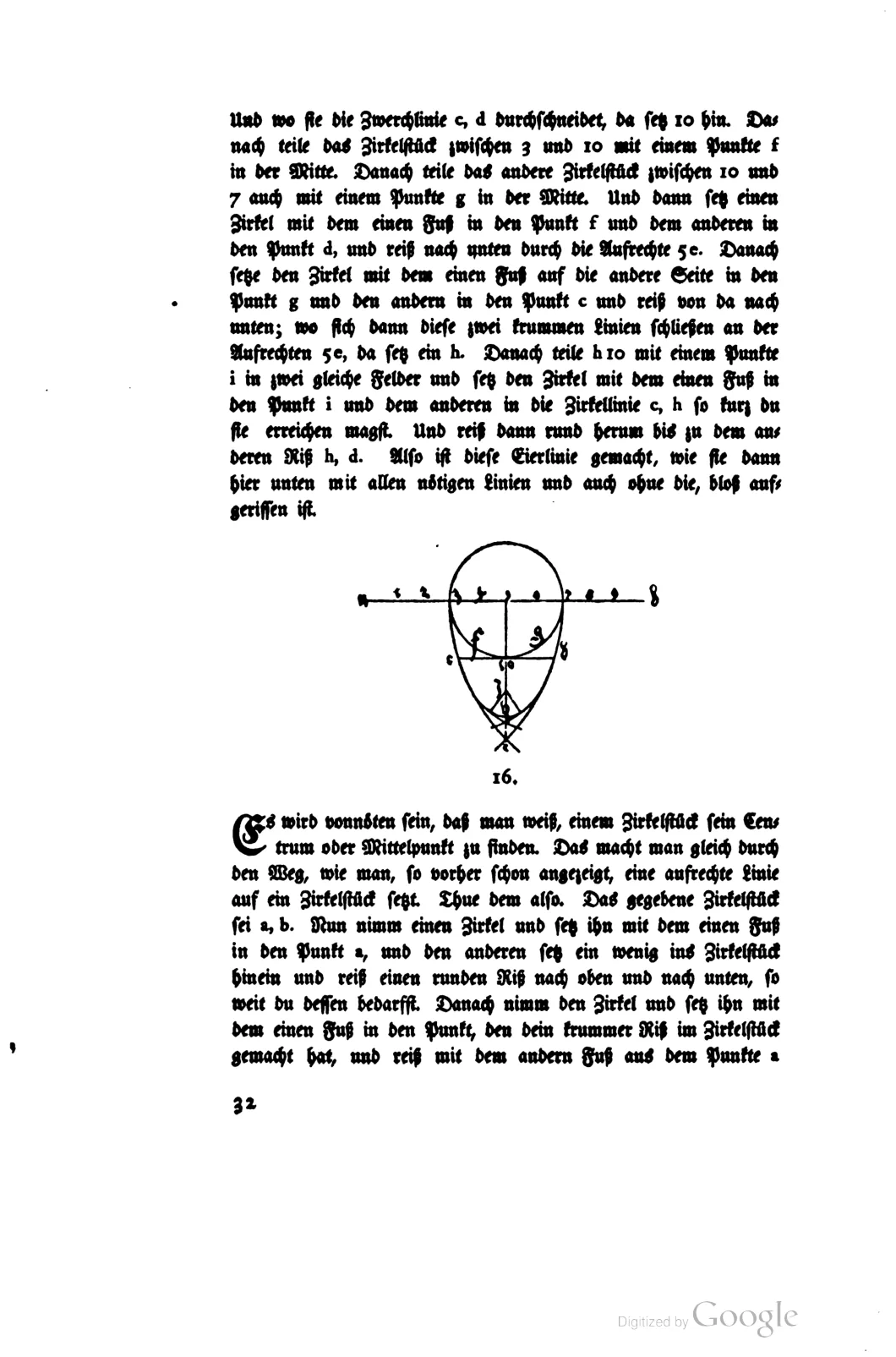
Die erste Sehlinie des Gesichtes, welches zu dem aufgezogenen Grund gestellt ist, ziehe ich in den Punkt des Lichtes o, die andere ziehe ich unten zum Ende von des Lichtes Zirkel. Danach ziehe ich zwei Linien oben in die vier Ecken des Würfels, von denen ja vorn zwei in den Punkt 2, 3 und hinten zwei in a d zusammen fallen. Danach ziehe ich zwei Sehlinien in die zwei Punkte k, i. Weiter ziehe ich zwei Linien auf die zwei Orte der Zwerchlinie, auf welcher der Würfel steht und welche eine Vierung bedeutet, weshalb ihre

Dürer, Underweysung der Messung — leaf 175
Bk IV: the nets & orthographic projection · leaf 175

two ends are marked g f in front, e h behind. Thus the raised ground is rightly drawn from the eye with sight-lines, as it should be. Then, from the lower eye, which is set to the laid-down ground, also draw sight-lines to all the points of the laid-down ground on its plane.

First run sight-lines from the eye-point to the four corners of the plane f, g, h, e. Then to the four corners of the cube's base, which then count as eight corners, wherefore they are marked in front with b a and c 3, behind with d 4 and 2 1. Then draw three more sight-lines to the three corners l, m, n of the cube's shadow. Now all the sight-lines are drawn to both grounds, as many of them as you need.

Now if that which the eye reaches with its sight-lines is to be brought into a picture, one accomplishes this by means of the aforesaid sight-plane, that is, a transparent plan or flat field that cuts through all the sight-lines. This plan you must, in the layout, let be a line. Therefore make this upright parallel line near to the ground, between it and the eye, so that the things appear large, as reported before. And on this line the two eyes must stand at right angles. One could also, where it is needful, lean this line backward or forward. But this line cuts off all the sight-lines. Then from the eye-points draw two cross-lines at equal angles to the upright line of the sight-plane, and at the points where they touch it draw two eyes as well. These four eyes now signify one eye. But this splitting brings ease into the work.

Now once you see the aforedescribed intention before your eyes and understand it, take another sheet of paper and draw on it two cross-lines at right angles. And in the middle, where they intersect, set the eye-point. This stands here in place of the former four eyes. To this eye-point all the heights, lows, depths, and breadths on both sides must be brought and set, which the former sight-lines indicated.

Therefore take two compasses for your measuring, so that no error arise. Use the one for the raised ground, the other for the laid-down one.

Original — Peltzer 1908

beiden Enden vorn g f, hinten e h bezeichnet sind. Also ist der aufrechte Grund aus dem Gesicht mit Sehlinien recht bezogen, wie das sein soll. Danach ziehe aus dem unteren Auge, welches zu dem niedergedrückten Grunde gestellt ist, auch Sehlinien in alle Punkte des niedergedrückten Grundes auf seiner Ebene.

Erstlich fahre aus dem Punkte des Gesichts mit Sehlinien auf die vier Ecken der Ebene f, g, h, e. Danach auf die vier Ecken von des Würfels Grunde, die dann acht Ecken bedeuten, weshalb sie vorne mit b a und c 3, hinten mit d 4 und 2 1 bezeichnet sind. Danach ziehe noch drei Sehlinien auf die drei Ecken l, m, n von des Würfels Schatten. Nun sind alle Sehlinien zu beiden Gründen gezogen, so viel du deren bedarfst.

Soll nun das, was das Gesicht mit seinen Sehlinien erreicht, in ein Gemälde gebracht werden, so bringt man das durch die vorgemeldete Sehebene, das ist ein durchsichtiger Plan oder ebenes Feld, das alle Sehlinien durchschneidet, zu Wege. Diesen Plan mußt du beim Aufreißen eine Linie sein lassen. Darum mache diese aufrechte Parallellinie nahe bei dem Grunde zwischen dem Gesicht, auf daß die Dinge groß scheinen, wie vorher gemeldet. Und auf dieser Linie müssen die zwei Gesichte in rechtwinkliger Richtung stehen. Man könnte auch, wo es vonnöten ist, diese Linie hinter sich oder vor sich lehnen. Diese Linie aber schneidet alle Sehlinien ab. Danach ziehe aus den Gesichtspunkten zwei Zwerchlinien zu gleichen Winkeln in die aufrechte Linie der Sehebene und reiße in die Punkte, da sie anrühren, auch zwei Augen. Diese vier Augen bedeuten nun ein Gesicht. Aber diese Zerspaltung bringt Leichtigkeit in die Arbeit.

So du nun diese vorbeschriebene Meinung vor Augen siehest und sie verstehst, so nimm ein ander Papier und reiße darauf zwei Kreuzlinien zu rechten Winkeln. Und in der Mitte, wo sie sich durcheinanderschließen, da setze den Punkt des Auges hin. Das steht hier anstatt der vorigen vier Augen. Zu diesem Punkte des Auges müssen alle Höhen, Niederen, Tiefen und Breiten auf beiden Seiten gebracht und gesetzt werden, welche die vorigen Sehlinien anzeigten.

Darum nimm zwei Zirkel zu deinem Messen, damit kein Irrtum entstehe. Den einen brauche zu dem aufrechten Grund, den anderen zu dem niedergedrückten.

Dürer, Underweysung der Messung — leaf 176
Bk IV: the nets & orthographic projection · leaf 176

the eye is drawn to the point of the light p. So carry these two points together, with the two compasses, to your subsequent cross-line, in order to see with the first one how high the point o stands above the eye. The other compass then tells you how far the point p stands to the side. These two points come together into a single point. Mark it then with o p. Do likewise with all the sight-lines that cross the transparent line. And take, as reported before, all their heights and lows from the upper eye with the first compass. Do the same with the other compass on the transparent line at the lower eye. Take all the breadths from the crossed sight-line, how far they stand from the eye to the side, and then carry them all to the eye of your cross-line.

Thus the two points that are taken on the transparent line at both eyes — that of the raised and that of the laid-down ground — always fall together into one point, however high, low, or far to one side they are to stand. Mark them then, wherever they fall, with their letters or figures. And where I speak of the transparent line, I always mean the sight-plane that is drawn upright nearest to the grounds.

Then join the points you have made with straight lines; so you see what comes of it. And from these things you learn where all the corners of any thing whatever are to stand, even those that cannot be seen by the eye. This is shown here with hidden (dotted) construction-lines, as I have properly laid it out hereafter beside its cross-line. Opposite, however, I have laid out only that which is seen, and have (rendered) the shadow

Original — Peltzer 1908

Auge in den Punkt des Lichtes p gezogen ist. Also trage diese zwei Punkte mit den zwei Zirkeln zusammen zu deiner nachfolgenden Kreuzlinie, um mit dem ersten zu sehen, wie hoch der Punkt o über dem Auge stehe. So giebt dir der andere Zirkel an, wie weit der Punkt p auf der Seite steht. Diese zwei Punkte kommen in einen einzigen Punkt. Den bezeichne dann mit o p. Also thue desgleichen mit allen Sehlinien, die da die durchsichtige Linie durchstreichen. Und nimm, wie vorher gemeldet, alle ihre Höhen und Niederen von dem oberen Auge mit dem ersten Zirkel. Desgleichen thue mit dem anderen Zirkel auf der durchsichtigen Linie bei dem unteren Auge. Nimm alle Breiten von der durchstrichenen Sehlinie, wie weit sie von dem Auge auf der Seite stehen, und trage die dann alle zu dem Auge deiner Kreuzlinie.

So fallen allweg die zwei Punkte, die auf der durchsichtigen Linie genommen werden bei beiden Augen, des aufgezogenen und des niedergedrückten Grundes, in einen Punkt, wie hoch, niedrig oder weit sie auf einer Seite stehen sollen. Bezeichne die dann allweg, wo sie hin fallen, mit ihren Buchstaben oder Ziffern. Und wo ich von der durchsichtigen Linie rede, da verstehe ich alleweg die Sehebene, die zunächst bei den Gründen aufrecht gezogen ist.

Danach ziehe die gemachten Punkte mit gestreckten Linien zusammen; so siehst du, was daraus wird. Und aus diesen Dingen erfährst du, wo alle Ecken eines jeglichen Dinges stehen sollen, auch die, welche da von dem Auge nicht gesehen werden können. Das ist hier mit Blindrissen angezeigt; wie ich das hernach bei seiner Kreuzlinie eigentlich aufgerissen habe. Gegenüber aber habe ich solches aufgerissen, was allein gesehen wird, und habe den Schatten

Dürer, Underweysung der Messung — leaf 177
Full-page woodcut: the two-eye perspective construction transferred to the single cross-line — the foreshortened cube on its squared plane, with hidden construction-lines and the cast shadow. Raw page is empty. · leaf 177
Dürer, Underweysung der Messung — leaf 178
Full-page woodcut: the finished foreshortened cube with its cast shadow on the squared field. Raw page holds only stray woodcut-label noise. · leaf 178
Dürer, Underweysung der Messung — leaf 179
Full-page woodcut (continuation of the perspective-construction plates). Raw page is empty. · leaf 179
Dürer, Underweysung der Messung — leaf 180
Full-page woodcut (perspective-construction plate). Raw page contains only the 'Digitized by Google' watermark. · leaf 180
Dürer, Underweysung der Messung — leaf 181
Bk IV: the nets & orthographic projection · leaf 181

indicated a little with the hatching, for you to follow. This is the true foundation of the foreshortening of whatever belongs to painting.

31.

Hereafter I will bring the aforedescribed thing, foreshortened, into the picture by another and nearer way. By such a way. — I lay crosswise a line, of the length of the

Original — Peltzer 1908

ein wenig mit der Schraffierung angezeigt, dich danach zu richten. Dies ist der rechte Grund des Abstehlens dessen, was zu der Malerei gehört.

31.

Hernach will ich durch einen anderen und näheren Weg das vorbeschriebene Ding abgestohlen in das Gemälde bringen. Durch einen solchen Weg. — Ich lege überzwerch eine Linie in der Länge der

Dürer, Underweysung der Messung — leaf 182
Bk IV: the nets & orthographic projection · leaf 182

... draw an upright line a a, b b that touches the front corner. Where then this upright line cuts off the long sight-line drawn from the lower eye into the acute angle, there set the point c c. From this point c c draw a transverse parallel line through the two sight-lines that are drawn from the near eye to the two lower places of the cross-line of the square. Where the sight-lines are then cut through, there they make two corners. Thus this squared plane is rightly foreshortened, just like the one just made. Therefore mark its four corners too with the four letters e, f, g, h, as was done before in the first one. This I have laid out hereafter, before I go further.

Now once this squared plan is finished in foreshortening, then set the cube upon it in its place, in the same way as it stands here in front on its foreshortened plan. To do this, proceed thus. Take the length of one side of the cube in the front laid-down ground, and set it with two points x, y on the lower cross-line f, g of your present foreshortened square — and indeed as far from the corner f as it is removed, in the front laid-down ground, from the side e, f of the squared plan. Then draw two sight-lines from the eye into the two points x, y. Between these two lines the cube, with its lower square, must be set toward the back upon this plan. But how far back, seek out thus. If in the front laid-down ground you draw a baseline e, g, then this baseline becomes at the same time a baseline in the laid-down ground of the

Original — Peltzer 1908

... reiße eine aufrechte Linie a a, b b, die das vordere Eck anrührt. Wo dann diese aufrechte Linie die lange Sehlinie, die aus dem unteren Auge in den spitzigen Winkel gezogen ist, abschneidet, da setze [den] Punkt c c. Aus diesem Punkte c c ziehe eine zwerche Parallellinie durch die zwei Sehlinien, die da aus dem nahen Auge auf die zwei unteren Orte der Zwerchlinie der Vierung gezogen sind. Wo dann die Sehlinien durchschnitten werden, da machen sie zwei Ecken. Also ist diese gevierte Ebene recht abgestohlen, gleich wie die soeben gemachte. Darum bezeichne auch ihre vier Ecken mit den vier Buchstaben e, f, g, h, wie vorhin im ersten gethan ist. Dies habe ich hiernach, ehe ich weiter gehe, also aufgerissen.

So nun dieser gevierte Plan abgestohlen fertig ist, alsdann stelle darauf den Würfel an seine Stelle gleicher Weise, wie er dann hier vorn auf seinem abgestohlenen Plan steht. Das zu machen finde also. Nimm die Länge von einer Seite des Würfels im vorderen niedergedrückten Grund und setze die mit zwei Punkten x, y auf die untere Zwerchlinie f, g deiner jetzigen abgestohlenen Vierung, und zwar so weit von dem Eck f als sie im vorderen niedergedrückten Grund von der Seite e, f des gevierten Planes entfernt ist. Danach ziehe zwei Sehlinien aus dem Auge in die zwei Punkte x, y. Zwischen diese zwei Linien muß der Würfel mit seiner unteren Vierung hinten auf diesen Plan gestellt werden. Aber wie weit nach rückwärts, das suche also. So du in dem vorderen niedergedrückten Grunde einen Ortstrich e, g reißest, so wird dieser Ortstrich auch zugleich ein Ortstrich im niedergedrückten Grund des

Dürer, Underweysung der Messung — leaf 183
Full-page woodcut: the 'nearer way' foreshortening — the squared plan abbreviated to a single eye and the cube set upon it. Raw page is empty. · leaf 183
Dürer, Underweysung der Messung — leaf 184
Bk IV: perspective & the casting of shadows · leaf 184

... and is made, then set the light and make the shadow of the cube upon its plan. But to find this, do thus. Set the light up high above the eye, on whichever side you please. Let this light be o. But I set it directly at the place [...]

Now that the cube stands foreshortened on its squared field,

Original — Peltzer 1908

... und gemacht ist, alsdann stelle das Licht und mache den Schatten von dem Würfel auf seinen Plan. Aber das zu finden thue also. Stelle das Licht über dem Auge in die Höhe, auf welche Seite du willst. Dieses Licht sei o. Aber ich stelle es gleich an die Stelle [...]

So nun der Würfel abgestohlen auf seinem gevierten Felde steht

Dürer, Underweysung der Messung — leaf 185
Full-page woodcut: the foreshortened cube with its cast shadow, light-point o set above the eye. Raw page contains only a stray figure-label ('7'). · leaf 185
Dürer, Underweysung der Messung — leaf 186
Bk IV: perspective & the casting of shadows · leaf 186

from the point o a [line downward; ... then] a point p is to be set, by which the lower light is understood. Now if I wish to displace the light, I set the point o higher on the line drawn down from o. But if I wish to have the light nearer, I move the point p farther down. Here, however, I will set it roughly at the distance at which it stood before.

Now once these two light-points o and p are made, then draw straight rays from the light o through the upper three corners of the cube, 2, 3 and 4, and let the rays run downward. Then again draw straight lines from the point p through the lower three corners of the cube, b, c, d. Where these three rays then cut the upper three rays of the light o, there set three points l, m, n. Then join together with straight lines d, l and l, m and m, n and n, d. Thus the shadow of the cube is rightly made in its foreshortening, as described before.

And so that this may be seen clearly, I have laid out the whole thing with its appurtenances. In it you will also find the previous one. I have also, after that, laid out and hatched separately by itself only what is to remain in the picture, so that it may be the better understood.

35.

Original — Peltzer 1908

aus dem Punkte o eine [Linie herab; ... so] gehört ein Punkt zu setzen p, wobei das untere Licht verstanden werde. Will ich nun das Licht versetzen, so setze ich den Punkt o auf der Linie, die vom o herabgezogen ist, desto höher. So ich aber das Licht näher haben will, so rücke ich den Punkt p desto ferner herab. Aber hier will ich es ungefähr in der Weite setzen, wie es vorhin stand.
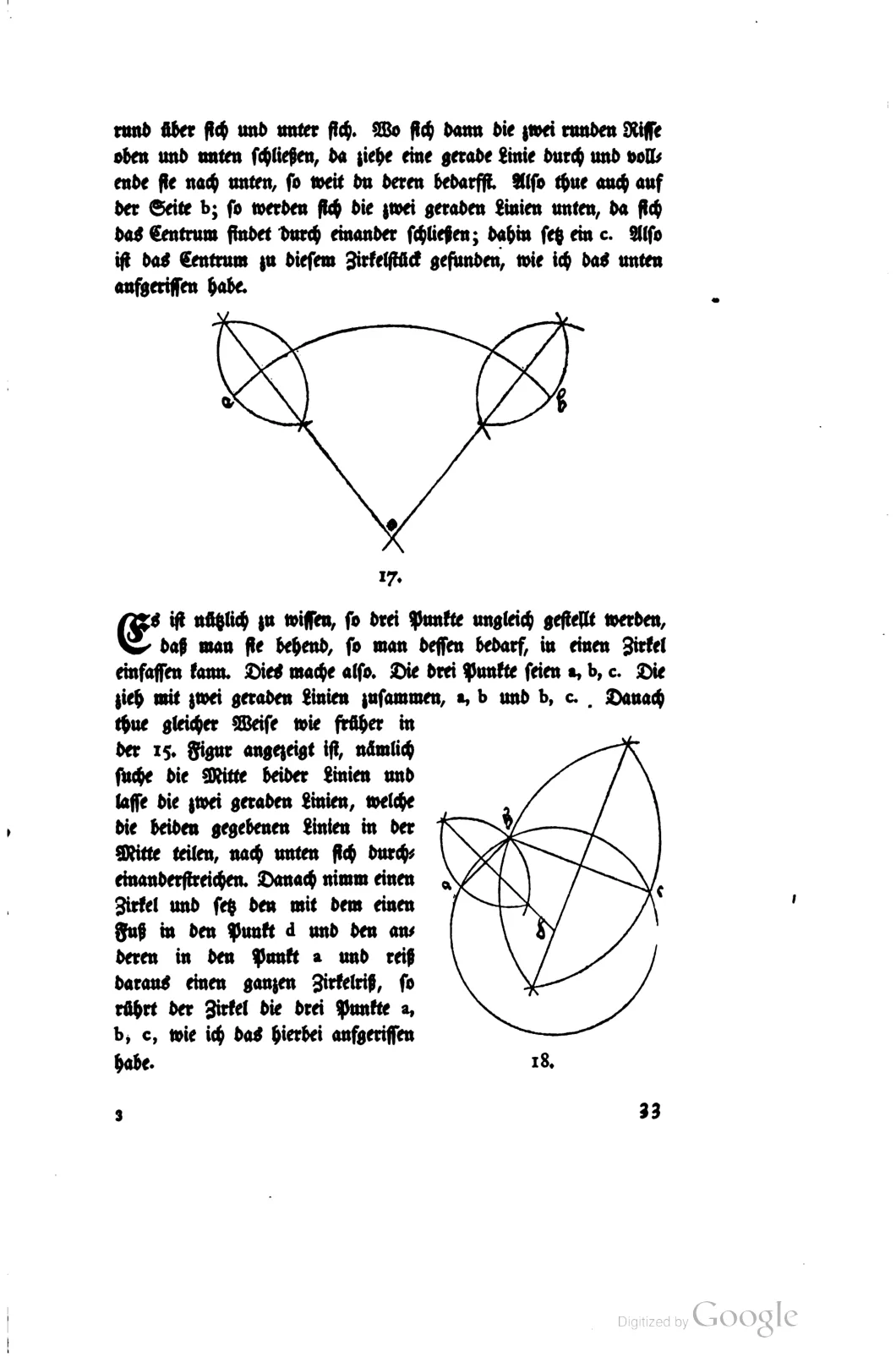
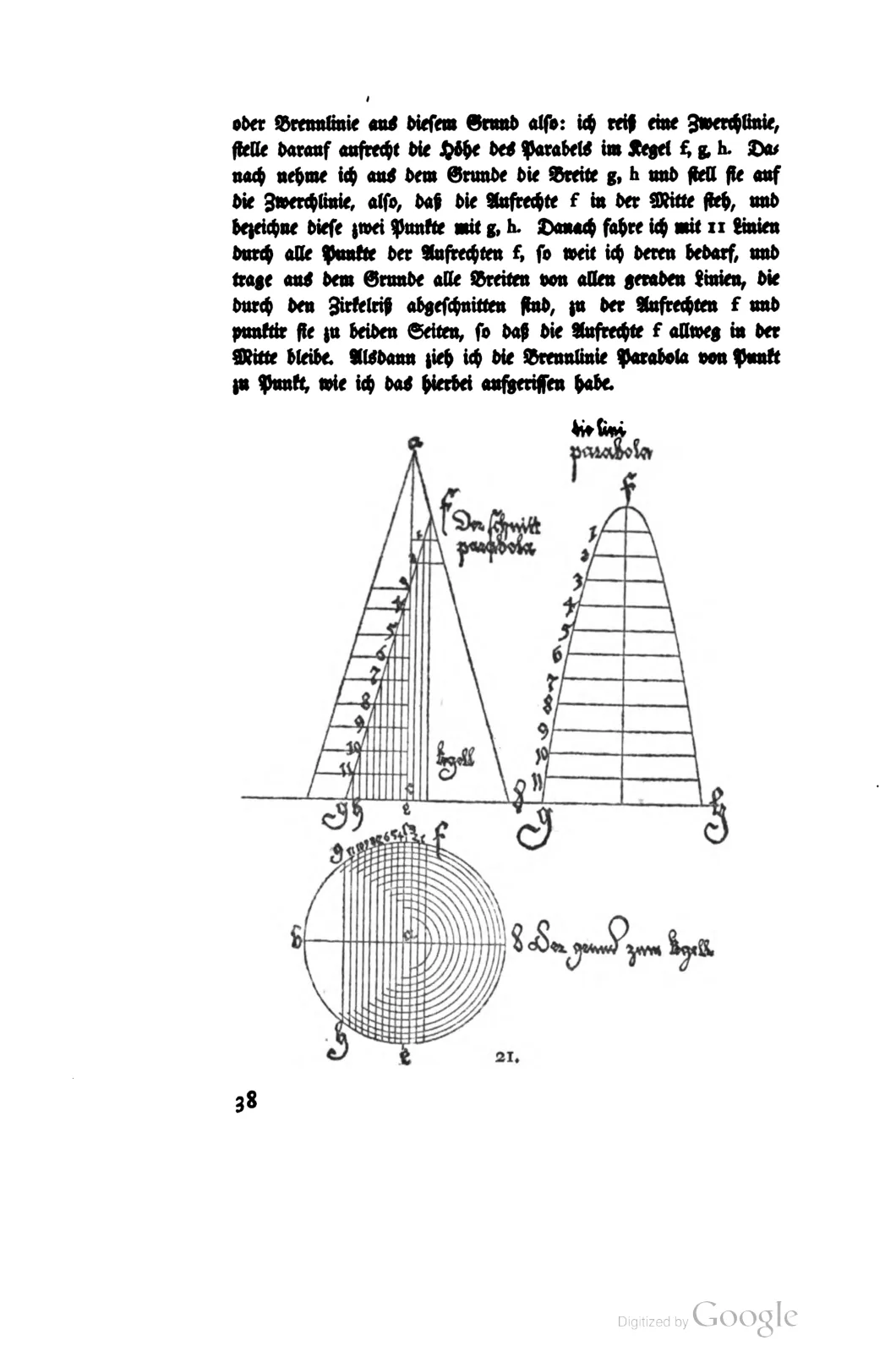
So nun diese zwei Punkte des Lichtes o und p gemacht sind, alsdann ziehe gerade Strahlenlinien aus dem Lichte o durch die oberen drei Ecken des Würfels 2, 3 und 4, und lasse die Strahlen abwärts streichen. Danach reiße abermals gerade Linien aus dem Punkte p durch die unteren drei Ecken des Würfels b, c, d. Wo dann diese drei Strahlenlinien die oberen drei Strahlenlinien des Lichtes o abschneiden, da setze drei Punkte l, m, n hin. Danach ziehe mit geraden Linien d, l und l, m und m, n und n, d zusammen. Also ist der Schatten des Würfels recht gemacht in seinem Abstehlen, wie vorher beschrieben.

Und damit das klar gesehen werde, habe ich das ganze Ding mit seinem Zubehör aufgerissen. Darin wirst du auch das vorige finden. Habe auch danach besonders das, was zum Gemälde bleiben soll, allein aufgerissen und schraffiert, damit das desto besser zu verstehen sei.
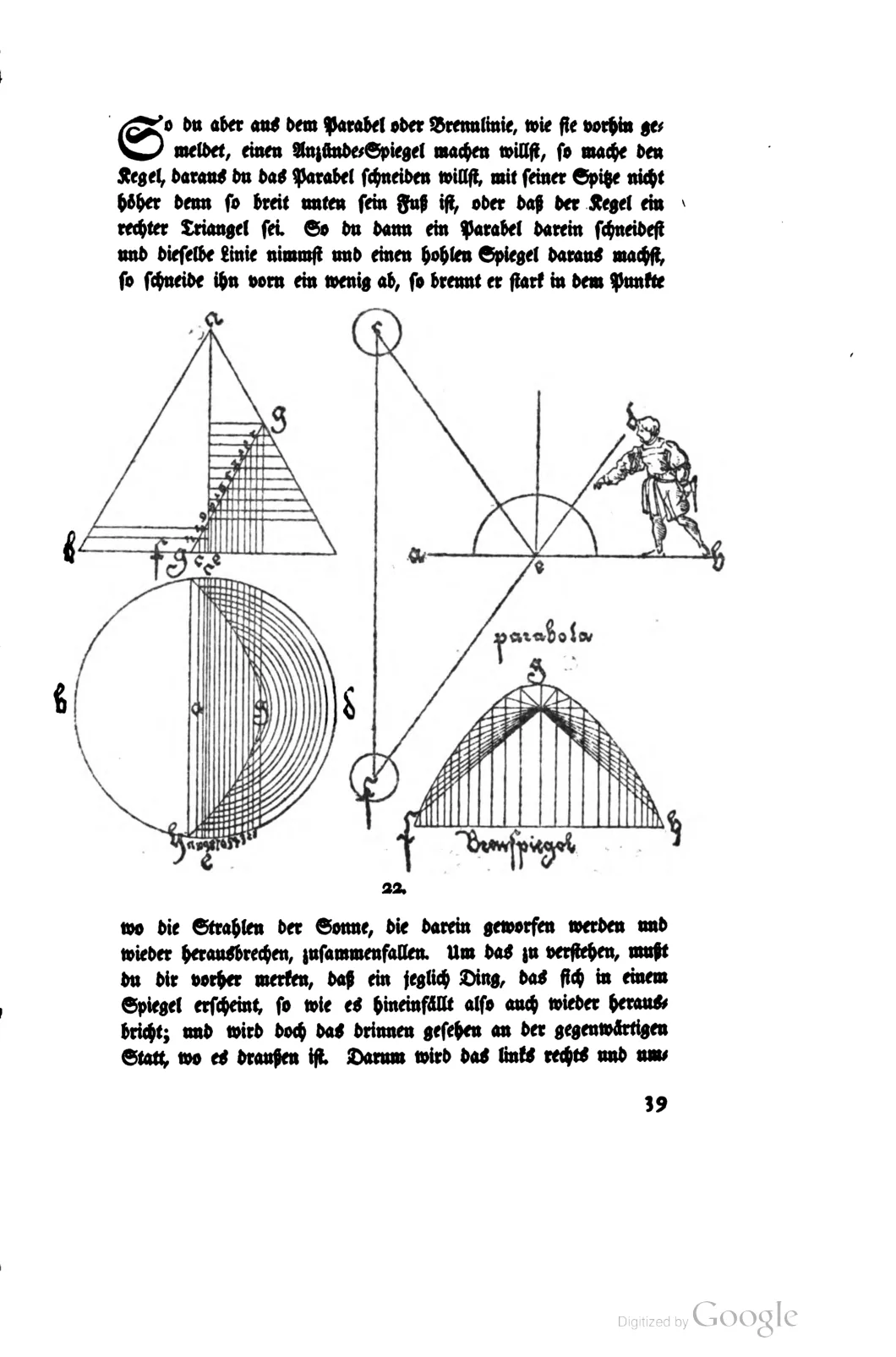
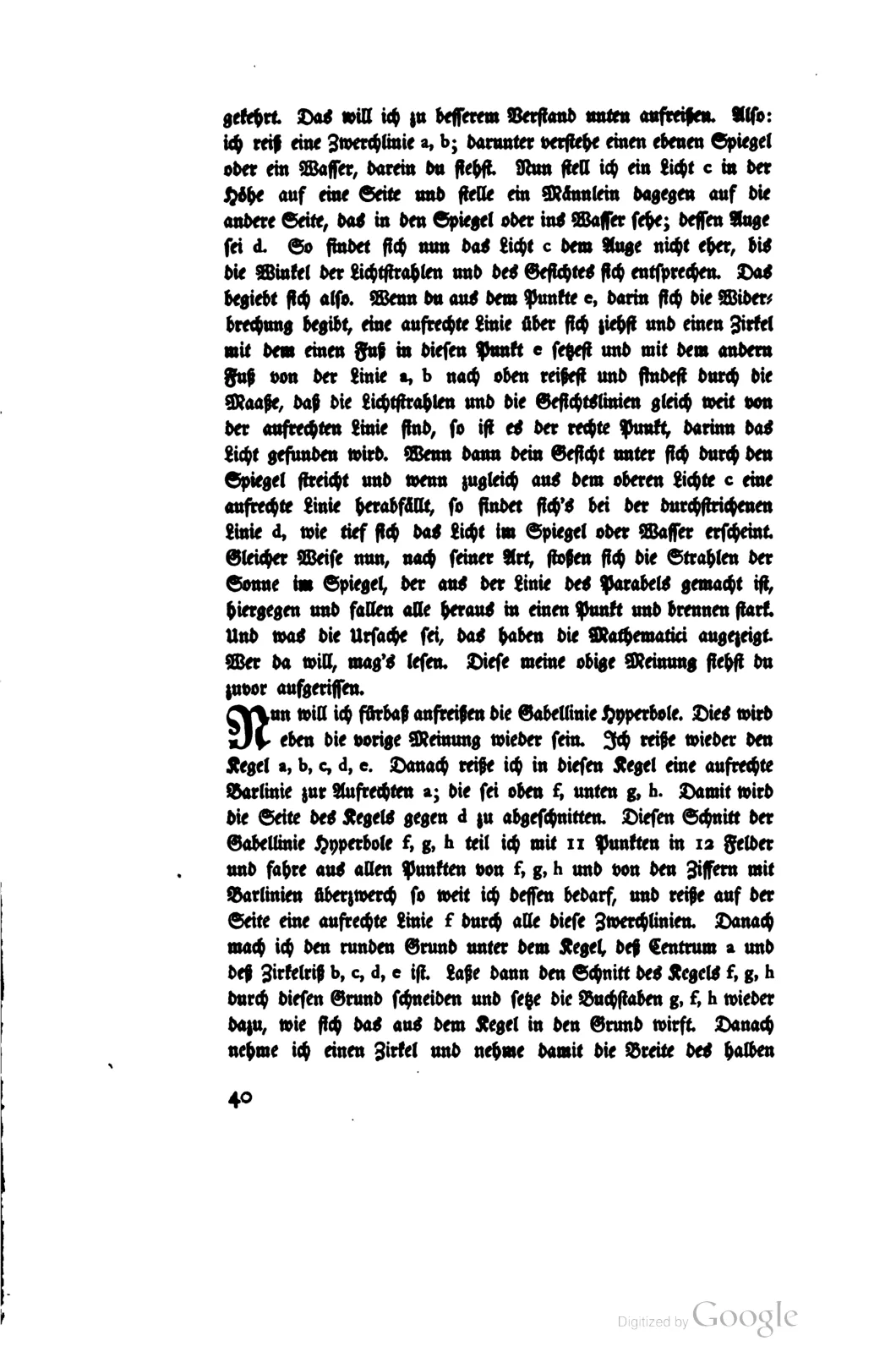
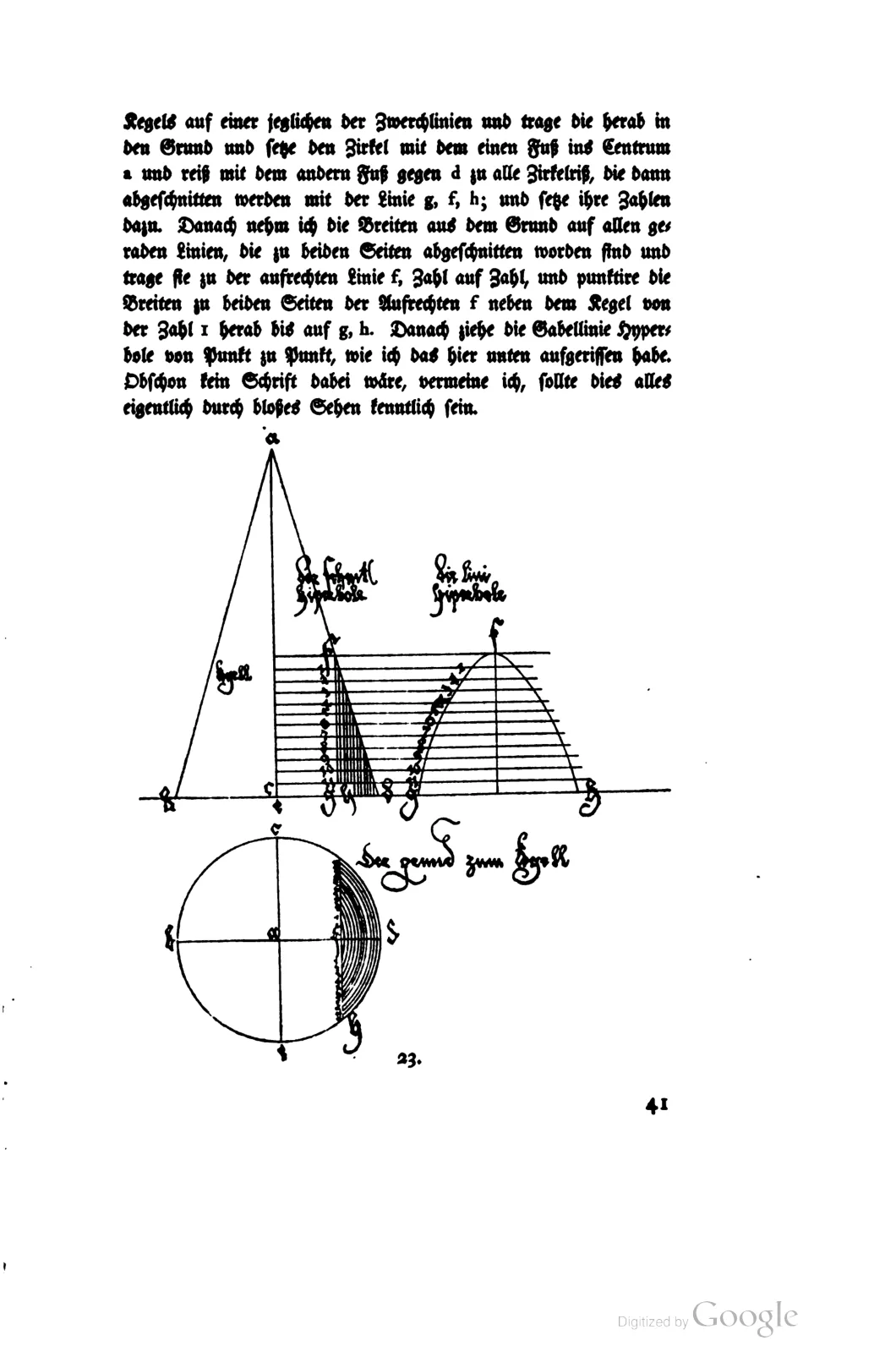
35.

Dürer, Underweysung der Messung — leaf 187
Bk IV: perspective & the casting of shadows · leaf 187

In the same way as I have brought the cube into a foreshortened picture, so may one bring into a picture, by such a way, all solids that one can lay down on the ground and raise up.

Hereafter, however, I will teach how one can measure any thing whatever that one sees and that does not stand very far off, by means of three threads, and thereby bring it into a picture.

First, though, I will teach yet another thing, namely how one can trace through that which one sees.

If you wish to trace through what you see before you, equip yourself for it with an apt device. Namely thus. Fit a clean flat glass into a squared frame. Then make a board as wide as the frame is, but longer. Mount the glass frame with two hinges, and nail both hinges, on the other side of the joints, to the inside of the board, so that the frame and the board can be opened and closed upon it like a folding gameboard, so that one may lay the glass down onto the board whenever one wishes. Then fix, on both sides, at the middle of the board, two little blocks with little iron rods that can be jointed; and make them so long that they reach the frame of the glass when you lift it up from the board at a right angle. And in front make the little rods flat, with a hole through them; and set a little hook behind, which turns about. Then fix into the glass frame, on both sides, where the flat ends of the rods reach, two little blocks. When you then lay the rods against them and put the little hooks before them, the frame stands firm. Then make a squared piece of wood, over-long — longer than the board is wide. Cut it out on one side, as wide as the board is, and so that the squared wood extends fully out over the board on both sides. And clamp this wood crosswise onto the board, so that one can slide it back and forth toward the glass and against it. This four-cornered wood, which lies on the board, hollow out along its length, four-square, in the middle above — but not entirely to its ends. Through the two ends, however, bore two round holes;

Original — Peltzer 1908

Zu gleicher Weise, wie ich den Cubus in ein abgestohlenes Gemälde gebracht habe, also mag man alle Körper, die man in den Grund legen und aufziehen kann, auf solchem Wege in ein Gemälde bringen.
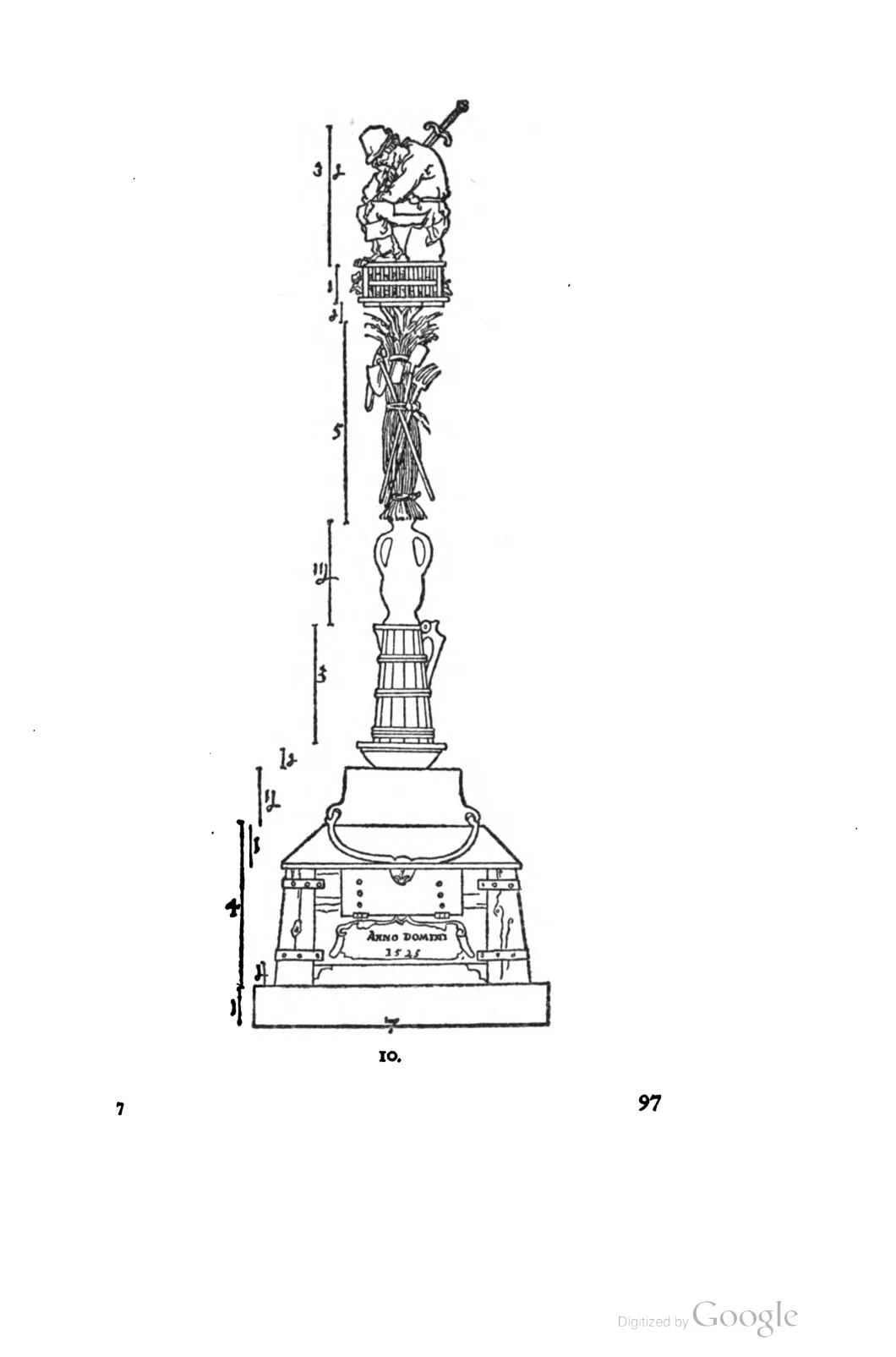
Hernach aber will ich unterweisen, wie man ein jedes Ding, das man sieht und das nicht sehr weit steht, durch drei Fäden messen und dadurch in ein Gemälde bringen kann.
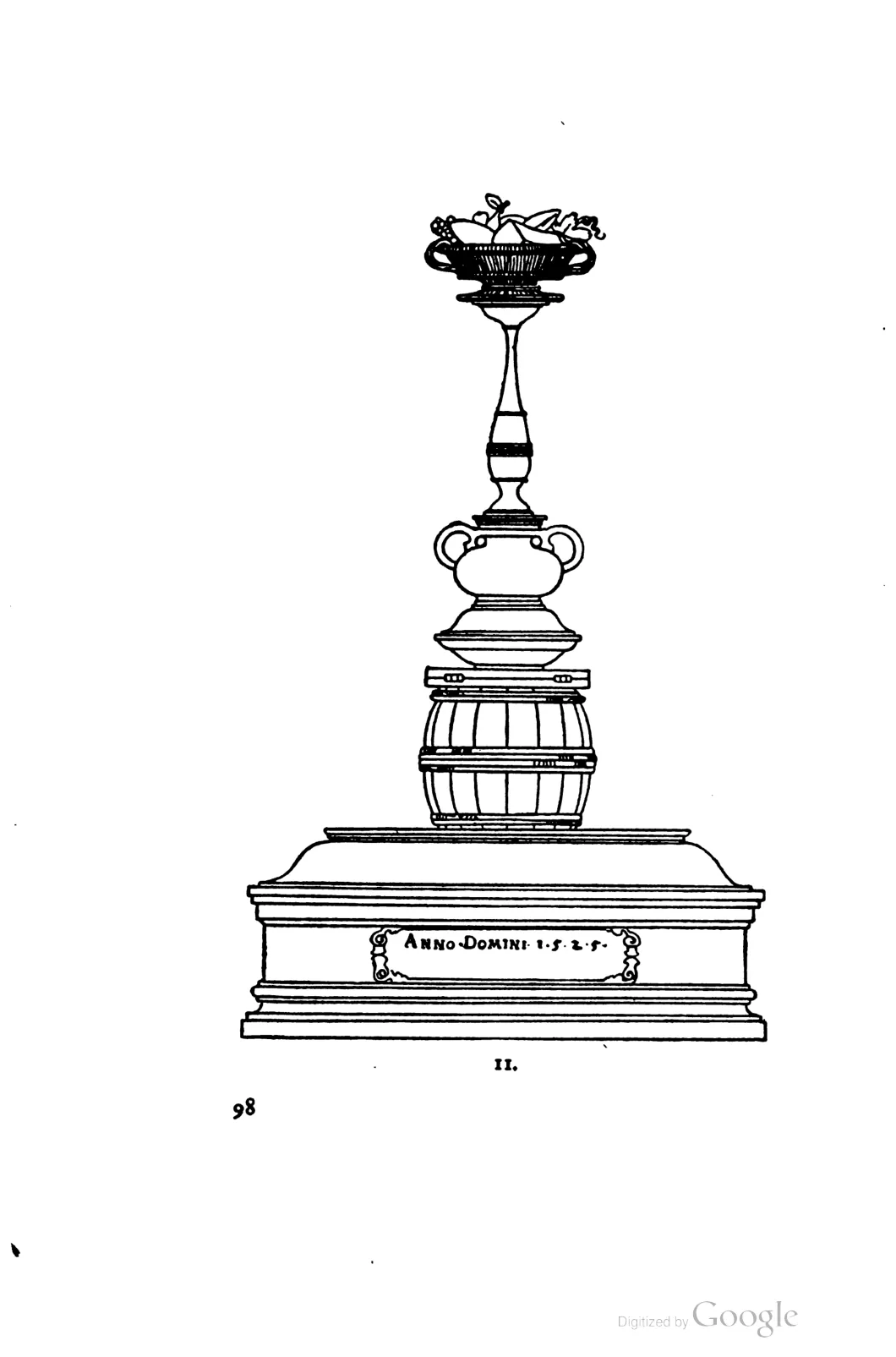
Zuerst will ich noch ein Anderes lehren, nämlich wie man durchzeichnen kann das, was man sieht.
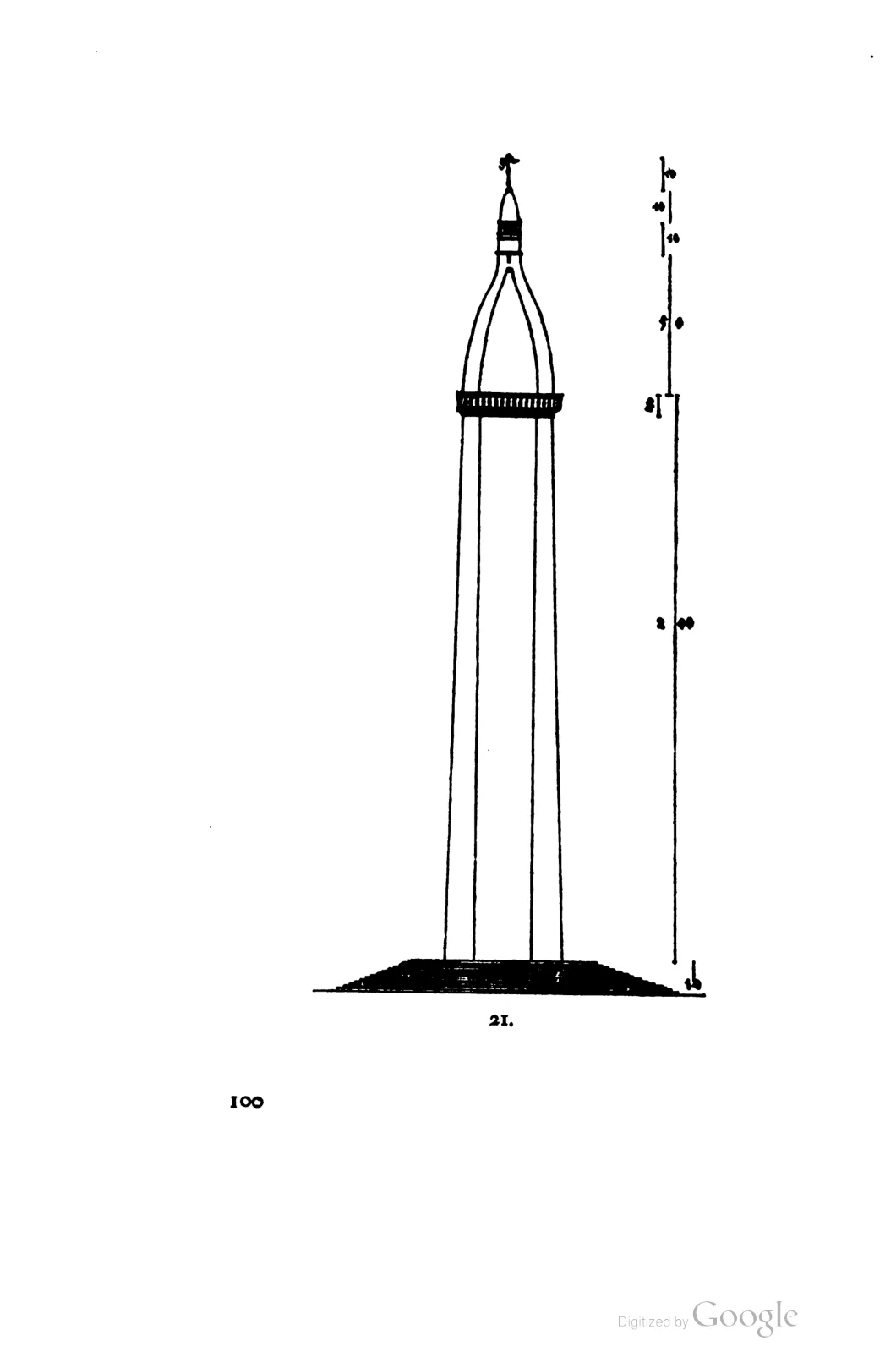
Willst du durchzeichnen, was du vor dir siehst, so rüste dazu ein geschicktes Zeug. Nämlich also. Faße ein reines flaches Glas in einen gevierten Rahmen. Danach mache ein Brett so breit als der Rahmen ist, aber länger. Beschlage den Glasrahmen mit zwei Banden und nagle beide Banden auf der anderen Seite der Gelenke innen an das Brett, also daß der Rahmen und das Brett daran auf und zu gethan mögen werden wie ein Brettspiel, auf daß man das Glas auf das Brett, so man will, niederlegen möge. Danach schlage auf beiden Seiten mitten an das Brett zwei Klöblein mit eisernen Stänglein, die sich gelenken lassen; und mache die so lange, daß sie den Rahmen des Glases erreichen, so du denselben von dem Brett im rechten Winkel aufhebst. Und mache vorne die Stänglein flach und ein Loch dadurch; und schlage ein Häflein dahinter, welches sich herumdreht. Danach schlage in den Glasrahmen zu beiden Seiten, wo die Flächen der Stänglein hinreichen, zwei Klöblein. So du dann die Stänglein daran legst und die Häcklein vorthust, so steht der Rahmen fest. Danach mache ein geviertes überlanges Holz, länger denn das Brett breit ist. Das nimm auf einer Seite heraus, so breit das Brett ist und so, daß das gevierte Holz zu beiden Seiten vollständig über das Brett hinausgehe. Und zwinge dieses Holz also zwerchs auf das Brett, auf daß man es hin und wieder gegen das Glas und daran schieben könne. Dieses viereckige Holz, welches auf dem Brett liegt, nimm in der Mitte oben der Länge nach viereckig hohl aus, aber nicht ganz bis an seine Enden. Durch die zwei Enden aber bohre zwei runde Löcher;

Dürer, Underweysung der Messung — leaf 188
Full-page woodcut: the hinged glass-pane drawing instrument (the durchzeichnen frame) standing on its board, with the sighting-rod and grid. Raw page p188.txt holds only OCR garble picked up from the woodcut — no body prose. (Manifest marks this 'text', but the raw is pure figure-noise.) · leaf 188
Dürer, Underweysung der Messung — leaf 189
Bk IV: perspective & the casting of shadows · leaf 189

and then you stick the turned rod into it, which has iron pins below, so that everything fits rightly together — you may aptly use this as a table for this device. All of this can be taken apart, so that it is easy to carry and to handle. This I have laid out hereafter.

Another method.

By three threads you may bring any thing whatever that you can reach with them into a picture, to be recorded on a panel. Do it thus.

If you are in a hall, drive a great needle with a wide eye, made for the purpose, into a wall, before [the place of] an eye. Draw a strong thread through it and hang a lead weight on it below. Then set a table or a panel as far from the needle's eye, in which the thread is, as you please. Upon it set an

Original — Peltzer 1908

und dann den gedrehten Stab darein steckst, der unten eiserne Stifte habe, damit alles recht sich ineinander füge, — magst du das zu diesem Ding füglich als einen Tisch brauchen. Dies alles mag zerlegt werden, auf daß es leichtlich zu tragen und damit zu hantieren sei. Solches habe ich hernach aufgerissen.

Eine andere Meinung.

Durch drei Fäden magst du ein jedes Ding, das du damit erreichen kannst, in ein Gemälde bringen, auf eine Tafel zu verzeichnen. Dem thue also.

Bist du in einem Saal, so schlage eine große Nadel mit einem weiten Ohr, die dazu gemacht ist, in eine Wand, vor ein Auge. Ziehe dadurch einen starken Faden und hänge unten ein Bleigewicht daran. Danach setze einen Tisch oder eine Tafel so weit von dem Nadelöhr, darin der Faden ist, als du willst. Darauf stelle einen

Dürer, Underweysung der Messung — leaf 190
Bk IV: the draughtsman's machines · leaf 190

upright frame, crosswise to the needle's eye, high or on whichever side you please. Let the frame have a little door [that can be opened and shut]. Let this little door be your panel, on which you mean to paint. Then nail two threads, as long as the upright frame is long and wide, at the top and middle of the frame, and the other also at the middle of one side of the frame, and let them hang. Then make a long iron pin that has, foremost at its tip, a needle's eye. Through it thread the long thread that [is drawn] through the needle's eye on the wall.

Now use it thus. Lay a lute, or whatever else you please, as far from the frame as you wish, only that it stay unmoved as long as you have need of it. Let your companions

Original — Peltzer 1908

aufrechten Rahmen, zwerchs gegen das Nadelöhr, hoch oder auf welche Seite du willst. Der Rahmen habe ein Thürlein, [das man auf und zu thun] kann. Dieses Thürlein sei deine Tafel, darauf du malen willst. Danach nagele zwei Fäden, die ebenso lang sind als der aufrechte Rahmen lang und breit ist, oben und mitten in den Rahmen, und den anderen auf einer Seite auch mitten in den Rahmen, und lasse sie hängen. Danach mache einen eisernen langen Stift, der zuvorderst an der Spitze ein Nadelöhr habe. Darein fädele den langen Faden, der durch das Nadelöhr an der Wand [gezogen ist].

Nun gebrauche dies also. Lege eine Laute oder was dir sonst gefällt, so fern von dem Rahmen als du willst, nur daß sie unverrückt bleibe, so lange du ihrer bedarfst. Lasse deine Gesellen die

Dürer, Underweysung der Messung — leaf 191
Peltzer's afterword (Nachwort) · leaf 191

...stretch the needle with the thread out to the most necessary points of the lute. And as often as he stops at one point and stretches the long thread, then always set the two threads on the frame, stretched crosswise, against the long thread; fasten them on both sides to the frame with wax, and tell your assistant to let go of his long thread. Then close the little door and mark on the panel that same point where the threads cross one over the other. Then open the little door again, and do the same once more with another point, until you have plotted the whole lute onto the panel. Then join with lines all the points that have come from the lute onto the panel, and you will see what results. In this same way you may copy other things too. I have laid this idea out below.

And with that, gracious dear sir, I will bring my writing to an end; and if God grants me grace to bring into print in time the books I have written on human proportion and the other matters belonging to it, I will have hereby warned everyone that, should anyone presume to reprint this little book I have published, I will print it myself again and let it go forth with more and greater additions than has now been done. Let each man govern himself accordingly.

To God the Lord be praise and honor everlastingly.

Printed at Nuremberg in the year 1525.

Original — Peltzer 1908

Nadel mit dem Faden hinausstrecken auf die nötigsten Punkte der Laute. Und so oft er an einem still hält und den langen Faden streckt, so schlage allweg die zwei Fäden am Rahmen kreuzweis gestreckt an den langen Faden, klebe sie an beiden Seiten mit Wachs an den Rahmen und heiße deinen Gesellen seinen langen Faden nachlassen. Danach schlage das Thürlein zu und zeichne denselben Punkt, wo die Fäden kreuzweise übereinander gehen, auf die Tafel. Danach thue das Thürlein wieder auf und thue mit einem anderen Punkte abermals so, bis daß du die ganze Laute gar an die Tafel punctirst. Dann ziehe alle Punkte, die von der Laute auf der Tafel geworden sind, mit Linien zusammen, so siehst du, was daraus wird. Also magst du andere Dinge auch abzeichnen. Diese Meinung habe ich hernach aufgerissen.

Und damit, günstiger lieber Herr, will ich meinem Schreiben ein Ende geben, und so mir Gott Gnade verleih, die Bücher, so ich von menschlicher Proportion und anderem dazugehörigem geschrieben habe, mit der Zeit in Druck bringen, und dabei männiglich gewarnt haben, ob sich jemand unterstehen würde, mir dieses herausgegebene Büchlein wieder nachzudrucken, daß ich das selbst auch wieder drucken will und auslassen gehen mit mehrerem und größerem Zusatz, denn jetzt geschehen ist. Darnach mag sich ein Jeder richten.

Gott dem Herrn sei Lob und Ehre ewiglich.

Gedruckt zu Nürnberg im 1525. Jahr.

Dürer, Underweysung der Messung — leaf 192
Figure / blank leaf (no body prose); near-empty raw file. · leaf 192
Dürer, Underweysung der Messung — leaf 193
Peltzer's afterword (Nachwort) · leaf 193

Afterword by the Editor.

The credit for having prompted this new edition of a book by Albrecht Dürer belongs to Hans Thoma. He gave the impulse; it was his wish and his will. By it he has had a memorial stone set up again to that lofty forebear of German art, a stone that had lain aside, almost unregarded. The great living artist professes, in proud and noble reverence, his allegiance to the genius of an earlier age. May the present book be regarded as a gift from both.

In what spirit the master who works among us acknowledges these old rules and commends them to use, he has made known to us in his preface. Let the editor be permitted, in closing, to give an account of his own work and to add a few reflections and art-historical accompanying words.

The present edition reproduces the original in its first edition, though with certain abridgments which it was thought desirable and possible to make without impairing its practical value or its interest for us moderns. For the sake of a more immediate intelligibility, the text has been brought closer to our present-day language, but with all possible care to spare Dürer's manner of expression. To do full justice to the merit of this brilliant painter as a writer, one must bear in mind that there did not yet exist any scholarly mathematical literature in the German language in his time. In many cases, therefore, he had first to coin new expressions himself for particular concepts, thoughts, and notions. Not altogether unjustly has he therefore been ranked, in this respect too, beside his contemporary Luther: namely as one of our German shapers of language, even if in a more limited field. Whoever wishes to appreciate the work in this regard will of course always have to turn to the original. This rendering makes no claim to philological value.

In some cases Dürer's own terms have been retained. In others the editor thought it well, here and there, to [substitute] the more recent mathematical [terms] familiar to us all from our schooling...

Original — Peltzer 1908

Nachwort des Herausgebers.

Das Verdienst, diese Neuausgabe eines Buches von Albrecht Dürer veranlaßt zu haben, gebührt Hans Thoma. Er gab die Anregung; es war sein Wunsch und Wille. Dem hohen Vorfahren in der deutschen Kunst hat er damit einen Denkstein wieder aufrichten lassen, der fast unbeachtet beiseite gelegen hat. Der große lebende Künstler bekennt sich in stolzer, edler Verehrung zu dem Genius der Vorzeit. Als ein Geschenk beider möge das vorliegende Buch betrachtet werden.

Mit welchem Sinne der unter uns schaffende Meister diese alten Regeln anerkennt und zur Benutzung empfiehlt, hat er uns in seiner Vorrede kundgetan. Dem Herausgeber sei es zum Schluß gestattet, Rechenschaft über seine Arbeit abzulegen und einige Betrachtungen und kunsthistorische Begleitworte hinzuzufügen.

Die vorliegende Ausgabe gibt das Original in seiner ersten Ausgabe, jedoch mit einigen Kürzungen wieder, die zu machen für wünschenswert und möglich erachtet wurden, ohne den praktischen Wert und das Interesse für uns Neuere zu beeinträchtigen. Zugunsten einer unmittelbareren Verständlichkeit wurde der Text unserer heutigen Sprache angenähert, aber mit möglichster Schonung der Dürerschen Ausdrucksweise. Um das Verdienst des genialen Malers als Schriftsteller recht zu würdigen, gilt es zu bedenken, daß es eine wissenschaftliche mathematische Literatur in deutscher Sprache zu seiner Zeit noch nicht gab. Er mußte sich also in vielen Fällen für bestimmte Begriffe, Gedanken und Vorstellungen neuen Ausdruck erst selbst prägen. Nicht ganz mit Unrecht hat man ihn deshalb schon in diesem Betracht seinem Zeitgenossen Luther an die Seite gestellt: als einen unserer deutschen Sprachbildner nämlich, wenn auch auf beschränkterem Gebiete. Wer das Werk in dieser Beziehung würdigen will, wird natürlich immer zum Original greifen müssen. Diese Übertragung erhebt keinen Anspruch auf philologischen Wert.

In einigen Fällen sind die Dürerschen Bezeichnungen beibehalten worden. In anderen glaubte der Herausgeber hie und da die uns allen vom Schulunterricht her geläufigeren neueren mathematischen

Dürer, Underweysung der Messung — leaf 194
Peltzer's afterword (Nachwort) · leaf 194

[in order] to make [the book] a counselor and reference work for the cases that arise, the editor has added a table of contents arranged by its most important teachings and propositions, which the original edition lacks. Dürer himself doubtless wished that a careful reading of the whole work should be regarded as a necessary course of instruction for every artist. He made a gift of it to his countrymen and to his fellow artists in particular, as of something entirely new. To the modern reader much of it will seem already familiar from elementary schooling. The many practical instructions, however, for making certain things quickly and surely, given by a master and a proven practitioner, should be welcome to all who create, who regard drawing and form as the foundation of their art.

Should mathematicians be of the opinion that much of what Dürer offers could be done "better" by them nowadays, let it be answered that the painter did not write the book for them, and that a master living today—as our preface by Hans Thoma testifies, and as is to be expressly emphasized here once more—places its usefulness to artists beyond all question. Moreover, Dürer was well aware of the difference between the requirements of artistic practice and those of scientific

Original — Peltzer 1908

Ratgeber und Nachschlagebuch in vorkommenden Fällen zu machen, hat der Herausgeber ein Verzeichnis des Inhaltes nach seinen wichtigsten Lehren und Sätzen hinzugefügt, dessen die Originalausgabe ermangelt. Dürer selbst hat ohne Zweifel gewünscht, daß die sorgfältige Lektüre des ganzen Werkes als ein notwendiger Lehrkursus für jeden Künstler angesehen werde. Er beschenkte seine Landsleute und seine Kunstgenossen insbesondere damit, als mit etwas ganz Neuem. Die modernen Leser wird manches als schon vom Elementarunterricht vertraut anmuten. Die vielen praktischen Anleitungen indessen, gewisse Dinge schnell und sicher zu machen, von einem Meister und erprobten Praktiker gegeben, dürften allen Schaffenden, welche Zeichnung und Form als Grund ihrer Kunst ansehen, willkommen sein.

Sollten Mathematiker der Meinung sein, daß manches, was Dürer bringt, von ihnen heutzutage „besser“ gemacht werden könne, so sei ihnen entgegnet, daß der Maler das Buch nicht für sie verfaßt hat und daß ein heute lebender Meister, wie unsere Vorrede von Hans Thoma bezeugt und wie hier noch einmal ausdrücklich betont sein soll, seine Brauchbarkeit für Künstler außer aller Frage stellt. Übrigens war sich Dürer des Unterschiedes zwischen den Erfordernissen der künstlerischen Praxis und denen des wissenschaftlichen

Dürer, Underweysung der Messung — leaf 195
Peltzer's afterword (Nachwort) · leaf 195

thought. He clothes this very difference in the contrast of "mechanice" (mechanically, i.e., approximately exact) and "demonstrative" (demonstratively, i.e., rigorously proven), and for his own part contents himself with the former—that is, with a merely approximate degree of precision, which fully suffices for the practical purposes of artistic drawing and of mechanical fashioning and forming. There are, however, on the whole only very few cases where he finds himself compelled to make this distinction. It is art that he wishes to serve; upon the foundation of simple but eternally valid natural laws, clothed in scientific dress, he wishes to see both its practice and the training of its disciples placed.

Art is hard! Here it is not freely creating imagination that speaks, nor feeling craving to express itself. A master full of understanding gives his pupils the rules that are to serve their skill. Without strict regularity, without clarity and distinctness of formation, there is no convincing expression. Without skill, no art!

German art has always pressed toward expressive animation and toward characterization full of spirit and soul. But character—the innermost essence of all things that are created, of all living things that breathe—reveals itself to us in the forms that this very essence stamps upon itself in its appearance. A manner of art that masters the forms and does not leave them out of account will therefore always be able to answer to such a conception alone.

With the basic concepts and the fundamental features of all perception of form and space, with the mathematical foundation of all the art of drawing, does this present Dürer book deal. Its aim is directed toward the fathoming and the fixing of the natural lawfulness in this regard. For the simplest cases of this lawfulness that occur in practical use, it seeks to offer the necessary handles and instructions.

Hans Thoma stands up for this sense and this endeavor. There lies, perhaps, more significance in this fact than it may seem to the casual observer. May this call and this renewed teaching not die away wholly unheard.

Original — Peltzer 1908

Denkens. Er kleidet denselben in die Gegenüberstellung „mechanice“ genau und „demonstrative“, und begnügt sich seinerseits mit dem ersteren, d. h. nur annähernden Grade von Präzision, welcher für die praktischen Zwecke des künstlerischen Zeichnens und mechanischen Bildens und Formens durchaus hinreicht. Indessen sind es überhaupt nur sehr wenige Fälle, wo er sich gezwungen sieht, diesen Unterschied zu machen. Der Kunst will er dienen; auf die Grundlage einfacher, aber ewig gültiger natürlicher Gesetze, in wissenschaftliches Gewand gekleidet, will er ihre Ausübung sowie die Ausbildung ihrer Jünger gestellt sehen.

Die Kunst ist schwer! Hier spricht nicht die freischaffende Phantasie, nicht das mitteilungsbedürftige Gefühl. Ein Meister voll Verstand gibt seinen Schülern die Regeln, die dem Können dienen sollen. Ohne strenge Gesetzmäßigkeit, ohne Klarheit und Deutlichkeit des Bildens gibt es keinen überzeugenden Ausdruck. Ohne Können keine Kunst!

Die deutsche Kunst drängte immer nach ausdrucksvoller Belebung und nach geist- und seelenvoller Charakteristik. Der Charakter aber, das innerste Wesen aller Dinge, die da geschaffen sind, alles Lebenden, das da atmet, offenbart sich uns in den Formen, welche eben dieses Wesen sich in der Erscheinung prägt. Eine die Formen beherrschende und nicht unberücksichtigt lassende Kunstweise wird deshalb immer nur solcher Auffassung entsprechen können.

Von den Grundbegriffen und den Grundzügen aller Form- und Raumanschauung, von der mathematischen Grundlage aller Zeichenkunst handelt dies vorliegende Dürersche Buch. Auf die Ergründung und Festlegung der natürlichen Gesetzmäßigkeit in dieser Beziehung geht sein Streben. Für die einfachsten vorkommenden Fälle dieser Gesetzmäßigkeit im praktischen Gebrauch will es die nötigen Handhaben und Anleitungen bieten.

Hans Thoma tritt für diesen Sinn und dieses Bestreben ein. Es liegt wohl mehr Bedeutung in dieser Tatsache, wie es vielleicht dem flüchtigen Beobachter den Anschein hat. Möchte dieser Ruf und diese erneute Lehre nicht ganz ungehört verhallen.

Dürer, Underweysung der Messung — leaf 196
Peltzer's afterword (Nachwort) · leaf 196

The capacity for draughtsmanly skill threatens, in certain large circles of the younger generations of artists, to vanish ever more — indeed, to sink into utter impotence. A foreign, un-German art — about whose worth and justification for the expressive needs of other nations no judgment shall be passed here — has forced its way in among us and has estranged many among us from the German artistic spirit. The catchphrase circulates that this other manner of painting and conception of art is the “modern” one, because it answers to the sensibility of our age; yet in this people forget that what is truly significant — that which still seizes us — in the art of a Dürer or of all the great masters of the past is verily not what is bound up with their own time, but rather that which is in it purely human, natural and lawful, and so, as it were, timeless.

Today one no longer wishes to behold the world in characterful and expressive forms — one asserts that one must see in “patches.” Not light-filled space and distinct shape, but merely “light broken up into colors” is now to be painted. Since the strict discipline of draughtsmanship and of a form-perception that presses toward the essence are to count for nothing any longer, there can push to the fore, on the one hand, a comfortable and indolent dilettantism, and on the other, an effect-chasing virtuosity — as we now witness at all our exhibitions. One imitates a foreign manner and then still lays claim to being taken for a progressive innovator. The old, to be sure, is likewise not to be merely copied; but of our innate mode of feeling we may well become once more more freely aware.

The German sense for nature did not and does not, however, follow the drifting clouds into the vastness of space. The world out there is for us not merely insubstantial light, but also breadth and distance and corporeal form, upon which light and shadow first reveal themselves at all to our eye. And the objects and beings, one and all, are for us distinct and characteristically individual not only according to color, but above all according to their form.

Draughtsmanly form-creation and perspective the painter — who wishes to give expression to this feeling, to this view of nature — will therefore be unable to do without.

Original — Peltzer 1908

Das Vermögen zeichnerischen Könnens droht in gewissen großen Kreisen jüngerer Künstlergenerationen immer mehr zu entschwinden, ja zur völligen Impotenz herabzusinken. Eine fremde, undeutsche Kunst, — über deren Wert und Berechtigung für das Ausdrucksbedürfnis anderer Nationen hier nicht geurteilt werden soll — ist bei uns eingedrungen und hat Viele bei uns dem deutschen Kunstwesen entfremdet. Es geht das Schlagwort um, daß diese andere Malweise und Kunstauffassung die „moderne" sei, weil sie der Empfindungsweise unserer Zeit entspräche; man vergißt aber dabei, daß das Bedeutende, das, was auch uns noch ergreift, in der Kunst etwas eines Dürer oder aller großen Meister der Vergangenheit wahrlich nicht das ist, was mit ihrer Zeit zusammenhängt, sondern das, was darin ein rein Menschliches, Natürliches und Gesetzmäßiges, also sozusagen Zeitloses ist.

Man will heute die Welt nicht mehr in charaktervollen und ausdrucksfähigen Formen schauen, — man behauptet, man müsse in „Flecken" sehen. Nicht lichterfüllter Raum und deutliche Gestalt, sondern bloß noch „in Farben zerlegtes Licht" soll gemalt werden. Da die strenge Zucht des Zeichenkönnens und der auf das Wesen dringenden Formanschauung nichts mehr gelten sollen, kann sich einerseits ein bequemes und trägerisches Dilettantentum und andererseits eine effekthaschende Virtuosität vordrängen, wie wir das jetzt auf allen unsern Ausstellungen erleben. Eine fremde Art imitiert man und stellt dann noch den Anspruch, für fortschrittliche Neuerer gehalten zu werden. Nachgeahmt soll gewiß auch das Alte nicht werden; aber unserer angeborenen Empfindungsweise mögen wir uns wieder freier bewußt werden.

Der Deutschen Sinn für die Natur ging und geht nun aber einmal nicht den ziehenden Wolken in die Weite des Raumes. Die Welt da draußen ist uns nicht bloß wesenloses Licht, sondern auch Weite und Ferne und körperliche Gestaltung, an der Licht und Schatten sich überhaupt erst unserem Auge zeigen. Und die Gegenstände und Wesen alle sind uns unterschiedlich und charakteristisch individuell nicht nur nach Farbe, sondern vor allem nach ihrer Form.

Zeichnerische Formgestaltung und Perspektive wird deshalb der Maler, der diesem Empfinden, dieser Anschauung der Natur Ausdruck verleihen will, nicht entbehren können.

Dürer, Underweysung der Messung — leaf 197
Peltzer's afterword (Nachwort) · leaf 197

With ardent longing the greatest artists before us strove to win for this vision the possibility of artistic creation, to lay firm foundations for skill, and to bring these into relation with the principles of immovable natural laws capable of scientific formulation. Over this our Albrecht Dürer became a profound brooder and a scholar. After long research and labor, he brought out the present book three years before his death. Another, far more extensive theoretical work, on the proportions of the human body, was found among his remains. It was published after his passing by his friend Willibald Pirckheimer. To demonstrate the typical regularities in the structure of the human organism is the aim of the manifold discussions and calculations of that other book—just as we see him, in the present "Instruction in Measurement" too, laying great stress on the representation of definite proportions and on the wise observance of good proportional relations as the foundation of all beauty and harmony. For the deeper meaning of the erection of triumphal monuments and tombs that he describes with such great humor in the third book is, after all, none other than precisely this.

The geometric construction of the letters of the alphabet too, which he sets up as a model, sprang in him from such an endeavor. Would that his splendid and legible characters might bring to shame and to their senses certain "modern" artists who today, out of arbitrary whim and out of effect-seeking, invent and have printed scripts that are neither beautiful nor legible.

The circumstance that Dürer dedicated this work, among his friends, to that very Pirckheimer is, in this connection, quite telling. For to this humanist in particular—as the champion and leader of the new culture, the culture of the Renaissance, in Germany—an endeavor that aimed at classical perfection of style was bound to be welcome.

The Nuremberg painter had himself found his teachers in Italy. There, much earlier than in Germany, men had set out to provide such secure foundations for artistic image-making, for drawing and painting, and to develop for the natural

Original — Peltzer 1908

Mit heißem Verlangen haben die größten Künstler vor uns sich gemüht, für diese Anschauung die Möglichkeit künstlerischen Gestaltens zu erringen, feste Grundlagen zu legen für das Können und diese mit den Grundsätzen unverrückbarer und wissenschaftlich auszusprechender Naturgesetze in Beziehung zu setzen. Unser Albrecht Dürer wurde darüber zum tiefsinnigen Grübler und Gelehrten. Nach langem Forschen und Arbeiten gab er drei Jahre vor seinem Tode dies vorliegende Buch heraus. Ein anderes, noch viel umfangreicheres theoretisches Werk, über die Proportionen des menschlichen Körpers, fand sich in seiner Hinterlassenschaft. Es wurde nach seinem Abscheiden von seinem Freunde Willibald Pirckheimer herausgegeben. Die typischen Gesetzmäßigkeiten in dem Bau des menschlichen Organismus nachzuweisen ist das Bestreben der vielfachen Erörterungen und Berechnungen dieses anderen Buches, wie wir ihn denn ja auch in der vorliegenden „Unterweisung der Messung“ auf die Darstellung bestimmter Proportionen und die weise Berücksichtigung guter Maßverhältnisse als Grundlage aller Schönheit und Harmonie großen Nachdruck legen sehen. Ist doch z. B. der tiefere Sinn der von ihm mit so großem Humor im dritten Buch beschriebenen Errichtung von Sieges- und Grabmälern kein anderer wie eben dieser.

Auch die geometrische Konstruktion der Buchstaben des Alphabets, die er vorbildlich hinstellt, entsprang bei ihm einem solchen Bestreben. Möchten doch seine prächtigen und deutlichen Lettern gewisse „moderne“ Künstler zur Beschämung und zur Besinnung bringen, welche heute aus willkürlicher Laune und aus Effekthascherei Schriften sich erfinden und drucken lassen, die weder schön noch leserlich sind.

Der Umstand, daß Dürer diese Arbeit unter seinen Freunden gerade jenem Pirckheimer zugeeignet hat, ist in diesem Zusammenhange recht bezeichnend. Mußte doch gerade diesem Humanisten, als dem Vorkämpfer und Führer der neuen, der Renaissancekultur in Deutschland, ein Streben willkommen sein, das auf klassische Stilvollendung ausging.

Der Nürnberger Maler hatte selbst seine Lehrmeister in Italien gefunden. Dort war man viel früher wie in Deutschland darauf ausgegangen, dem künstlerischen Bilden, dem Zeichnen und Malen solche sicheren Grundlagen zu verschaffen und sich für das natür-

Dürer, Underweysung der Messung — leaf 198
Peltzer's afterword (Nachwort) · leaf 198

[...] feeling for space and form to build up an understanding of space and form.

"O che bella cosa la prospettiva!"—what a beautiful thing perspective is!—Paolo Uccello, one of the pioneering masters of Renaissance art at the beginning of the 15th century in Florence, is said to have exclaimed again and again, as he sat brooding and experimenting in his workshop. It was then that, for the first time, the possibility of a more true-to-life representation of space and of multidimensional bodies upon the mere surface of the picture was recognized and explored. With this, however, men won for themselves not only new means of naturalistic depiction, but at the same time greater possibilities of expression and new elements of stylistic regularities and harmonies. Hence the joy, hence the zeal! More liveliness and fidelity to nature—more soulful and spiritual expression, more characterization, and besides, with greater variety, a higher harmony! Unity of space, lawfulness of the organic forms! That was what men sought and found.

The brilliant Masaccio, Uccello, Castagno, Piero della Francesca, and others were the founders of the new art. The great architect Brunelesco, the first Renaissance master-builder, took part theoretically and practically in these endeavors, which benefited painting and architecture alike. Manetti, the humanist scholar and mathematician, came to their aid from the side of science. Soon it was discovered that such knowledge had already been widespread in antiquity. They made their own the writing of the Greek philosopher and mathematician Euclid. It is to him, the "most acute of all," that Dürer too refers in our book.

Thus there appeared in Italy, in the course of the 15th and 16th centuries, a whole number of theoretical works of this kind composed by artists. Masters such as Leone Battista Alberti, such as Lionardo da Vinci—to name but two of the very greatest names—set down the results of their researches and their knowledge, like so many practical attainments, in books meant to serve art and to further the training of young artists.

Of the Germans, Dürer was the first who had recognized the importance of such studies. The sense for it had, in

Original — Peltzer 1908

[...] liche Raum- und Formgefühl einen Raum- und Formenverstand zu bilden.

„O che bella cosa la prospettiva!“ — was für eine schöne Sache die Perspektive! — soll Paolo Uccello, einer der bahnbrechenden Meister der Renaissancekunst zu Beginn des 15. Jahrhunderts in Florenz, einmal über das andere Mal ausgerufen haben, wenn er grübelnd und experimentierend in seiner Werkstätte saß. Damals war es gewesen, daß zum ersten Male die Möglichkeit einer naturgetreueren Darstellung vom Raum und von mehrdimensionalen Körpern auf der bloßen Fläche des Bildes erkannt und erforscht wurde. Damit aber eroberte man sich nicht bloß neue Mittel naturalistischer Schilderung, sondern zugleich größere Ausdrucksmöglichkeiten und neue Elemente stilistischer Gesetzmäßigkeiten und Harmonien. Daher die Freude, daher der Eifer! Mehr Lebendigkeit und Naturtreue: — mehr seelischer und geistiger Ausdruck, mehr Charakteristik und überdies bei größerer Mannigfaltigkeit höhere Harmonie! Einheit des Raumes, Gesetzmäßigkeit der organischen Formen! Das war es, was man suchte und fand.

Der geniale Masaccio, Uccello, Castagno, Piero della Francesca und andere sind die Begründer der neuen Kunst gewesen. Der große Architekt Brunelesco, der erste Renaissancebaumeister, beteiligte sich theoretisch und praktisch an diesen Bemühungen, die Malerei und Architektur gleich zugute kamen. Manetti, der humanistische Gelehrte und Mathematiker, kam von seiten der Wissenschaft zu Hilfe. Bald entdeckte man, daß schon in der Antike solche Kenntnisse verbreitet waren. Die Schrift des griechischen Philosophen und Mathematikers Euklides machte man sich zu eigen. Auf ihn, den „allerscharfsinnigsten“, bezieht sich ja auch Dürer in unserem Buche.

In Italien erschien so im Laufe des 15. und 16. Jahrhunderts eine ganze Anzahl theoretischer, von Künstlern verfaßter Werke dieser Art. Meister wie Leone Battista Alberti, wie Lionardo da Vinci — um nur zwei von den allergrößten Namen zu nennen — legten die Ergebnisse ihrer Forschungen und ihre Kenntnisse wie praktische Errungenschaften in Büchern nieder, die der Kunst dienen und der Ausbildung junger Künstler förderlich sein sollten.

Von den Deutschen war Dürer der erste, welcher die Bedeutung solcher Studien erkannt hatte. Der Sinn dafür war ihm in

Dürer, Underweysung der Messung — leaf 199
Peltzer's afterword (Nachwort) · leaf 199

Italy itself, dawned upon him fully, after a Venetian artist, Jacopo de Barbari, who had drifted there, had already brought him in Nuremberg all manner of dim tidings of these matters. It had been in Venice that he had tarried, and where, in reverence and wonder, he had stood before the masterpieces of this more advanced Italian Renaissance art, eagerly instructing himself in the secure theoretical foundations of all this beauty, these harmonies, the power of expression, the unfailing effect of these works. Of Lionardo da Vinci and his endeavors he seems to have been told there; various of the older theoretical writings of other masters may have been shown to him. In one of his surviving letters to Pirckheimer, written from Venice to Nuremberg, we read that he had the intention of traveling on to Bologna, where there lived a man who possessed the greatest knowledge—indeed secrets—concerning the art of perspective and proportions. We do not know whether he actually made this excursion; nor does he name this learned man. It seems, however, to have been none other than Luca Pacioli, a friend of Lionardo's and a great scholar, who was then staying in Bologna, and who also published a work of such content, which Dürer demonstrably [knew of].

From those days on he did not rest until he had fully made all this knowledge his own. His further life and work in Nuremberg, down to his death, is accompanied by a passionate striving after these things. Thus arose his books, one of which is here laid again before more recent readers and modern artists. He wished to impart his own experiences to the German artists. Modestly he once wrote, in another place, that on the basis of these attainments art was first to rise, in Germany too, to its greatest perfection. He did not yet recognize himself and his achievement as the summit.

We, however, know that German character has never expressed itself more significantly in the forms of the visual arts than through him. He too was conditioned by his age; the great and ever-valid element in his genius and in his striving and creating rests

Original — Peltzer 1908

Italien selbst ganz aufgegangen, nachdem ihm schon in Nürnberg ein dorthin verschlagener venezianischer Künstler, Jacopo de Barbari, allerhand dunkle Kunde von diesen Dingen gebracht hatte. Es war in Venedig gewesen, wo er geweilt und wo er verehrend und staunend vor den Meisterschöpfungen dieser fortgeschritteneren italienischen Renaissancekunst gestanden hatte, begierig sich unterrichtend von den sicheren theoretischen Grundlagen all dieser Schönheit, dieser Harmonien, der Macht des Ausdrucks, der unfehlbaren Wirkung dieser Werke. Von Lionardo da Vinci und dessen Bestrebungen scheint man ihm da berichtet, verschiedene der älteren theoretischen Schriften anderer Meister mag man ihm gezeigt haben. In einem der uns erhaltenen Briefe von ihm an Pirckheimer, aus Venedig nach Nürnberg geschrieben, lesen wir, daß er die Absicht hatte, noch nach Bologna zu reisen, wo ein Mann lebe, der die größten Kenntnisse, ja Geheimnisse in betreff der Kunst der Perspektive und Proportionen besitze. Wir wissen nicht, ob er diesen Ausflug wirklich gemacht hat; auch nennt er den Namen dieses Wissenden nicht. Es scheint aber kein Anderer gewesen zu sein wie Luca Pacioli, ein Freund Lionardos und großer Gelehrter, der sich damals in Bologna aufhielt, und der auch ein Werk solchen Inhaltes herausgegeben hat, welches Dürer nachweislich [bekannt war].

Von diesen Tagen an ruhte er nicht, bis er sich alle diese Kenntnisse selbst vollauf zu eigen gemacht hatte. Sein ferneres Leben und Schaffen in Nürnberg bis zu seinem Tode ist begleitet von einem leidenschaftlichen Sichbemühen um diese Dinge. So entstanden seine Bücher, von denen das eine hier neueren Lesern und modernen Künstlern wieder vorgelegt wird. Er wollte den deutschen Künstlern seine eigenen Erfahrungen mitteilen. Bescheiden schrieb er einmal an anderer Stelle, daß auf Grund dieser Errungenschaften die Kunst auch in Deutschland sich erst zur größten Vollendung erheben solle. Sich selbst und seine Leistung erkannte er noch nicht als den Gipfel.

Wir indessen wissen, daß sich deutsches Wesen in den Formen bildender Kunst nie bedeutender ausgesprochen hat wie durch ihn. Auch er war bedingt durch seine Zeit; das Große und Immergültige an seinem Genius und in seinem Streben und Schaffen beruht

Dürer, Underweysung der Messung — leaf 200
Peltzer's afterword (Nachwort) · leaf 200

[...] but in something purely and eternally human, in something naturally lawful. To imitate him would be foolish; but to follow after him in that respect can only be of benefit.

May many a "modern" find this newly published book of his serviceable for many things, and draw from his "Instruction" a lesson in more than one sense.

Original — Peltzer 1908

[...] aber in einem rein und ewig Menschlichen, in einem natürlich Gesetzmäßigen. Ihn nachzuahmen wäre töricht; ihm aber in jenem nachzufolgen, kann nur von Nutzen sein.

Möge mancher „Moderne“ dieses sein neu erschienenes Buch zu manchen Dingen dienlich finden, und aus seiner „Unterweisung“ eine Lehre ziehen in mehr als einem Sinne.

Dürer, Underweysung der Messung — leaf 201
Peltzer's afterword (Nachwort) · leaf 201

Table of Contents.

Page Preface by Hans Thoma . . . . . . . . . . . 3 Dürer's Dedication to Willibald Pirckheimer . . . 15

First Book. Of Points, Lines, Planes, and Bodies . . . 21 To draw various spiral lines (to make capitals, titles, and the like from them) . . . 21—29 To divide a given line into three equal parts and at the middle; likewise a way to set an upright line upon or within an arc of a circle . . . 30—31 To draw a line in the form of an egg . . . 31—32 To find the center of a given circle . . . 32—33 To enclose three given, unequally placed points within a circle To make a line curved upward . . . 34 Of the conic sections . . . 35 To make an ellipse . . . 37 To make a parabola . . . 38 Of the burning-mirror and of the [focal point] of [the same] . . . 40 To make a hyperbola . . . 40—41 To make a conchoid (shell-line) . . . 42 An instrument for drawing the conchoid To make serpentine lines . . . 44—48 To have straight lines or magnitudes in given [proportions] . . . 49—50 The same Three kinds of proportion . . . 52—53 Of a good proportion of three magnitudes (as in the golden section) . . . 53

Second Book. Of the kinds of plane figures, of angles and corners . . . 56 To make an equilateral hexagon . . . 56—57 To make an equilateral triangle within a given circle . . . 57 From it, to make an equilateral heptagon . . . 57 To make equilateral 14- and 28-gons To make a square within a circle . . . 58 From it, to make an octagon and a sixteen-gon . . . 58—59 To make equilateral pentagons and decagons within a [circle] . . . 59 From it, to make a fifteen-gon To make an equilateral nine-gon To make an [eleven-] and a [thirteen-gon] within a circle To divide an arc of a circle into three equal parts . . . 61—62 Ornaments from squares, rhombi, circles [...]

Original — Peltzer 1908

Verzeichnis des Inhaltes.

Seite Vorrede von Hans Thoma . . . . . . . . . . . 3 Widmung Dürers an Willibald Pirckheimer . . . 15

Erstes Buch. Von Punkten, Linien, Ebenen und Körpern . . . 21 Verschiedene Schneckenlinien zu ziehen (daraus Capitäle, Titel und dergleichen zu machen) . . . 21—29 Eine gegebene Linie in drei gleiche Teile und in der Mitte zu teilen; sowie ein Weg, auf oder in ein Kreisstück eine aufrechte Linie zu setzen . . . 30—31 Eine Linie zu ziehen in der Form eines Eies . . . 31—32 Zu einem gegebenen Kreise den Mittelpunkt zu finden . . . 32—33 Drei gegebene, ungleich gestellte Punkte in einen Kreis zu fassen Eine nach oben gekrümmte Linie zu machen . . . 34 Von den Kegelschnitten . . . 35 Eine Ellipse zu machen . . . 37 Eine Parabel zu machen . . . 38 Vom Brennspiegel und vom [Brennpunkt] der[selben] . . . 40 Eine Hyperbel zu machen . . . 40—41 Eine Muschellinie zu machen . . . 42 Ein Instrument, die Muschellinie zu ziehen Schlangenlinien zu machen . . . 44—48 Gerade Linien oder Größen in bestimmten [Verhältnissen] [zu haben] . . . 49—50 Desgleichen Drei Arten von Proportionen . . . 52—53 Von einer guten Proportion dreier Größen (wie beim goldenen Schnitt) . . . 53

Zweites Buch. Von den Arten der ebenen Figuren, der Winkel und Ecken . . . 56 Ein gleichseitiges Sechseck zu machen . . . 56—57 Ein gleichseitiges Dreieck in einen gegebenen Kreis zu machen . . . 57 Daraus ein gleichseitiges Siebeneck zu machen . . . 57 Gleichseitige 14- und 28-Ecke zu machen Ein Quadrat in einen Kreis zu machen . . . 58 Daraus ein Acht- und ein Sechszehneck zu machen . . . 58—59 Gleichseitige Fünfecke und Zehnecke in einen [Kreis] zu machen . . . 59 Daraus ein Fünfzehneck zu machen Ein gleichseitiges Neuneck zu machen Ein [Elf- und] ein [Dreizehneck] in einen Kreis zu machen Ein Kreisstück in drei gleiche Teile zu teilen . . . 61—62 Zierrate aus Quadraten, Rauten, Kreisen [...]

Dürer, Underweysung der Messung — leaf 202
Peltzer's afterword (Nachwort) · leaf 202

The same, from [tri]angles . . . 67 The same, from rhombi . . . 67—68 The same, from five-, six-, seven-, and eight-gons . . . 68—73 Of irregular figures . . . 73 To make various figures of equal area . . . 73—74 To enlarge and reduce figures according to given proportions . . . 74—77 From an unequal-sided (scalene) triangle to make a quadrilateral of equal area . . . 77—78

[Third Book.] Of round, angular, and twisted columns . . . 82—83 Of cones and pyramids . . . 83—84 Various kinds of columns . . . 84—86 Vitruvius, a master-teacher in the art of building . . . 86 To make twisted and latticed columns . . . 86—88 Of capitals, bases, and pedestals . . . 88—91 To make a column a swelling (entasis) . . . 91—92 [A monument of victory] to erect in good measures . . . 93—94 Another, upon the victory over rebellious peasants . . . 95—96 A tomb for a drunkard . . . 97—98 [How letters or parts, set higher up, are to be sized so that their upper] parts appear as large as the lower . . . 101—103 To make the letters of the Latin alphabet in beautiful form . . . 103—130 To make the letters of the Textur (blackletter) alphabet . . . 120—137

Fourth Book. Of three kinds of solids . . . 138 The regular solids . . . 138—141 A sphere cut through by meridians . . . 141—143 All manner of irregular solids; and how to make the same in pasteboard . . . 143—151 How the Athenians and the philosopher Plato obeyed Apollo's command to double his altar; together with the teachings on how one can enlarge solids according to given proportions . . . 151—156 Another way to double cubes or to reduce them by half . . . 156—158 The same, according to unequal proportions . . . 158—159 To two given lengths, to find two others proportional to them; likewise, to a rectangle, another equal to it in area . . . 159—161

Original — Peltzer 1908

Desgleichen aus [Drei]ecken . . . 67 Desgleichen aus Rauten . . . 67—68 Desgleichen aus Fünf-, Sechs-, Sieben- und Achtecken . . . 68—73 Von unregelmäßigen Figuren . . . 73 Verschiedene Figuren von gleichem Inhalt zu machen . . . 73—74 Figuren nach bestimmten Verhältnissen zu vergrößern und zu verkleinern . . . 74—77 Aus einem ungleichseitigen Dreieck ein Viereck gleichen Inhaltes zu machen . . . 77—78

[Drittes Buch.] Von runden, eckigen und gedrehten Säulen . . . 82—83 Von Kegeln und Pyramiden . . . 83—84 Mancherlei Arten der Säulen . . . 84—86 Vitruv, ein Lehrmeister in der Baukunst . . . 86 Gedrehte und vergitterte Säulen zu machen . . . 86—88 Von Capitälen, Basen und Postamenten . . . 88—91 Einer Säule einen Bauch zu machen . . . 91—92 [Ein Siegesmal] nach guten Maßen errichten . . . 93—94 Einen anderen auf den Sieg über aufrührerische Bauern . . . 95—96 Ein Grabmal für einen Trunkenbold . . . 97—98 [Wie Buchstaben oder Teile, höher gestellt, so groß bemessen werden, daß ihre oberen] Teile gleich groß erscheinen wie die unteren . . . 101—103 Die Buchstaben des lateinischen Alphabets in schöne Form zu machen . . . 103—130 Die Buchstaben des Textur-Alphabets [zu machen] . . . 120—137

Viertes Buch. Von dreierlei Arten der Körper . . . 138 Die regelmäßigen Körper . . . 138—141 Eine Kugel durch Meridiane zerschnitten . . . 141—143 Allerhand unregelmäßige Körper; sowie dieselben in Pappe herzustellen . . . 143—151 Wie die Athener und der Philosoph Plato Apollons Geheiß, seinen Altar zu zwiefachen, befolgten; sowie die Lehren, wie man Körper nach bestimmten Proportionen vergrößern kann . . . 151—156 Ein anderer Weg, Würfel zu verdoppeln oder um die Hälfte zu ver[kleinern] . . . 156—158 Desgleichen nach ungleichen Verhältnissen . . . 158—159 Zu zwei gegebenen Längen zwei andere zu finden, die jenen proportional sind, sowie zu einem Rechteck ein anderes, das ihm an Inhalt gleich ist . . . 159—161

Dürer, Underweysung der Messung — leaf 203
Peltzer's afterword (Nachwort) · leaf 203

Page To multiply solids according to this teaching . . . 161—162 The same, [for] the weight of spheres . . . 162—163 How one can bring bodily things into a painting; or, of light and shadow, of the line of sight and the plane of sight . . . 163—178 To make a glass frame for tracing through . . . 179—181 How one can bring solids onto the surface of the painting by means of three threads . . . 181—183 Afterword by the Editor . . . 185

Original — Peltzer 1908

Seite Nach dieser Lehre Körper zu vervielfältigen . . . 161—162 Desgleichen das Gewicht von Kugeln . . . 162—163 Wie man körperliche Dinge in ein Gemälde bringen kann; oder von Licht und Schatten, von der Sehlinie und der Sehebene . . . 163—178 Einen Glasrahmen zum Durchzeichnen zu machen . . . 179—181 Wie man Körper mit Hilfe von drei Fäden auf die Fläche des Gemäldes bringen kann . . . 181—183 Nachwort des Herausgebers . . . 185

Albrecht Dürer, Underweysung der Messung (Nuremberg, 1525), set from Alfred Peltzer's edition (Süddeutsche Monatshefte, Munich, 1908). Public domain (Google-digitized). English translation prepared in the ARMISTICE Scriptorium from the Peltzer German — given freely, for the dissemination of knowledge and the love of the game.
Return to the preface