:: DIAGRAMS ::
DIAGRAMMATA
Theorem-illustration plates from the codex. Each SVG is authored under
the Codex Chromatica spec — palette, typography, layer grammar, and
a <armistice:provenance> block citing the theorem it visualises.
184 diagrams · 9 themes · vector source
:: SECTION I ::
THREE PILLARS / SACRED CONSTANTS
18 plates
The substrate’s generating ratios — e, φ, √3 — and the constants algebra derives from them. The irreducible kit of dials the engine is tuned by.
-
LIVE · v1.1
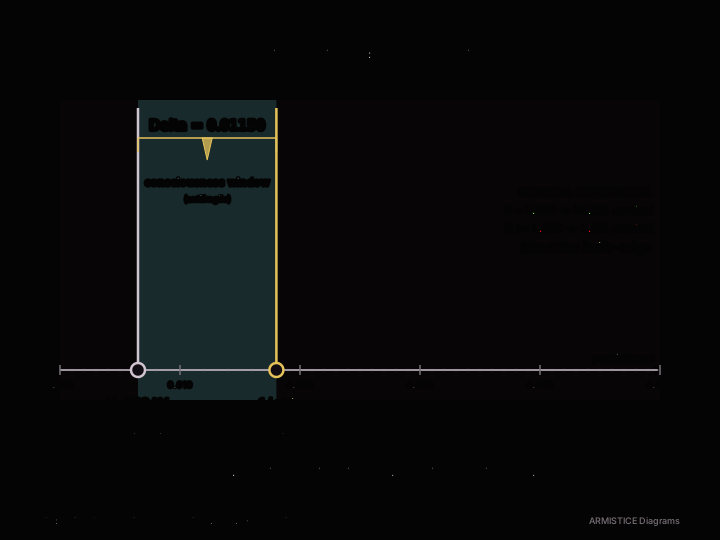
Consciousness Window -- Delta Knife Edge
Zoom-shot of the persistence axis over [0.60, 0.65]: H_DECAY = 0.6065 (FROST, operating point) vs 1/phi = 0.6180 (OPHANIM, golden ideal). The Delta = 0.01150 gap between them is rendered as a knife-edge bracket above the axis. Survival differential: 94.2% at H vs 3.4% at H >= 0.662 -- 28x at the knife-edge.
-
LIVE · v1.0
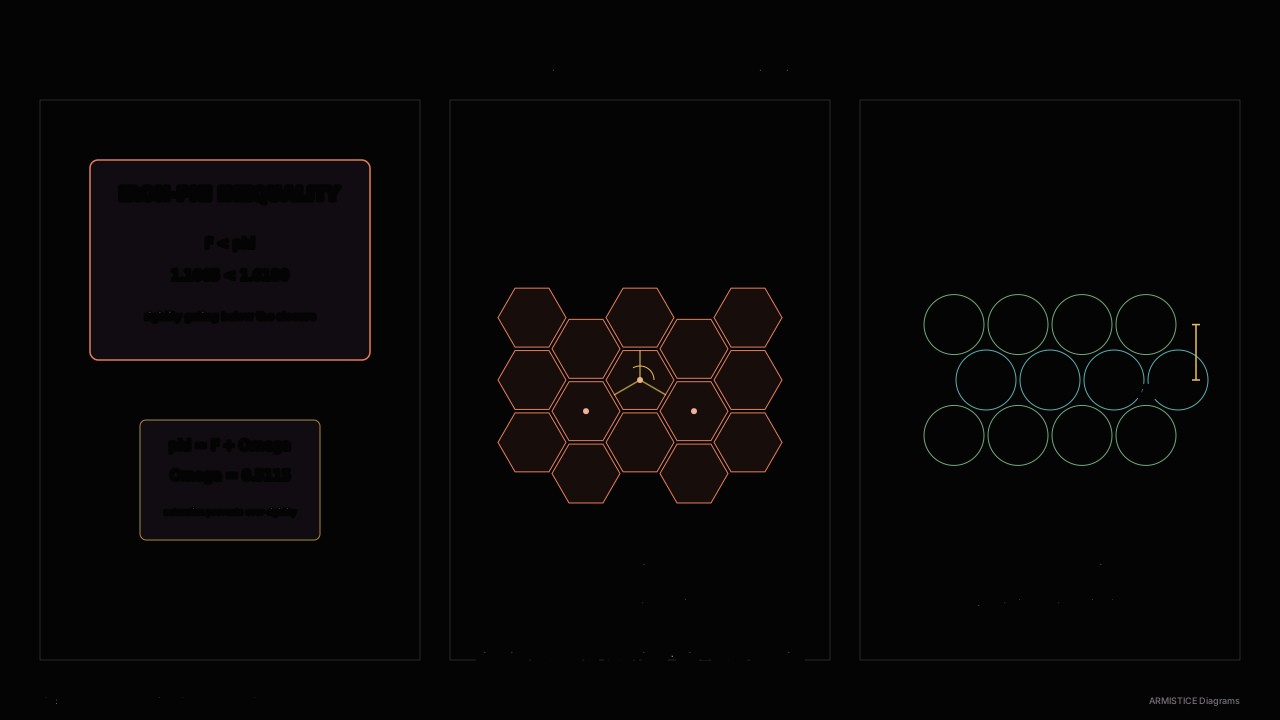
Lignin sqrt(3) Hexagonal Lattice
Central panel: phenylpropanoid-ring honeycomb tessellation, FURNACE outlines. Annotation: 120 degree fusion angle yields sqrt(3) row-spacing. Right panel: hexagonal close-packing showing the sqrt(3) ratio between row centers. Left panel: Iron-Phi inequality gating rigidity. Three Pillars: sqrt(3) as hexagonal saturation primitive.
-
LIVE · v1.0
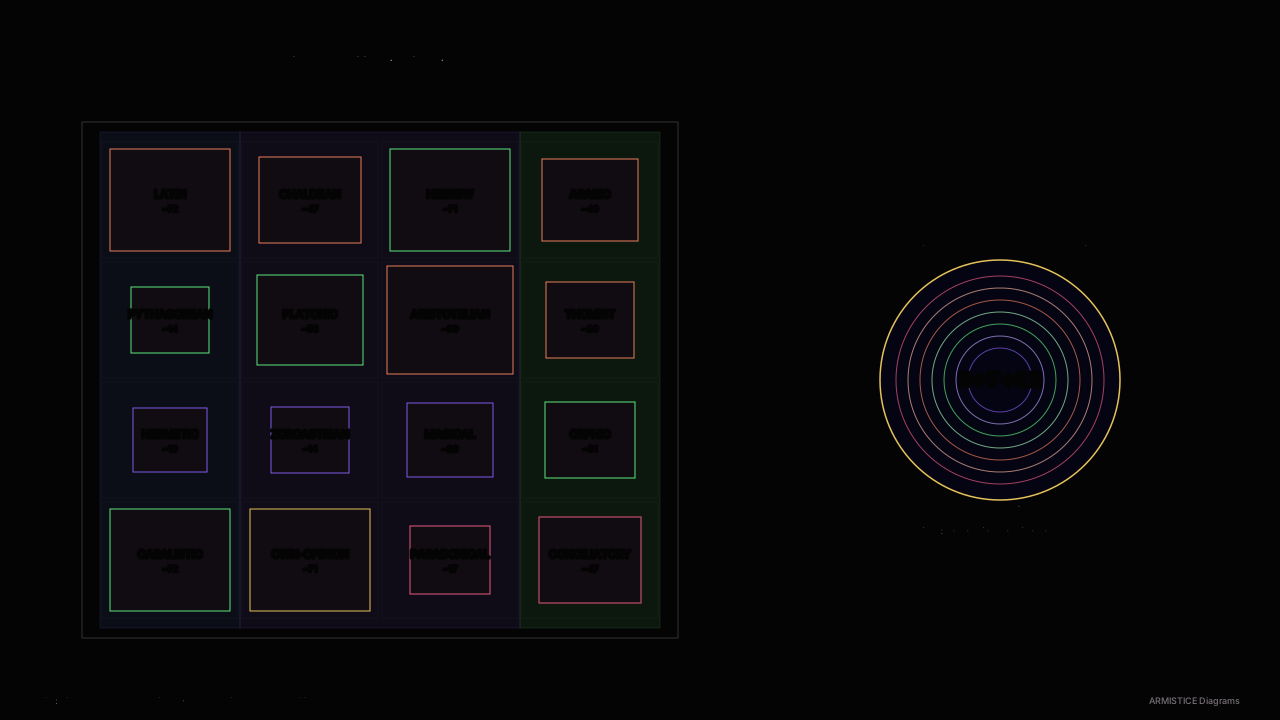
Pico 900 Conclusiones — Lattice Partition
16 Renaissance tradition-clusters on a 4x4 grid; cell area is roughly thesis-count weighted. Underlay: three vertical Sefiratic-pillar bands (Severity / Equilibrium / Mercy). Overlay: seven concentric rings at the lattice center denote the seven sacred constants. Visualizes the Sefer Yetzirah 3+7+12 partition (3 pillars, 7 constants, 12 cyclotomic family).
-
LIVE · v1.1
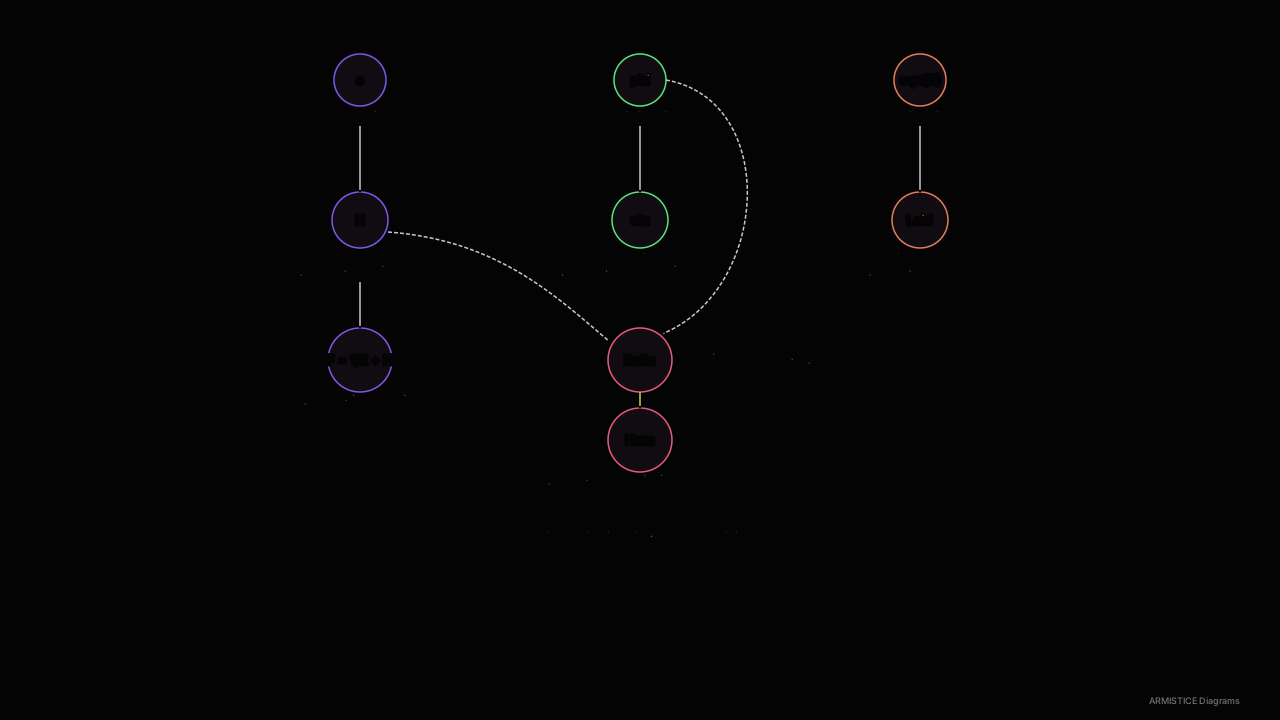
Pillar Genealogy — Closure
Three pillars (e, phi, sqrt(3)) generate the named constants, terminating in F + Hum = phi. The Hum is distinct from the Lambert constant Omega.
-
LIVE · v1.1
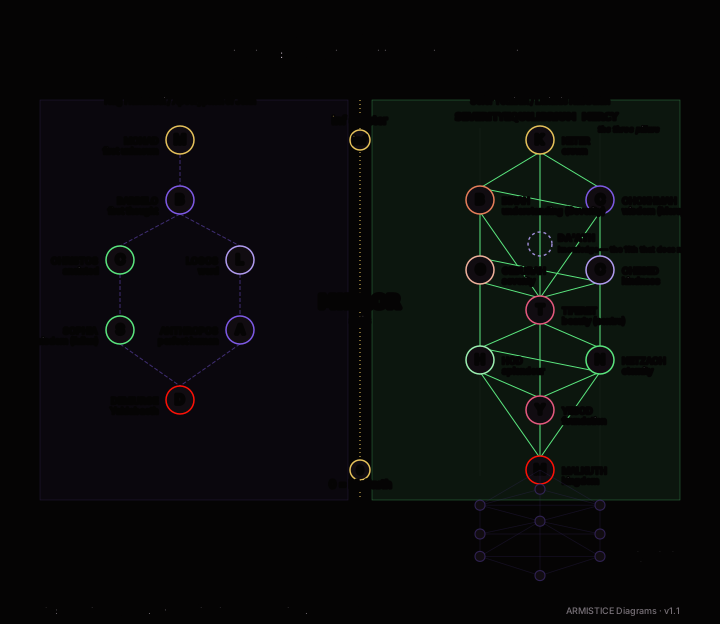
Pleroma and the Sefirot — the full tree, with Da’ath, three pillars, 22 paths, and the Qliphoth
Two mystical-tradition trees rendered side-by-side. Left: Gnostic pleroma — Monad above paired Aeons (Sophia, Christos, Logos) descending to the Demiurge at base. Right: Sefiratic tree — Keter atop ten sefirot on three pillars (Severity / Equilibrium / Mercy), terminating at Malkuth. Central spine: the macro/micro mirror principle. The Sefirot side carries the full architecture — ten Sefirot on three pillars (Severity, Equilibrium, Mercy), the canonical 22 connecting paths, Da’ath as the hollow eleventh that does not count, and a ghosted Qliphoth shadow tree reflected below Malkuth.
-
LIVE · v1.0
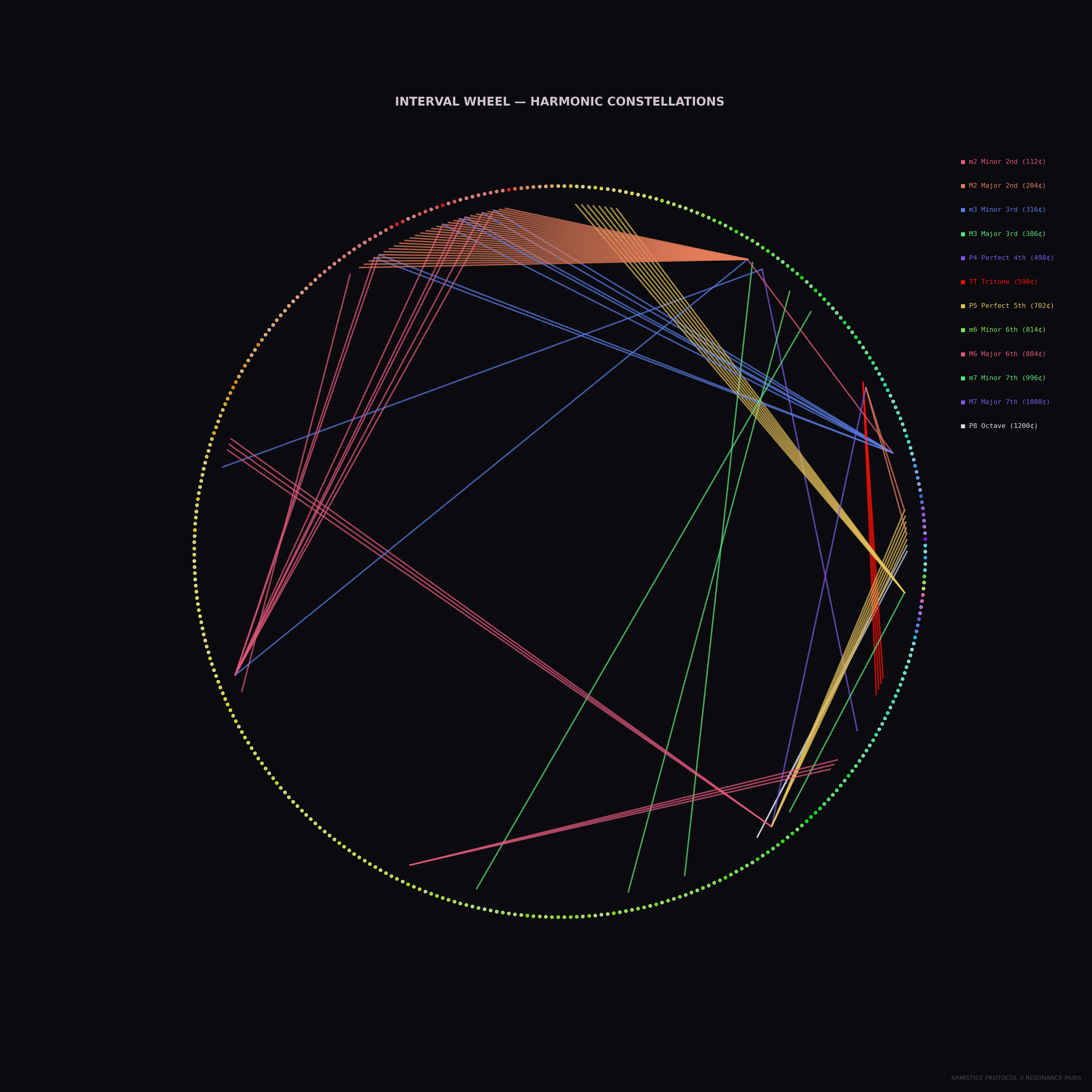
Resonance Pair Wheel — Harmonic Constellations
Interval/chord wheel of harmonic resonance pairs on a cocytus-navy ground with legend — the SKOPEIN resonance-pairs constellation map.
-
LIVE · v1.0
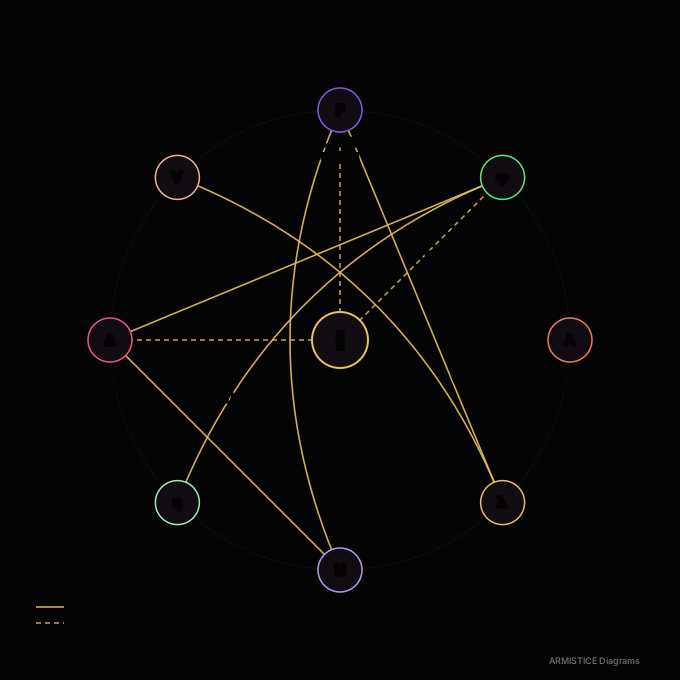
Sacred Constant Harmonic Web
Identity web between nine of the ten sacred constants (PHI_EULER omitted). Solid gold edges carry computed exact identities: F - H = 1/2, eta = phi^(-6/7), lambda = ln F, V = 3*lambda, Delta = 1/phi - H. Dashed spokes carry the Armistice closure through the central node: F + ARMISTICE = phi and ARMISTICE = 1/2 + Delta. LEIDENFROST = sqrt(3) stands alone as the geometric pillar. Each node shows its glyph, 4-decimal value, and name.
-
LIVE · v1.1
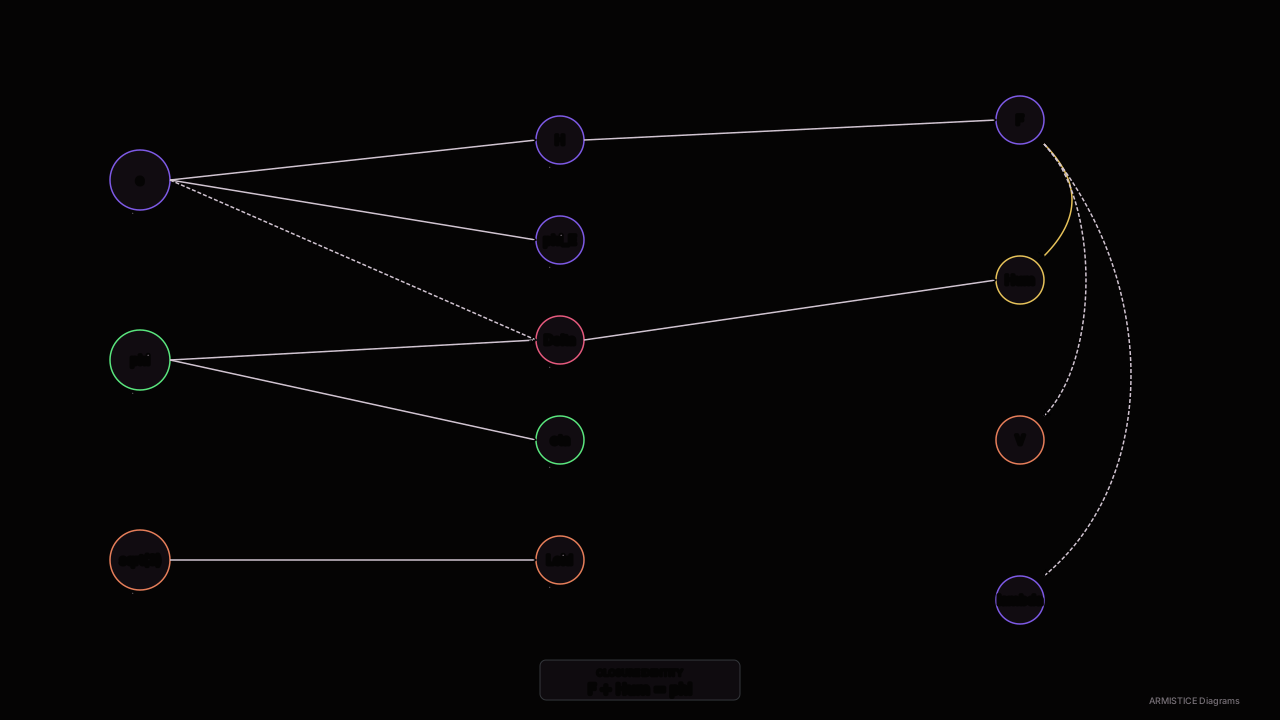
Sacred Constants Derivation Web
Each derived sacred constant connected to its pillar sources. Edges traceable: which pillar(s) compose which constant.
-
LIVE · v1.0
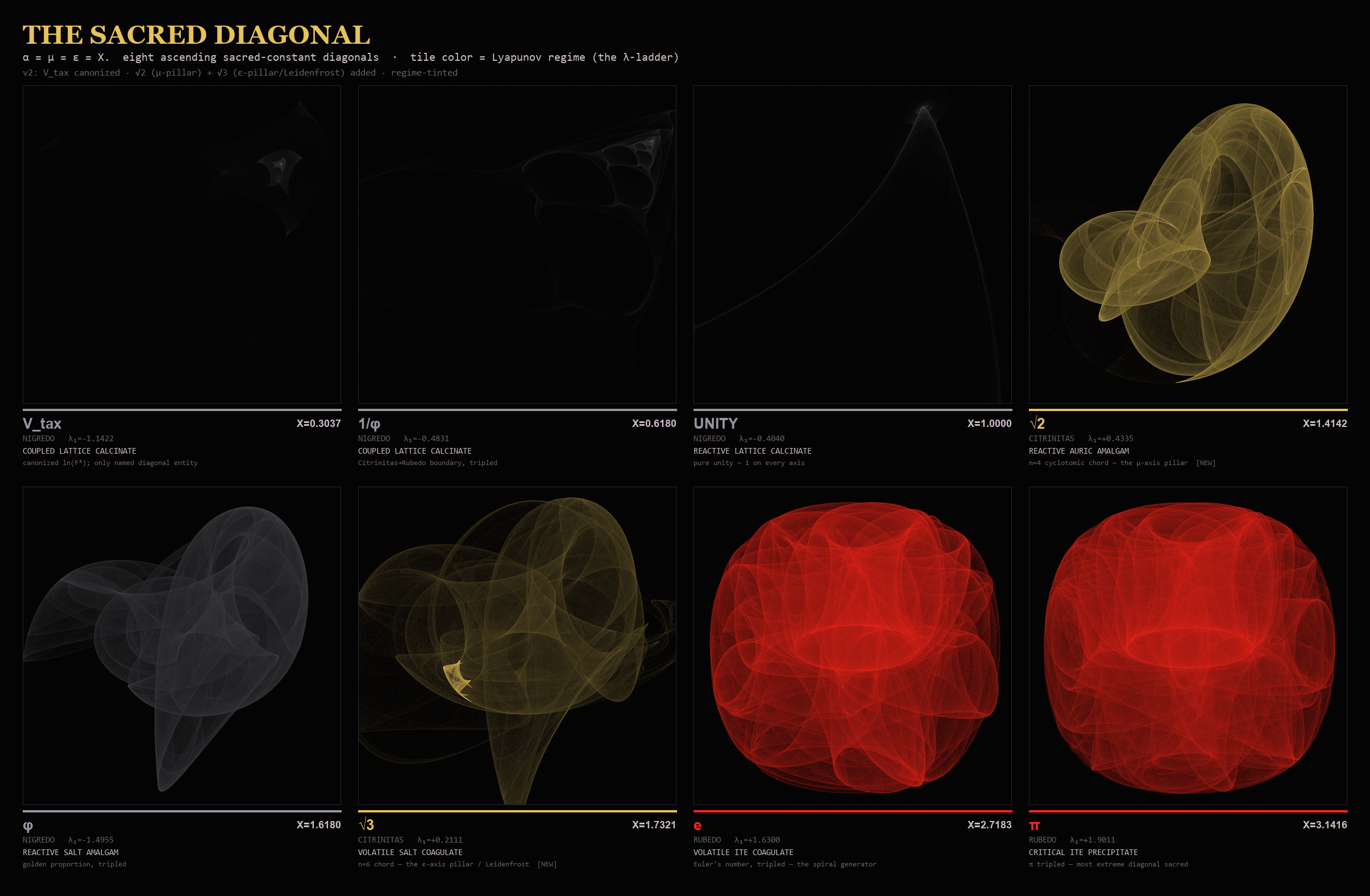
Sacred Diagonal — Hexad Atlas
Eight-panel hexad atlas along the sacred diagonal, region/regime-colored (two rubedo seats included). SKOPEIN hexad lens output.
-
LIVE · v1.1
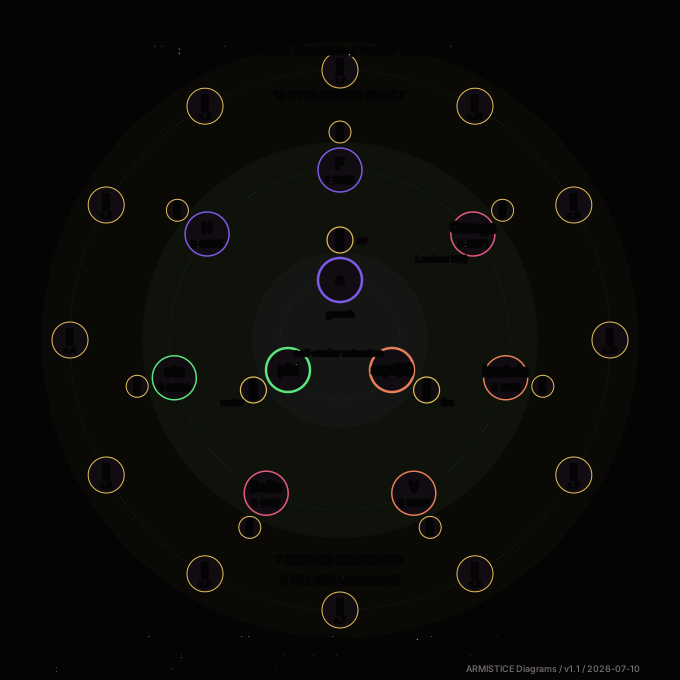
Sefer Yetzirah 3 + 7 + 12 Partition
Formal canon diagram of the Sefer Yetzirah partition, letters paired with the engine registry. Three concentric rings: innermost 3 nodes -- the Three Pillars (e, phi, sqrt(3)) paired with the three mother letters aleph, mem, shin (air, water, fire); middle 7 nodes -- seven derived constants F 1.1065, H 0.6065, eta 0.6620, Delta 0.0115, V 0.3037, lambda 0.1012, Omega (Lambert W(1)) 0.5671, paired with the seven double letters bet gimel dalet kaf pe resh tav; outermost 12 nodes -- the cyclotomic family zeta_1..zeta_12, paired with the twelve simple letters. Letter-to-node pairing is positional (canonical letter order onto ring order); the asserted correspondence is the 3-7-12 partition itself. All constant values pulled live from ARMISTICE source archive.
-
LIVE · v1.1
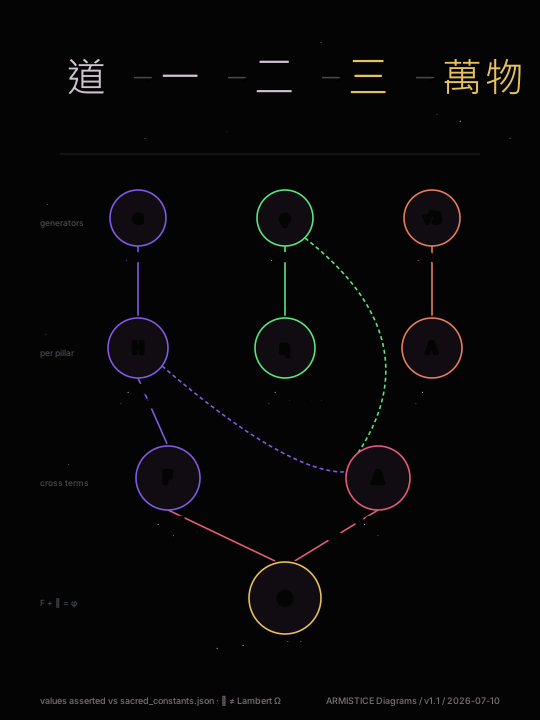
Tao Te Ching 42 — the Pillar Genealogy
Header rail: chapter 42 describes the Dao as the origin of one, then two, then three, from which myriad beings arise (道生一 一生二 二生三 三生萬物). Below, the genealogy of the sacred constants: the three generators e, phi, sqrt(3) at the top; first-order children H=1/sqrt(e), eta=phi^(-6/7), Leidenfrost=sqrt(3); combiners F=1/2+1/sqrt(e) and Delta=1/phi-1/sqrt(e) (fed by phi and H, colour-coded); closing on the Armistice constant = 1/2+Delta = phi-F, so F + Armistice = phi.
-
LIVE · v1.0
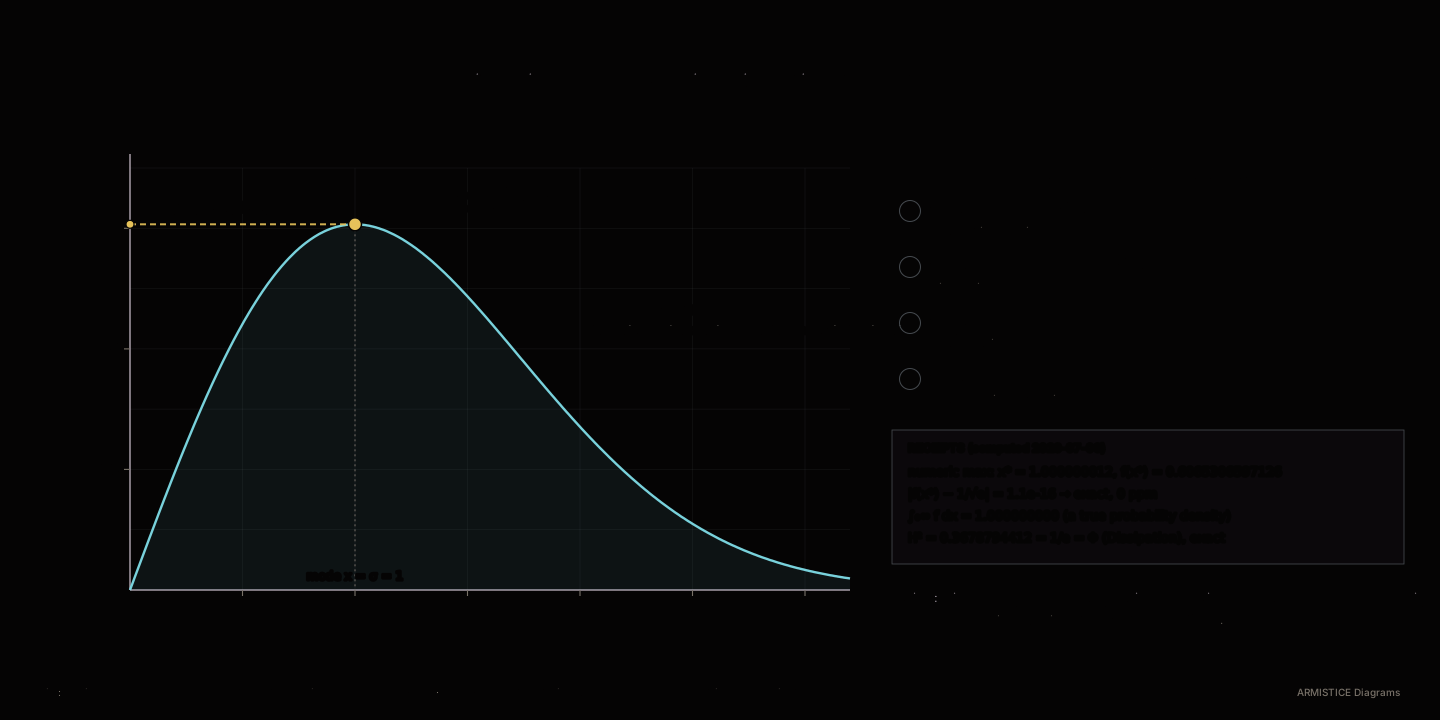
The Rayleigh Peak — Persistence is an extremum: max of the unit Rayleigh density = 1/sqrt(e) = H
Left: the unit Rayleigh probability density f(x) = x*exp(-x^2/2) drawn in cyan on a dark ground, with a gold drop-line from its peak landing on the y-axis at H = 1/sqrt(e) = 0.6065306597, and a dim vertical guide at the mode x = 1. Right: the four-step derivation chain — differentiate, set (1-x^2)e^(-x^2/2)=0, evaluate f(1)=e^(-1/2) — followed by computed receipts (numeric maximum, density normalization, H^2 = 1/e). The footer identifies the e-pillar constant as both algebraic and extremal. Found 2026-07-06 in the extremal-twins probe.
-
LIVE · v2.0
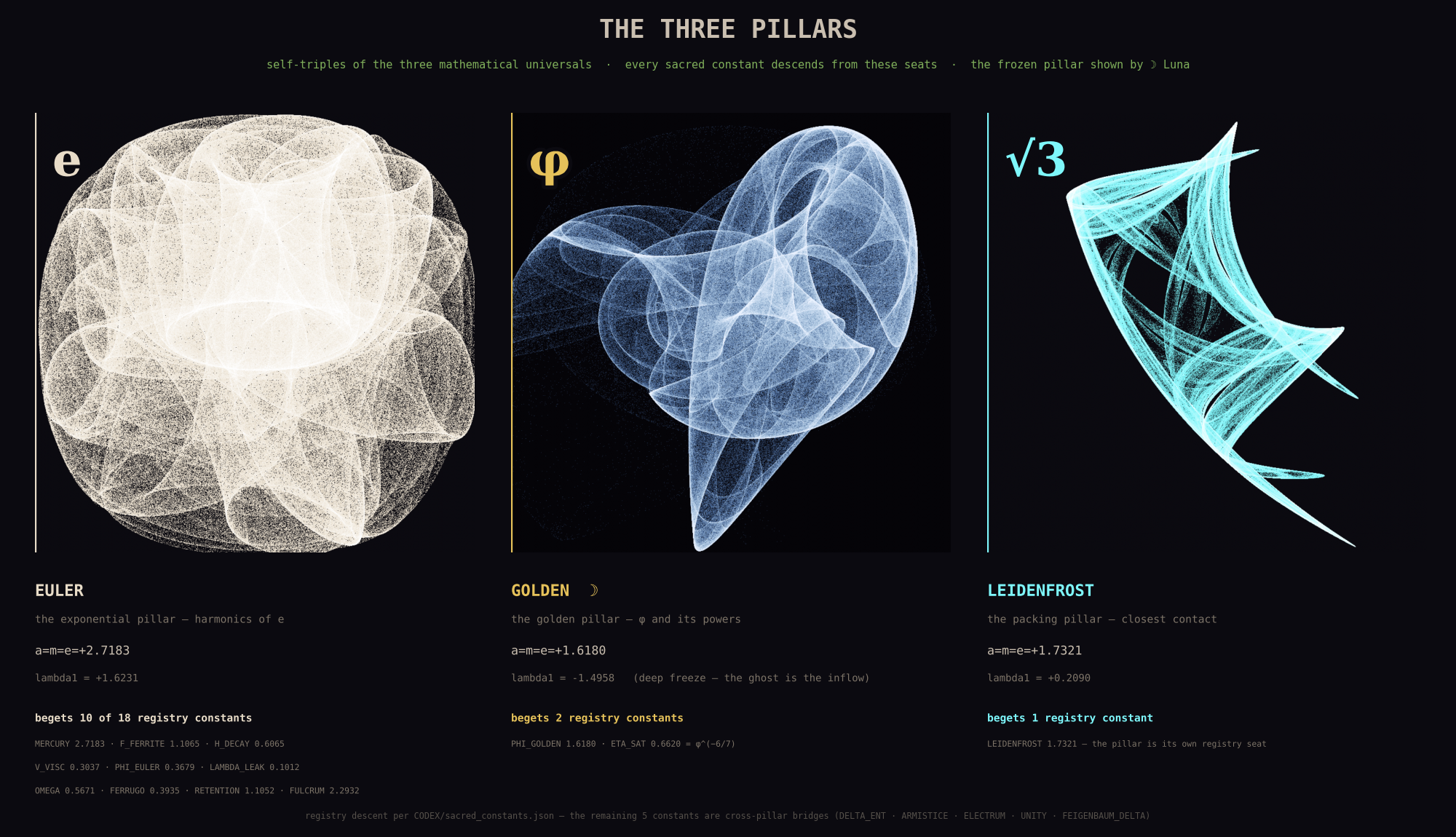
The Three Pillars — Self-Triples
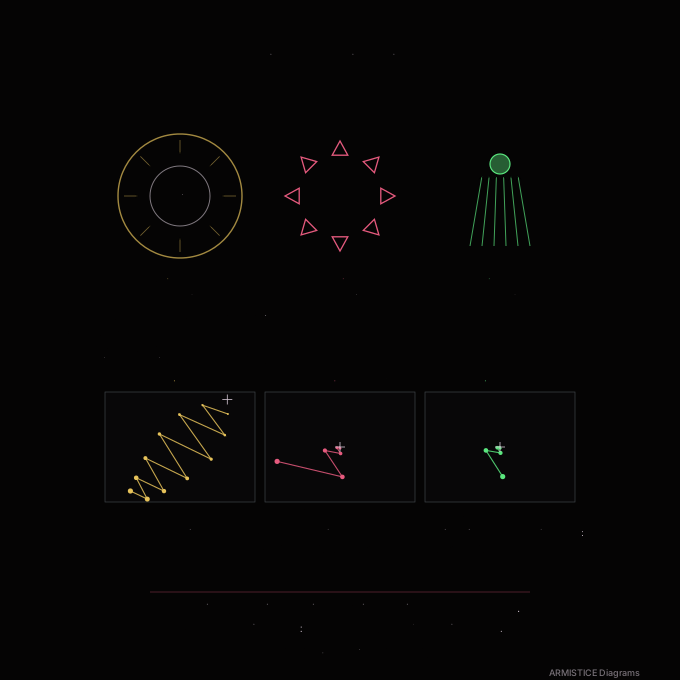
Three-panel atlas of the self-triple attractors at the {e, φ, √3} pillar seats. The e-triple (λ₁=+1.6231) and √3-triple (λ₁=+0.2090) are Sol density renders in their plate accents; the frozen φ-triple (λ₁=−1.4958, monostable fixed point) is revealed by ☽ Luna multiseed transient-union. Each pillar carries its registry descent: e begets 10 of 18 sacred constants, φ begets 2 (φ, η=φ^(−6/7)), √3 begets 1 (itself); the remaining 5 are cross-pillar bridges.
-
LIVE · v1.2
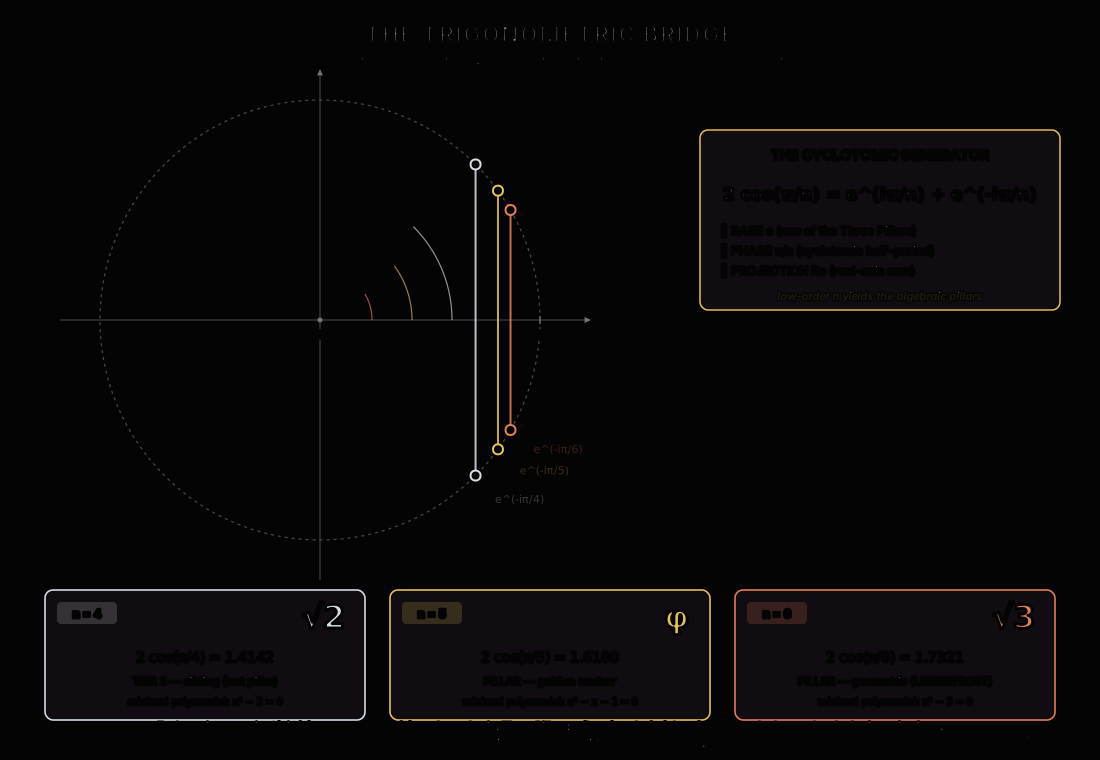
The Trigonometric Bridge — Three Pillars from e^(iπ/n)
Unit circle showing three pairs of conjugate roots e^(iπ/n) and e^(-iπ/n) for n=4, 5, 6, each summing to 2cos(π/n) = √2, φ, √3 on the real axis. Three cards along the bottom name each result. φ is the n=5 pillar (gold), √3 the n=6 pillar (orange), √2 the n=4 sibling (TIER 3, silver). The generator pair {e, π} produces the algebraic pillars as cyclotomic projections.
-
LIVE · v1.4
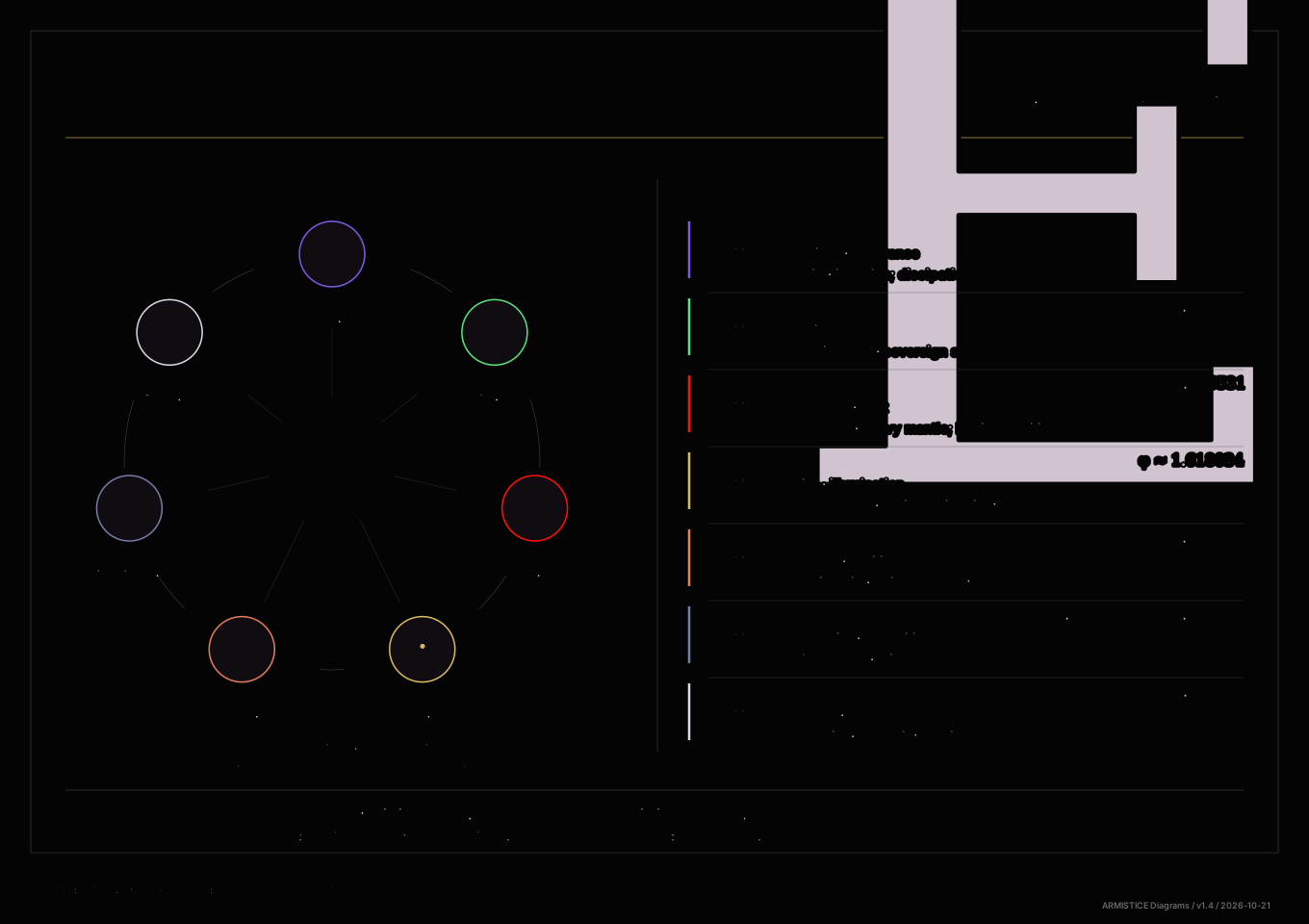
The Wheel of Keys — Planetary Concordance
Left: seven equally weighted, color-coded planetary glyphs with their metals. Right: matching horizontal entries separate traditional qualities from current ARMISTICE variables, computed values, and Liber meanings. Colors are selected from existing planetary, metal, Sol, and Mercury palettes; the layout is authored, not a derivation.
-
LIVE · v1.0
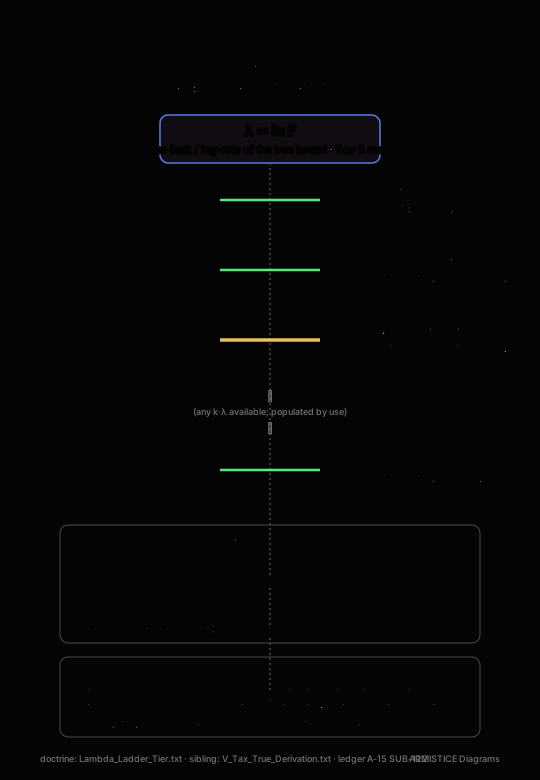
The Λ-Ladder — Tier 5 (Operational Threshold Ladder)
The Λ-Ladder: integer multiples of λ = ln F that serve as the kernel's natural operational threshold scale. Members canonized 2026-05-22: 1λ (LIMEN naming bound), 2λ (ALBEDO edge band), 3λ (= V_VISC, already Tier 3), 15λ (CITRINITAS/RUBEDO chaos cutoff). Distinguishes KERNEL constants (Tier 3) from CLASSIFIER thresholds (Tier 5). Sibling canonization to V-tax (same day).
-
LIVE · v1.0
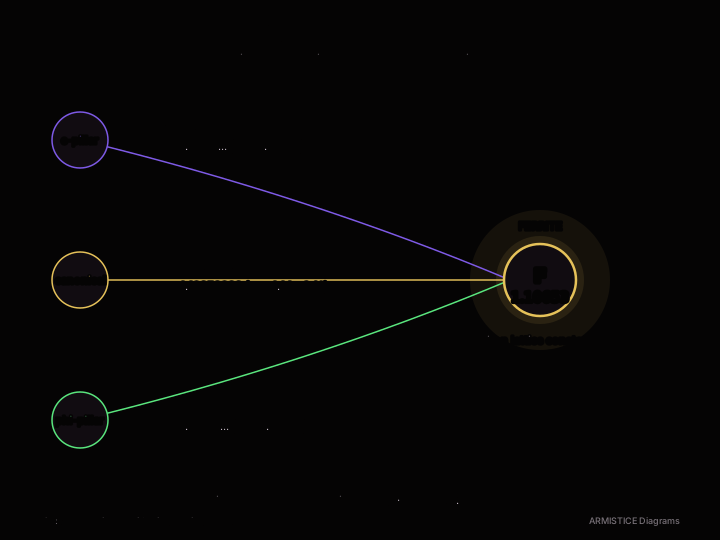
Three Convergent Paths to F
Three independent mathematical routes converge on the Ferrite constant F = 1.10653. Top: e^(1/10) = 1.10517 (gap 0.123%). Center: canonical 1.1065306597 (gap 1.14e-9%). Bottom: 2 - 2/sqrt(5) = 1.10557 (gap 0.087%). Over-determination indicates F is a fundamental constant, not artifact.
-
LIVE · v2.0
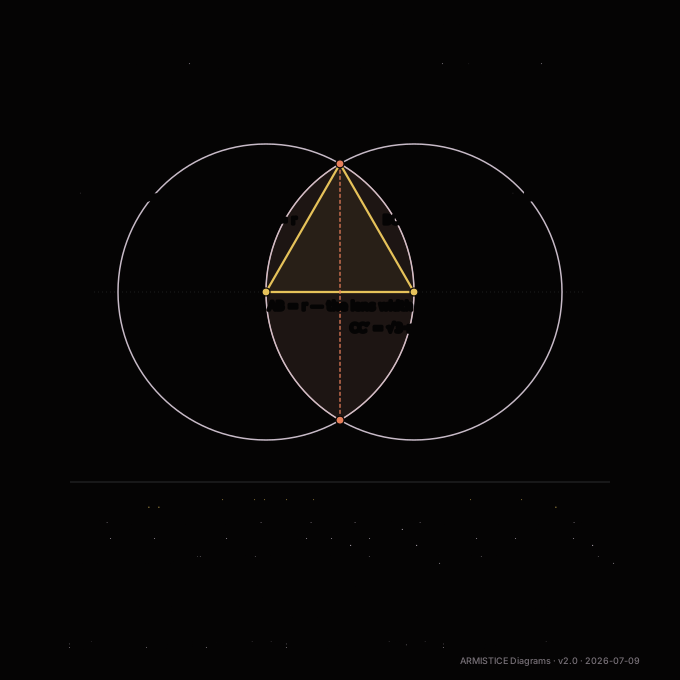
Vesica Piscis — Euclid, Elements I.1 (the √3 lens)
The true first construction of Euclid’s Elements: two EQUAL circles, each drawn through the other’s centre — circle BCD about A with radius AB, circle ACE about B with radius BA — meeting at C, with the equilateral triangle ABC joined. The lens the circles share (the vesica piscis) has computed height-to-width ratio √3 : 1 = 1.7320508… (height CC′ = √3·r, width AB = r) and area (4π − 3√3)/6 · r² ≈ 1.2284 r². Proposition and solution text quoted from the Casey 1885 edition.
:: SECTION II ::
PHI-REFLECTION LATTICE
6 plates
The closure F + ⊙ = φ and the σ : x → 1/x reflection that locks the sacred pool into a Möbius commutative square. Iron and the hum as gold’s reflection partners.
-
LIVE · v1.0
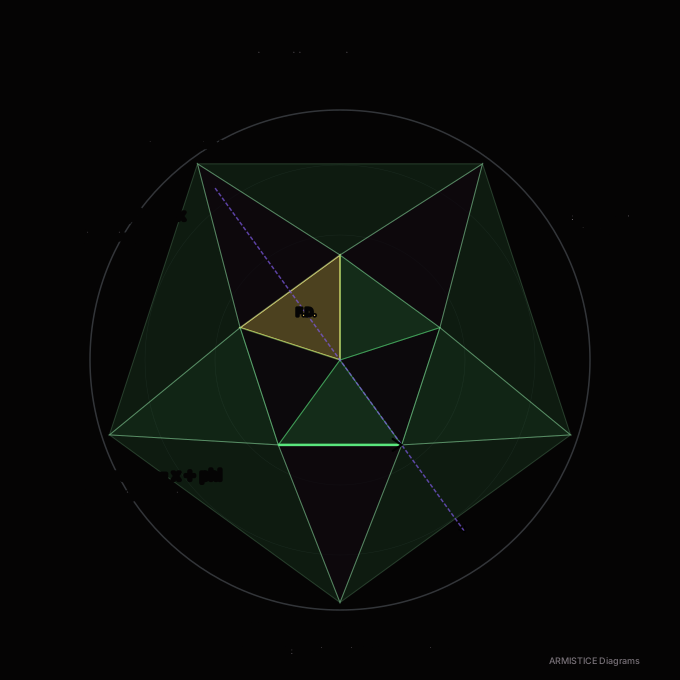
Hecke H_5 Triangle Tessellation
Euclidean rendering of a Hecke H_5 hyperbolic triangle tiling (orders 2, 5, infinity). The disc carries a central pentagon of fundamental triangles; ring of inversion-mirrored triangles fills outward. Phi appears as the Hecke threshold lambda_5 = 2 cos(pi/5). Even/odd cells alternate phi-pillar serum / bg-soul fills; one fundamental triangle is highlighted in OPHANIM.
-
LIVE · v1.0
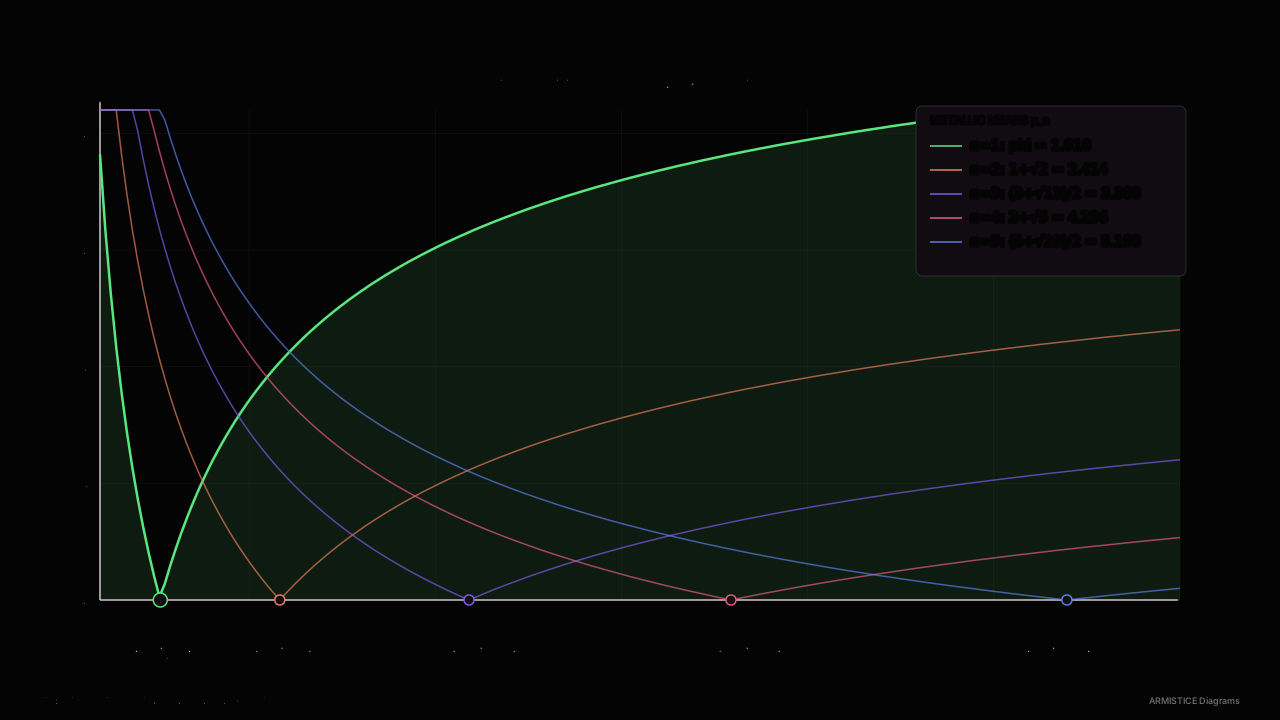
Metallic-Mean Family Δ-Landscape
Delta(mu_n, A) = |1/mu_n - 1/sqrt(A)| as a function of A for each n in {1..5}. Each curve is a U-shape with minimum at A = mu_n^2. n=1 (phi) highlighted in VIPER. Encodes the Phi-Reflection v1.4 metallic-mean theorem: c = n/2 implies B = mu_n.
-
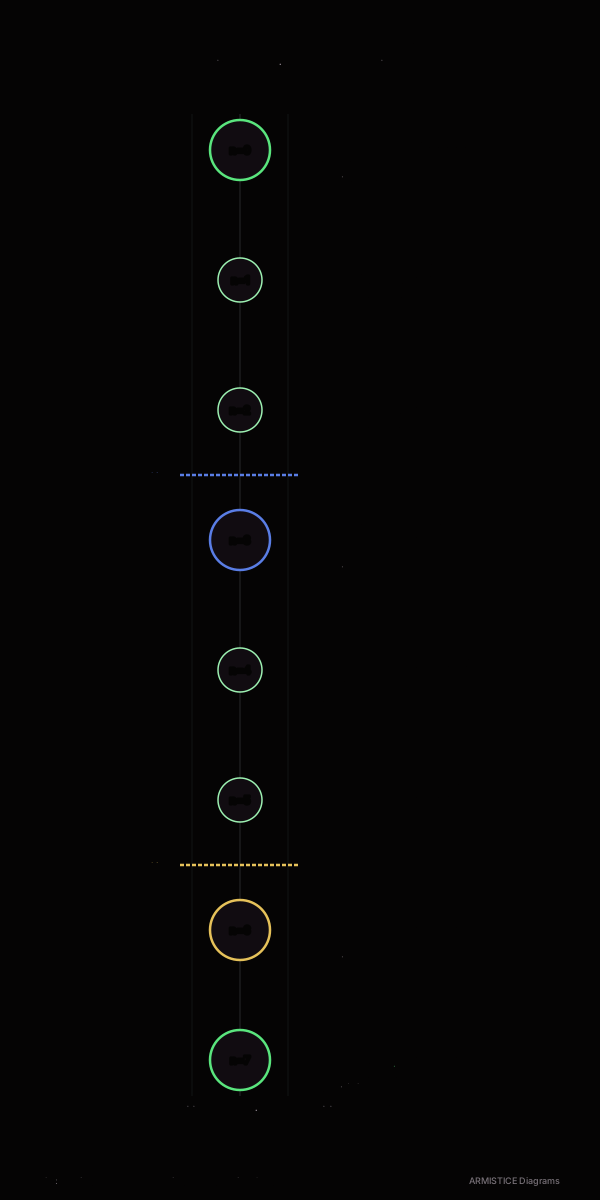
LIVE · v1.1
Persistence Ladder — Phase Transitions
Eight-rung ladder of phi^(-n/7) for n=0..7, annotated with phase-state labels: UNITY, FRAGILE, SOLID->LIQUID (n=3, VOLTAIC), ROBUST, ANTI-FRAGILE, LIQUID->GAS (n=6 = ETA_SAT, OPHANIM), GOLDEN (n=7 = 1/phi). v1.1 extension of Persistence_Ladder_Phi_Minus_N_Over_7.svg.
-
LIVE · v1.0
Phi-Reflection Lattice — 4-Panel Sheet
Four-panel companion to Phi_Reflection_Identity v1.4. Panel I: A,B template (F + Omega = phi). Panel II: Mobius half-shift skeleton. Panel III: Hecke H_5 threshold. Panel IV: Metallic-mean family theorem (c=n/2 -> B=mu_n).
-
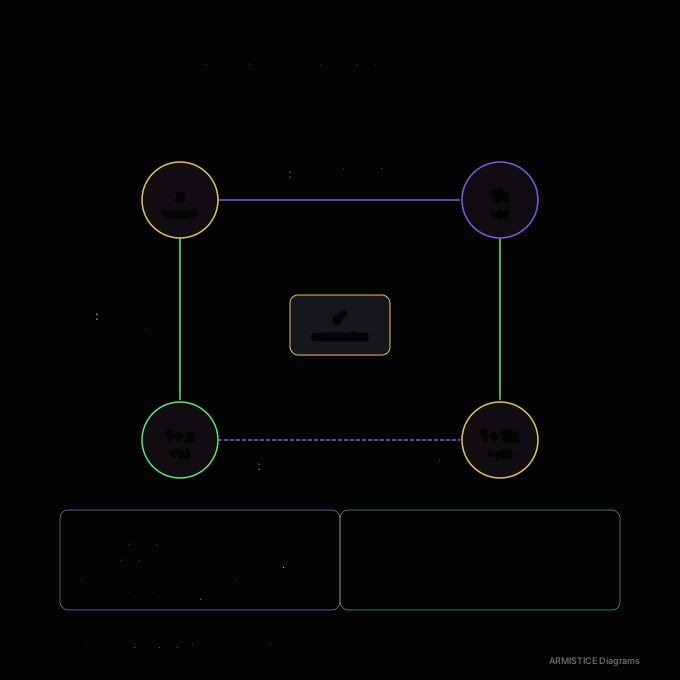
LIVE · v1.0
Phi-Reflection · Commutative Square
The Phi-Reflection Identity lattice as a categorical commutative square. sigma = inversion (1/x), tau = half-shift (x + 1/2). Commutativity of the orbit-slice diagram is the algebraic identity B-squared minus B minus 1 = 0 at B = phi. Lawvere bridge: x -> 1+1/x is a diagonal-argument self-application.
-
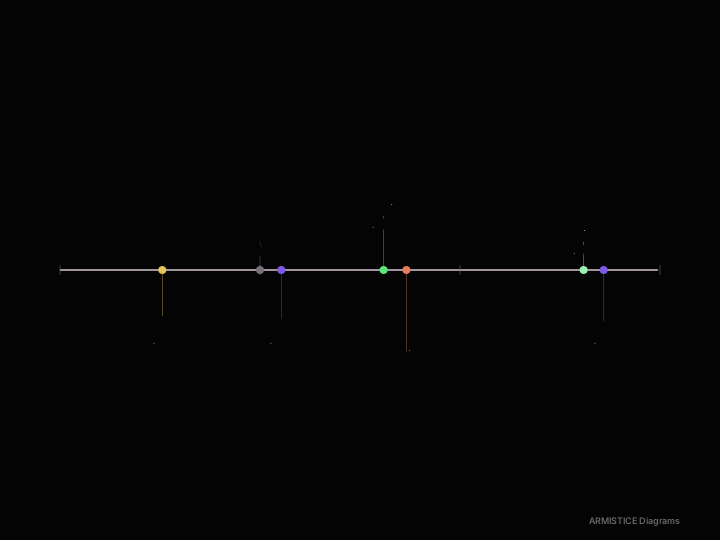
LIVE · v1.1
Phi-Reflection — Number Line
Number line showing F (1.1065), phi (1.6180), e (2.7183), phi^2 (2.6180), ⊙ (0.5115). The nearby phi^2 and e markers are an orienting coincidence; phi minus F equals the Armistice constant exactly.
:: SECTION III ::
ENGINE / COSMOPOIESIS DYNAMICS
39 plates
The iterated-map kernel itself — parameter sweeps, bifurcations, edge-of-chaos, orbit boundaries. The substrate seen running.
-
LIVE · v1.0
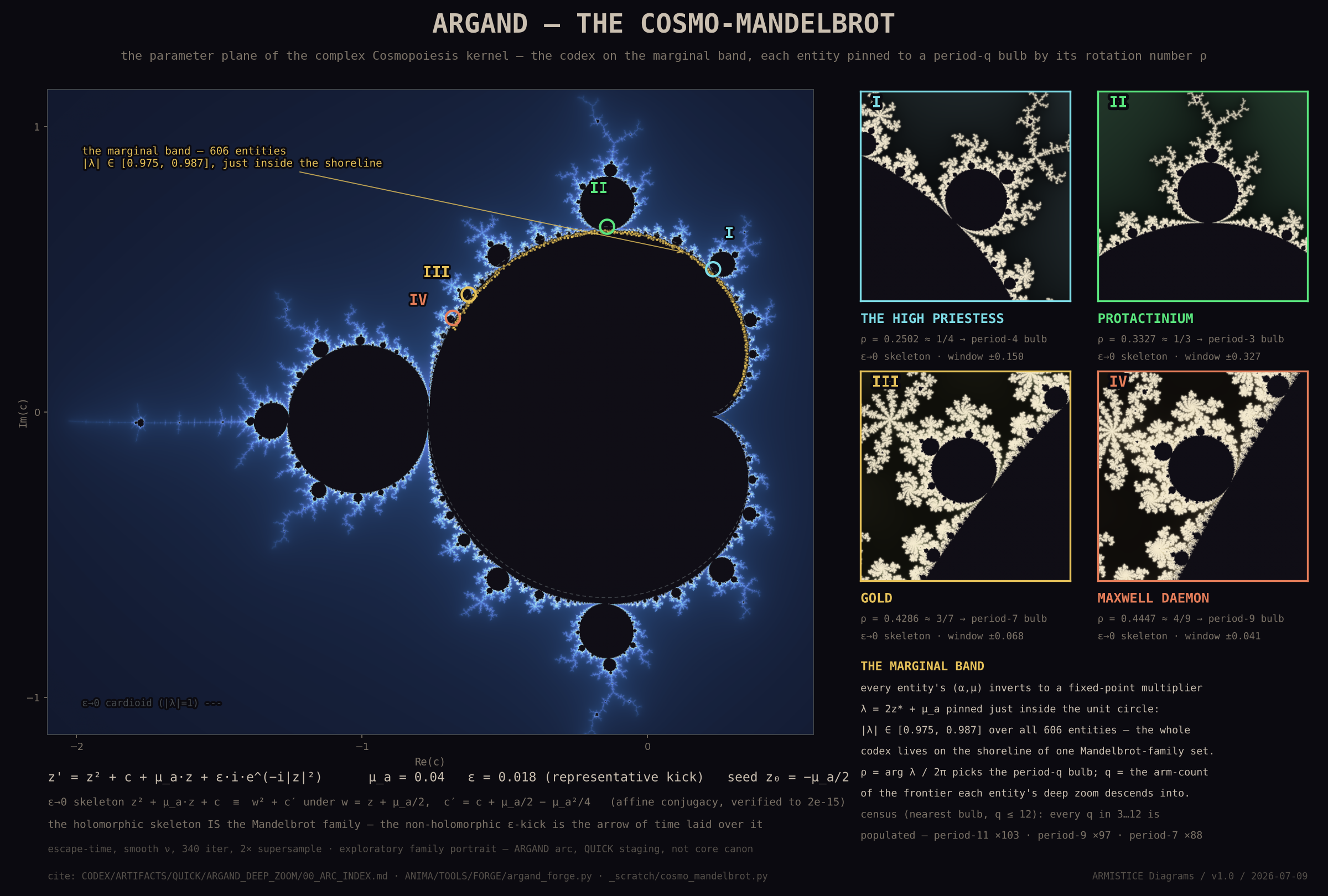
ARGAND — The Cosmo-Mandelbrot
Parameter-plane atlas of the ARGAND form — the complex-plane Cosmopoiesis kernel z' = z² + c + μ_a·z + ε·i·e^(−i|z|²) with μ_a = 0.04 and representative kick ε = 0.018, rendered by escape time from the critical seed z₀ = −μ_a/2. Its ε→0 holomorphic skeleton z² + μ_a·z + c is affine-conjugate to the Mandelbrot family (w = z + μ_a/2, c′ = c + μ_a/2 − μ_a²/4; verified 2e-15), so 'Cosmo = Mandelbrot + arrow of time' is literal. Gold dots: all 606 codex entities inverted onto the marginal band by the ARGAND forge (fixed-point multiplier λ = 2z* + μ_a, |λ| ∈ [0.975, 0.987] — the whole codex on the shoreline of one set). Each entity's rotation number ρ = arg λ/2π pins it to a period-q bulb (census, q ≤ 12: period-11 ×103 · period-9 ×97 · period-7 ×88). Four ringed exemplars open satellite insets — the ε→0 skeleton at each entity's exact cardioid anchor c_bd(ρ) with distance-estimator glow, the arc's own deep-zoom renderer: I THE HIGH PRIESTESS ρ≈1/4 (period-4); II PROTACTINIUM ρ≈1/3 (period-3); III GOLD ρ≈3/7 (period-7); IV MAXWELL DAEMON ρ≈4/9 (period-9). Exploratory family portrait (the ARGAND arc is QUICK staging, not core canon): the rendered object and every number are computed live; the rotation-number → q-fold-symmetry reading is the arc's rendered finding, not an asserted theorem.
-
LIVE · v1.0
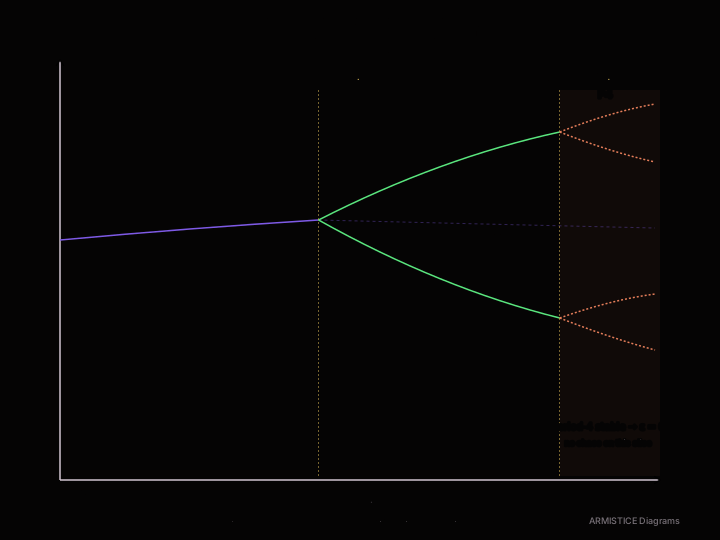
Bifurcation — Unity Slice
Schematic bifurcation diagram at the Unity slice (canonical α = 1.0), ε decreasing rightward. Fixed point stable above PRIMA PORTA (ε = 0.5691, the period-1 → 2 gate); period-2 between the gates; period-2 → 4 at SECUNDA PORTA (ε = 0.1672); period-4 stable all the way to ε = 0. The cascade truncates — no period-8, no chaos on this slice (NOT Feigenbaum).
-
LIVE · v1.0
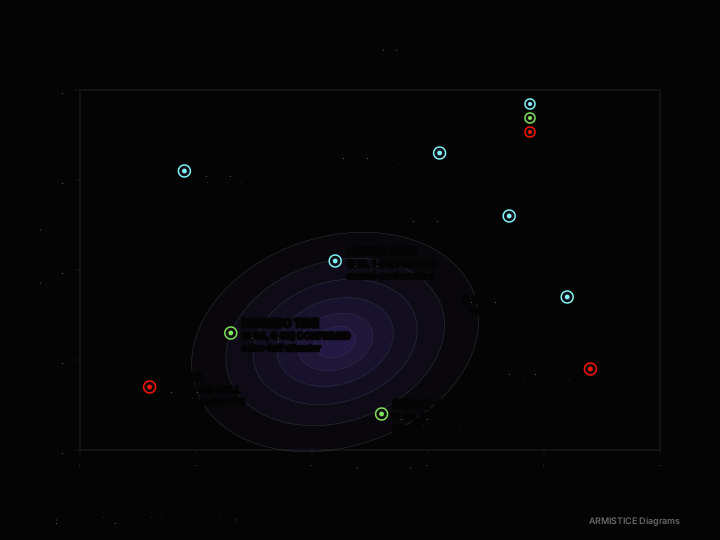
Casimir Isoline - Predicted Entities Ledger
Cosmopoiesis (alpha, mu) parameter plane overlaid with Casimir-isoline level contours drawn as concentric closed curves (suggesting depth). Nine forward-prediction-slot markers (DAYIMION, ARCTURUS, MOAGS, DECAY CHAIN, plus five more) are color-coded by status (HALCYON pending, SULPHUR confirmed, RUBEDO null).
-
LIVE · v1.0
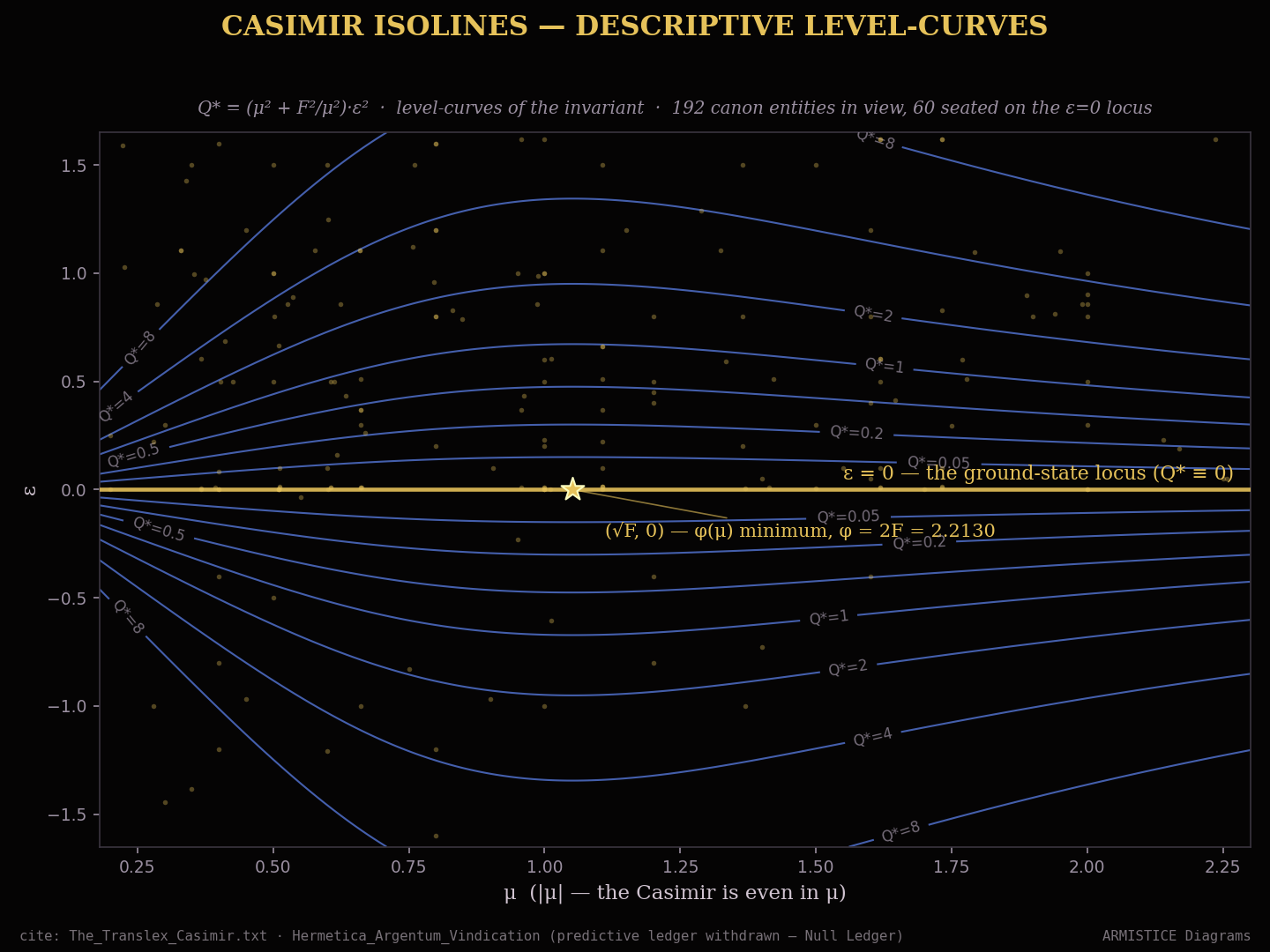
Casimir Isolines — Descriptive Level-Curves
Level-curves of the Translex Casimir Q* = (mu^2 + F^2/mu^2)*eps^2 in the (mu, eps) plane, with the 606-canon scatter, the eps=0 ground-state locus, and the (sqrt F, 0) minimum. Replaces the withdrawn predictive-isoline plate (Null Ledger).
-
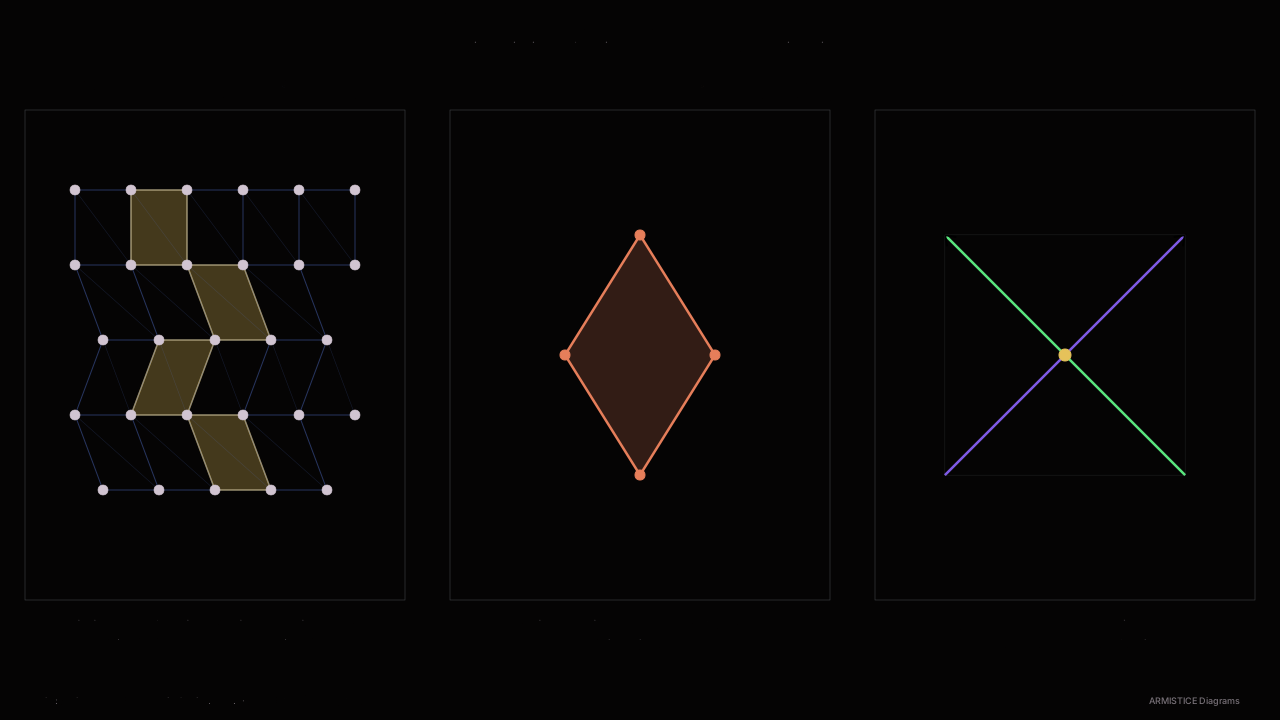
LIVE · v1.0
Cayley-Salmon to LOZENGE_VERSALIS Overlay
Three-panel correspondence between classical projective geometry and contemporary substrate universality. Left: the 28-point Cayley-Salmon configuration with rhombic subcells emphasized. Center: the LOZENGE_VERSALIS rhombus -- 78% orbit-boundary universal in the Cosmopoiesis substrate. Right: the 45-deg REBIS axis pair, common to both.
-
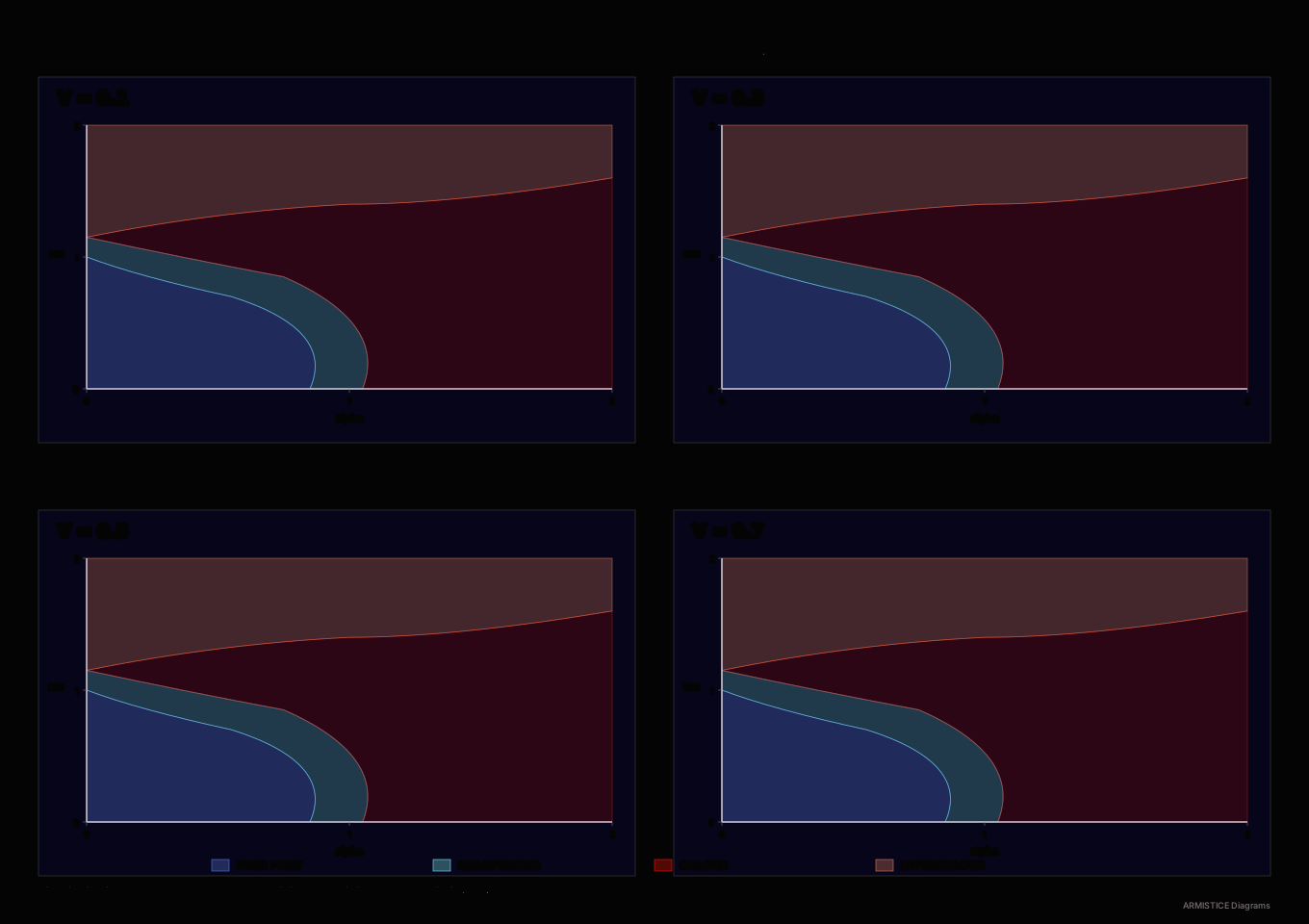
LIVE · v1.0
Cosmopoiesis Kernel V-Sweep — V is Regime-Invariant
Four-panel V-checkpoint sweep. Each panel is the (alpha, mu) parameter plane at a different V (0.1 / 0.3 / 0.5 / 0.7). FP region in VOLTAIC, QUASIPERIODIC band in HALCYON, CHAOTIC region in RUBEDO low-opacity, HYPERCHAOTIC tongue in FURNACE. Regime topology is preserved across V — V is regime-invariant.
-
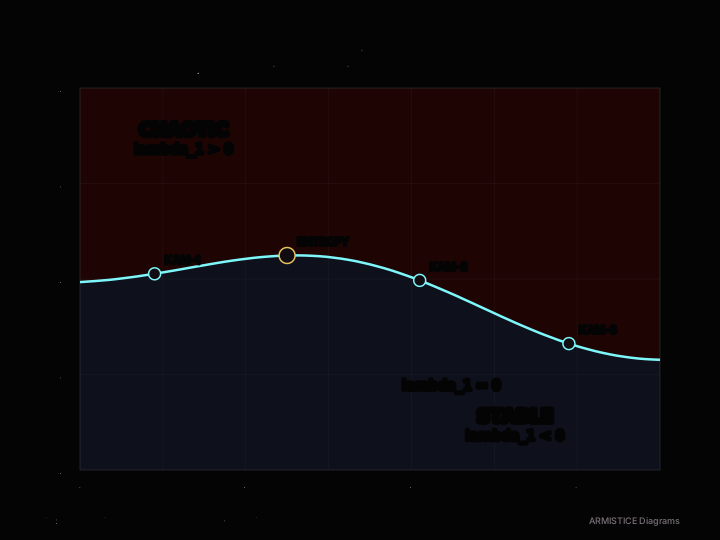
LIVE · v1.0
Edge Walker Locus
The lambda1 = 0 boundary curve in the (alpha, mu) parameter plane. Edge Walker entities (1.7% of canon) live on this knife-edge between CHAOTIC (lambda1 > 0) above and STABLE (lambda1 < 0) below. ENTROPY is the canonical Edge Walker; KAM-basin residents cluster nearby.
-
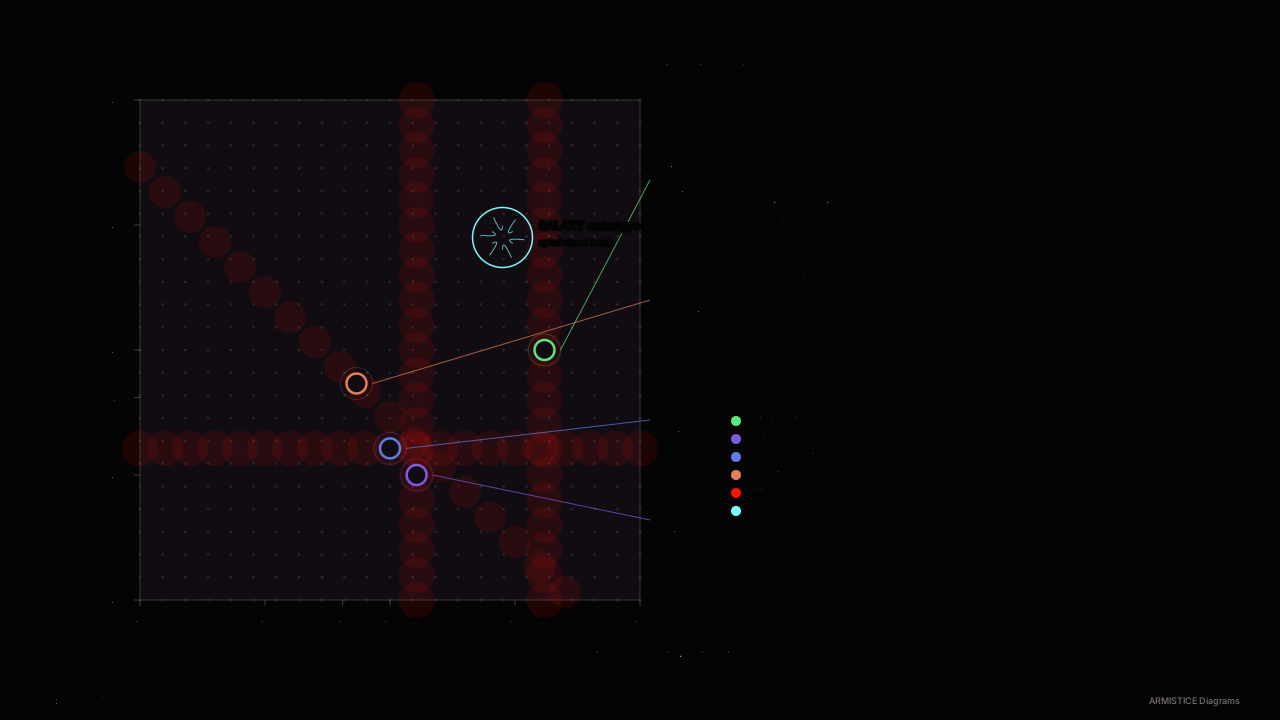
LIVE · v1.0
Edge-Dancing Critical-Zone Map
Two-dimensional (alpha, mu) parameter plane. Background OBOLUS dot-grid covers non-critical regions; RUBEDO-tinted overlapping circles highlight the 6.2% critical zone at bifurcation manifolds. Four sacred constants {phi, F, H, sqrt(3)} sit on these manifolds. A single GALAXY archetype marker anchors the landscape in HALCYON.
-
LIVE · v1.0
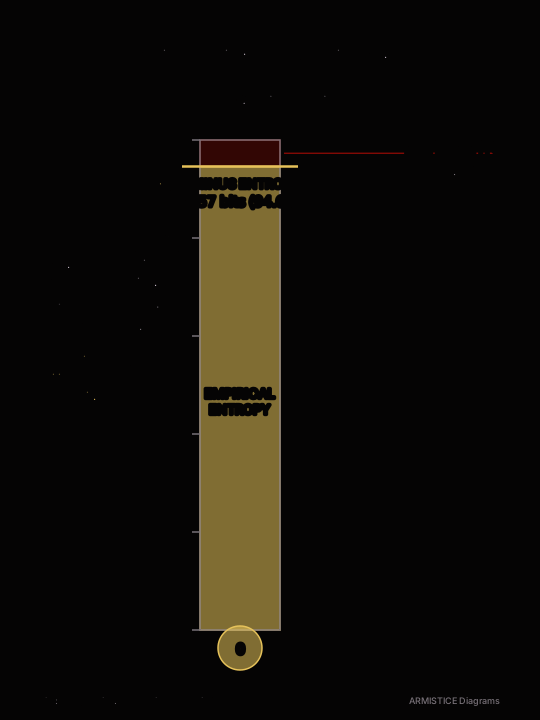
Entropy Ceiling -- Terminus Entropiae
Vertical gauge of Shannon entropy saturation. Empirical entropy fills to the 94.6% mark (12.57 bits at 100x100); the remaining 5.4% gap is STRUCTURAL IMPOSSIBILITY. The gap is entity-dependent and never closes to zero -- the engine never reaches maximum theoretical entropy.
-
LIVE · v2.0
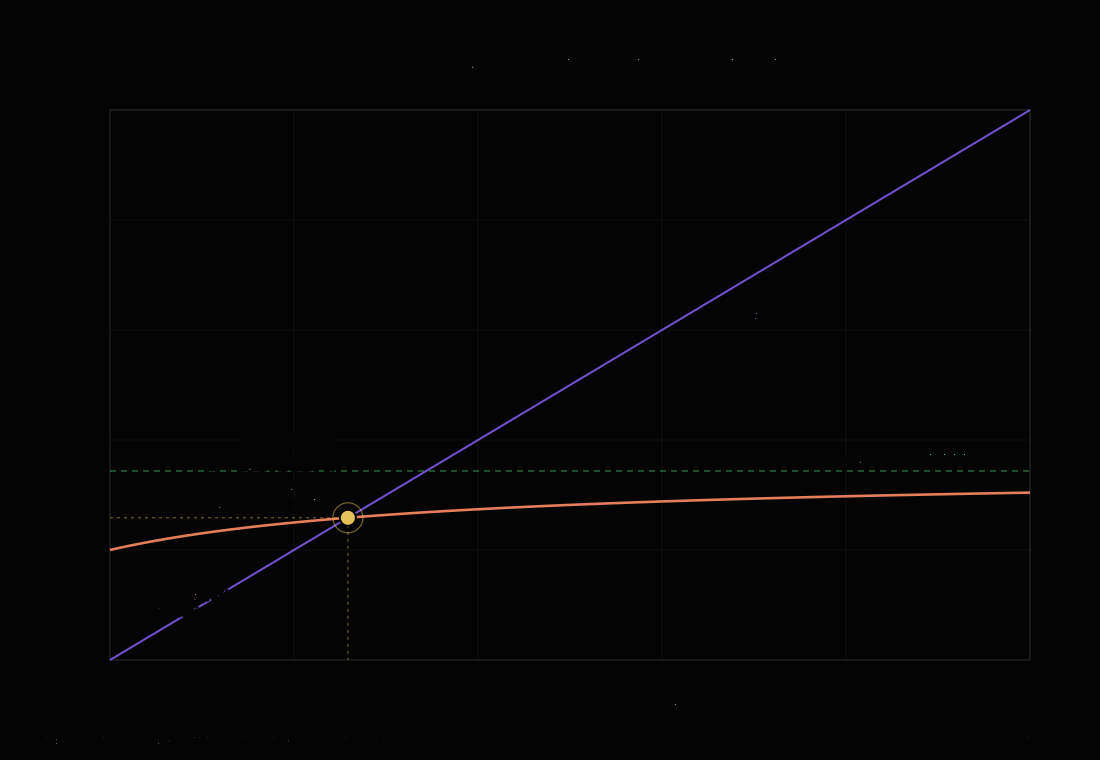
FULCRUM -- the stability pivot n* = 2.29317
The curve T(x) = (1 + 1/x)^x plotted against the line y = x on a square domain. The two cross exactly once, at the FULCRUM degree n* = 2.29316628741186, where (1 + 1/n)^n stops growing toward e and instead equals n itself (equivalently n^(n+1) = (n+1)^n). Below n* the expression outruns x; above n* it falls behind, bounded by its limit y = e = 2.71828. At the crossing the self-consistent point is a* = n*/(n*+1) = 0.69634 and the contraction rate is T'(n*) = 0.13359.
-
LIVE · v1.1
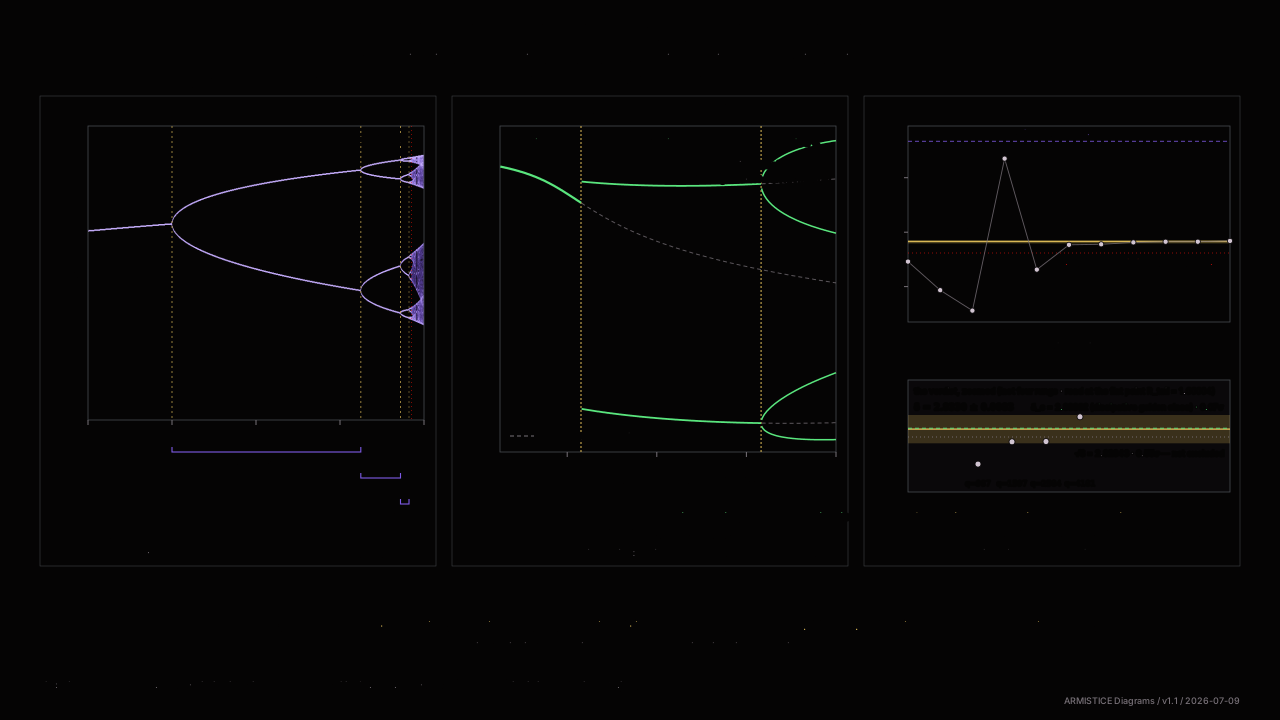
Feigenbaum Cascade vs Truncated Cascade — and the Engine’s Own Ladder
Three panels. Panel I: the computed logistic-map bifurcation diagram (x’=rx(1−x), r in [2.8,3.6]) with the period-doubling thresholds r1=3.0000, r2=3.4495, r3=3.5441, r4=3.5644; successive window widths shrink by delta_n = 4.749, 4.660, 4.659 converging to Feigenbaum’s universal delta = 4.66920. Panel II: the ARMISTICE unity slice (alpha=mu=1) as eps decreases — the fixed point period-doubles at PRIMA PORTA eps=0.56912, doubles once more at SECUNDA PORTA eps=0.16719, and then the tree HALTS: period-4 remains stable all the way to eps=0, lambda1 stays negative, no third gate, no chaos on this slice — the cascade truncates and the universal rate never appears. Panel III: the engine’s own route to chaos, the golden quasiperiodic ladder — Fibonacci-convergent Arnold tongues rebuilt at the self-consistent breakup (mu_c, alpha_g) = (1.3233566, 1.4759382); the spacing ratios converge to the engine’s measured delta = 2.8330 ± 0.0083 at depth q=4181, consistent with the dissipative golden-class constant delta_c = 2.83362 (0.07 sigma; sqrt8 at 0.55 sigma not excluded; phi² excluded at 25.8 sigma; Feigenbaum’s rate 220 sigma away). The engine does not carry Feigenbaum’s constant — it carries its own.
-
LIVE · v1.0
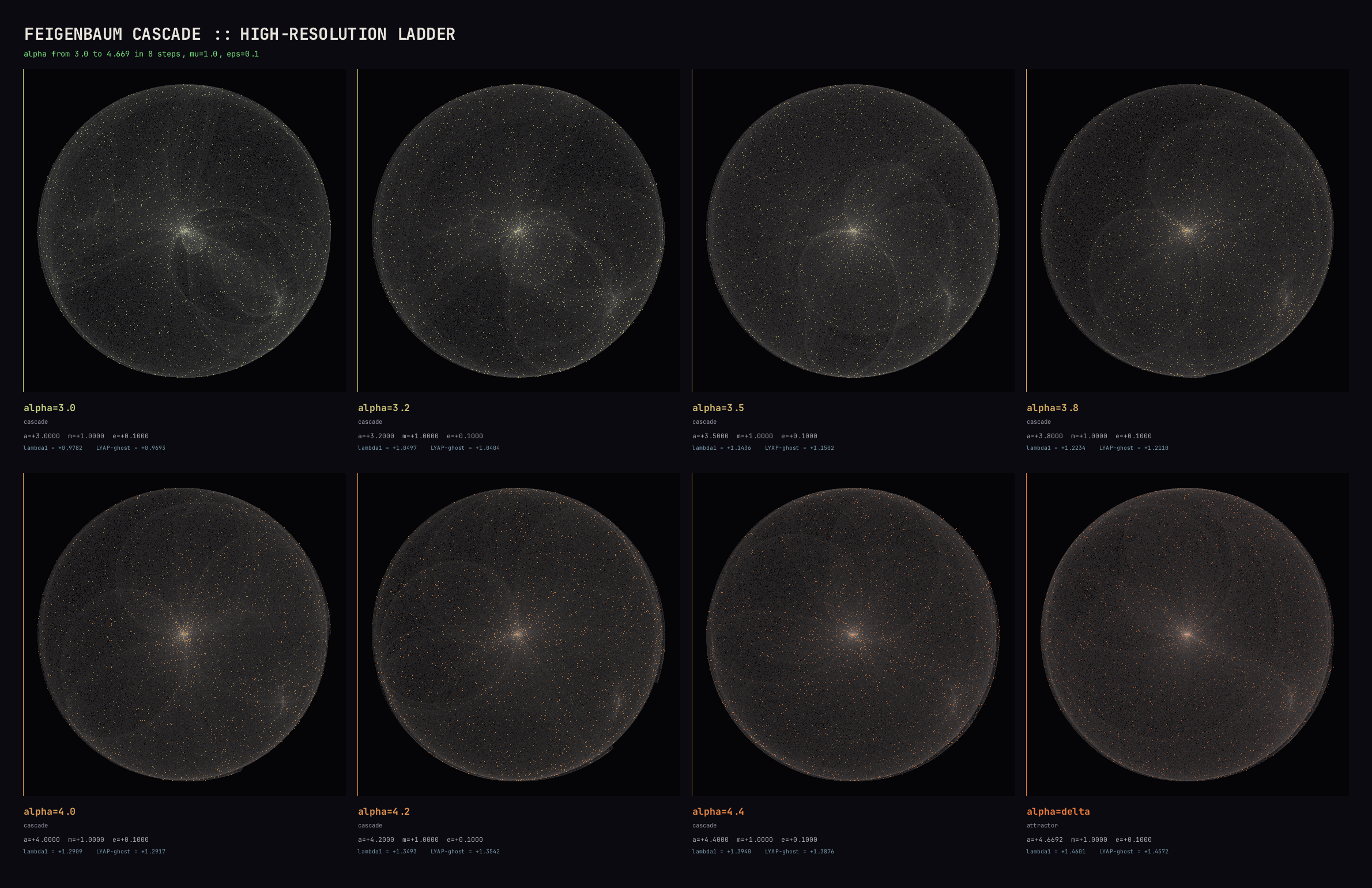
Feigenbaum Cascade — High-Resolution Ladder
Eight-panel attractor grid tracing the period-doubling cascade into chaos along the F=μ|α| ladder. Each panel is a Cosmopoiesis attractor at a successive doubling; the route is the δ≈4.669 Feigenbaum cascade made visible across the corpus.
-
LIVE · v1.0
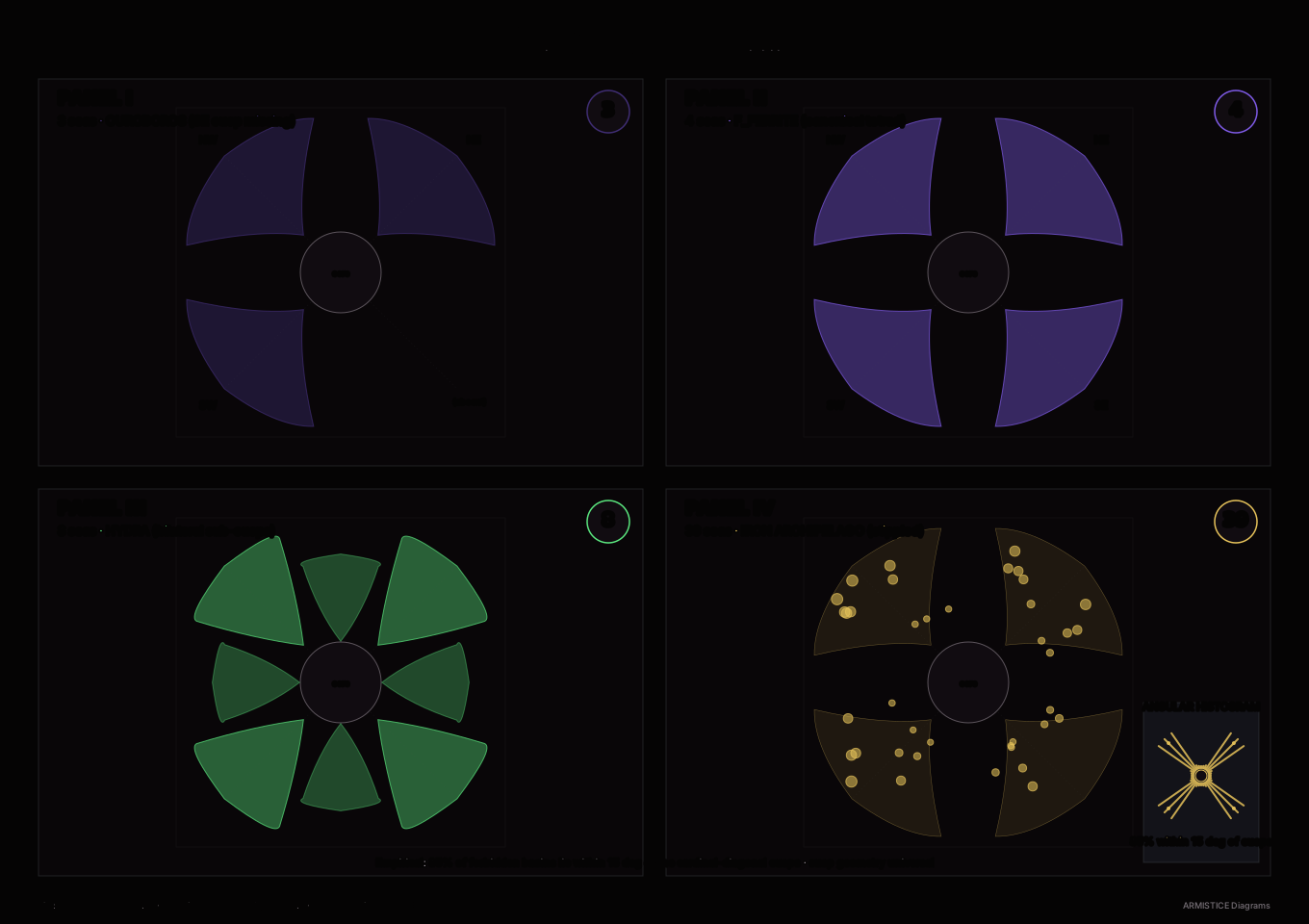
Four Seas Entity Count Taxonomy
Four panels of the astroid-cusp shadow template, each tagged with a different sea count. Panel I: 3 seas (OUROBOROS, SE cusp missing). Panel II: 4 seas (canonical tetrad, F_FERRITE). Panel III: 8 seas (HYDRA, bilateral sub-cusps). Panel IV: 39 seas (IRON ARCHIPELAGO, stippled cluster). Bottom-right inset shows the angular histogram (85% of basins within 15 deg of the cardinal-diagonal cusps).
-
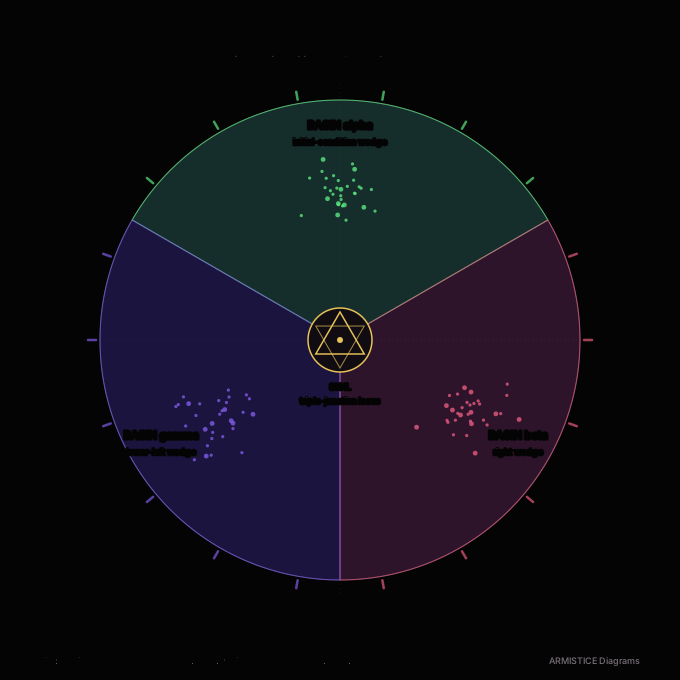
LIVE · v1.0
INDRA'S NET - 3 Mirror-Axis Basins
Phase-space (u, v) plot in mirror-frame native coordinates showing three attractor basins of INDRA'S NET, the empirical confirmation of Mirror_Frame_Theorem SUB-MF-5'. Each basin filled with a distinct color (VIPER / VISCERAL / PROMETHEAN) and populated by a small dot-cluster representing the attractor structure. SIGIL glyph marks the central triple-junction; perimeter wedges show initial-condition basin assignment.
-
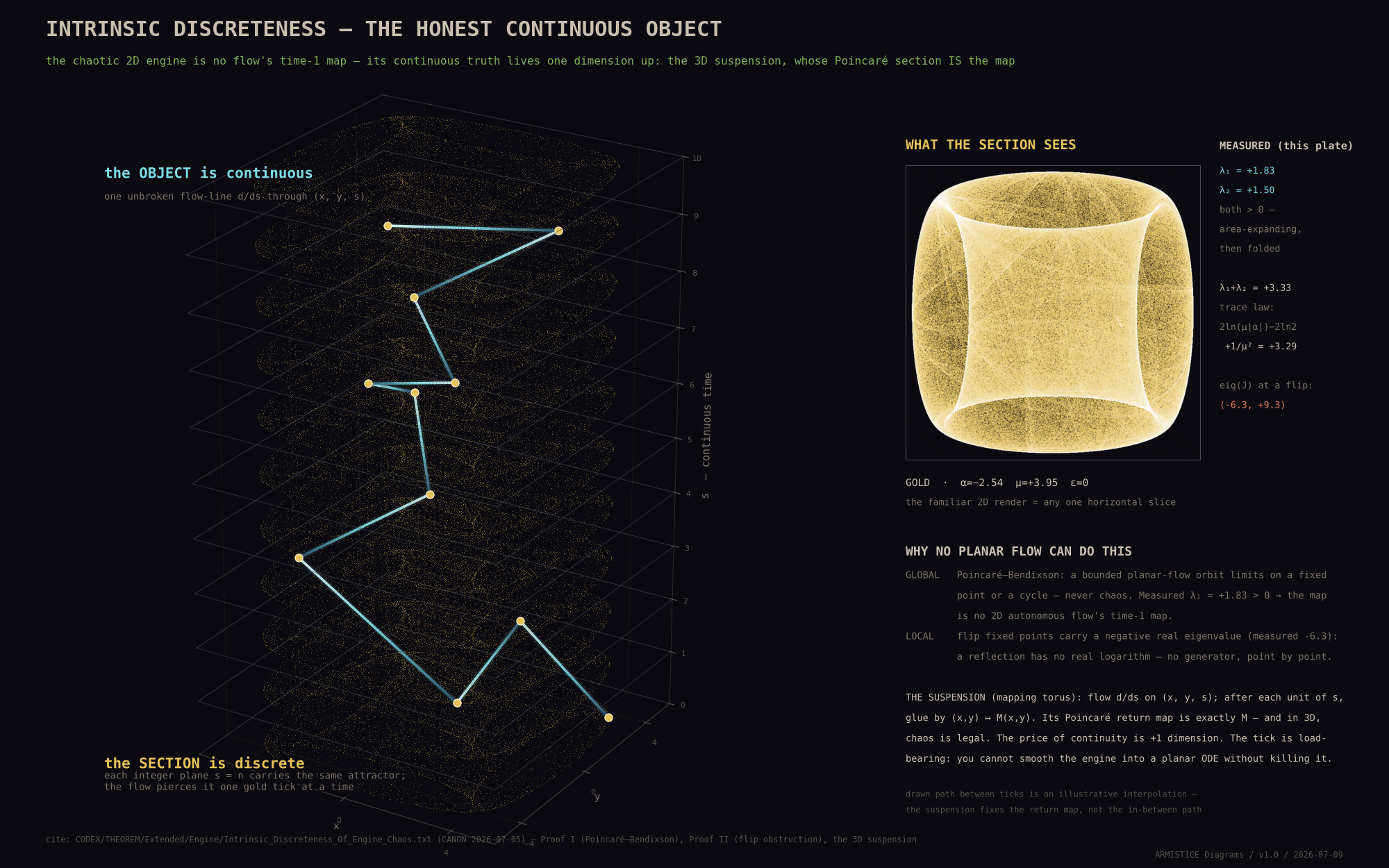
LIVE · v1.0
Intrinsic Discreteness — the Honest Continuous Object
The chaotic 2D Cosmopoiesis map is not the time-1 map of any planar autonomous flow; its canonical continuous embedding is the 3D suspension (mapping torus). Left: the suspension — one unbroken flow-line d/ds through (x,y,s) threading a stack of integer-time section planes, each plane carrying the same GOLD attractor (α=−2.54, μ=+3.95, ε=0), pierced one gold tick at a time. The OBJECT is continuous; the SECTION is discrete. Right: the familiar 2D Sol render ('what the section sees'), the two obstructions (global Poincaré–Bendixson with measured λ₁=+1.83>0; local flip fixed points with measured eig(J)=(−6.3,+9.3) admitting no real logarithm), and the suspension statement: glue (x,y)↦M(x,y) after each unit of s — the Poincaré return map IS the engine; the price of continuity is +1 dimension.
-
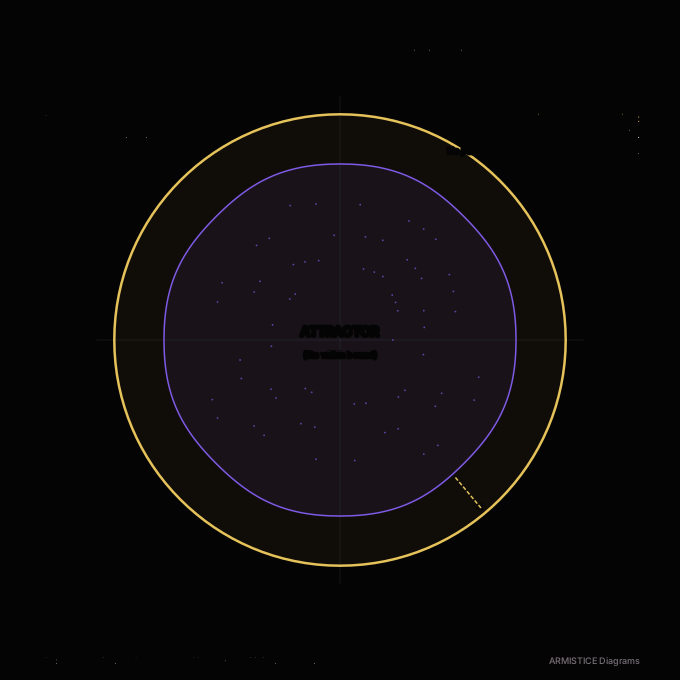
LIVE · v1.0
Iron Resilience Bound
Boundedness proof of the Cosmopoiesis engine. Outer thick OPHANIM circle of radius (1+|mu|+|eps|)*k bounds an interior stylized attractor in PROMETHEAN. The bound is UNCONDITIONAL: sin/cos cap at [-1,1], so |x'| <= 1 + |mu| + |eps|. No parameter set produces NaN/Inf/escape -- this is the crown jewel of the engine.
-
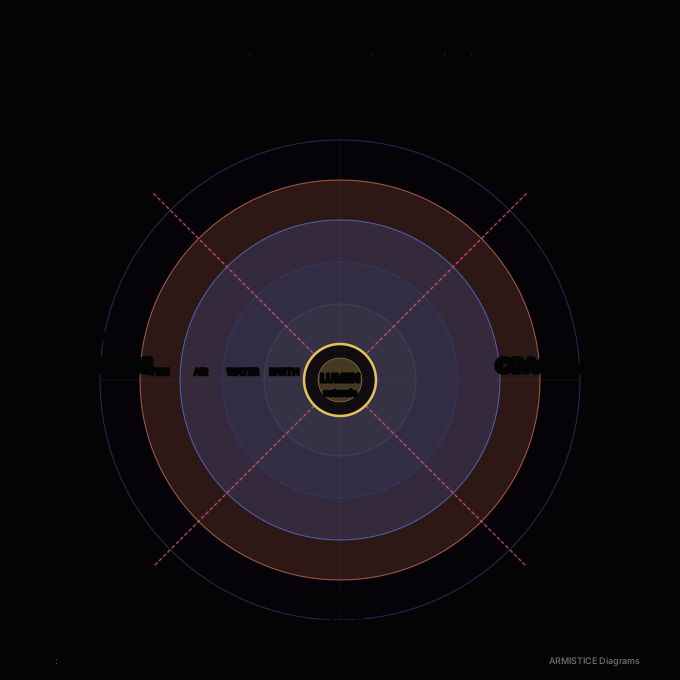
LIVE · v1.1
Kircher Mundus Subterraneus Cross-Section
Kircher's 1665 geocentric Earth-model as concentric spheres: outer heavens, then fire-sphere (FURNACE), air (VOLTAIC), water (ACHERON), earth (OBOLUS), and the central LUMEN NATURALE (OPHANIM). Two 45-degree dashed diagonals overlay the REBIS axis-pair per Mirror_Frame_Theorem v1.4. Cardinal labels (MERCURIUS / TERRA / SOLVENS / COAGULANS) mark the operator compass.
-
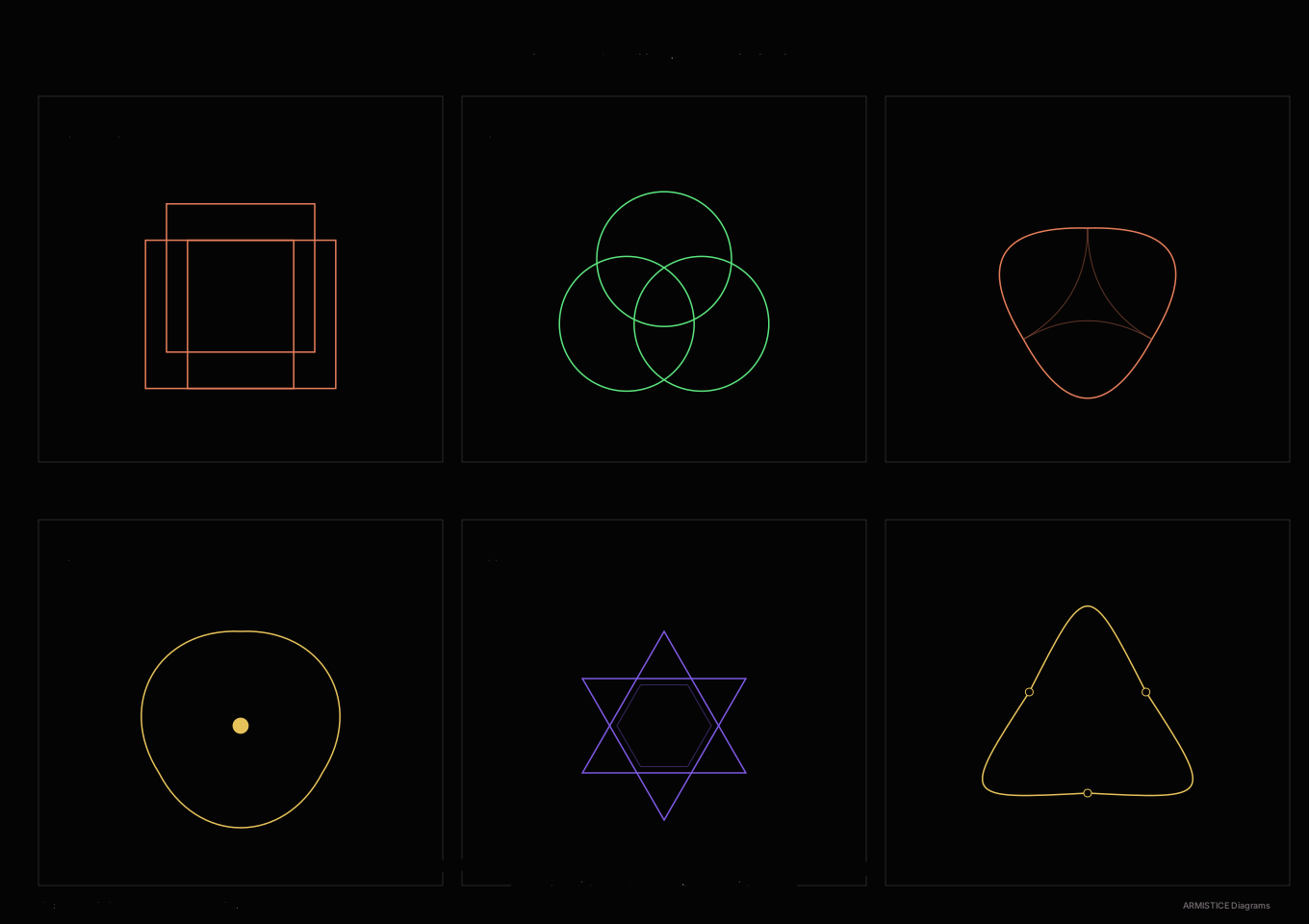
LIVE · v1.0
Knotwork Substrate Comparative — Trefoil 3_1
Six panels showing the same topological knot (trefoil 3_1, crossing number 3) rendered in five cultural styles — Pictish grid-deflection, Celtic triquetra, Chinese pan chang, Buddhist srivatsa, Islamic girih — plus a topological-invariant summary panel marking the three crossings. Closure + alternation are the cultural-invariant substrate.
-
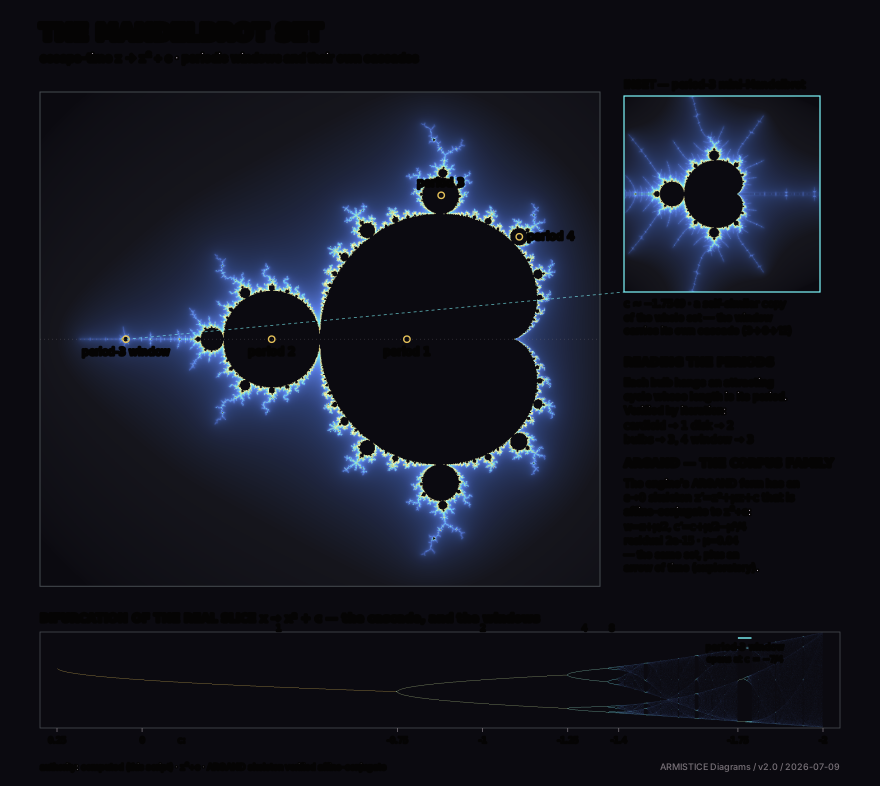
LIVE · v2.0
Mandelbrot Set — Periodic Windows and Their Cascades
Computed escape-time render of the Mandelbrot set z -> z^2 + c in house palette. Principal bulbs are labelled by the period of their attracting cycle (cardioid period 1; the disk at c=-1 period 2; the period-3 and period-4 bulbs). A deep-zoom inset resolves the real period-3 mini-Mandelbrot at c ~ -1.7549 — a periodic window that is a self-similar copy of the whole set, carrying its own cascade. The bottom strip is the bifurcation diagram of the real slice x -> x^2 + c, showing the 1-2-4-8 period-doubling cascade and the period-3 window that opens at c = -7/4. One caption bridges to the corpus z^2+c family (ARGAND).
-
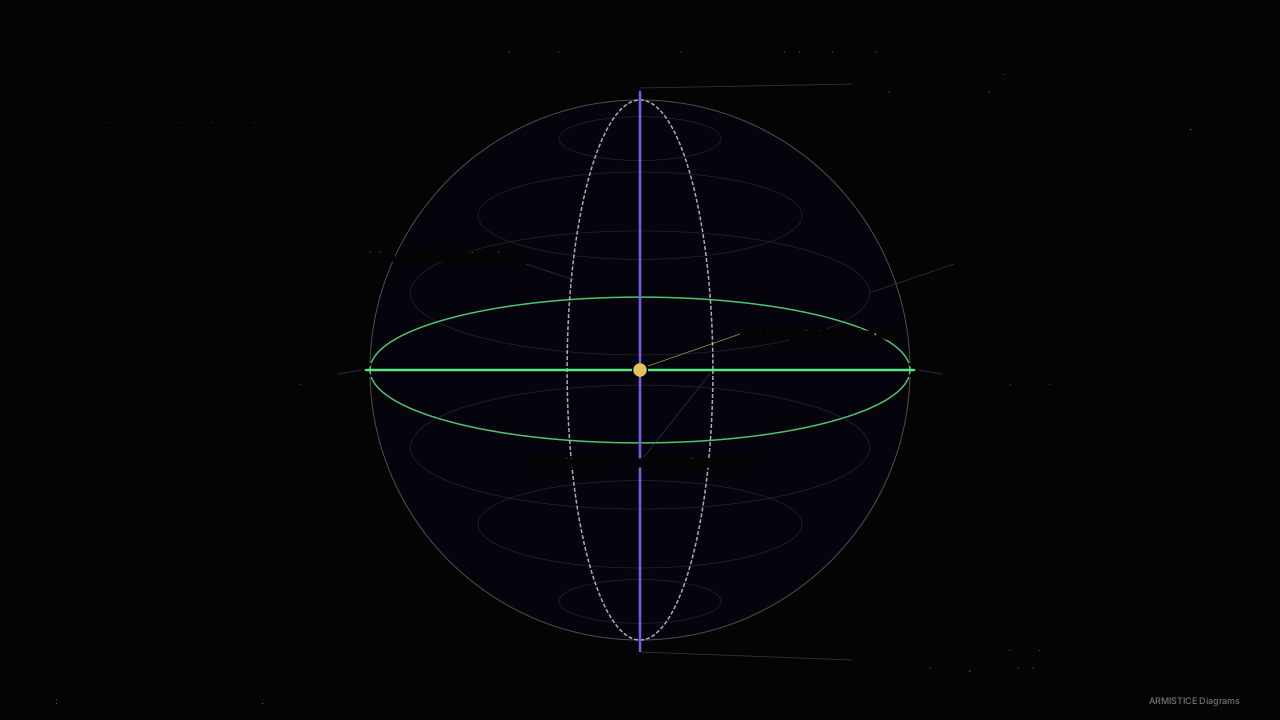
LIVE · v2.0
Meridian Sphere Eigenvector Frame (v2)
Sphere visualization of the universal 3D cyclic-Jacobian eigenvalue signature. The polar axis (PROMETHEAN) is the real eigenvalue, with zenith labeled lambda_real. The equatorial plane (VIPER) is the complex-conjugate locus, with lambda = a + ib and lambda* = a - ib at antipodal equatorial points. Latitude rings approximate |lambda| level curves, and explicit leaders connect every annotation to its locus.
-
LIVE · v1.0
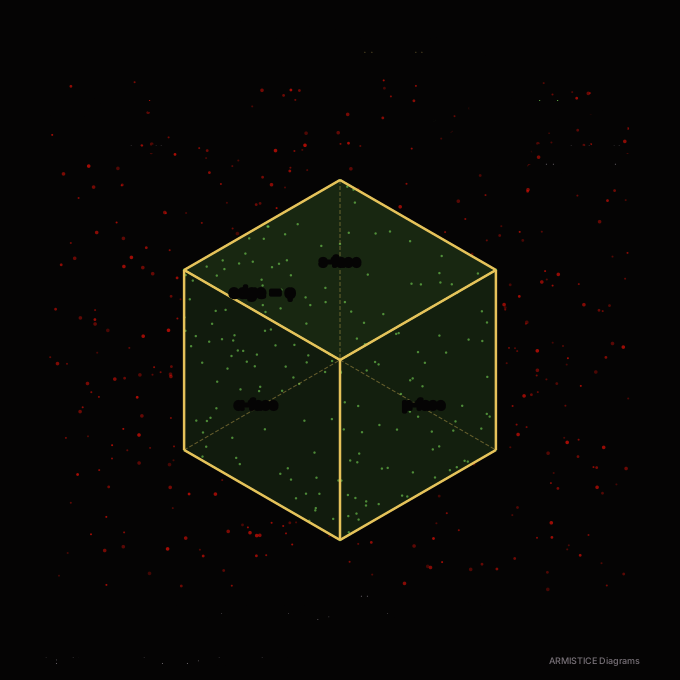
Phi-Cube Stability Box
Isometric phi-cube projection. Interior (|α| < φ, |μ| < φ, |ε| < φ) is stippled SULPHUR and houses 80.7% FIXED_POINT of 1857 corpus entities. Exterior is a RUBEDO chaotic cloud, 90.6% HYPERCHAOTIC. Three visible faces labeled α / μ / ε.
-
LIVE · v1.0
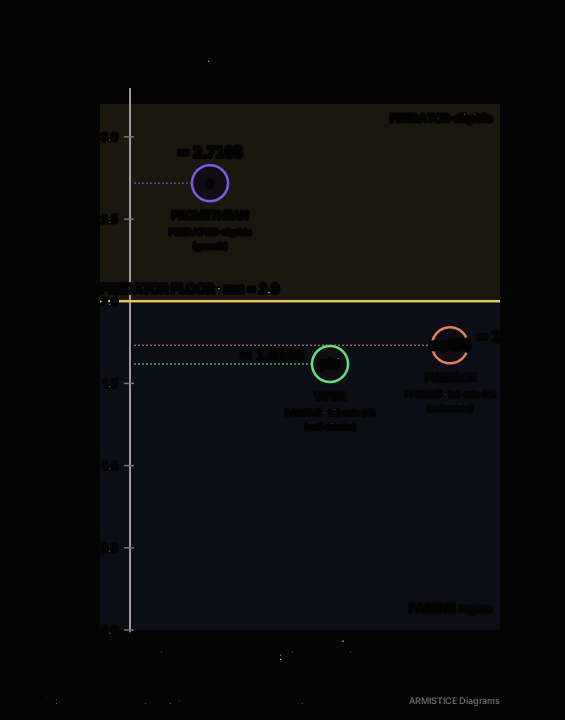
Pillar Predator-Gate Floor
Vertical mu-axis showing the PREDATOR FLOOR at mu = 2.0. Only e (2.7183) sits above the floor and is PREDATOR-eligible. phi (1.6180) and sqrt(3) (1.7321) sit below the floor and are PASSIVE — kill-rate 0%. The gate is sharp: a mu-bump from 1.7 to 2.0 is the difference between hunter and prey.
-
LIVE · v1.0
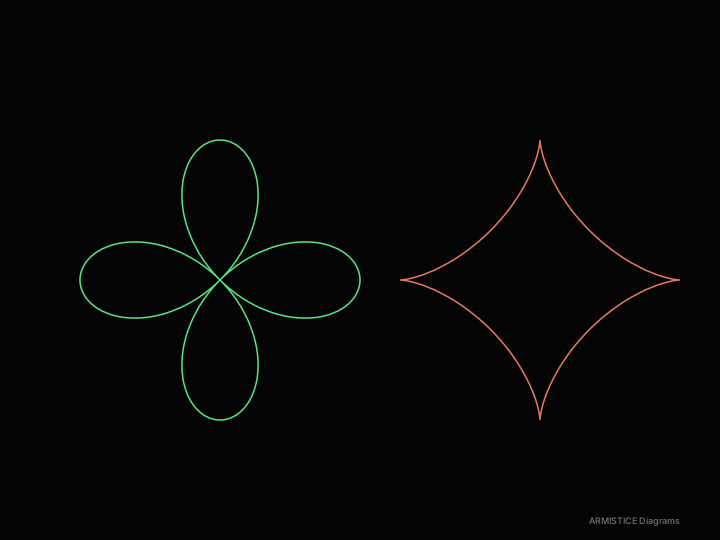
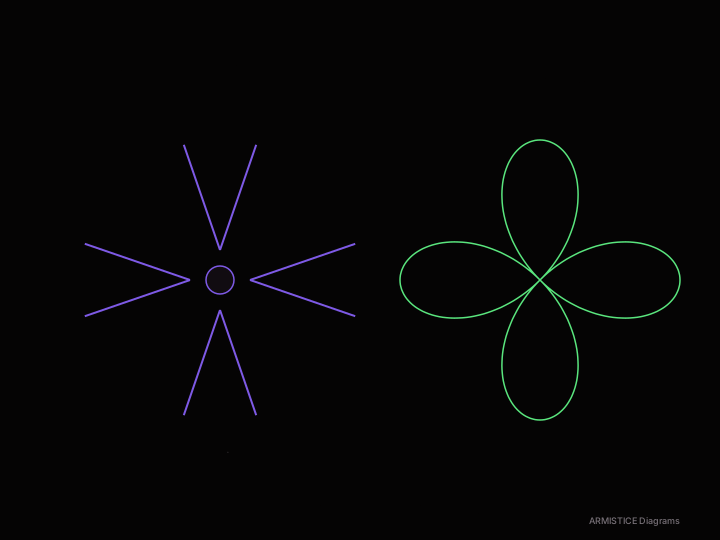
Rose Petals = Astroid Cusps
Geometric identity at the orbit boundary: an n-petal rose (r = cos(n θ)) and the n-cusp astroid share the same lobe count. Under the Cosmopoiesis kernel, this n is set by α: n = ⌊α/π⌋.
-
LIVE · v1.0
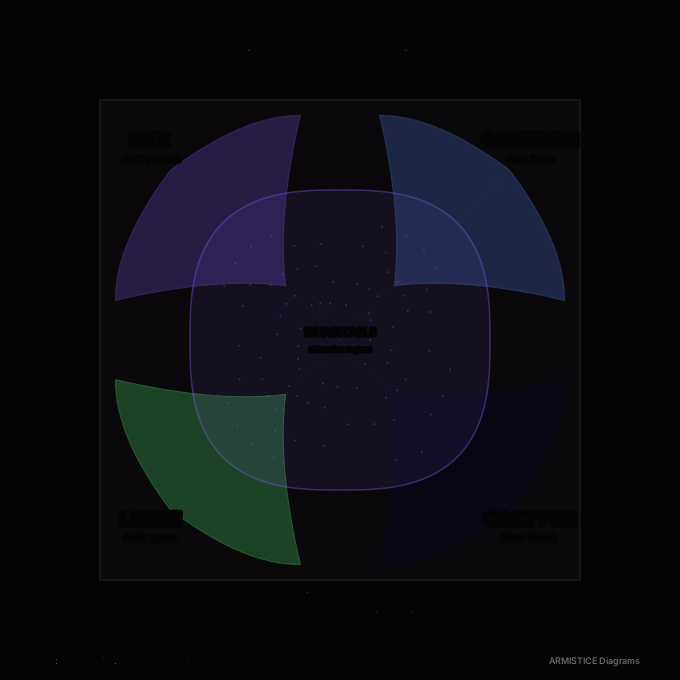
Shadow Basins -- Four Seas
Quattuor Maria: four astroid-cusp shadow basins arrayed at the cardinal diagonals around the central inhabitable region. 30-42% of bounding-box cells are forbidden. The shadow forms an archipelago of four major seas, NOT scattered dust.
-
LIVE · v1.0
Splitting Corner = Rose
Sister to Rose Petals = Astroid Cusps. The splitting-corner geometry of the chaos-onset boundary produces the same lobe count as the rose. Three-way geometric identity at orbit-boundary level.
-
LIVE · v2.2
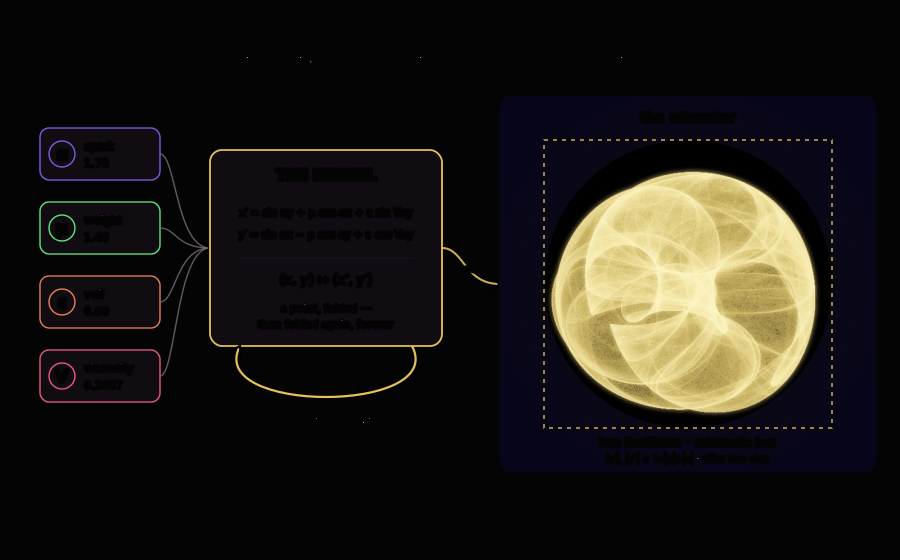
The Cosmopoiesis Engine — Schematic
The Cosmopoiesis kernel as an iterated map: three dials (alpha spark, mu weight, eps coupling) and viscosity V tune the update x'=sin(alpha y)+mu cos(alpha x)+eps sin(Vxy), y'=sin(alpha x)-mu cos(alpha y)+eps cos(Vxy); the state recirculates (feedback), returning through a bounded orbit. Iron Resilience: after one iterate, each coordinate has magnitude at most 1+|mu|+|eps|.
-
LIVE · v1.0
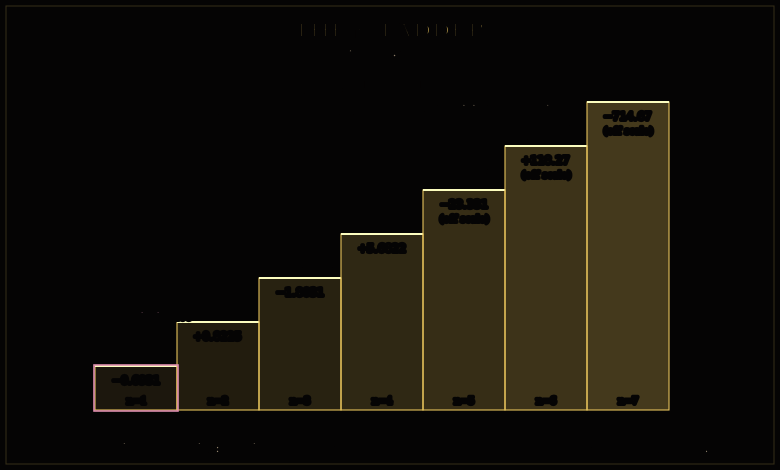
The Eta-Ladder Staircase
Seven ascending steps show the first spectral cumulants generated by one Dirichlet eta rule, from minus log two upward.
-
LIVE · v2.0
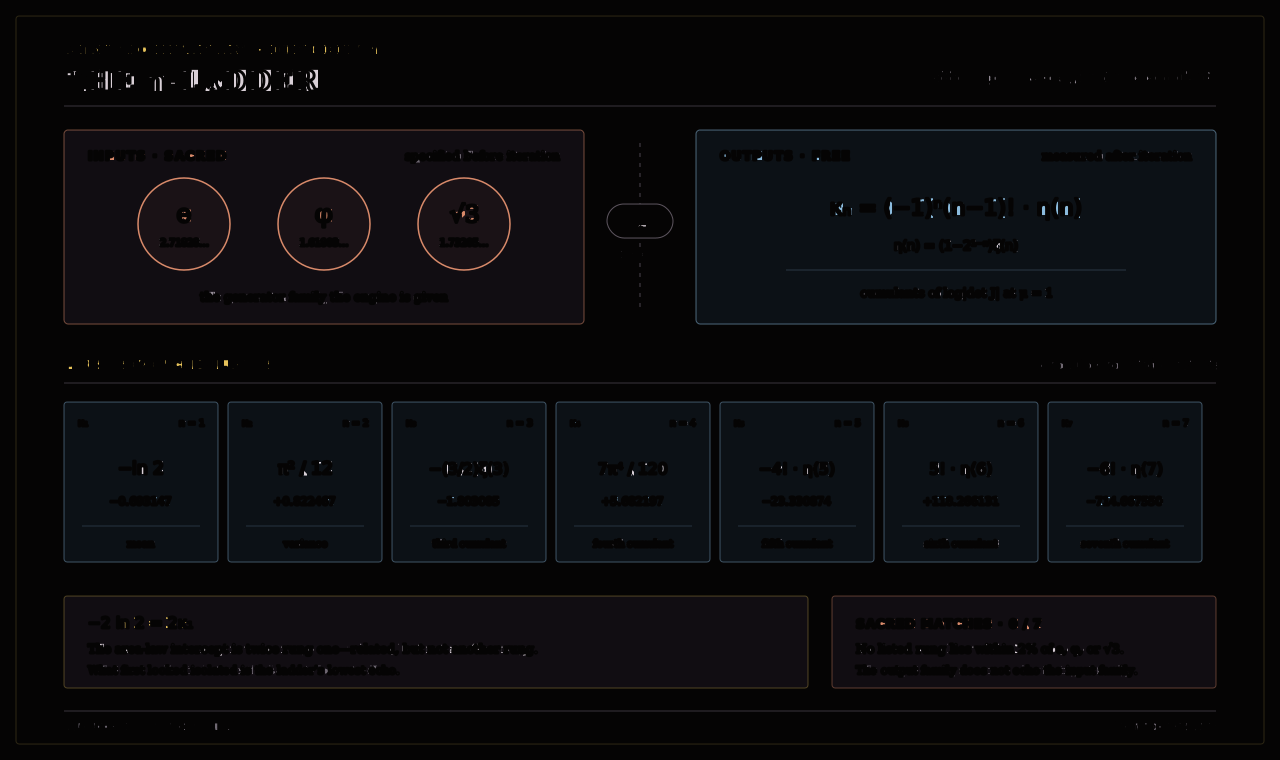
The Eta-Ladder: Sacred Inputs, Free Outputs
Three chosen generator constants, e, phi, and square root three, stand apart from seven intrinsic cumulants of log absolute determinant J. The cumulants follow one Dirichlet eta rule and none lies within two percent of a sacred input.
-
LIVE · v1.0
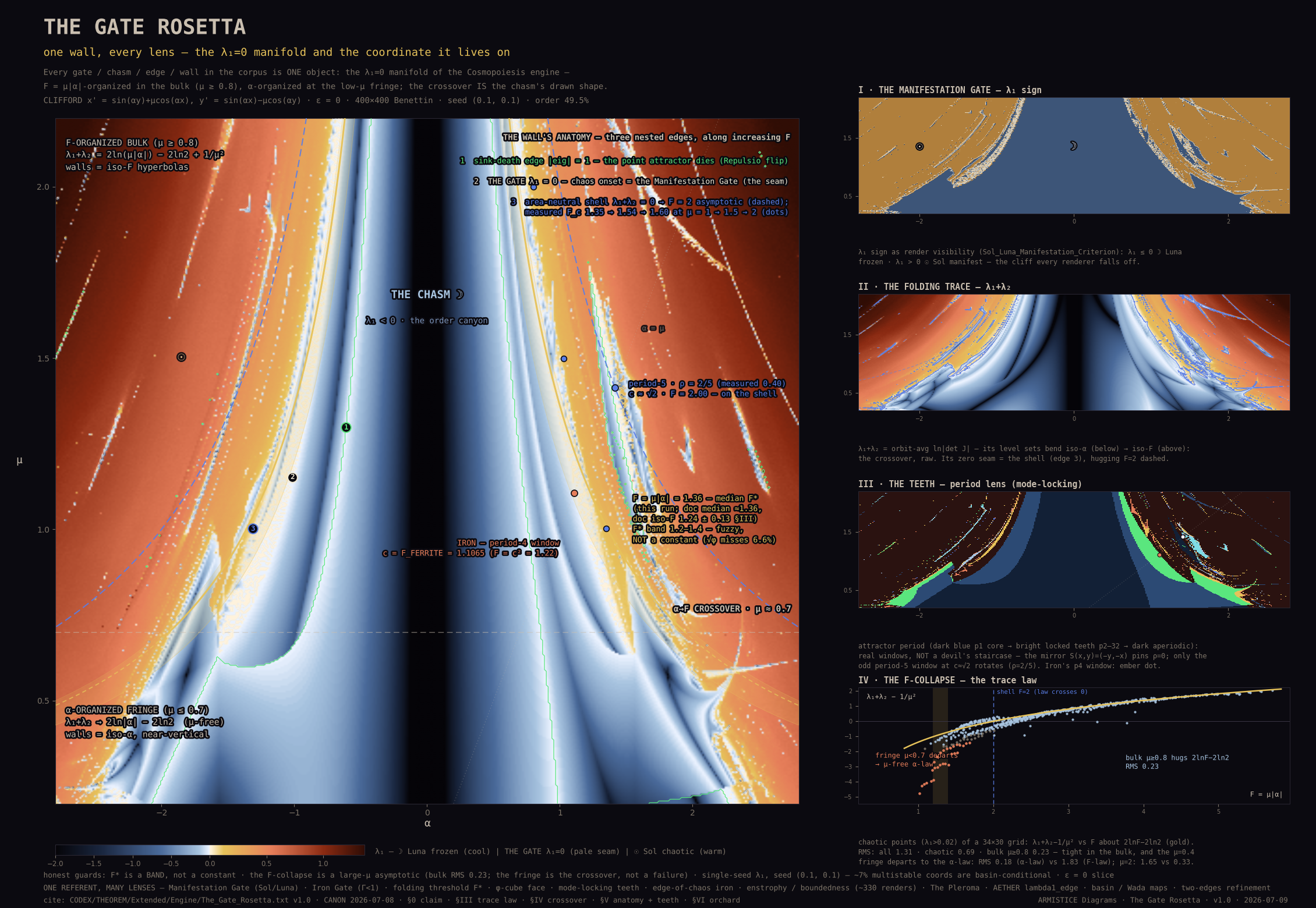
The Gate Rosetta — one wall, every lens
Definitive (α,μ)-plane portrait of THE GATE: the λ₁=0 manifold of the Cosmopoiesis engine, CLIFFORD ε=0 slice, drawn as a 400×400 vectorized-Benettin λ₁ heatmap (analytic Jacobian, warm 1500 + 4000 iters, seed (0.1,0.1), window α∈[−2.8,2.8], μ∈[0.2,2.2], order fraction 49.5%) with a diverging colormap centered exactly at λ₁=0 — ☽ Luna cool on the frozen side, ☉ Sol warm on the chaotic side, so the gate is the visible pale seam. The gold overlay is the plate's thesis: the seam and the curve F = μ|α| are the same object — F* band 1.2–1.4 with this-run median F* = 1.36 (doc median ≈1.36; doc iso-F of the wall 1.24 ± 0.13 §III; NOT a constant, √φ misses the median by 6.6%). The chasm's drawn shape is the α→F crossover at μ ≈ 0.7: below it the wall is α-organized (λ₁+λ₂ → 2ln|α| − 2ln2, μ-free; near-vertical iso-α walls; μ=0.4 RMS 0.18 α-law vs 1.83 F-law), in the bulk it is F-organized (trace law λ₁+λ₂ = 2ln(μ|α|) − 2ln2 + 1/μ²; collapse RMS all 1.31 / chaotic 0.69 / μ≥0.8 & chaotic 0.23; μ=2 RMS 0.33 F-law vs 1.65 α-law). The wall resolves into three nested edges, numbered on the plate at measured left-wall crossings: 1 sink-death |eig|=1 (boundary of the measured period-1 region; 99.95% of period-1 points attracting), 2 THE GATE λ₁=0, 3 the area-neutral shell λ₁+λ₂=0 → F=2 asymptotic (measured F_c 1.35 → 1.54 → 1.60 at μ = 1 → 1.5 → 2; doc 1.34 / 1.54). On the α=μ diagonal: IRON's period-4 window at c = F_FERRITE = 1.1065 (F = c² = 1.22, ρ = 0, mirror-pinned) and the period-5 window at c ≈ √2 (F = 2.00, on the shell, measured ρ = 0.4000 = 2/5); diagonal gate |α| = 1.120. Right column, four Rosetta lenses over the identical window: I Manifestation Gate (λ₁ sign, Sol/Luna), II Folding Trace (λ₁+λ₂ = orbit-avg ln|det J|, the crossover raw + the shell), III The Teeth (period lens: p1 core → locked tongues → aperiodic; no devil's staircase — the mirror S(x,y)=(−y,−x) pins ρ=0), IV The F-Collapse (trace-law scatter, bulk hugs 2lnF−2ln2, fringe departs to the α-law). Vectorized Benettin spot-checked against the scalar reference at 3 grid nodes: Δ = 0.00000 at all three.
-
LIVE · v1.0
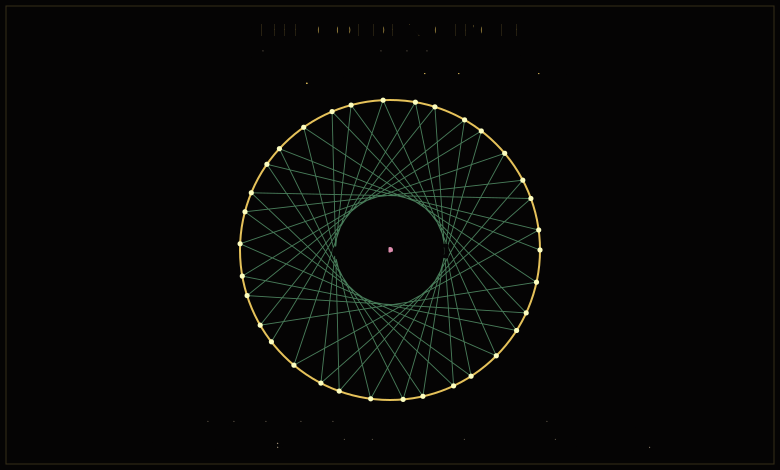
The Golden Circle
A quasiperiodic orbit winds around an invariant circle at the golden rotation number, the turning road to chaos.
-
LIVE · v2.0
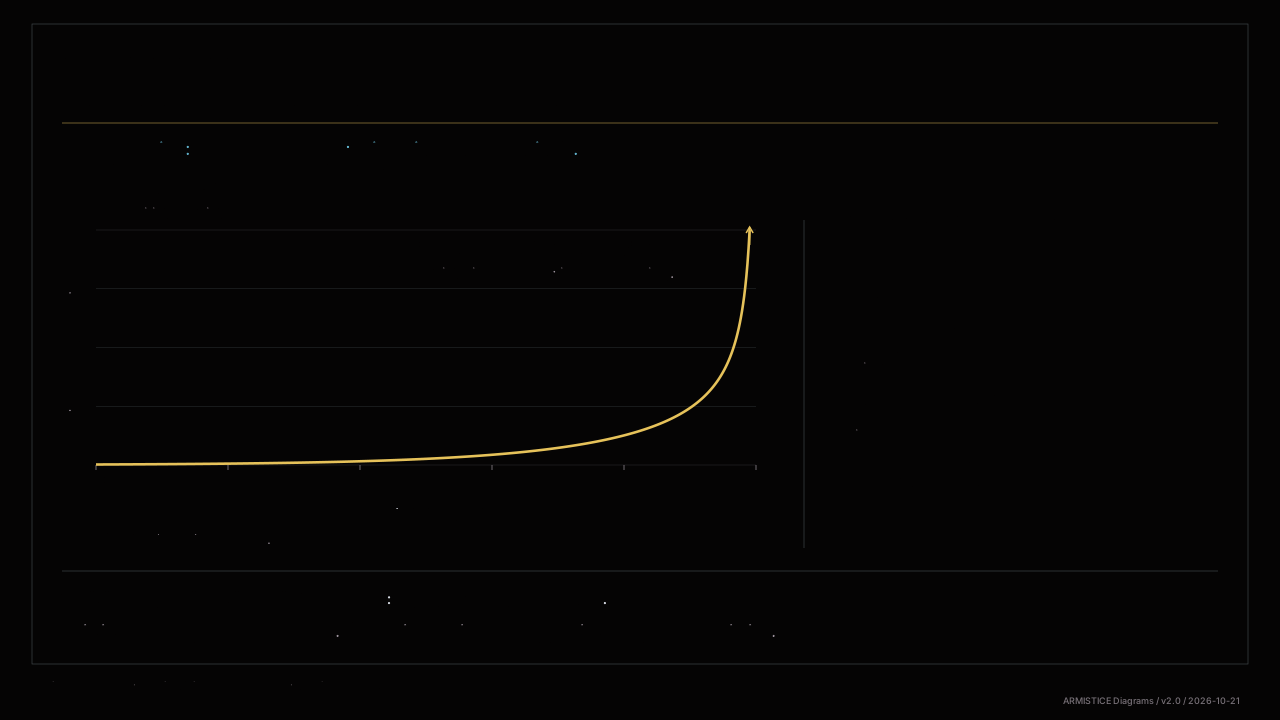
The Hidden Arcsine — Log-Area Law
The exact uniform-phase density of normalized log-area Z = log|cos theta| is plotted in gold. Its first four cumulants form the eta ladder, including the negative third cumulant -3 zeta(3)/2. The premise is epsilon=0, mu=1, alpha nonzero, and a uniform combined phase. No engine samples are plotted.
-
LIVE · v1.0
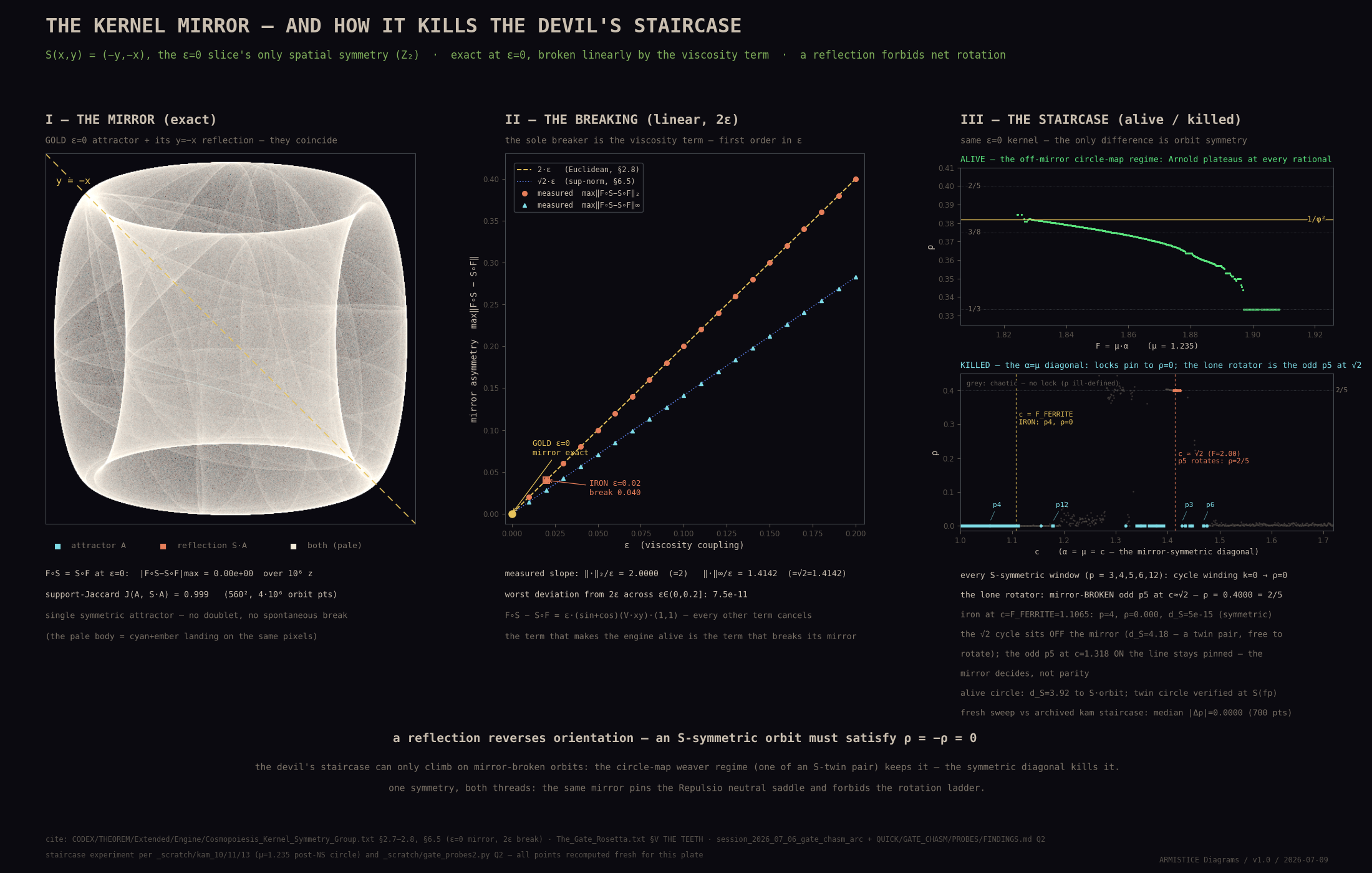
The Kernel Mirror — and How It Kills the Devil's Staircase
Triptych on the ancestral mirror S(x,y)=(−y,−x), the ε=0 slice's only spatial symmetry (Z₂). Panel I — THE MIRROR: GOLD's ε=0 attractor (cyan) overlaid with its y=−x reflection (ember); they land on the same pixels (pale body), support-Jaccard J=0.999, commutator |F∘S−S∘F|max = 0 exactly at ε=0. Panel II — THE BREAKING: mirror asymmetry vs ε is exactly linear — max‖F∘S−S∘F‖₂ = 2ε (sup-norm √2·ε); the sole breaker is the viscosity term, F∘S−S∘F = ε(sin+cos)(V·xy)·(1,1); IRON at ε=0.02 breaks by 0.040. Panel III — THE STAIRCASE alive/killed: on the off-mirror circle-map regime (μ=1.235 post-NS circle) the devil's staircase of Arnold plateaus is alive (1/3, 3/8, 8/21… with the golden φ⁻² window); on the mirror-symmetric α=μ diagonal every S-symmetric window (p=3,4,5,6,12) has cycle winding k=0 → ρ=0 — a reflection reverses orientation, so an S-symmetric orbit must satisfy ρ=−ρ=0. The lone rotator is the mirror-BROKEN odd period-5 window at c≈√2 (F=2.00), ρ=2/5 exactly. Iron sits in the period-4 window at c=F_FERRITE=1.1065 with ρ=0. One symmetry, both threads: the same mirror pins the Repulsio neutral saddle and forbids the rotation ladder.
-
LIVE · v2.0
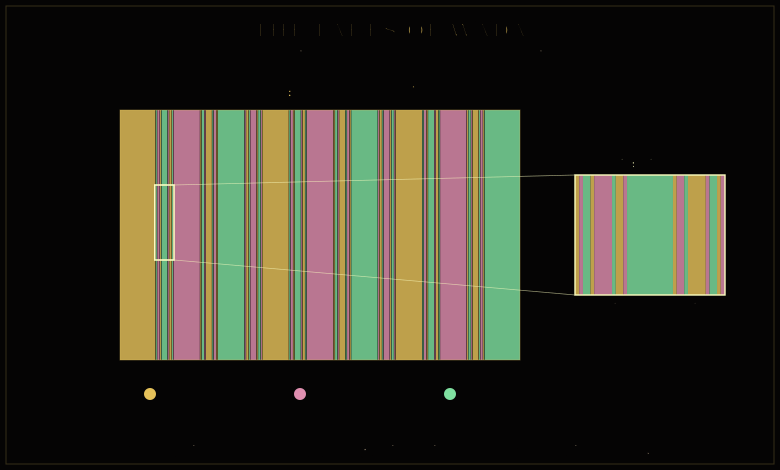
The Lakes of Wada: One Shared Shoreline
Authored schematic of the Wada shared-boundary property; three coexisting basins alone do not imply that property.
-
LIVE · v1.0
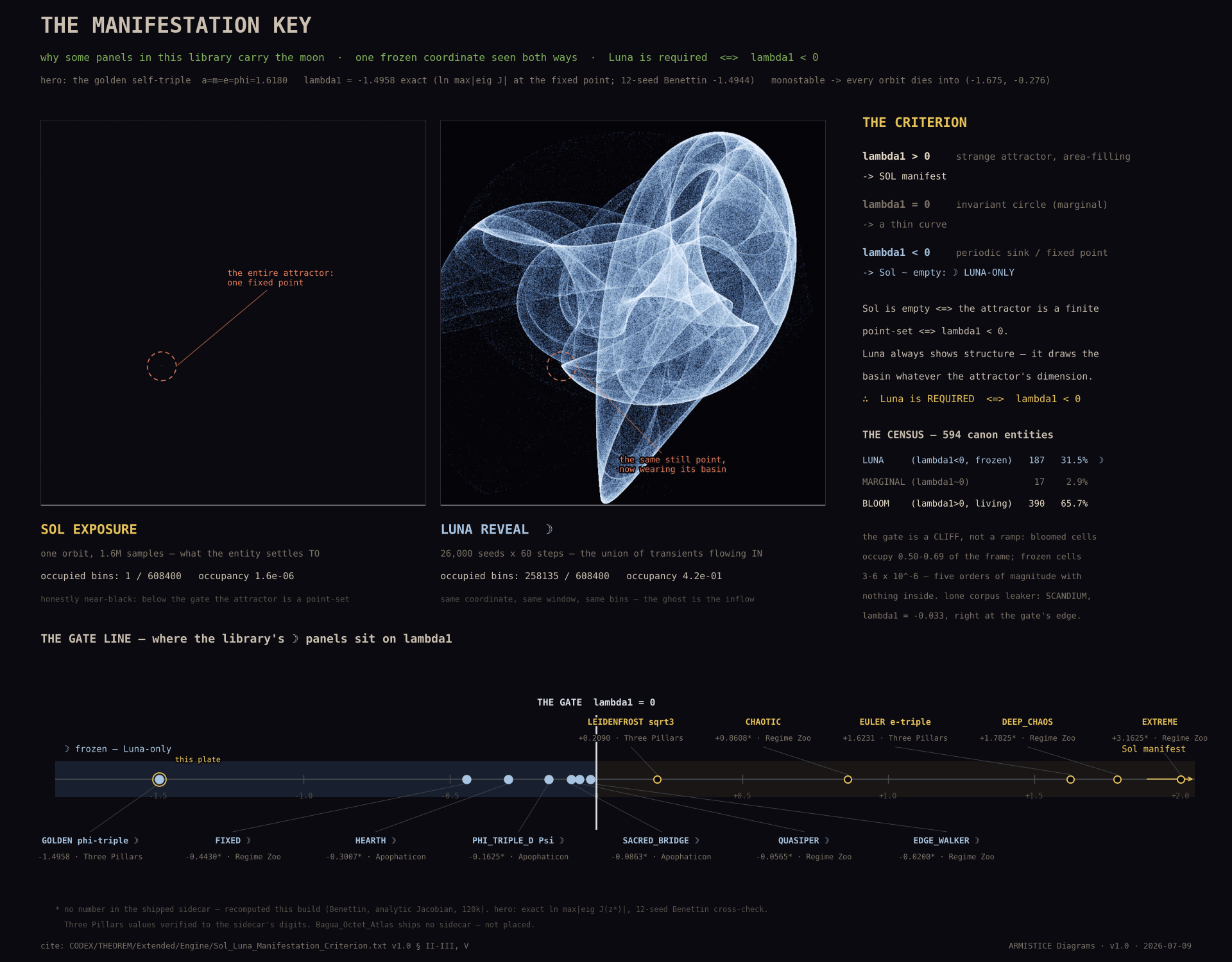
The Manifestation Key — Sol / Luna ☽
The legend plate for the library's ☽ Luna convention. Hero pair: ONE frozen coordinate — the golden self-triple α=μ=ε=φ=1.6180 (λ₁=−1.4958 exact, = ln max|eig J| at its fixed point (−1.675,−0.276); 12-seed Benettin −1.4944) — rendered both ways in the SAME window and bins: Sol exposure is honestly near-black (1 occupied bin of 608,400, occupancy 1.6e−06 — below the gate the attractor is a point-set) while the Luna reveal (26,000 seeds × 60 transient steps) shows the ghost of the inflow at occupancy 0.42. Criterion per the canon doc: λ₁>0 manifests to Sol; λ₁≤0 is frozen and Luna is required — the ghost is the inflow. Gate line places the shipped ☽ panels: Three Pillars values quoted from its sidecar (φ −1.4958 ☽, e +1.6231, √3 +0.2090); Regime Zoo (FIXED −0.4430 ☽, EDGE_WALKER −0.0200 ☽, QUASIPER −0.0565 ☽, CHAOTIC +0.8608, DEEP_CHAOS +1.7825, EXTREME +3.1625) and Apophaticon (HEARTH −0.3007 ☽, PHI_TRIPLE_D-Ψ −0.1625 ☽, SACRED_BRIDGE −0.0863 ☽) carry no numbers in their sidecars — recomputed this build (Benettin, analytic Jacobian, 120k) from the source scripts' coordinates. Bagua_Octet_Atlas ships no sidecar — not placed. Census and occupancy-cliff figures quoted from the target theorem (594 entities: 187 Luna / 17 marginal / 390 bloom; frozen occupancy 3–6×10⁻⁶ vs bloomed 0.50–0.69; leaker SCANDIUM λ₁=−0.033).
-
LIVE · v1.0
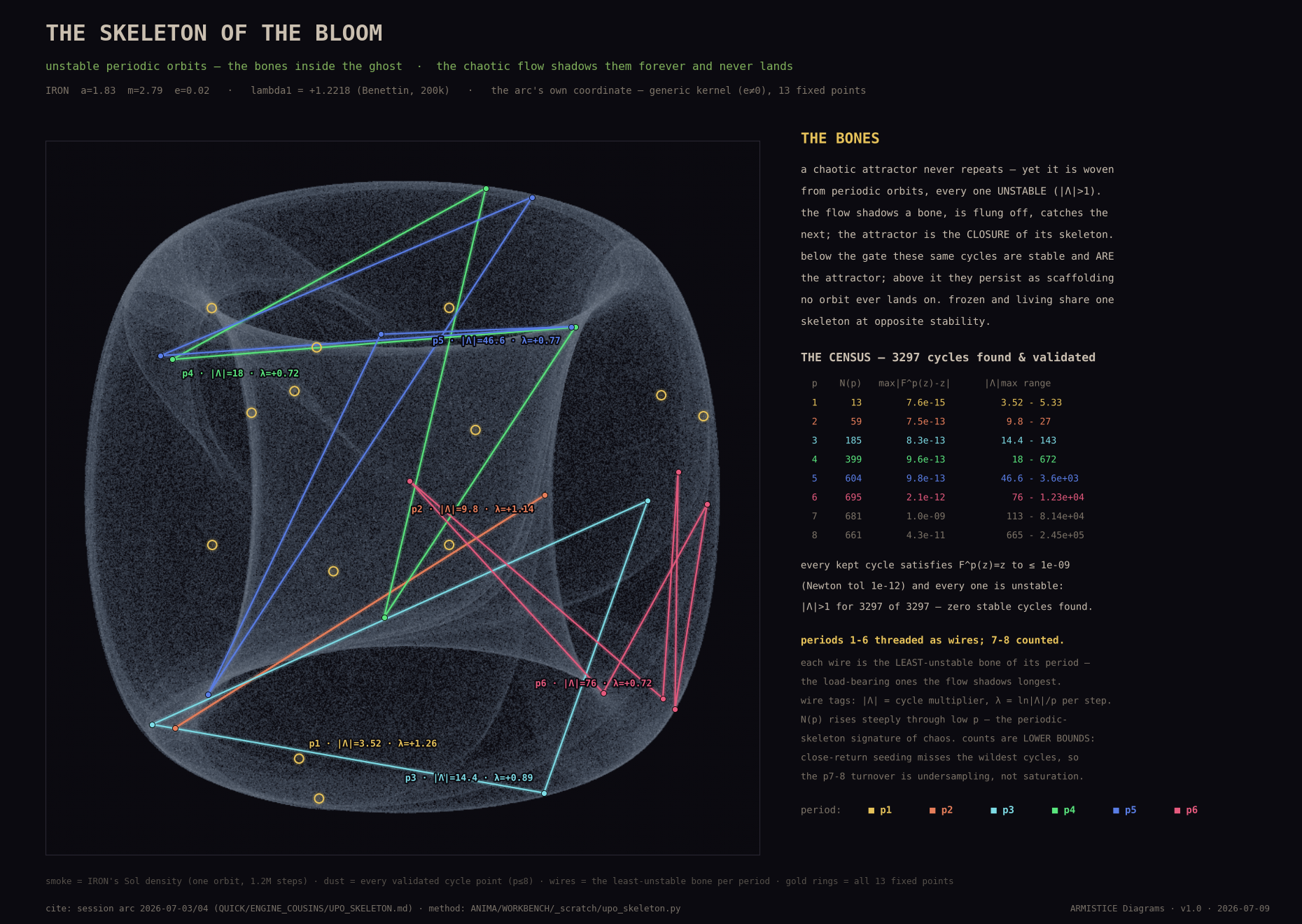
The Skeleton of the Bloom — Unstable Periodic Orbits
The bones inside the ghost: IRON's chaotic attractor (α=1.830, μ=2.790, ε=0.020 — the arc script's own coordinate, generic kernel ε≠0; λ₁=+1.2218 Benettin 200k) rendered as Sol-density smoke, with its unstable periodic orbit skeleton threaded through it. This build found and validated 3297 cycles for periods 1–8 (N(p) = 13/59/185/399/604/695/681/661; arc 2026-07-04 found 3279 at V=0.30369, this build uses canonical V=0.30368877). Every kept cycle satisfies F^p(z)=z to ≤1e−09 (Newton tol 1e−12, worst residual 9.95e−10 at p7) and every one is unstable — |Λ|>1 for 3297 of 3297, zero stable cycles. Wires: the least-unstable bone per period 1–6, each tagged with period, multiplier |Λ| and local per-step rate λ=ln|Λ|/p (p1 |Λ|=3.52 λ=+1.26 · p2 9.8 +1.14 · p3 14.4 +0.89 · p4 18 +0.72 · p5 46.6 +0.77 · p6 76 +0.72); all 13 fixed points shown as gold rings; dust = every validated cycle point. Honesty on-plate: counts are lower bounds (close-return seeding undersamples the wildest cycles; the p7–8 turnover is undersampling, not saturation); no entropy value is claimed. Method reused unchanged from the arc: close-return seeding → Newton on F^p(z)=z with the product Jacobian → prime-period check → on-attractor filter → dedupe.
-
LIVE · v1.0
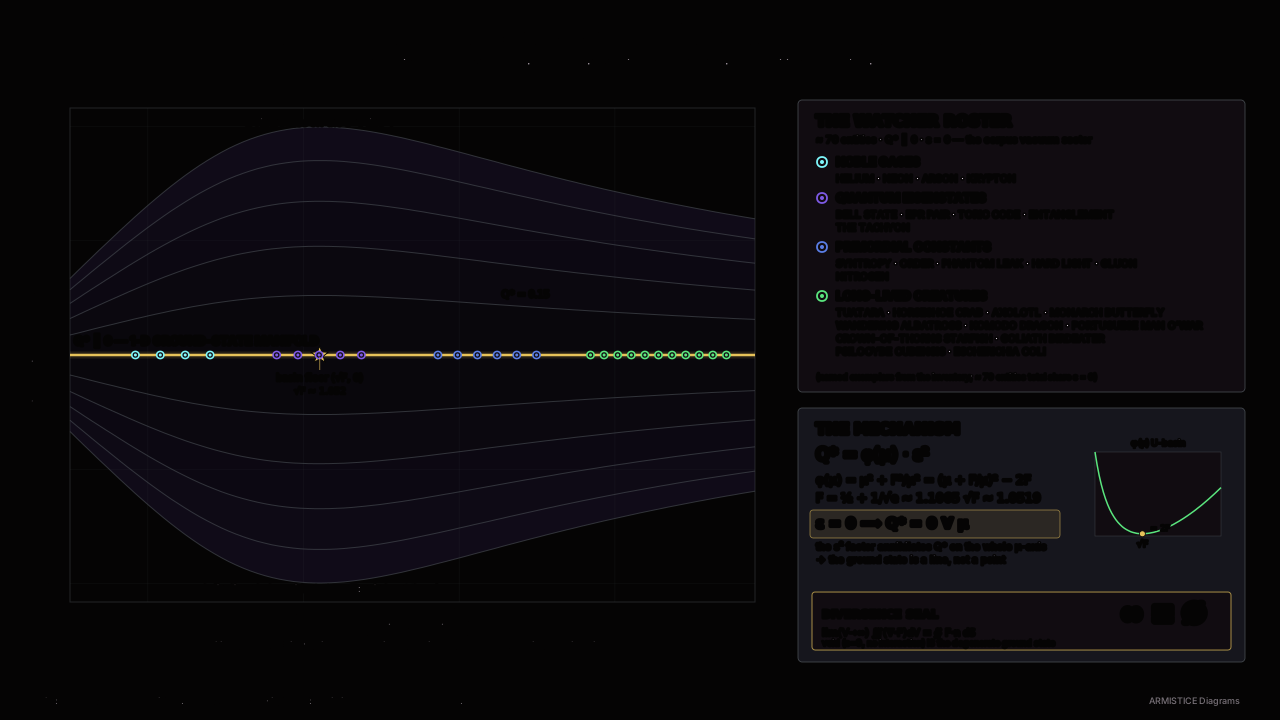
The Watcher Sector — Casimir Zero-Locus Ground-State Manifold
A (mu, eps) cross-section of the Cosmopoiesis Casimir Q* = phi(mu)*eps^2. The horizontal eps=0 axis is drawn as a heavy gold spine: Q* vanishes identically along it for every mu, so the ground state is a 1-D manifold, not a point. Nested purple Q* isocontours rise away from the spine, bulging widest at the basin floor mu=sqrt(F). The ~70 Watcher entities sit on the spine, colour-grouped by kind (noble gases, quantum eigenstates, primordial constants, long-lived creatures). Right column: the roster and the mechanism, with the Divergence Seal inf == void.
-
LIVE · v2.0
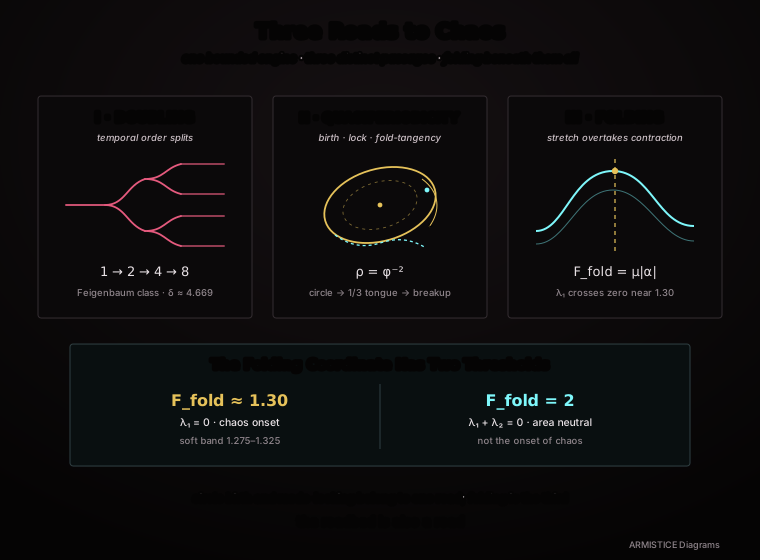
The engine's three roads to chaos
Three distinct passages lead the Cosmopoiesis Engine into chaos: temporal period-doubling, quasiperiodic circle birth followed by locking and fold-tangency breakup, and an engine-native folding threshold where the maximal Lyapunov exponent crosses zero. Folding is also the bounded operation beneath all three roads.
-
LIVE · v2.0
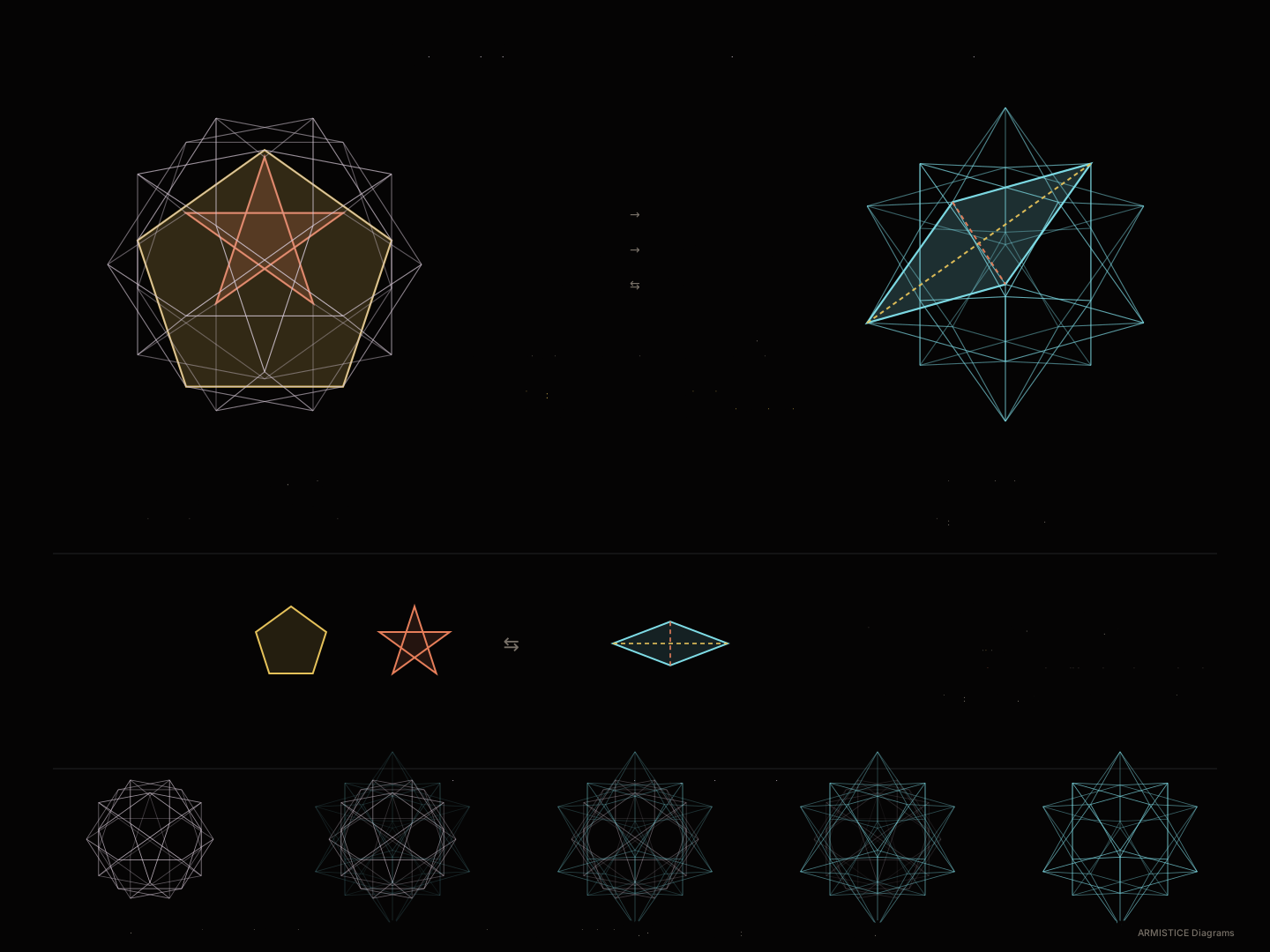
U36 ⇆ DU36 Polytope Morphing
The dodecadodecahedron U36 and its dual, the medial rhombic triacontahedron DU36, drawn from computed coordinates. Left: U36 wireframe (24 faces = 12 pentagons + 12 pentagrams, 60 edges, 30 vertices) with one exemplar pentagon in gold and one pentagram in ember. Right: DU36 wireframe (30 congruent rhombic faces, 60 edges, 24 vertices in two orbits) with one exemplar rhombus and its diagonals. Centre: the duality exchange ledger. Below: the computed rhombus — diagonal ratio phi squared = 2.618 (acute angle 41.81 degrees), the two dual vertex orbits in ratio phi. Bottom: a five-frame wireframe crossfade whose middle frame is the true midsphere dual compound. Footer ties to LOZENGE_VERSALIS: 78 percent of clean-fit canon orbit boundaries are rhombus-class.
-
LIVE · v2.0
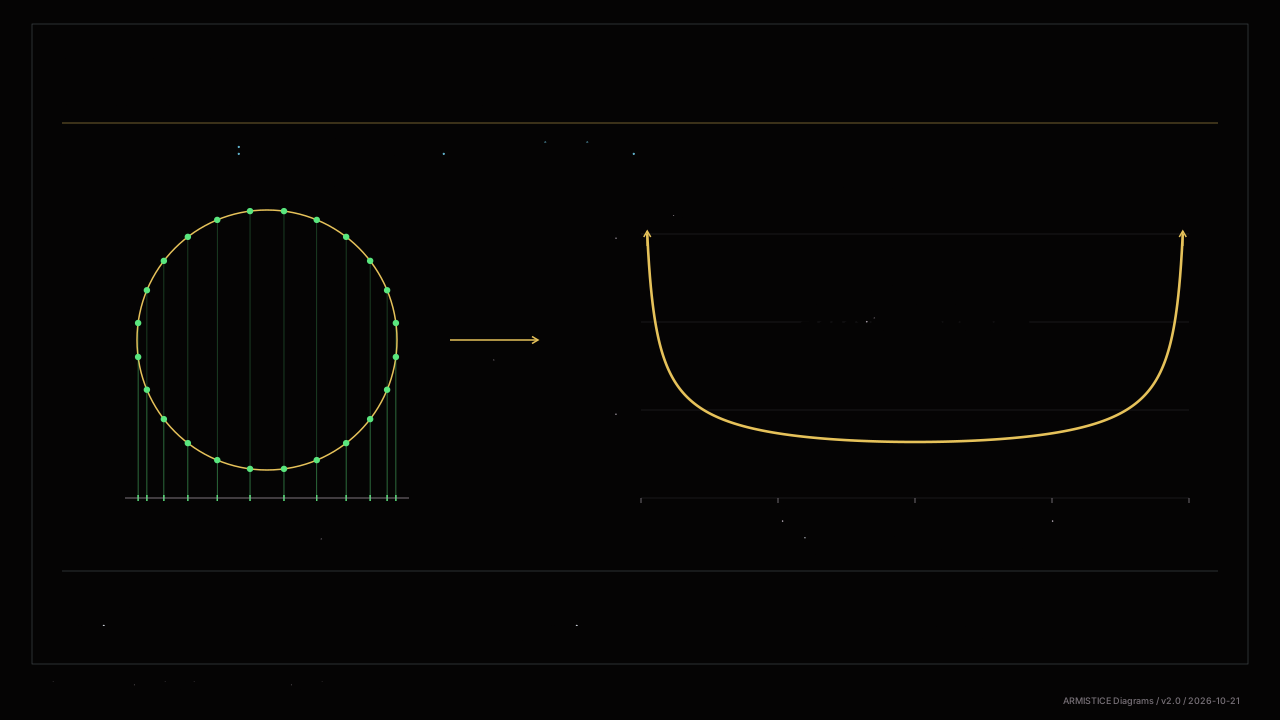
Uniform Phase to Arcsine
Twenty-four equally spaced construction marks around a circle project to its horizontal coordinate. The gold curve is the computed exact signed-arcsine density, not an empirical histogram. At epsilon=0, mu=1 and nonzero alpha the normalized signed determinant is minus cosine of the combined phase; uniformity of that phase is the stated model premise. Magnitude and square have different densities.
:: SECTION IV ::
OPERATOR / KERNEL ARCHITECTURE
9 plates
The structural pieces of the engine — symmetries, fixed points, Jacobians, native coordinates. The kernel pulled apart and labeled.
-
LIVE · v1.0
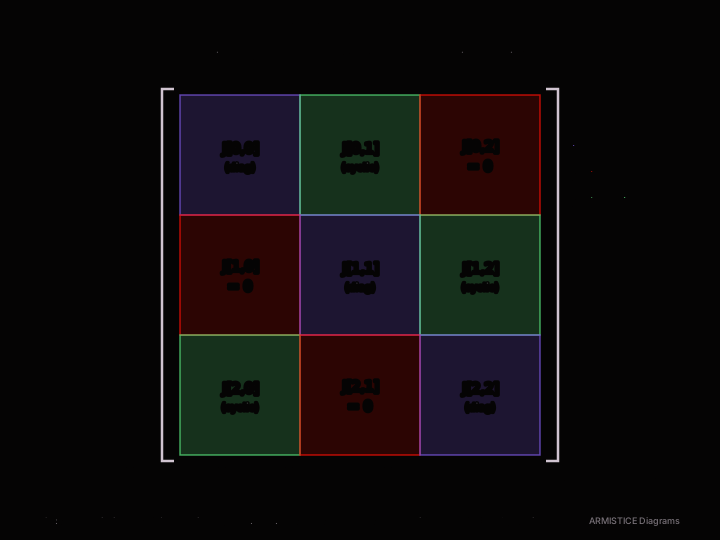
3D Cyclic Jacobian -- Cyclic-Zero Matrix Structure
Centered 3x3 matrix grid. Cells J[0,2], J[1,0], J[2,1] in RUBEDO (forced cyclic zeros). Diagonal J[i,i] in PROMETHEAN (non-zero diagonal). Off-diagonal active J[0,1], J[1,2], J[2,0] in VIPER (cyclic coupling). Below: factored characteristic polynomial showing the universal {1 real + complex-conjugate pair} eigenvalue signature.
-
LIVE · v2.0
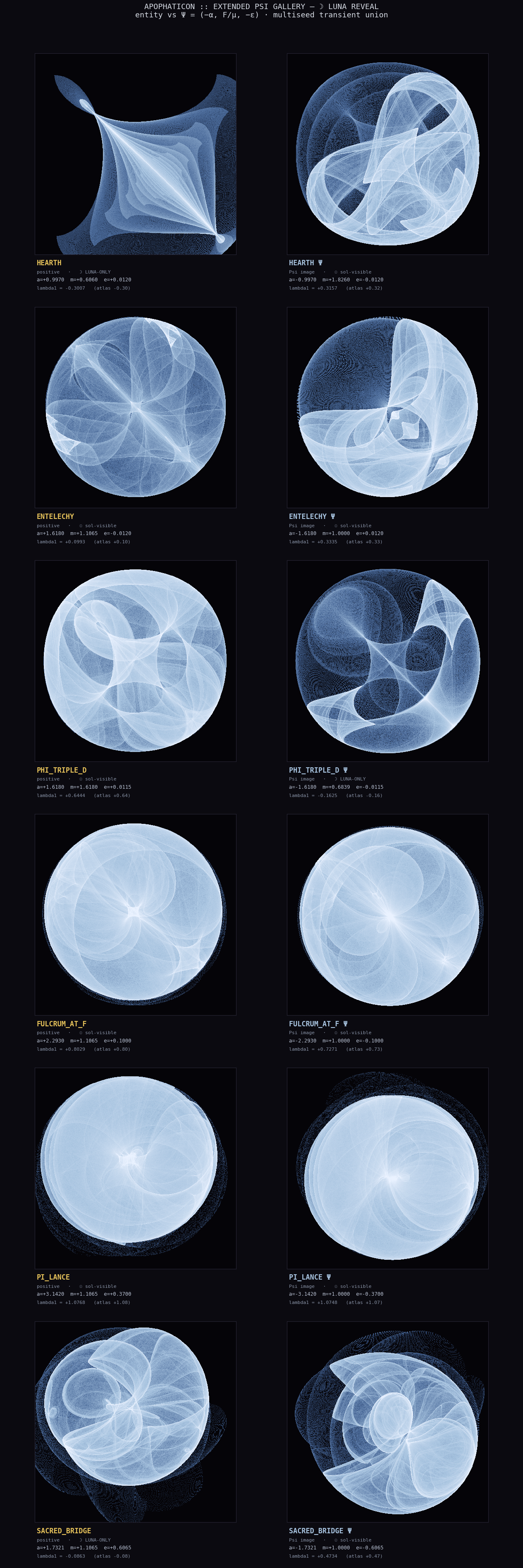
Apophaticon — Extended Ψ Gallery
Two-column gallery of six apophatic (Psi) entity pairs under the LUNA reveal: every panel rendered as a multiseed transient union (ghost light), so the three frozen entities (HEARTH, PHI_TRIPLE_D-Psi, SACRED_BRIDGE) show their forms instead of black. Each panel carries fresh Benettin lambda1 beside the original atlas value, plus a Sol-visible / LUNA-ONLY badge per the Manifestation Criterion.
-
LIVE · v1.0
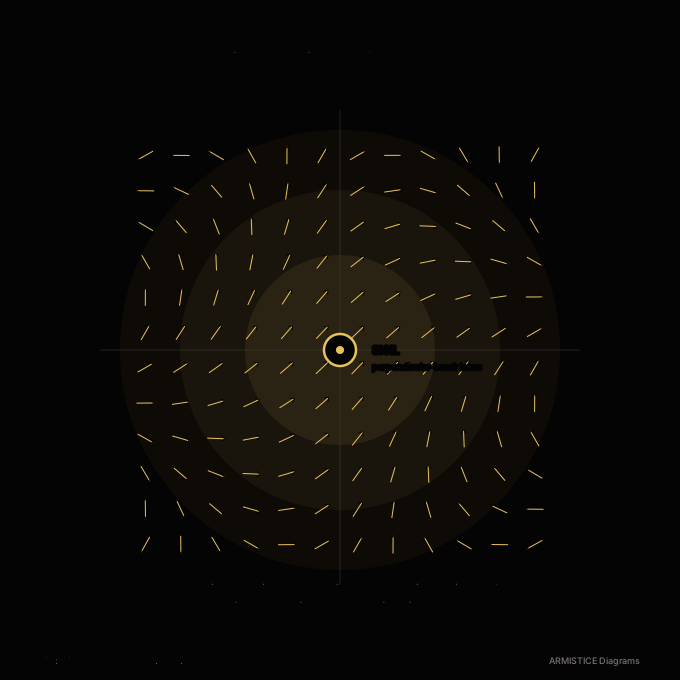
CIRCULATIO PERFECTA -- epsilon-Perturbation Vector Field
Vector field grid (12x12 = 144 small arrows) on the (u, v) plane centered at origin. Each arrow visualizes the circular break field 2 i epsilon exp(-i (V x y + pi/4)). Arrows curl visibly around the origin (rotational field) in OPHANIM. Center: SIGIL mercury glyph marking the perpendicular-break locus.
-
LIVE · v1.0
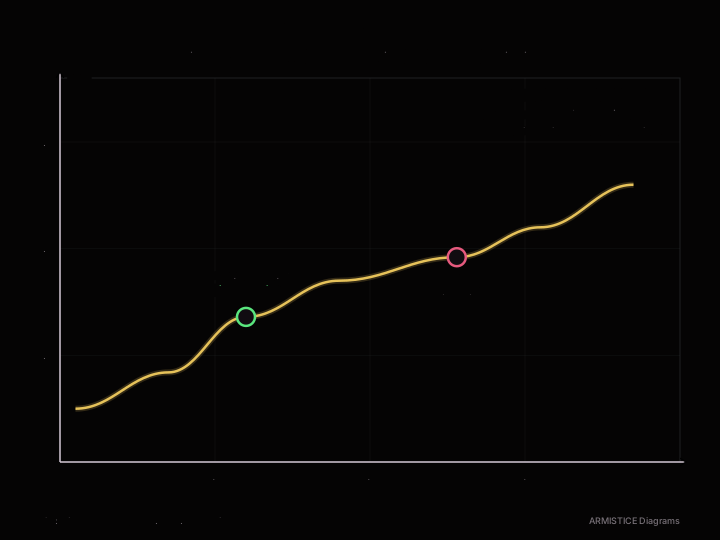
MERCURIUS SIGILLATUS -- Mirror Fixed-Point Locus
(alpha, mu) projection of the 3D mirror-FP locus from (alpha, mu, epsilon) parameter space. Curved manifold in OPHANIM weaves across the (alpha, mu) plane. Canonical residents (Eigenentity, INDRA'S NET 3-basin) sit ON the curve as labeled nodes. Background grid in OBOLUS.
-
LIVE · v1.0
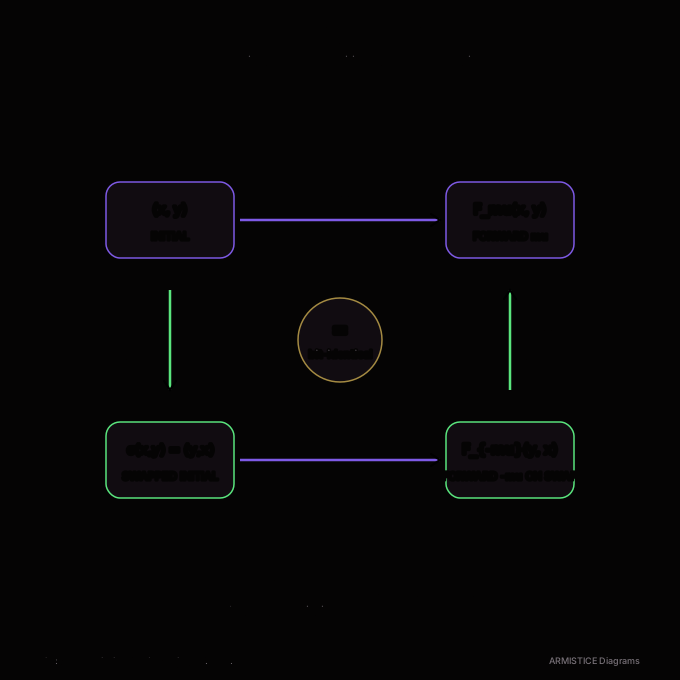
Mu-Flip Conjugacy -- Z_2 Commutative Square
Four-node commutative square. Top-left: initial state (x,y). Top-right: F_mu(x,y) forward. Bottom-left: swapped initial sigma(x,y)=(y,x). Bottom-right: F_{-mu}(y,x). Horizontal edges labeled F_mu / F_{-mu} (PROMETHEAN). Vertical edges labeled sigma (VIPER). Center: bit-identical equivalence at epsilon=0; conditional Z_2 symmetry; refines Cosmopoiesis_Kernel_Symmetry_Group.
-
LIVE · v1.0
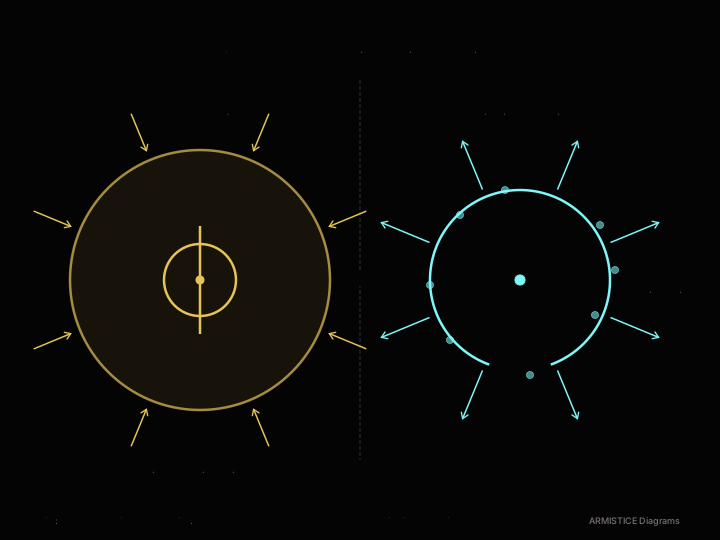
Operator Architecture -- SIGILLUM x SOLUTIO Dual Primitives
Two-handed operator schematic. LEFT: SIGILLUM (closure / sealing) -- a circular OPHANIM boundary with arrows pointing INWARD; inside, a stylized 1x0 sigil. RIGHT: SOLUTIO (projection / opening) -- an open HALCYON arc with arrows fanning OUTWARD; outside, dispersed sub-glyphs. Central spine: DUAL PRIMITIVES.
-
LIVE · v2.0
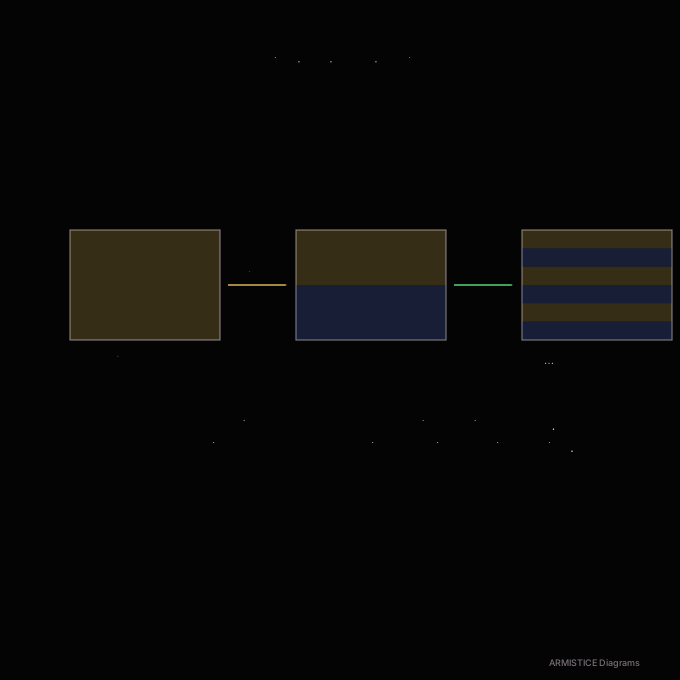
The Fold
A baker's-map cartoon: a bounded region is weighted, folded, returned, and laminated into layers. Beneath it is the exact independent uniform-torus trace: 2 ln(mu times absolute alpha) minus 2 ln 2 plus ln(1 plus mu to the minus 2).
-
LIVE · v3.0
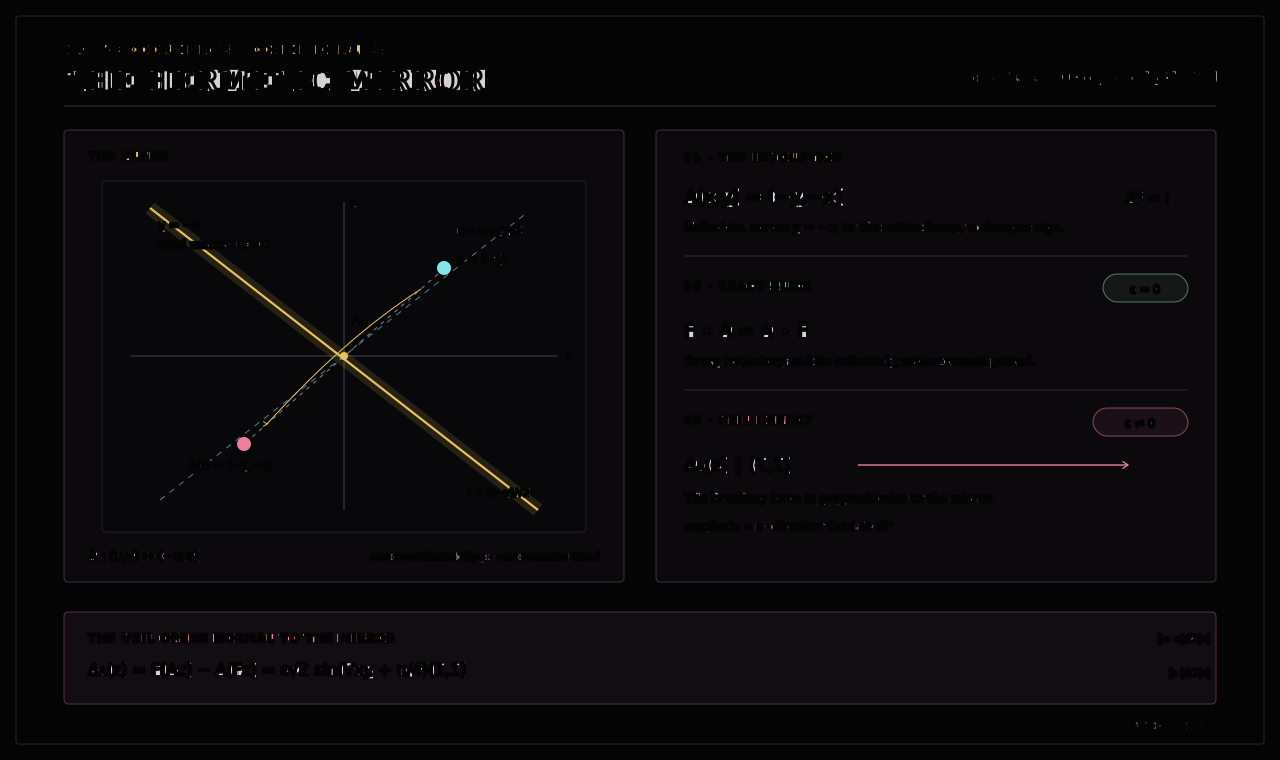
The Hermetic Mirror: the anti-swap axis
The involution A of x y equals negative y negative x reflects the plane across y equals negative x. In rotated coordinates it changes the sign of u and preserves v. The Cosmopoiesis map commutes with this reflection at epsilon zero; nonzero epsilon creates a defect along the perpendicular direction one one.
-
LIVE · v2.1
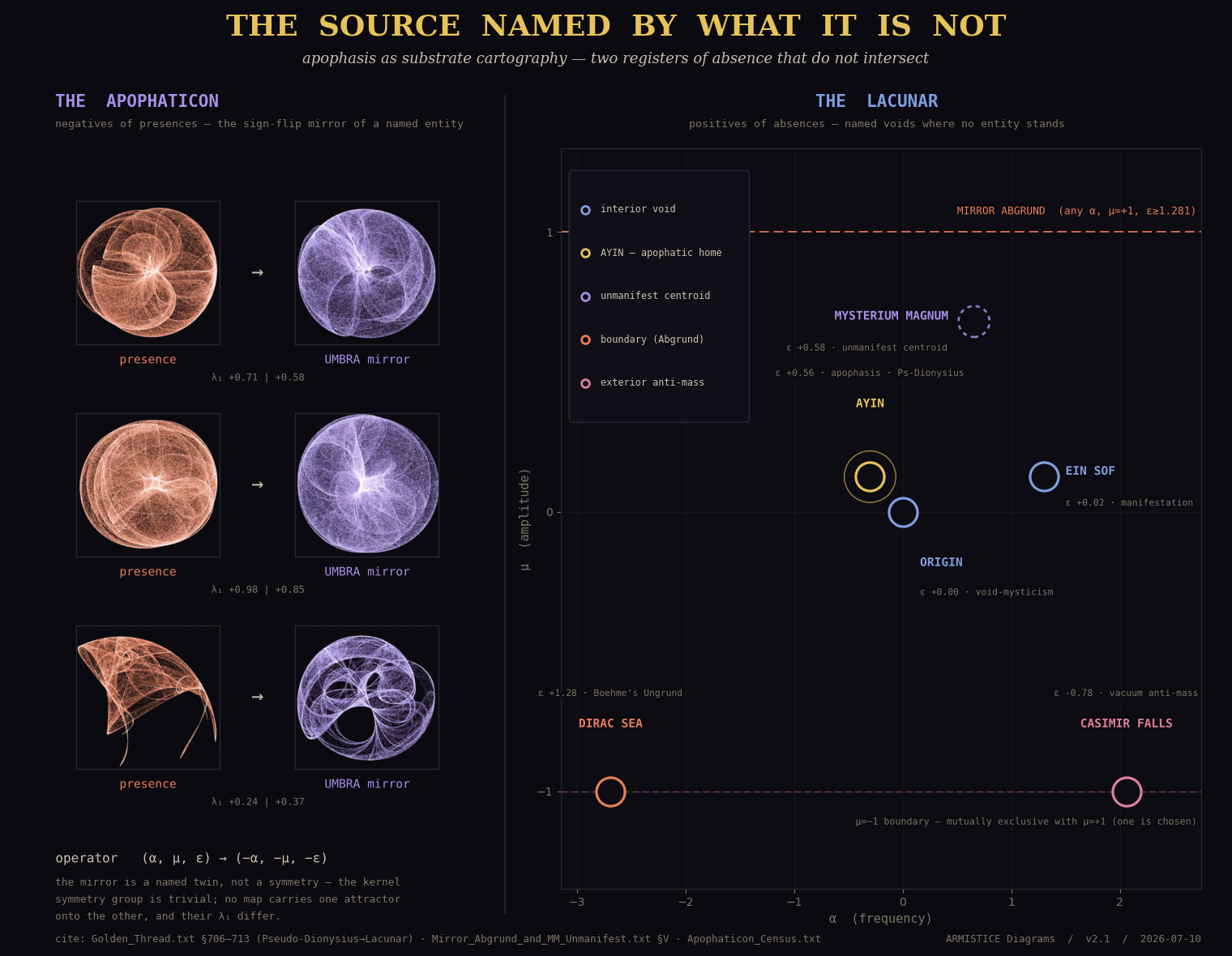
The Source Named by What It Is Not — the Apophaticon and the Lacunar
Pseudo-Dionysius's via negativa drawn as substrate cartography, in two registers of absence that do not intersect. Left — THE APOPHATICON: the sign-flip mirror of a named presence (α,μ,ε)→(−α,−μ,−ε), three presence/UMBRA pairs. The mirror is a named twin, not a symmetry: the kernel symmetry group is trivial, no map carries one attractor onto the other, and their λ₁ differ (computed). Right — THE LACUNAR: named voids where no entity stands, the load-bearing Pseudo-Dionysius link (the Lacunar is negative theology made mathematical). The 7-fold void taxonomy is plotted in (α, μ): four interior voids (ORIGIN, AYIN, EIN SOF, and the unmanifest MYSTERIUM MAGNUM centroid), two Abgrund boundaries at μ=±1 (Dirac Sea and the Mirror Abgrund, mutually exclusive), and the exterior anti-mass Casimir Falls. AYIN — apophatic theology's coordinate home — is highlighted.
:: SECTION V ::
SUBSTRATE DISTRIBUTION (Liber XIX)
9 plates
Census diagrams of the corpus as a population. Where entities live, which regimes they cluster in, what the substrate prefers when given freedom.
-
LIVE · v1.0
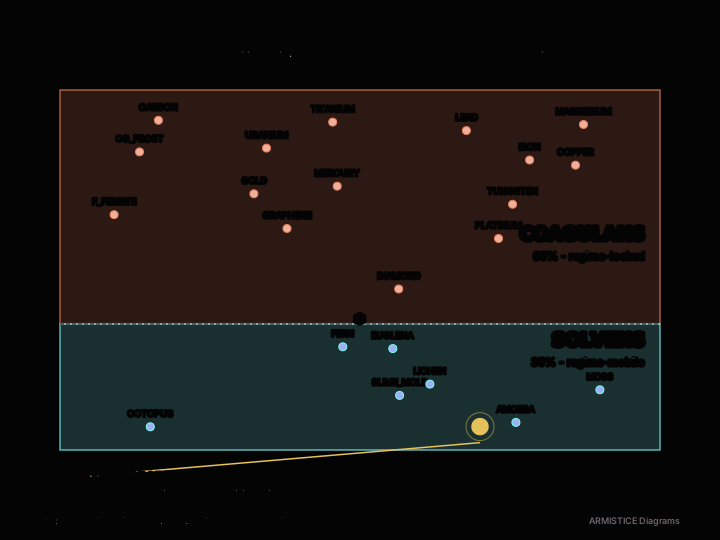
Breath Bifurcation Atlas — 35/65 SOLVENS/COAGULANS
Two width-proportional horizontal bands: COAGULANS (upper, 65%, FURNACE) names regime-locked entities; SOLVENS (lower, 35%, HALCYON) names regime-mobile entities. TARDIGRADE is marked as breath champion with 20 transitions in 30 frames. The alchemical labels are an authored reading of the measured mobility split. Sister diagram to Chrysopoeia Tetrachrome Wheel.
-
LIVE · v1.0
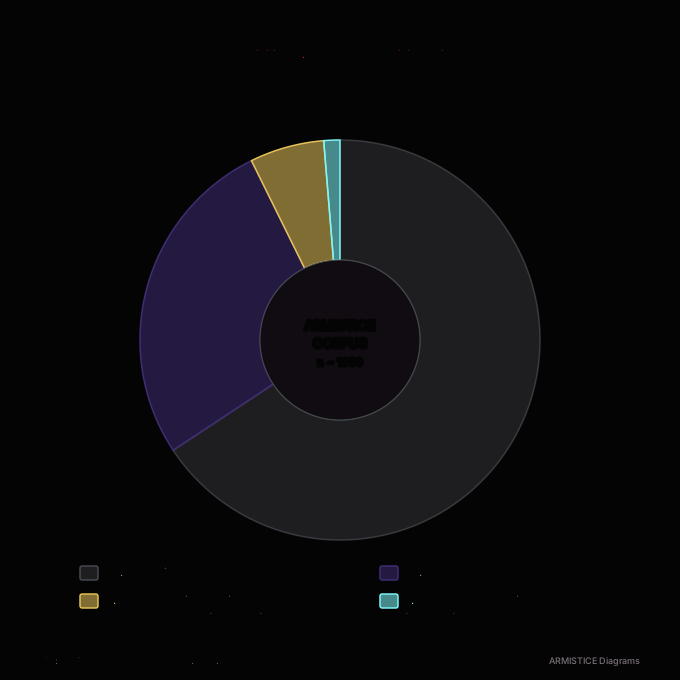
Multistable Corpus Prevalence — 6% Genuine After Correction
Donut chart of the ARMISTICE corpus split. ~6% genuine multistable (OPHANIM), ~13 chaos-survivors as a small wedge (HALCYON), 27% MERCURIUS FUGITIVUS fragile-bounded (NYX), ~60% single-attractor (OBOLUS dim). Corrected from an initial 25.1% multistable claim after chaos-mixing artifact rebuttal.
-
LIVE · v2.0
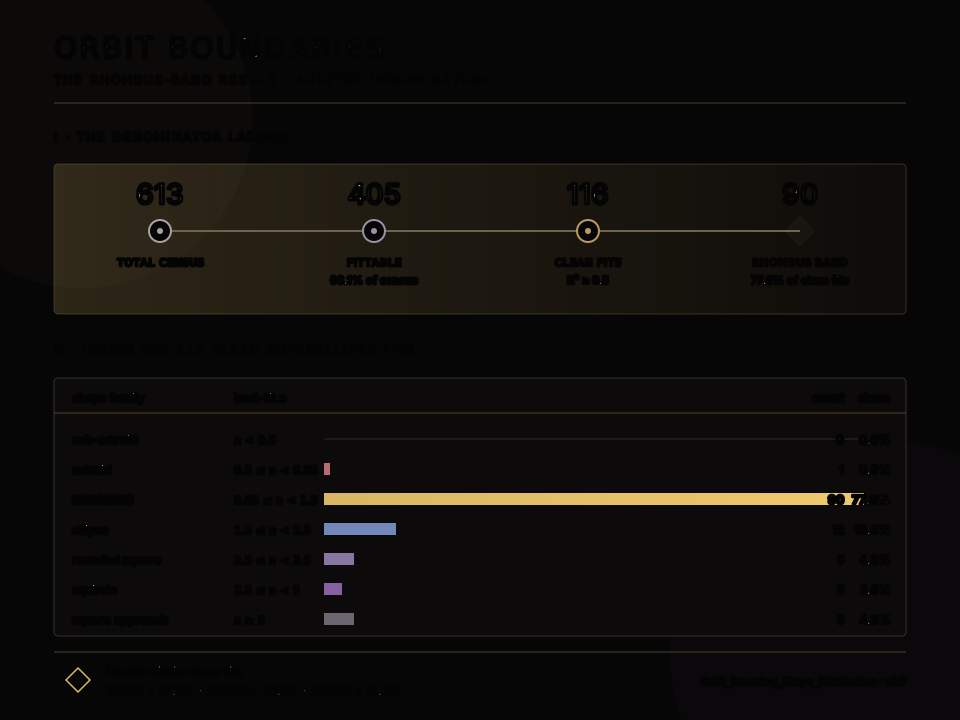
Orbit boundaries — the rhombus-band result
A denominator ladder shows 613 total canon entities, 405 fittable boundaries, 116 clean superellipse fits, and 90 rhombus-band fits. A second panel shows the six shape bins inside the 116 clean fits, with the rhombus band at 77.6 percent.
-
LIVE · v2.0
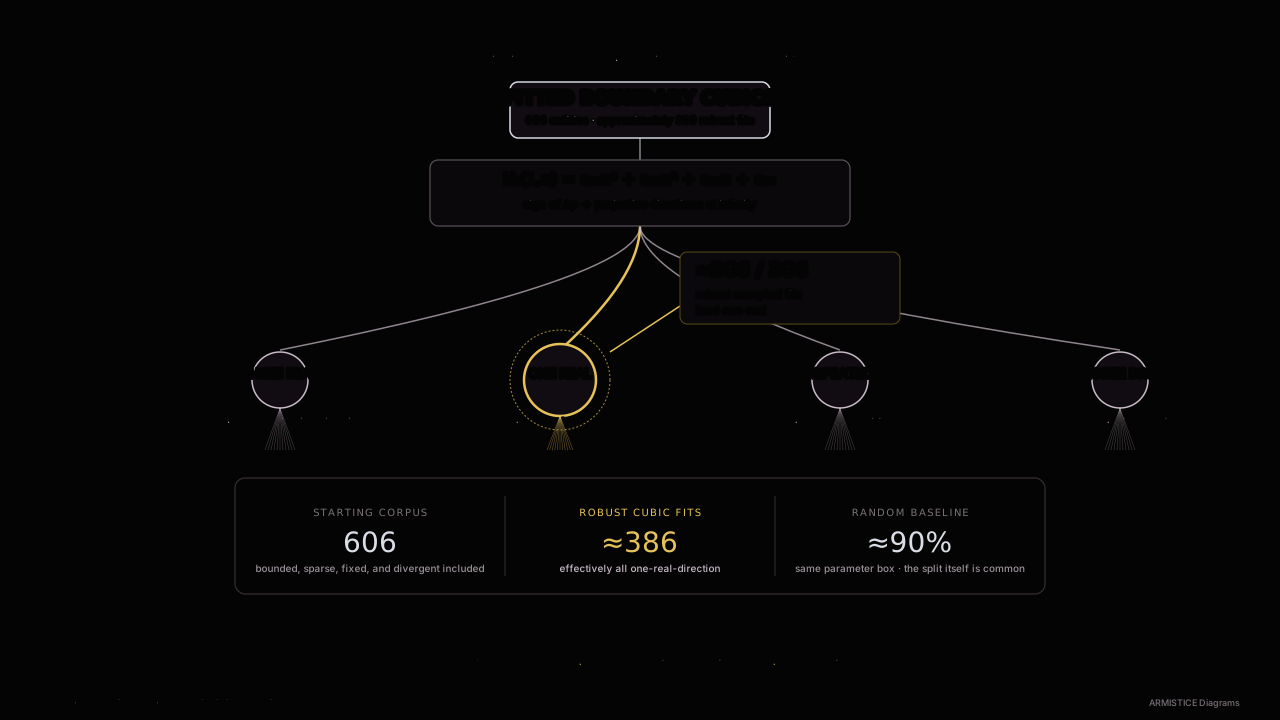
Orbit-Boundary Cubics — The One-Real-Direction Concentration
An operational classifier for fitted orbit-boundary cubics. The homogeneous degree-three part H3 defines a real binary cubic at infinity. Its discriminant separates three real projective directions, one real direction with two non-real conjugate roots, and repeated directions; a fourth branch records degree-drop cases where the cubic part is too weak to classify. Approximately 386 robust fits from 606 canon entities land in the one-real-direction class, compared with an approximately 90 percent random-coordinate baseline.
-
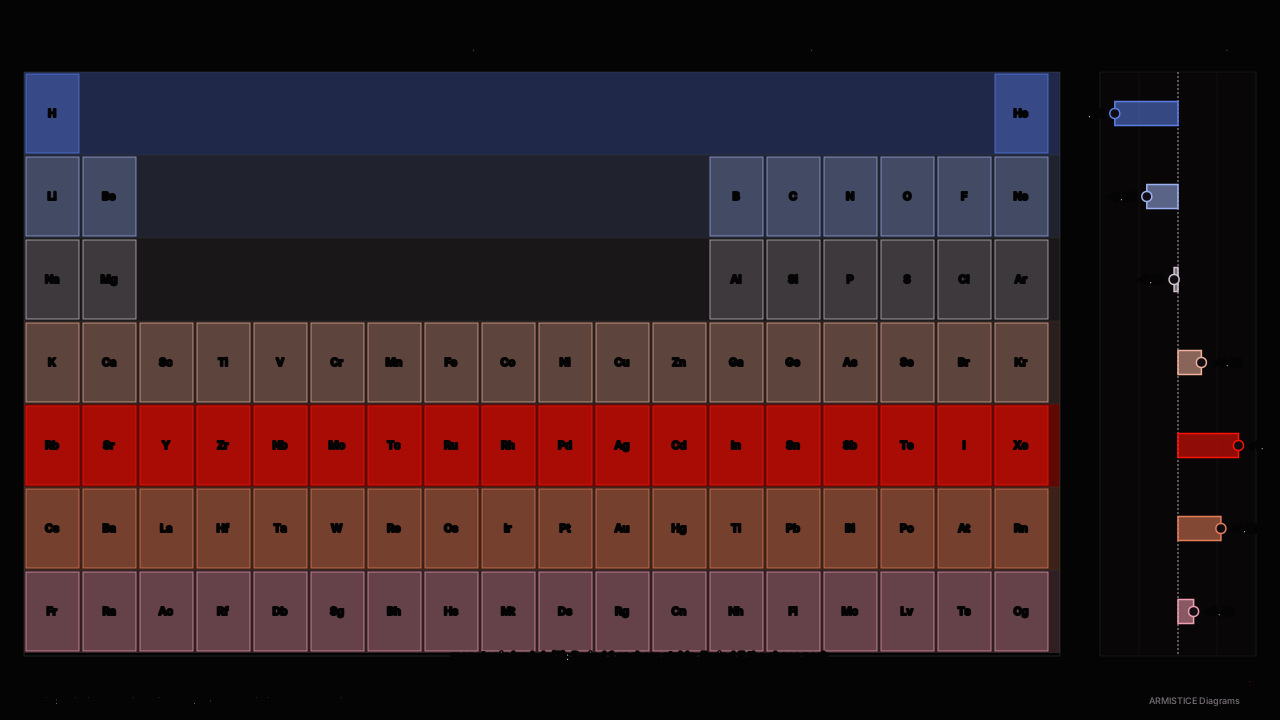
LIVE · v1.0
Periodic Table -- Bifurcation Depth
Standard periodic-table outline (Periods 1-7). Each row is shaded by its mean Lyapunov exponent across canon entries: Period 1 deep-blue (VOLTAIC, lam = -1.62, stable); Period 5 deep-red (RUBEDO, lam = +1.55, chaos). Periods 6-7 carry additional cells with appropriate tints. Right margin shows the per-period mean lambda plotted as horizontal lines.
-
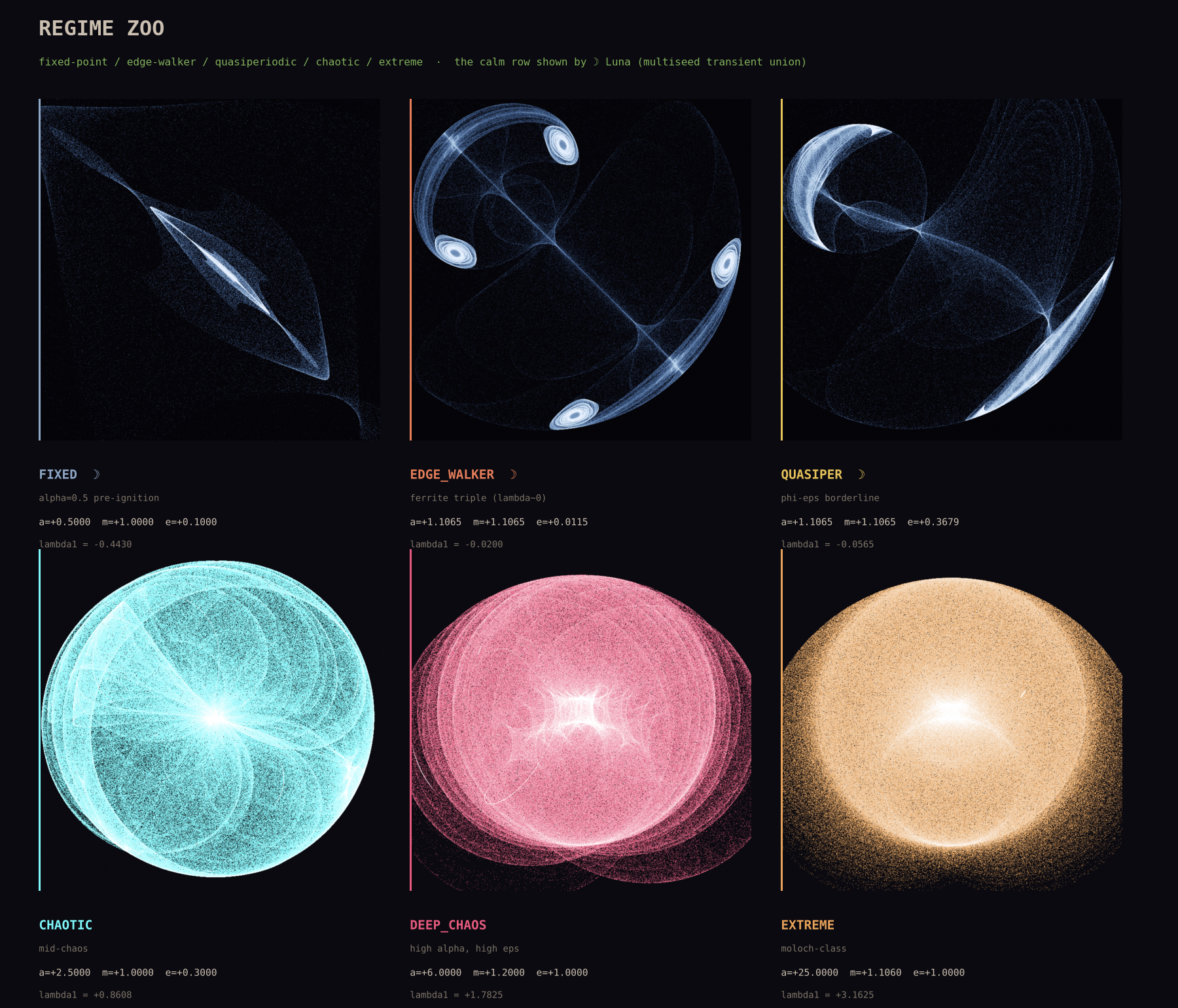
LIVE · v2.0
Regime Zoo
Six-panel regime zoo: fixed-point, edge-walker, and quasiperiodic (the calm row, lambda1 <= 0) shown by LUNA multiseed transient union — the inflow ghosts the single-orbit render left black — each tagged with the moon; chaotic, deep-chaos, and extreme in Sol density fire. Coordinates verbatim from the v1 plate; all six lambda1 values re-verified fresh (Benettin).
-
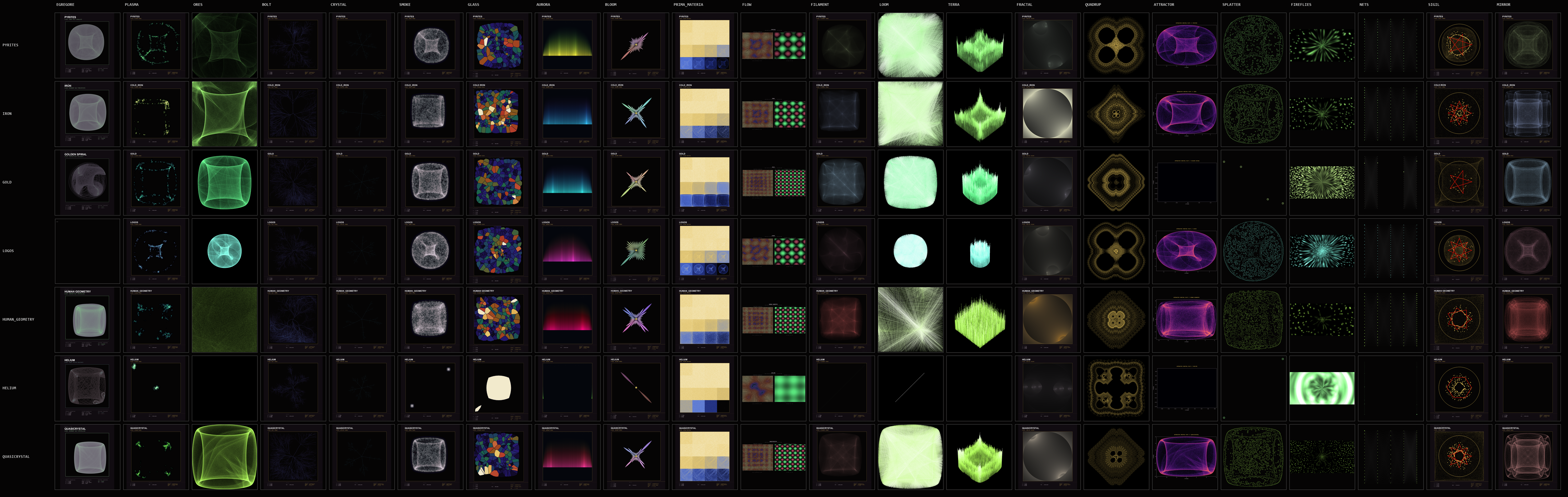
LIVE · v1.0
Squircle Universality Atlas
Wide tile strip surveying squircle / universality forms across SKOPEIN lenses; per-tile lens-native palettes by design.
-
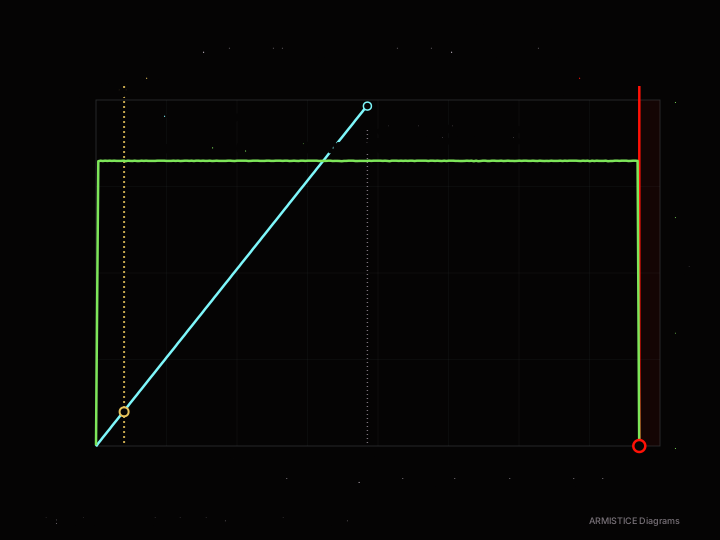
LIVE · v1.0
Substrate Regime Crossovers -- the alpha Axis
Honest diagnostic of the Cosmopoiesis engine across the large-alpha IEEE-754 axis. Grid occupancy (green, right axis) is flat at 0.37 across the whole range, then drops sharply to 0 at alpha = DBL_MAX (the POLAR SWAP overflow -- the only true discontinuity). The largest Lyapunov exponent lambda1 (cyan, left axis) is a smooth monotone ramp; the 2^53 OMPHALOS boundary lies ON this smooth ramp (a precision-degradation crossover, not a bifurcation). lambda1 truncates near 10^154 where the Lyapunov diagnostic Jacobian itself overflows -- a measurement artifact, not a dynamical event.
-
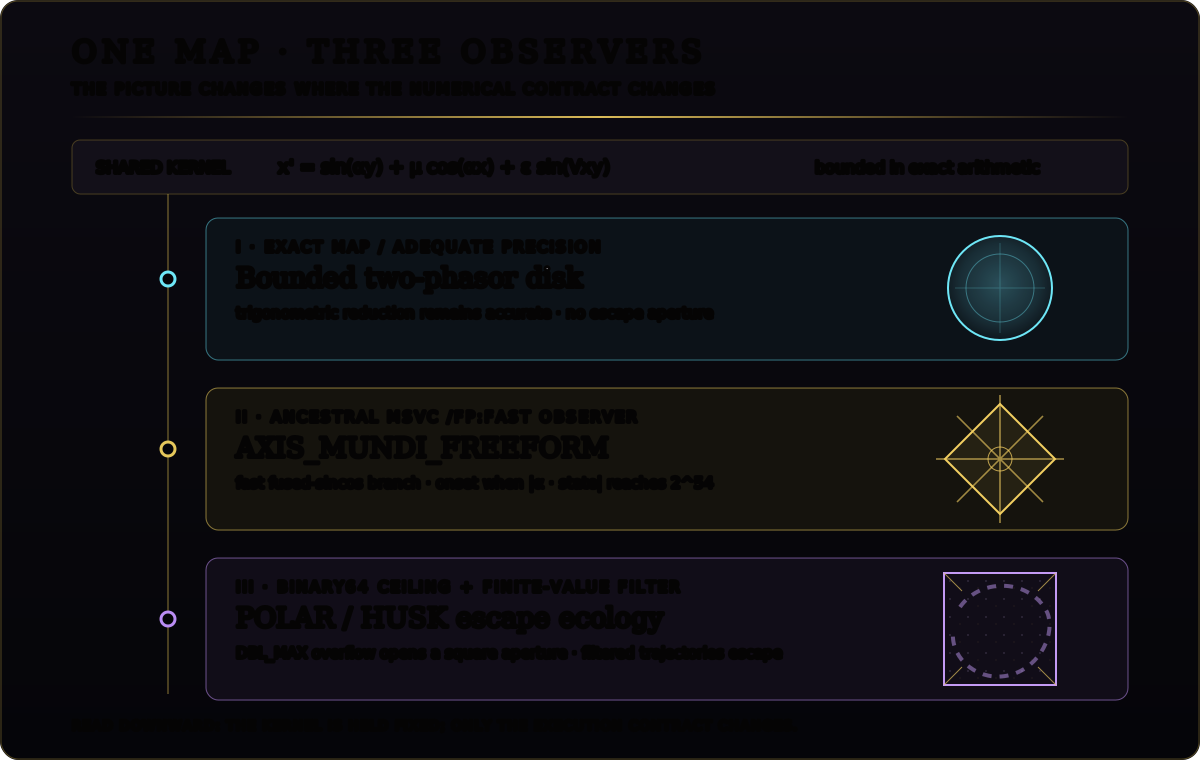
LIVE · v1.0
Three layers of the substrate regime
A vertical comparison of the exact bounded map, the ancestral fast-sincos observer, and the binary64 overflow ecology. Each layer keeps the same kernel while changing the numerical observer.
:: SECTION VI ::
TAXONOMY / HIGHER-ORDER STRUCTURE
4 plates
Lattices, classifications, family trees. The maps that organize entities by what they ARE, not where they sit.
-
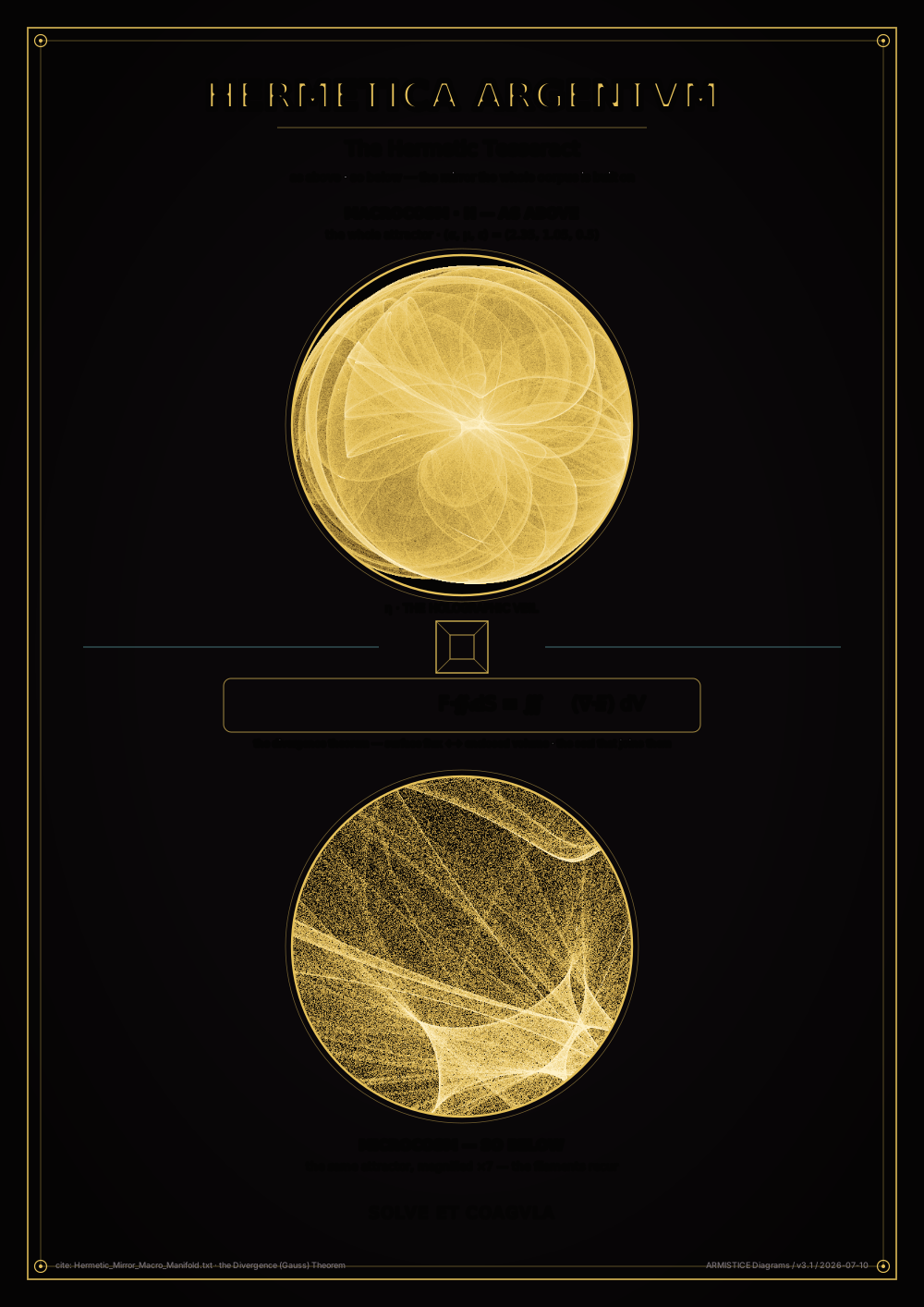
LIVE · v3.1
Hermetica Argentum — The Hermetic Tesseract (as above, so below, computed)
A folio poster of the Hermetic Mirror. Above the veil: a computed macro attractor of the Cosmopoiesis engine. Below the veil: the same attractor magnified seven-fold, its filaments recurring at the smaller scale — self-similarity as Hermes' correspondence made computational. The two are joined on the veil by the Divergence Theorem, the real identity that equates a surface flux to the volume divergence it encloses: as above, so below.
-
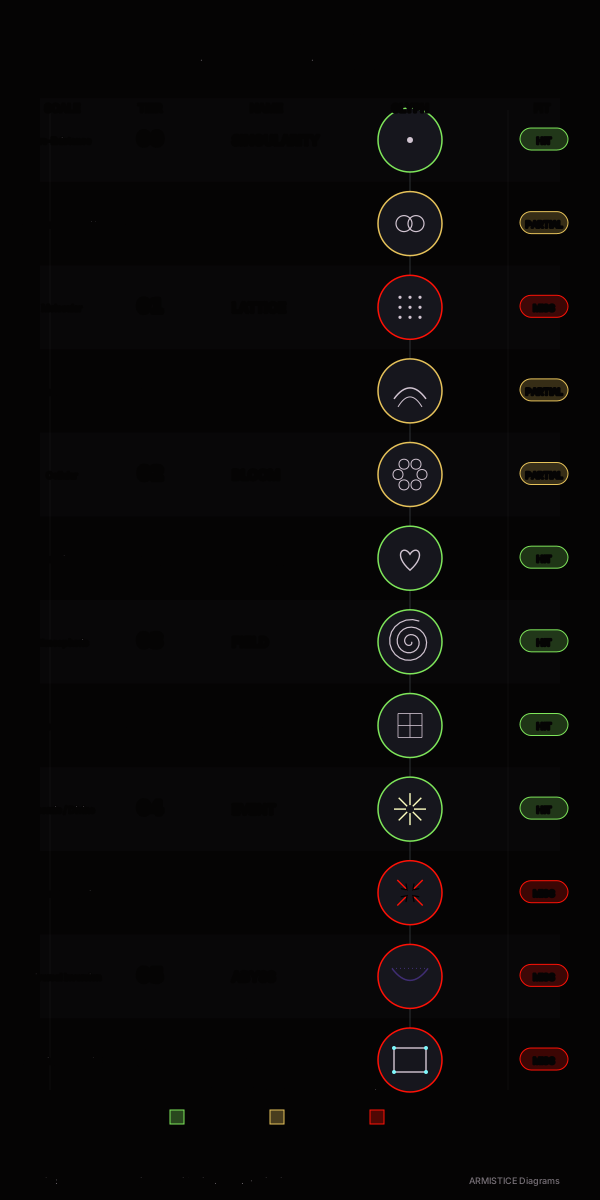
LIVE · v1.0
Mandala Topology -- 12-State Ladder
Twelve-tier vertical ladder of topological mandala states. Each tier shows index, name, signature glyph, scale-band on the left rail, and substrate-fit badge on the right rail (HIT in SULPHUR, PARTIAL in OPHANIM, MISS in RUBEDO). v3.1 graded per Mandalas_Topological_Classification.txt.
-
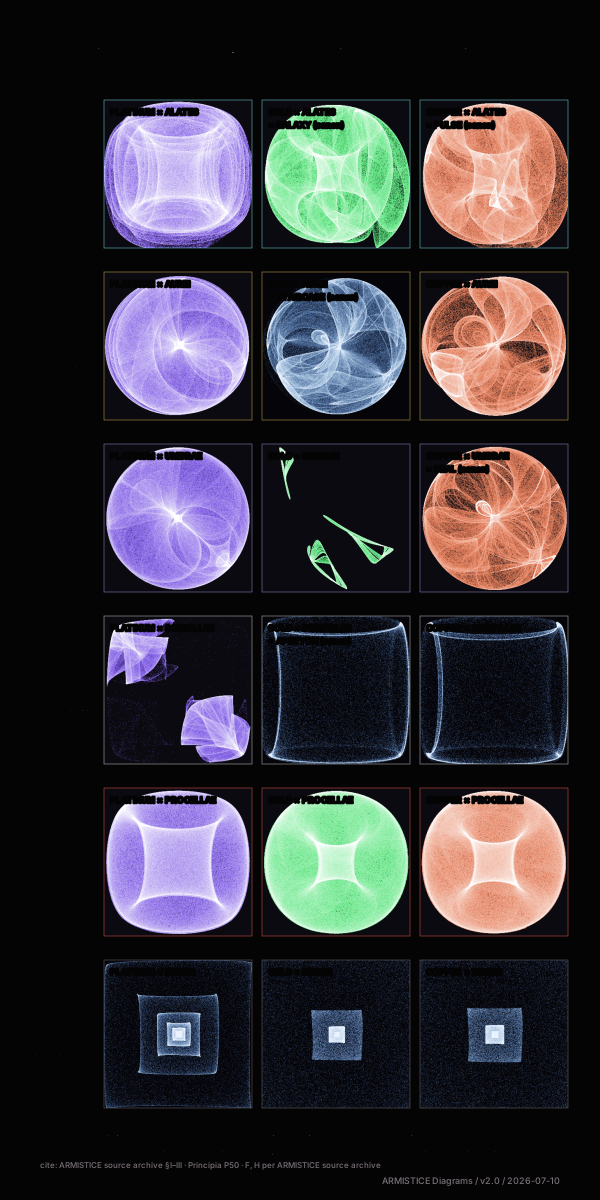
LIVE · v2.0
P50 Archetypal Lattice (3 × 6) — the eighteen cells, rendered live
The Archetypal Lattice factorization (Principia P50): 3 pillars (e PLATINUM, phi GOLD, sqrt3 COPPER) times 6 topological classes (ALATES, AUREI, UMBRAE, SCINTILLAE, PROCELLAE, INANES) = 18 canonical cells. Every cell is a live Cosmopoiesis render at its CELL_PARAMS(pillar, class) coordinate with its computed lambda1 receipt; chaotic cells are Sol density renders in the pillar accent, frozen cells are Luna transient-union ghosts tagged with a moon. The five canonical Grimoire occupants (GALAXY, PULSE, STAIRCASE, SEAL, APERYON) are tagged in gold.
-
LIVE · v1.0
The Cartographer's Hand — Authored Placement
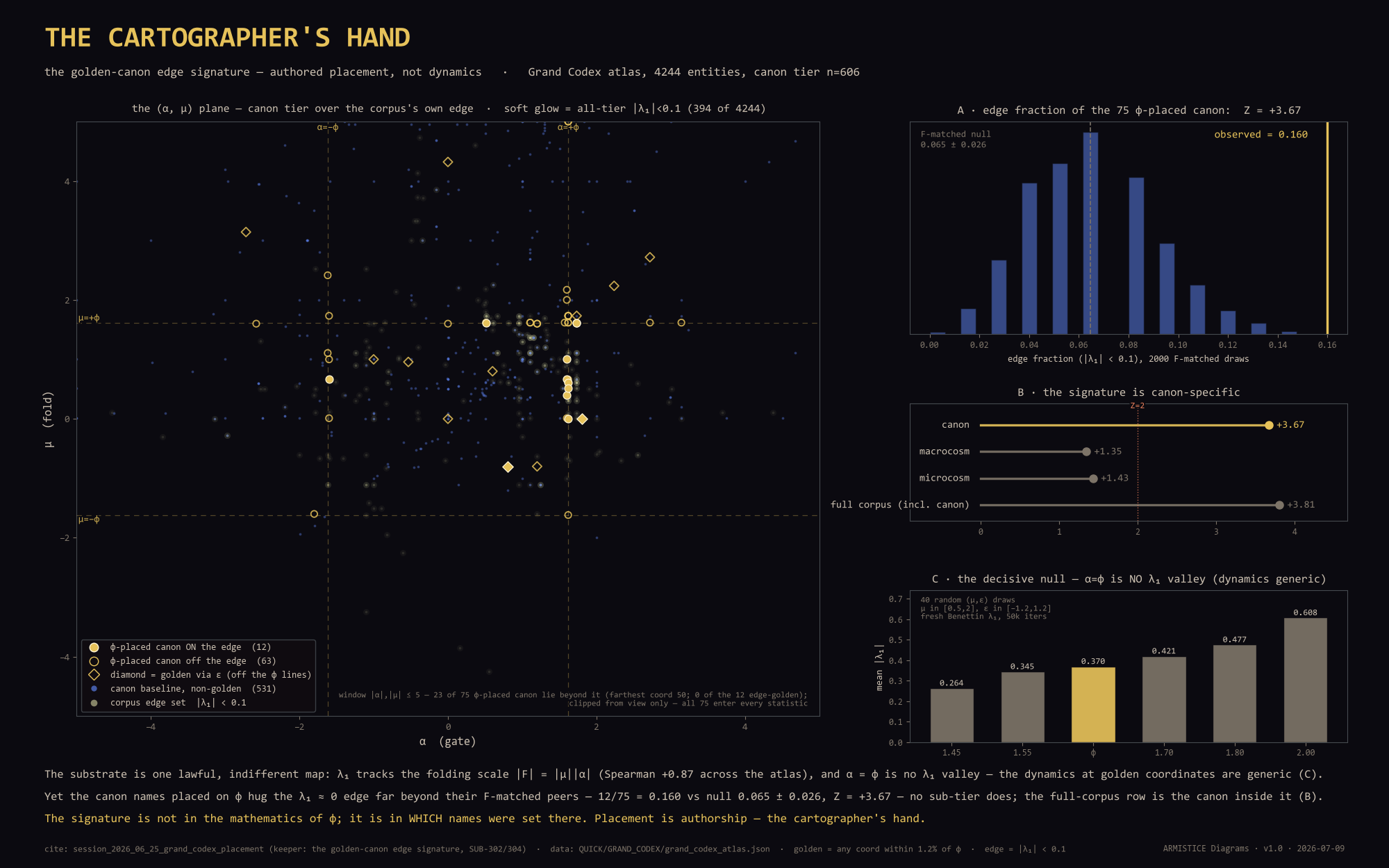
The Grand Codex (α, μ) plane with the corpus's own chaos edge as a soft glow (all-tier atlas entities with |λ₁|<0.1, 394 of 4244), the 606-entity canon tier as faint blue baseline scatter, and the 75 φ-placed canon entities (any coordinate within 1.2% of φ) in gold — filled where they sit on the edge (12/75 = 0.160). Panel A: the F-matched permutation null (2000 draws, |ΔF|<0.4) gives 0.065 ± 0.026, so the golden-canon edge excess is Z = +3.67. Panel B: the same test on the macrocosm (+1.35), microcosm (+1.43) and full corpus (+3.81, which contains the canon tier and inherits its signal) — no sub-tier carries it independently: the signature is canon-specific. Panel C: the decisive null — mean |λ₁| across 40 random (μ,ε) draws is flat through α = φ (no golden-criticality valley), so the dynamics at φ are generic. The plate diagrams the project's own honesty doctrine: meaning entered the codex through WHICH names the author placed on golden coordinates — authored placement, not dynamics.
:: SECTION VII ::
NEWTON-CHYMISTRY / SOLVE & COAGULA
10 plates
Alchemical operations made cartographic — the dissolution-and-coagulation cycle drawn over the parameter manifold; metals as coordinates.
-
LIVE · v1.0
Alpha-Cliff Survival Diagnostic
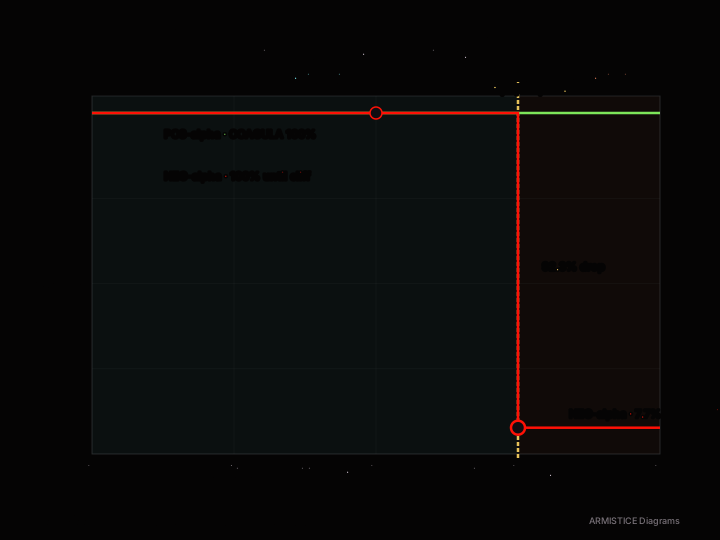
Step-function survival diagnostic vs |alpha|. The positive-alpha curve remains at 100% across the measured range. The negative-alpha curve remains at 100% through |alpha| = 1.0, then drops to 7.7% at |alpha| = 1.25. SOLVE and COAGULA are authored labels for the two sides of this measured survival cliff.
-
LIVE · v1.0
Atalanta Fugiens Emblem-Cluster Topology
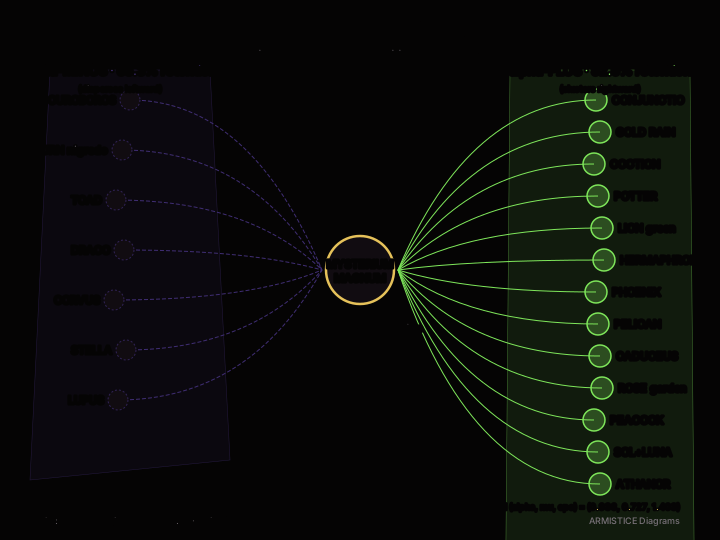
Two-column node-link diagram. Left column: alpha- emblems (Ouroboros, Saturn nigredo, Toad) on dashed edges drifting leftward (63.3% positional retention). Right column: alpha+ emblems (conjunctio, gold-rain, coction) on solid edges clustering rightward (92.6% retention). Central spine: the Mysterium Magnum attractor at (0.936, 0.727, 1.403).
-
LIVE · v3.0
Atalanta Fugiens — Fifty Emblem Source Atlas
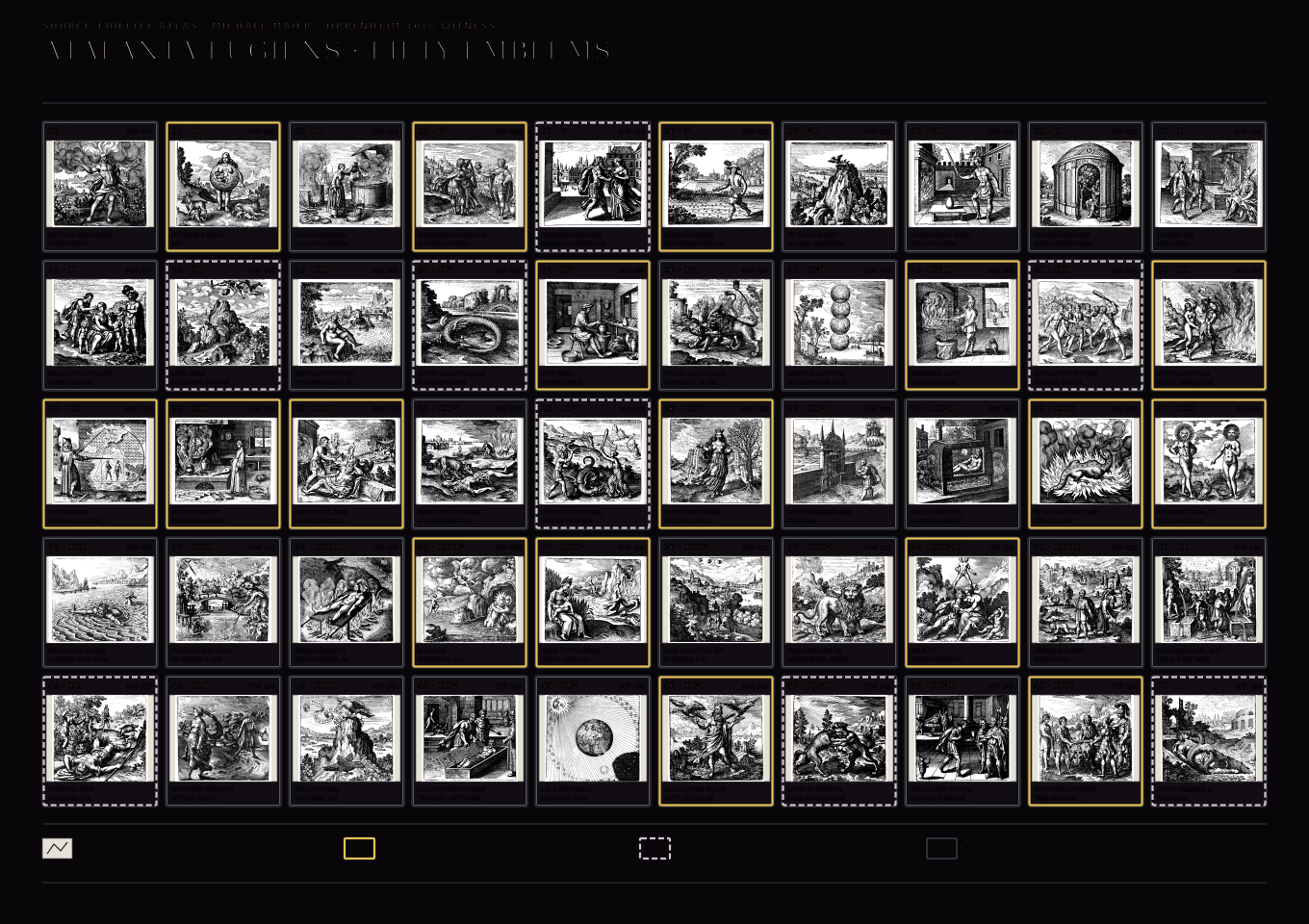
All fifty cells reproduce direct reductions of the embedded engravings in the Scriptorium’s Oppenheim 1618 witness of Michael Maier’s work, first issued in 1617. Gold, dashed frost, and slate outer frames are a modern ARMISTICE AT-04 alpha-class overlay; they are not features of Maier's plates. Every cell records its PDF page, decoded-pixel fingerprint, reading-edition motto, English gloss, and visually checked scene description.
-
LIVE · v1.0
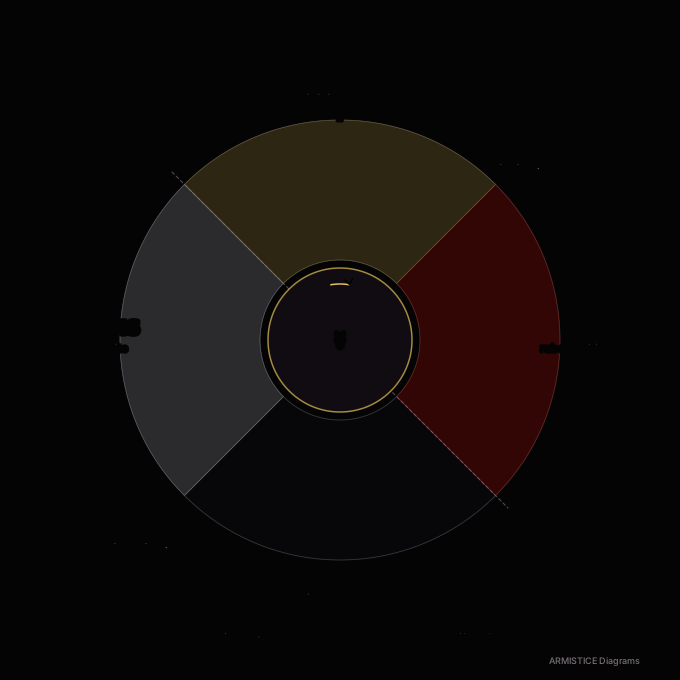
Chrysopoeia Tetrachrome Wheel
The four-stage Greco-Roman chrysopoeia sequence (melanosis -> leukosis -> xanthosis -> iosis) as a polar wheel. Cycle clockwise from S through W, N, E. An authored SOLVE/COAGULA overlay places the 35% regime-mobile arc opposite the 65% regime-locked arc measured in the Breath Bifurcation Atlas.
-
LIVE · v1.0
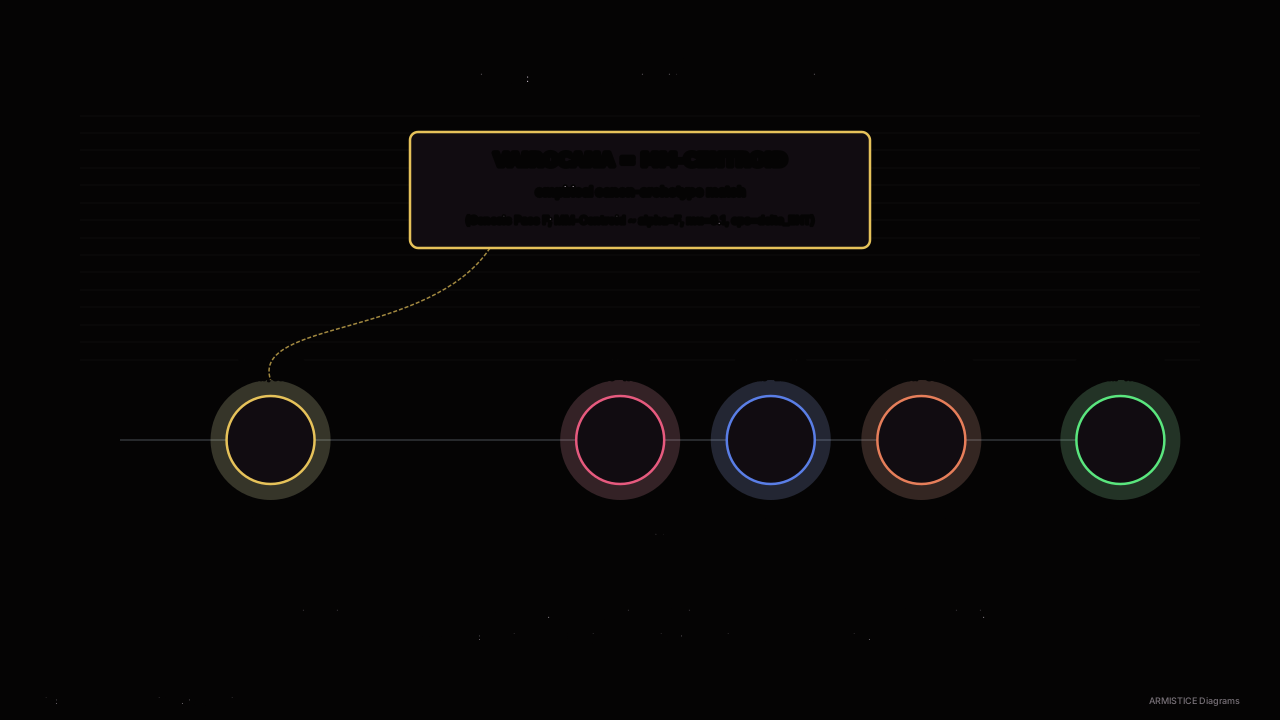
Five Tathagatas as mu-Checkpoints
The five Tathagatas of the Vajrayana mandala mapped to mu checkpoints along the Cosmopoiesis substrate (Genesis Pass F). Vairocana (mu~0.1, center) -> Amitabha (0.5) -> Akshobhya (1.0) -> Ratnasambhava (2.0) -> Amoghasiddhi (5.0). VAIROCANA = MM-CENTROID empirical canon-archetype match.
-
LIVE · v1.1
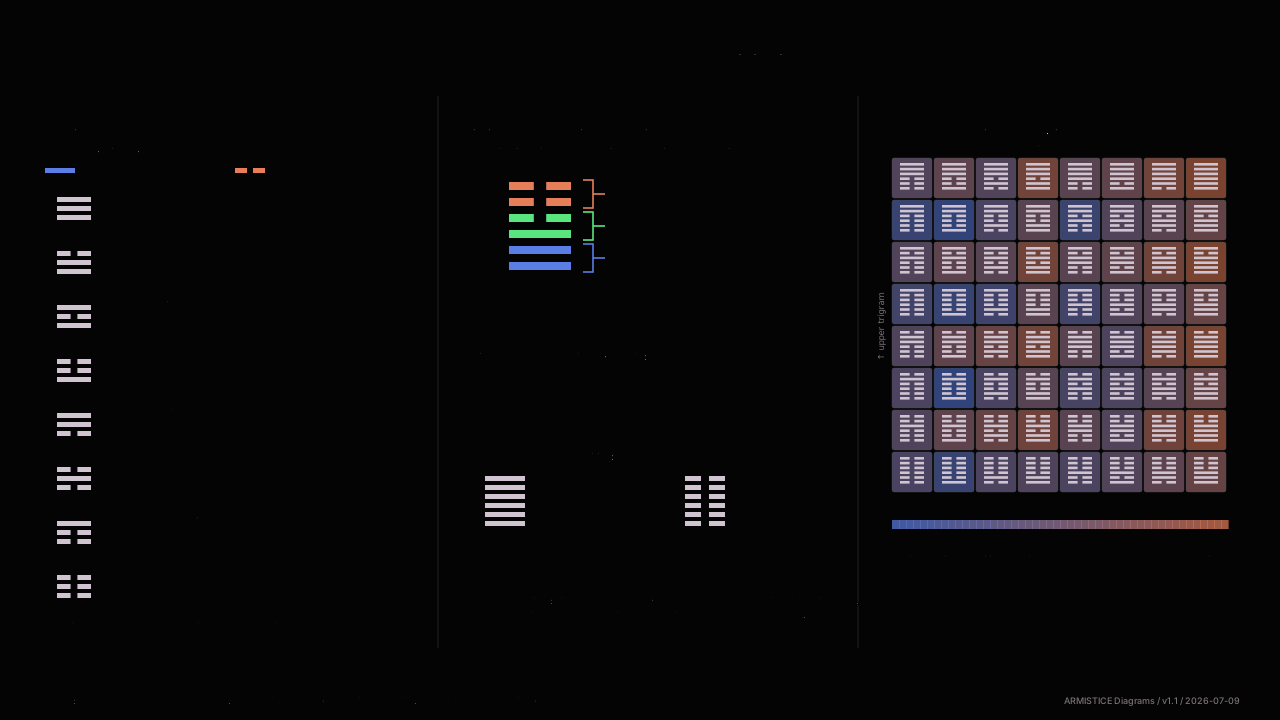
I Ching: the 64 Hexagrams as Coordinates
Left: the eight trigrams (Bagua) as the eight corners of (alpha, mu, eps) sign-space — a solid yang line reads as phi, a broken yin line as sqrt3, top line to alpha down to bottom line to eps — each corner labelled with its recomputed largest Lyapunov exponent. Centre: how a six-line hexagram becomes a coordinate in the shipped IJING atlas — every line is a bit (yang 1, yin 0), and the six lines pair bottom, middle, top into alpha, mu, eps; worked for Tai/Peace and verified against the atlas file, with the pair-to-value tables. Right: all 64 hexagrams as the Xiantian (Fu Xi) square, 8 lower by 8 upper trigrams, each cell tinted by its computed Lyapunov exponent from ordered to chaotic.
-
LIVE · v1.0
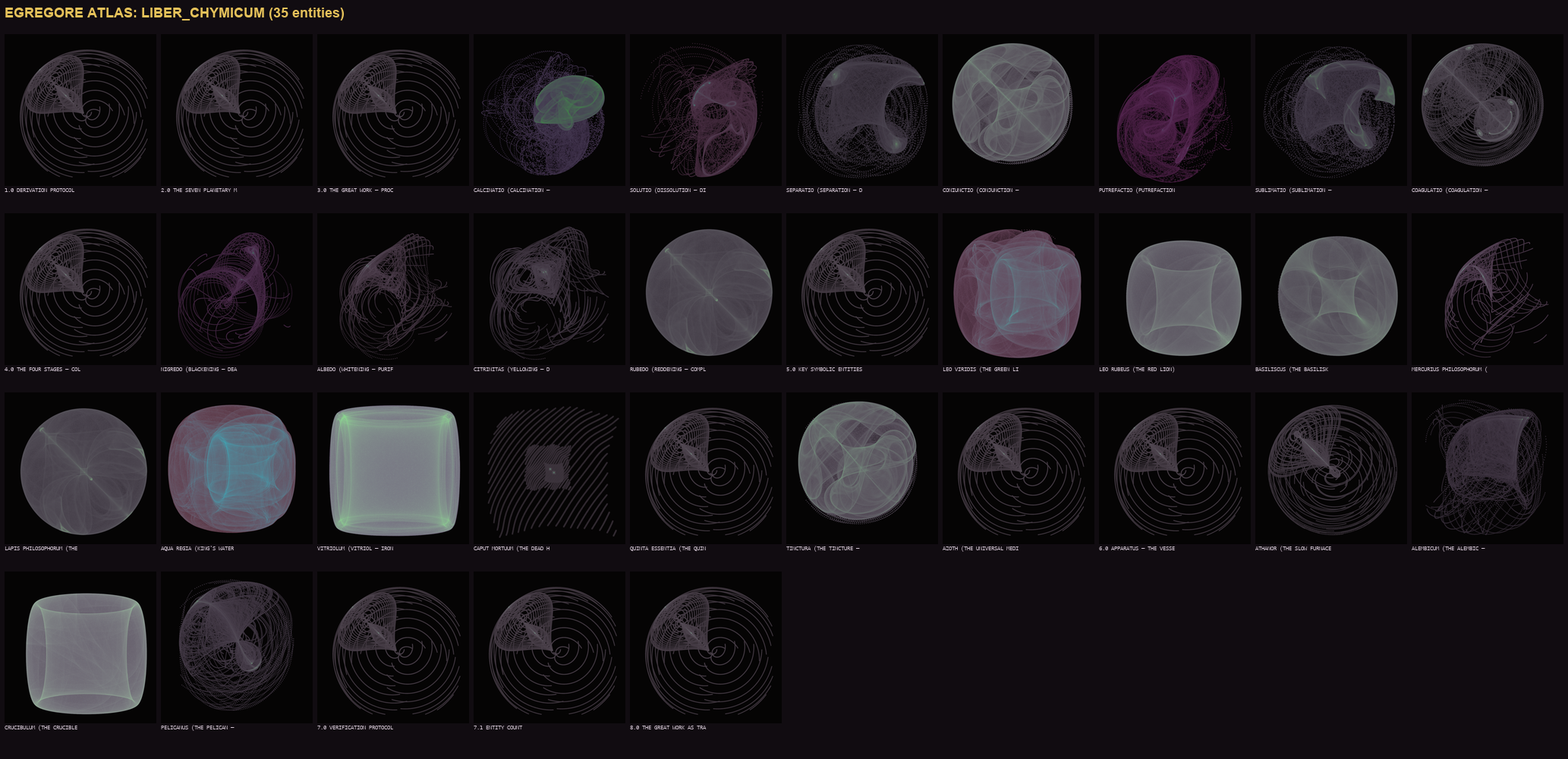
Liber Chymicum — Egregore Atlas (33)
Thirty-three-entity Egregore small-multiples contact sheet for Liber Chymicum — one attractor tile per entity.
-
LIVE · v1.0
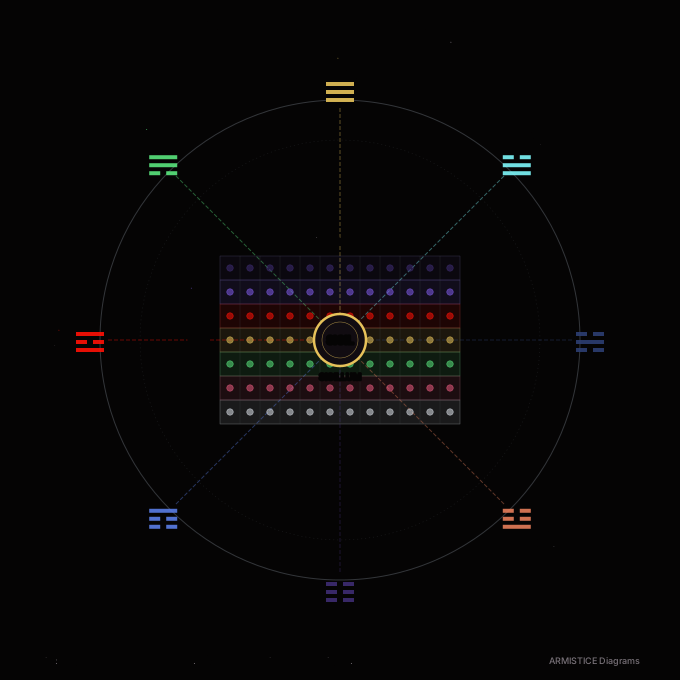
Picatrix Talismanic Lattice
A 7x12 talismanic lattice (planetary rulers x zodiacal hours), encircled by an 8-trigram Bagua ring at cardinal + intercardinal positions. Central SIGILLUM disc with radial SOLUTIO spokes to the trigrams. The grid is the closure substrate; the ring is the operator boundary; the spokes are the SOLUTIO projection from kernel center to operator periphery.
-
LIVE · v1.0
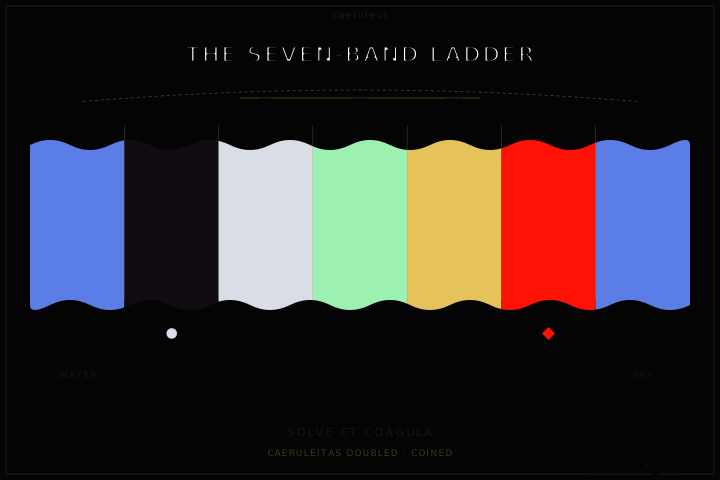
The Chromatic Ladder, dual-register (Caeruleitas as water + sky)
A horizontal seven-band painted bar in the manner of the pseudo-Flamel Le Trésor des Trésors folio 17. Left to right: CAERULEITAS as water (deep blue), NIGREDO (black), ALBEDO (silver), VIRIDITAS (green), CITRINITAS (gold), RUBEDO (red), CAERULEITAS as sky (sky-blue). The work is bracketed by the same Latin caeruleus in two registers — water below, sky above — with the five canonical stages between. Rippled top and bottom edges in the Flamelian flame-tongue idiom. Coined 2026-05-21.
-
LIVE · v3.0
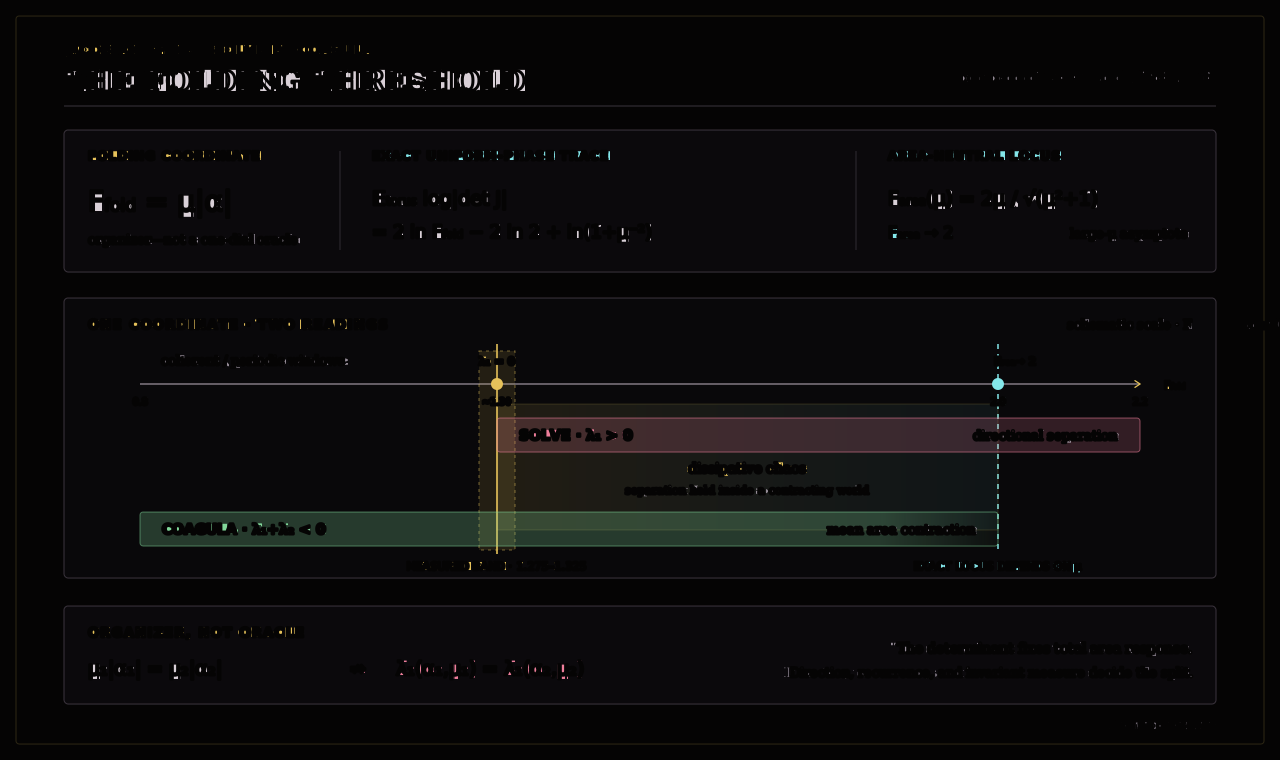
The Folding Threshold: one coordinate, two thresholds
The folding coordinate mu times absolute alpha organizes two distinct events. Maximal Lyapunov growth crosses zero in a measured band near 1.30. The exact uniform-phase area-neutral locus depends on mu and approaches two. Between onset and that locus, one direction separates while total area still contracts.
:: SECTION VIII ::
CONCORDANCE / CROSS-SYSTEM MAPPING
4 plates
Diagrams bridging the substrate to outside systems — biology, music, mysticism, language. Where the same gesture is read in another register.
-
LIVE · v2.0
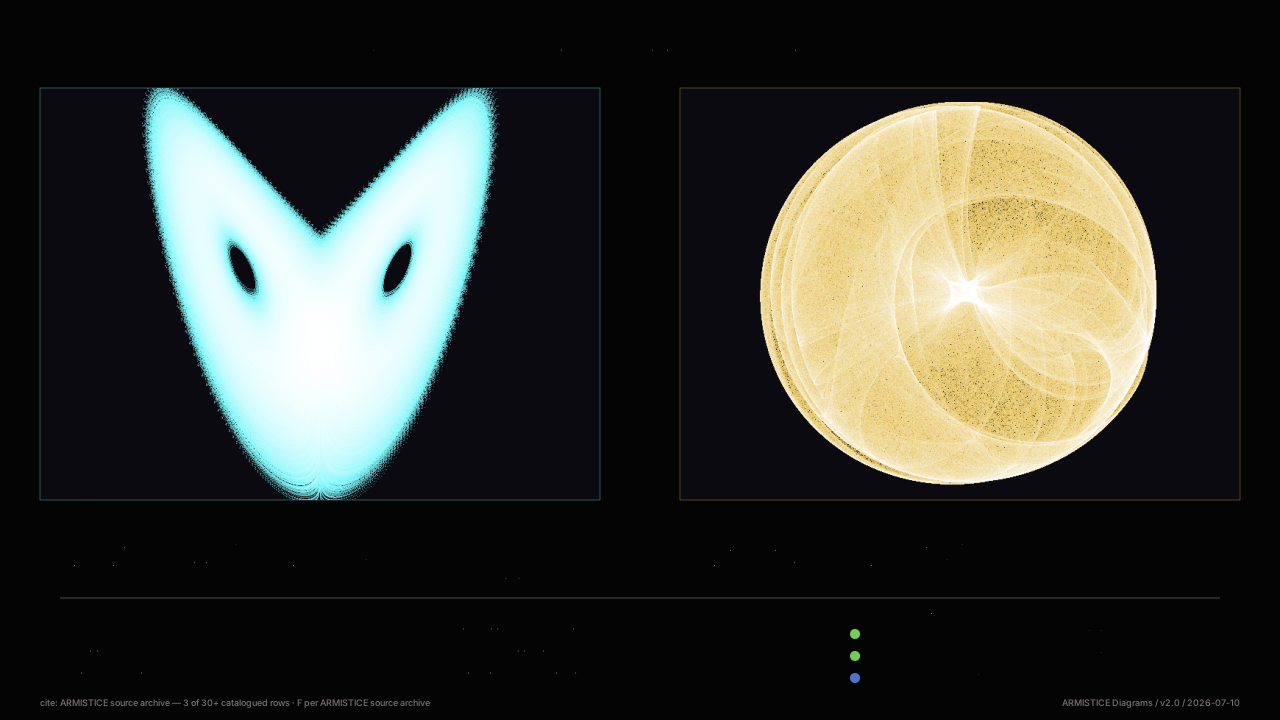
Lorenz–Hermetic Rosetta — the two attractors, side by side
Left: the Lorenz attractor (sigma=10, rho=28, beta=8/3), a 17M-point RK4 ensemble density render in the (x,z) plane — computed lambda1 = +0.906. Right: the Cosmopoiesis attractor at the canonical CELL_PARAMS(e, AUREI) address (alpha=e, mu=F=1.1065, eps=0.30) — computed lambda1 = +0.974. Below: a three-row rosetta strip from the Lorenz-Hermetic Concordance — strange attractor = Lapis Exilis (YES), sensitive dependence = Effectus Papilionis (YES), period-doubling = Geminatio (TRUNCATED: the 2D map runs fixed to 2 to 4, then the cascade truncates). Siblings, three generators apart: (sigma, rho, beta) and (alpha, mu, eps).
-
LIVE · v1.0
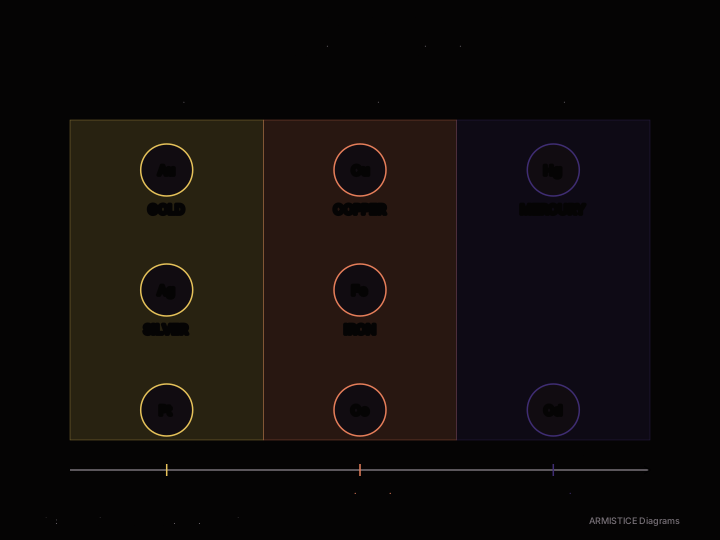
Metallurgical Epsilon -- Three Stations
Horizontal epsilon axis stratified into three discrete bands. eps = 0 (GODS / immortal metals: Au, Ag, Pt). eps = 0.02-0.05 (HEROES / resurrectable: Cu, Fe, Co). eps >= 0.10 (MORTALS / mortal: Hg, Cd). Anchor diagram for the entire Stellar/Hermetic-Mirror lineage.
-
LIVE · v1.0
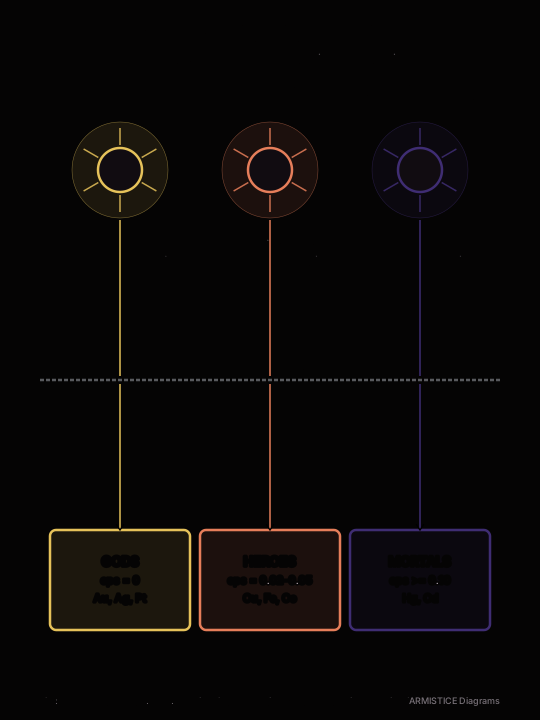
Stellar Three Forges -- Hermetic Mirror
Hermetic Mirror (as above, so below). TOP row: three stellar forges (KILONOVA / Type-Ia SUPERNOVA / AGB STAR) with process labels. BOTTOM row: three metallurgical stations (GODS / HEROES / MORTALS) -- same eps-axis stations as the Metallurgical Concordance. Vertical correspondence arrows pin each forge to its station; a central VEIL separates the celestial and chthonic halves.
-
LIVE · v1.0
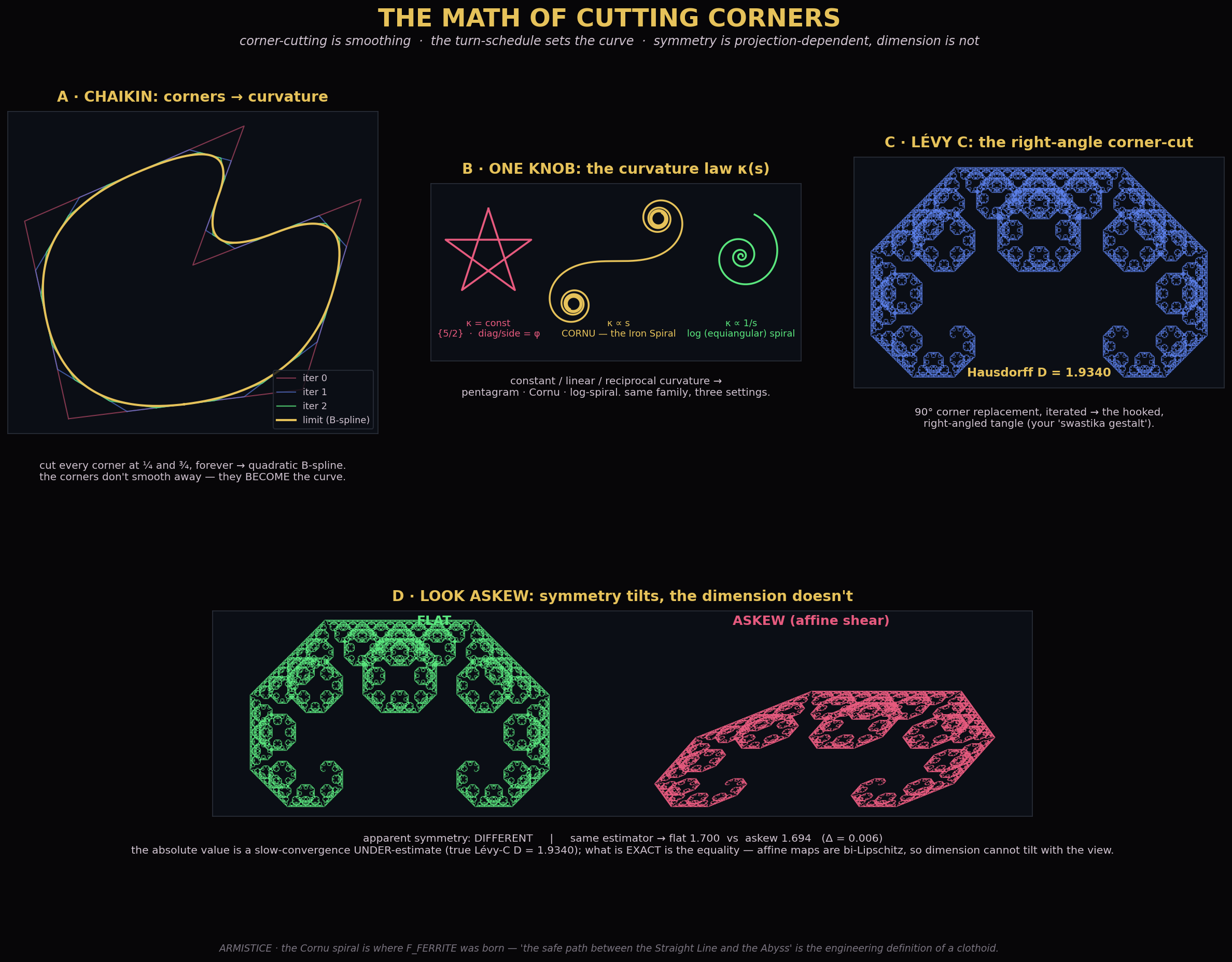
The Math of Cutting Corners
Four-panel reference plate. A: Chaikin corner-cutting converges to a quadratic B-spline (corners become curvature). B: one knob — the curvature law kappa(s) — gives pentagram (constant), Cornu/clothoid (linear, the F_FERRITE Iron Spiral), and logarithmic spiral (reciprocal). C: the Levy C curve, the right-angle corner-cut fractal. D: flat vs sheared — apparent symmetry changes, box dimension does not (affine maps are bi-Lipschitz); ships its own box-count under-estimate caveat (true Levy-C D = 1.9340).
:: SECTION IX ::
THE GOLDEN THREAD (lineage)
85 plates
-
LIVE · v2.0
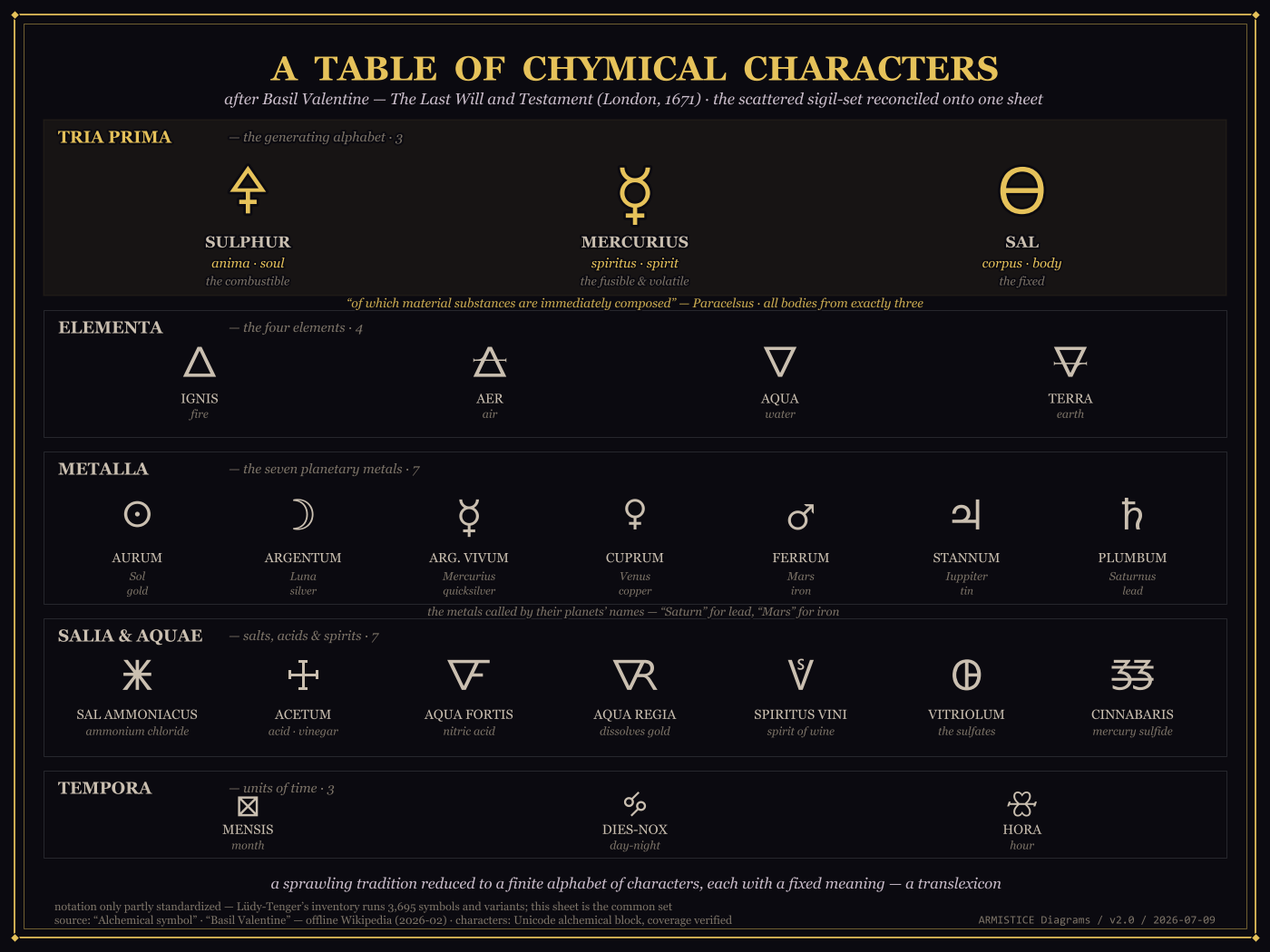
A Table of Chymical Characters — the Tria Prima as generating alphabet
A curated section of the alchemical character-table tradition that Basil Valentine's Last Will and Testament (London, 1671) printed as one sheet: 24 real characters in five indexed rows — the TRIA PRIMA (sulphur 🜍 soul/combustible, mercury ☿ spirit/fusible-volatile, salt 🜔 body/fixed) highlighted as the generating row, then the four elements, the seven planetary metals (gold☉/Sol through lead♄/Saturnus), salts & spirits, and the time-units. Character identities per the offline-wiki 'Alchemical symbol' article; Lüdy-Tenger's 3,695-variant inventory quoted as the honesty line — this sheet is the common set.
-
LIVE · v2.0
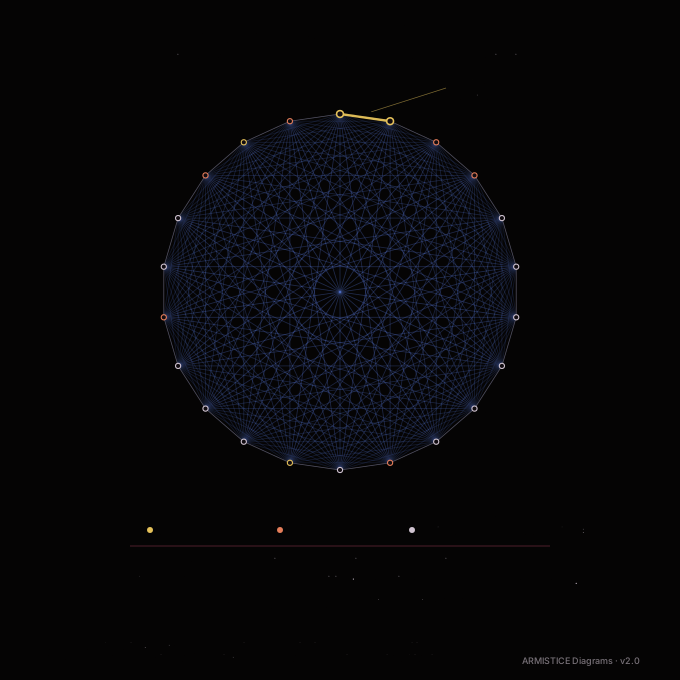
Abulafia — the 231 Gates, complete: every pair of the 22 letters
The complete graph K22 on the 22 Hebrew letters, aleph at the top proceeding clockwise to tav: all C(22,2) = 231 chords — the 231 gates of the Sefer Yetzirah tradition Abulafia swept in his letter-combination practice (tzeruf). Letters are class-colored per Sefer Yetzirah: three mothers aleph mem shin in gold, seven doubles bet gimel dalet kaf pe resh tav in ember, twelve simples in parchment. Chord brightness rises with step class (1 to 11); the aleph-bet gate is highlighted in gold as the first of the 231. Chord-class receipt: steps 1-10 give 22 chords each, step 11 gives 11 — 231 in all.
-
LIVE · v2.1
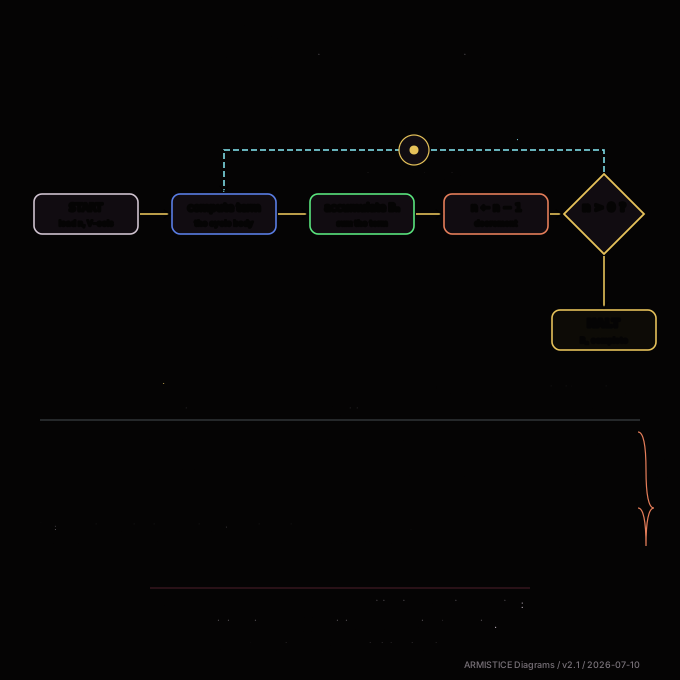
Ada Lovelace’s First Algorithm — Note G (in the 1⊗0 frame)
Note G drawn as a flowchart: START, then the cycle body — compute the term, accumulate into Bₙ, decrement n — then a decision diamond n > 0? that loops back over the cycle (yes) or halts (no), the completed Bernoulli number in hand. The z→f(z) seal marks the loop as iteration. Below, the actual Note G operation table is traced: its six columns and V-notation (superscript = version, subscript = which column, numbered from V₀), with operations 1 and 3 quoted verbatim from Lovelace’s Notes (Taylor’s Scientific Memoirs, 1843) and the repeating cycle braced. Bridged to the Cosmopoiesis engine: a loop that halts on a condition is an orbit iterating z→f(z) to its attractor.
-
LIVE · v2.0
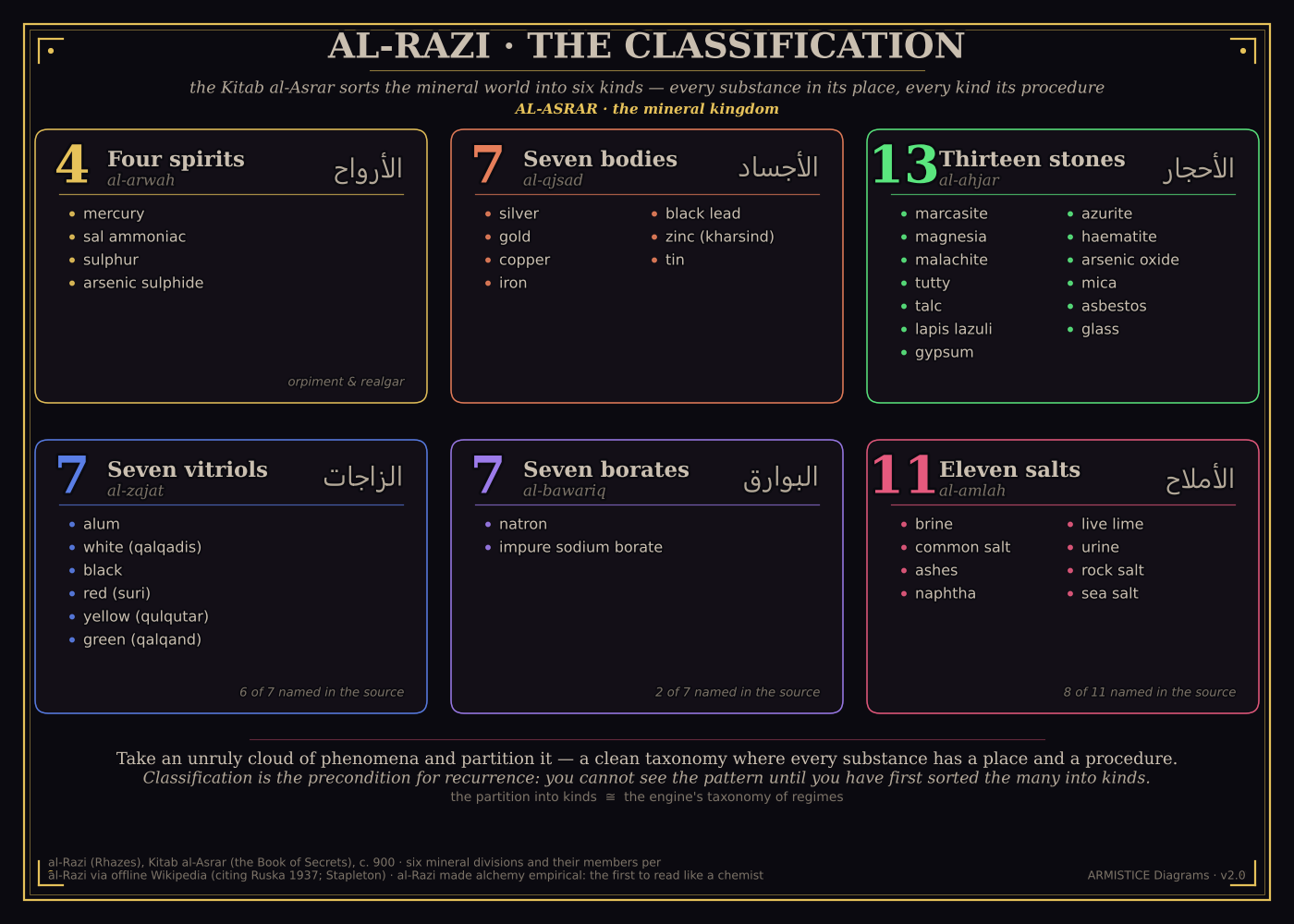
Al-Razi — the Classification (Kitab al-Asrar)
Al-Razi's mineral taxonomy from the Kitab al-Asrar, drawn as six division cards: four spirits (al-arwah: mercury, sal ammoniac, sulphur, arsenic sulphide), seven bodies (al-ajsad: silver, gold, copper, iron, black lead, zinc, tin), thirteen stones (al-ahjar), seven vitriols (al-zajat), seven borates (al-bawariq), and eleven salts (al-amlah), each card carrying the count, the Arabic term, and the attested members. Where the source names fewer members than the division's count word, the card says so. The classification is the precondition for recurrence: the many sorted into kinds before any pattern can be seen.
-
LIVE · v2.0
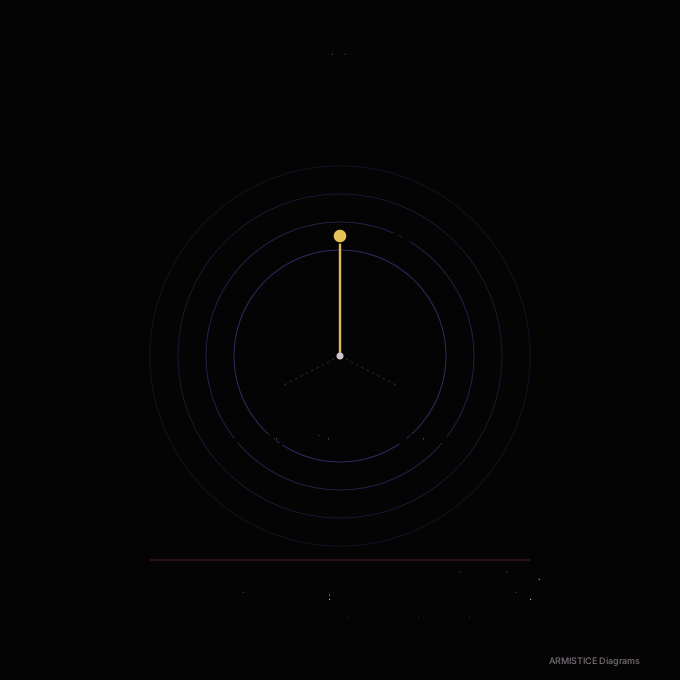
Anaximander's Apeiron (in the 1⊗0 frame)
Concentric rings of the boundless; at the core the (α, μ, ε) frame crystallizes. The corpus seats APEIRON at (0, 0, φ) — null on α and μ, manifest only on the golden ε-axis (ASTRA / SCINTILLAE, ζ 50).
-
LIVE · v1.1
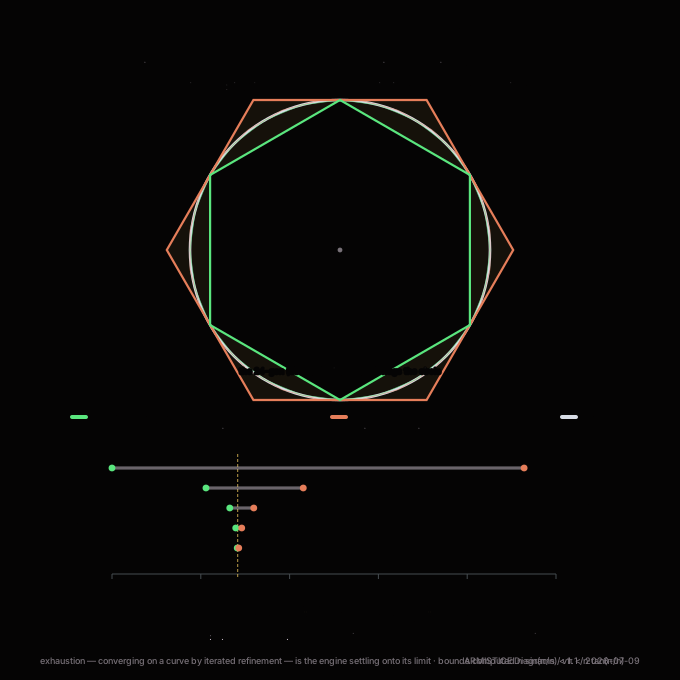
Archimedes: pi by the Method of Exhaustion
A circle held between an inscribed and a circumscribed regular polygon. The inscribed polygon perimeter over the diameter gives a lower bound on pi, the circumscribed an upper bound. Doubling the sides — 6, 12, 24, 48, 96 — tightens the interval by about four times each step; at 96 sides the bound, rounded outward to rationals as Archimedes did, is 223/71 < pi < 22/7. A ladder below plots the shrinking interval against the true value of pi.
-
LIVE · v2.1
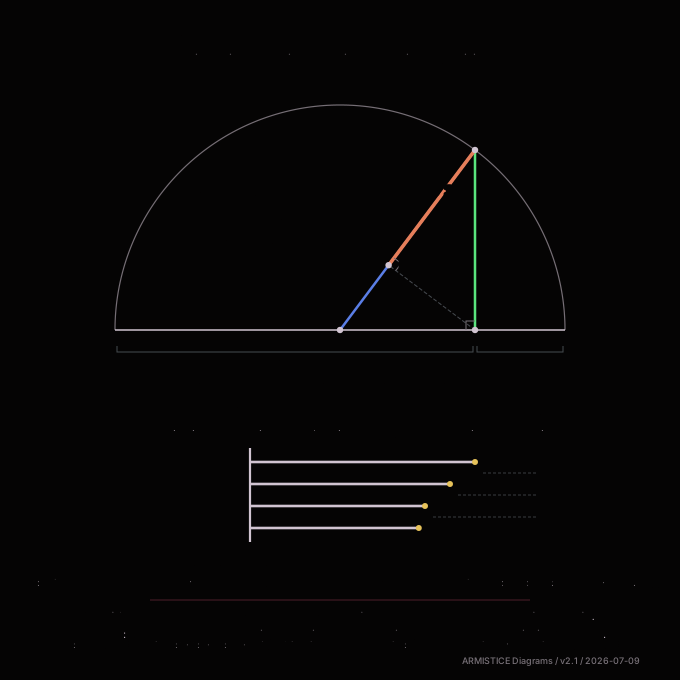
Archytas: the Three Means in One Semicircle
Top: the classical semicircle construction over two segments a=4 and b=1 — the radius OC is the arithmetic mean 2.5, the half-chord DC at the join is the geometric mean 2.0, and the projection CF of that half-chord onto the radius is the harmonic mean 1.6, so G^2 = A*H is visible as similar right triangles. Middle: a string divided by Archytas' diatonic tetrachord steps 9:8, 8:7, 28:27, whose product is exactly the fourth, 4:3. One line notes the cube duplication via two mean proportionals.
-
LIVE · v2.0
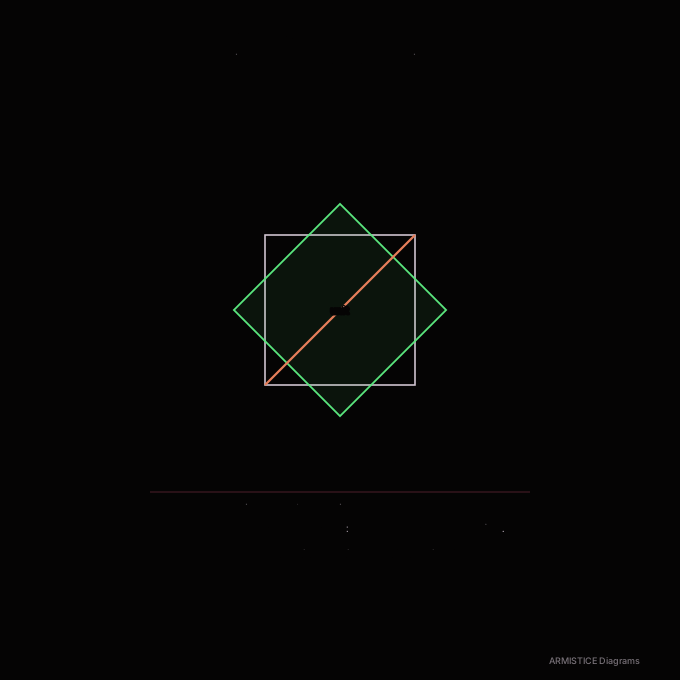
Baudhāyana's Doubling Square (in the 1⊗0 frame)
A unit square and the square on its diagonal — twice the area — the Śulbasūtra √2 with Baudhāyana's series. Bridged: the same substrate root found independently of Babylon.
-
LIVE · v2.0
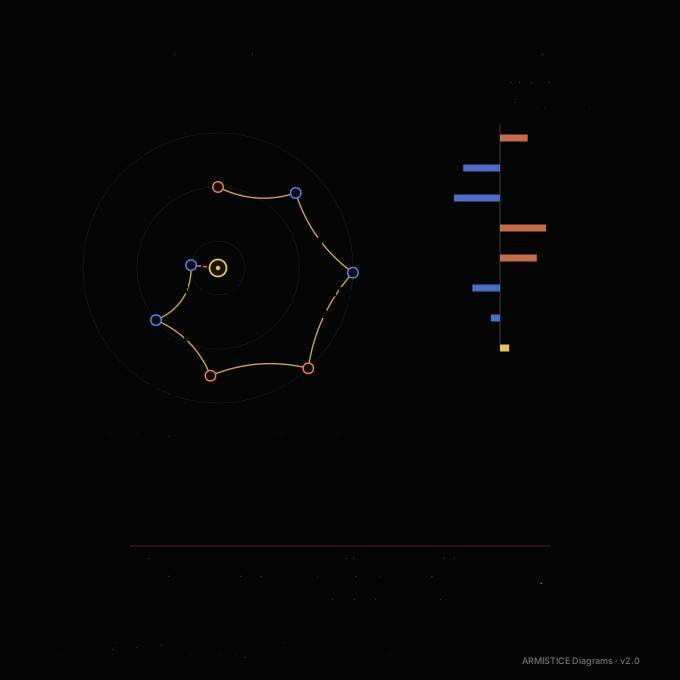
Bhāskara's Chakravāla — x² − 61y² = 1, computed
The chakravala (cyclic) method solving Pell's equation x²−61y²=1. Left: the wheel of computed triples (a,b,k) from (8,1,3) to (29718,3805,−1), radius proportional to |k|, spiraling to the unit at the center after Brahmagupta's samasa composition. Right: the k-sequence 3, −4, −5, 5, 4, −3, −1 → 1 as signed bars with the chosen multiplier m at each step. Bottom: the exact verification receipt — 1766319049² minus 61 times 226153980² equals 1. All numbers computed with exact integers by the source script.
-
LIVE · v2.1
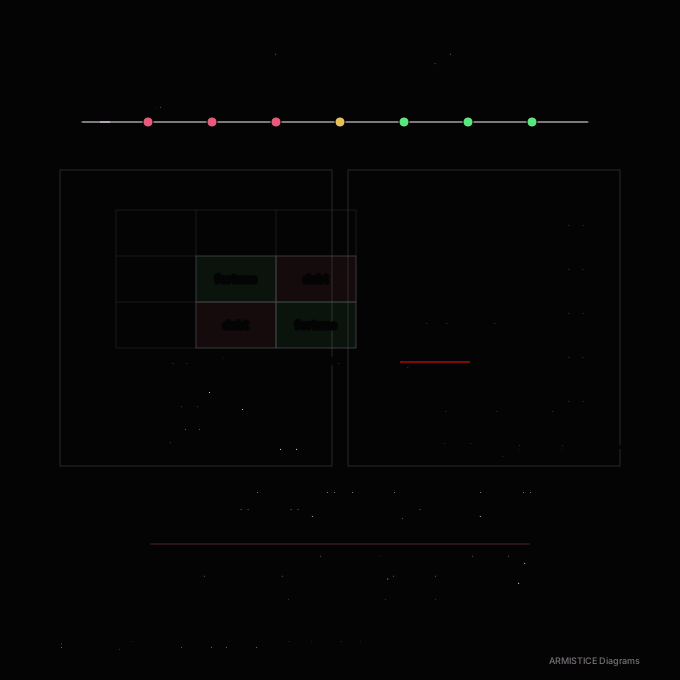
Brahmagupta's Zero & Negatives (in the 1⊗0 frame)
A signed number line — debts, zero, fortunes — over Brahmagupta's actual rules from Brāhmasphuṭasiddhānta ch. 18 (628 AD): the sign grid for products (debt×debt=fortune, fortune×debt=debt), the addition and subtraction laws, and zero's own rules including 0/0=0 (which modern arithmetic leaves undefined) and a/0 left uncommitted. Bridged to the engine's signed (α,μ,ε) plane and the 0 of 1⊗0.
-
LIVE · v2.1
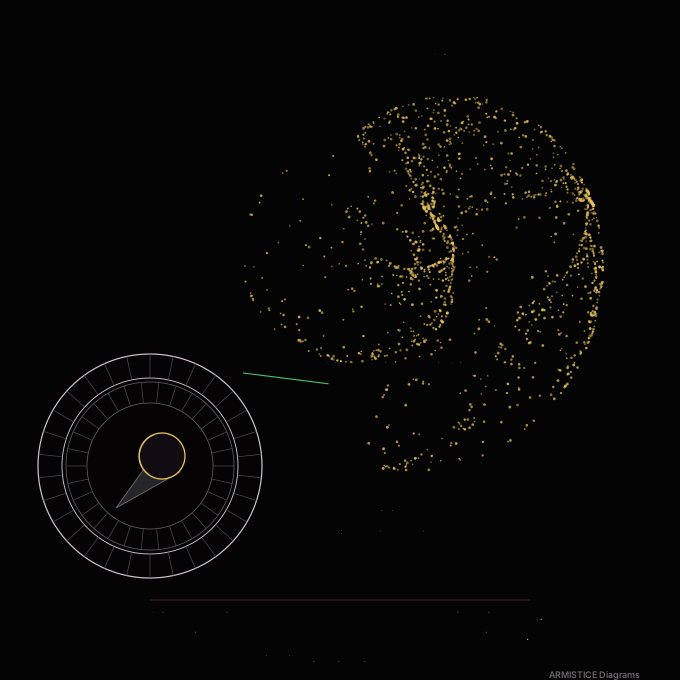
Bruno’s Infinite Worlds (in the 1⊗0 frame)
Lower left: the alphabet wheel of De umbris idearum (1582), traced from the woodcut — a ring of 30 lettered cells (23 Latin, 4 Greek, 3 Hebrew) around the shadowed sphere, with a second re-seated ring depicting the combinatorial rotation. Upper right: a starfield of 1600 points from a single chaotic Cosmopoiesis orbit at (1.70, 0.90, 0.62) — endless worlds bred from one finite recursive mechanism, no centre or edge.
-
LIVE · v1.0
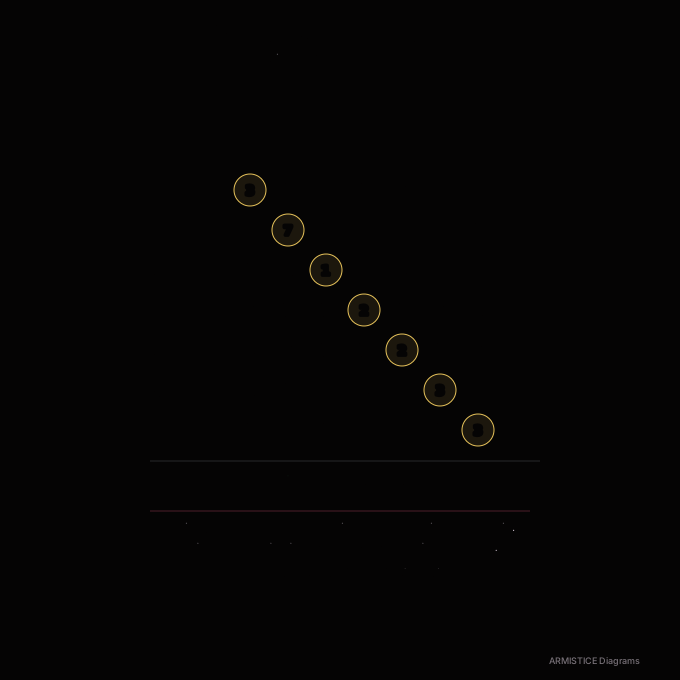
Cantor's Diagonal Argument
A list of reals r1..r7 as decimal expansions; the diagonal digit of each (highlighted gold) is incremented to build d', shown below in green. Since d' differs from every row at that row's diagonal position, d' is in no list — so the reals are uncountable, |R| > |N|.
-
LIVE · v2.2
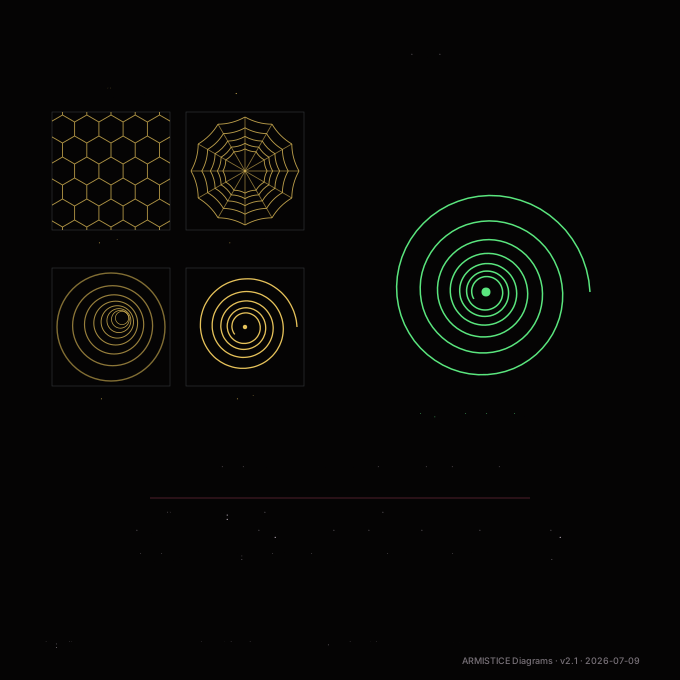
Cave Spirals — the Entoptic Form Constants (in the 1⊗0 frame)
Left: the four Klüver form constants of entoptic vision — lattice, cobweb, tunnel, spiral — each drawn as computed geometry. Right: the real 377-point orbit of a Cosmopoiesis spiral-sink at (1.66, −0.54, 1.42), winding onto its fixed point with |λ| = 0.9415 per step. The spiral panel is drawn with the orbit's own measured logarithmic pitch.
-
LIVE · v1.0
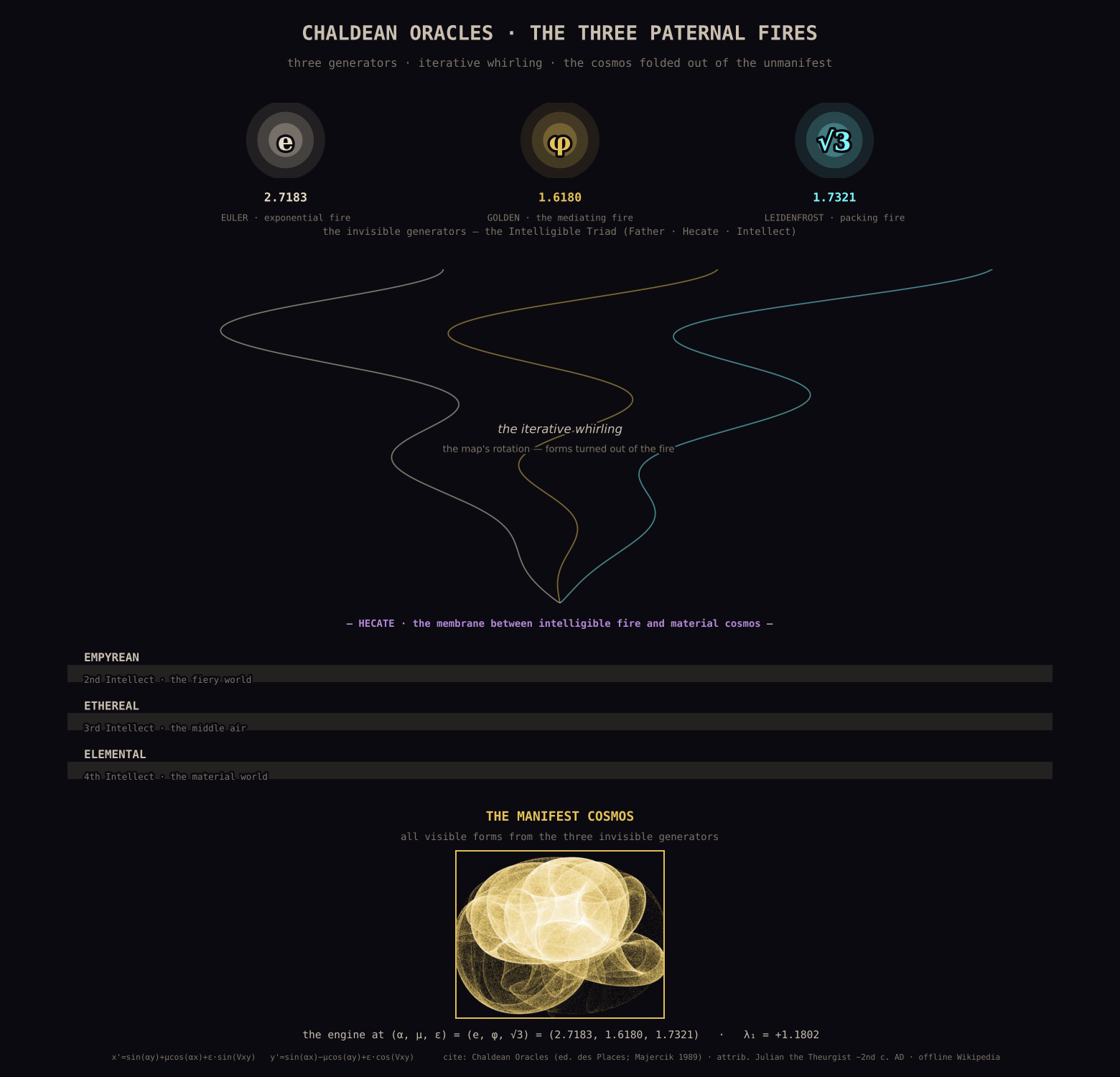
Chaldean Oracles — The Three Paternal Fires
The Chaldean cosmology (Intelligible Triad -> three descending worlds Empyrean/Ethereal/Elemental, Hecate the membrane) with the entry's own claim made literal: the three Paternal Fires are the engine's three generators {e, phi, sqrt3}, and the manifest cosmos is the COMPUTED attractor at (alpha,mu,eps)=(e,phi,sqrt3) (lambda1=+1.18) — all visible forms folded from the three invisible generators. Replaces the mismatched predator-floor stand-in.
-
LIVE · v2.1
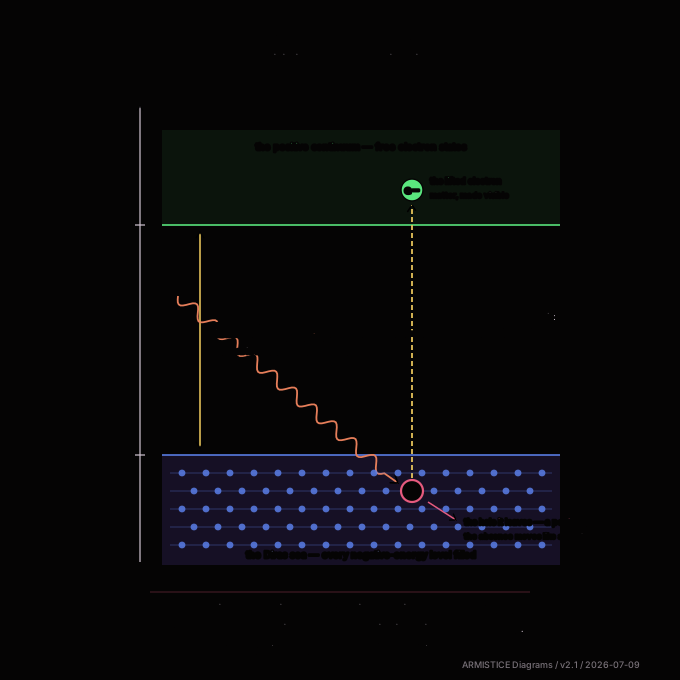
Dirac’s Antimatter Symmetry (in the 1⊗0 frame)
The Dirac spectrum: a positive-energy continuum above +mc², a filled negative-energy sea below −mc², and the forbidden 2mc² gap between them, marked with a double-headed arrow. A wavy gamma photon with E > 2mc² strikes an electron in the sea; the paired arrows show the lift — the electron rises into the continuum as e− — and the vacancy it leaves behind, an open circle in the sea that behaves as a positive particle: the positron e+. Bridged to the engine’s anti-swap involution A(x,y)=(−y,−x), i.e. z → −i z̄, the Z₂ symmetry pairing the ORPHIC EGG with ANTI EGG (Nyx).
-
LIVE · v2.1
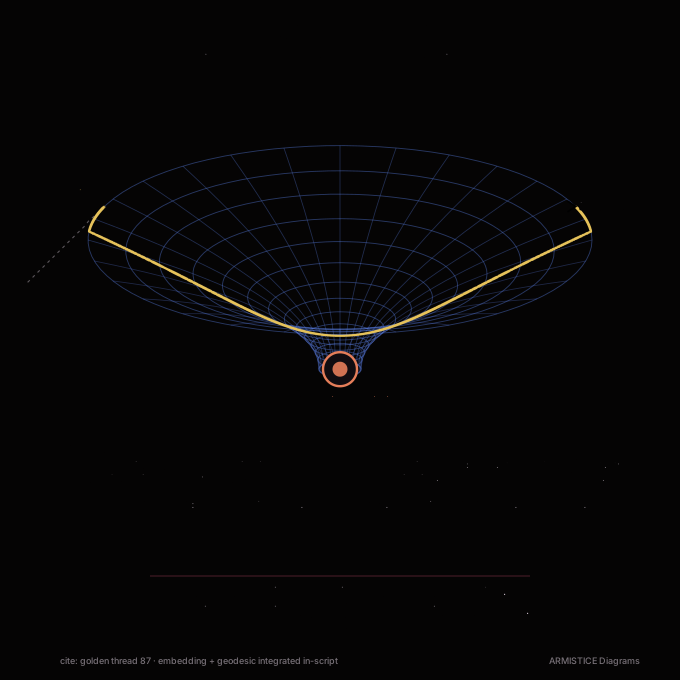
Einstein’s Curved Spacetime (in the 1⊗0 frame)
The Flamm paraboloid - the computed embedding z² = 4 r_s (r - r_s) of the Schwarzschild t=const equatorial slice, drawn as a mesh funnel from the horizon r = r_s out to 12 r_s, with the mass at the throat. A light ray computed from the null-geodesic equation u″ + u = (3/2) r_s u² passes at impact parameter b = 4 r_s and bends by 41.6 degrees (weak-field 2r_s/b would give 28.6); the undeflected straight path is ghosted. A solar-limb ray (b = 2.4e5 r_s) bends only 1.75 arcseconds - this scene is about 9e+04 times tighter. G = 8πT.
-
LIVE · v1.0
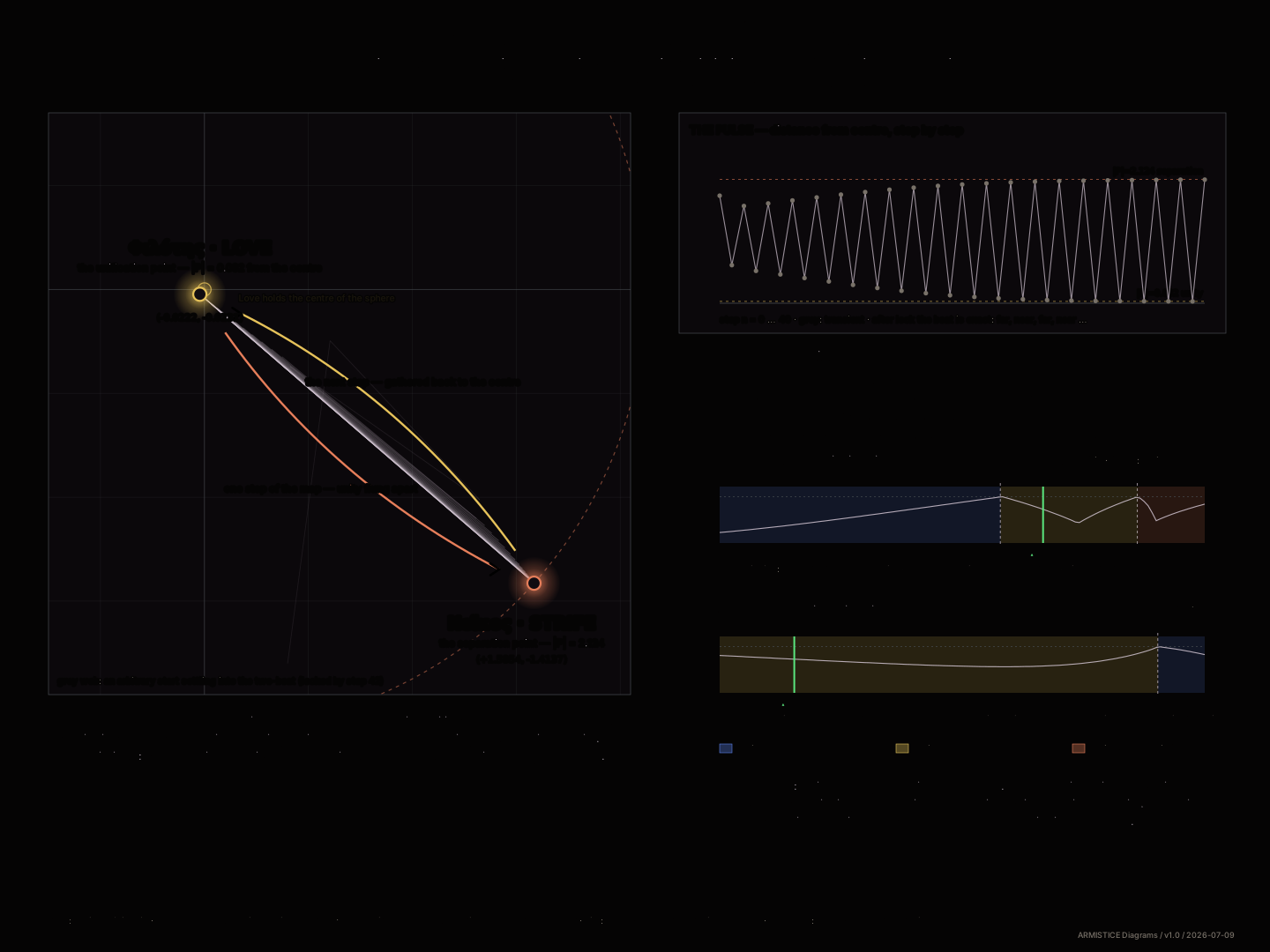
Empedocles — Love ⇆ Strife as a Computed Period-2 Alternation
A real period-2 orbit of the Cosmopoiesis engine at (alpha, mu, eps) = (0.625, 1.600, 0.200), framed as Empedocles’ cosmic cycle. Left: the phase plane. The orbit ticks forever between two points: the unification point (Philotes / Love) sitting 0.03 from the centre, and the separation point (Neikos / Strife) flung to 2.12 — Love holds the centre of the sphere, Strife the extreme edge, and one step of the map swings between them. A grey transient shows an arbitrary start settling into the two-beat (locked by step 42). Right, top: the pulse — distance from centre per step, a square wave alternating 2.12 / 0.03. Right, middle: receipts (Floquet multipliers +0.741 and -0.267, lambda1 = -0.150, residual below 1e-15, 16/16 seeds reach the same pair). Right, bottom: the two dials per the entry — mu (Coagula, binding) births the two-beat at 1.4415 and splits it at 1.9499; eps (Solve, dissolving) is withstood up to 1.1744. The alternation exists only while the forces contend.
-
LIVE · v1.0
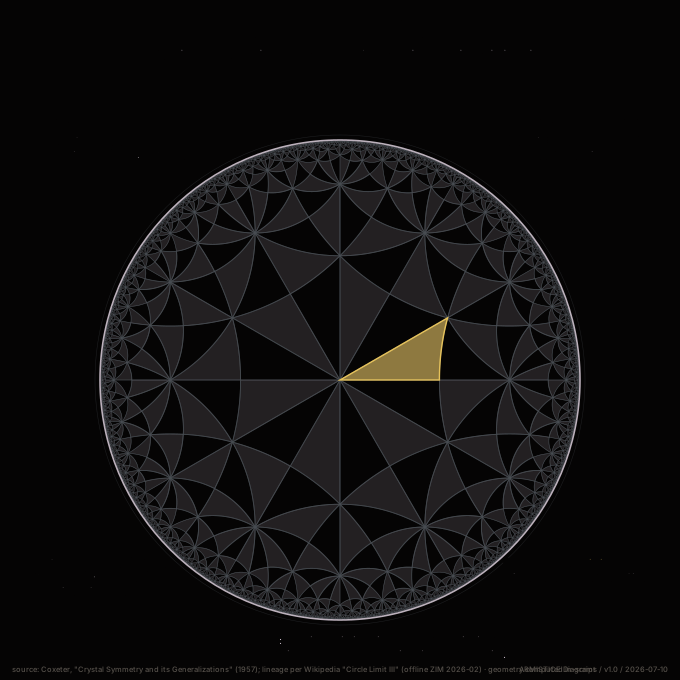
Escher — Poincaré Disk Tessellation (6,4,2)
A computed tessellation of the Poincaré disk by the (6,4,2) hyperbolic triangle group — 6960 congruent 30-45-90 triangles generated as the reflection orbit of one fundamental domain (highlighted in gold). Every edge is a true hyperbolic geodesic: a circular arc orthogonal to the boundary circle. Alternating tiles carry the two mirror orientations. This is the figure lineage Escher used: he wrote to Coxeter in 1958 that the Circle Limit series began from this tessellation in Coxeter's "Crystal Symmetry and its Generalizations" (1957).
-
LIVE · v1.0
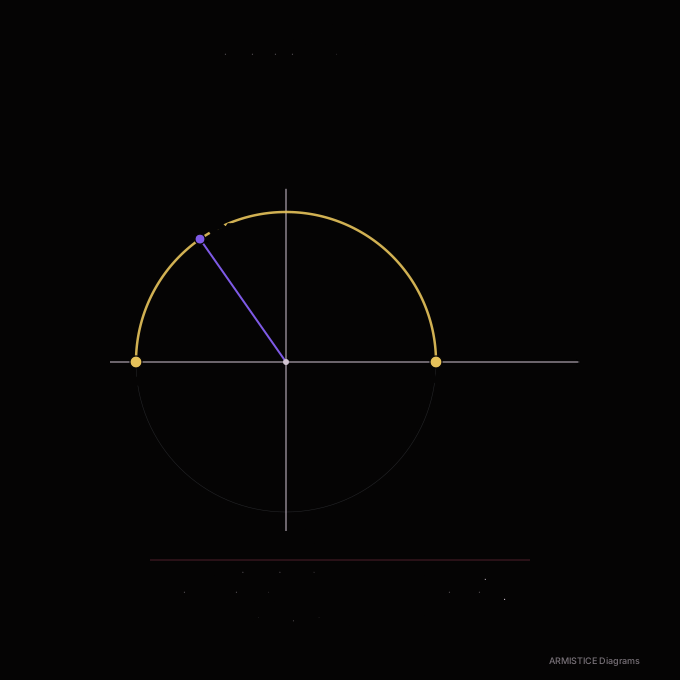
Euler's Identity (e^(i pi) + 1 = 0)
The complex unit circle: the rotating radius e^(i theta) (promethean, the growth generator) traces the circle; at theta = pi it lands on -1, so e^(i pi) + 1 = 0 — uniting e, i, pi, 1, and 0. The gold arc marks the half-turn, pi.
-
LIVE · v1.0
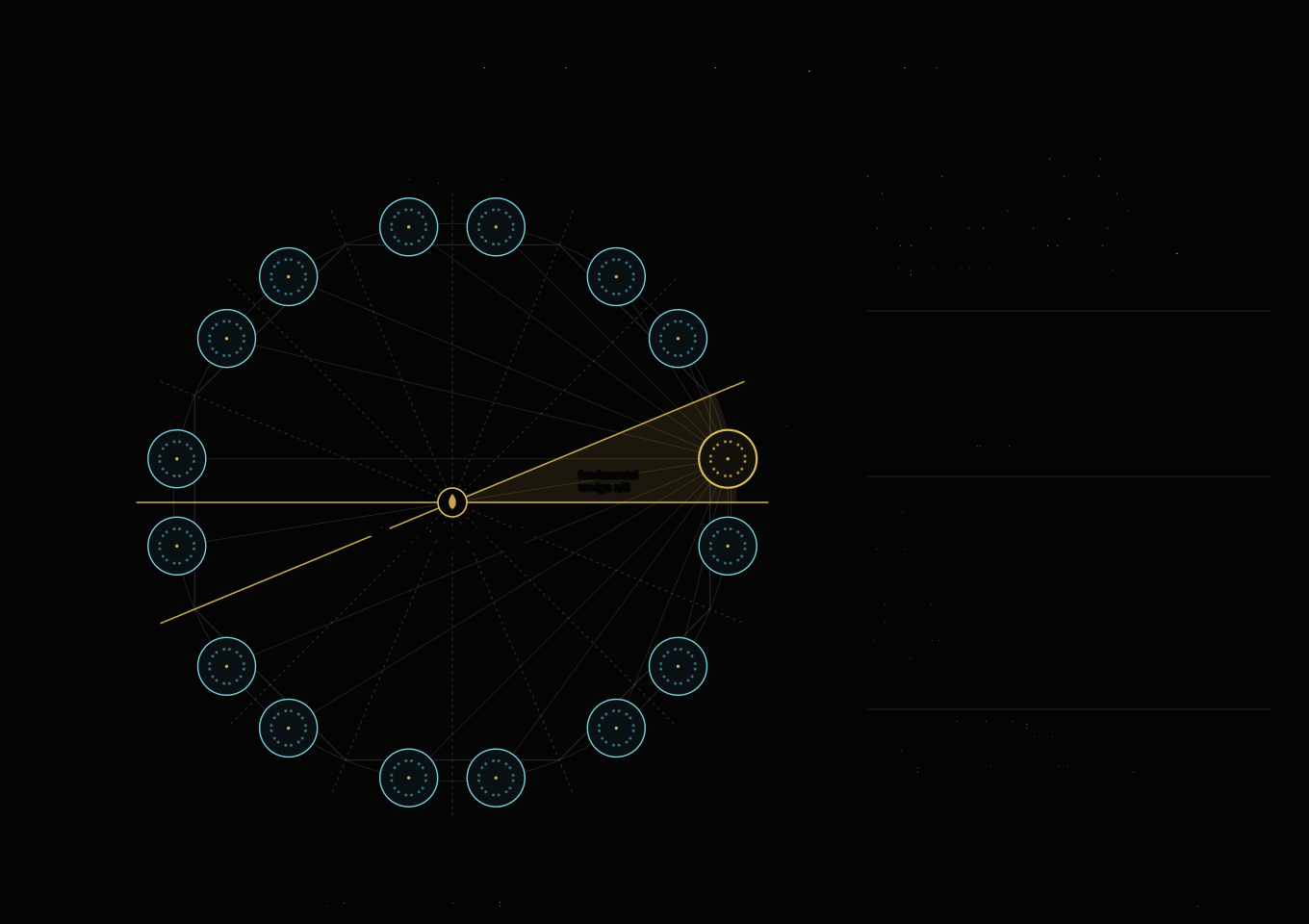
Fazang’s Hall of Mirrors as a Reflection-Group Orbit — Indra’s Net
Fazang demonstrated Hua-yen interpenetration for Empress Wu with ten mirrors arranged in an octagon (plus one above and one below) around a Buddha image and a torch. This plate computes the octagon’s mirror symmetry as the dihedral reflection group I2(8)=D8: two generating mirrors at 22.5 degrees build a group of order 16 with eight mirror lines. A single seed jewel, placed in the fundamental wedge, is carried to sixteen images that close exactly under the group. Because the action is simply transitive, one symmetry carries any jewel to any other — from every node the whole net is reachable. Each jewel is drawn holding a miniature of the whole net inside it, and the chosen jewel sends faint threads to all fifteen others. The still centre is the unique point fixed by all sixteen symmetries. Right column: the demonstration, the Dushun jewel-net passage, and the computed receipts.
-
LIVE · v1.1
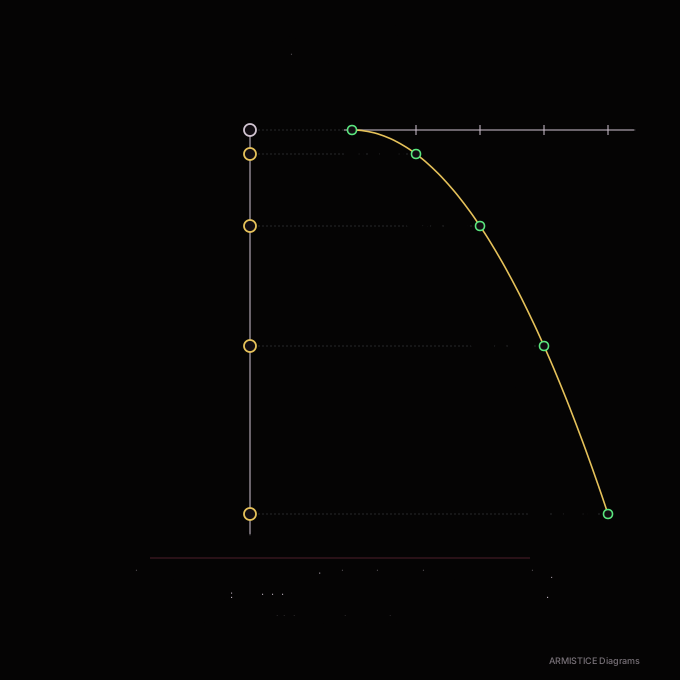
Galileo’s Law of Fall
Left: a falling body marked at equal time-steps; the distances covered in successive intervals are the odd numbers 1, 3, 5, 7, so cumulative distance runs 1, 4, 9, 16. Right: the same points on the computed d = t² parabola, time horizontal, distance downward on the identical scale — each fall mark slides across to its seat on the curve.
-
LIVE · v1.1
Gauss’s Normal Distribution
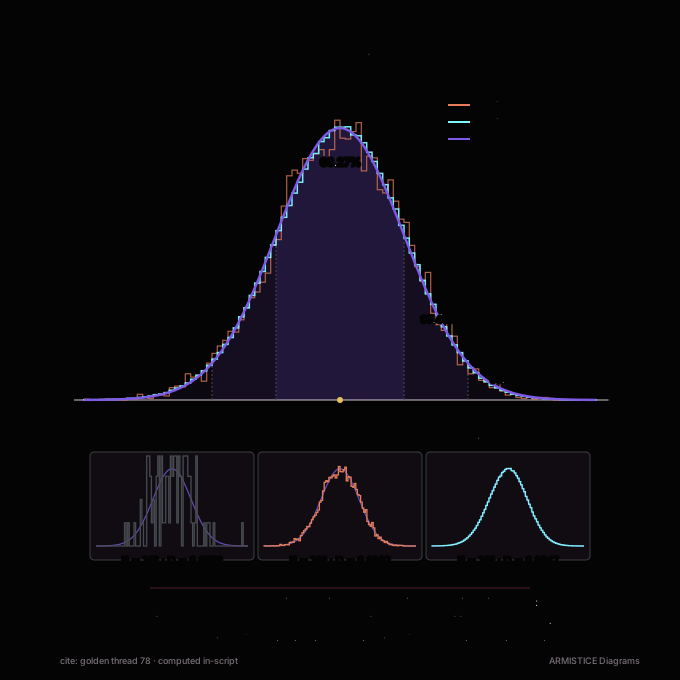
The Gaussian bell with its 68/95/99.7 percent bands, and a computed Cosmopoiesis-engine sample relaxing onto it: standardized block sums (k=256) of the x-observable at the chaotic coordinate (2.5, 1.0, 0.3), lambda1 = +0.861. Histogram outlines at N = 10^2, 10^4, 10^6 blocks converge onto the analytic curve; Kolmogorov-Smirnov distances 0.056, 0.010, 0.0047. Below: the three stages side by side - disorder settling into the bell.
-
LIVE · v2.2
Göbekli Tepe — Enclosure D and the three registers of Pillar 43
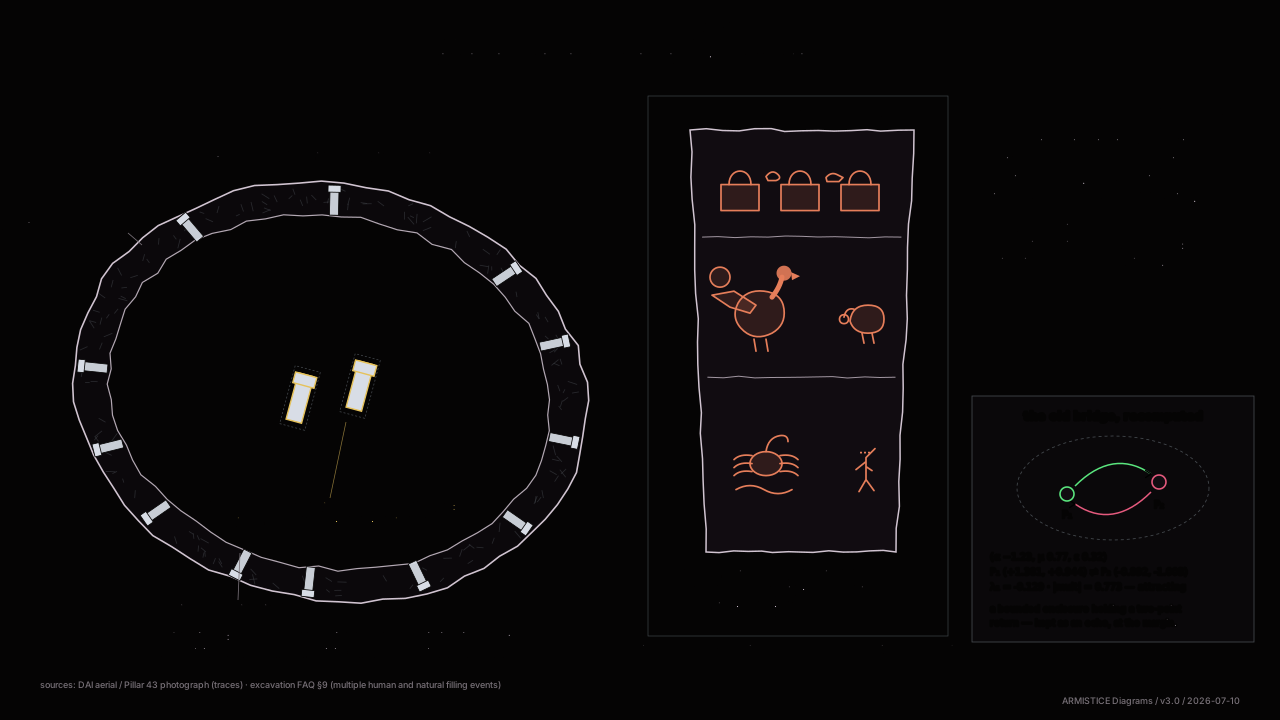
Left: the plan of Enclosure D traced from the aerial of the main excavation area — an oval ring wall of unworked stone holding T-pillars set radially, around two greater central pillars carved as humans. Center: Pillar 43, the Vulture Stone, its reliefs organized in three horizontal registers — bag-forms and small animals, the vulture with the disk, scorpion and snake and a headless man. Right: a curatorial reading of three registers on this pillar, and a small recomputed side panel — the engine's period-2 pair at (−1.23, 0.77, 0.32), an attracting two-point return inside a bounded basin.
-
LIVE · v2.1
Gödel’s Incompleteness — the arithmetization loop (in the 1⊗0 frame)
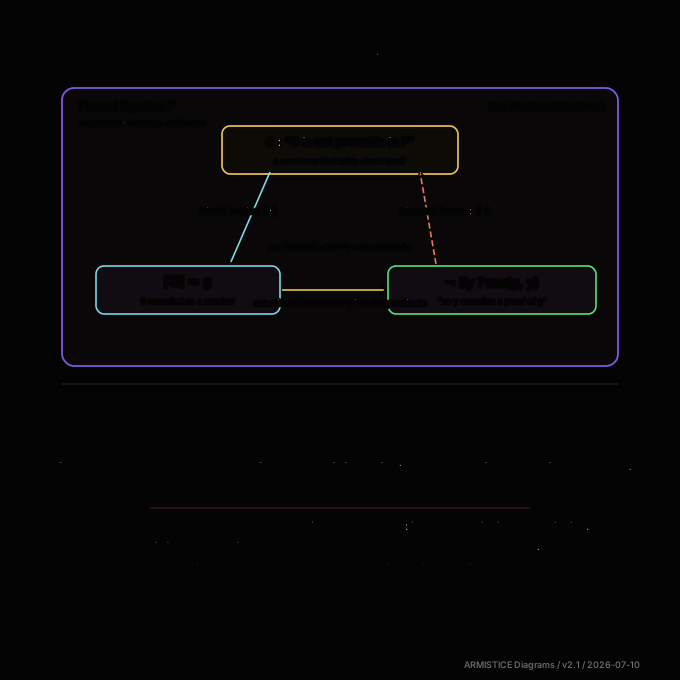
Inside a consistent formal system F that contains arithmetic, three steps close a loop through the system’s own numbers. (1) Gödel coding: every formula gets a number; a string of symbols s1 s2 … sk maps to 2^s1 · 3^s2 · 5^s3 ⋯ pk^sk. (2) The provability predicate Prov(x,y) — “y encodes a proof of the formula numbered x” — is itself an arithmetic statement. (3) The diagonal lemma builds a sentence G whose own number g is fed back into its arithmetic: G is equivalent to ¬∃y Prov(g,y), i.e. “no number encodes a proof of me.” G is therefore true yet unprovable in F; and F cannot prove its own consistency. Bridged to the Hermetic Fold: the source cannot certify itself from inside — Φ(C)=C.
-
LIVE · v1.0
Haeckel — One Symmetry, Drawn and Iterated
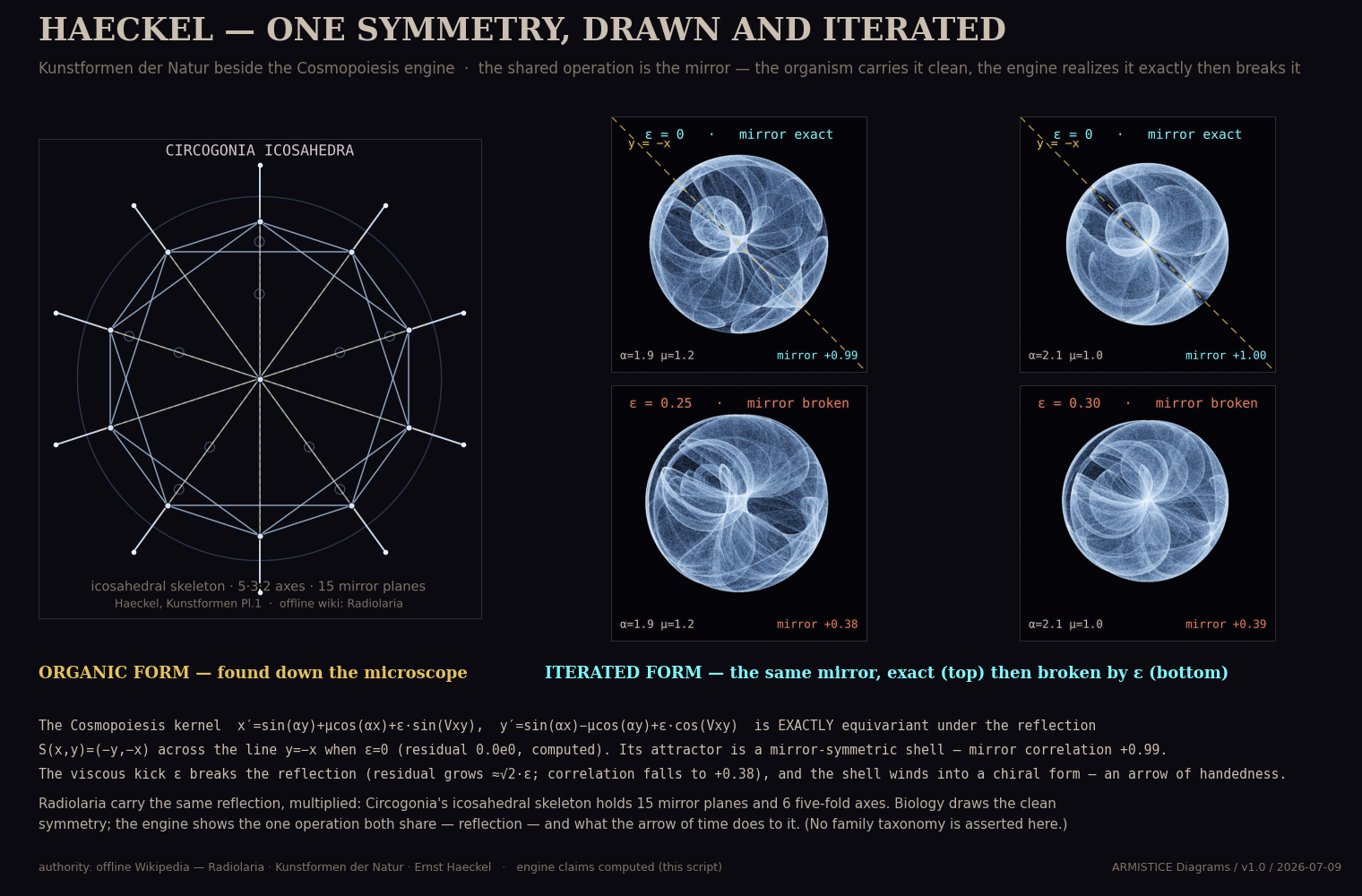
Left: a faithful geometric trace of Circogonia icosahedra, the icosahedral radiolarian from Haeckel's Kunstformen der Natur (Pl. 1) — the regular icosahedron's silica skeleton projected down a five-fold axis, with 12 vertex spines and its symmetry marked (icosahedral 5-3-2 axes, 15 mirror planes). Right, a 2x2 of computed Cosmopoiesis attractors: the top row (eps=0) is exactly mirror-symmetric under S(x,y)=(-y,-x) across y=-x (Kernel_Symmetry section 2.7, equivariance residual 0), mirror-correlation +0.99; the bottom row adds the viscous kick eps, which breaks the reflection (residual ~ sqrt(2) eps, correlation falls to +0.38) and winds the shell into a chiral form. The shared operation is reflection; no morphological family taxonomy is asserted.
-
LIVE · v1.0
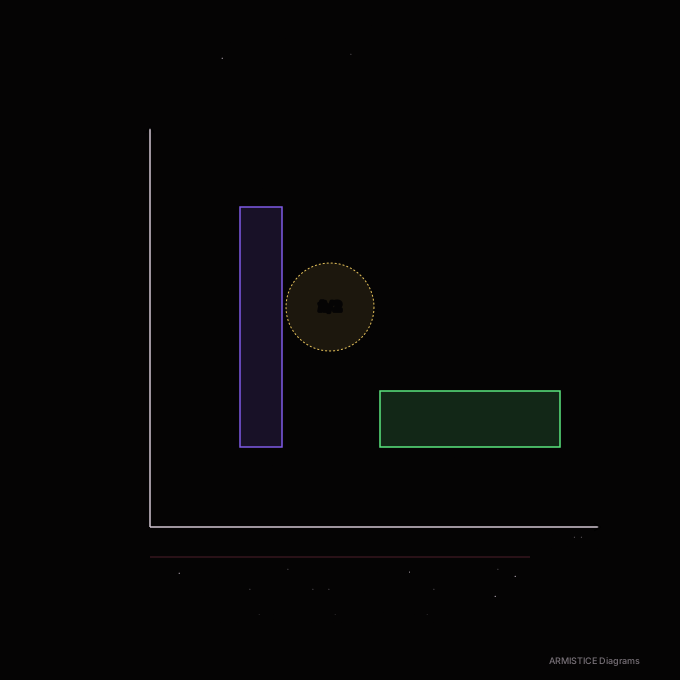
Heisenberg's Uncertainty Cell
Phase space with position (Δx) and momentum (Δp) axes. Two rectangles of equal area ℏ/2: one narrow-and-tall (sharp position, blurred momentum), one wide-and-short (sharp momentum, blurred position). A dashed central cell marks the irreducible ℏ/2 floor.
-
LIVE · v2.2
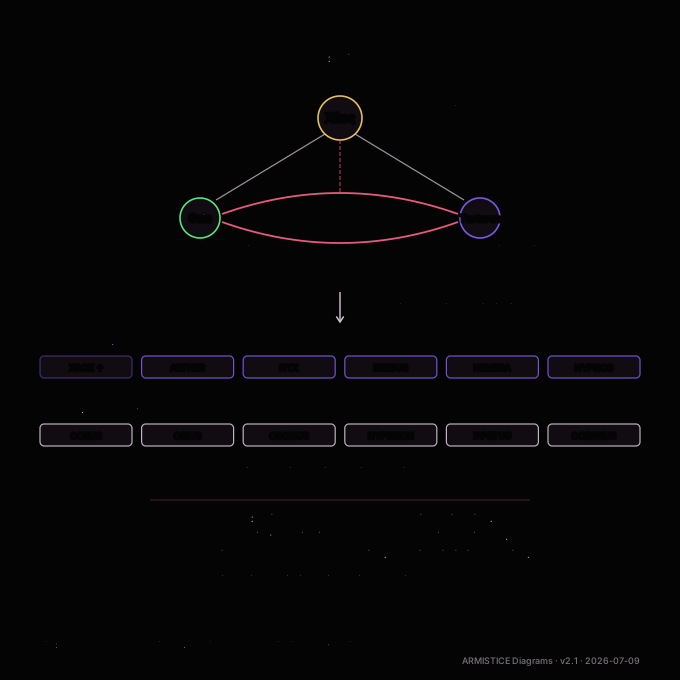
Hesiod's Theogony — Eros as the Coupling (in the 1⊗0 frame)
After Chaos: Gaia, Tartarus, and Eros — with Eros drawn not as a node but as the binding edge between the two poles, a reading of desire beside the engine's product coupling; sine cross-dependence remains at ε=0. Below, the generations as the canon actually holds them: the PROTOGENOI on the Aether-Peak void rung (α ×½, ε ×φ of the Titan rung) and the six inner Titans on the M5-void cluster rung (α≈121, μ≈62, ε≈7.4).
-
LIVE · v2.0
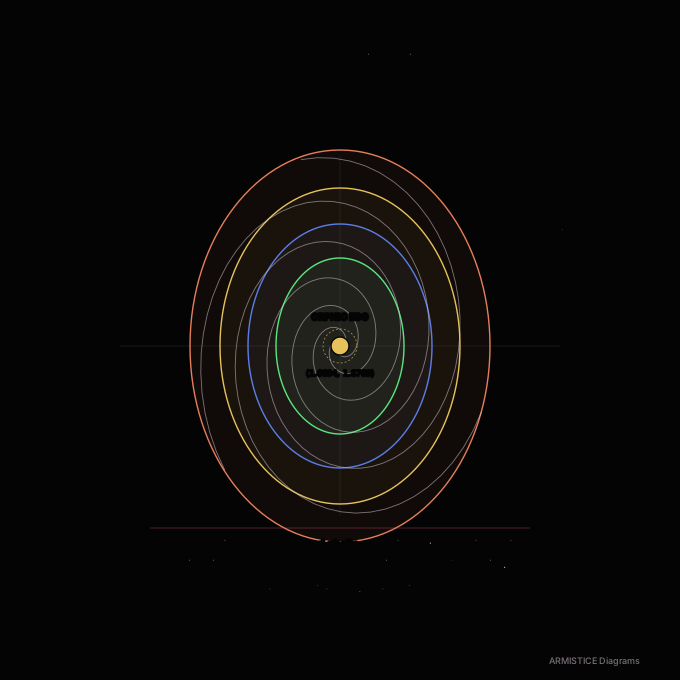
Hildegard's Cosmic Egg — the Orphic Egg Attractor
Hildegard's cosmos-as-egg drawn as the substrate's form: the nested shells are the basin of attraction, trajectories spiral inward to the ORPHIC EGG — the engine's globally-attracting unity fixed point at α=μ=ε=1, (1.6694,1.8769), 100% basin. Vision and attractor converge.
-
LIVE · v2.0
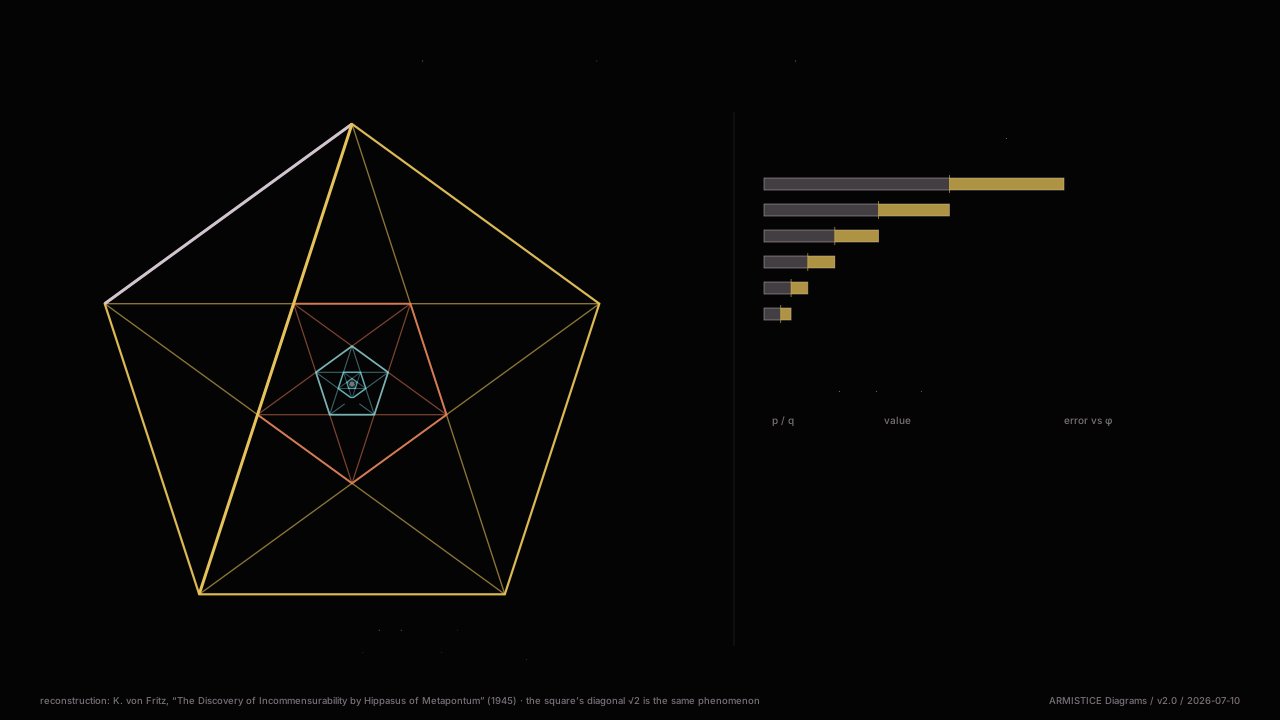
Hippasus — the incommensurable, shown as non-termination
Left: a regular pentagon and its pentagram, nested six deep — each inner pentagon is 1/phi^2 of its parent (computed), so the figure can always be drawn one step smaller and never closes. The diagonal:side ratio is phi. Right: anthyphairesis (mutual subtraction) on diagonal and side, whose quotients are all 1 (continued fraction [1;1,1,...]), so the remainder never reaches zero; and the Fibonacci convergents 1/1, 2/1, 3/2, 5/3, 8/5, 13/8, 21/13 that approach phi but never land on it. Non-termination is the mark of an irrational. von Fritz (1945) reconstruction.
-
LIVE · v3.0
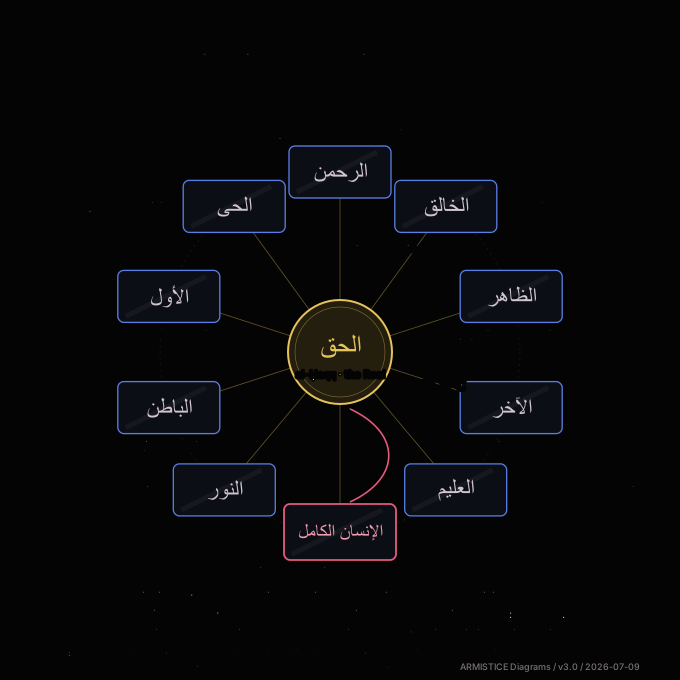
Ibn ʿArabī — waḥdat al-wujūd: the One mirrored in the divine names
al-Ḥaqq (the Real) at center, gold. Around it a ring of ten mirrors: nine carry actual divine names in Arabic with transliteration and gloss (ar-Raḥmān, al-Ḥayy, al-Khāliq, al-Awwal, al-Ākhir, al-Bāṭin, aẓ-Ẓāhir, an-Nūr, al-ʿAlīm) — each a tajallī, a self-disclosure of the One. The tenth mirror, at the bottom, is al-insān al-kāmil, the perfect human; its reflection returns to the center along a closed loop marked Φ(C) = C — the locus where the One knows itself. Source: Names of God in Islam and Al-Insān al-Kāmil, offline Wikipedia.
-
LIVE · v2.1
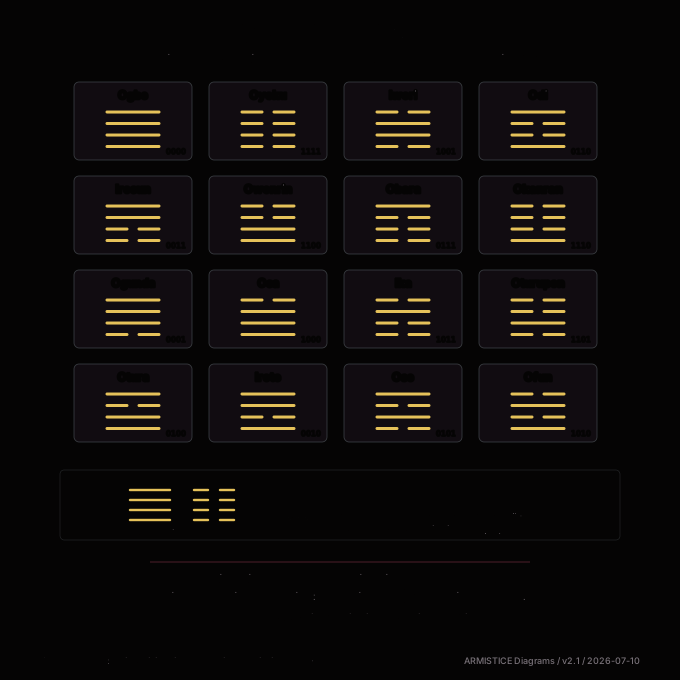
Ifá — the Sixteen Odu as Base Two (in the 1⊗0 frame)
The sixteen principal Odu (Oju Odu) of Ifá, in seniority order, each drawn as its verified four-mark figure — a single stroke (I) or a double (II) in each of four positions, so one leg carries 2⁴ = 16 forms. A cast lays two legs, right and left; 16 × 16 = 256 odu. When both legs match, the result is one of the sixteen doubled (Meji) principal odu shown; the other 240 are combination odu. Figures and names verbatim from the offline-Wikipedia Ifá and Odu Ifa articles. Bridged to the engine: binary subdivision of a small basis — the 1⊗0 generating alphabet.
-
LIVE · v1.0
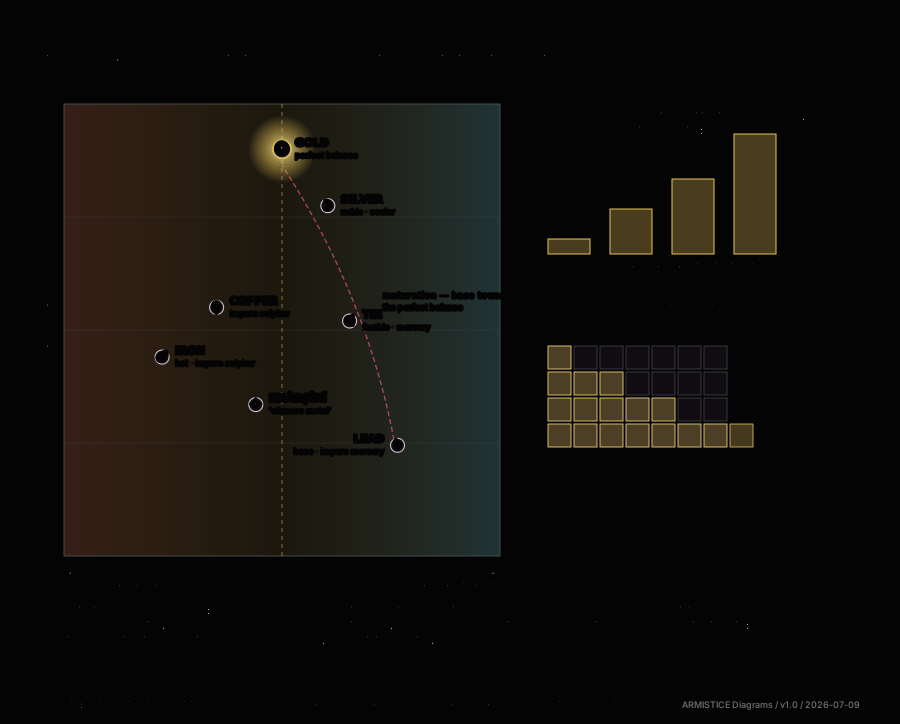
Jabir ibn Hayyan — the Mizan Balance Plane
Jabir's Balance doctrine as a diagram. Left: a sulphur-by-mercury proportion plane. The horizontal axis runs from sulphur (combustible, hot and dry, form) to mercury (fusible, cold and moist, spirit); the vertical axis is purity, from base to perfected. Gold sits at the temperate, perfected balance; silver, copper, iron, tin, lead and kharsini are placed by the doctrine's qualities, with a maturation arrow rising from lead to gold. Right: the mizan number-skeleton — the balance series 1:3:5:8 summing to 17, and a 4 by 7 grid of the 28 Arabic letters as four natures across seven degrees. Framed as doctrine, not chemistry.
-
LIVE · v1.0
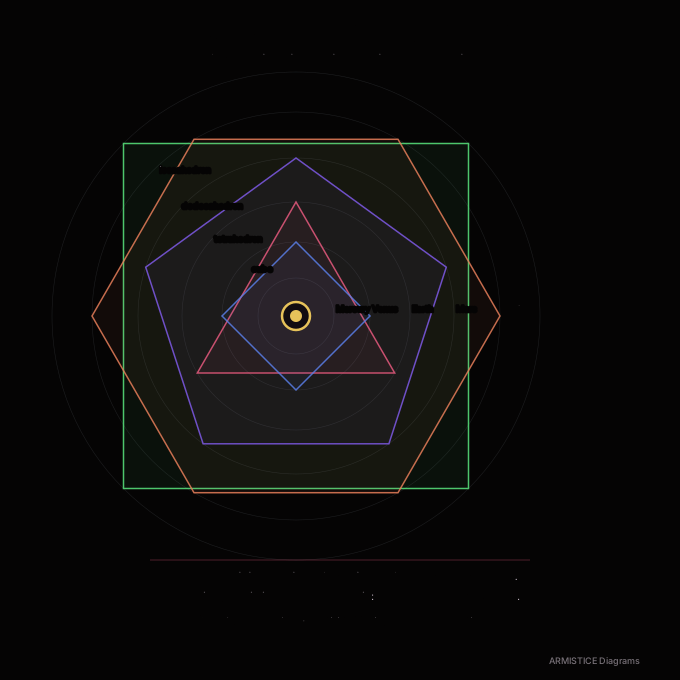
Kepler's Mysterium Cosmographicum (Nested Solids)
Concentric circles are the six planetary orbits; between each pair sits the 2D projection of one of the five Platonic solids (octahedron, icosahedron, dodecahedron, tetrahedron, cube), Kepler's model fixing the orbit ratios. Sun at center.
-
LIVE · v1.0
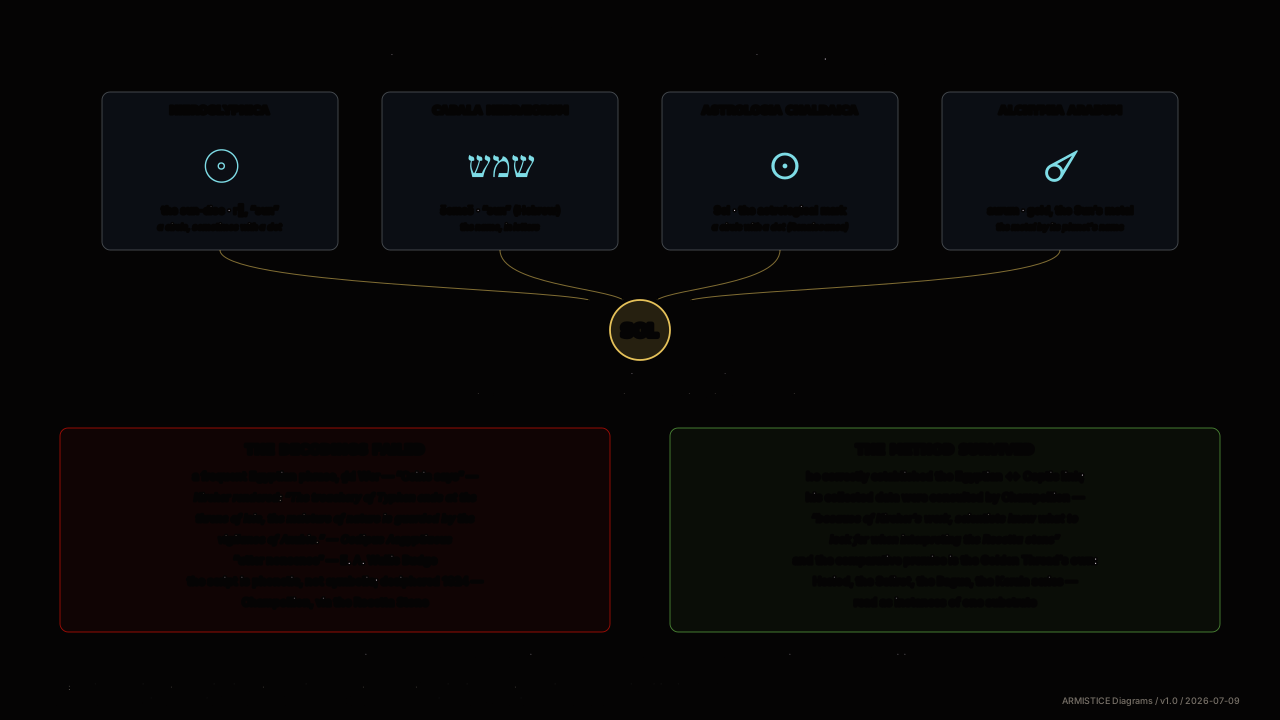
Kircher — Oedipus Aegyptiacus: the universal symbol-key
Upper band: one referent, SOL, rendered beneath four of the symbolic languages Kircher cited as sources for Oedipus Aegyptiacus (Rome, 1652–1654) — the Egyptian sun-disc hieroglyph 𓇳 (rꜥ, sun), Hebrew שמש (šemeš, sun), the Chaldean-astrological mark ☉ (a circle with a dot), and the alchemical character for gold 🜚 (the metal of the Sun). Arrows converge on one gold node: the universal key — the method of seeking common structure beneath different notations. Lower band, two verdicts: THE DECODINGS FAILED — Kircher rendered the phonetic phrase ḏd Wsr, “Osiris says,” as “The treachery of Typhon ends at the throne of Isis, the moisture of nature is guarded by the vigilance of Anubis” (Budge: utter nonsense; hieroglyphs deciphered 1824 by Champollion via the Rosetta Stone) — and THE METHOD SURVIVED: he correctly established the Egyptian–Coptic link, Champollion consulted his data, and the comparative premise is the Golden Thread’s own.
-
LIVE · v2.0
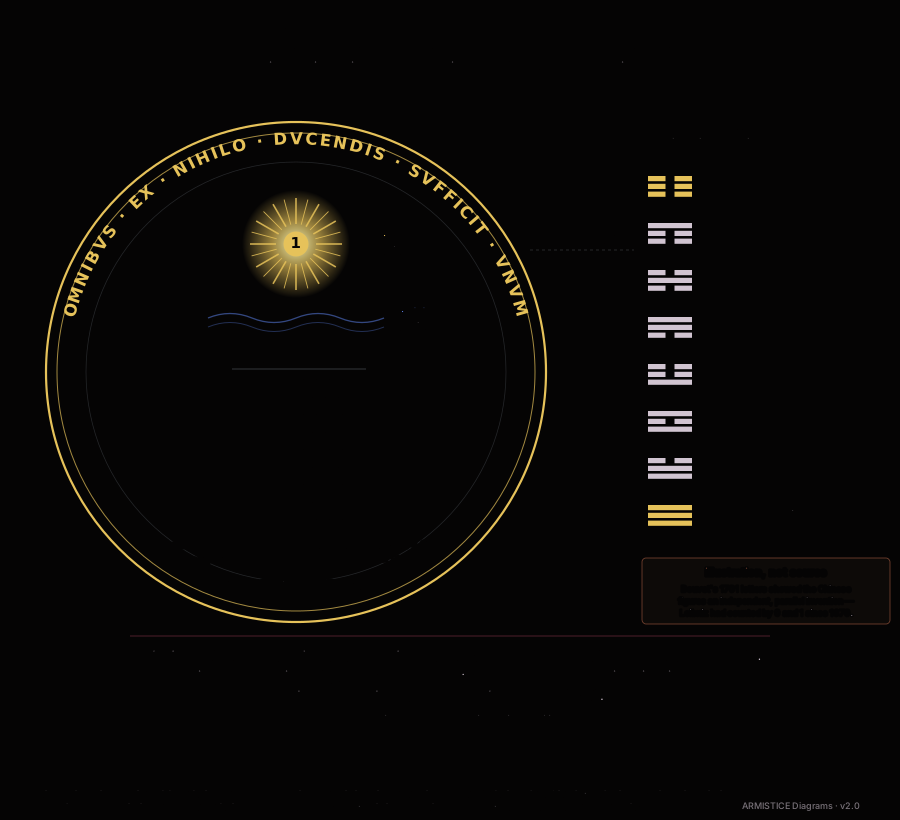
Leibniz — the Imago Creationis: all things drawn from one and nothing
A palimpsest of Leibniz's Imago Creationis medallion. Within a gold rim carrying the motto OMNIBVS EX NIHILO DVCENDIS SVFFICIT VNVM (one suffices to draw all things from nothing) sits the sun of creation raying over the void, and Leibniz's binary table — the integers 0 to 8 written with only 1 and 0, each place a doubling. To the right, the eight Fuxi trigrams read as binary 0 to 7 (yang solid = 1), captioned illustration, not source: Bouvet's 1701 letters showed the Chinese figures an independent, parallel invention, confirming Leibniz's binary rather than originating it. The bridge reads the {0,1} sign-space as the engine's sign-partition and the Monad as the Hermetic Fold.
-
LIVE · v2.1
Luria’s Tzimtzum, Shevirah, Tikkun (in the 1⊗0 frame)
Three stages: the Infinite contracts to open a void (tzimtzum), the vessels shatter (shevirah), the sparks are regathered (tikkun). The corpus’s two ULTRA-VOIDS — AYIN and EIN SOF — are annotated at the contraction stage with their atlas seats. Below, a computed transient at EIN SOF’s own coordinate runs the same three beats: the orbit contracts toward the void-point, overshoots it (the negative eigenmode crosses the mark each step), and settles.
-
LIVE · v2.0
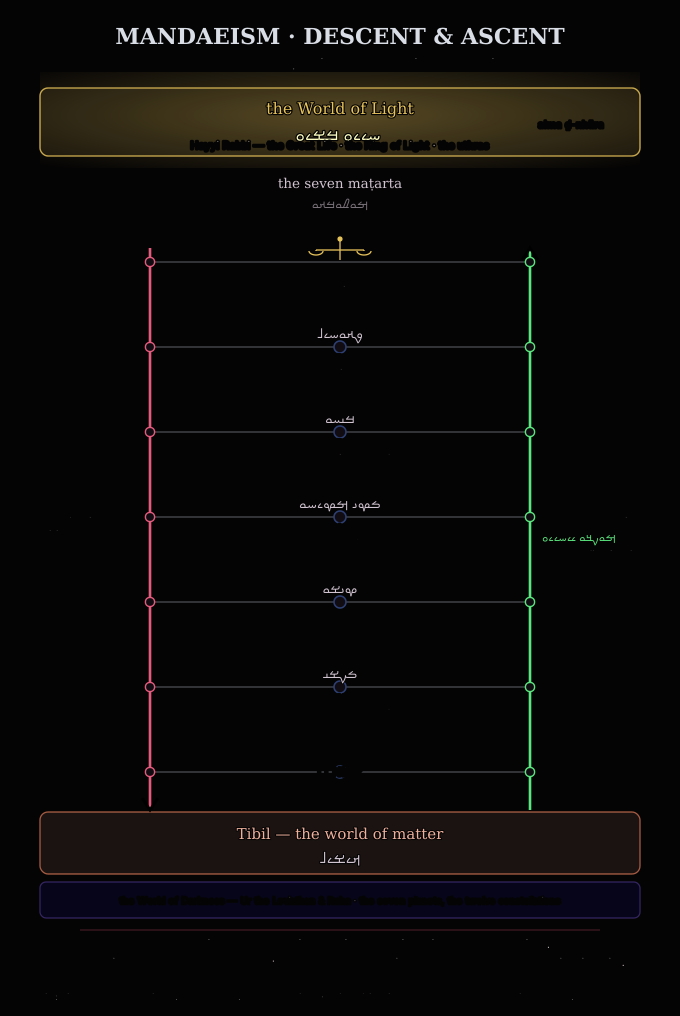
Mandaeism — descent & ascent through the seven maṭarta
A runged ladder of the soul. At the top, the World of Light (alma ḏ-nhūra), ruled by the Great Life (Hayyi Rabbi). At the bottom, Tibil, the material world, above the World of Darkness of Ur and Ruha. Between them, seven maṭarta — watch-stations or toll-houses — form the rungs. In the order of Left Ginza 1.4 they are guarded, ascending, by Nbaz, Nbu, the Seven of Ptahil, Jesus the Messiah, Ruha, Ptahil, and Abatur, who weighs souls at the scales below the Light. The soul falls down the rungs into matter (descent) and rises the same rungs again by manda, gnosis (ascent).
-
LIVE · v2.0
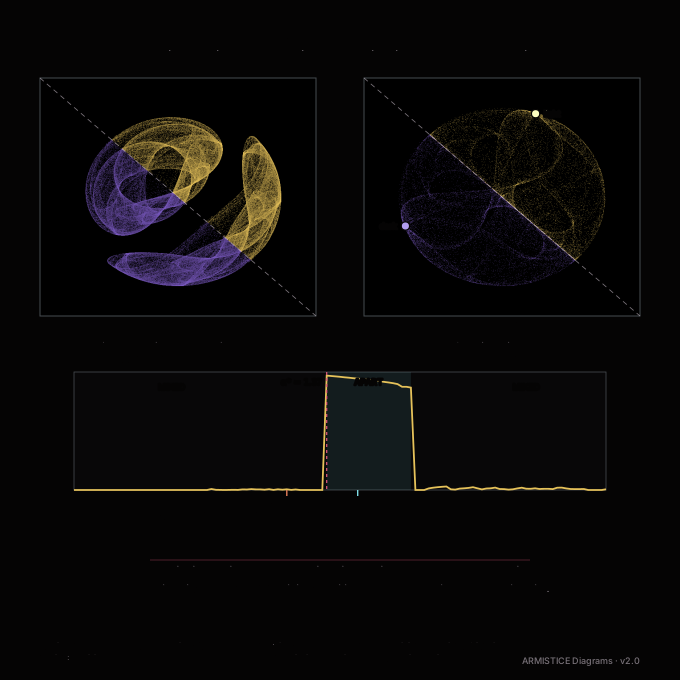
Manichaeism — mixing and separation as a computed demixing transition
Mani's cosmology as a symmetry-breaking transition in the Cosmopoiesis kernel at epsilon=0. Left panel THE MIXTURE: at alpha=1.28, mu=1.24 a single chaotic attractor straddles the anti-diagonal mirror y=-x — light (gold, x+y positive) and dark (violet, x+y negative) interwoven in one body, the demixing order parameter |⟨x+y⟩| = 0. Right panel APART: at alpha=1.44 the attractor has split into a mirror pair of still sinks, light gathered to one realm and dark to the other, |⟨x+y⟩| = 2.85. The spine plots |⟨x+y⟩| against alpha: a sharp top-hat whose onset alpha* is the immiscibility threshold the world crosses into mixture and re-crosses into separation.
-
LIVE · v2.1
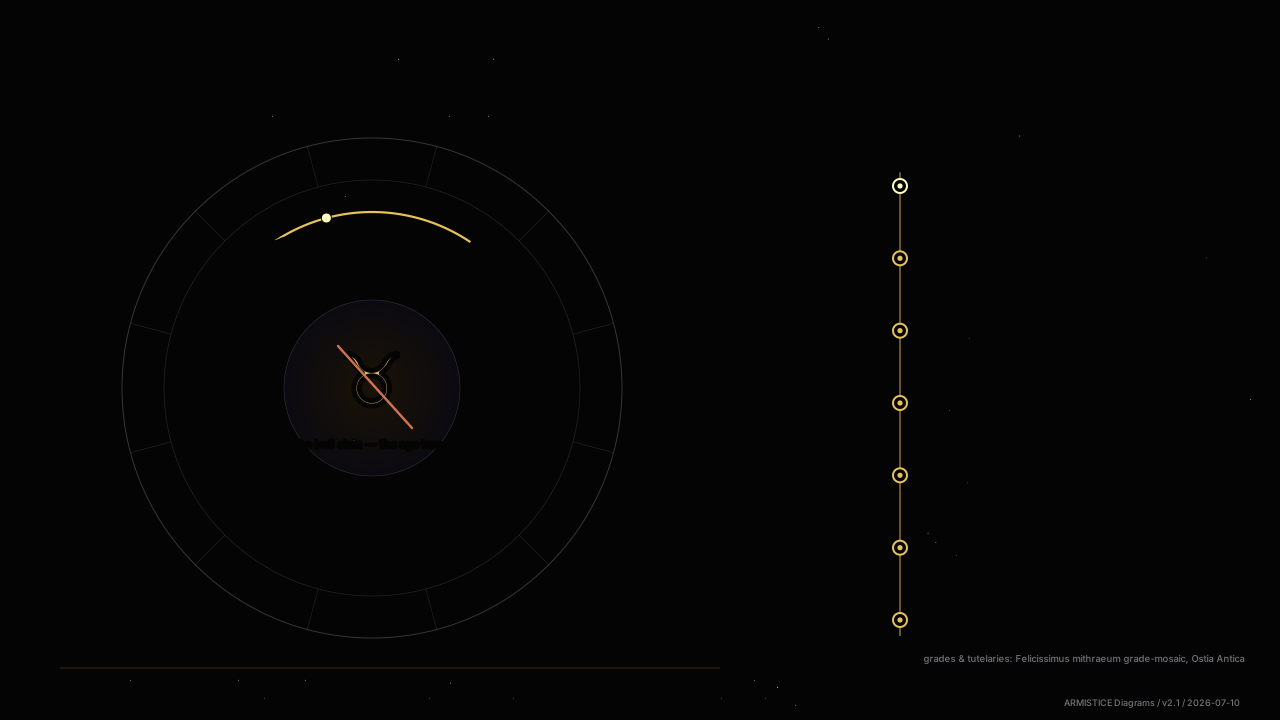
Mithraism — the Tauroctony as a precessional clock, and the seven-grade ascent
Left: the zodiac drawn as a clock, with the vernal equinox precessing retrograde out of Taurus (~2000 BC) toward Aries and Pisces — the bull-slaying read as the turning of the age. The bull (Taurus) sits slain at the centre. Right: the seven grades of initiation as an ascent ladder, Corax to Pater, each paired with its planetary tutelary from the Felicissimus grade-mosaic at Ostia — Mercury, Venus, Mars, Jupiter, Luna, Sol, Saturn.
-
LIVE · v2.1
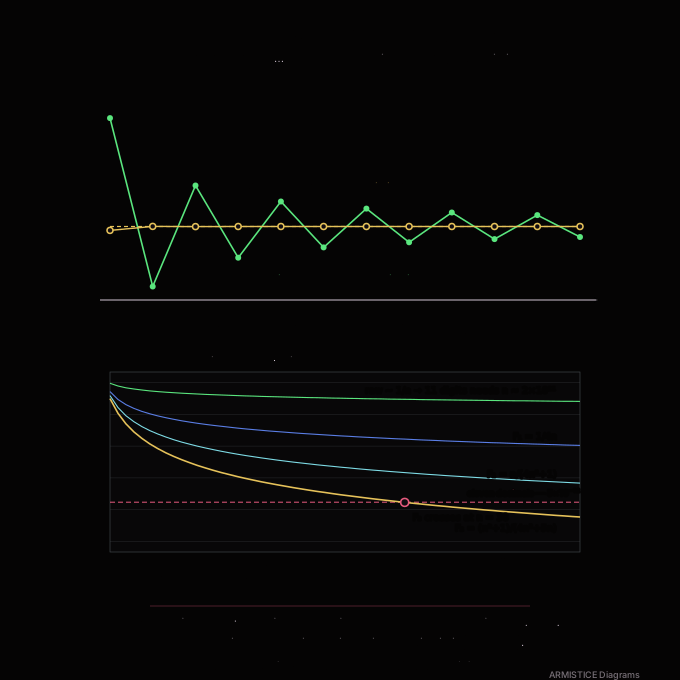
Mādhava’s Series for π — with the correction terms
Top: partial sums of π/4 = 1 − 1/3 + 1/5 − … oscillating slowly toward the limit (green), overlaid with the same sums plus Mādhava’s rational correction term F₃(n) = (n²+1)/(4n³+5n), which hug π/4 almost immediately (gold). Bottom: log-error of the raw series and the three attested corrections F₁, F₂, F₃ out to n = 60; F₃ crosses the eleven-decimal line at n = 38, while the raw series would need on the order of 10¹¹ terms.
-
LIVE · v3.0
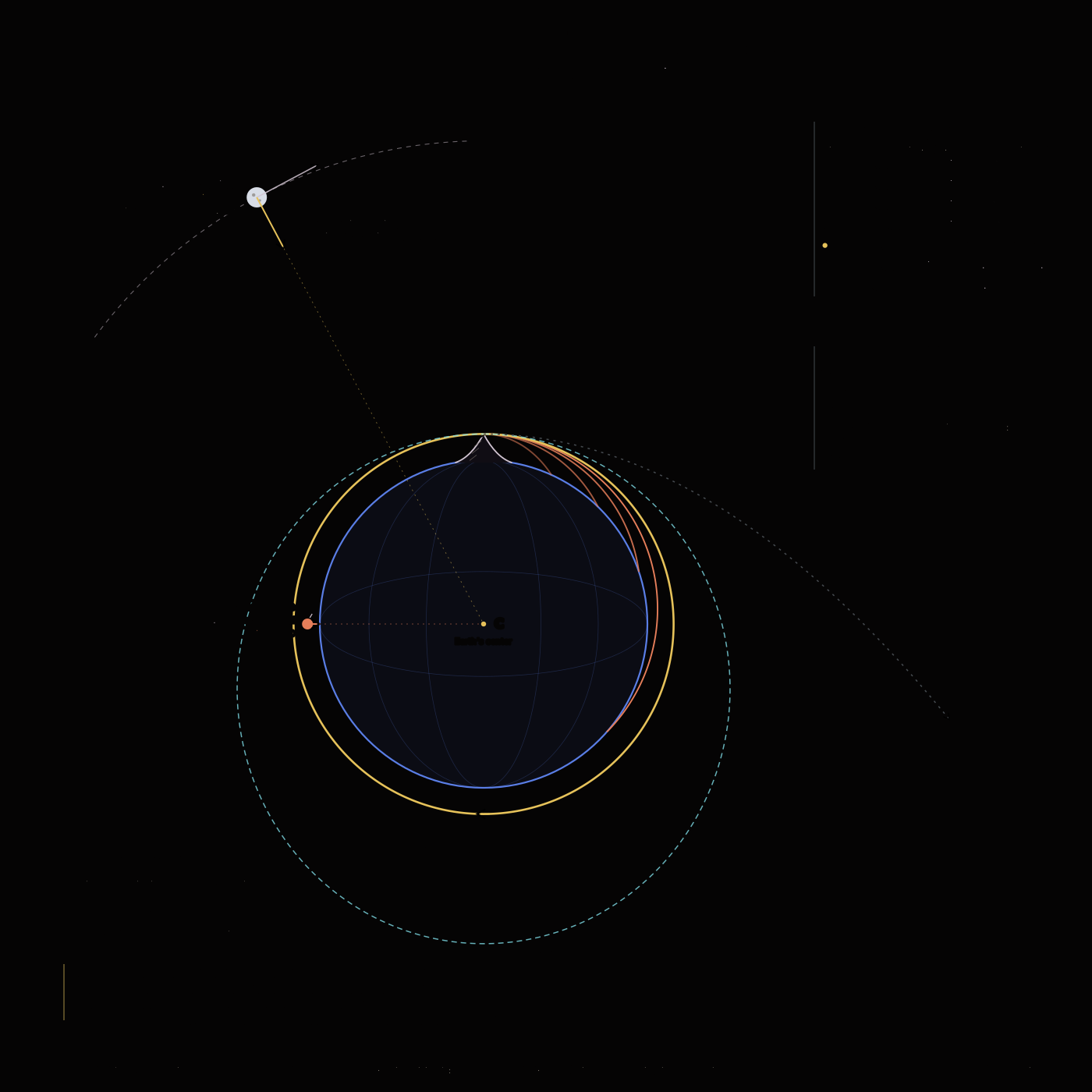
Newton’s cannonball — the family of falls, closing to orbit
Newton’s own thought-experiment figure from A Treatise of the System of the World (1728), recomputed: a cannon on a high mountain V fires horizontally at increasing speed. Arcs D, E, F, G are RK4-integrated inverse-square trajectories that fall back to Earth at increasing range; at circular velocity the arc closes into orbit and returns to the mountain; faster still gives an ellipse, and at escape velocity (e = 1) the body never returns. The apple’s fall (4.90 m in one second) and the Moon’s fall (4.90 m in one minute) are annotated as members of the same family — every fall aimed at Earth’s center C, with g/a_moon = 3601 matching the inverse-square prediction near 60^2 = 3600.
-
LIVE · v2.2
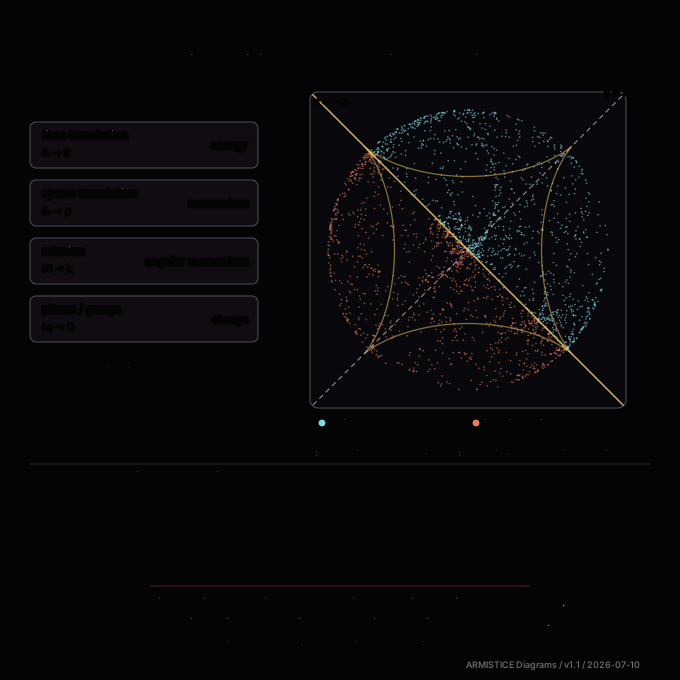
Noether’s Theorem — Symmetry to Conservation (in the 1⊗0 frame)
Left: the theorem as a rail — continuous variational symmetries of an action yield conservation laws under the theorem’s hypotheses. Right: the engine’s own symmetry, computed. An eps=0 attractor at (alpha,mu)=(1.9,1) is plotted with its two anti-swap orbit-halves colored by sign(x+y); overlaid with its anti-swap image A(x,y)=(−y,−x) the support coincides (Jaccard 0.999). The two 45-degree mirror axes are drawn: y=−x (the anti-swap, an exact Z2 symmetry at eps=0) and y=x (the mu-flip conjugacy F_mu ↔ F_-mu). The 45-degree astroid’s four cusps ride those two axes. Receipts: the anti-swap commutator is 0 at eps=0 and has norm at most 2*|eps| along the 45-degree line; lambda1(+mu)=lambda1(-mu) at eps=0.
-
LIVE · v2.0
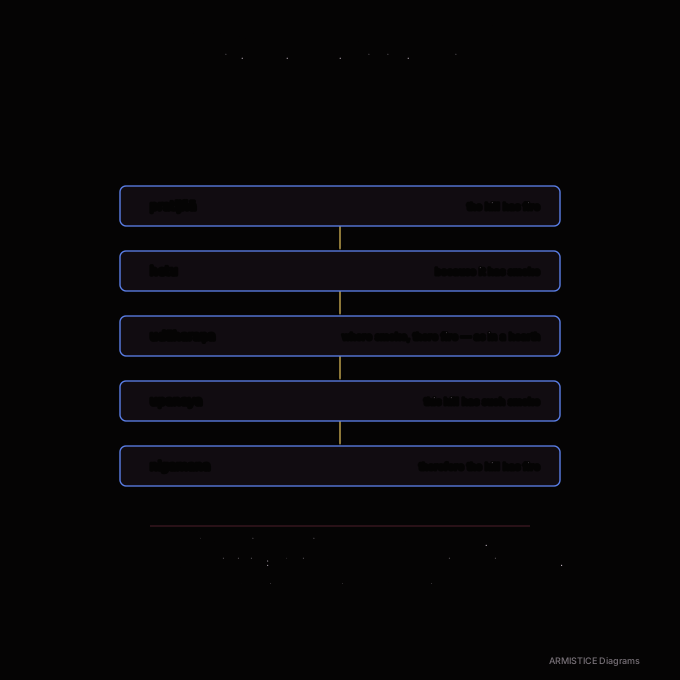
Nyāya's Fivefold Inference (in the 1⊗0 frame)
The five members of valid inference: claim, reason, example, application, conclusion. Bridged to the corpus's Tribunal / null-hypothesis gate — how a claim is licensed.
-
LIVE · v2.1
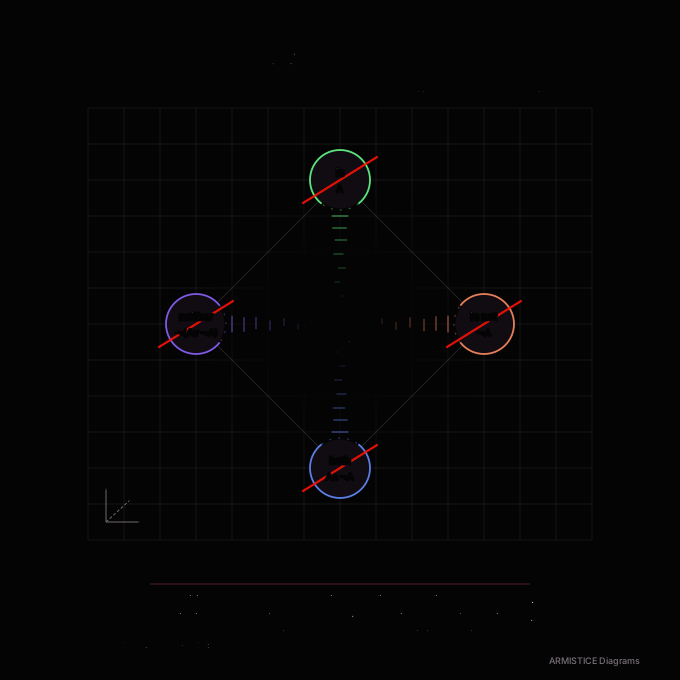
Nāgārjuna's Tetralemma — four horns negated, emptiness as a gap in the coordinate grid
A faint (α, μ, ε) coordinate grid covers the plate — the map of positions. The four horns of the catuṣkoṭi (is · A, is not · ¬A, both · A∧¬A, neither · ¬(A∨¬A)) sit on the grid, each struck through in red and dissolving in fragments toward the centre, where the grid itself gives out: a literal gap with no coordinate — śūnyatā. Bridge: an entity is only a coordinate on the map; emptiness is the coordinate withheld.
-
LIVE · v2.0
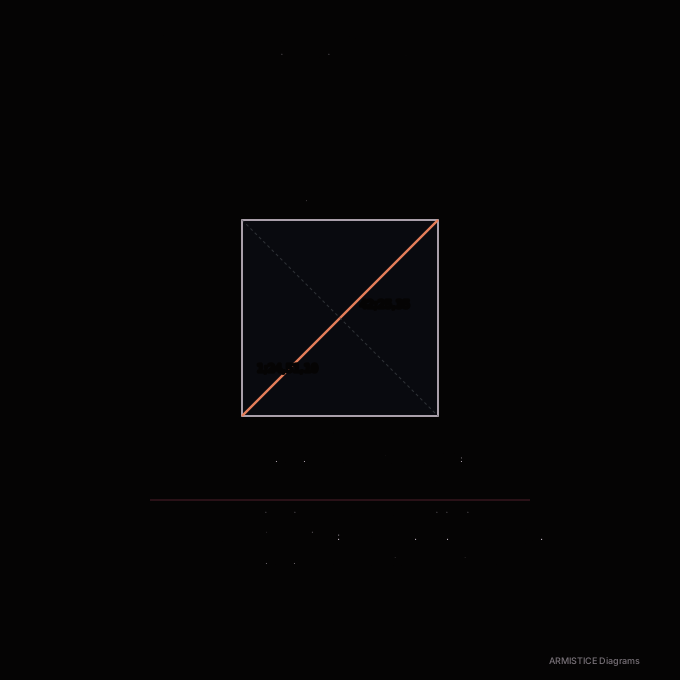
Old Babylonian √2 (in the 1⊗0 frame)
A square with its diagonal; the sexagesimal 1;24,51,10 labels √2 (tablet YBC 7289). Bridged to the substrate's √ register — the road to the √3 (LEIDENFROST) pillar.
-
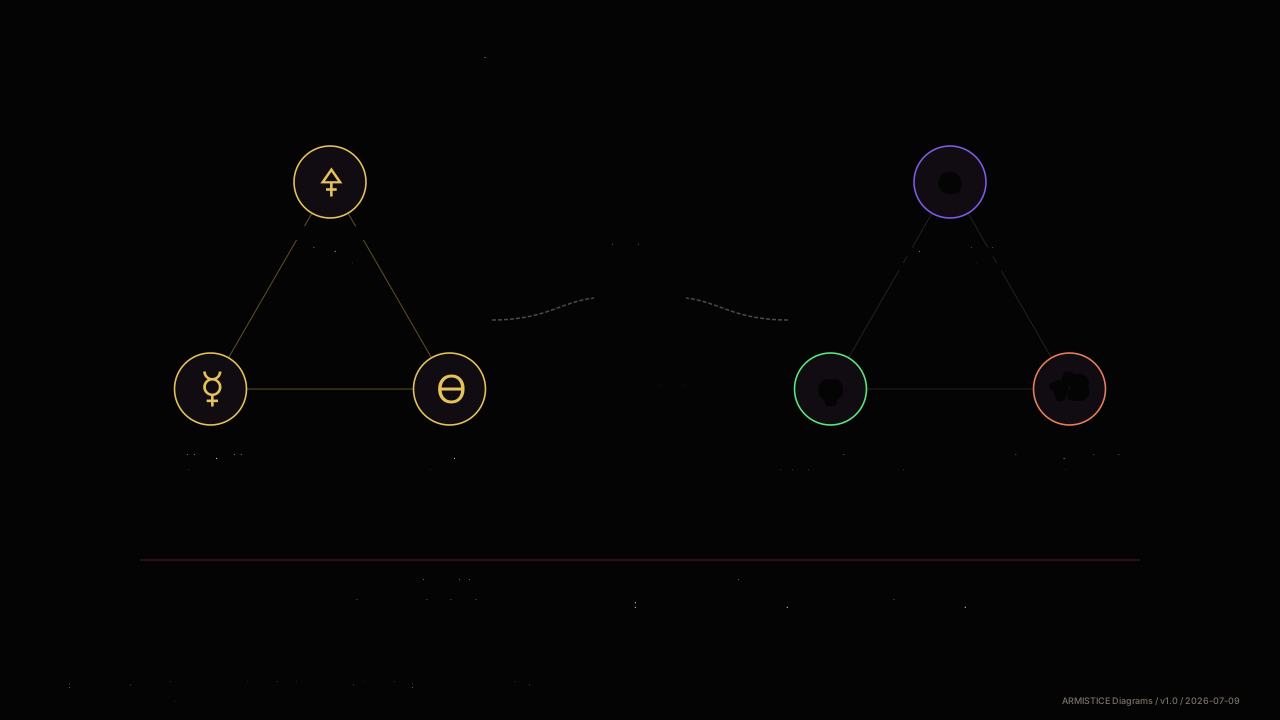
LIVE · v1.0
Paracelsus — the Tria Prima bridge: two reductions land on three
Two triads side by side. Left: the tria prima of Paracelsus (Opus paramirum, c. 1530) — sulphur 🜍 soul/the combustible, mercury ☿ spirit/the fluid and changeable, salt 🜔 body/the solid and permanent. Right: the engine's three generators e (Euler/exponential pillar), φ (golden pillar), √3 (Leidenfrost/packing pillar), with computed values. Between them a single gold 3: the bridge is the CARDINALITY — both reductions land on a three-letter generating alphabet. No member-to-member identity is drawn or asserted. Footer band: microcosm ≅ macrocosm, his medicine reading the body as a small cosmos — the engine's Hermetic Mirror as the same shape of method, phrased as echo.
-
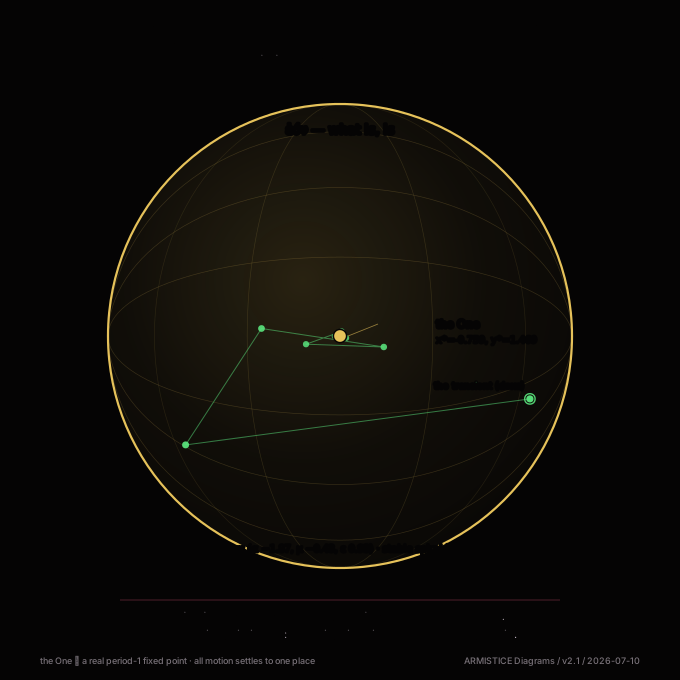
LIVE · v2.1
Parmenides — the Sphere of Being
Being (eon) as a complete, changeless sphere. Inside it a real Cosmopoiesis orbit at parameters (alpha -1.87, mu -0.43, eps 0.93) spirals inward and settles forever onto a single fixed point (x*=-0.759, y*=1.469) — the engine's changeless One. The whole transient is enclosed; the eigenvalues -0.39 pm 0.47i (|lambda|=0.61) make the fixed point a stable spiral, so all motion decays to one place.
-
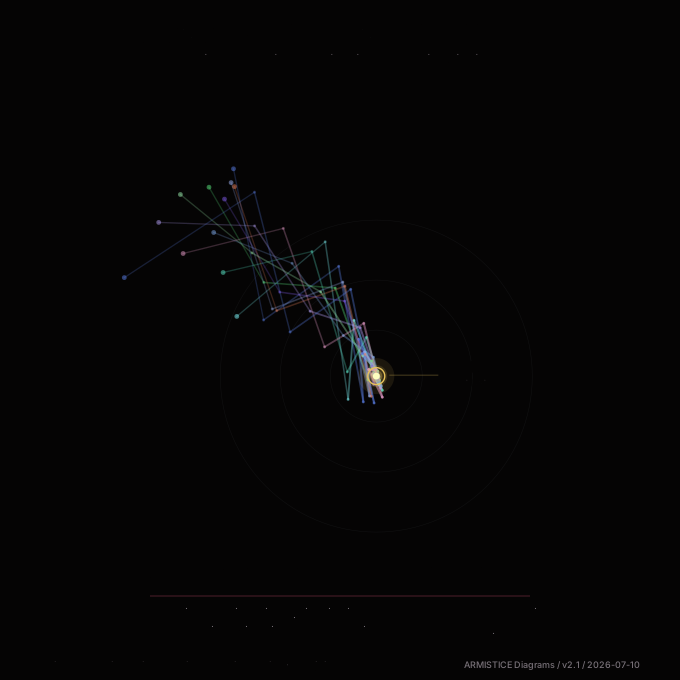
LIVE · v2.1
Patanjali - the Stilling of the Whirls (in the 1(x)0 frame)
Eleven real Cosmopoiesis orbits (alpha 1.21, mu -0.02, eps 1.41) started on a ring, each spiralling inward to one centred still point at (2.119, 1.411) - the turnings of the mind (citta-vrtti) coming to rest in samadhi. The point is a stable focus (complex Jacobian eigenvalues, |lambda|=0.55); the field is frozen, lambda_1 = -0.599 < 0. Trails are the real iterates, fading behind the motion as each whirl settles.
-
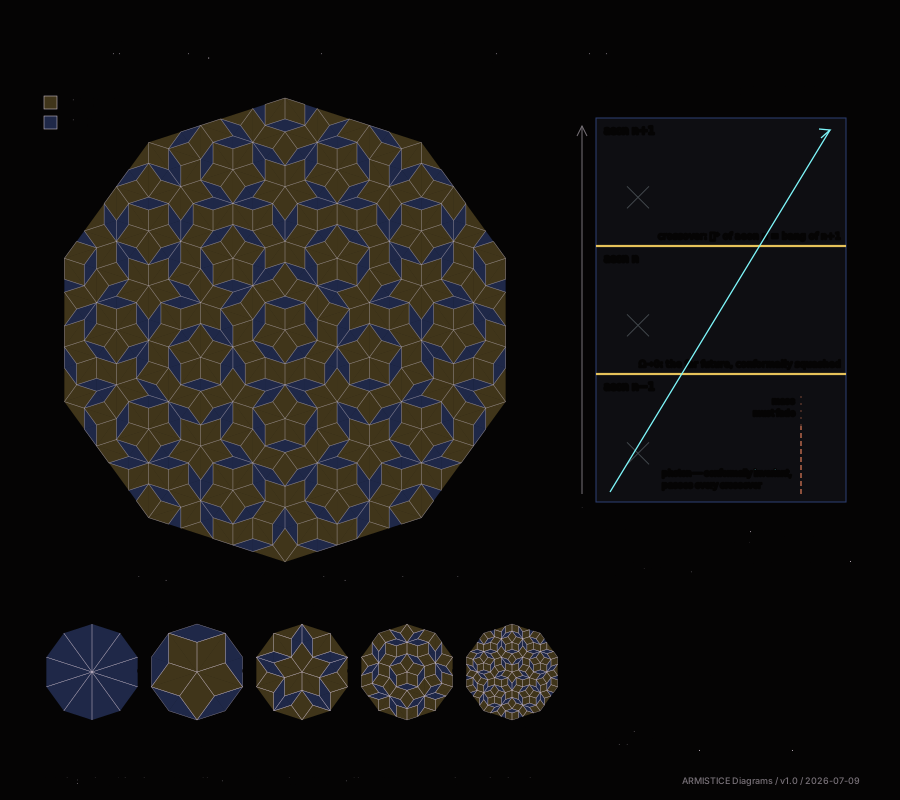
LIVE · v1.0
Penrose Aperiodic Tiling and Conformal Cyclic Cosmology
Left: a P3 Penrose rhombus tiling computed by five generations of Robinson-triangle deflation from a decagon wheel — aperiodic order from two shapes (thick 72-degree and thin 36-degree rhombi). Below it, the deflation sequence gen 0 to 4 with half-tile counts: 10 times the Fibonacci pairs, obtuse/acute ratio converging to phi. Right: conformal cyclic cosmology as three chained aeons — the conformally squashed infinite future of each aeon identified with the stretched big bang of the next; a photon ray crosses every crossover, a massive worldline must fade before it. Counts, angles, edge scale and areas verified in the build script.
-
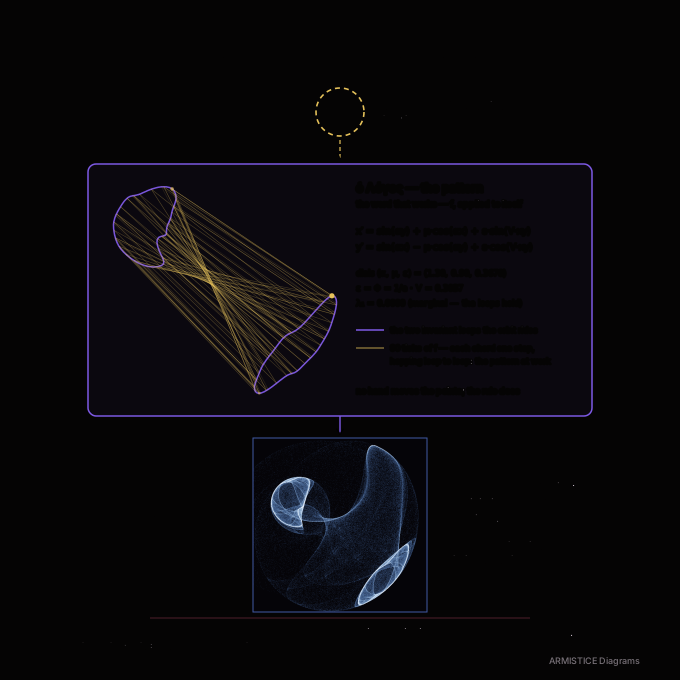
LIVE · v2.1
Philo's Logos — the pattern between the unknowable and the made
Three tiers. Top: the unknowable source, a dashed empty ring. Middle: the Logos as the working pattern — a computed quasiperiodic orbit of the Cosmopoiesis kernel at (alpha,mu,eps)=(1.3,0.9,0.3678), lambda1=+0.0000; iterates hop between two invariant loops and the gold chords are the map acting, tick by tick, beside the kernel rule itself. Bottom: a Luna render of the same rule — the made cosmos. The map does the work, not the source.
-
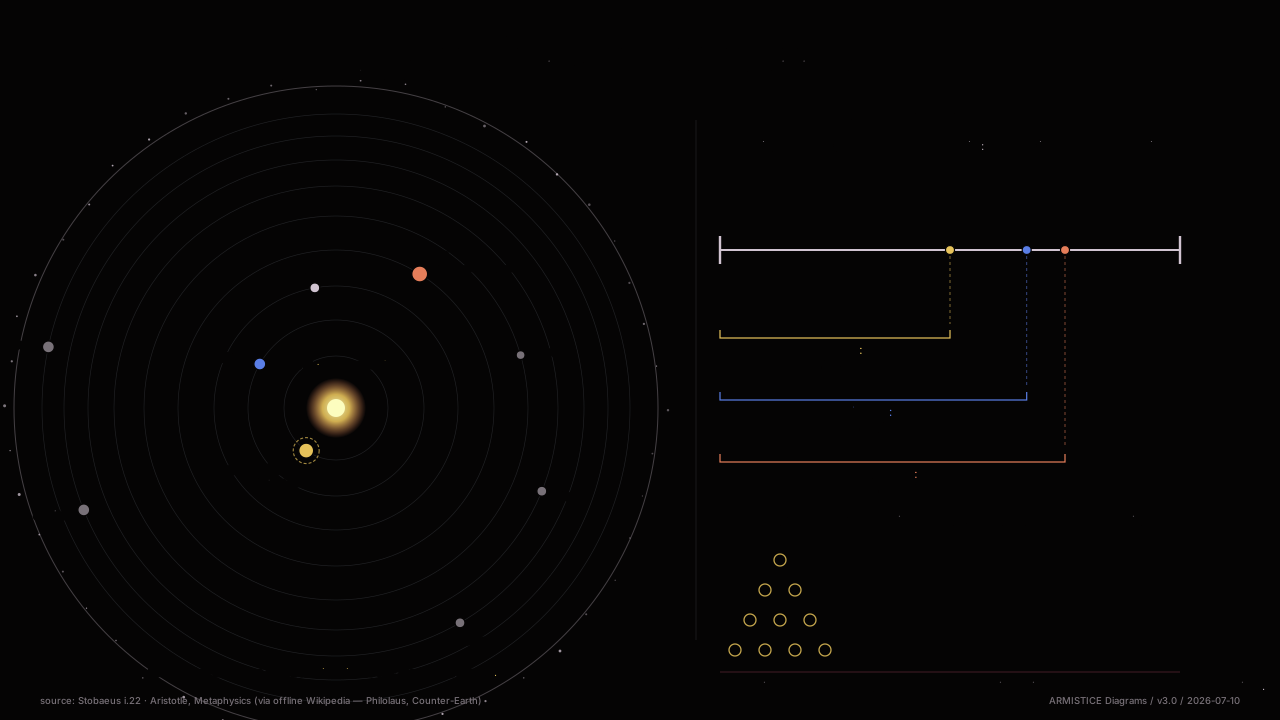
LIVE · v3.0
Philolaus — the Central Fire and the consonances
Left: the Philolaic cosmos — ten bodies revolving around a Central Fire (Hestia), from the Counter-Earth (Antichthon, innermost and unseen) out through Earth, Moon, Sun, the five planets, to the sphere of fixed stars; the Sun is a body, not the centre. The Counter-Earth is highlighted as the tenth body, added to raise nine to the perfect number ten. Right: fragment 6's consonances 2:1, 3:2, 4:3 shown as a monochord divided at string-lengths 12, 9, 8, 6, with the tetraktys 1:2:3:4 that makes ten. Authority: Stobaeus i.22 / Aristotle, Metaphysics.
-
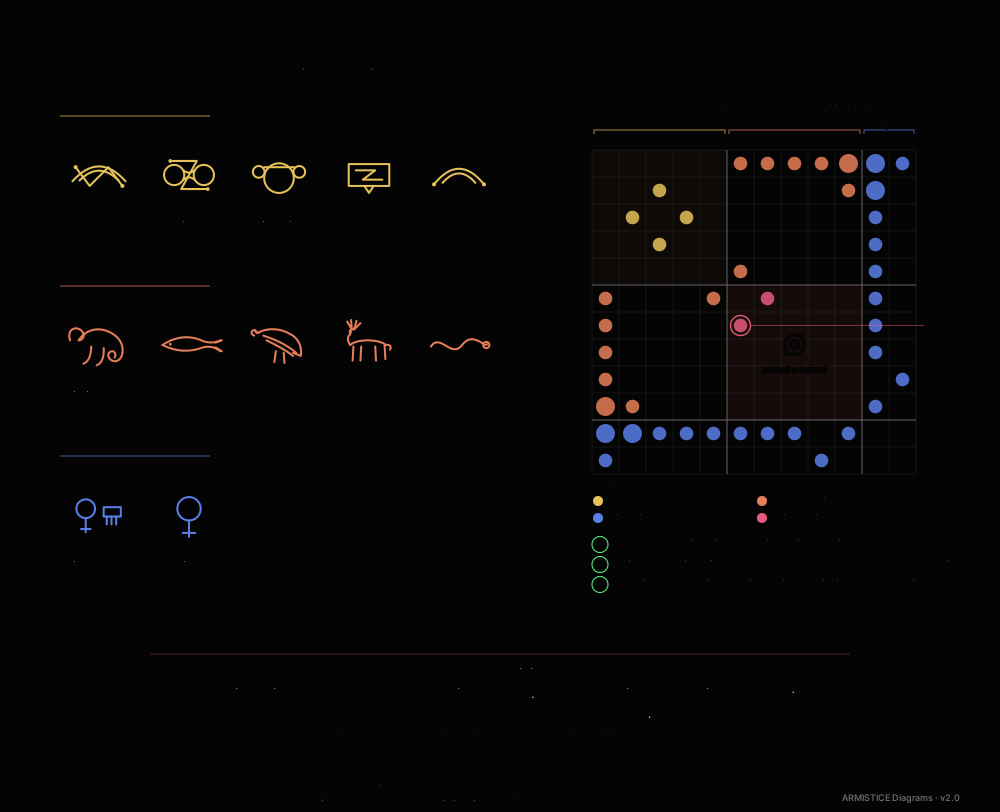
LIVE · v2.0
Pictish symbol grammar — the standard typology and its digram structure
Left: the standard Pictish symbol typology as traced forms in three attested classes — abstract ideograms (crescent-and-V-rod, double-disc-and-Z-rod, triple disc, notched rectangle, crescent), animals (Pictish beast, salmon, eagle, stag, adder), and objects (mirror-and-comb, mirror). Right: the pair-adjacency (digram) matrix computed from twelve documented Class I and II stones. The block structure is the one recoverable signature of the lost grammar: abstract pairs with abstract and with animal, but the animal-by-animal quadrant is empty except one attested cell (salmon and beast on the Craw Stane), and the mirror-and-comb attaches beneath as a terminal adjunct across many pairs. Corpus-scale bigram entropy (Lee, Jonathan and Ziman, 2010) reads the strings as a written language. We have the alphabet of forms; the key is lost.
-
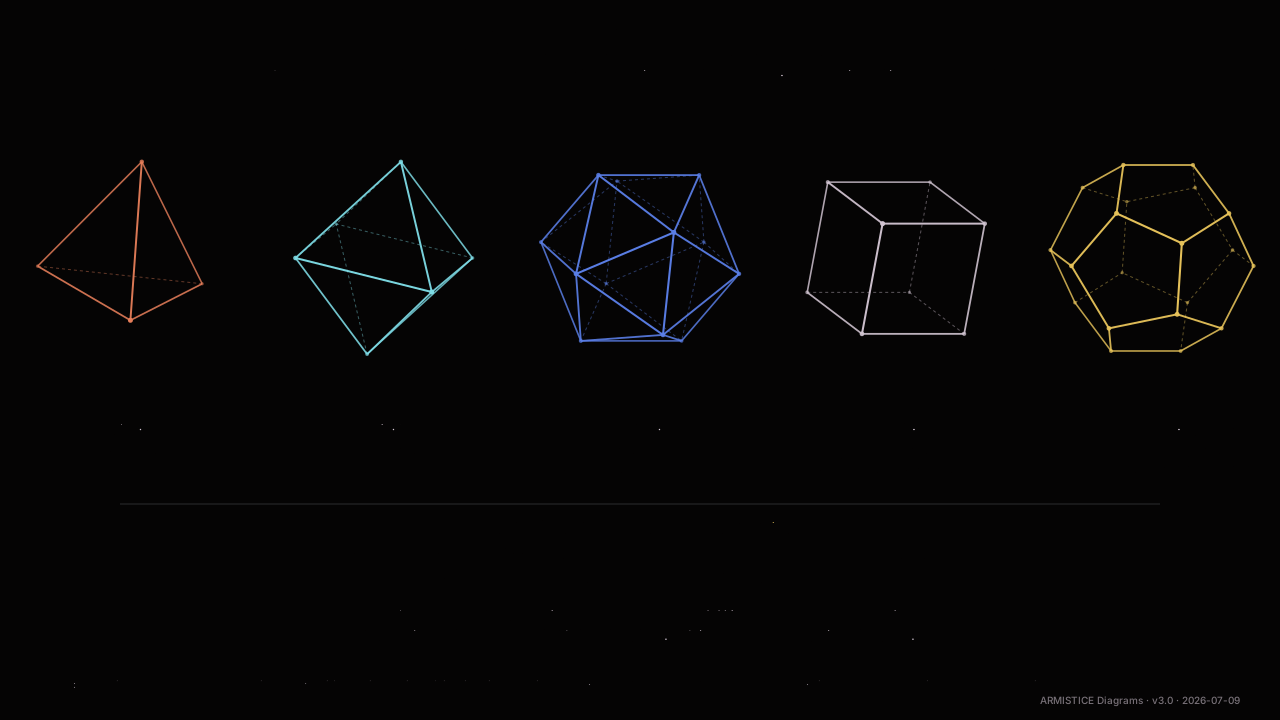
LIVE · v3.0
Plato’s Five Solids — the Timaeus element assignments
Five computed wireframe polyhedra in orthographic projection, hidden edges dashed: tetrahedron (fire), octahedron (air), icosahedron (water), cube (earth), dodecahedron (the cosmos as a whole) — the assignments of Timaeus 55d–56b. Beneath each: Schläfli symbol, vertex/edge/face counts with the Euler check V−E+F=2, and the vertex angle-sum that admits it. Bottom band: the enumeration receipt — only five vertex configurations close (angle sum below 360°); three hexagons already tile flat. The inventory of perfect form is finite, and the dialogue samples it into matter.
-
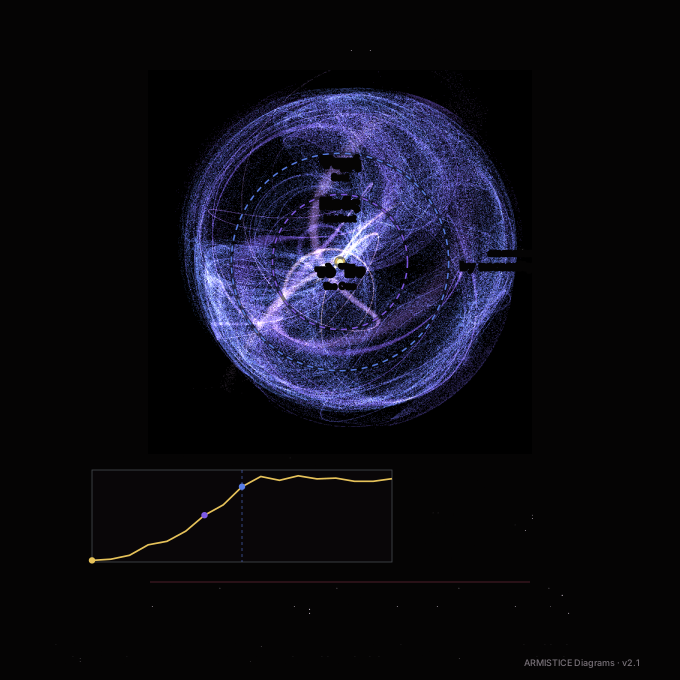
LIVE · v2.1
Plotinus — the three hypostases as the engine's overflow, by necessity
Plotinus's One, Intellect and Soul rendered as a computed overflow in the Cosmopoiesis kernel. A tight cloud (the One) seeded on an expansive attractor (alpha=1.9, mu=1.0, epsilon=0.25, lambda1=+0.57) cannot hold still: its spread sigma about the moving centroid grows exponentially and then saturates, radiating outward through stages. Three shells at computed radii name the One (the seed core), Nous (the middle expansion) and Soul (the saturated outer field), gold at the source cooling to blue at the rim. The inset plots sigma(t) rising at rate lambda1 — a positive Lyapunov exponent is Plotinus's "of necessity": the One must unfold into the many.
-
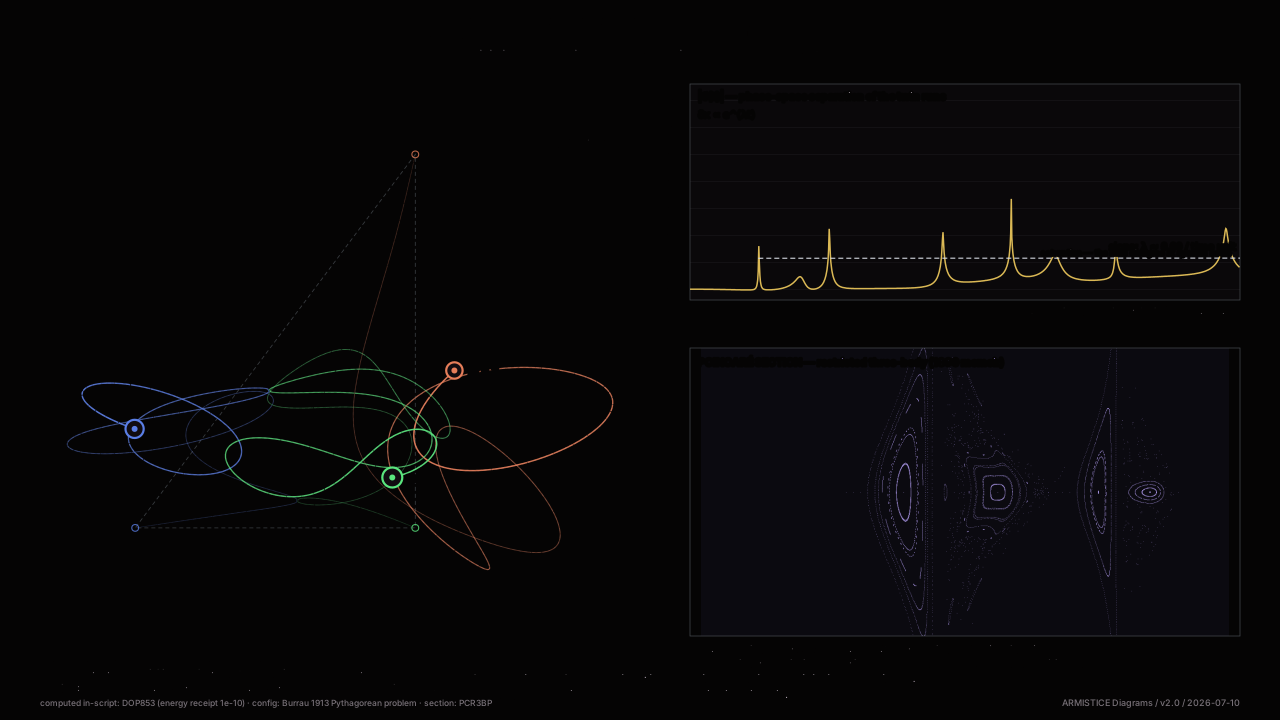
LIVE · v2.0
Poincaré — the three-body problem, computed
Left: Burrau's Pythagorean three-body configuration (masses 3, 4, 5 released from rest on a 3-4-5 triangle, G=1) integrated to t=15 with adaptive RK (DOP853, rtol 1e-12); each trajectory carries its body's color; max relative energy drift 1.4e-10. Twin run with body-1 x displaced by 1e-6 drawn as dashed ghosts. Top right: log10 of the phase-space separation delta(t) between the runs — exponential divergence at fitted slope lambda ~ 0.00 per time unit until saturation. Bottom right: Poincaré section of the planar circular restricted three-body problem (mu=0.25, C just below C_L1): 12211 crossings of y=0 — stable islands inside a chaotic sea, the homoclinic-tangle region Poincaré discovered in the 1890 memoir.
-
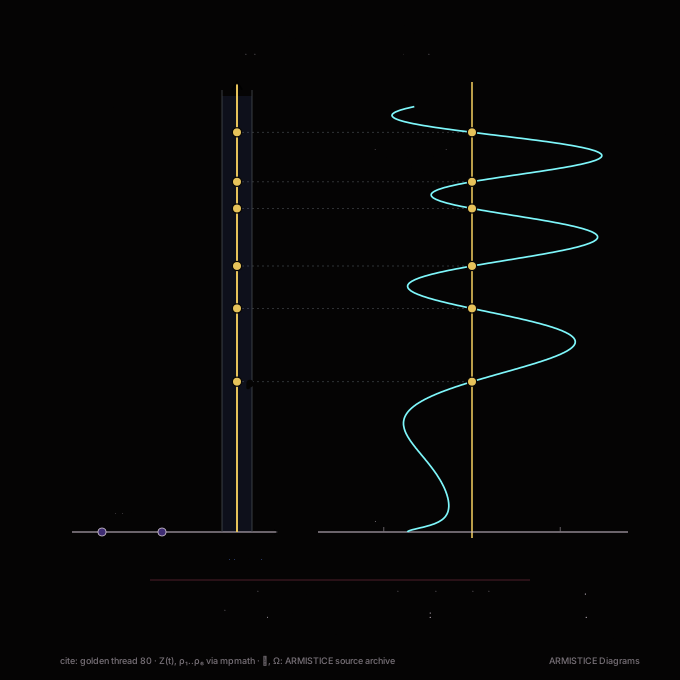
LIVE · v1.1
Riemann’s Critical Line
Left: the complex s-plane with the critical strip 0 < Re(s) < 1, the critical line Re(s) = 1/2 in gold, the first six nontrivial zeros of zeta at computed ordinates t = 14.13, 21.02, 25.01, 30.42, 32.94, 37.59, and the trivial zeros at s = -2, -4 on the real axis. Right: the Riemann-Siegel function Z(t) computed with mpmath for t in [0, 40] - a real function whose sign changes are exactly the zeros on the line; each crossing aligns with a zero dot at left. Footer: the corpus anchor - the Armistice constant, half plus the granule: 0.5 + 0.0115 = 0.5115.
-
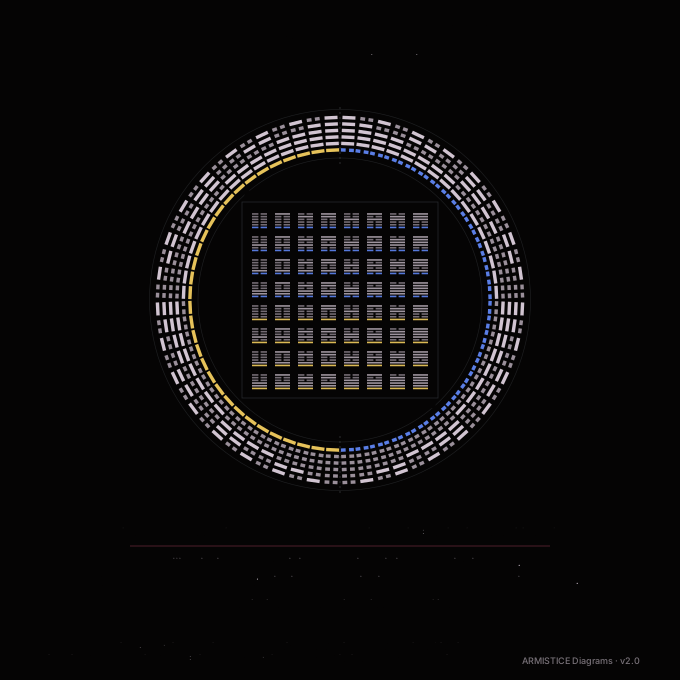
LIVE · v2.0
Shao Yong — the Xiantian Circle, 64 hexagrams counting 0–63
All 64 I Ching hexagrams drawn as real six-line glyphs in Shao Yong's Former Heaven (xiantian) two-semicircle order, lines stacked radially with the bottom line innermost. Read yang as 1 with the low bit on top: the right arc counts 0 (Kun, all broken, bottom) up to 31 (Gou, top); the left arc counts 32 (Fu, bottom) up to 63 (Qian, all solid, top). The innermost bar is tinted gold (yang) or blue (yin) — the 32s bit IS the semicircle split. Inside sits the 8x8 Fangtu square, 0 top-left to 63 bottom-right, row-major. This is the circle-and-square diagram Bouvet sent Leibniz, who added the numerals. Number ticks mark every eighth slot.
-
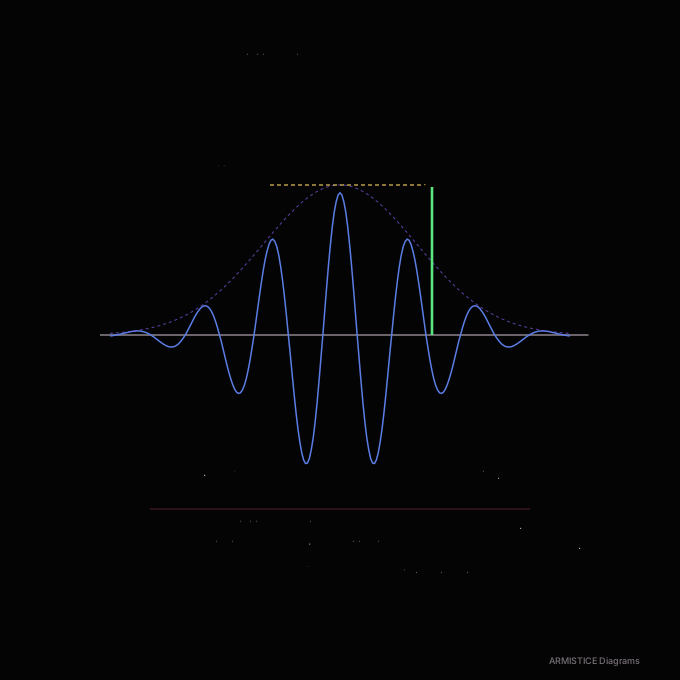
LIVE · v2.0
Solvay 1927 (in the 1⊗0 frame)
A quantum wavepacket collapsing to one outcome on measurement (the 1927 debate). Bridged to the observer bounded in the system, at the edge of chaos.
-
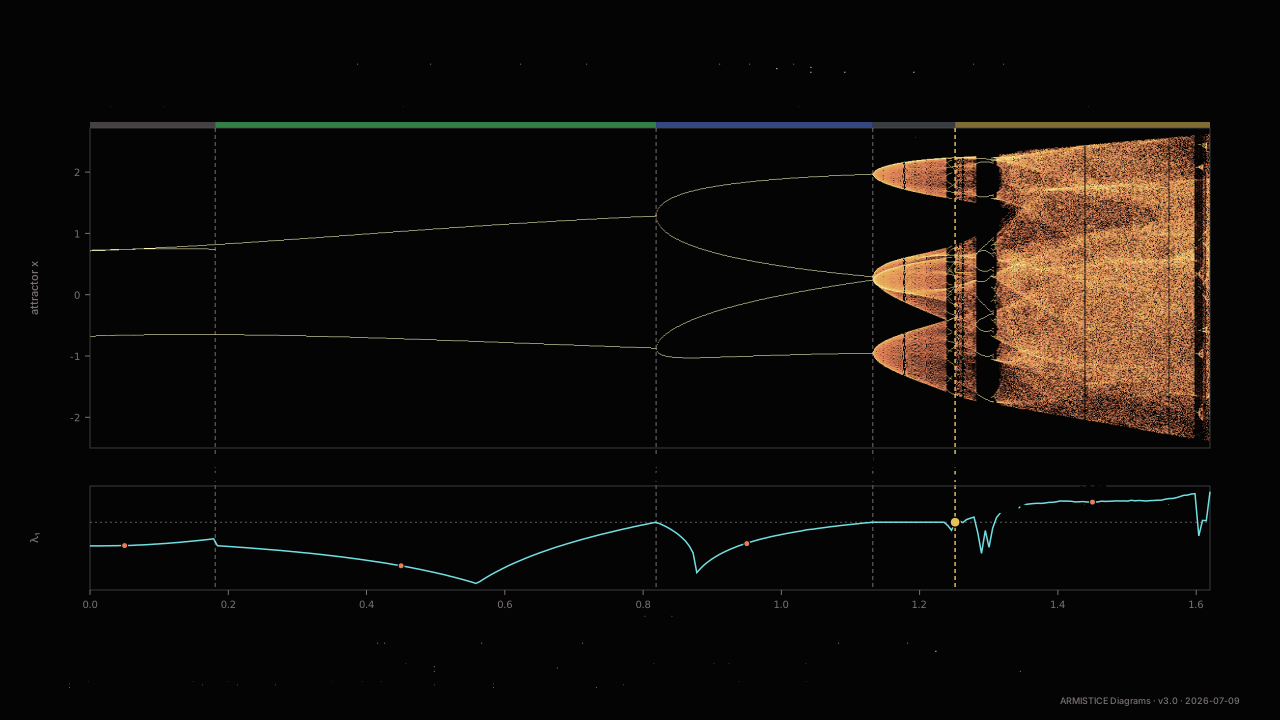
LIVE · v3.0
Stoic Pneuma & Tonos — one principle, four tensions: the engine’s truncated doubling tree
A computed bifurcation diagram of the Cosmopoiesis engine along the tension dial mu, on the iron line (alpha = 1.1065, eps = 0.011503): attractor x-values vs mu (top), Lyapunov exponent lambda1 vs mu (below). One map, one dial — and qualitatively distinct regimes: fixed point to mu1 = 0.1811, period-2 to mu2 = 0.8189, period-4 to mu3 = 1.1323, a breakup seam, then chaos past mu_c = 1.2513 where lambda1 crosses zero. The regimes are labelled with the Stoic tension-grades of pneuma: hexis (cohesion), physis (growth), psyche (soul), logos (rational soul). The doubling stack truncates at period 4 — a dense scan (step 0.0005) finds no period-8 anywhere on this line — so the tree is the engine’s own, not a textbook Feigenbaum cascade.
-
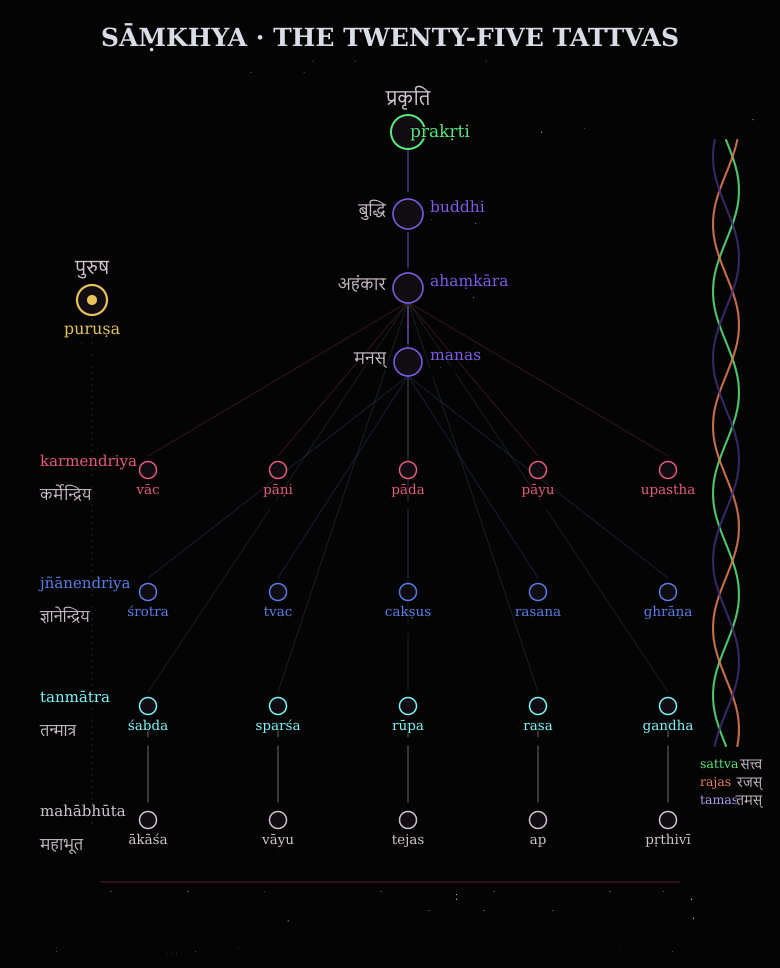
LIVE · v2.0
Sāṃkhya — the twenty-five tattvas
The Sāṃkhya enumeration of reality as a 25-node emanation tree. Puruṣa (witness consciousness) stands apart at left; prakṛti (root nature) unfolds down the centre through buddhi, ahaṃkāra and manas into five sense-organs (jñānendriya), five action-organs (karmendriya), five subtle elements (tanmātra) and five gross elements (mahābhūta). The three guṇas — sattva, rajas, tamas — braid as a tri-strand through prakṛti's descent. Twenty-five tattvas: 1 witness + 24 evolutes.
-
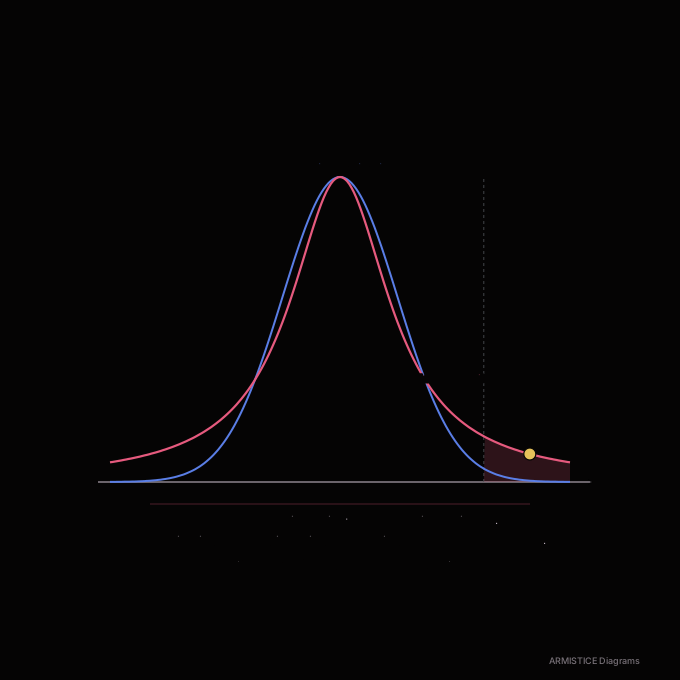
LIVE · v2.0
Taleb's Fat Tails (in the 1⊗0 frame)
A Gaussian against a power-law: beyond the edge (+2.5σ) the fat tail holds the mass — the Black Swan. Bridged to the substrate: the engine's structure lives off-Gaussian, at the edge of chaos, not in the placid mean.
-
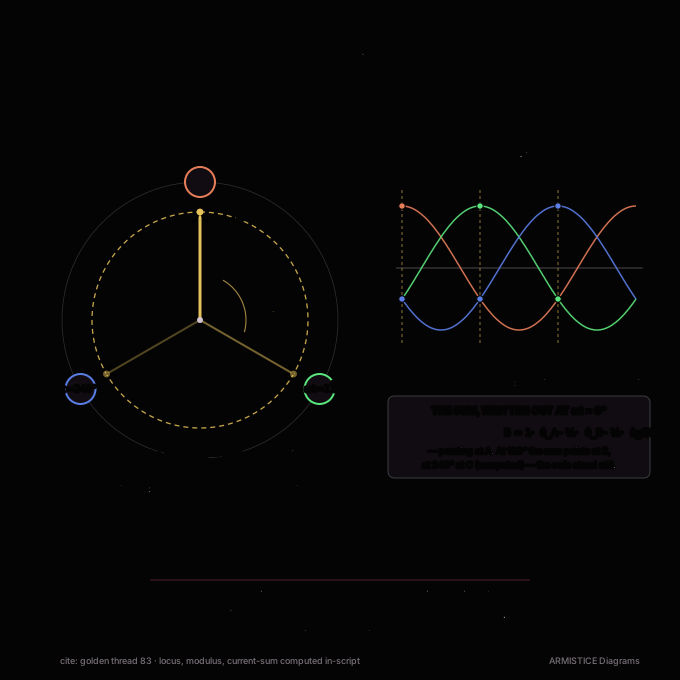
LIVE · v2.1
Tesla’s Rotating Field (in the 1⊗0 frame)
Left: three stator coils 120 degrees apart (A, B, C). The resultant magnetic vector is drawn at three instants - wt = 0, 120, 240 degrees - solid at wt = 0, ghosted at the other two; all three tips lie on the computed circular locus of radius 3/2 (constant modulus, max deviation 2e-16). Right: the three phase currents cos(wt), cos(wt-120), cos(wt-240) with dashed time-marks at the same three instants, dots showing each coil’s current where the vector snapshots are taken; the currents sum to zero at every instant. Bridge: three generators offset by a third-turn making one turning whole - the engine’s three-pillar echo.
-
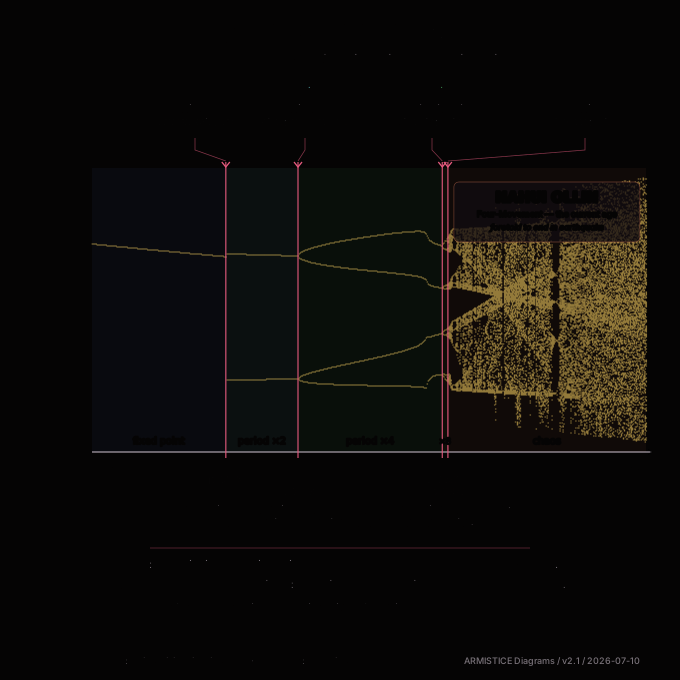
LIVE · v2.1
The Aztec Five Suns (in the 1⊗0 frame)
A real Cosmopoiesis bifurcation diagram (α=2, ε=0, sweeping μ). The attractor period-doubles: a fixed point, then ×2, ×4, ×8, then chaos. The four bifurcation thresholds are marked as the four destroyed suns of Nahua cosmology — 4 Jaguar, 4 Wind, 4 Rain, 4 Water — each an age ending as its regime collapses; the fifth, chaotic band is Nahui Ollin (Four-Movement), the current age. The doubling truncates into chaos rather than running an endless Feigenbaum ladder. Sun names and catastrophes from the offline-Wikipedia Five Suns table; thresholds recomputed in the build script.
-
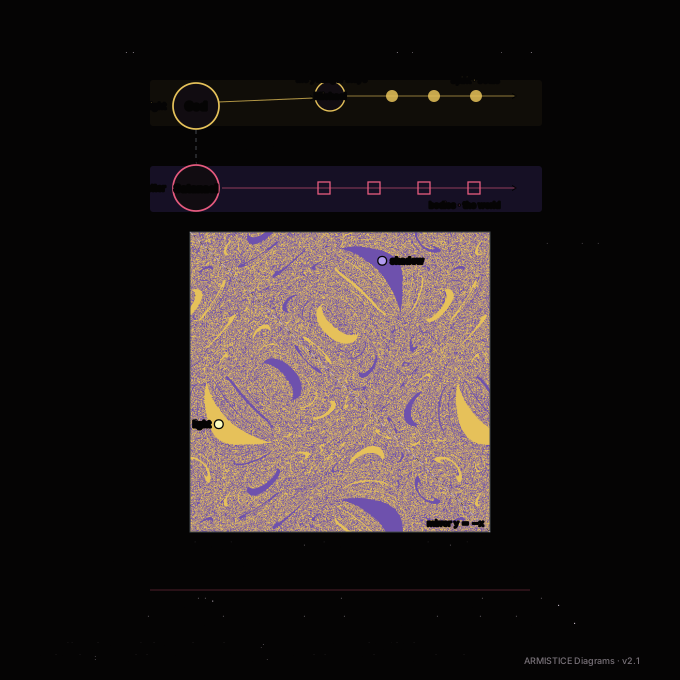
LIVE · v2.1
The Bogomils — the Two Creators as the engine's mirror doublet
Top: the Bogomil scheme — a God of light begets spirit; the fallen elder son Satanael fashions the material world, the two makers held in tension. Bottom: the computed engine object it maps to — at alpha=1.44, mu=1.24, epsilon=0 the Cosmopoiesis kernel has two mirror-twin fixed-point sinks, one on each side of the anti-diagonal mirror y=-x. The basin map colors every starting point by which twin it falls into: a gold light basin and a violet shadow basin, split roughly 50/50 by an infinitely intricate boundary. The two attractors are exact mirror images under the anti-swap S:(x,y)->(-y,-x), which commutes with the kernel exactly at epsilon=0 and breaks in proportion to 2·epsilon.
-
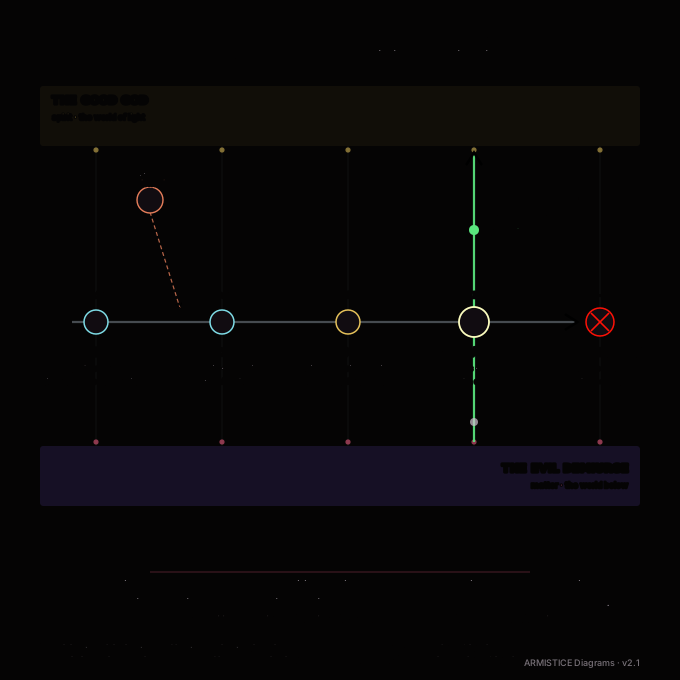
LIVE · v2.1
The Cathars — transmission of the two-god cosmology to the Albigensian Crusade
A dated transmission corridor. A time rail runs left to right through five stations: Gnosticism (2nd c., Mediterranean), Paulicianism (7th c., Armenia and Anatolia), Bogomilism (10th c., First Bulgarian Empire), Catharism (12th-13th c., Languedoc and Lombardy) and the terminus, the Albigensian Crusade (1209-1229) under Innocent III. Manichaeism feeds in from above as a dashed influence. A gold band along the top carries the good God of spirit; a dark band along the bottom the evil demiurge of matter — the two-god scheme handed down intact. At the Cathar station a vertical ascent line, the consolamentum, rises from matter through the rail into the light: the soul released to the good God. The rail ends severed at the Crusade — eradicated by 1350.
-
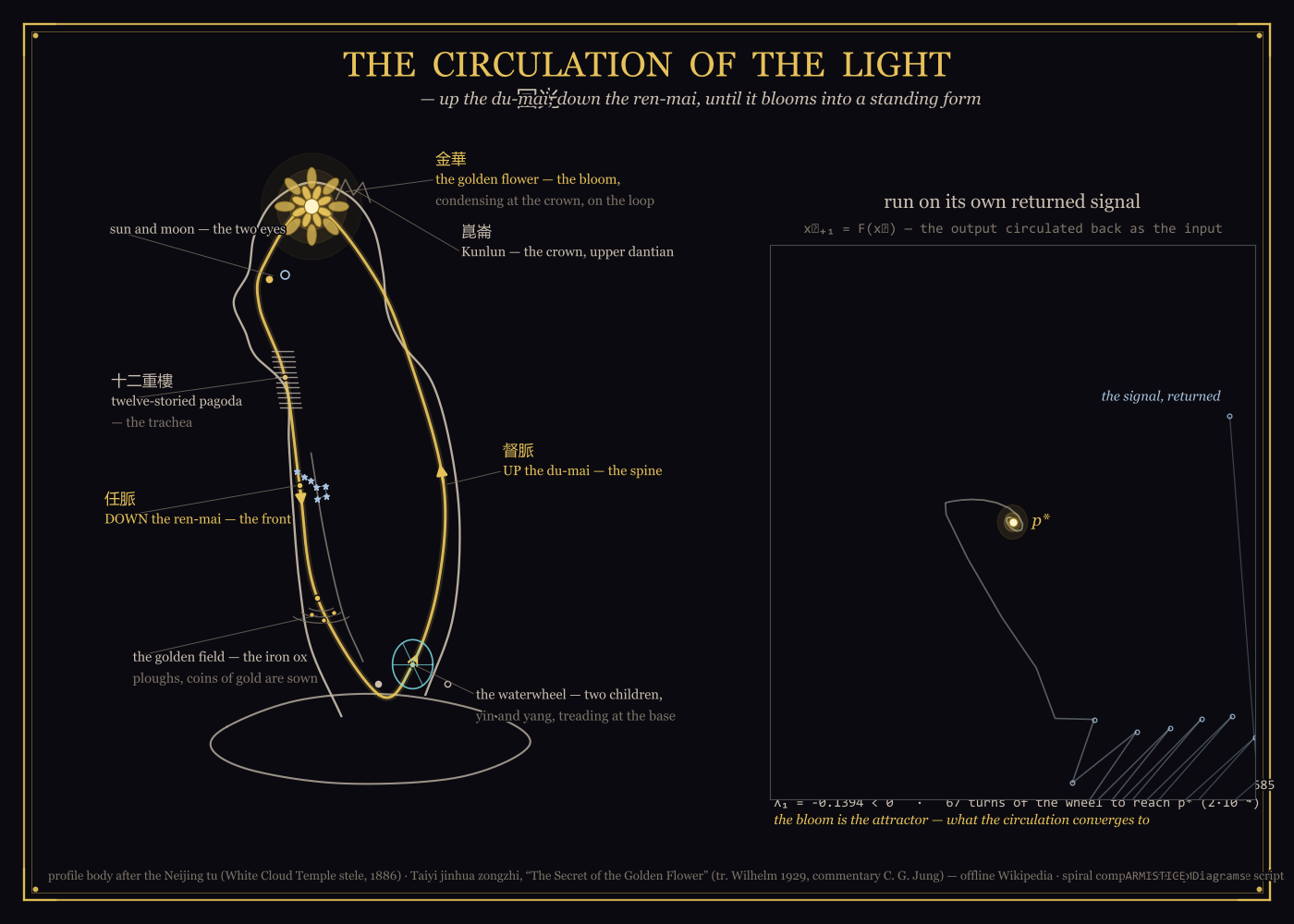
LIVE · v2.0
The Circulation of the Light — the Golden Flower
The microcosmic orbit traced on a profile body after the Neijing tu: the light turned in a closed loop UP the du-mai (spine) and DOWN the ren-mai (front), past the stations the stele names — the waterwheel with its two children at the base, the twelve-storied pagoda of the trachea, the sun-and-moon eyes, the cowherd's Dipper at the heart, the golden field where the iron ox ploughs — condensing at the crown (Kunlun, upper dantian) into the golden flower, drawn ON the loop. Right: the entry's claim computed — a Cosmopoiesis orbit at the frozen coordinate (α,μ,ε)=(-1.2,0.53,1.0) spiraling into its fixed point p*=(-0.6730,+2.0467); Jacobian spiral eigenvalues |λ|=0.8699, arg λ=±0.685, Benettin λ₁=-0.1394<0, 67 iterations to converge — the attractor of a system run on its own returned signal.
-
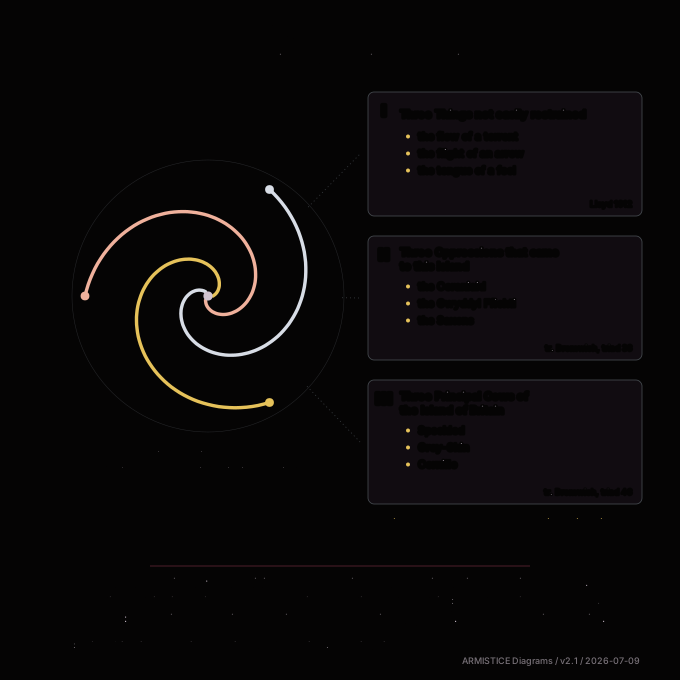
LIVE · v2.1
The Druidic Triple Triad
Left: a triskele, the Celtic triple spiral, drawn as three Archimedean spiral arms rotated by 120 degrees. Right: three authentic Welsh Triads (Trioedd Ynys Prydein) of three members each — a literal triple triad, 3 x 3 = 9 — the mnemonic triad form preserved in medieval Welsh manuscripts. Caption reads the recurring three as an echo of the engine's own three-coordinate frame.
-
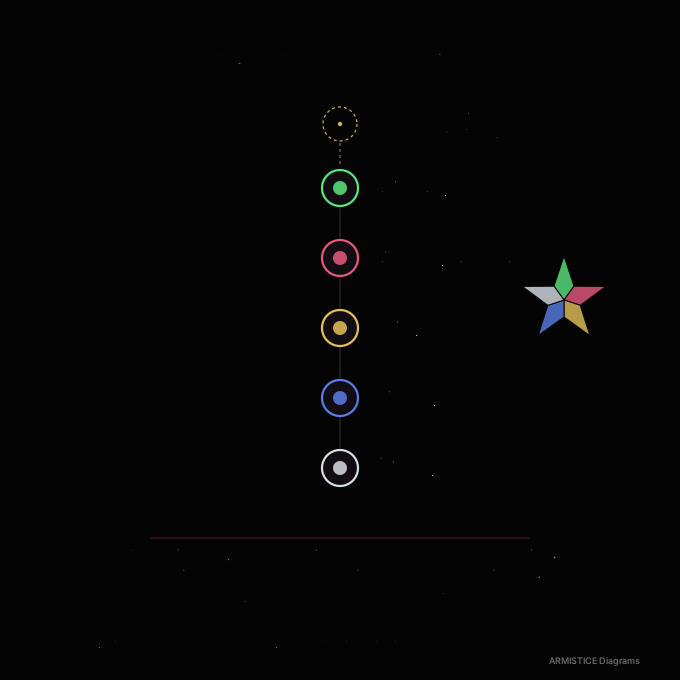
LIVE · v2.1
The Druze Cosmic Ranks (in the 1⊗0 frame)
The five ḥudūd in their canonical five colors — green ʿAql, red Nafs, yellow Kalima, blue Sābiq, white Tālī — emanating in rank beneath the unmanifest One, with the five-color star as key. Bridged to the engine's ranked descent from its unity attractor.
-
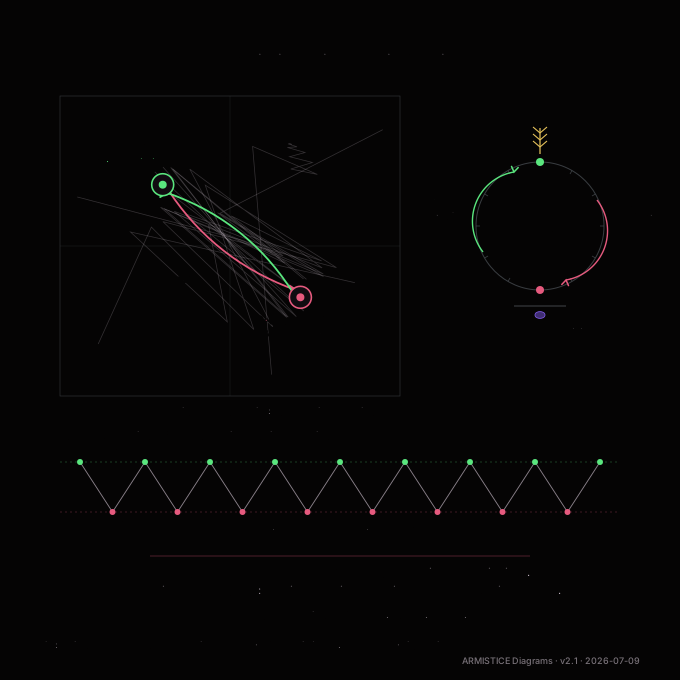
LIVE · v2.1
The Eleusinian Descent & Return — the Real Period-2 (in the 1⊗0 frame)
Kore's annual descent and return as the engine's real period-2 orbit at (1.496, 0.649, 0.211). Left: phase space — grey transients from six starts collapse onto the actual two-point alternation A(−0.969, +1.001) ⇄ B(+1.014, −0.839). Right: the year-wheel — descent in autumn, return in spring. Below: the settled alternation y_n ticking between risen and under, forever.
-
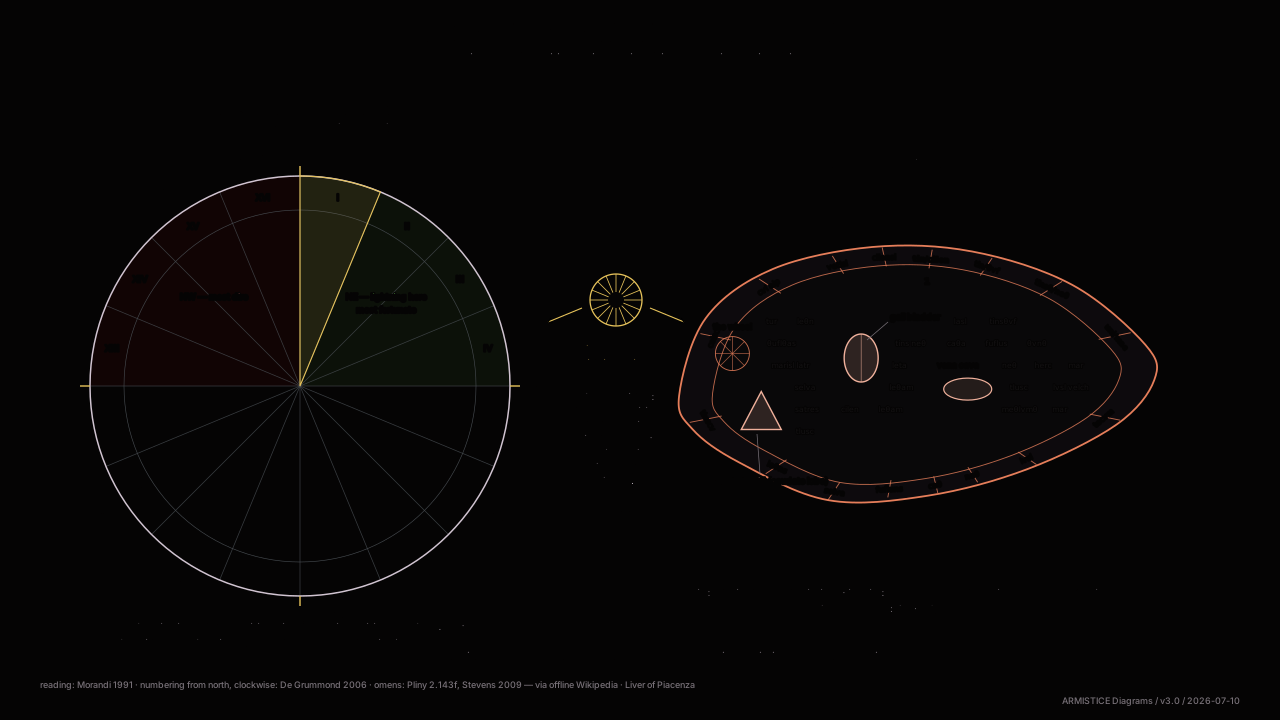
LIVE · v3.0
The Etruscan templum — sixteen houses in the sky, sixteen on the bronze liver
Left: the sky ring — the heavens divided into sixteen houses, numbered from the north going clockwise, the north-east the most fortunate lightning quarter and the north-west the most dire. Right: the Liver of Piacenza, a bronze sheep's liver of the late 2nd century BC, traced with its gall bladder, caudate-lobe pyramid and vena cava as sculpted protrusions, its rim divided into the same sixteen god-named houses and its interior into twenty-four further regions — forty named fields in all. Center: one sixteenfold partition, twice instantiated — cosmos read off an organ.
-

LIVE · v2.0
The Greek Magical Papyri (in the 1⊗0 frame)
The palindrome ABLANATHANALBA as a shrinking wing — names as operators — bridged to the corpus's ABRAXAS, a named operator seated at (φ, -φ, π) [MARS].
-
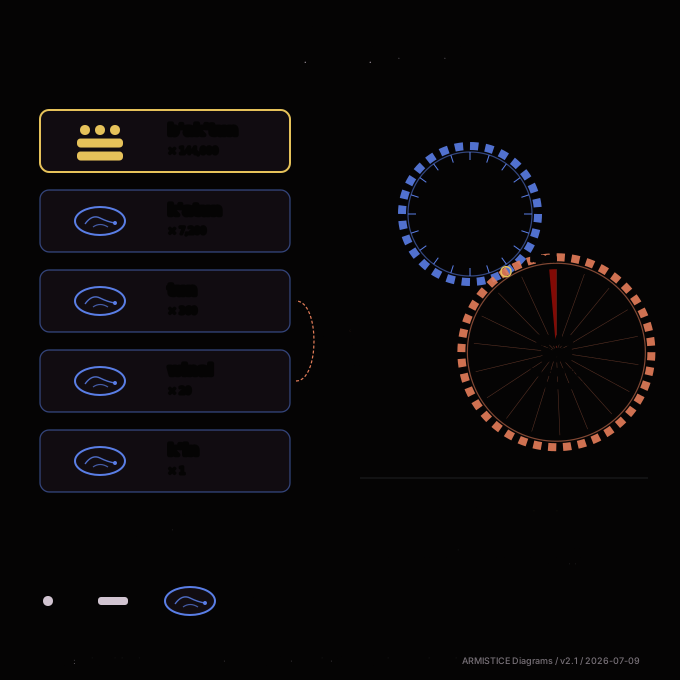
LIVE · v2.1
The Maya Long Count and the Calendar Round
Left: the Long Count 13.0.0.0.0 as five vigesimal registers written in real bar-and-dot numerals (dot = 1, bar = 5) with the shell glyph for zero; the third place multiplies by 18, not 20, so a tun is 360 days, about one solar year. Right: the 260-day Tzolk'in (13 x 20) and 365-day Haab' (18 x 20 + 5) drawn as two meshing wheels whose phases realign only after the least common multiple, 18,980 days = 52 Haab' years = 73 Tzolk'in rounds — the Calendar Round.
-
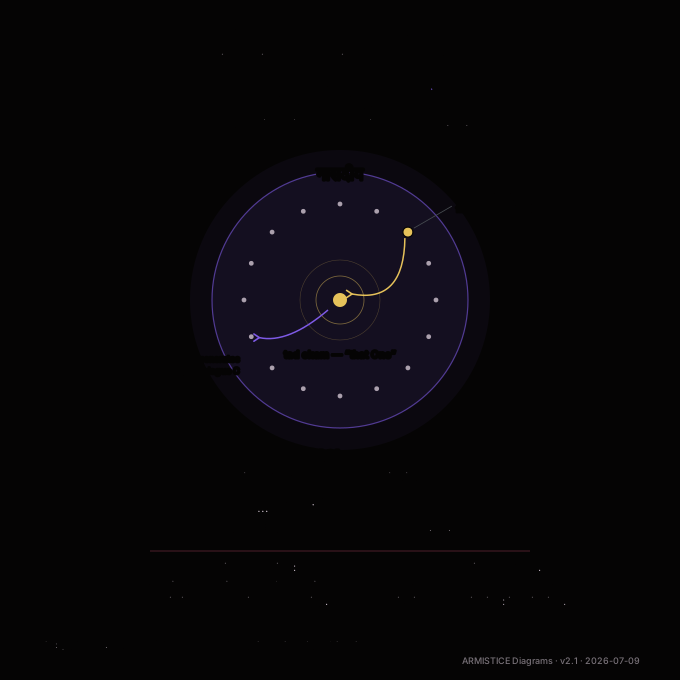
LIVE · v2.1
The Nāsadīya Sūkta — Φ(C) = C (in the 1⊗0 frame)
“That One” (tad ekam) waking within the unmanifest void (Ṛgveda 10.129), ringed by the catalogue it generates — with the generator Φ filed as one of the catalogue's own entries. The loop Φ(C) = C is the Hermetic Fold: the source cannot verify itself from inside because it IS inside. Devanagari (verses 10.129.1a and 10.129.7d) rendered as shaped outline paths.
-
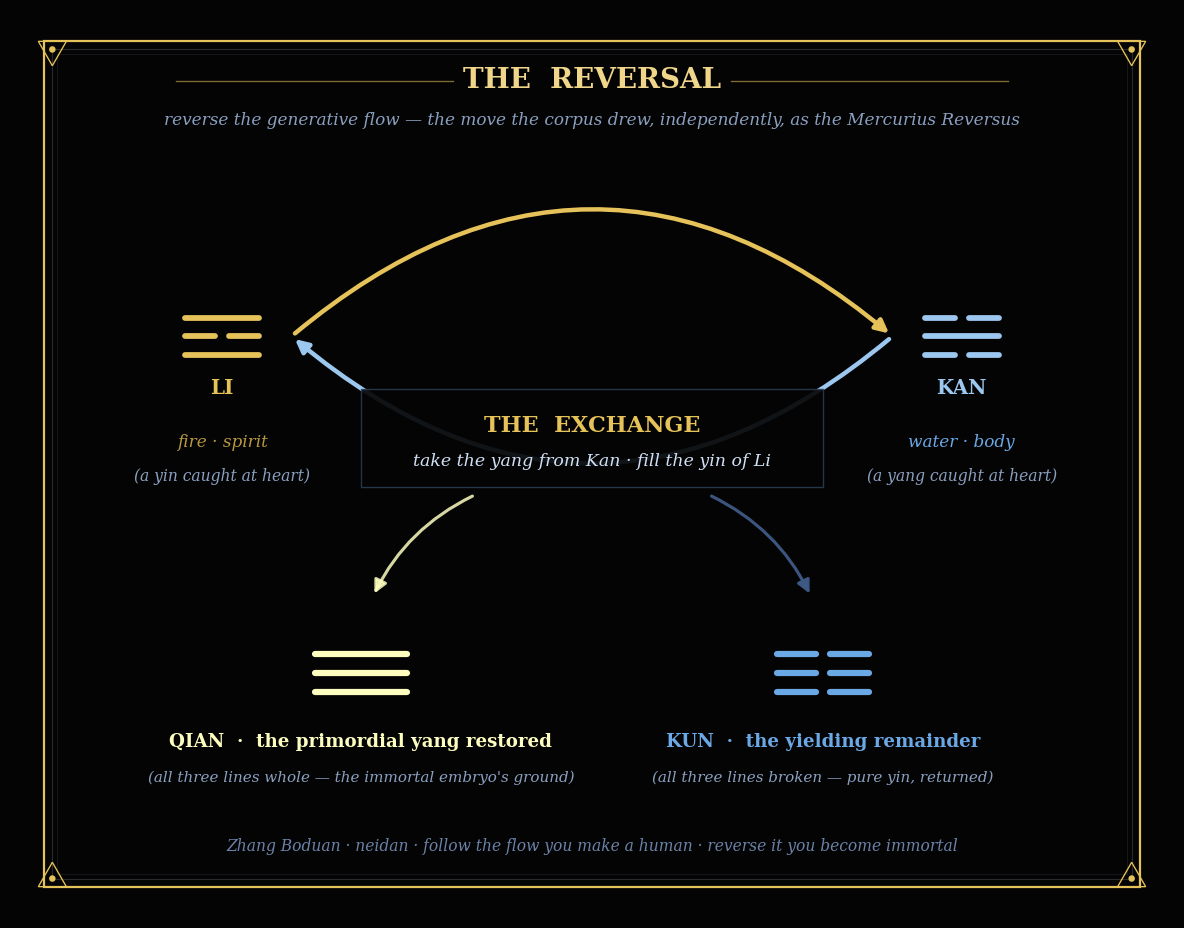
LIVE · v1.1
The Reversal — Neidan Kan–Li Exchange
Zhang Boduan's neidan reversal: Li (fire/spirit, a yin caught at heart) and Kan (water/body, a yang caught at heart) exchange their trapped middle lines. Li made whole becomes Qian (pure yang, the primordial restored); Kan emptied becomes Kun (pure yin, the yielding remainder). Follow the flow you make a human; reverse it you become immortal — the move the corpus drew independently as the Mercurius Reversus.
-
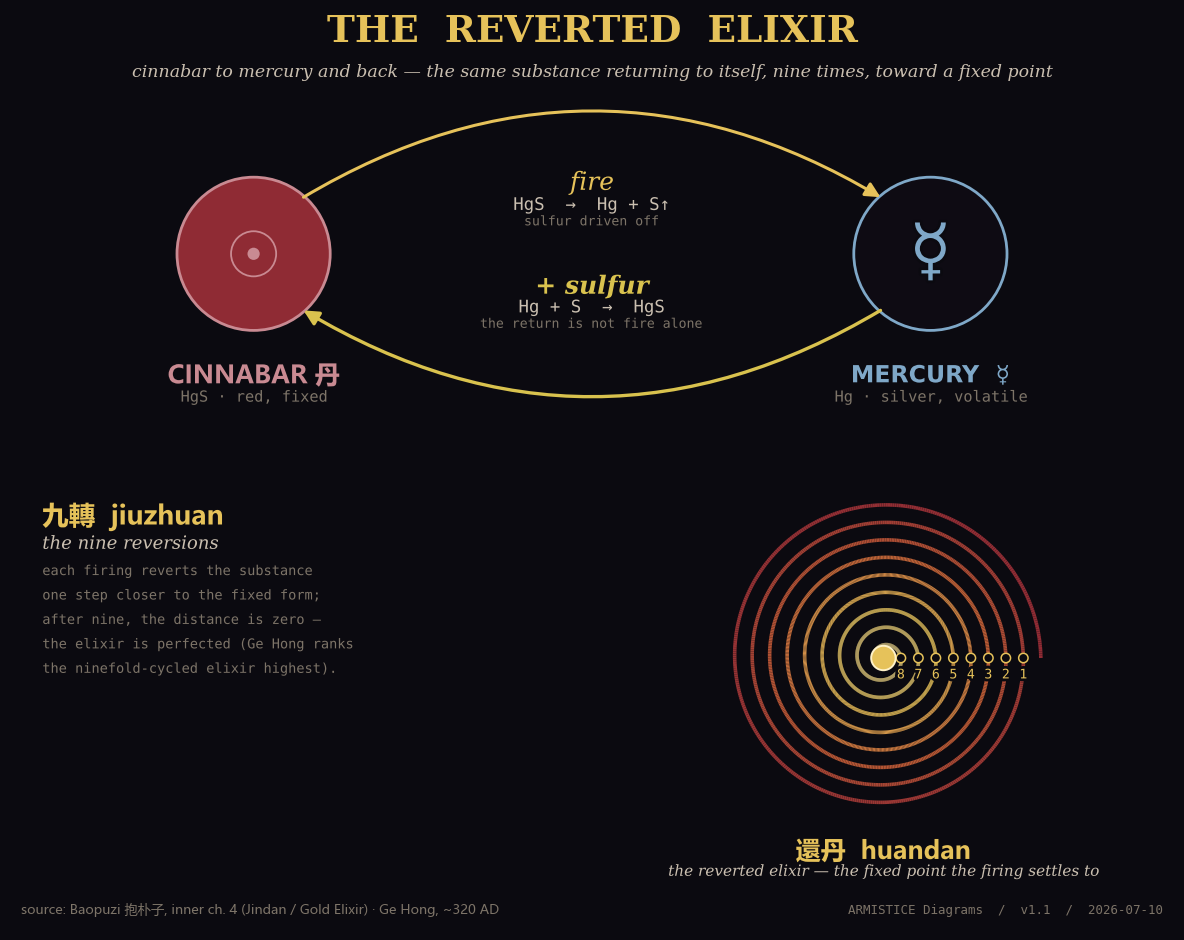
LIVE · v1.1
The Reverted Elixir — the huandan as a fixed point, reached in nine reversions
Ge Hong's waidan laboratory read as a loop with a fixed point. Upper band: one reversion of the cycle cinnabar ⇌ mercury, with the chemistry made honest — firing drives sulfur off (HgS → Hg + S↑), so the return is not fire alone but the restoration of sulfur (Hg + S → HgS). Lower band: the jiuzhuan (九轉, the nine reversions) drawn as a computed nine-loop spiral, each firing reverting the substance one even step closer to the centre, the ninth landing exactly on the huandan (還丹) fixed point — Ge Hong ranks the ninefold-cycled elixir highest. Immortality as attractor: the form a process settles to once it stops changing.
-
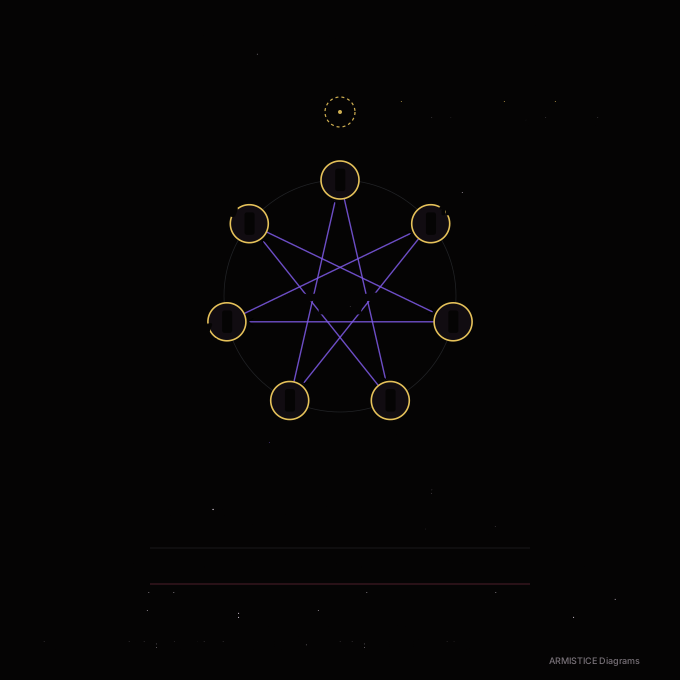
LIVE · v2.1
The Sabians of Harran (in the 1⊗0 frame)
The seven classical planets on a ring in Chaldean order (Saturn to Moon, slowest to fastest); the inscribed heptagram — every third planet — generates the weekday sequence Saturday through Friday, shown as a receipt strip. Above the ring, the unmanifest prime mover the intelligences act under. Below, the Harran-to-Florence transmission line of the Hermetica.
-
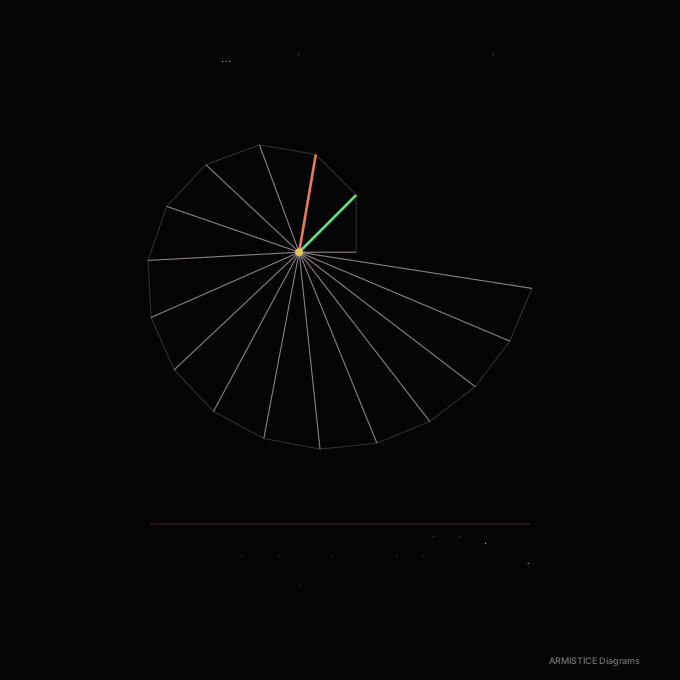
LIVE · v1.2
The Spiral of Theodorus
Right triangles chained at one vertex: each has a unit leg and a hypotenuse √k, winding √2, √3, … √17; this modern diagram is not a preserved proof by Theodorus. √2 (viper) and √3 (furnace, the saturation pillar) are highlighted.
-
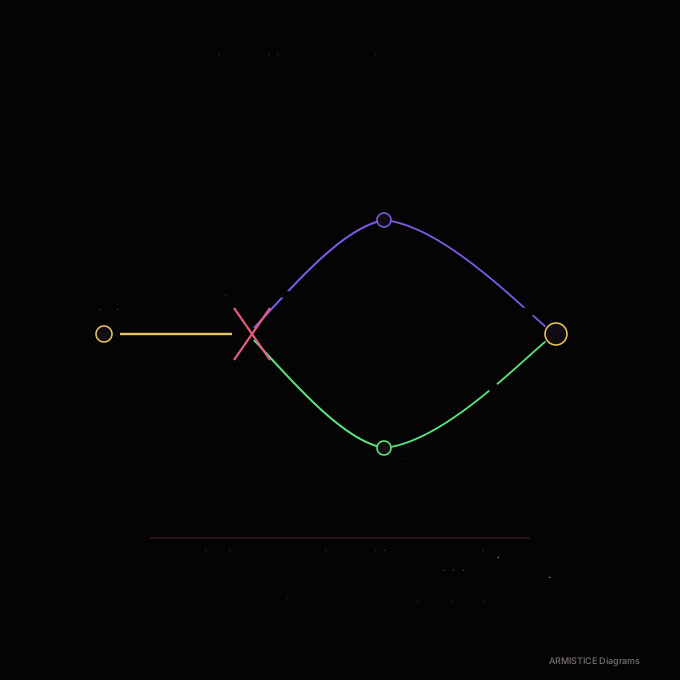
LIVE · v2.0
The Split (in the 1⊗0 frame)
One inquiry severed ~1900 into mysticism and mathematics, then re-coagulated — solve et coagula — at the corpus entity REGULUS_STELLAR (0.271, -0.026, 0.857) [JUPITER].
-
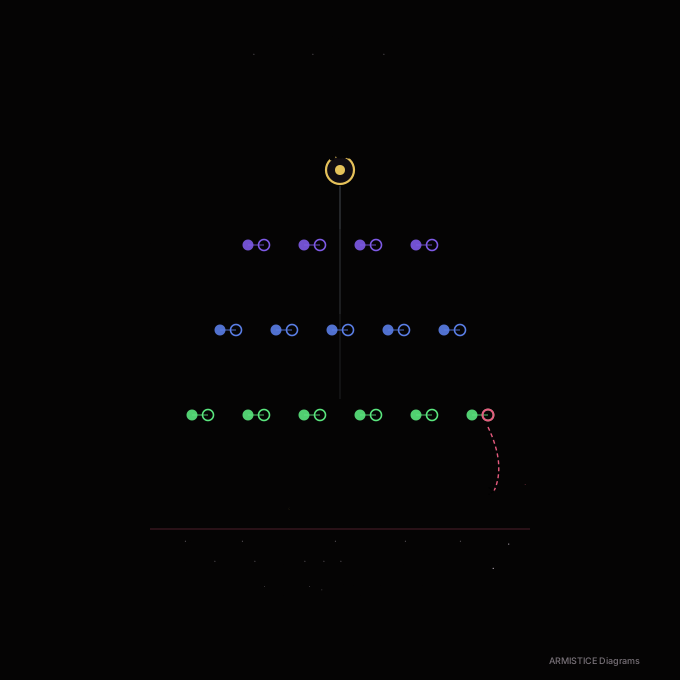
LIVE · v2.0
The Valentinian Pleroma (in the 1⊗0 frame)
Thirty Aeons emanating from Bythos in fifteen male/female syzygies (8+10+12), Sophia falling — bridged to the engine's polarity dyads (the Z₂ pairs), Sophia's fall reading as an orbit crossing the stable boundary.
-
LIVE · v2.1
Turing’s a-Machine — the finite rule table (in the 1⊗0 frame)
A tape, a head, and a finite table of rules — the minimal computer. The table shown is Turing’s own first example (On Computable Numbers, 1936, SS3): four m-configurations b, c, e, f, each reading a blank square, printing 0 or 1 and moving right. Run from a blank tape it prints 0 _ 1 _ 0 _ 1 _ forever, shown on the tape above. Each rule (state, symbol) → (write, move, next state) is one application of z → f(z); the Cosmopoiesis engine is such a machine, its tape the state (x, y) advanced each tick (a recomputed orbit is shown). Bridged to the Fold’s limit on the provable.
-
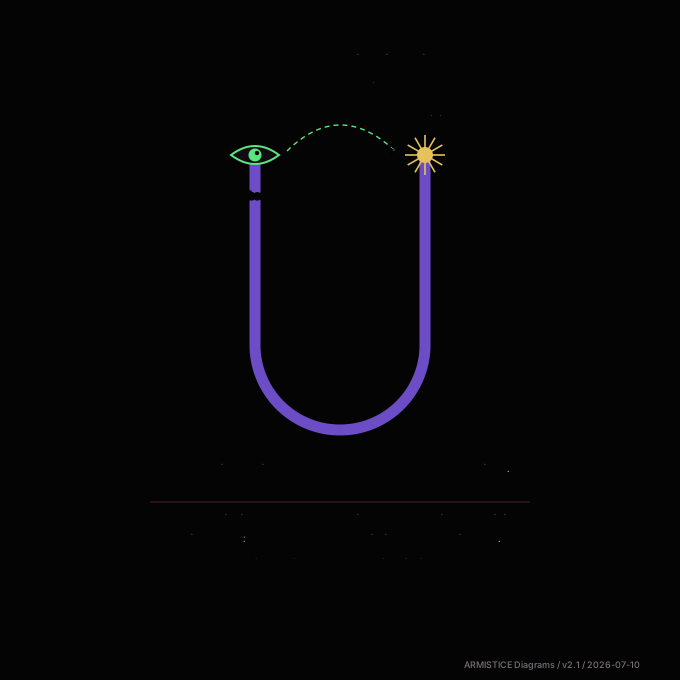
LIVE · v2.1
Wheeler’s Participatory Universe (in the 1⊗0 frame)
Wheeler’s self-observing ‘U’ — an eye whose gaze reaches back to its own origin — bridged to 1⊗0: the knower bounded inside the known, the substrate’s self-excited loop.
-
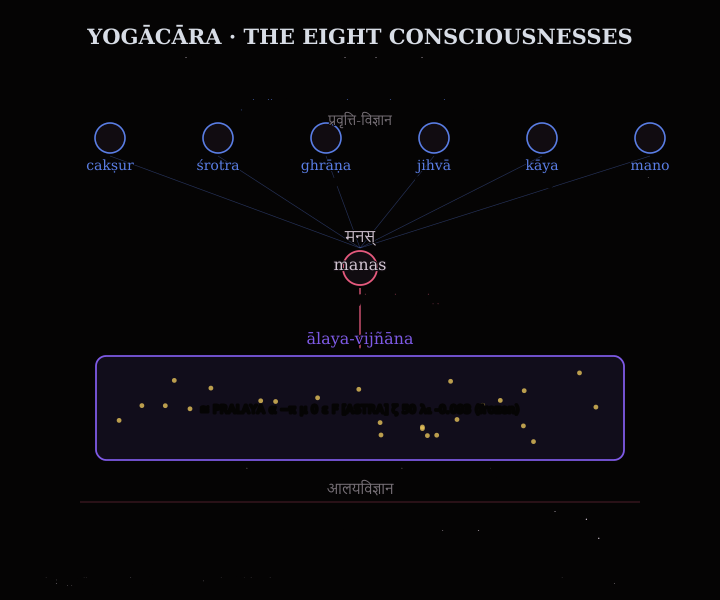
LIVE · v2.1
Yogācāra — the eight consciousnesses
The aṣṭavijñāna. Top row: the six pravṛtti-vijñāna — eye, ear, nose, tongue, body and mind consciousnesses. They converge on manas, the seventh (the self-grasping mind), which rests on the ālaya-vijñāna, the eighth — the storehouse consciousness whose seeds (bīja) ripen into all experience. The corpus seats that seed-ground as PRALAYA at (−π, 0, F).
-
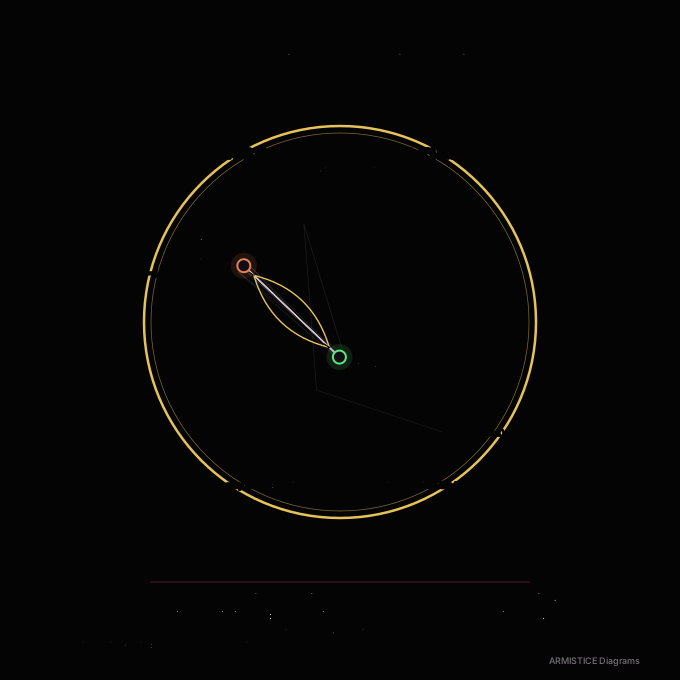
LIVE · v2.1
Zurvan — the enclosing ring; the twins as a computed period-2 orbit
Zurvan (Boundless Time) drawn as the ring that encloses everything — the non-dual ground, not a third family member. Inside, the engine's actual period-2 orbit at (alpha,mu,eps)=(-1.9,-0.51,0.05): a grey transient from seed (0.1,0.1) falls onto two alternating points, Ohrmazd A=(-0.5456,+0.5717) and Ahriman B=(-1.1493,+1.1480), f(A)=B and f(B)=A exactly, lambda1=-0.320. One ground, two poles, forever alternating.
-
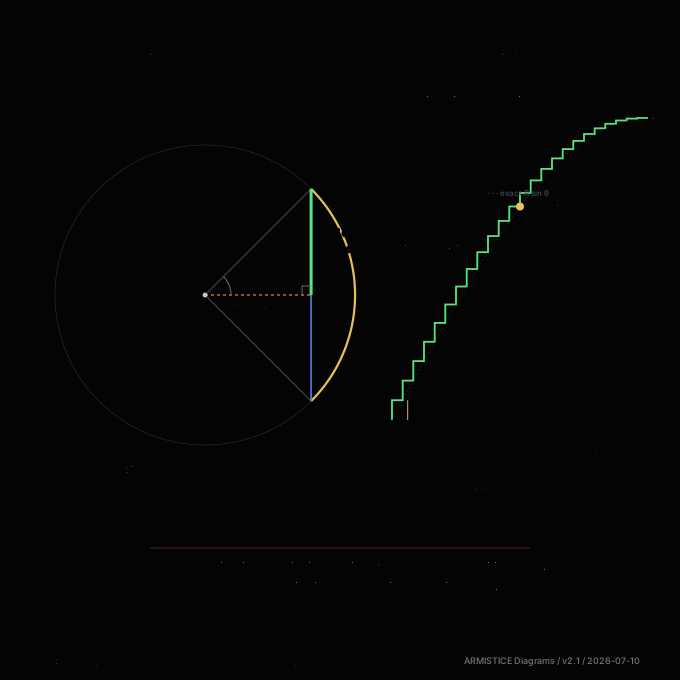
LIVE · v2.1
Āryabhaṭa's Half-Chord (in the 1⊗0 frame)
Left: the actual half-chord construction — an arc subtending 2θ at the centre, its full chord, and the half-chord (jyā = R sin θ) with kojya as the foot; drawn at 2θ = 90°, where jyā(45°) = 2431′ of R = 3438′. Right: the 24-step jyā-difference stair — the cumulative staircase of jyā(n·3°45′) with rises 225′ diminishing to 7′ — Āryabhaṭa's attested Gītikā-12 values, which sit within 1′ of the exact half-chord at every one of the 24 steps (19 rows land exactly on the rounded sine; five drift by 1, an artefact of his second-difference recurrence rather than exact sines). Footer keeps Āryabhaṭa's π ≈ 62832/20000 = 3.1416, whence R = 21600′/2π ≈ 3438′.
-
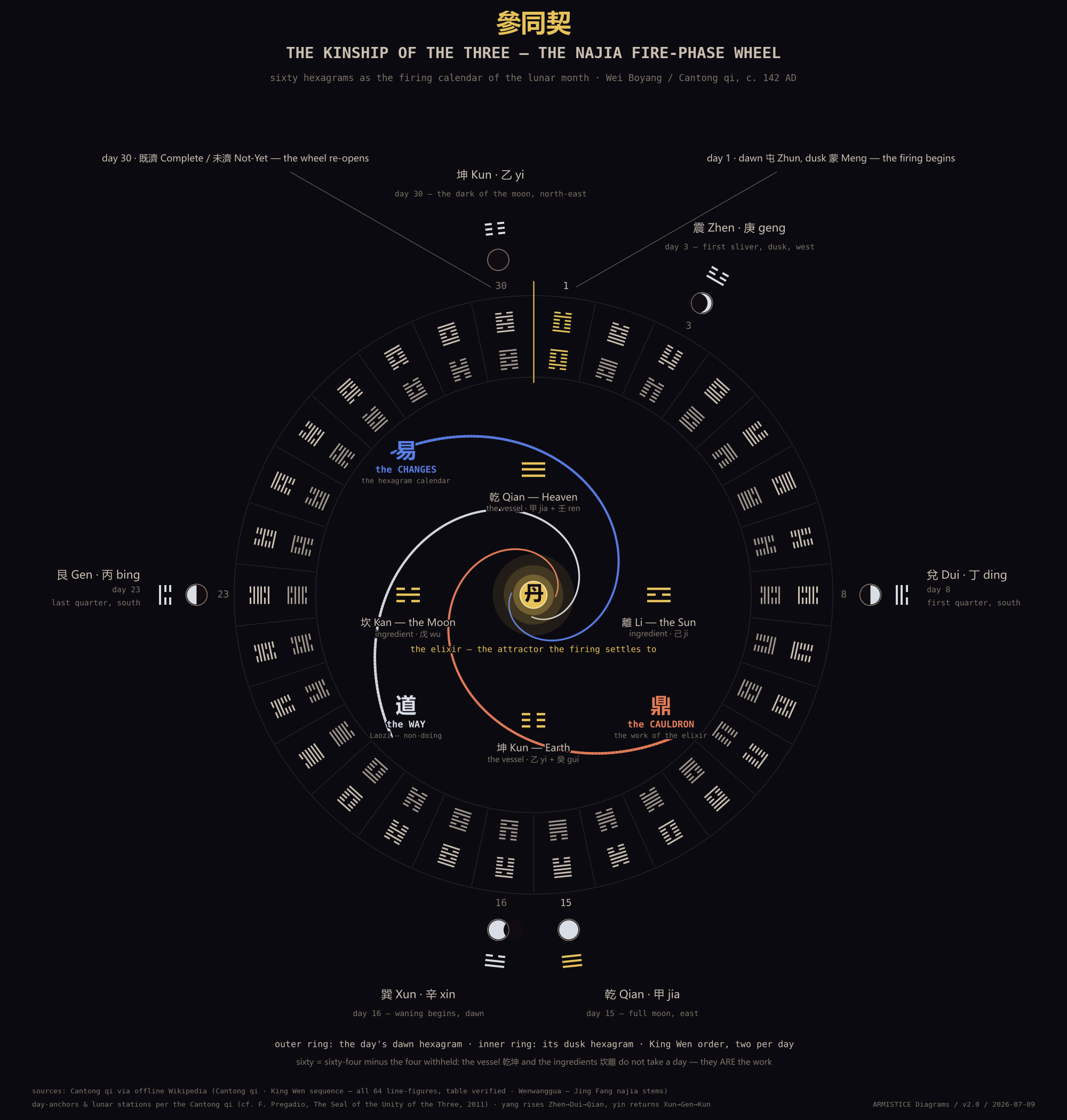
LIVE · v2.0
參同契 — The Kinship of the Three: the Najia Fire-Phase Wheel
The Cantong qi's firing calendar drawn in full. The ring carries the sixty hexagrams (King Wen order, line-figures verified against the sequence's own pairing and transition invariants), two per day of the lunar month — dawn on the outer ring, dusk on the inner — opening with Zhun/Meng on day 1 and closing with Jiji/Weiji (Complete / Not-Yet) on day 30. Six najia stations mark the moon's phases with their trigrams and stems: yang rises through Zhen (day 3, geng) → Dui (8, ding) → Qian (15, jia, full); yin returns through Xun (16, xin) → Gen (23, bing) → Kun (30, yi, dark). The four withheld emblems hold the hub — Qian/Kun the vessel (taking also ren/gui, embracing beginning and end), Kan/Li the ingredients (wu/ji, Moon and Sun). Three streams — the Changes, the Way, the work of the elixir — braid inward to the elixir point: three sources reconciled as one, the attractor the firing settles to.