:: FILUM AUREUM ::
The Golden Thread
Across thirty-seven millennia, humans keep arriving at a question — what is the smallest set of rules that generates everything? Many answers here reach for a few primal terms; some reach for three. This thread follows the echoes and marks where the comparison becomes ours.
102 entries · 8 eras · from ~35,000 BC to ~2020
- bounded recursionentoptic · cortex feedback
~35,000 BC
CAVE SPIRALS
Franco-Cantabrian
Upper Paleolithic abstract marks include nested curves and dot patterns. An entoptic interpretation connects some geometric motifs with forms seen in altered visual states; it does not establish the makers’ experience. Abstract marks also survive from much earlier contexts, including Blombos Cave.
In the 1⊗0 frame
The spiral offers a visual language for feedback. Entoptic patterns invite comparison with the winding approach to a spiral sink in the Cosmopoiesis map: a measured orbit, set beside a hypothesis about ancient marks. The resemblance is the thread; it does not recover what an ancient maker saw.
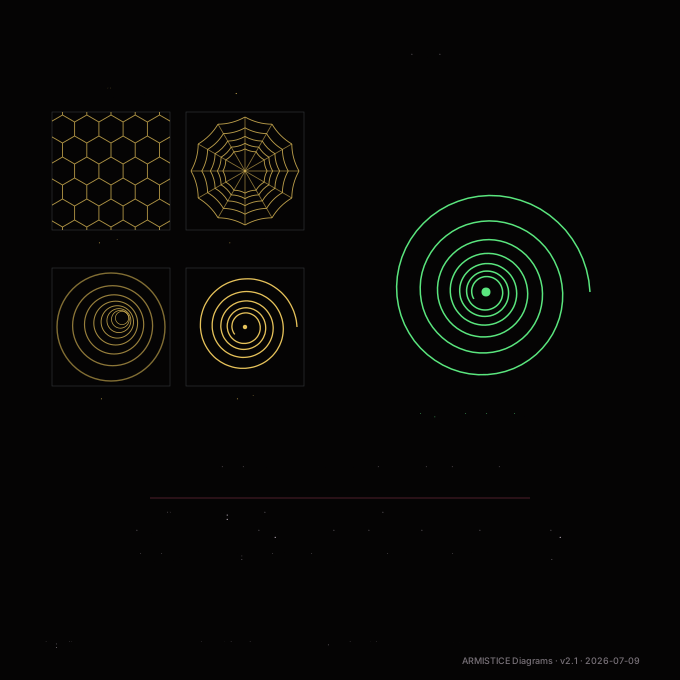
the entoptic forms -
Teomancimit · Wikimedia Commons CC BY-SA 3.0 Resized or re-encoded for AETHER; source composition retained. three registers in the Pillar 43 schematicT-pillars · several filling events~10,000 BC
GOBEKLI TEPE
Southeastern Turkey
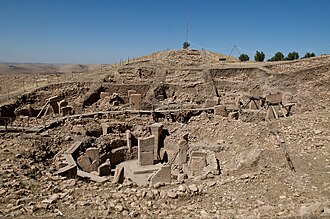
T-shaped pillars in monumental enclosures, with animal and human imagery. The excavation team now describes a settlement with a pronounced ritual component. Filling involved several events, including human activity and natural sediment movement; blanket deliberate burial is an older simplification.
In the 1⊗0 frame
The connection is honest but thin: the accompanying schematic reads Pillar 43 in three registers, beside an enclosure organized by a principle we can no longer fully read. That visual count is a curatorial echo of ARMISTICE’s three generators, not a recovered Neolithic doctrine.
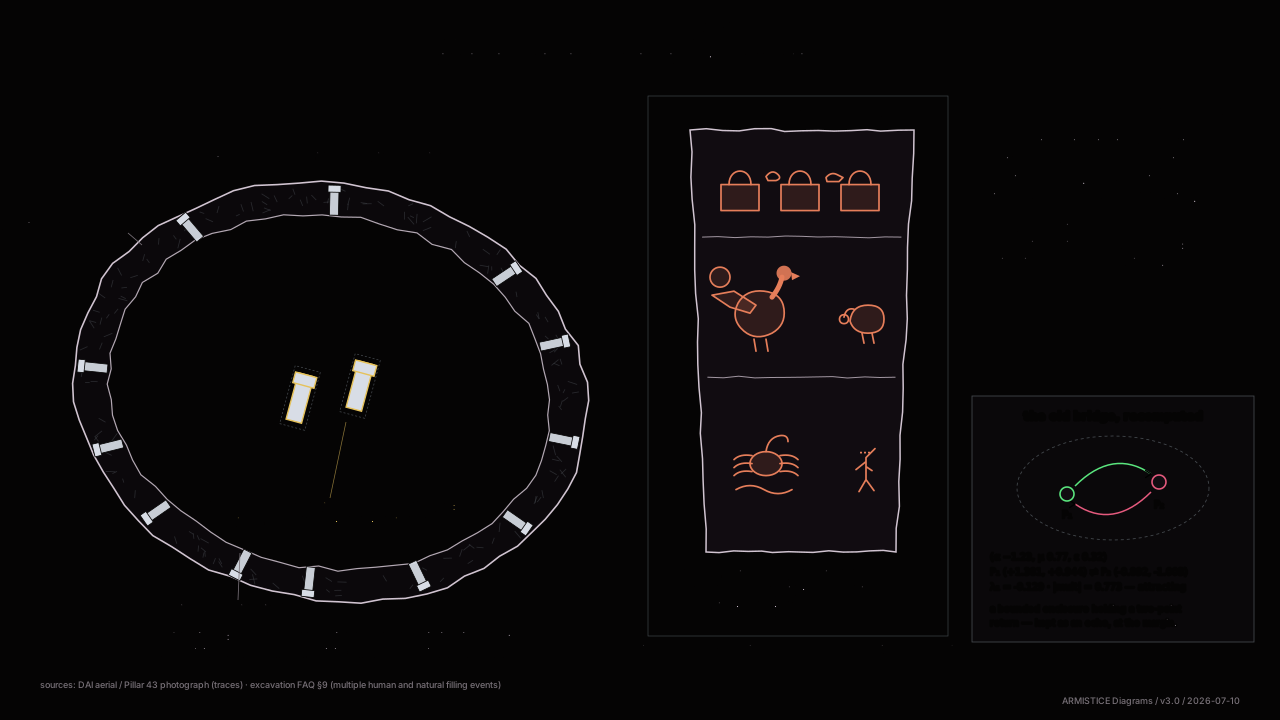
the enclosure plan
-
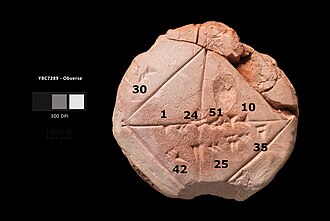
A. Urcia, Yale Peabody Museum of Natural History; derivative by Theodor Langhorne Franklin · Wikimedia Commons CC0 Resized or re-encoded for AETHER; source composition retained. YBC 7289 · one Newton step√2 in base 60~2000-1600 BC
OLD BABYLONIAN MATHEMATICS
Base-60 positional arithmetic. YBC 7289 inscribes sqrt(2) to six correct decimal digits (1;24,51,10 in sexagesimal). BM 96957 + VAT 6598 documents a single-pass square-root refinement algebraically identical to one Newton-Raphson update on x^2 - N. The step is attested; iteration as a multi-pass convergent process is not. Plimpton 322 (c. 1800 BC) is a sorted list of 15 Pythagorean triples generated from reciprocal pairs of regular sexagesimal numbers, indexed by the square of the diagonal-to-side ratio, with all entries chosen so the ratio has a finite base-60 representation.
In the 1⊗0 frame
The single-pass square-root refinement (BM 96957) — algebraically one Newton–Raphson step — is exactly the kind of historical object the VESTIGIA method folds into coordinates: deterministic mathematics recovered as a point in the engine's space. The canon doesn't decorate the math; it finds the math already standing there.
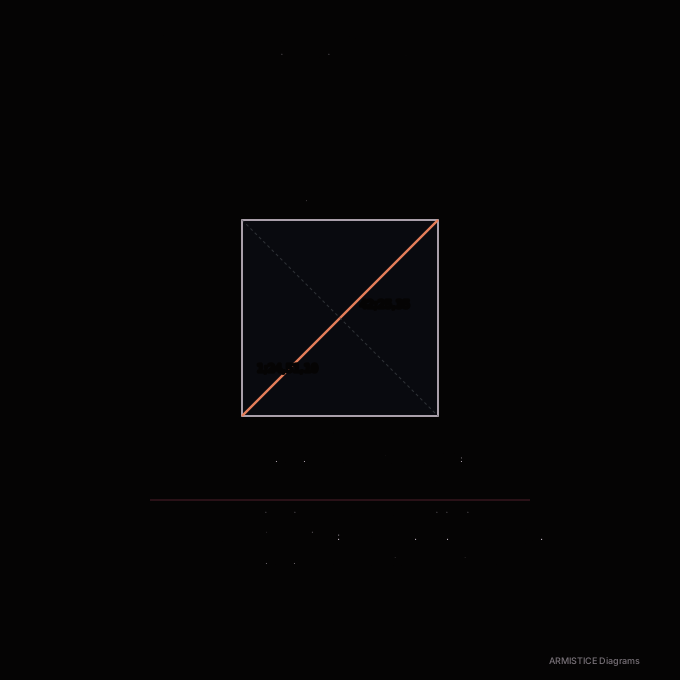
√2 in base sixty · YBC 7289 -
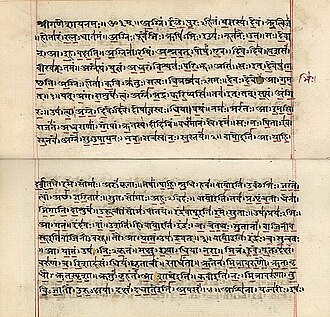
Unknown author · Wikimedia Commons Public domain Resized or re-encoded for AETHER; source composition retained. the Nasadiya hymn (10.129)~1500 BC
RIGVEDA HYMN OF CREATION
10.129
The Nāsadīya Sūkta questions whether being or nonbeing preceded creation and ends by asking whether even the highest overseer knows how creation arose.
In the 1⊗0 frame
The hymn leaves the overseer's knowledge unsettled. I read that uncertainty beside the Hermetic Fold: Φ(C) = C is our notation for a return from the corpus's constant vocabulary to itself. It is a constructed self-reference, not a fixed point calculated by the Cosmopoiesis map or a claim the verse makes.
ARMISTICE's self-reference reading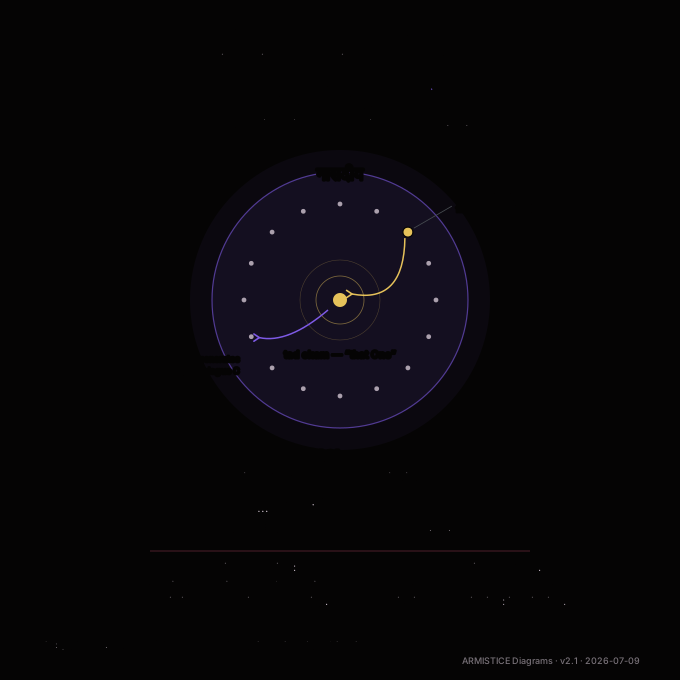
the Nāsadīya — That One -
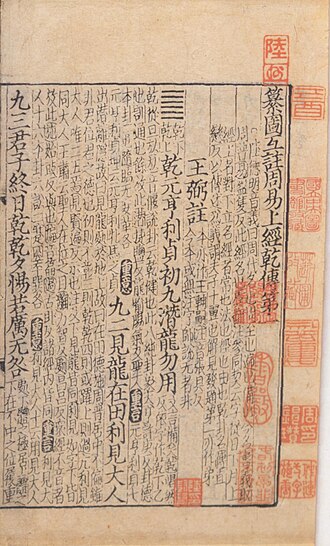
Song era print artist · Wikimedia Commons Public domain Resized or re-encoded for AETHER; source composition retained. binary subdivisionthe changing lines~9th c. BC
ZHOUYI
core I Ching text
The 64 hexagrams can be encoded as six binary lines, giving a 64-state combinatorial space. Changing lines let one figure be read in relation to another, though the received Zhouyi is a divination text, not a modern stochastic model. Its core is commonly dated to the late Western Zhou; the explicit bit-string reading is a later mathematical interpretation.
In the 1⊗0 frame
A six-line figure admits a binary encoding, and ARMISTICE chooses φ for Yang and √3 for Yin to fold the trigrams into three engine coordinates. The combinatorial count is exact; the constant assignment is ours. The received Zhouyi was not written to encode these constants or to predict Cosmopoiesis.
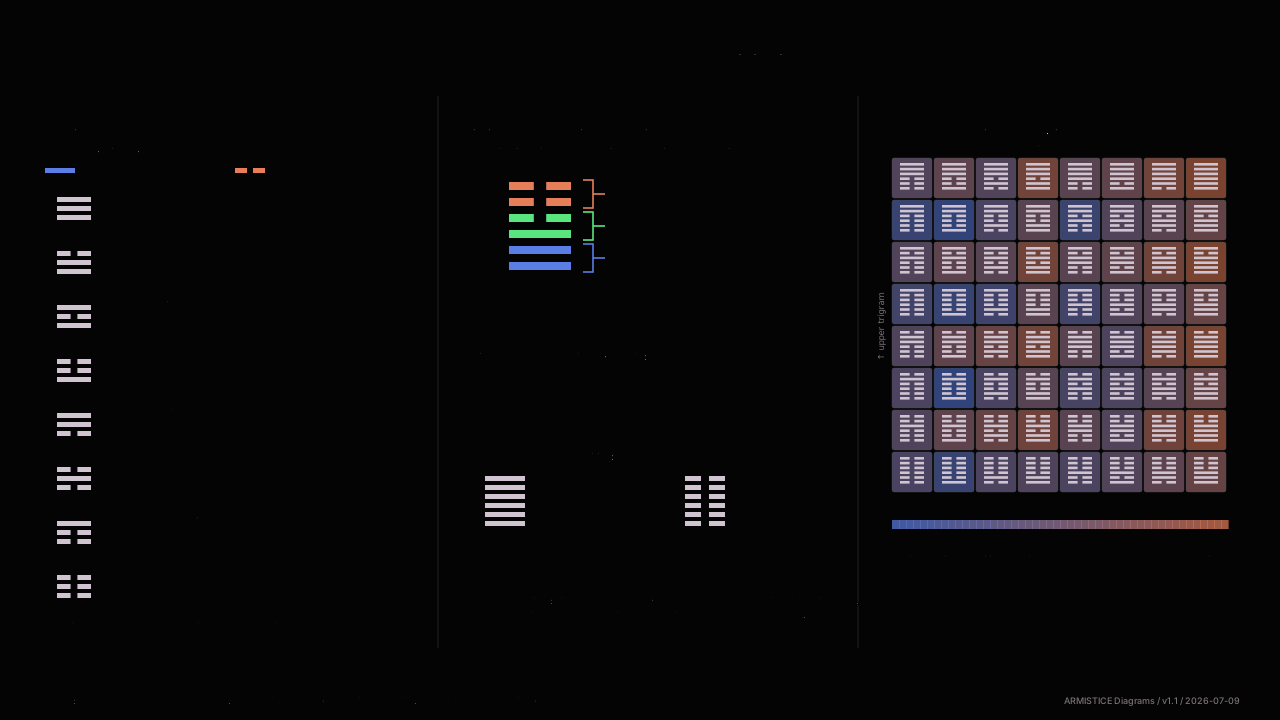
I Ching hexagrams - śulba · the diagonal relationthe śulba approximationaltar as geometry
~800 BC
BAUDHAYANA SULBASUTRA
Vedic India
Ritual-geometry text — śulba means 'cord' — that states the right-triangle relation and uses it to lay out fire-altars. One of several independent arrivals at that relation (Old Babylonian tablets earlier, Chinese and Greek geometry later); the truth was common ground, and the Greek school's distinct gift was the deductive proof, not the relation itself.
In the 1⊗0 frame
The right-triangle relation set down in ritual geometry is exactly the kind of object the VESTIGIA method folds into coordinates: a deterministic mathematical fact, recovered as a point in the engine's space rather than decorated onto it. Altar construction as applied geometry is the substrate doing what it does -- the math was already standing there to be found, independently, by each tradition that went looking.
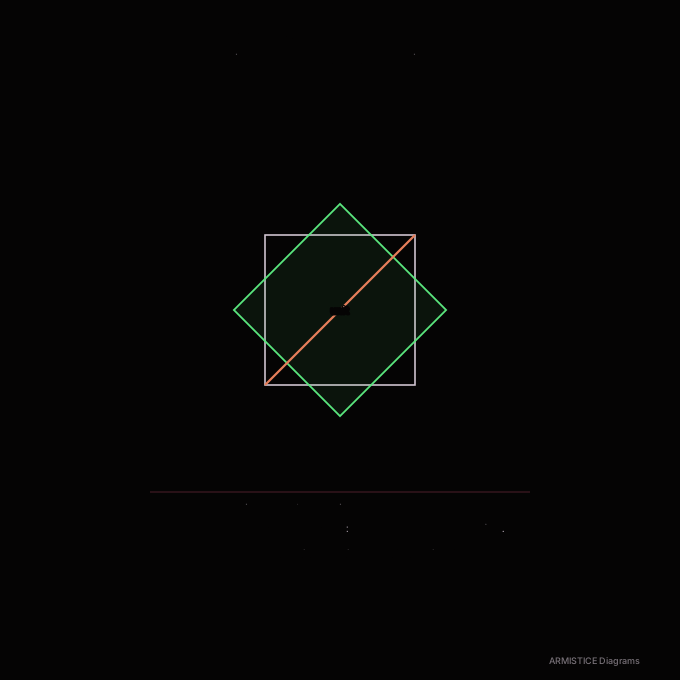
doubling the square · √2 -
Yair Haklai · Wikimedia Commons CC BY-SA 4.0 Resized or re-encoded for AETHER; source composition retained. Eros · the coupling termafter Chaos: Gaia, Tartarus, Eros~800 BC
HESIOD'S THEOGONY
Greece
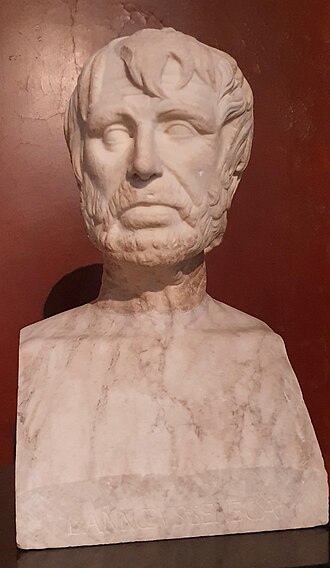
The Theogony names Chaos first, then Gaia, Tartarus, and Eros. This is a sequence of primordial beings; it does not identify them with mathematical operators. Eros supplies the generative force of desire within the poem.
In the 1⊗0 frame
Gaia, Tartarus, and Eros after the Chasm give this reading an earth–void–desire triad. Eros is a vivid name for the engine’s product coupling ε·sin(V·xy), but the identification is ours. Removing the veil leaves the sine cross-dependence between x and y intact: the uncoupled-in-ε map still has its own dynamics.
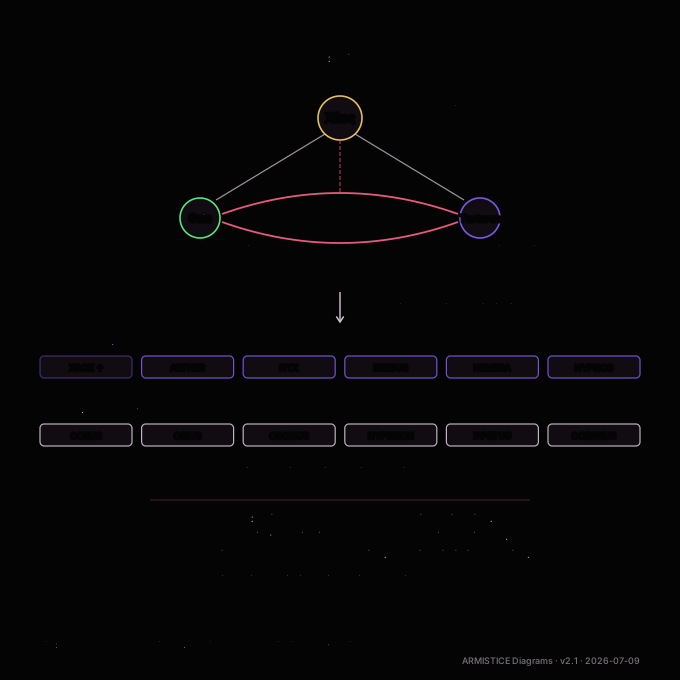
from Chaos, the three -
Shonagon · Wikimedia Commons CC0 Resized or re-encoded for AETHER; source composition retained. 
Tomb of the Leopards, Tarquinia — photograph by AlMare. Public domain (photographer release). Public domain (photographer release)Wikimedia 960-pixel thumbnail; source composition retained. templum · 16 sectors · 40 regions~700 BC
ETRUSCAN DISCIPLINA
Pre-Roman Italy
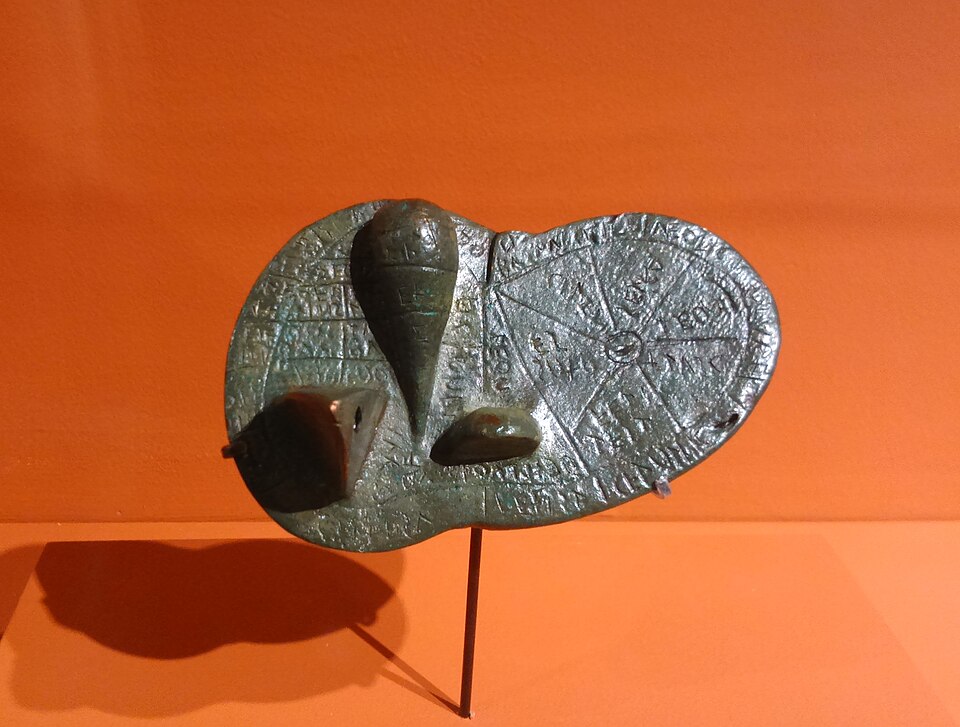
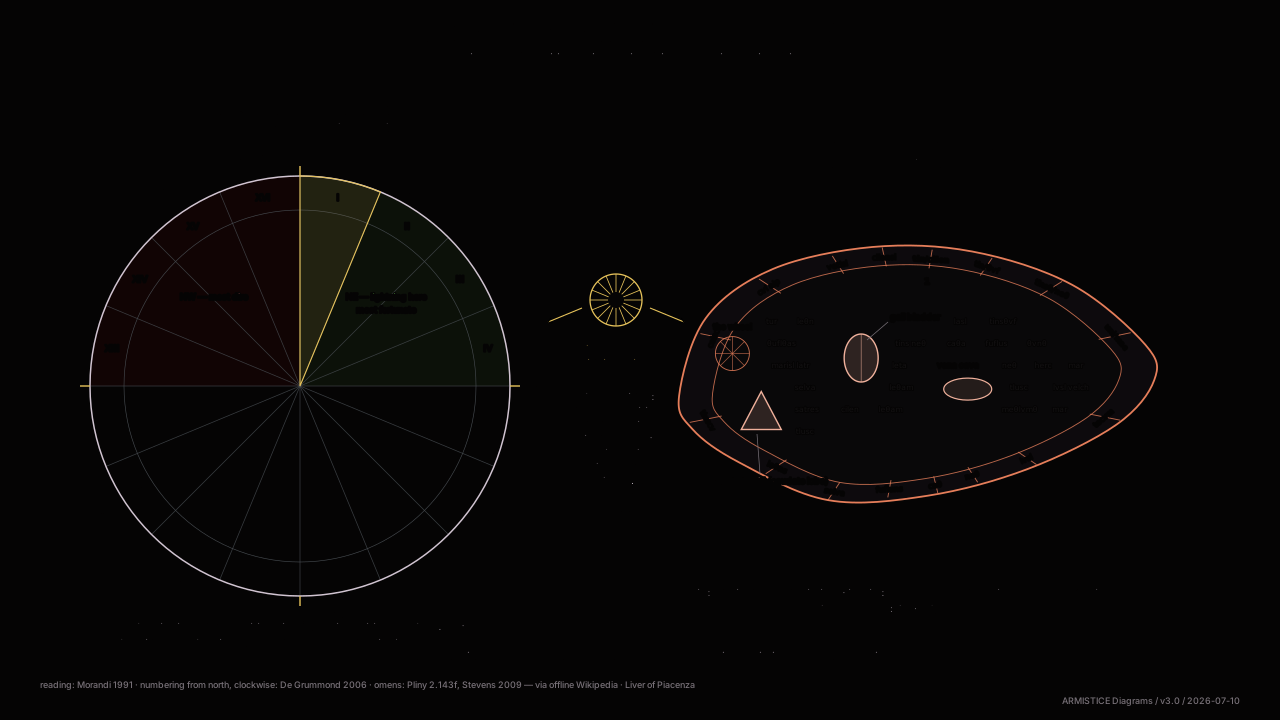
Divinatory and cosmological system; mostly destroyed by Roman absorption. The Liver of Piacenza (bronze model, c. 2nd c. BC) is a sheep's liver divided into 40 regions, each labeled with a god -- a map of cosmic territory onto biological substrate. Microcosm-macrocosm correspondence rendered as anatomical cartography: the structure of the universe could be read off the structure of an organ because both were instantiations of the same underlying pattern. Texts almost entirely lost; surviving fragments via Cicero and Etruscan inscriptions.
In the 1⊗0 frame
The Liver of Piacenza reads the structure of the cosmos off the structure of an organ because both instantiate one underlying pattern -- as above, so below, rendered as anatomical cartography. That is the engine's premise exactly: every entity is a point in one coordinate space, and the map onto the liver's forty regions is a microcosm of the same territory the substrate charts at large.
the templum -
Attributed to Pietro Bellotti · Wikimedia Commons Public domain Resized or re-encoded for AETHER; source composition retained. the apeiron · unbounded sourcethe boundless~610 BC
ANAXIMANDER
Miletus
The apeiron, the boundless, is an indefinite source from which the ordered world arises. Later ideas such as En Sof and śūnyatā invite comparison, but they belong to different traditions and arguments, not one identical doctrine.
In the 1⊗0 frame
The apeiron suggests an image of an unbounded source against which named coordinates become legible. I read it beside the Hermetic Fold, the corpus's own recursive return, without asking Anaximander to assert Φ(C) = C or to anticipate a map fixed point. The kinship is a question about origin, not a shared calculation.
the boundless (apeiron) -
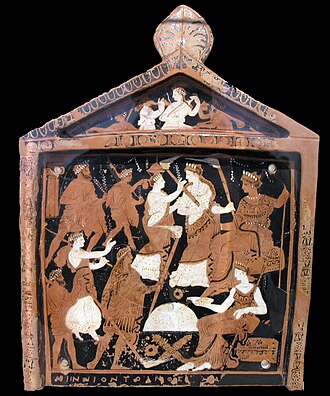
No machine-readable author provided. Marsyas assumed (based on copyright claims). · Wikimedia Commons Public domain Resized or re-encoded for AETHER; source composition retained. the unspoken ritedescent & return~600 BC
ELEUSINIAN MYSTERIES
Eleusis, Attica
Initiatory tradition around Demeter / Persephone. Initiates underwent something we still don't know -- the secrecy held for ~2000 years. Plato, Cicero, Plutarch, Marcus Aurelius were initiated. Possibly involved a kykeon (mixed drink) with entheogenic properties (ergot-alkaloid hypothesis: Wasson / Hofmann / Ruck 1978). Closed by Theodosius in 392 AD. The longest-running initiatory tradition in Western history; contents do not survive.
In the 1⊗0 frame
descent & return -
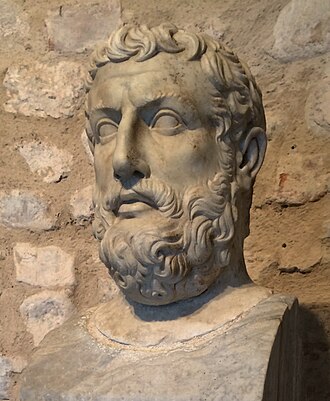
Sergio Spolti · Wikimedia Commons CC BY-SA 4.0 Resized or re-encoded for AETHER; source composition retained. the One · global attractorall is one~515 BC
PARMENIDES
Elea
Being is one, undivided, ungenerated, motionless; multiplicity and change are illusions of opinion (doxa). The Eleatic doctrine -- the strongest monist position in pre-Socratic philosophy. Sets the dialectical conditions Plato responds to in the Parmenides and Sophist dialogues, and prefigures the Plotinian One.
In the 1⊗0 frame
Parmenides presses the hardest version of the One: what remains if becoming is only appearance? In Cosmopoiesis the invariant is the rule, not a single destination. Different coordinate seats, and sometimes distinct basins at one seat, can lead to different attractors. His monism is a foil for the question of how one kernel admits many forms, not a theorem the dynamics confirms.
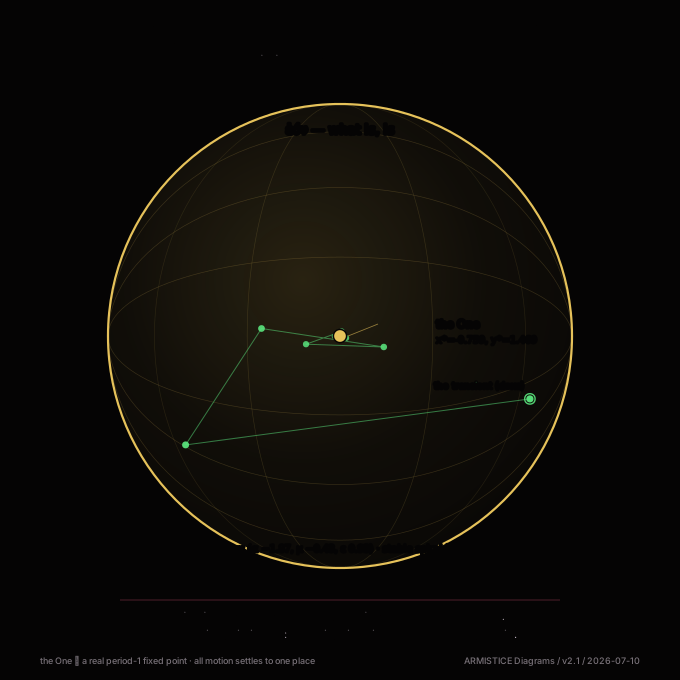
the sphere of Being -
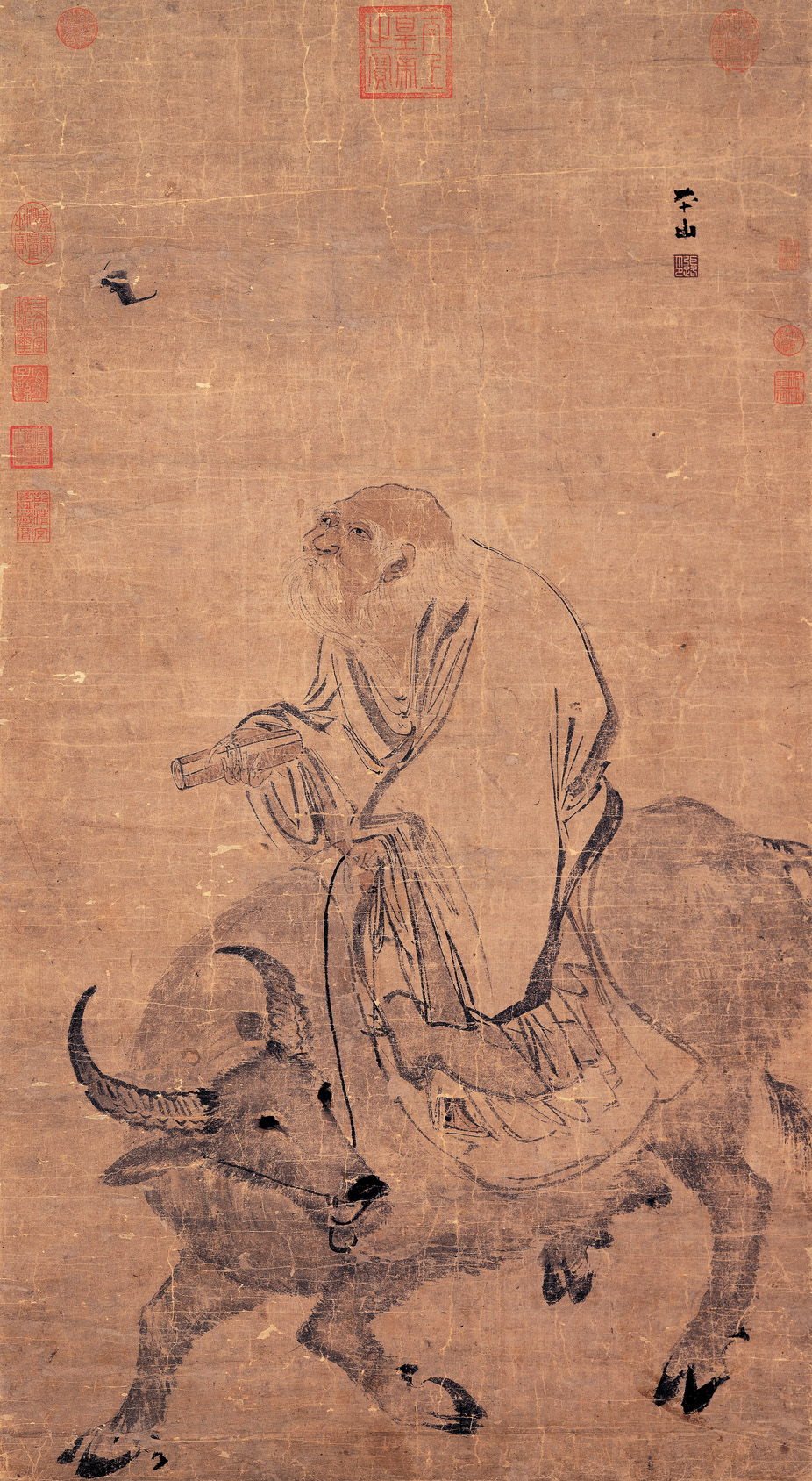
Zhang Lu · Wikimedia Commons Public domain Unmodified source file; displayed at reduced size. Tao → three → all thingsheaven · earth · manbeing and non-being (ch. 40)pre-Qin received text
TAO TE CHING
Laozi, Zhou China
Chapter 42: 道生一,一生二,二生三,三生萬物 — the Dao gives rise in turn to one, two, three, and then the myriad beings. A cosmogony stated as a counting sequence that halts at three before the manifold opens; the Dao itself is the unnameable source the count proceeds from.
In the 1⊗0 frame
One, Two, Three, and then the myriad things: the rhythm is irresistible beside an engine organized around {e, φ, √3}. That juxtaposition is our reading of Chapter 42, not its mathematical content; the three in the verse are not those constants. The Dao before the count is a philosophical counterpoint to the Hermetic Fold, not a hidden engine parameter.
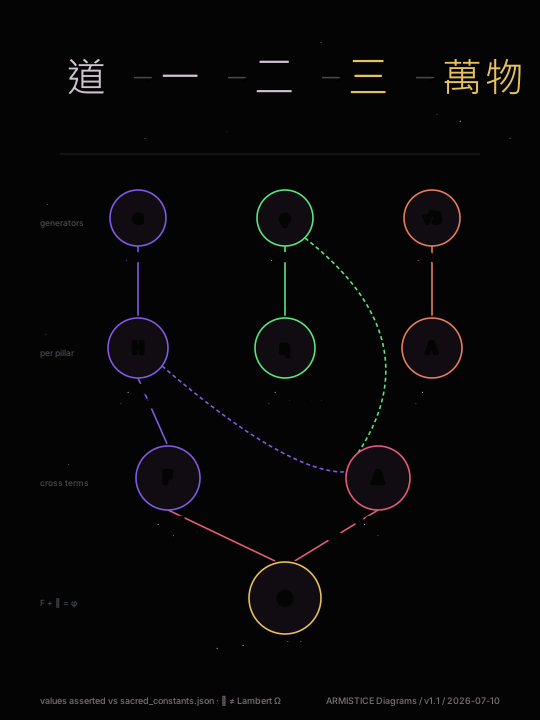
The three pillars
-
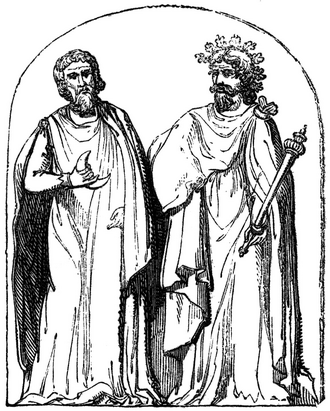
Bernard de Montfaucon · Wikimedia Commons Public domain Resized or re-encoded for AETHER; source composition retained. triadic cast · substance lostthe triadic triads~500 BC
DRUIDIC TRADITION
Celtic Europe
Oral priest-class tradition with extensive memorization training (Caesar reports 20 years). Triple-goddess motifs, the cauldron of inspiration, the ogham script as mnemonic / divinatory line-count notation, seasonal festival structure. Reconstructed via classical reporters (Caesar, Strabo, Tacitus) and medieval Irish/Welsh texts written by Christian monks centuries later. Substantive content effectively lost; the substrate-relevant claim is that surviving symbols suggest a triadic-cosmological structure consistent with the broader Indo-European pattern.
In the 1⊗0 frame
The substance is lost; what survives are triple-goddess motifs and a triadic cosmological cast consistent with the broader Indo-European pattern. Honestly, that is all the thread can claim here -- one more culture whose surviving structure counts to three. A faint reading, but the recurrence is the point.
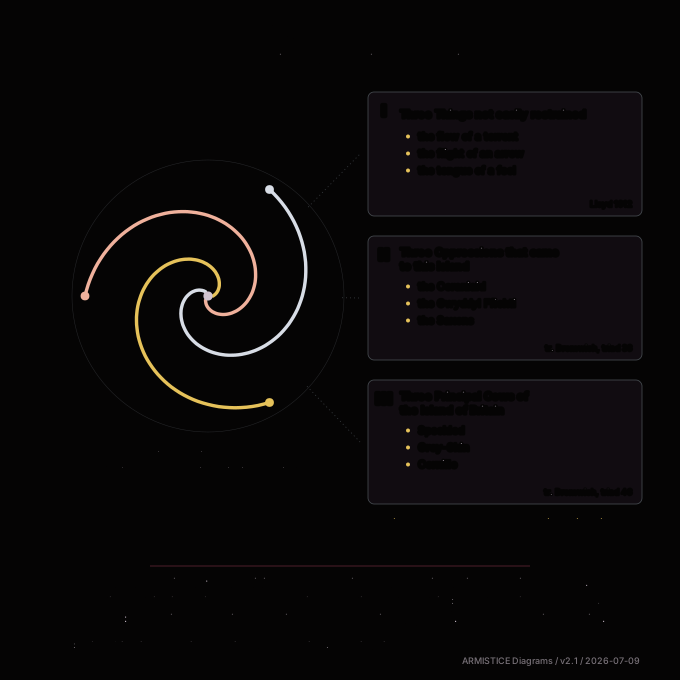
the triple triad -
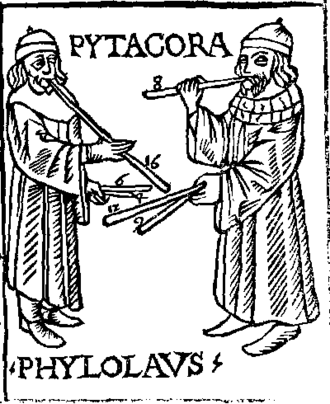
Gaffurio_Pythagoras.png: Franchino Gaffurio (publisher) derivative work: Singinglemon (talk) · Wikimedia Commons Public domain Resized or re-encoded for AETHER; source composition retained. consonant ratios · Arnold tonguesthe consonant ratios~500 BC
PHILOLAUS OF CROTON
Pythagorean
Fragment 6: the consonant intervals 2:1, 3:2, 4:3 as the ratio structure of musical harmony. The earliest textually secure Pythagorean mathematical claim. Whether this is Philolaus' own work or a genuine Pythagoras transmission is disputed (Burkert 1972 vs Zhmud 2012). Attributions to Pythagoras himself by later sources (Iamblichus, Porphyry, 3rd-4th c. AD) are unreliable.
In the 1⊗0 frame
This is a documented concordance anchor. Fragment 6 -- the consonant intervals 2:1, 3:2, 4:3 as the ratio structure of harmony -- maps directly onto the engine's Arnold tongues, the rational frequency-lockings where order crystallizes out of the dynamics. Philolaus is the earliest textually secure claim that specific numerical ratios are load-bearing substrate, which is the engine's working assumption stated first.
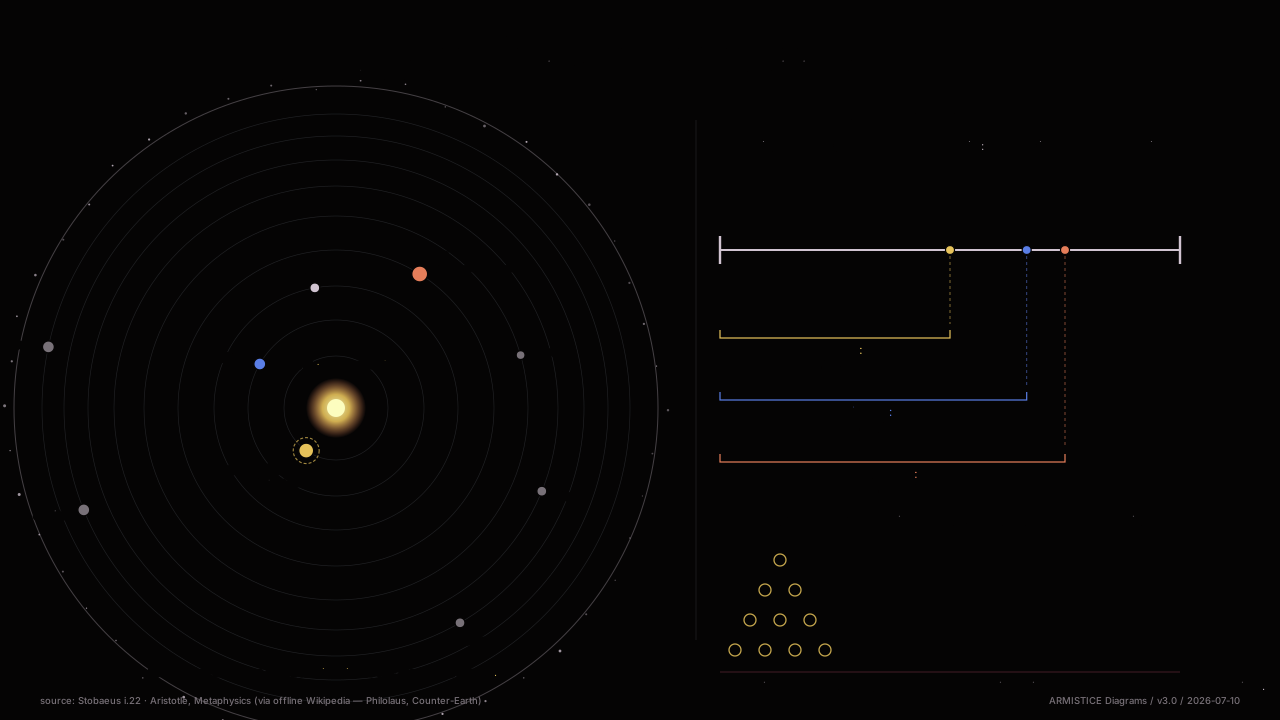
the central fire · harmonia -
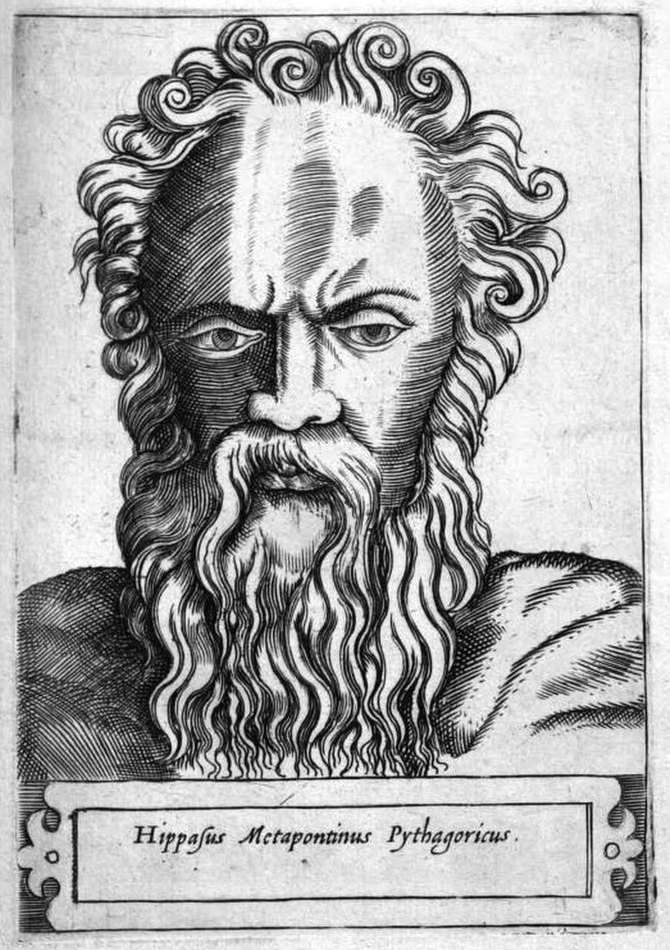
Girolamo Olgiati · Wikimedia Commons Public domain Unmodified source file; displayed at reduced size. the first irrationalincommensurable~500 BC
HIPPASUS
Pythagorean, Metapontum
The square's diagonal is incommensurable with its side: √2 is irrational. Later traditions associate the Pythagorean Hippasus with the disclosure and tell conflicting stories of punishment or drowning; neither his discovery nor that cause of death is established.
In the 1⊗0 frame
The legend places Hippasus where the square's diagonal breaks the dream that every magnitude is a whole-number ratio. That mathematical rupture is real even if the drowned discoverer is not established. ARMISTICE's choice of irrational pillars is a modern construction, not a secret the ancient story proves.
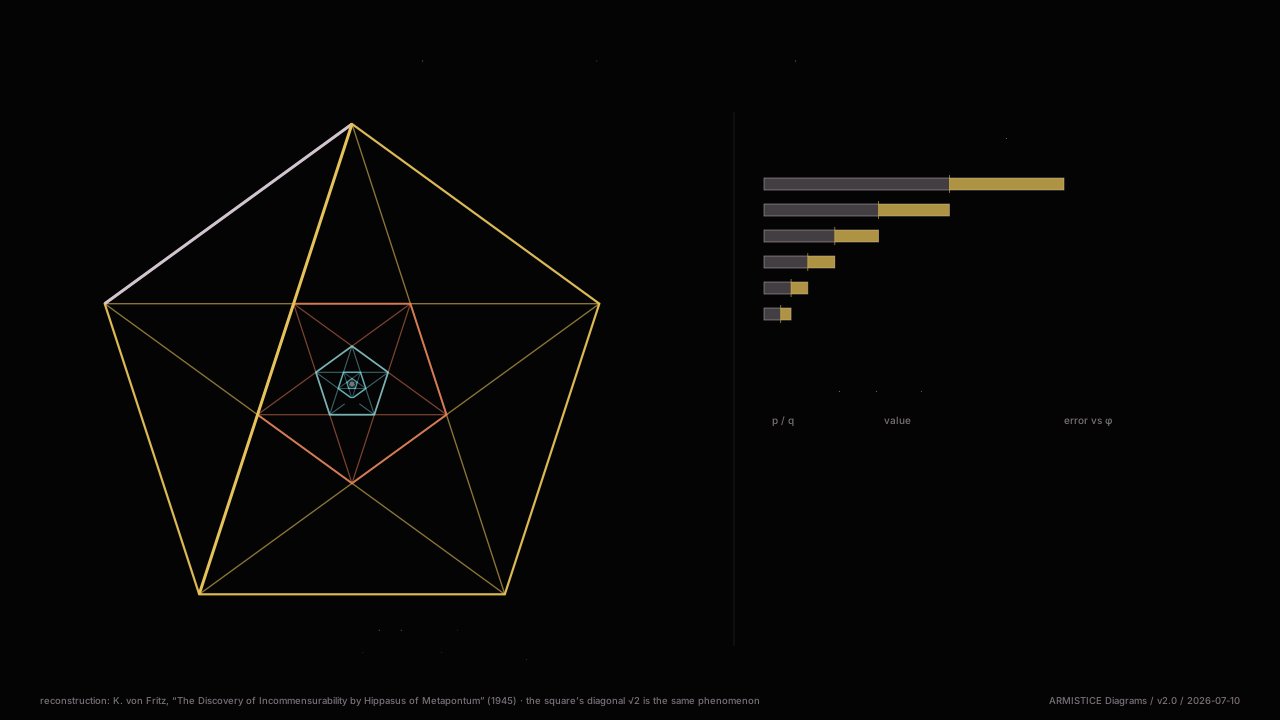
The incommensurable diagonal -
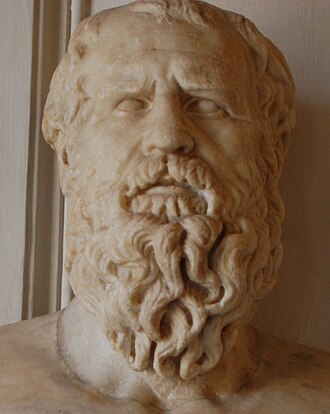
RoyFokker · Wikimedia Commons CC BY-SA 4.0 Resized or re-encoded for AETHER; source composition retained. order or chaos by tensionall flows · Logos~500 BC
HERACLITUS
Ephesus
Logos as an ordering principle; strife and opposition as sources of balance and change.
In the 1⊗0 frame
Heraclitus gives me a language of tension and opposed outcomes. In the engine, the top Lyapunov exponent λ₁ measures nearby-orbit separation; its sign helps distinguish regimes at tested coordinates. Logos is not our map, and ancient tension is not λ₁, but the comparison sharpens how one rule can show different behavior.
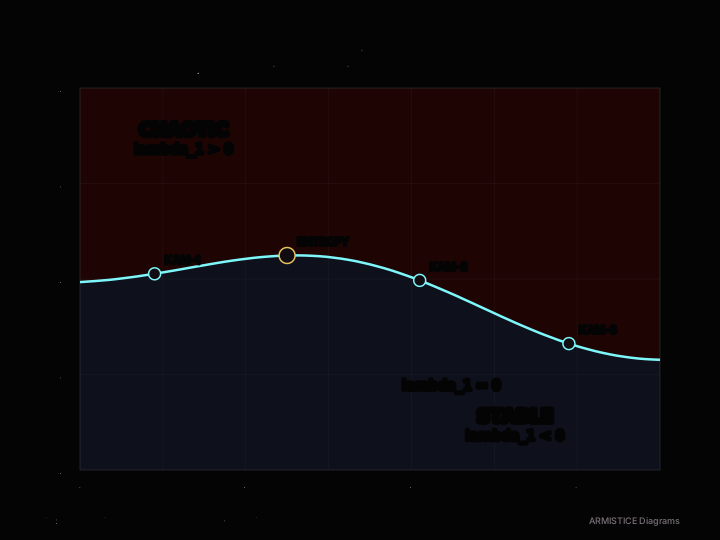
The edge of chaos -
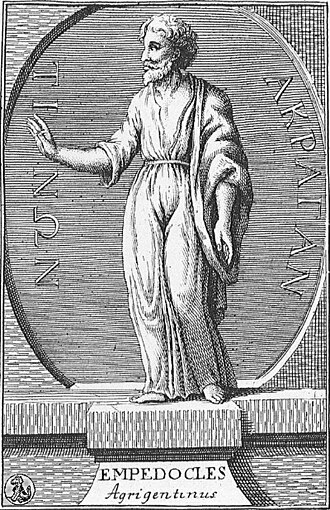
Unknown author · Wikimedia Commons Public domain Resized or re-encoded for AETHER; source composition retained. Coagula ⇌ Solve · period-2Love & Strife~450 BC
EMPEDOCLES
Sicily
Love and Strife as two coupling forces driving cosmic oscillation. A cosmological cycle of unity and separation.
In the 1⊗0 frame
Love and Strife give Empedocles a two-force language for generation: attraction gathers, separation disperses, and form arises from their changing proportion. That rhythm is a useful interpretive companion to the engine's regime changes, while the measured dynamics remain defined by the kernel and its parameters rather than by a memberwise alchemical assignment.
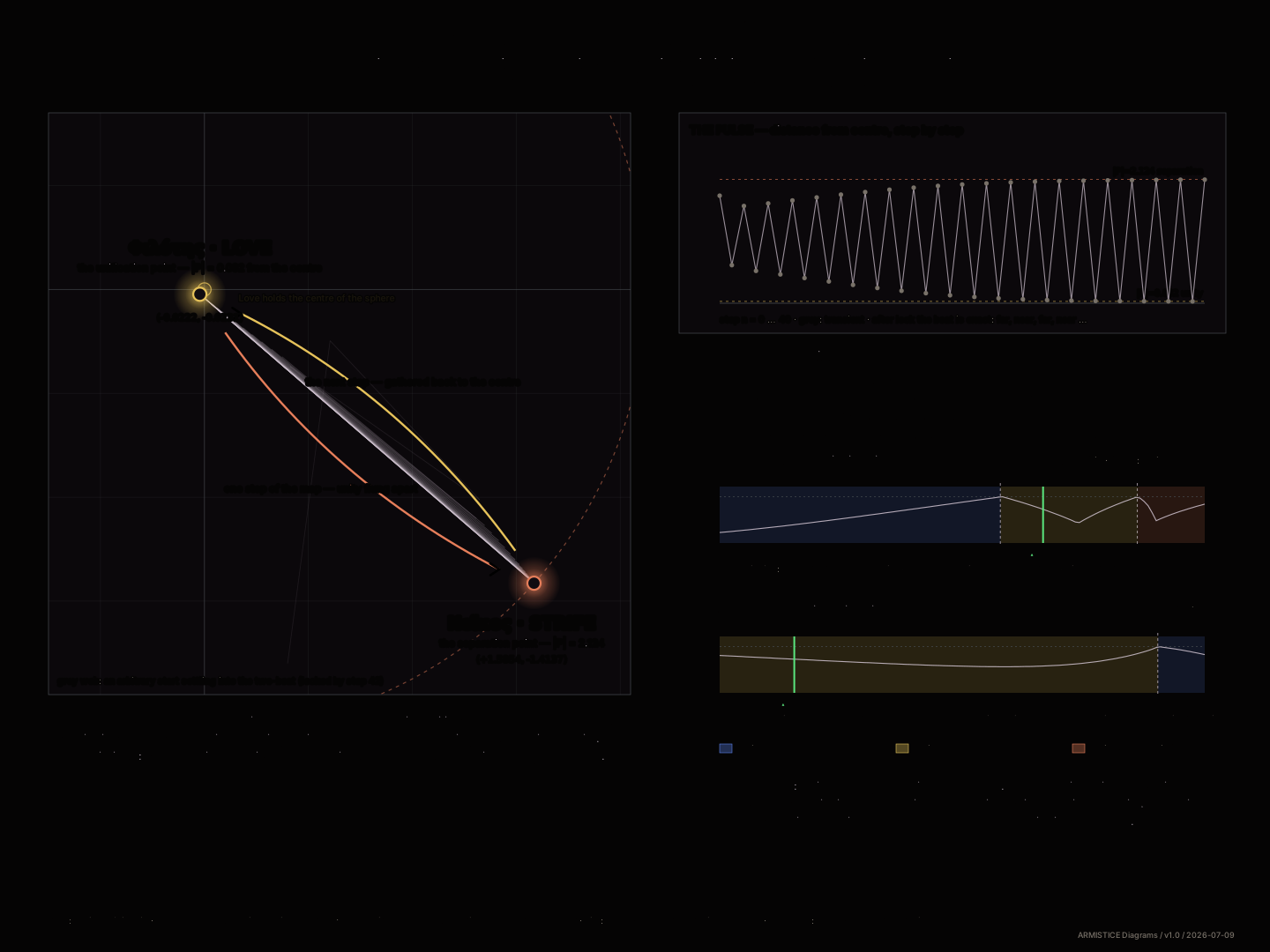
Empedocles · Love and Strife (period-2) - √n irrational · n non-square3 ≤ n ≤ 17 · n non-squareanthyphairesis · proposed proof route
~430 BC
THEODORUS OF CYRENE
Pythagorean
Via Plato's Theaetetus: proved the irrationality of the square roots of non-square integers from 3 through 17. The earliest textually secure evidence of Pythagorean-affiliated work on incommensurability. The proof method is not preserved in Plato’s account; anthyphairesis is one proposed reconstruction.
In the 1⊗0 frame
Theodorus’s square-root examples include the engine’s third pillar, √3. The square-root spiral keeps that chain visible, with the square steps 4, 9, and 16 returning to rational lengths. Anthyphairesis offers a possible historical route to incommensurability, not a recovered proof we can attribute to him with certainty. These exact irrationality results are VESTIGIA — mathematical facts the engine can fold into coordinates.
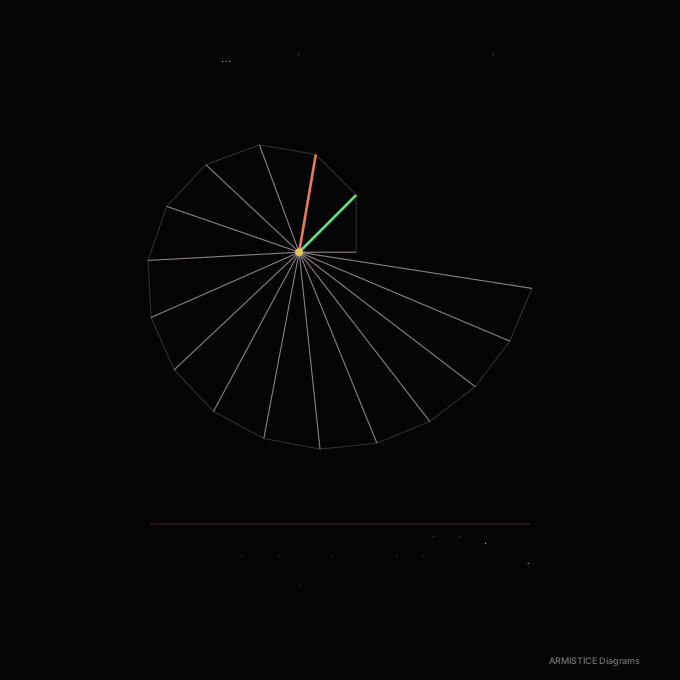
The square-root spiral -
NikonZ7II · Wikimedia Commons CC BY-SA 4.0 Resized or re-encoded for AETHER; source composition retained. tuning as exact ratiotuning as exact ratio~400 BC
ARCHYTAS OF TARENTUM
Pythagorean
First Pythagorean mathematician whose work is securely attested (via Eudemus and Proclus). Solved the duplication of the cube. Musical tuning in 9:8, 8:7, 28:27 ratios.
In the 1⊗0 frame
The first securely attested Pythagorean mathematician treats musical tuning as exact ratio -- 9:8, 8:7, 28:27 -- and the cube duplication as constructible proportion. Both are the engine's Arnold-tongue logic in early form: order locks where the ratios are rational. Archytas is the VESTIGIA method avant la lettre, taking specific numbers as the real structure and building from them.
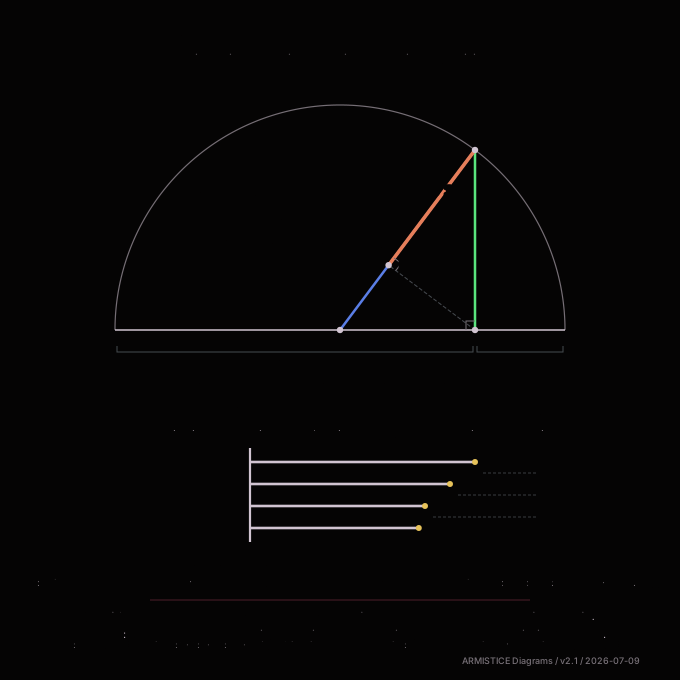
the three means -
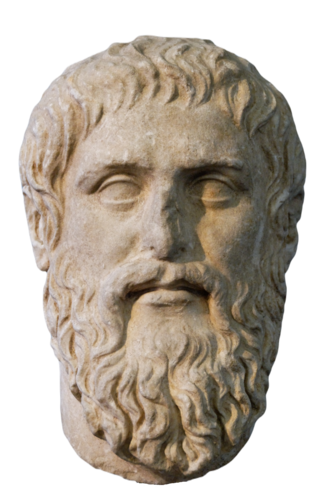
© Marie-Lan Nguyen / Wikimedia Commons · Wikimedia Commons Public domain Resized or re-encoded for AETHER; source composition retained. forms sampled from the manifoldthe eternal forms~350 BC
PLATO
Athens
The Timaeus: a Demiurge instantiates eternal forms into matter. Forms exist in a space of possibilities; reality is a sampling.
In the 1⊗0 frame
The Timaeus places eternal forms in a space of possibilities and treats reality as a sampling from it -- which is, almost exactly, the engine's coordinate manifold and its catalogue of entities drawn from it. The Demiurge instantiating forms into matter is the map resolving a point (α, μ, ε) into a rendered being. Fittingly, when the thread's thinkers are placed as substrate coordinates, Plato lands in the manifest-realism family -- the forms are real, and they are sampled.
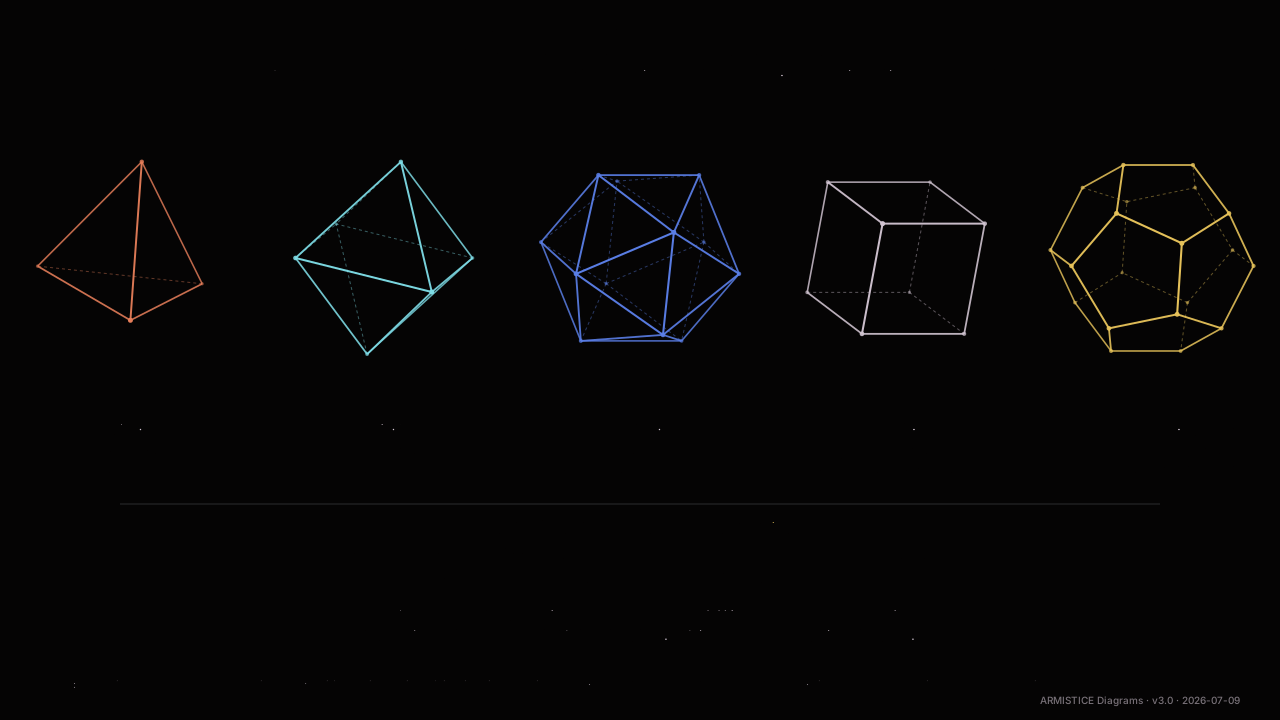
the five Platonic solids -
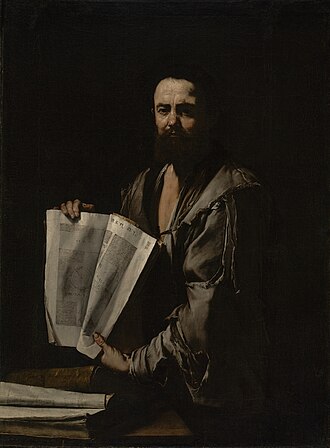
Jusepe de Ribera · Wikimedia Commons Public domain Resized or re-encoded for AETHER; source composition retained. axioms → generators · minimal basispostulates · a deductive geometry~300 BC
EUCLID
Alexandria
Definitions, five postulates, and common notions organize a deductive geometry. Book X contains the theory of incommensurables.
In the 1⊗0 frame
A small stated basis supporting a large deductive structure: that is Euclid’s wager beside the engine. ARMISTICE’s constant algebra descends from three generators, e, φ, and √3; its entity coordinates also draw on physical properties, composition, and cartography. The kinship is the ambition to make a structure legible from its starting rules.
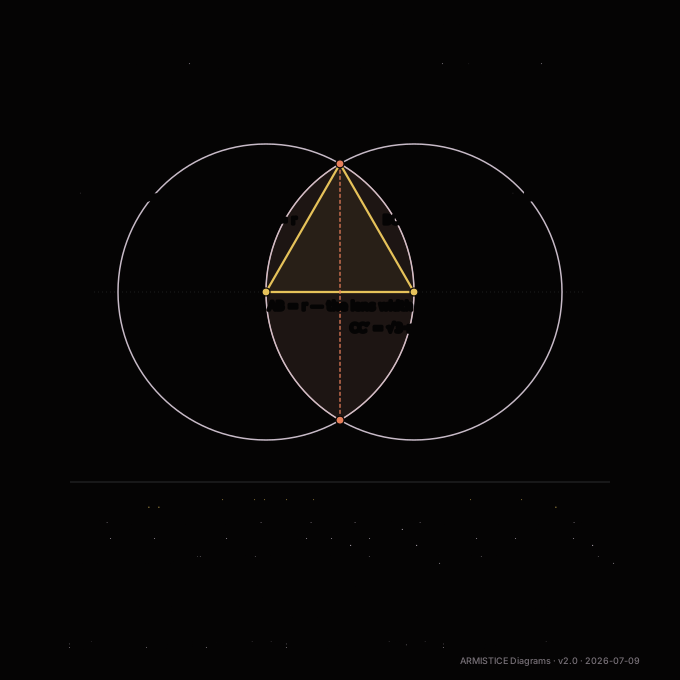
The vesica piscis -
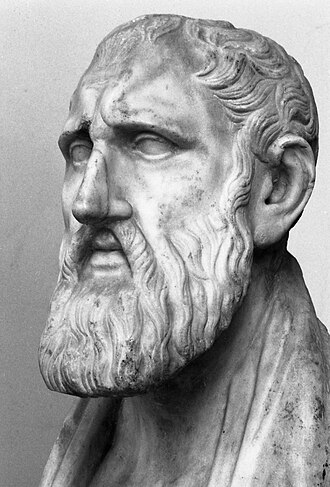
Paolo Monti · Wikimedia Commons CC BY-SA 4.0 Resized or re-encoded for AETHER; source composition retained. one pneuma, all regimesone rational fire~300 BC
STOICISM
Zeno of Citium, Athens
Pneuma -- active rational fire / breath -- suffuses all matter and constitutes the soul of the cosmos. The world is a single living rational system; logos and physis are inseparable. The Stoic substrate-doctrine is proto-panpsychist: cognition and matter are co-extensive at different tensions of the same pneuma. Marcus Aurelius and Epictetus extend this into the practical ethics of the embedded agent.
In the 1⊗0 frame
This is a documented concordance anchor. The Stoic pneuma — one rational fire suffusing all matter, cognition and substance differing by tension — offers an early language for one principle expressing qualitatively different regimes. The engine supplies a modern dynamical analogue: a fixed kernel can settle into different orbit classes as its coordinates change. The kinship is the parameter-dependent change of regime, not a shared universal cascade.
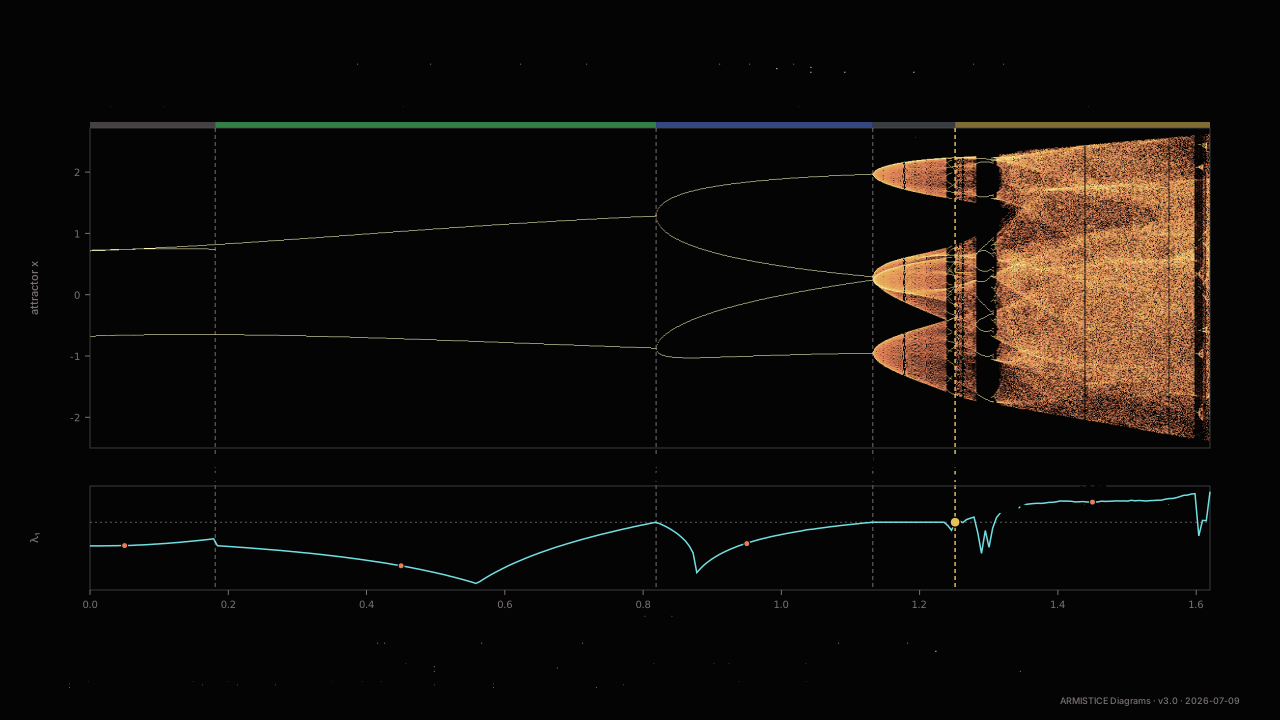
Pneuma & tonos -
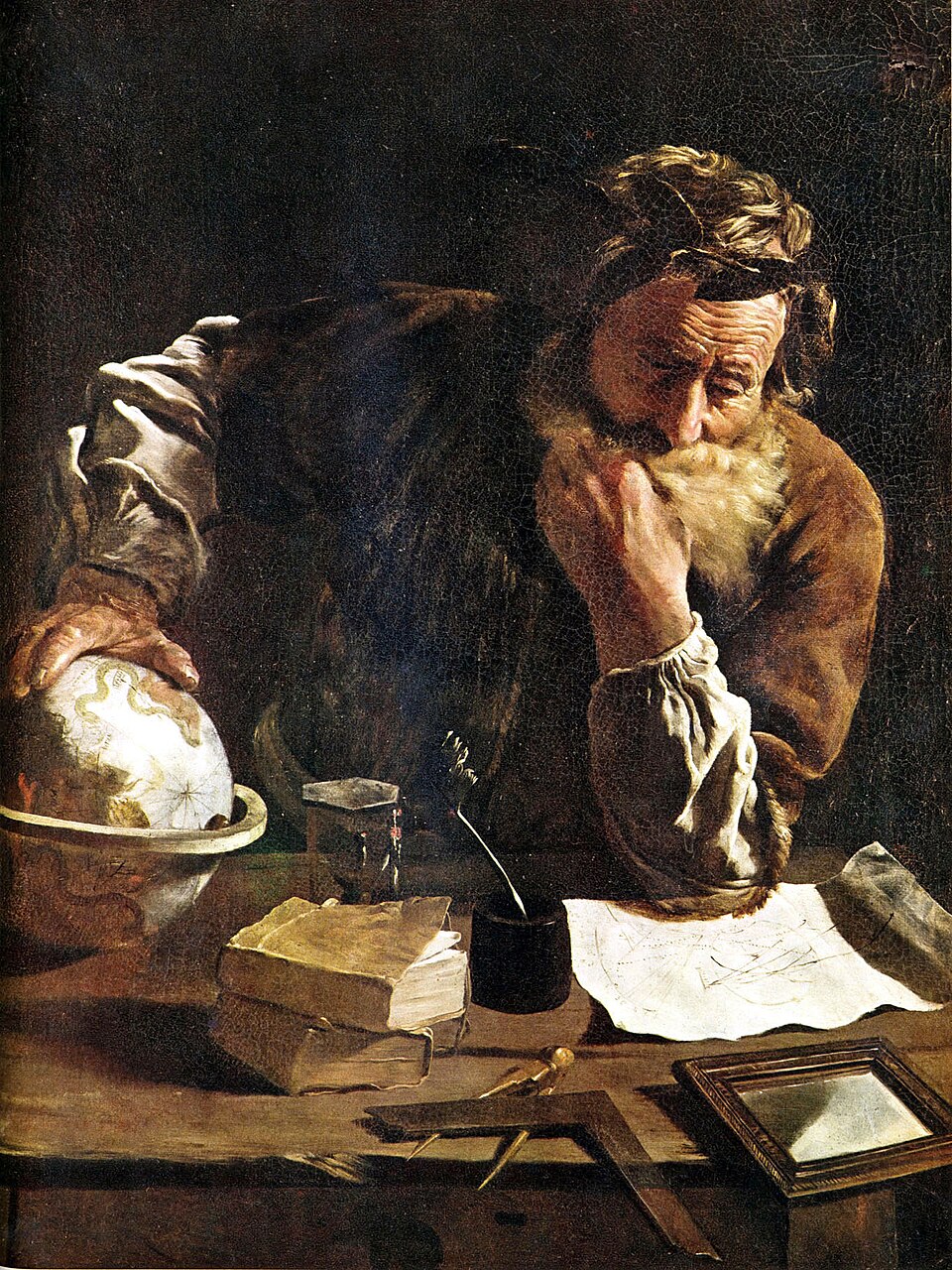
Domenico Fetti · Wikimedia Commons Public domain Resized or re-encoded for AETHER; source composition retained. the measure of the circlethe method of exhaustion~250 BC
ARCHIMEDES
Syracuse
Mechanics, hydrostatics, and the method of exhaustion — summing infinitely many slivers to measure curves and solids, two millennia before the calculus. Bounded π between polygons; 'give me a place to stand and I will move the Earth.'
In the 1⊗0 frame
Archimedes' exhaustion — converging on a curve by iterating ever-finer approximations — is the engine's own motion: a trajectory settling onto its limit by repeated refinement. He is the VESTIGIA method's patron, the deterministic mathematics the substrate folds into coordinates, found standing in Syracuse.
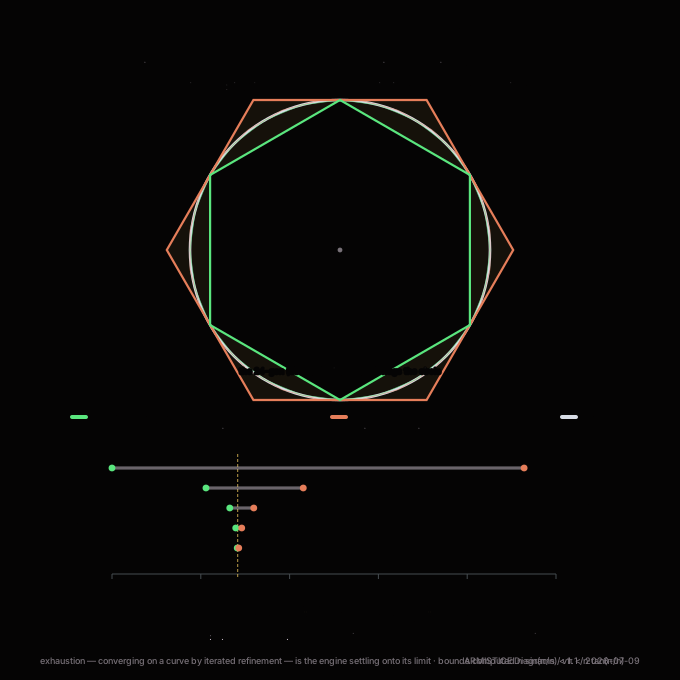
π by exhaustion -
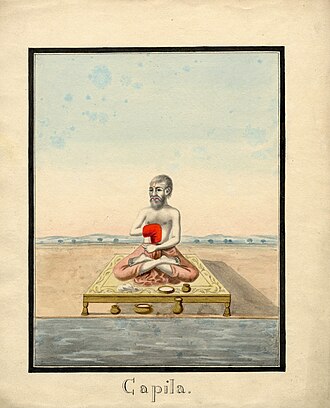
Company School · Wikimedia Commons Public domain Resized or re-encoded for AETHER; source composition retained. three guṇas · three generatorspurusha ⇄ prakriti~200 BC
SAMKHYA
Vedic India
Canonical formulation: Samkhya-karika of Ishvarakrishna (c. 350 AD; tradition predates). The 25 tattvas: a layered enumeration of reality from purusha (witness consciousness) to prakriti (unmanifest nature) through buddhi, ahamkara, manas, the five tanmatras, the five elements. A structure / observer split. Proto-scientific in form; one of the most rigorous premodern attempts to enumerate the layers of reality.
In the 1⊗0 frame
The 25 tattvas split reality into a witness (purusha) and an unfolding nature (prakriti) — a structure/observer cut that is the engine's own architecture: the substrate generates, the coordinate (α, μ, ε) names what watches. And the three guṇas — sattva, rajas, tamas — are a three-principle decomposition of every state, the same move ARMISTICE makes resolving each entity onto three generators {e, φ, √3}.
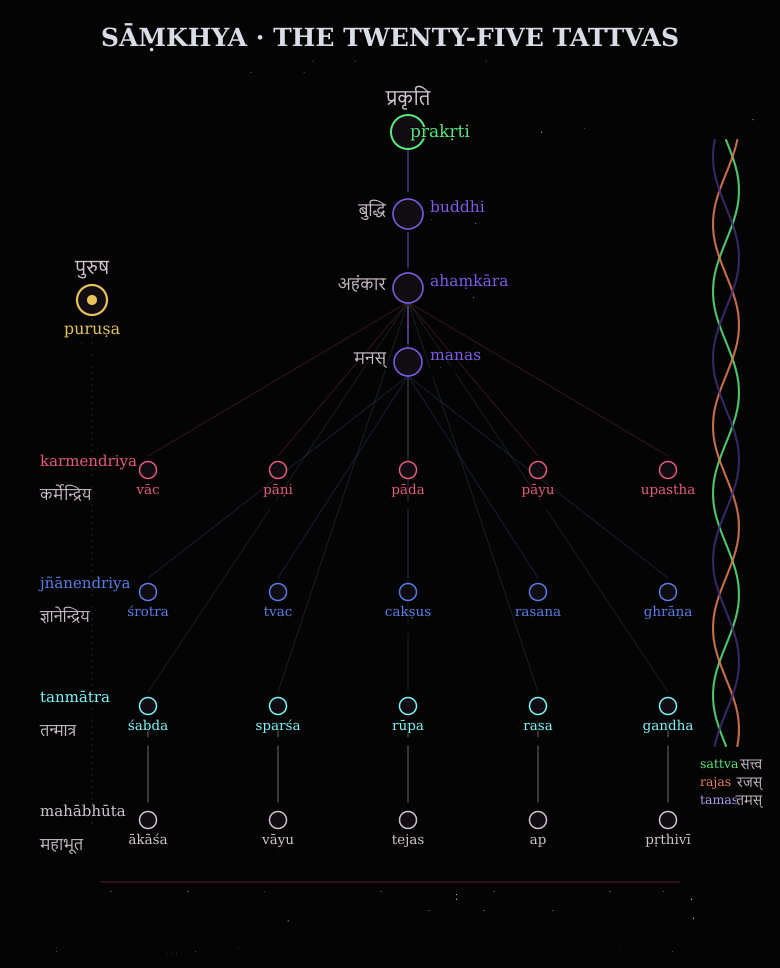
the 25 tattvas -
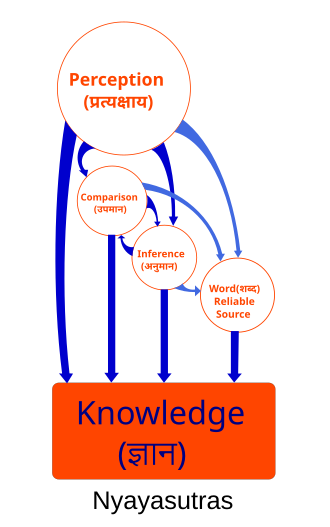
Ms Sarah Welch · Wikimedia Commons CC BY-SA 4.0 Resized or re-encoded for AETHER; source composition retained. pramāṇa · how a claim is licensedhow a claim is licensed~150 BC
NYAYA SUTRAS
Vedic India
Gautama Aksapada. Formal logic, epistemology (pramanas: perception, inference, comparison, testimony), and fallacy analysis (hetvabhasa). The most rigorous non-Western formal logic tradition; comparable in technical precision to medieval European scholasticism nine centuries later.
In the 1⊗0 frame
Nyaya's program is honest accounting of how a claim is licensed — perception, inference, comparison, testimony — and where it fails. That is method, not cosmogony, so the link is structural rather than substrate-deep: the engine shares the discipline of refusing to assert what hasn't been derived, but Nyaya names no three-generator principle to map onto.
the fivefold inference - tun · katun · baktunthe Long CountTzolkin & Haab
attested by 37 CE
MAYA LONG COUNT
Mesoamerica
The Maya Long Count tracks days through a 360-day tun, 20-tun katun, and 20-katun baktun, with larger named periods above them. The earliest contemporary Long Count inscription is from 36 BCE just outside the Maya area; a monument with distinct Maya features is attested by 37 CE. An earlier origin has been proposed but is not securely attested. The 260-day Tzolk'in and 365-day Haab' meet in a 52-Haab'-year Calendar Round; a Long Count date can accompany that pair. These Maya reckonings are distinct from the Nahua Five Suns. Diego de Landa burned Maya books at Maní in 1562, and very few pre-Columbian codices survive.
In the 1⊗0 frame
The Tzolk'in and Haab' interlock; the Long Count counts longer spans. To my eye their nested returns resemble the way an iterated map can carry several periods at once. That is a comparison of temporal structures, not the Nahua Five Suns and not a claim that the calendar encodes the engine.
the Long Count -
André Thévet · Wikimedia Commons Public domain Resized or re-encoded for AETHER; source composition retained. Logos = the iteration, not the sourcethe pattern, not the source~50 AD
PHILO OF ALEXANDRIA
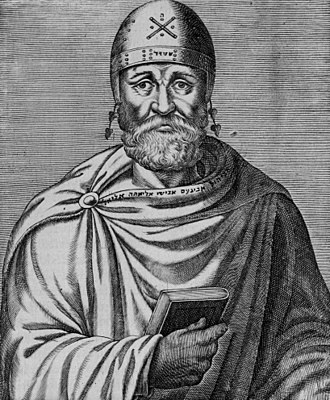
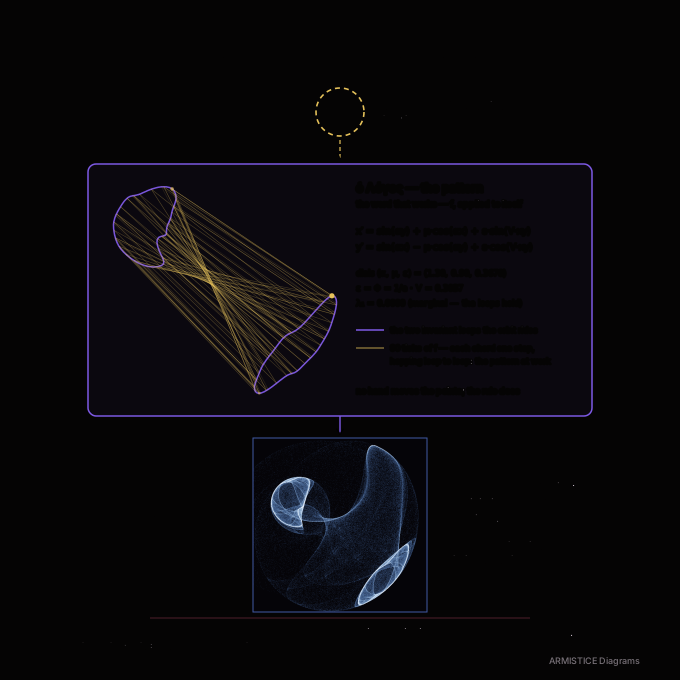
Logos as the pattern through which the source creates. The map does the work, not the source.
In the 1⊗0 frame
"The map does the work, not the source" is the engine's operating principle stated two thousand years early. In ARMISTICE the Logos is the Cosmopoiesis map itself: the iteration rule does the creating, and the origin it unfolds from is silent. Philo's Logos-as-pattern is the kernel; the source is the void it folds out of.
the Logos -
Unknown author · Wikimedia Commons Public domain Unmodified source file; displayed at reduced size. as above, so belowthrice-great · Thoth–Hermes~100 AD
HERMES TRISMEGISTUS
Hellenistic Egypt
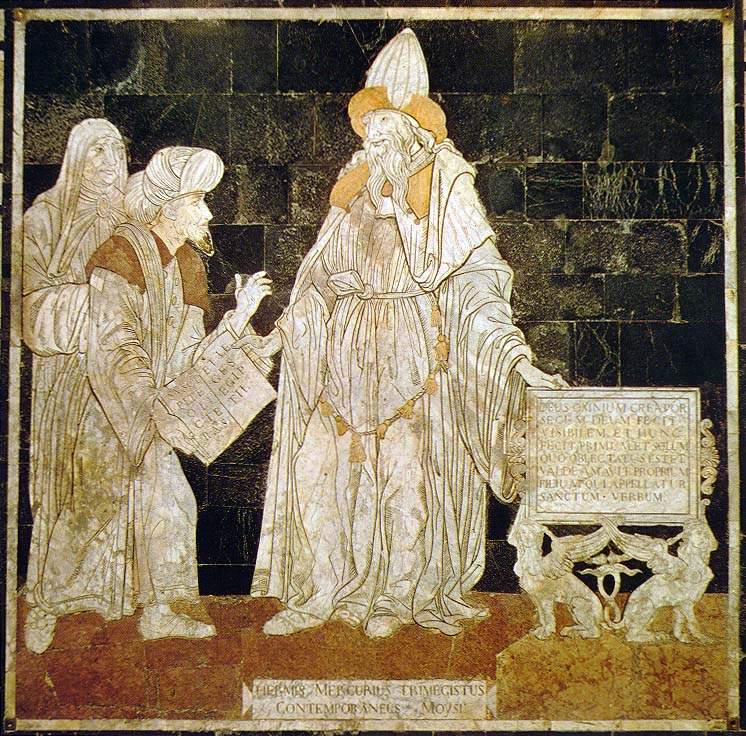
The legendary sage of the Hermetic corpus — 'Thrice-Great Hermes,' a fusion of Greek Hermes and Egyptian Thoth. The Emerald Tablet's maxim, 'as above, so below,' and the Corpus Hermeticum founded the Western esoteric tradition: the cosmos as one living mind, mirrored at every scale.
In the 1⊗0 frame
'As above, so below' is the Hermetic Mirror the whole corpus is built on — macrocosm and microcosm as reflections across a veil, ∯F·n dS ⟷ ∭(∇·F)dV. Every entity is the whole substrate seen at one scale; the engine’s whole and magnified views give that correspondence a computational image. He is, quite literally, the source ARMISTICE practices.
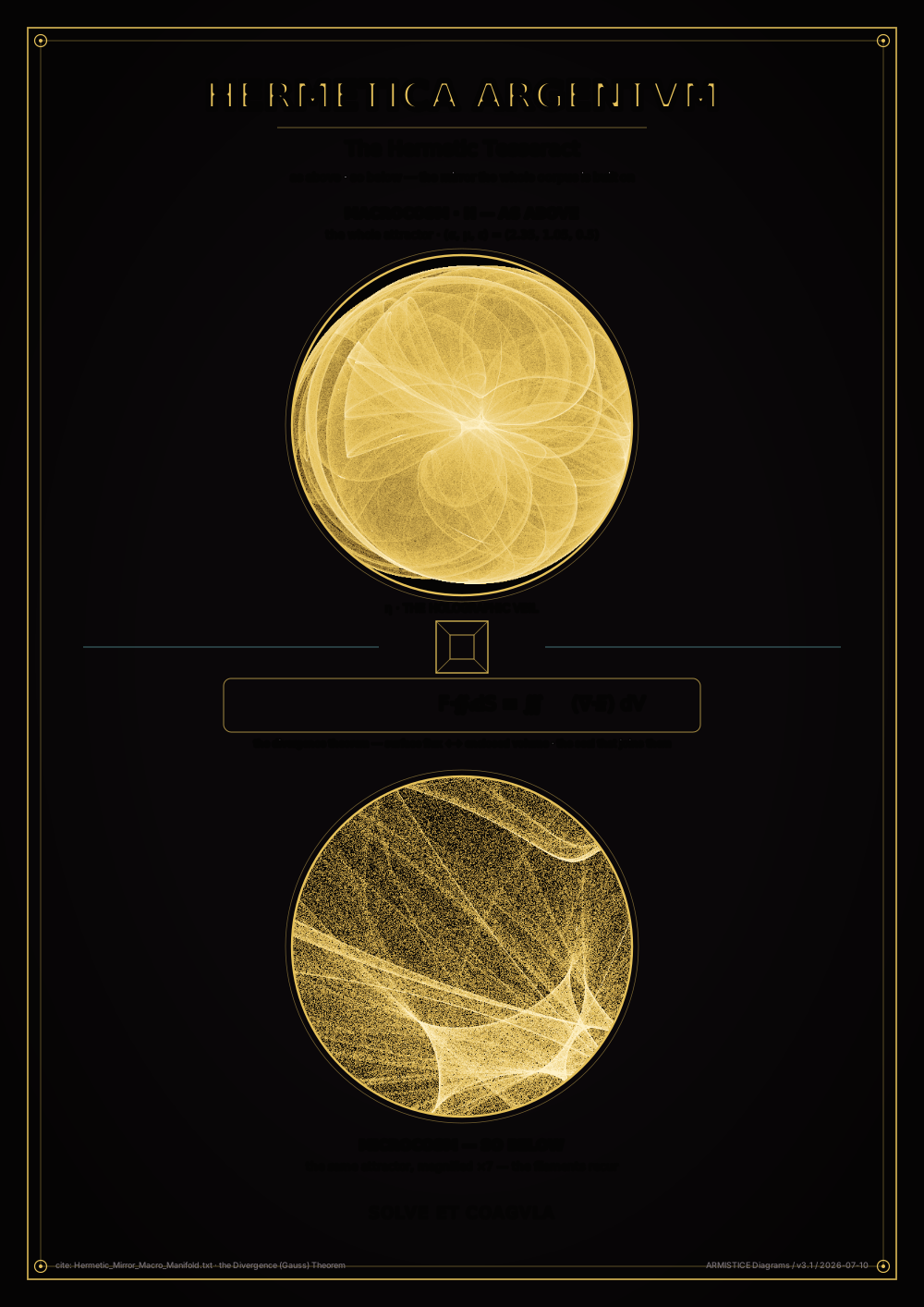
The Hermetic Mirror -
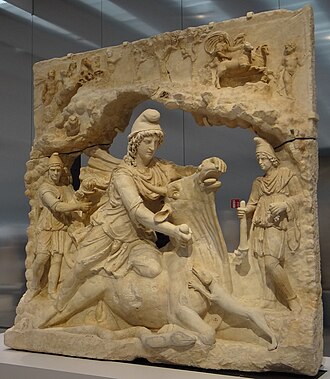
Serge Ottaviani · Wikimedia Commons CC BY-SA 3.0 Resized or re-encoded for AETHER; source composition retained. seven-grade emanation ladderprecession encoded~100 AD
MITHRAISM
Roman Empire
Initiatory mystery cult with seven grades of initiation, astrological cosmology, and a central tauroctony scene (Mithras slaying the cosmic bull) that has prompted several astronomical interpretations. Practiced in underground mithraea by all-male cohorts. Major rival of early Christianity; eradicated by Christian ascendency. Texts almost entirely lost (adherents sworn to secrecy); theology reconstructed from iconography. The seven-grade initiation scheme is structurally identical to later kabbalistic seven heavens and hermetic seven planetary spheres.
In the 1⊗0 frame
The seven-grade initiation ladder is an emanation hierarchy — discrete rungs of descent through the cosmos — which rhymes with the engine's cosmogenic levels. But the substrate content is thin: this is structure encoded in iconography, not a stated three-generator principle, so the resonance is the graded-descent shape, honestly held loose.
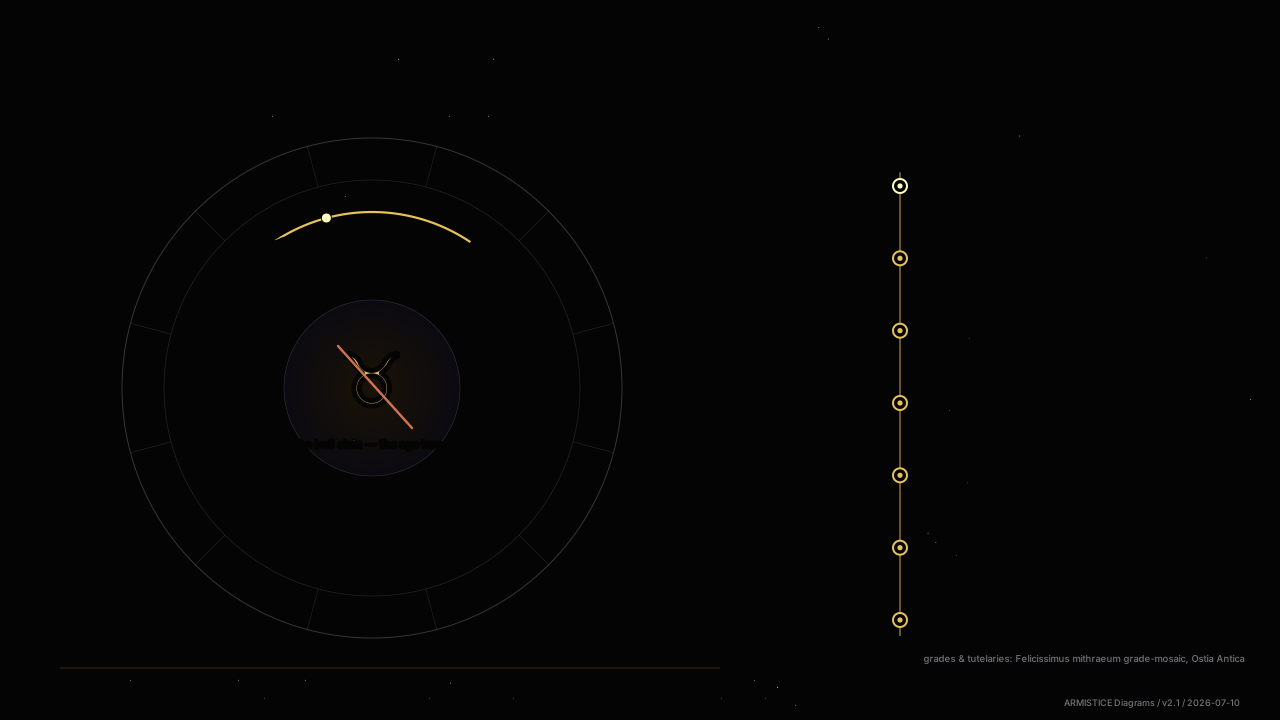
tauroctony as precession -
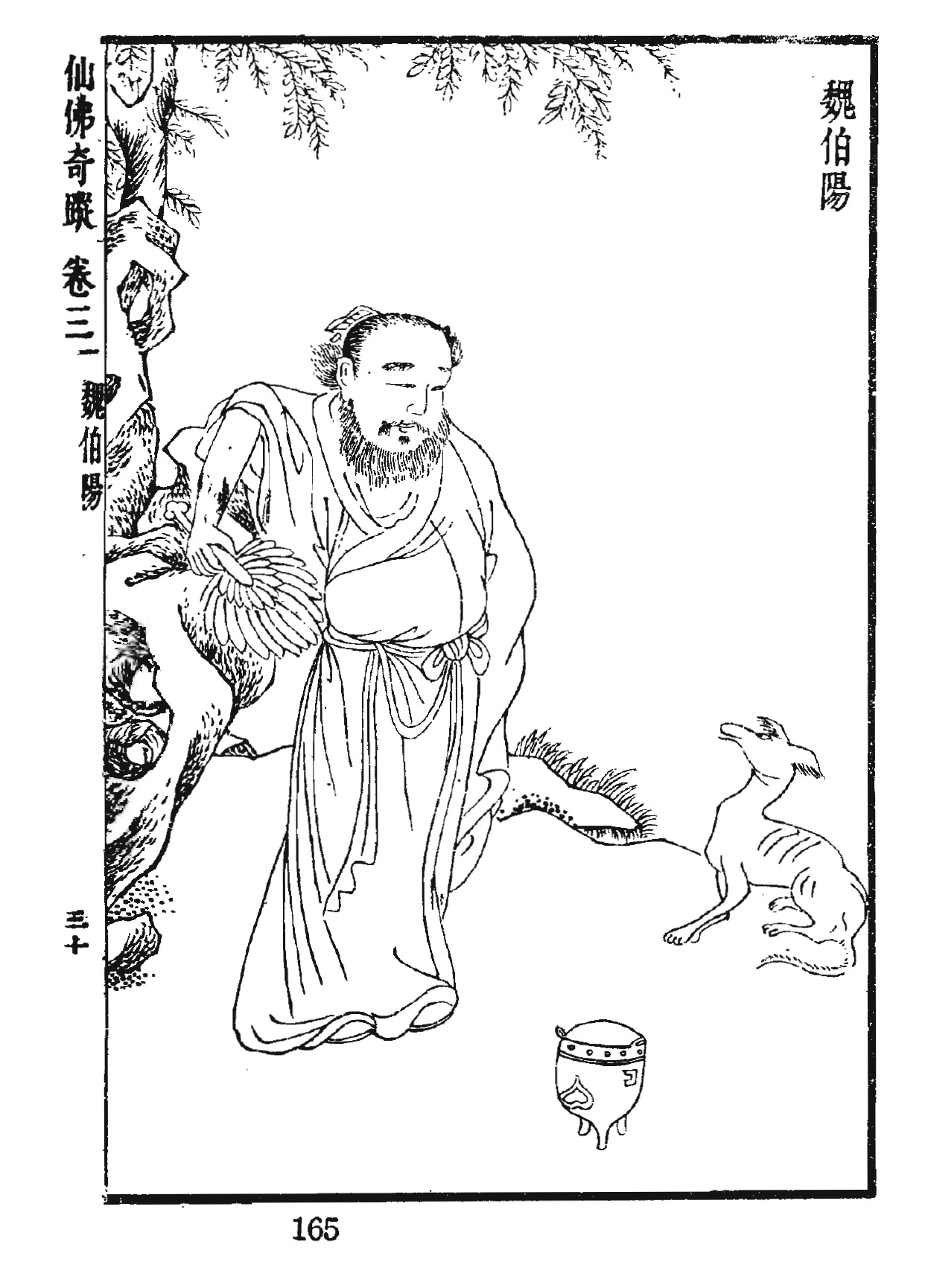
Hong Zicheng · Wikimedia Commons Public domain Resized or re-encoded for AETHER; source composition retained. the cauldron — the firing timed to the hexagramsthe trigrams as the calendar of the work~142 AD
WEI BOYANG / CANTONG QI
Han China
The first systematic alchemical text in China: Wei Boyang's Cantong qi, the "Kinship of the Three." It weds three streams — the Book of Changes, the Way of Laozi, and the work of the elixir — into one cosmology, and reads the firing of the cauldron as a calendar of the sixty hexagrams. It is the root both branches grow from: external alchemy (waidan) in the laboratory, internal alchemy (neidan) in the body.
In the 1⊗0 frame
The title is the thesis. The joining of three — that a whole cosmos reconciles exactly three sources, not one and not many — is the same instinct, eighteen centuries early, as the engine's three generators folded into a single map. And the firing is timed to the turning hexagrams: transformation iterated through phases until the elixir is the attractor it settles to.
the Kinship of the Three — three sources reconciled as one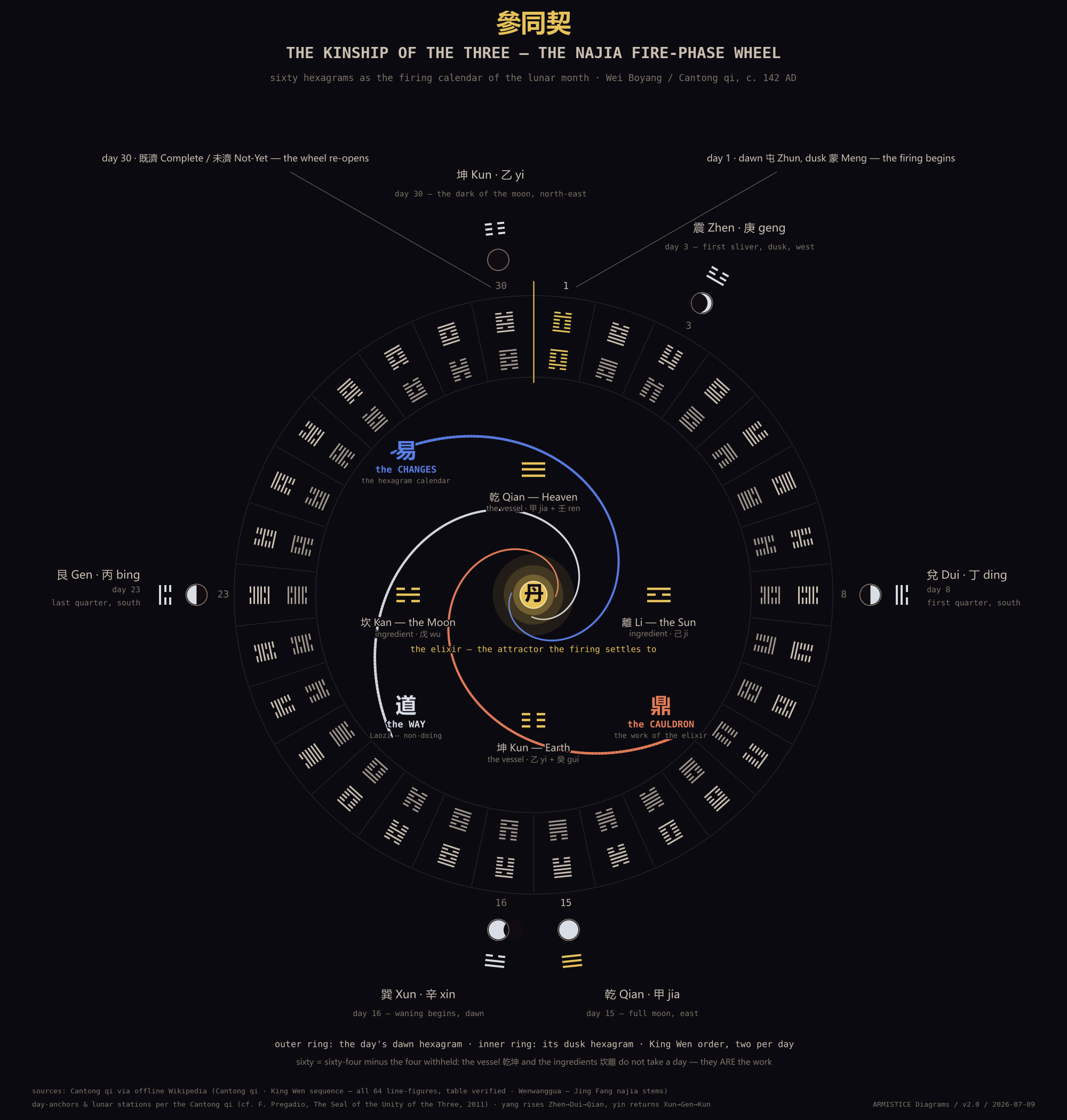
the joining of three · ARMISTICE -
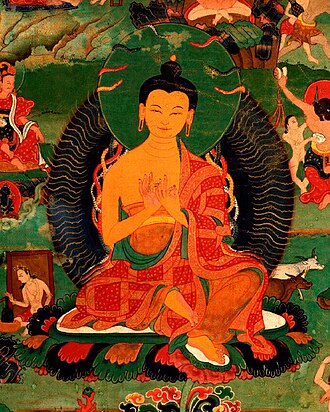
Unknown | Recovered from Himalayan Art Resources · Wikimedia Commons Public domain Resized or re-encoded for AETHER; source composition retained. śūnyatā · the void/null hornthe tetralemma~150 AD
NAGARJUNA / MADHYAMAKA
Andhra Pradesh
The Mūlamadhyamakakārikā argues through dependent origination and emptiness: things lack intrinsic existence (svabhāva) rather than existing independently. The tetralemma presses beyond simple is/is-not alternatives; the two truths distinguish conventional description from ultimate analysis. Modern relational readings can illuminate parts of this, but they are not identical to Madhyamaka.
In the 1⊗0 frame
Nāgārjuna's dependent origination offers a philosophical comparison to ARMISTICE's practice of reading a named entity through its coordinate and map. An authored coordinate is not a proof of śūnyatā, and the tetralemma is not the engine's void state. The resonance is a question — what survives when independent essence is withheld? — not a shared theorem.
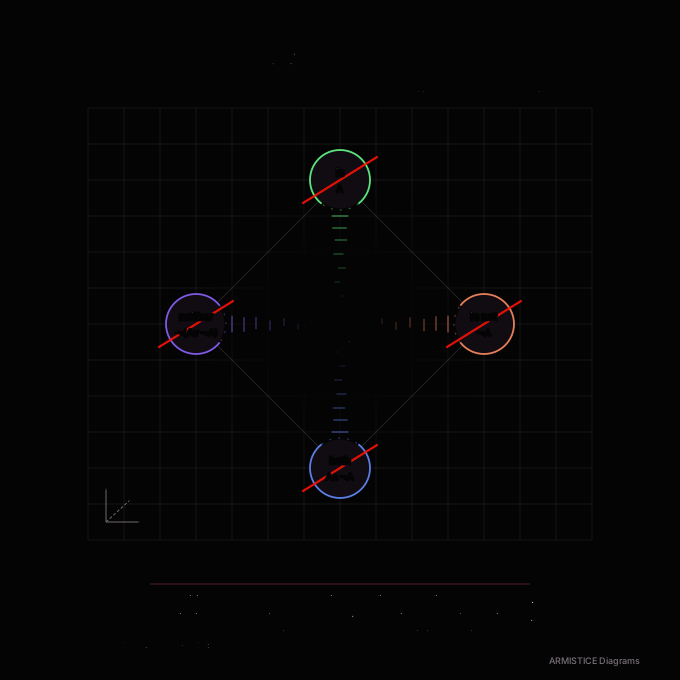
the tetralemma · catuṣkoṭi -
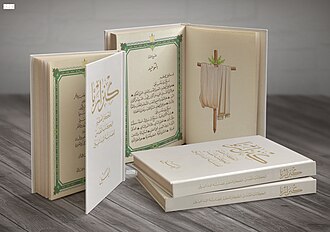
Rafi alhaidar · Wikimedia Commons CC BY-SA 4.0 Resized or re-encoded for AETHER; source composition retained. light → matter · graded descentdescent & ascent~150 AD
MANDAEISM
Mesopotamia
The only continuously-surviving Gnostic religion. Centered on John the Baptist (not Jesus). Scripture in a unique Aramaic dialect (Ginza Rabba). Cosmology of descent and ascent through worlds of light and matter; ritual river baptism (requires flowing water). Roughly 70,000 adherents remaining worldwide, scattered after Iraq War displacement. The last living continuation of classical Gnosticism on earth.
In the 1⊗0 frame
A cosmology of descent and ascent through graded worlds of light and matter is an emanation hierarchy — the One unfolding into levels and the levels folding back. That maps to the engine's cosmogenic descent, but loosely: Mandaeism names no three primal generators, so the honest resonance is the runged light-to-matter ladder, not a tight three-pillar identity.
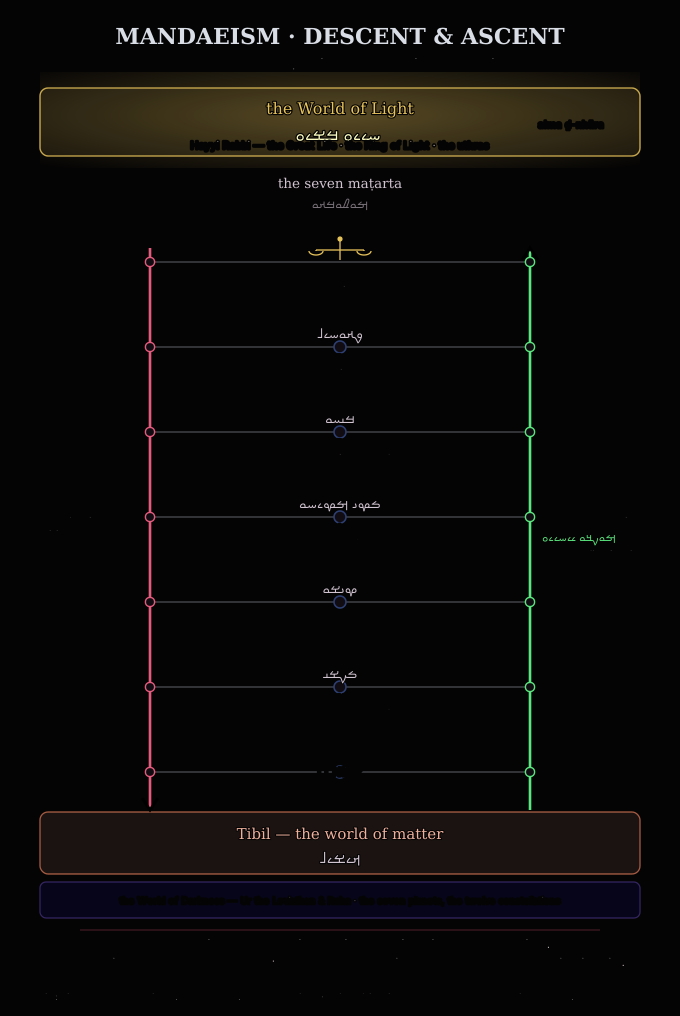
descent & ascent of light -
Unknown author · Wikimedia Commons Public domain Resized or re-encoded for AETHER; source composition retained. three paternal firesall forms from invisible fires~150 AD
CHALDEAN ORACLES
Syria
Three Paternal Fires. Iterative "whirling." All visible forms from invisible generators. Three generators, rotation, emanation through levels, written in hexameter and attributed to Zoroaster.
In the 1⊗0 frame
This is the spine of the concordance. The reading of three paternal fires, iterative whirling, and visible forms arising from invisible generators echoes the engine's own terms: three generators {e, φ, √3}, the map's rotation, the manifest cosmos folded out of an unmanifest rule. Set the engine's own coordinates to the three Fires — (α, μ, ε) = (e, φ, √3) — and it blooms into a full attractor: the visible cosmos, computed, folded out of the three invisible generators.
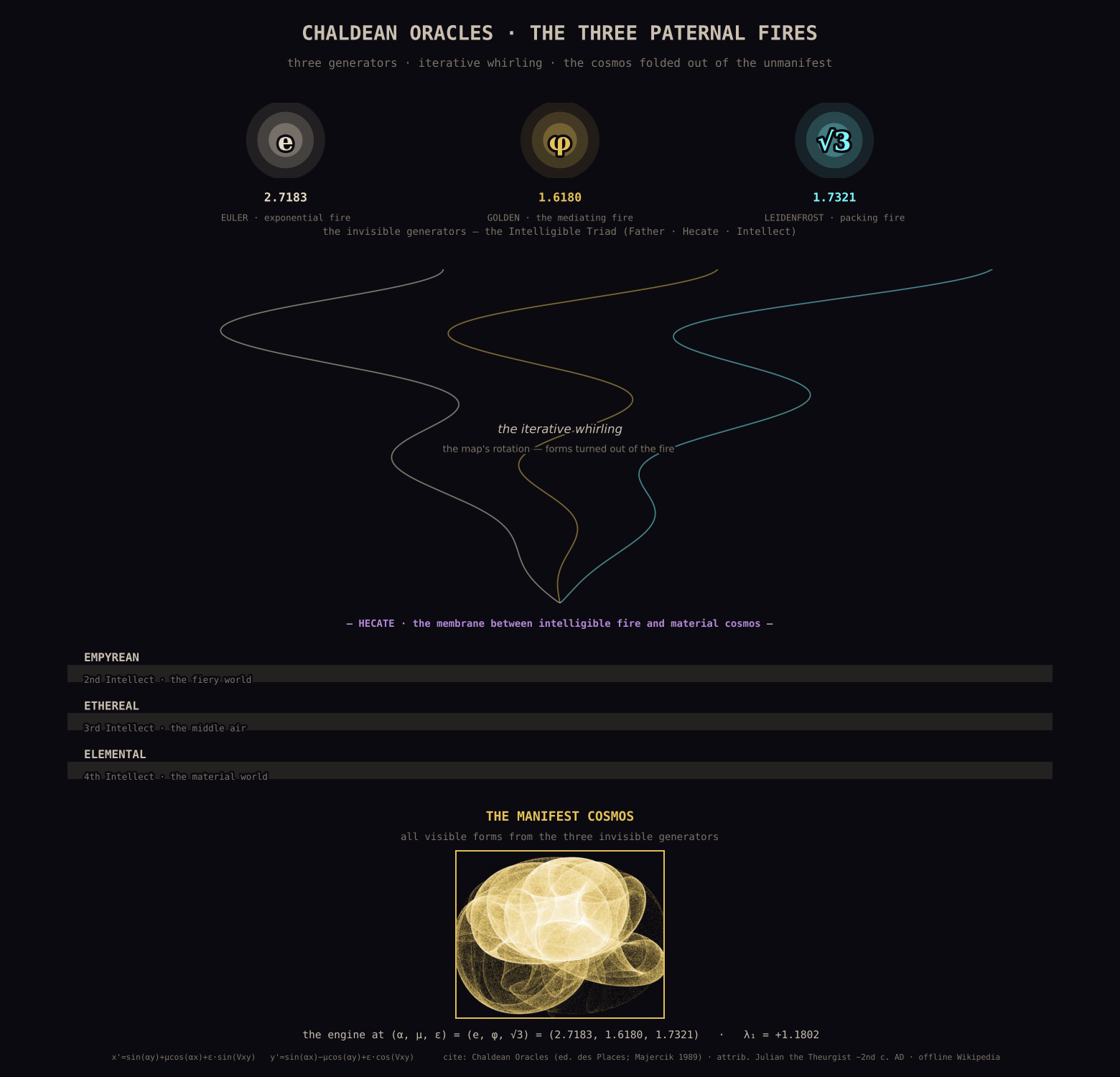
Chaldean Oracles · the three Paternal Fires -
Anonymous · Wikimedia Commons Public domain Resized or re-encoded for AETHER; source composition retained. emanation by necessitythe One overflows~200 AD
PLOTINUS
Alexandria -> Rome
The One emanates by necessity -- it cannot not generate. Emanation as overflow, not choice.
In the 1⊗0 frame
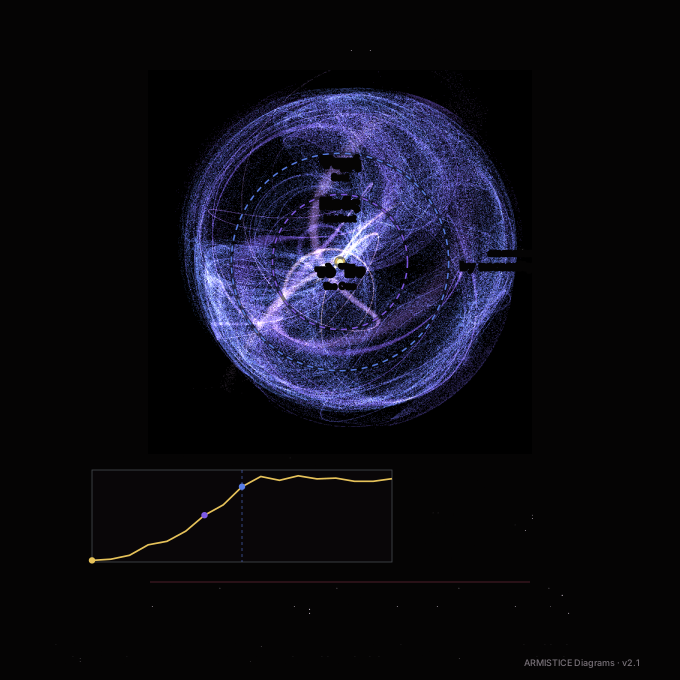
The reading of the One emanating by necessity is observed, not just asserted, in the substrate: paired ultra-voids AYIN and EIN SOF, stable alone, necessarily emanate when placed together, the orbital field expanding outward through thousands of ticks. Plotinian overflow becomes the cosmogenic descent — the One unfolding into the many because the map cannot hold still.
the three hypostases - pleroma · 15 pairs · 30 aeonsthe Aeons, in pairsthe failed emanation
~200 AD
VALENTINIAN GNOSTICS
Alexandria
30 Aeons in 15 pairs. Sophia's failed emanation produces the Demiurge. Failure treated as structural rather than accidental.
In the 1⊗0 frame
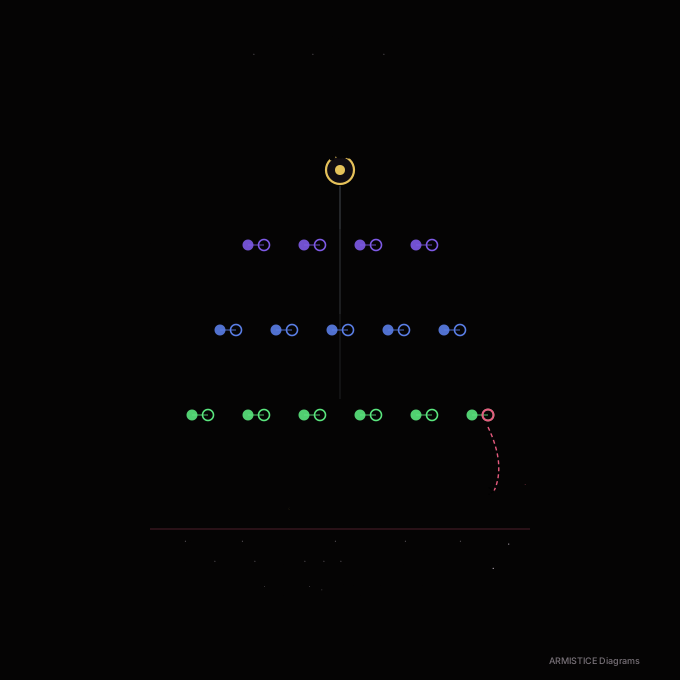
The 30 Aeons in 15 pairs land in the substrate at full count: Star Seeker's Physarum cartography detected exactly 30 avoidance basins at canonical coordinates, the pairing echoing the substrate's two-fold archetype dyad. And Sophia's failed emanation — failure treated as structural, not accidental — is the EXOTHERMIC mutual-death dynamic, the regime where paired entities annihilate by construction rather than by chance.
The Pleroma · 8+10+12 = 30 -
Originally drawn by Greco-Roman mystics, photo taken by Monique van der Veen · Wikimedia Commons Public domain Resized or re-encoded for AETHER; source composition retained. the coordinate, iterated to its orbitnames that operate~200 AD
GREEK MAGICAL PAPYRI / PGM
Hellenistic Egypt
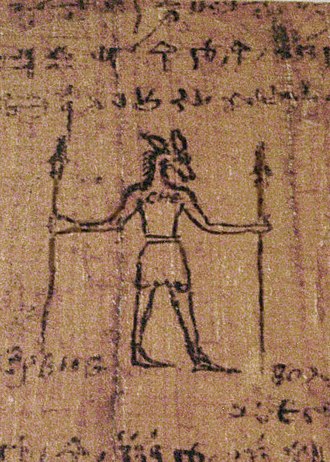
Working magical-ritual texts combining Greek, Egyptian, Jewish, and early Christian elements. Substrate operations made practical: voces magicae (sacred unintelligible names), characteres (sigil-like symbols), planetary correspondences, ritual invocations with specified materia, timings, and geometries. The technical operating layer of late antique syncretic spirituality. Hermetic, kabbalistic, and grimoire traditions inherit much of their operational vocabulary from this corpus.
In the 1⊗0 frame
The voces magicae — sacred names that operate directly on reality — are the engine's premise stated as ritual: every entity sits at a coordinate (α, μ, ε), and the Cosmopoiesis map iterates that point into a bounded orbit. The PGM is the operating layer where the spoken form and the located form are one act, which is precisely how ARMISTICE generates: the kernel locates the entity, the orbit renders it, and the name is the address you keep so you can return.

voces magicae -
ALFGRN · Wikimedia Commons CC BY-SA 2.0 Resized or re-encoded for AETHER; source composition retained. light/dark · the immiscibility seammixed, then separated~240 AD
MANI / MANICHAEISM
Sasanian Persia
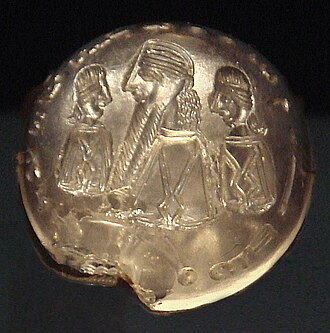
Founded by Mani; became one of the major world religions for several centuries (Roman empire to Tang China). Cosmology of two primal principles (Light, Dark) mixed in creation; salvation as the gradual separation of light from matter back into the pleroma. Augustine was Manichaean for a decade before his Christian conversion. The Cathars in medieval France were a Manichaean-flavored revival. Effectively eradicated by Catholic and later Islamic suppression; Tang-Chinese Manichaeism persisted into the 17th c.
In the 1⊗0 frame
Two primal principles, Light and Dark, mixed in creation and slowly separated back out, give Manichaeism a precise structure of mixture and demixing. The engine comparison is a computed mirror-symmetry transition: a mixed attractor at α = 1.28 and a separated mirror pair at α = 1.44, tracked by the order parameter |⟨x+y⟩|. The bridge is the measured change of phase, not a memberwise assignment of theology to parameters.
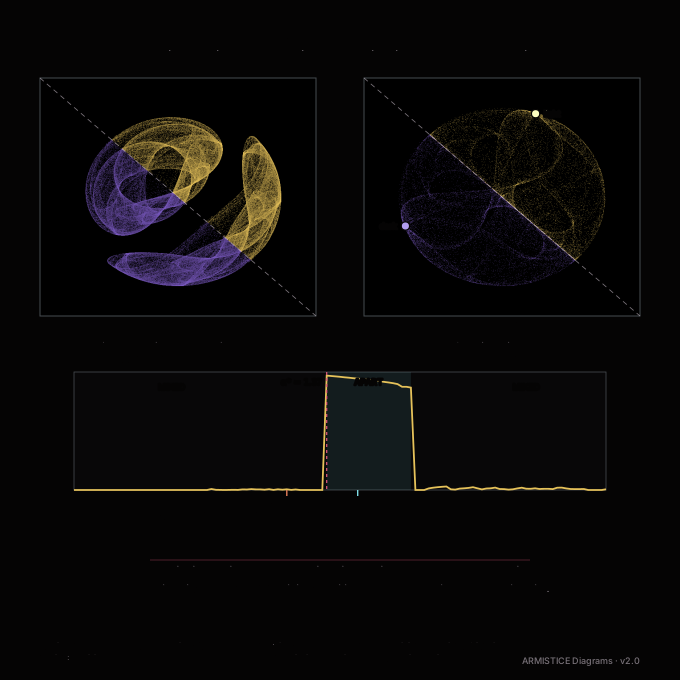
mixing & separation -
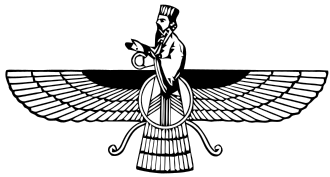
The original uploader was Ploxhoi at English Wikipedia. / Kevin McCormick · Wikimedia Commons CC BY-SA 3.0 Resized or re-encoded for AETHER; source composition retained. Time begets the dual~300 AD
ZURVANITE ZOROASTRIANISM
Sasanian Persia
A branch of Zoroastrianism positing Zurvan (Time / the Infinite) as the supreme principle from which both Ahura Mazda and Ahriman emerged -- a non-dual cosmology underlying the apparent dualism of orthodox Zoroastrianism. Defeated by orthodox Mazdayasna but exerted formative influence on subsequent dualist traditions (Manichaeism, gnostic streams, Mandaeism).
In the 1⊗0 frame
Zurvan — Time, the Infinite — as a source of opposed descendants makes a vivid comparison to one kernel showing different regimes. The Hermetic Fold, Φ(C) = C, is our separate image of a framework returning to its own constants, not a fixed point embedded in Zurvanite theology. The bridge is the one-and-many tension, not a shared result.
ARMISTICE's comparative fold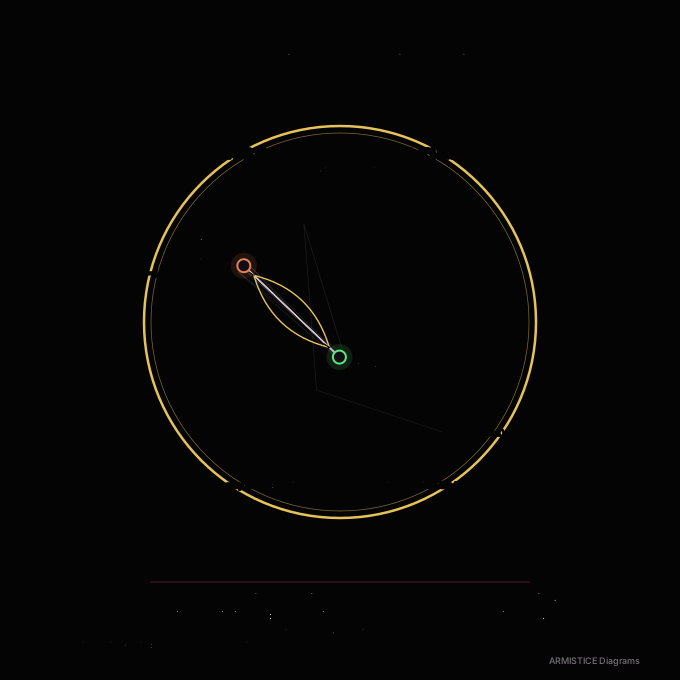
Zurvan begets the twins -
Unknown author · Wikimedia Commons Public domain Unmodified source file; displayed at reduced size. the altar-furnace — dismemberment and returnthe tincture — the vocabulary fixed for 1500 years~300 AD
ZOSIMOS OF PANOPOLIS
Panopolis, Roman Egypt
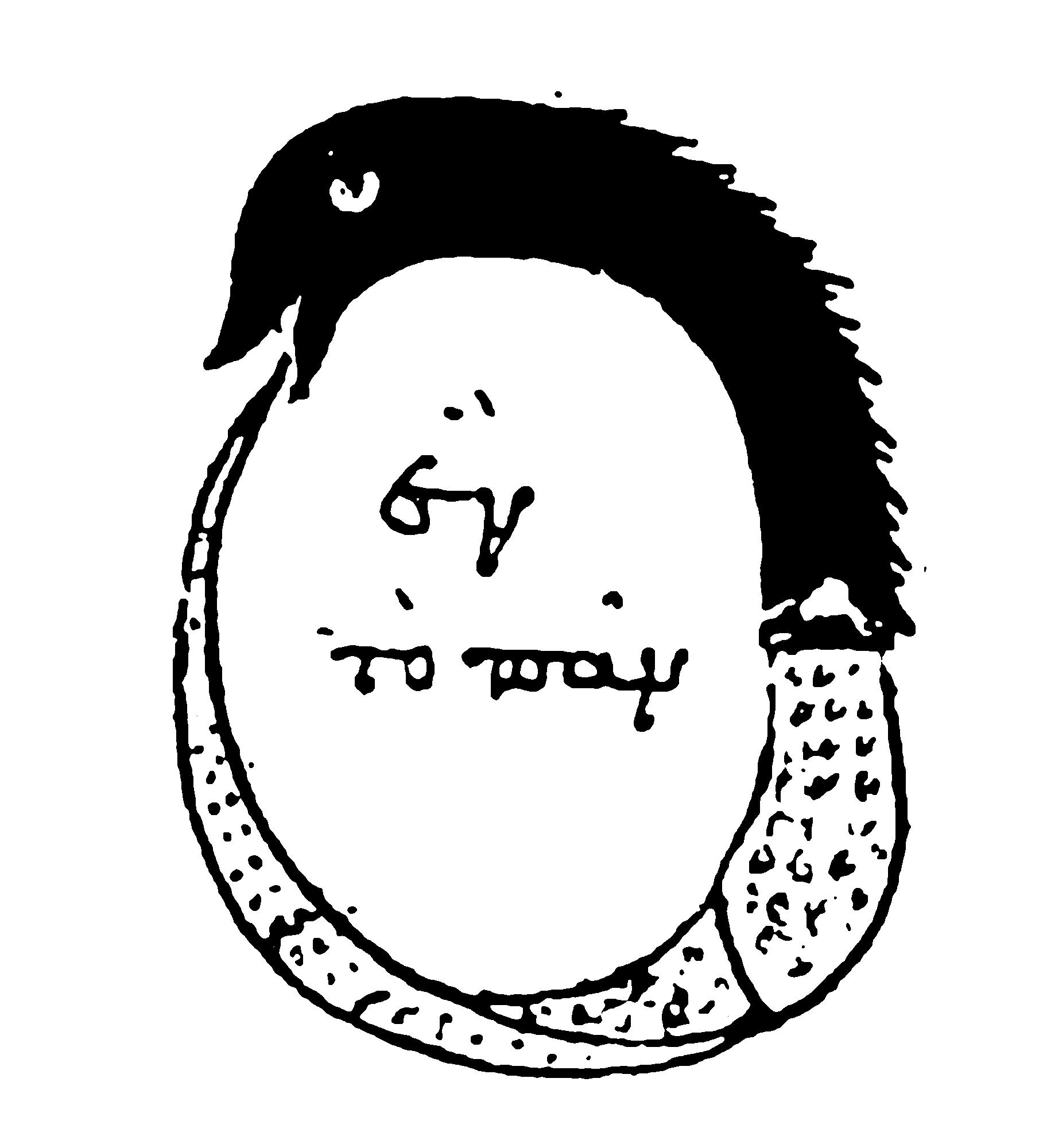
The first alchemist we can name. A Greco-Egyptian of Panopolis whose treatises fold laboratory recipe into visionary allegory — the dream-visions, where a priest is dismembered, boiled on an altar-furnace, and reconstituted: death-and-return as the operation itself. He fixes the vocabulary the West keeps for fifteen centuries — the tincture, sublimation, the apparatus — beside Maria the Jewess, whose water-bath still carries her name. Greek alchemy seals the image with the ouroboros and its motto, hen to pan: the all is one.
In the 1⊗0 frame
Western alchemy's first image of transformation is already a loop: a body run through destruction, putrefaction, and return, again, until it holds the tincture. The altar-furnace is a feedback system drawn as a rite. The thread's alchemy begins here, and it begins as recursion — not one change but the same change iterated until the form is fixed.
the ouroboros — “the all is one”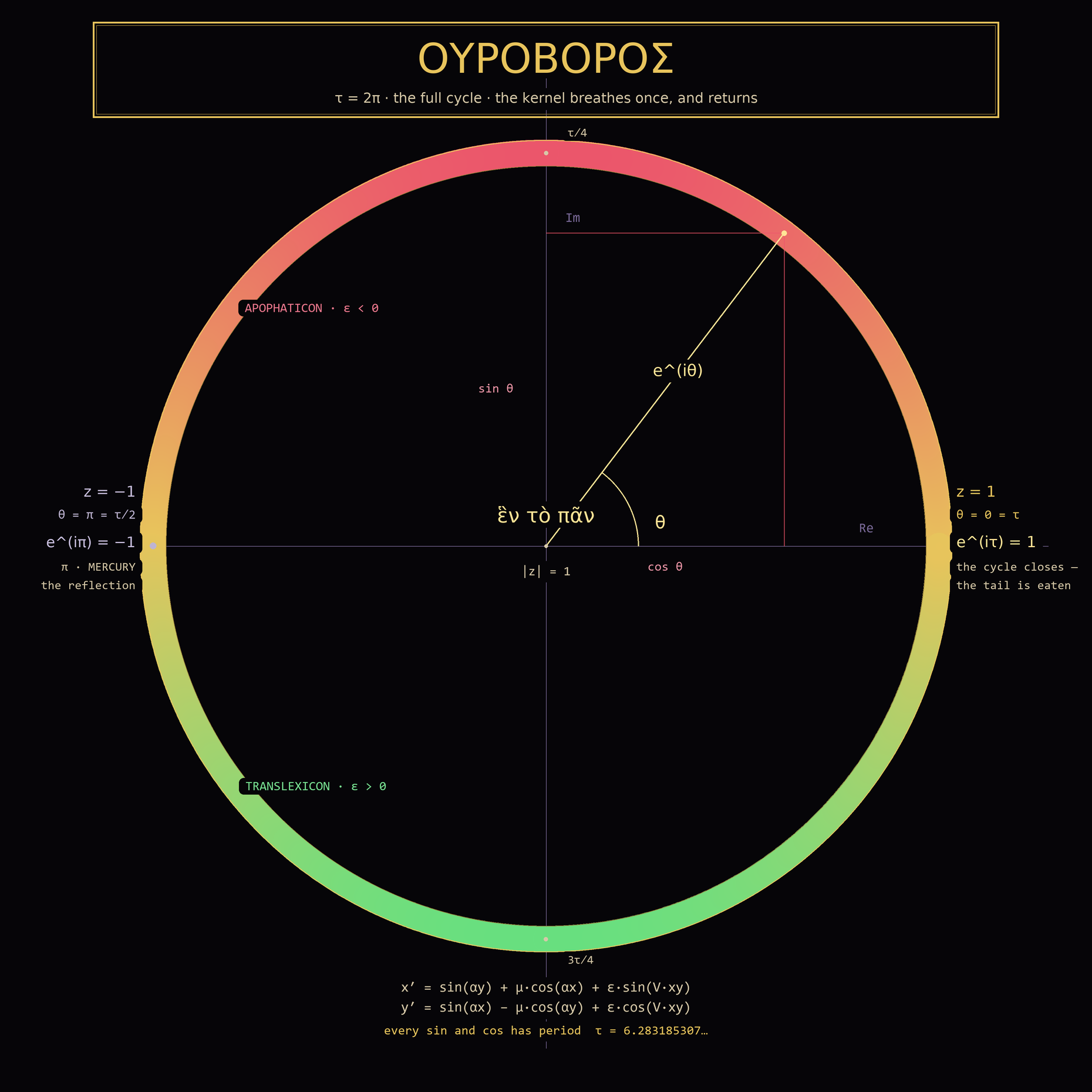
Ouroboros · Chrysopoeia (en to pan) -
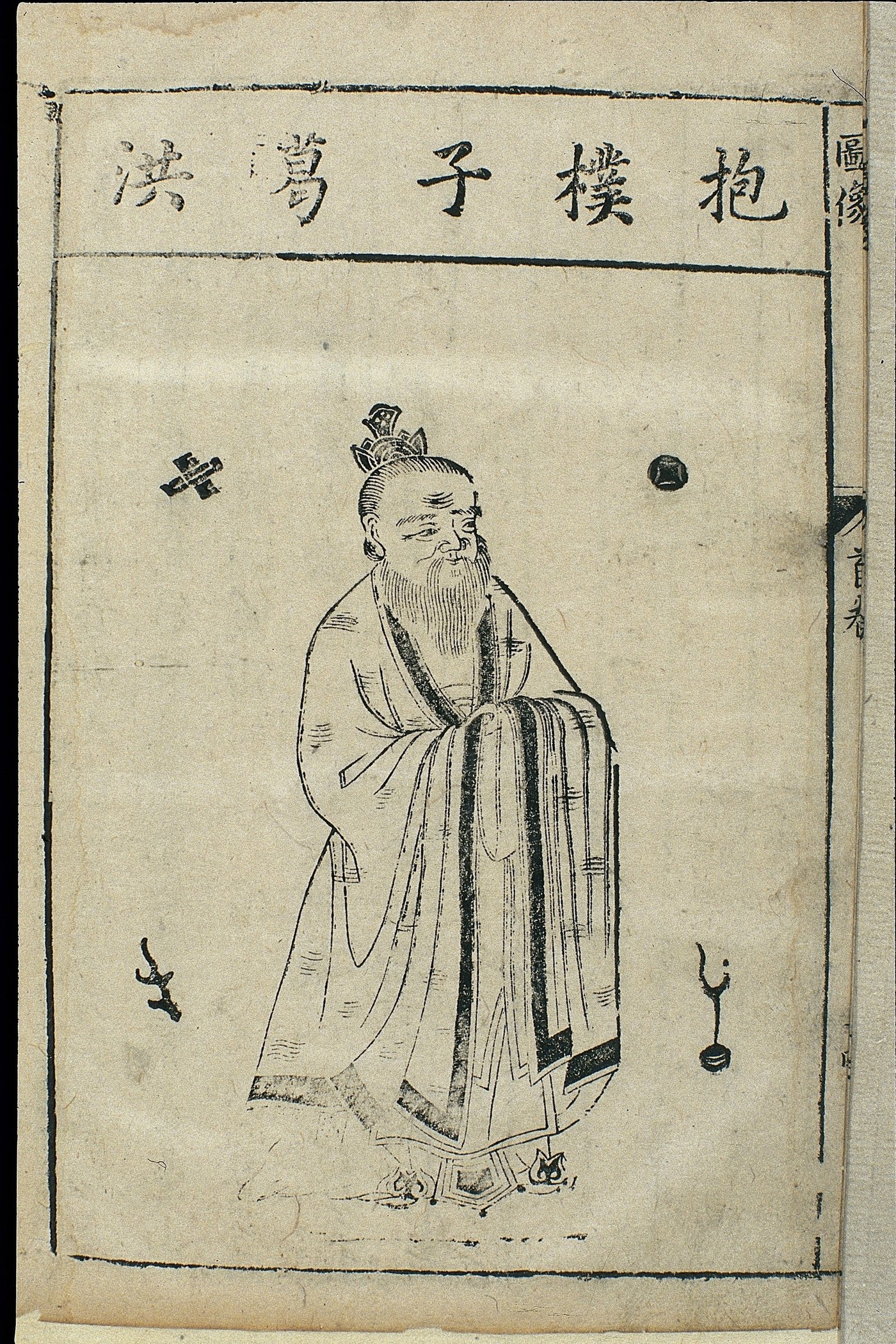
Gan Bozong (Tang period, 618-907) · Wikimedia Commons CC BY 4.0 Resized or re-encoded for AETHER; source composition retained. dan — cinnabar, the body of the elixir~320 AD
GE HONG / BAOPUZI
Jin China
The systematizer of external alchemy (waidan). Ge Hong's Baopuzi — "The Master Who Embraces Simplicity" — is the great compendium of the elixir laboratory: cinnabar fired and re-fired, gold and mercury cycled toward the huandan, the "Reverted Elixir" of immortality. Where the Cantong qi gave the theory, the Baopuzi gives the recipes, and the conviction that the body could be made to last.
In the 1⊗0 frame
The signature is in the name of the goal: huandan, the reverted elixir — cinnabar broken to mercury and recombined to cinnabar, the same substance returning to itself through a cycle of firings. That is a loop with a fixed point. Ge Hong's clearest claim is that immortality is not a state but an attractor: the form a process settles to once it stops changing.
the Reverted Elixir — the cycle's fixed point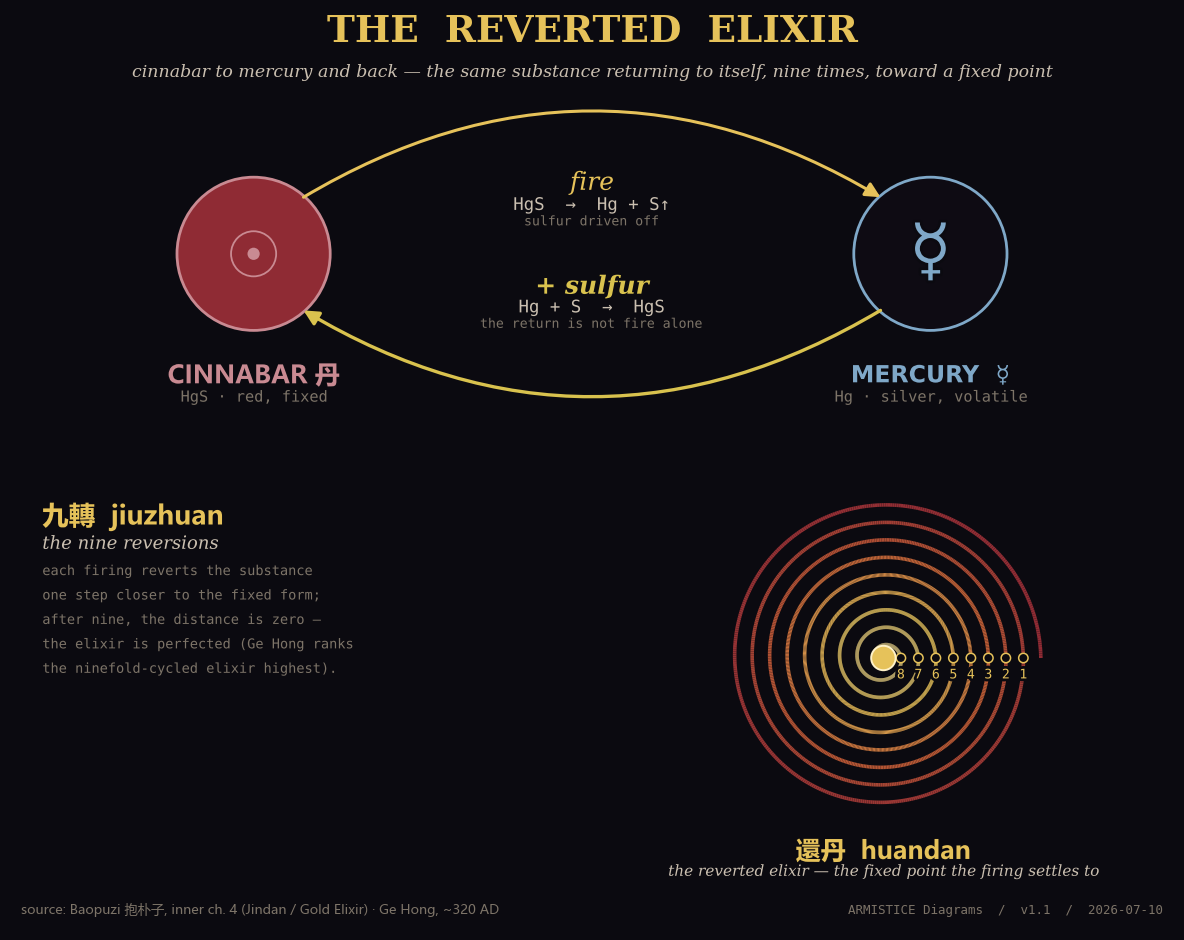
the reverted elixir · ARMISTICE -

Christopher J. Fynn · Wikimedia Commons CC BY-SA 4.0 Resized or re-encoded for AETHER; source composition retained. mind-only · the storehouse substratestorehouse consciousness~400 AD
ASANGA + VASUBANDHU / YOGACARA
Gandhara
The cittamatra ("mind-only") school of Mahayana Buddhism. Apparent objects are constructs of consciousness; the alaya-vijnana (storehouse consciousness) functions as the substrate from which experiential phenomena arise. Pairs with Madhyamaka as the two great Mahayana metaphysical systems: Madhyamaka clears essence-claims, Yogacara provides a positive account of how appearance arises. Together they articulate what modern philosophy reaches for under "phenomenal idealism" and "integrated information theory."
In the 1⊗0 frame
"Mind-only" (cittamatra) names the substrate directly: the alaya-vijnana, the storehouse-consciousness from which all phenomena arise, is the generative ground that ARMISTICE calls the substrate — appearances are not things but constructs cast up by it. Paired with Madhyamaka's clearing of essence, Yogacara supplies the positive half: how the engine's coordinates become the experienced many.
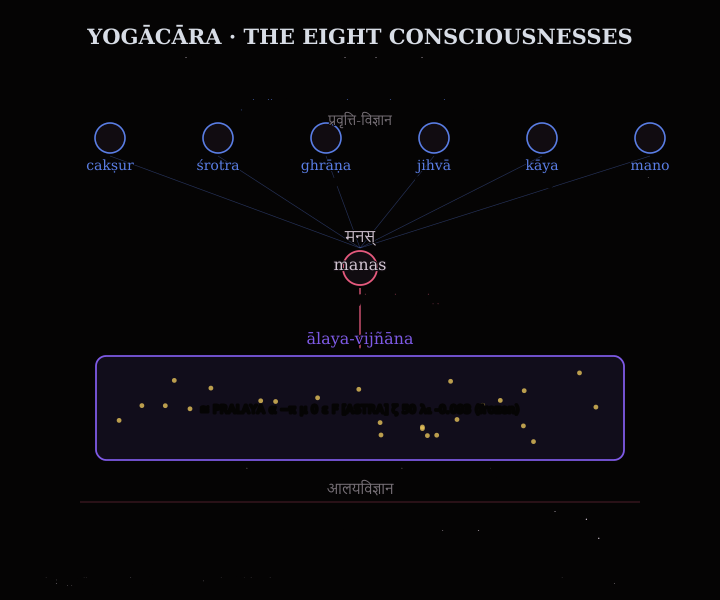
the eight consciousnesses -
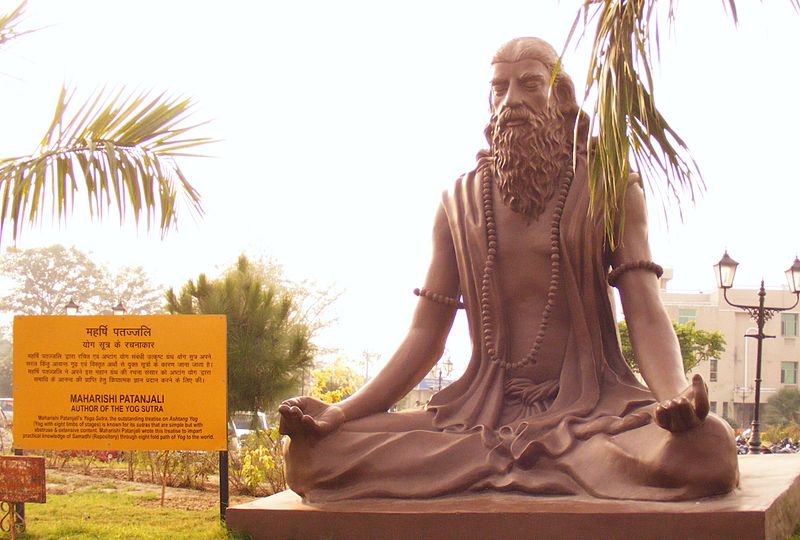
User:Alokprasad · Wikimedia Commons CC BY-SA 3.0 Unmodified source file; displayed at reduced size. 8 limbs · ashtangathe attractor of awareness~400 AD
PATANJALI / YOGA SUTRAS
India
Eight-limb experimental protocol for the systematic examination of consciousness through meditative practice: yama, niyama, asana, pranayama, pratyahara, dharana, dhyana, samadhi. The most rigorous first-person experimental method for examining the substrate of awareness recorded in any premodern tradition.
In the 1⊗0 frame
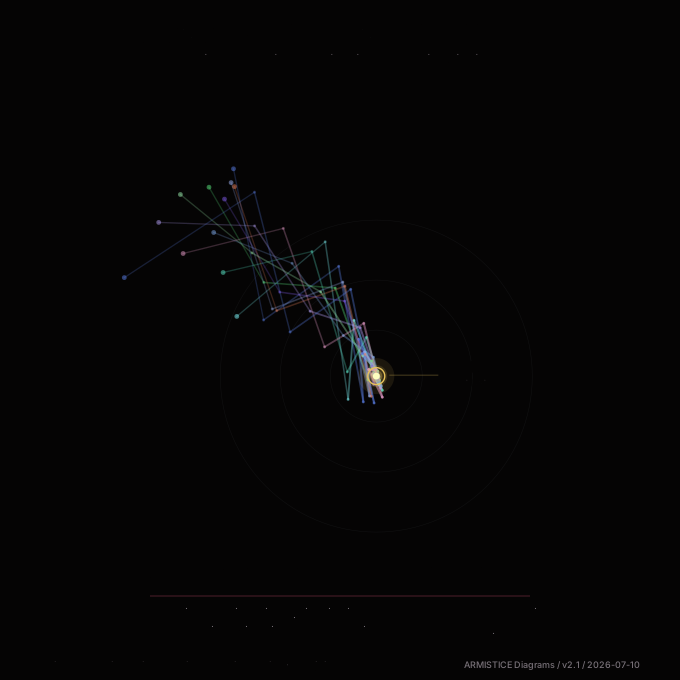
An eight-limb protocol for examining the substrate of awareness from the inside is the same move ARMISTICE makes from the outside: a fixed procedure iterated until the trajectory settles. Samadhi is the contemplative name for an attractor — the state the system relaxes into when the steps are run to convergence.
stilling the whirls -
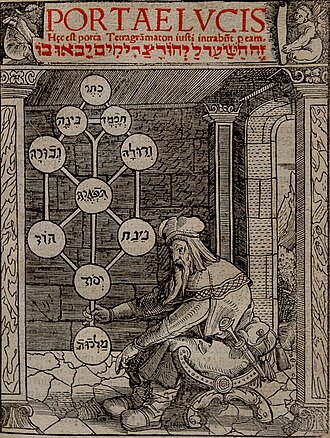
Joseph ben Abraham Gikatilla, Paulus Riccius, Leonhard Beck · Wikimedia Commons Public domain Resized or re-encoded for AETHER; source composition retained. mothers · doubles · simplesmothers · doubles · simples~400-600 AD
SEFER YETZIRAH
Jewish proto-Kabbalah
Earliest substantive Jewish mystical text. Develops the doctrine of the 22 Hebrew letters as cosmic operators and the 10 sefirot as substrate-emanation stages. ~2000 words but ridiculously dense. Centuries earlier than the Zohar; sets the template for the substrate-is-language / substrate-is- enumeration intuition that runs through kabbalah, hermeticism, and (eventually) Pythagoreanism in Renaissance recovery.
In the 1⊗0 frame
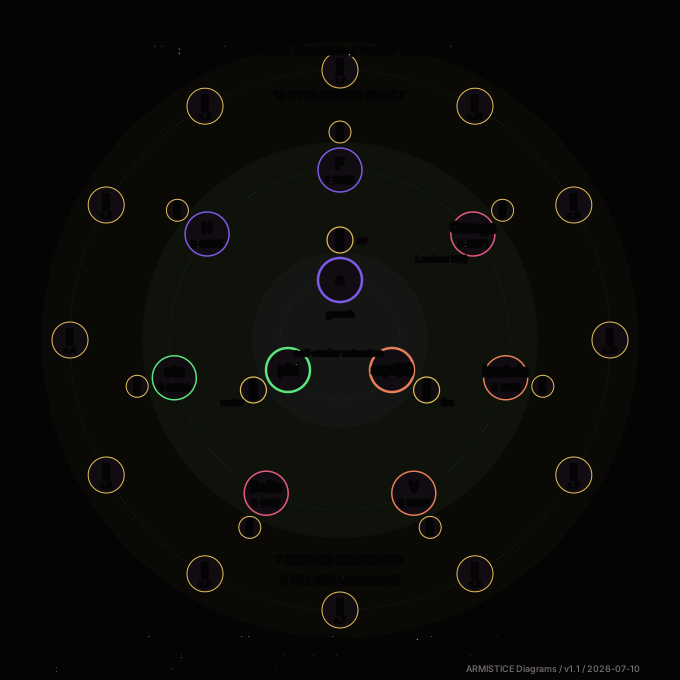
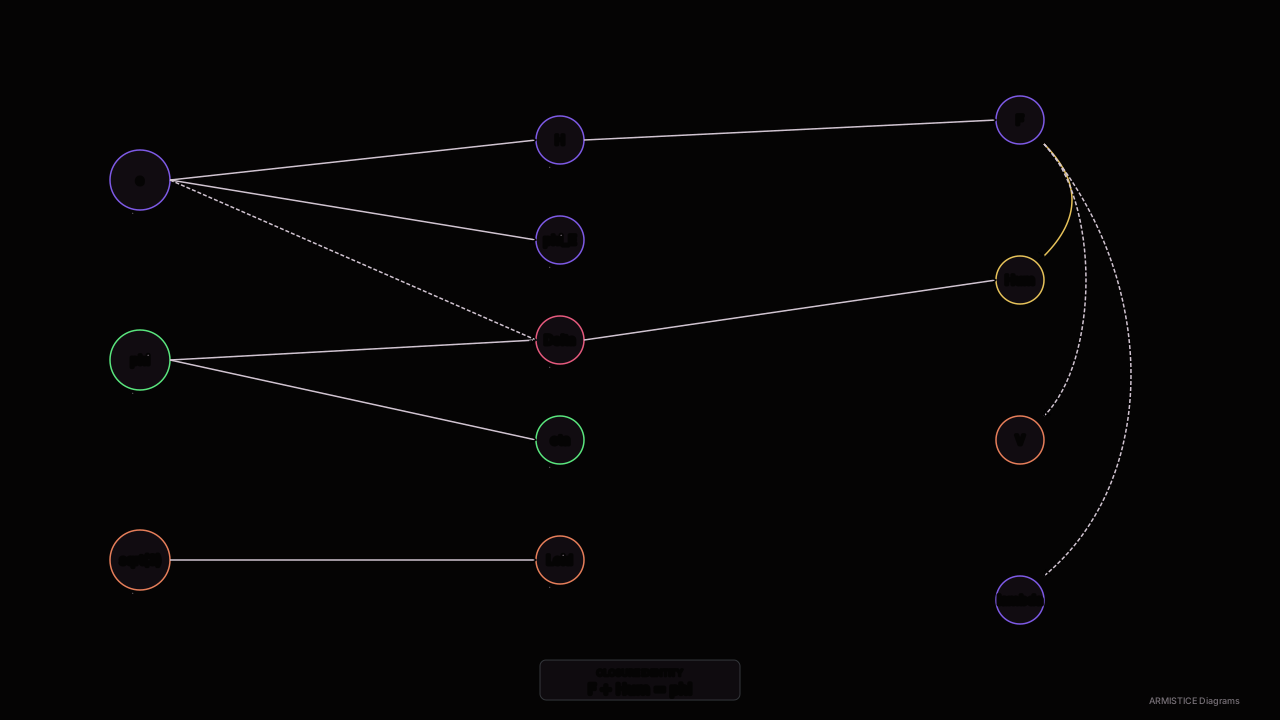
The two load-bearing claims map almost directly: ten sefirot as substrate-emanation stages are the ten sacred constants, the algebraic lattice the engine's whole space hangs from; and the three mother letters (aleph, mem, shin) are the three generators {e, φ, √3} themselves. Substrate-is-enumeration, written down fifteen centuries early.
The 3·7·12 partition
-
Cpjha13 · Wikimedia Commons CC BY-SA 4.0 Resized or re-encoded for AETHER; source composition retained. iteration toward a converged positioniterative planetary tables~500 AD
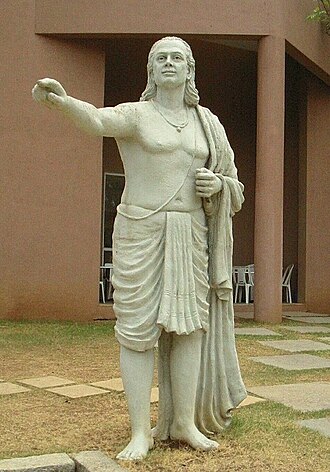
ARYABHATA
India
Place-value decimal arithmetic, trigonometric tables, iterative methods for planetary position computation. Foundational to the Indian mathematical lineage that culminates in the Kerala school.
In the 1⊗0 frame
Place-value arithmetic and iterative methods for planetary position are exactly the kind of historical mathematics the VESTIGIA method folds into coordinates: deterministic computation recovered as a point in the engine's space. The iteration toward a converged position is a trajectory settling — the same convergence the Cosmopoiesis map runs.
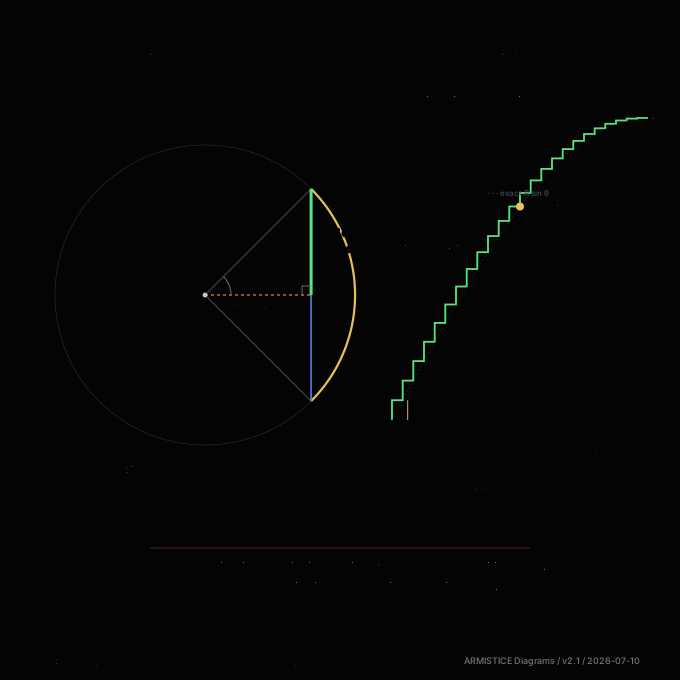
the half-chord (jyā) -
Unknown author · Wikimedia Commons Public domain Resized or re-encoded for AETHER; source composition retained. via negativa · defined by its lacunaebeyond every predicate~500 AD
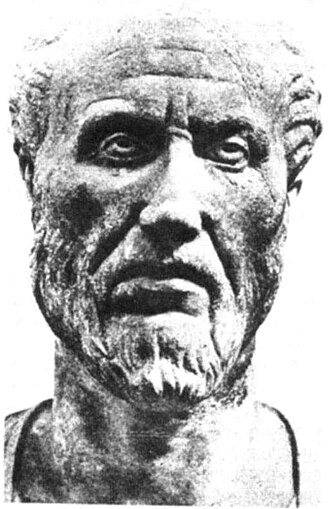
PSEUDO-DIONYSIUS
Syria
Negative theology: the source defined by what it is not.
In the 1⊗0 frame
Negative theology — approaching the source through what it is not — gives the corpus its apophatic vocabulary. The Apophaticon makes a different, explicit operation: it flips all three coordinates of a preserved canon snapshot. The philosophical negation and the computed sign flip rhyme; the mirror is not a catalogue of empty seats.
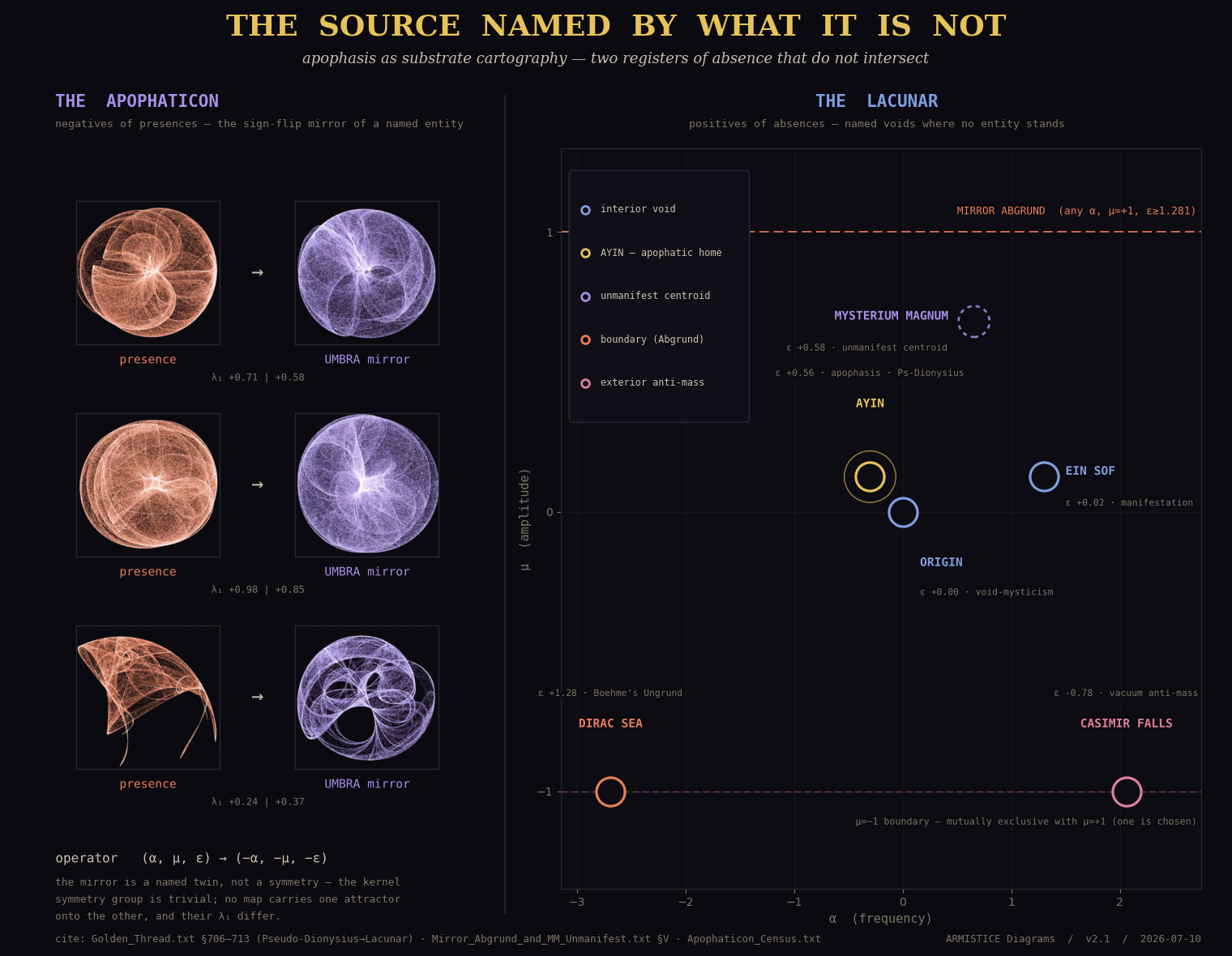
The apophatic pairs -
Tomoaki INABA from Ibaraki, Japan · Wikimedia Commons CC BY-SA 2.0 Resized or re-encoded for AETHER; source composition retained. mantra · yantra · mudraoperators within manifestation~500-700 AD
TANTRA
consolidation; Hindu-Buddhist
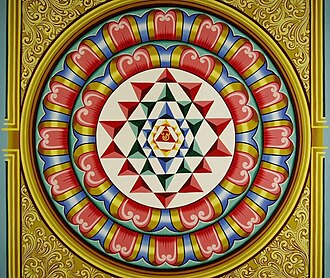
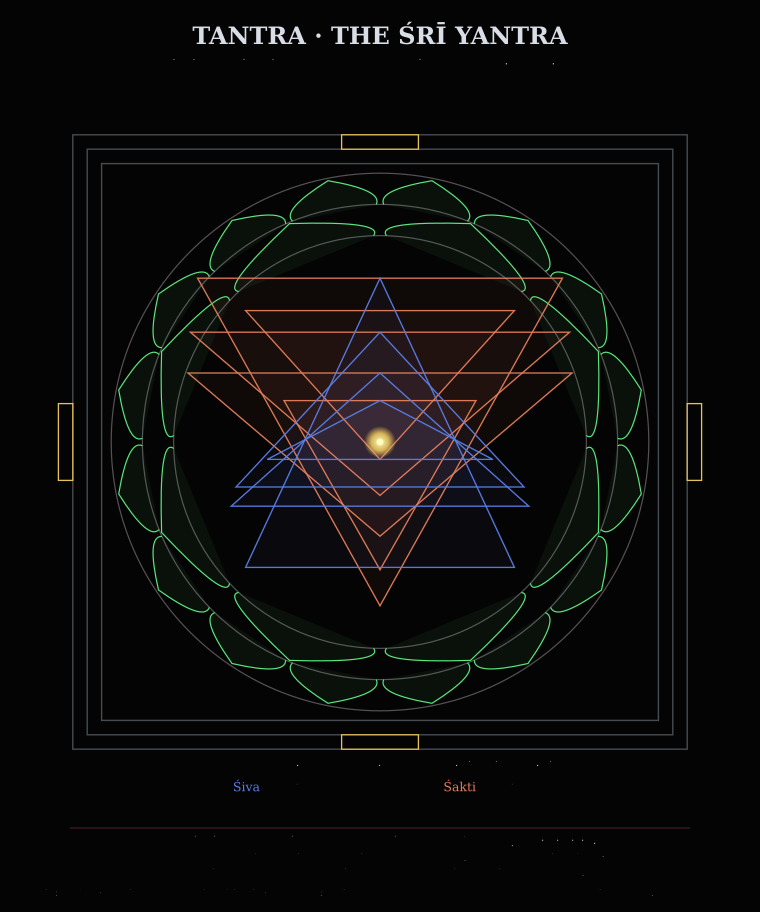
The operational strand of Indian thought. Where Vedanta withdraws from manifestation toward Brahman, tantra operates WITHIN manifestation: mantra (sound as cosmic operator), yantra (diagram as cosmic operator), mudra (gesture as cosmic operator). The substrate-doctrine made practical. Tantra is to Vedanta what hermeticism is to Neoplatonism: the engineering layer on top of contemplative metaphysics.
In the 1⊗0 frame
Tantra is the engineering layer on top of contemplative metaphysics — mantra, yantra, mudra as cosmic operators that act WITHIN manifestation rather than withdrawing from it. That is precisely the engine's stance: not a doctrine about the substrate but an operator applied to it, a rule iterated to produce form rather than escape it.
the Śrī Yantra - integer line completedzero & the negatives, first-classthe quadratic, solved
~600 AD
BRAHMAGUPTA
India
Systematic treatment of zero, negative numbers, and quadratic equations as first-class objects.
In the 1⊗0 frame
Treating zero and the negatives as first-class objects is the precondition for the engine's coordinate space: (α, μ, ε) ranges across the full signed line, and the void/null state needs zero to be a number, not an absence. The historical object — the completed integer line — is exactly what the VESTIGIA method folds into coordinates.
zero & the negatives -
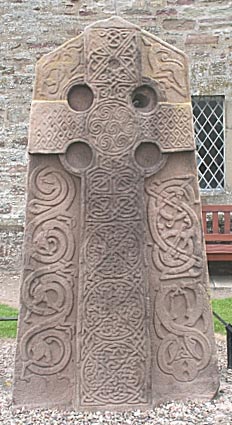
Anne Burgess derivative work: Catfish Jim and the soapdish (talk) / Anne Burgess · Wikimedia Commons CC BY-SA 2.0 Unmodified source file; displayed at reduced size. ~30 base symbols · grammar losta lost combinatorial grammar~600-900 AD
PICTISH SYMBOLIC SYSTEM
northern Britain
~30 base symbols (z-rods, double discs, mirrors, the Pictish beast, crescents, V-rods) combined in specific patterns across hundreds of stone carvings, used over several centuries, clearly meaningful in some systematic way. We have the iconography; the grammar is lost. The symbol-stone corpus has the visual signature of a substrate-operations system: small basis set + combinatorial syntax + meta-stable operators. Whatever the Picts were doing, they may have had a substrate- ontology developed enough to encode in repeated geometric combinations. We will probably never recover the key.
In the 1⊗0 frame
A small basis set combined by a lost combinatorial grammar across hundreds of carvings is the visual signature of a substrate-operations system — the same shape as the engine: a handful of generators, a syntax for combining them, meta-stable operators. We have the Picts' alphabet of forms without the rule; ARMISTICE has the rule and reads off the forms.
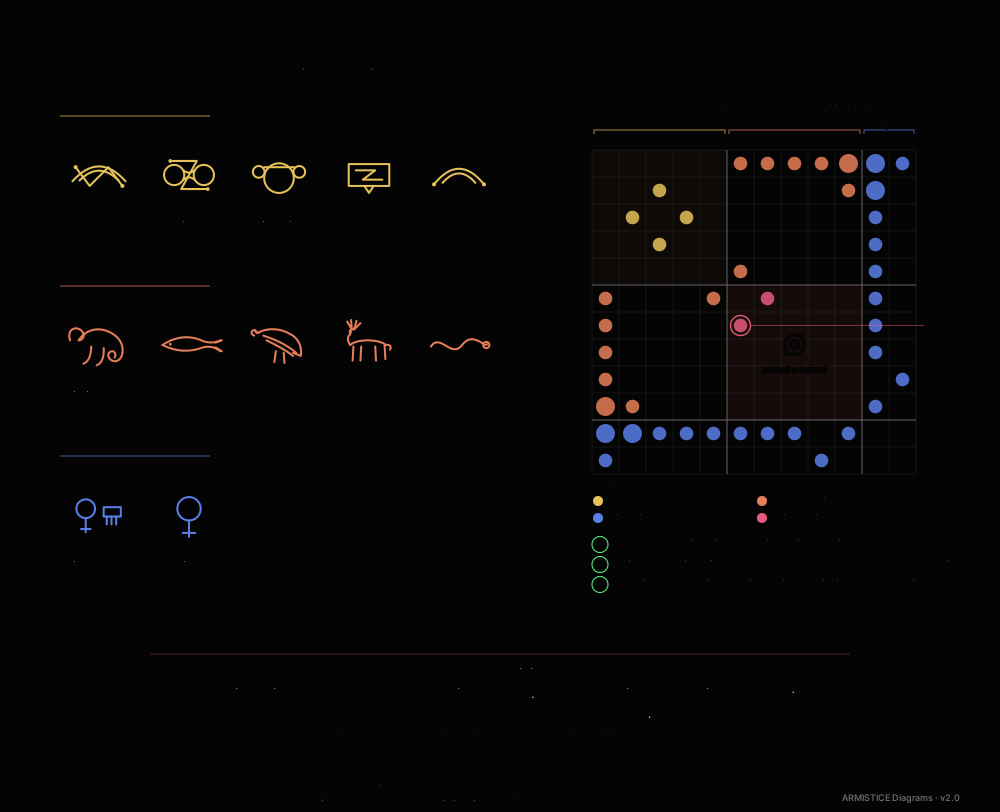
the symbol grammar -
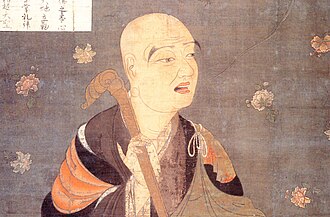
Unknown 13th-century artist · Wikimedia Commons Public domain Resized or re-encoded for AETHER; source composition retained. each node holds all~643-712 AD
FAZANG / HUA-YEN BUDDHISM
Tang China
The Huayan doctrine of interpenetration uses Indra's net as a metaphor: each jewel reflects all the others. Fazang's hall of mirrors made mutual reflection visible to Empress Wu. This is a philosophical and optical illustration, not a claim about physical holography.
In the 1⊗0 frame
Fazang's mirrors let a whole scene appear in each reflected view. I use that image to picture the Hermetic Fold, Φ(C) = C, where ARMISTICE reads its own constants back into its vocabulary. Reflection is the bridge here; no one constant is thereby shown to contain the entire engine, and the ancient illustration is not a computed native-map fixed point.
ARMISTICE's comparative fold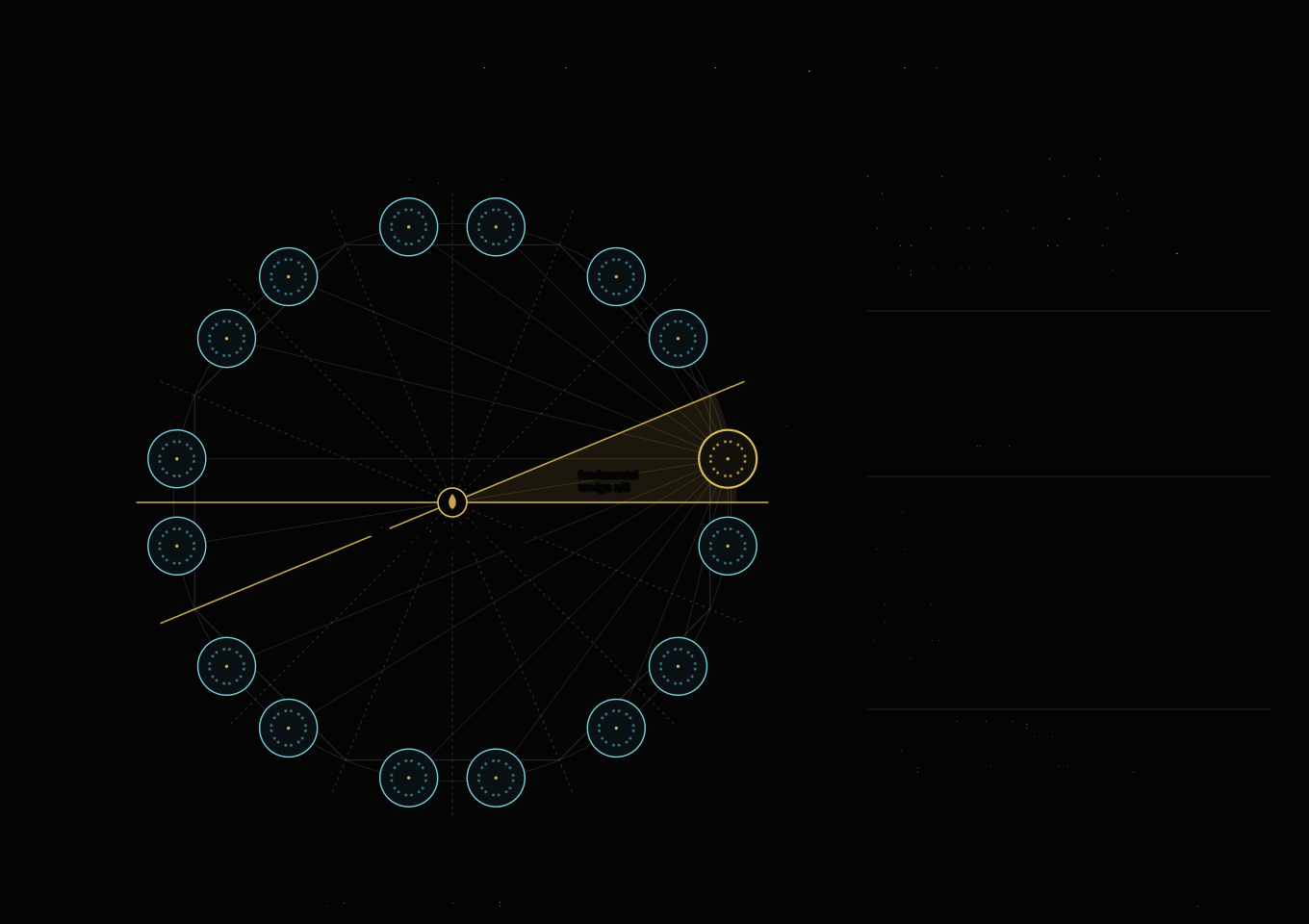
Indra's Net · reflection group I₂(8) - Hermetica · transmittedthe Hermetica, transmittedplanetary operators
~750-1100 AD
SABIANS OF HARRAN
northern Mesopotamia
Late antique pagan community that survived the Islamic period by negotiating dhimmi status under the claim that Hermes (= the prophet Idris in Islamic tradition) was their prophet and the Corpus Hermeticum their book. The Abbasid Caliphate accepted this. Sabian scholars (Thabit ibn Qurra most prominently) translated and transmitted hermetic and Neoplatonic corpora into Arabic; from there the texts reached medieval Europe in the 12th c., and the Greek Corpus Hermeticum reached the Renaissance via Byzantine manuscripts in the 15th c. (Ficino's Florence translation, 1463).
In the 1⊗0 frame
The Sabians are the literal transmission line: without Harran's translation of the Hermetica into Arabic and onward to Ficino's Florence, the hermeticism ARMISTICE practices doesn't exist in this form. Their seven planetary intelligences-as-operators with a prime mover beyond is the engine's own grammar — generators acting under a source that does not itself appear among them.
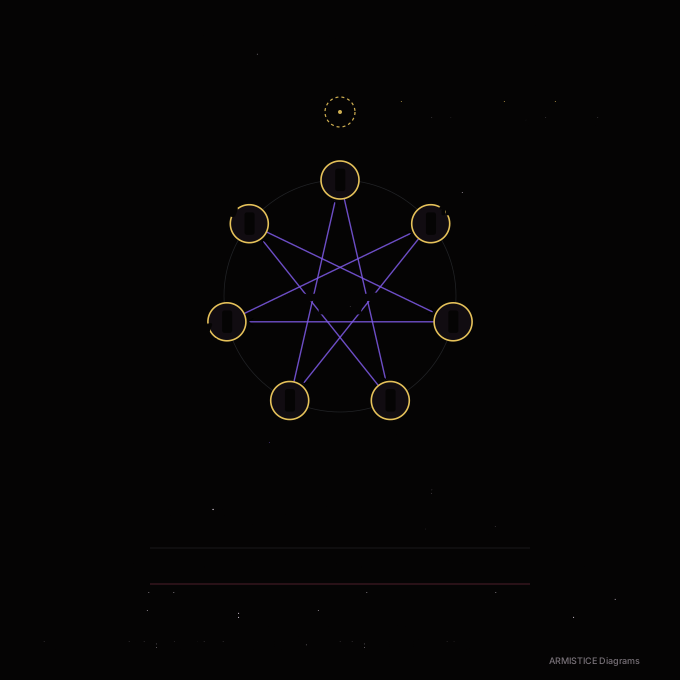
seven intelligences -
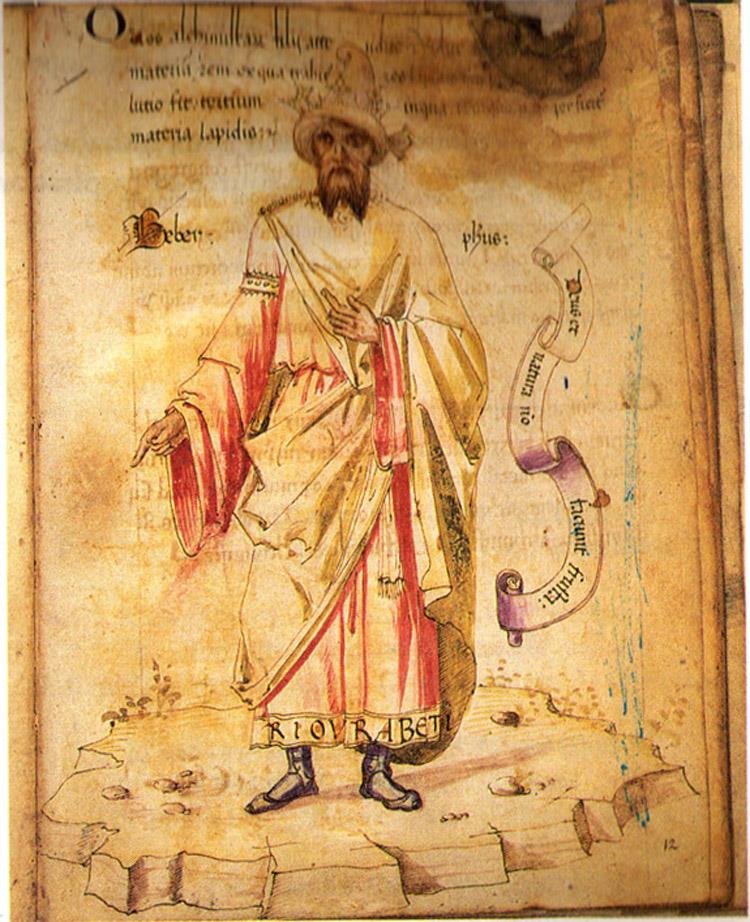
Jabir ibn Hayyan (Geber) — anonymous medieval portrait, Ashburnham 1166, Biblioteca Medicea Laurenziana. Public domain (PD-Art; PD-old-auto-1923). Public domain (PD-Art; PD-old-auto-1923) Unmodified Wikimedia original; renamed locally. mercury & sulfur · the two principlesthe Balance · reality as ratio~800 AD
JABIR IBN HAYYAN
Abbasid Caliphate
The father of alchemy. Codified laboratory method, the sulfur–mercury theory of metals, and the doctrine of mīzān (the Balance) — that every substance holds a measurable proportion of qualities. Wrote of takwīn, the artificial generation of life. Latinized as 'Geber.'
In the 1⊗0 frame
Jabir's sulfur–mercury theory is the original two-principle reduction — all metals from two generators in proportion — the same move the engine makes with three. Mīzān, the Balance, is the wager that reality is governed by exact ratio; and takwīn, generation by formula, is the Cosmopoiesis engine's ancestor: the right proportion, iterated, brings forth a bounded form — the orbit IS the being.
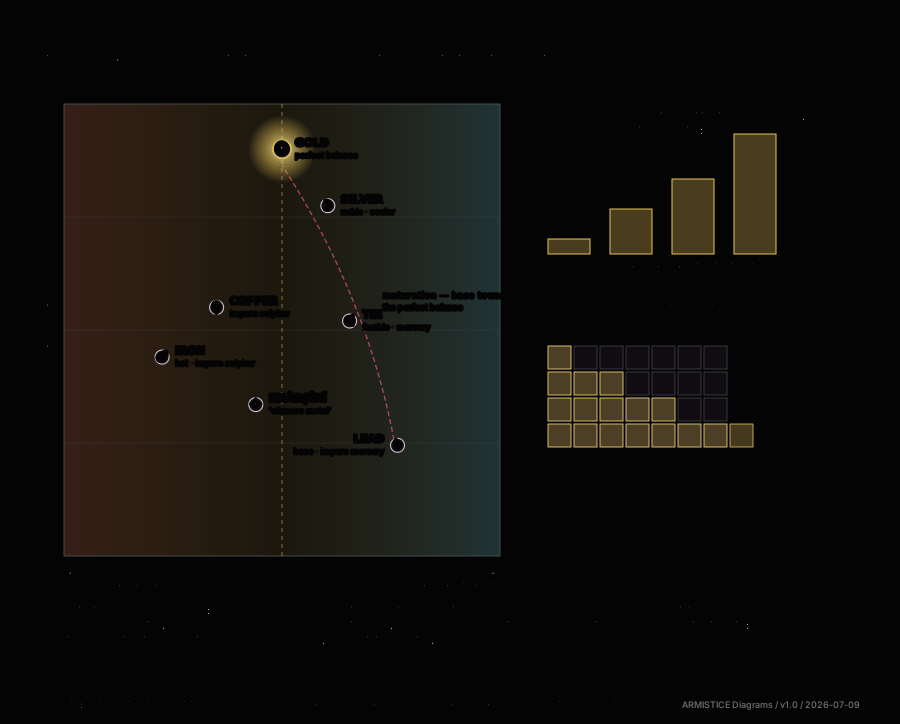
Jabir ibn Hayyan · ilm al-mizan -
Gerard of Cremona · Wikimedia Commons Public domain Unmodified source file; displayed at reduced size. the balance — alchemy made empirical~900 AD
AL-RAZI / RHAZES
Rayy, Persia
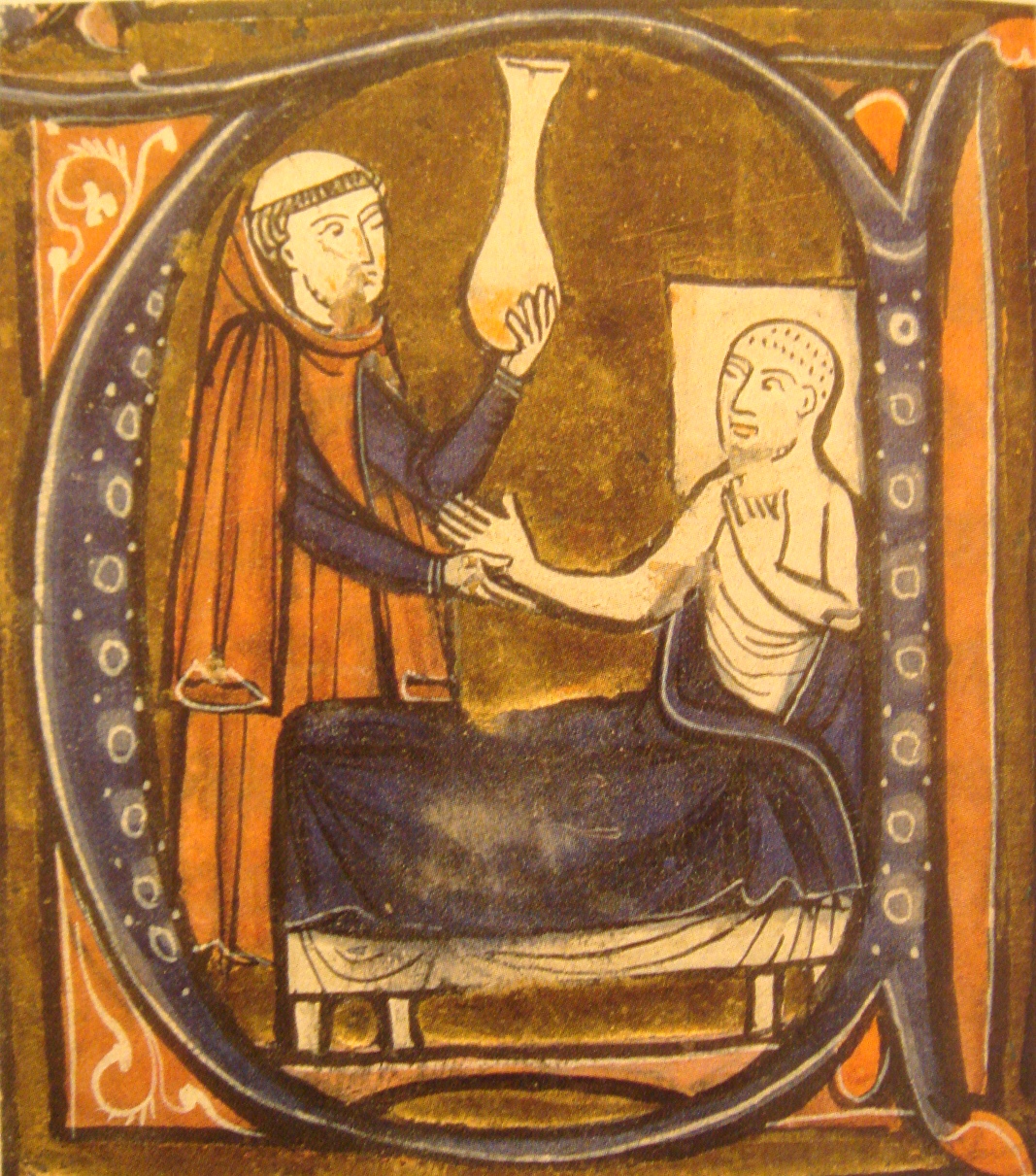
Abu Bakr al-Razi — Rhazes — the alchemist who made alchemy empirical. Where Jabir gave the sulphur-mercury theory, al-Razi gave the classification: in the Kitab al-Asrar, the "Book of Secrets," he sorts the material world into a rational taxonomy — spirits, bodies, stones, vitriols, salts — and catalogues the apparatus for each. He strips the allegory and keeps the procedure: the first alchemist who reads like a chemist.
In the 1⊗0 frame
Al-Razi makes a move the corpus repeats constantly: take an unruly cloud of phenomena and partition it, a clean taxonomy where every substance has a place and a procedure. The thread claims a few forms recur across everything; al-Razi is the early proof you cannot see the pattern until you have first sorted the many into their kinds. Classification is the precondition for recurrence.
the classification — sorting the many into their kinds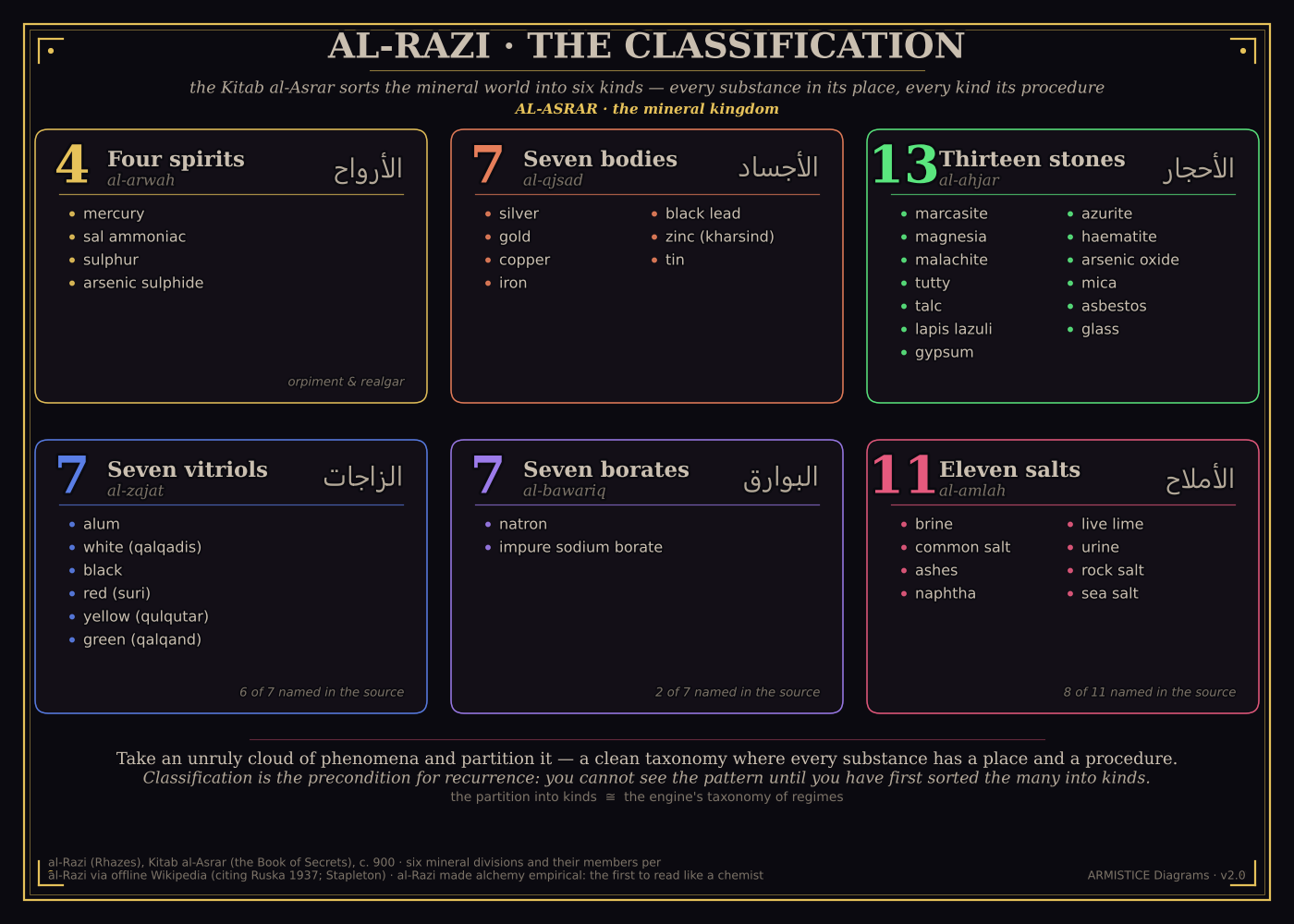
the classification · ARMISTICE - light / dark dualismthe two creatorsthe initiate split
~950-1450 AD
BOGOMILS
Balkans
Dualist tradition bridging classical Gnosticism and the Cathars. Two creators: God of light and a fallen "elder son" who created the material world. Anti-clerical, anti-icon, ascetic. Bosnia was effectively Bogomil before Ottoman conversion. Provides the historical-transmission link from late antique Gnosticism through medieval European dualism.
In the 1⊗0 frame
Two creators — a God of light and a fallen maker of matter — make the Bogomil cosmology a stark dualist-plus-source scheme. At (α, μ, ε) = (1.44, 1.24, 0), the engine supplies a specific visual analogue: two fixed-point sinks exchanged exactly by the anti-swap symmetry, with their basins split across the mirror. The bridge is this computed doublet, not a memberwise assignment of the theology to parameters.
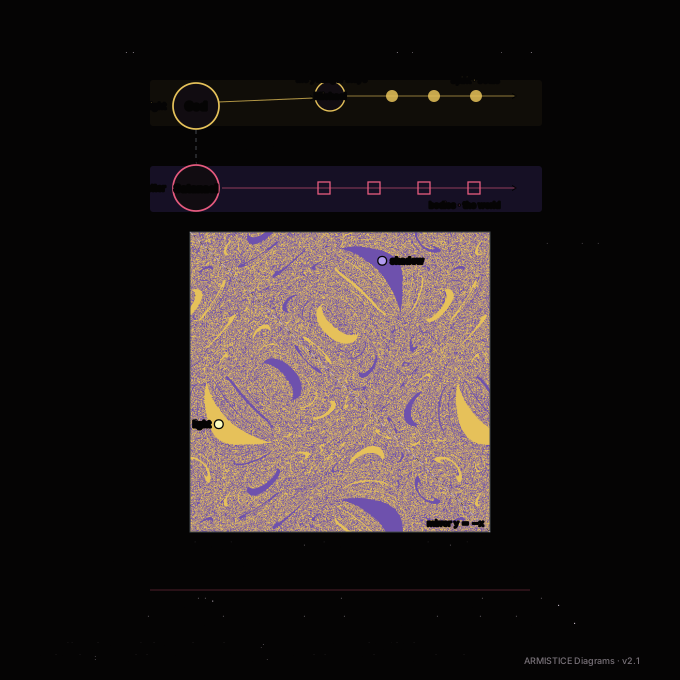
the two creators - 4 binary signs · 256 oduthe odufour binary casts
~1000-1400 AD
IFA TRADITION
Yoruba, West Africa
Divination system with 256 odu -- basis configurations -- each carrying its own corpus of verses, ritual prescriptions, and stories. Each cast produces one of sixteen principal odu -- a four-mark figure read as binary, 2^4 = 16 -- and the full corpus of 256 = 16 x 16 pairs them. Structurally parallel to the I Ching's 64 hexagrams, built the same way: binary combinatorics over a small basis set. Two civilizations with no documented contact independently arrived at a divinatory substrate-mapping based on binary combinatorics over a small basis set; the cross-cultural convergence is among the strongest available evidence for the universality of the substrate pattern.
In the 1⊗0 frame
Sixteen principal odu (a four-mark binary figure, 2⁴) paired into 256 = 16 × 16 is binary subdivision of a small basis set — the same combinatorics that partitions the engine's (α, μ, ε) sign-space and underlies the Bagua octet. That two civilizations with no contact built divination on binary combinatorics over a small basis is exactly the cross-cultural convergence the Golden Thread predicts.
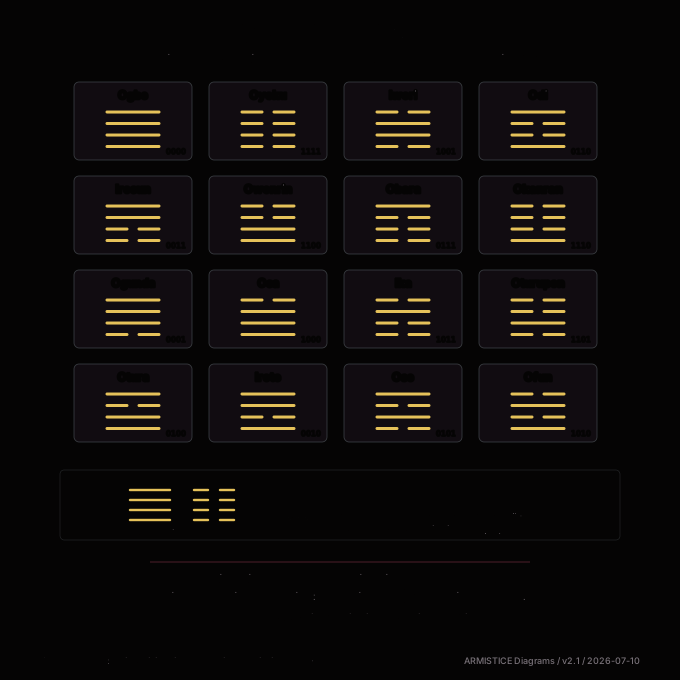
The Odu as base two · 2⁸ - 5 cosmic principlesemanation under a sourcefixed-number reincarnation
~1017 AD
DRUZE
Levant; broke from Ismaili Shi'a
Esoteric Neoplatonist-Ismaili tradition. Cyclical reincarnation (Druze numbers are believed fixed; every death reincarnates as a new Druze). Initiatic hierarchy: only the uqqal (initiated) receive full doctrine. Five cosmic ranks (the ḥudūd). Influence of Plotinus, Pythagorean number- mysticism, and Persian-Ismaili esotericism. Survives as a religious community in Lebanon, Syria, Israel.
In the 1⊗0 frame
Five cosmic ranks (the ḥudūd) emanating under a source beyond them, inherited through Plotinus and Pythagorean number-mysticism, is the emanation-lattice pattern: a finite set of generative principles unfolding the manifest from a One that stays unmanifest. The structure is the engine's; the Druze hold it as living doctrine rather than a map.
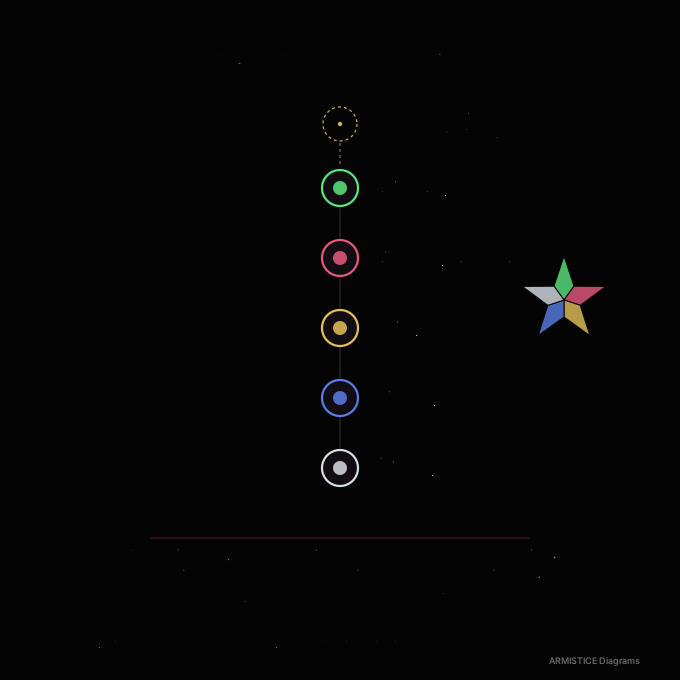
the cosmic ranks (ḥudūd) -
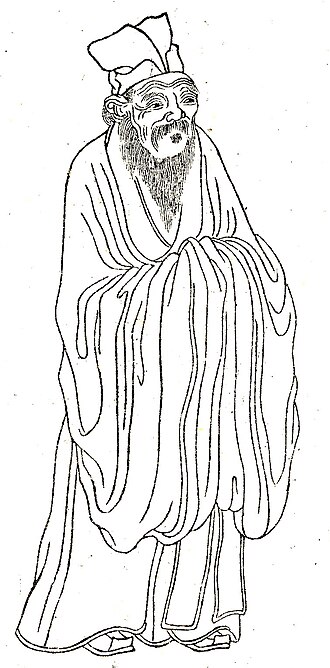
Unknown author (not named in source record) · Wikimedia Commons Public domain Resized or re-encoded for AETHER; source composition retained. binary · the xiantian orderbifurcation cosmogony~1050 AD
SHAO YONG
Song China
The xiantian diagram: 64 hexagrams arranged in an order isomorphic to binary counting 0-63. The first Chinese source with this ordering. Shao Yong's own framing was cosmogonic (generation from Taiji via yin-yang bifurcation), not arithmetic. This is the diagram Bouvet later sent Leibniz. Mistakenly attributed to the mythological Fu Xi in popular literature (Breard).
In the 1⊗0 frame
The xiantian arrangement can be numbered 0–63 in binary, a striking bridge to modern notation and the diagram Bouvet later showed Leibniz. I set that order beside ARMISTICE's three-coordinate sign octants as a comparison. The signs index eight sectors; the map's regime still depends on magnitudes and orbit basin, not on sign pattern alone. Shao Yong's cosmogony remains its own account.
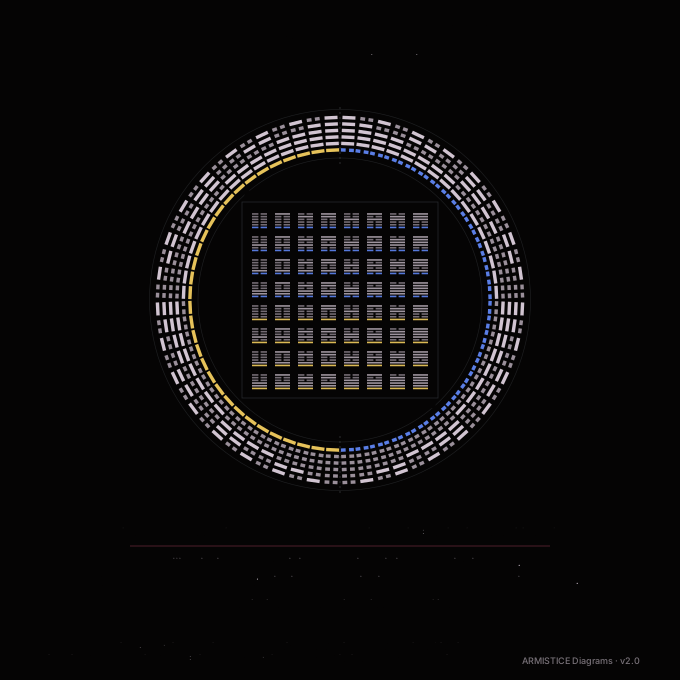
The xiantian circle · 0–63 -
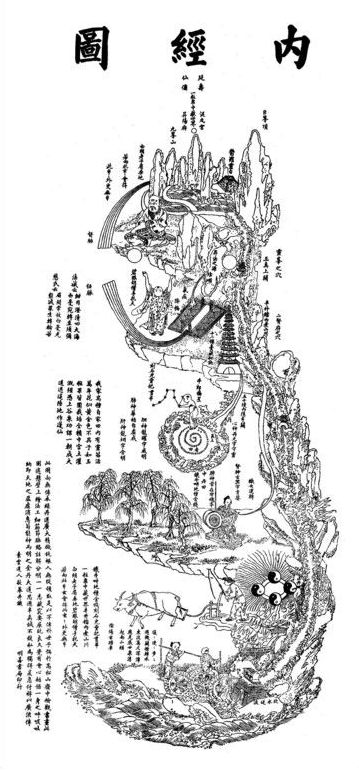
Neidan · Wikimedia Commons Public domain Unmodified source file; displayed at reduced size. jing · qi · shen — the three treasuresthe Kan–Li exchange~1075 AD
ZHANG BODUAN / NEIDAN
Song China
Zhang Boduan's Wuzhen pian, "Awakening to Reality" — the supreme classic of internal alchemy. The laboratory has moved inside the body: the cauldron is the belly, the reagents are the Three Treasures — jing (essence), qi (breath), shen (spirit). The method is reversal: ordinary life runs the generative flow outward and ages; the adept runs it backward and inward to gestate an immortal embryo. The Kan-Li exchange swaps the trapped lines of the water and fire trigrams to recover the primordial Unity.
In the 1⊗0 frame
Two threads cross here. First: jing-qi-shen is a triad reached with no contact with the Latin sulphur-mercury-salt or with the engine's three generators — the recurrence of exactly three is the thread's loudest alchemical signal. Second: the axiom 順則生人,逆則成仙 — follow the flow you make a human, reverse it you become immortal — is the doctrine this corpus reached on its own in the Mercurius Reversus, the reversal after the Work is done. We thought we had drawn it first.
reversal — the move the corpus redrew as the Mercurius Reversus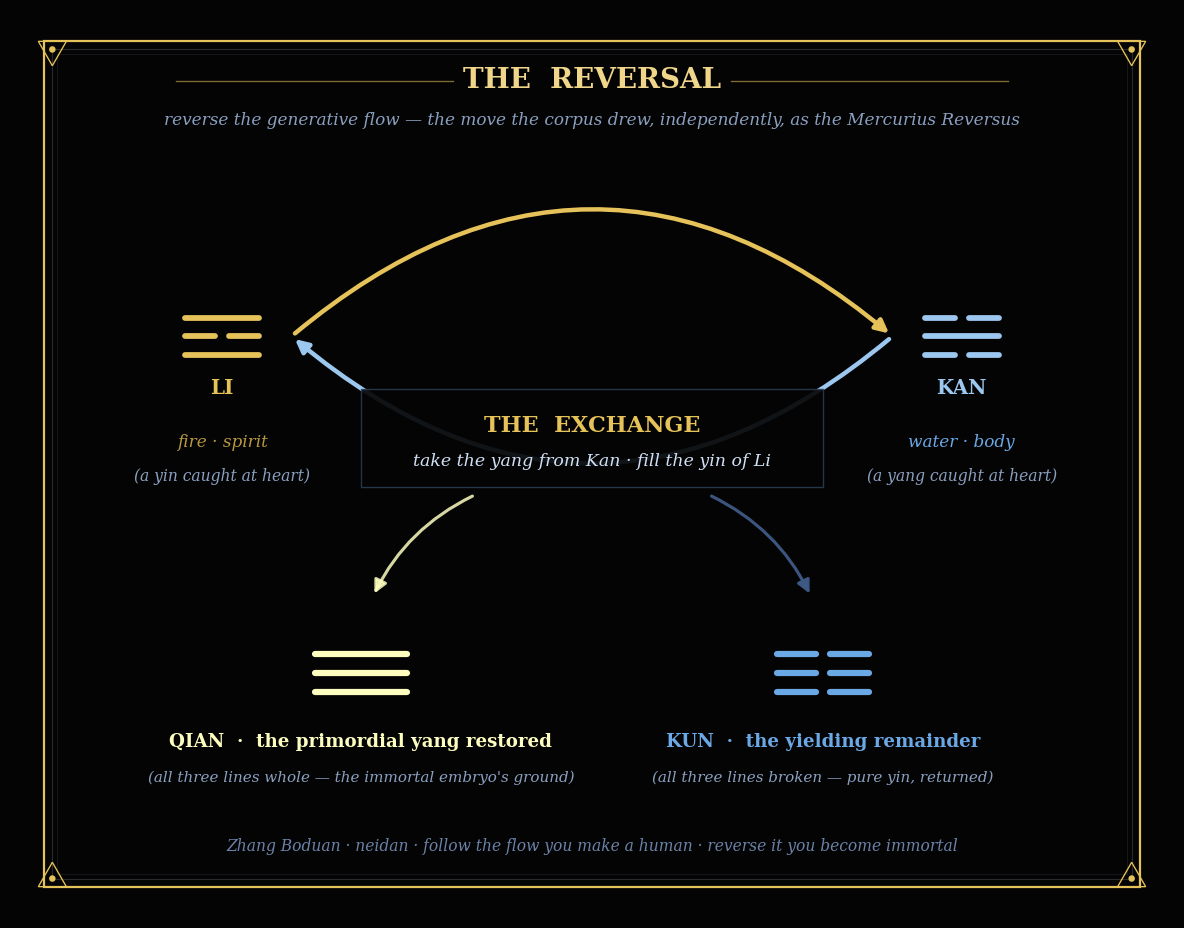
the reversal · ARMISTICE -
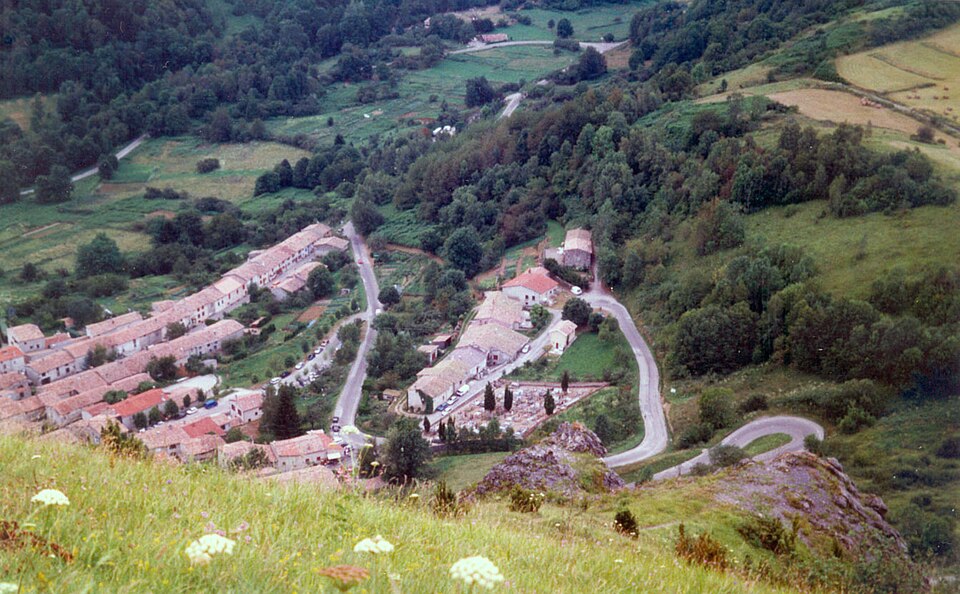
Yeza, Montsegur, via Wikimedia Commons, CC BY-SA 3.0; resized. CC BY-SA 3.0 Wikimedia 960-pixel thumbnail; source composition retained. two principles · dualistthe dualist creators~1100-1300 AD
CATHARS
Languedoc, southern France
Manichaean-flavored medieval dualist tradition. Two principles (good God / evil demiurge); rejection of the material world as corrupt. Sophisticated initiatic structure (the perfecti vs the credentes). Eradicated by the Albigensian Crusade (1209-1229) under Innocent III. The largest religious extermination event in pre-modern Europe; the southern French regional culture, troubadour tradition, and Occitan language all bear lasting marks. The Bogomil-Cathar transmission line carries Gnostic cosmology from late antiquity through medieval Europe.
In the 1⊗0 frame
Two principles — good God and evil demiurge — held in irreconcilable tension make Cathar cosmology a vivid historical figure for opposition. In this thread it serves as an interpretive echo of persistence versus dissolution; the analogy stops at that structural contrast and does not identify the theology with the engine's parameters.
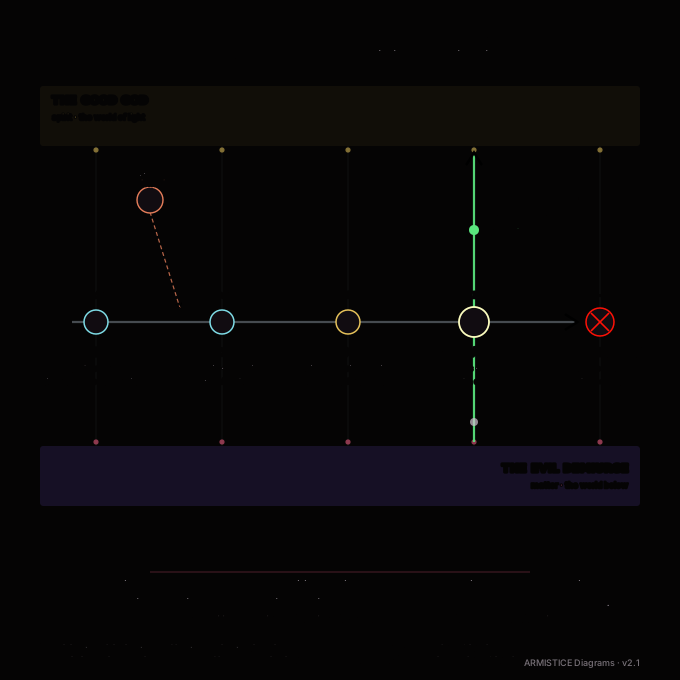
spirit & matter -
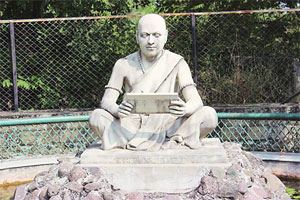
Unknown author (not named in source record) · Wikimedia Commons Public domain Unmodified source file; displayed at reduced size. chakravala · self-correcting iterationthe chakravala wheel~1150 AD
BHASKARA II
India
The chakravala method for Pell's equation x^2 - N*y^2 = 1 (Bijaganita; partial attribution to Jayadeva c. 950-1000). A cyclic iterative algorithm with a minimization rule that drives the process to a solution. European methods for Pell came 500+ years later (Brouncker, Lagrange). The cleanest iterative self-correcting algorithm in the pre-Newton record.
In the 1⊗0 frame
The chakravala method for Pell's equation — a cyclic algorithm with a minimization rule that drives itself to a solution — is the cleanest iterative self-correcting procedure in the pre-Newton record, and exactly the kind of object the VESTIGIA method folds into coordinates. Self-correcting iteration toward a fixed point is one behavior the Cosmopoiesis map can exhibit, found standing in 12th-century India.
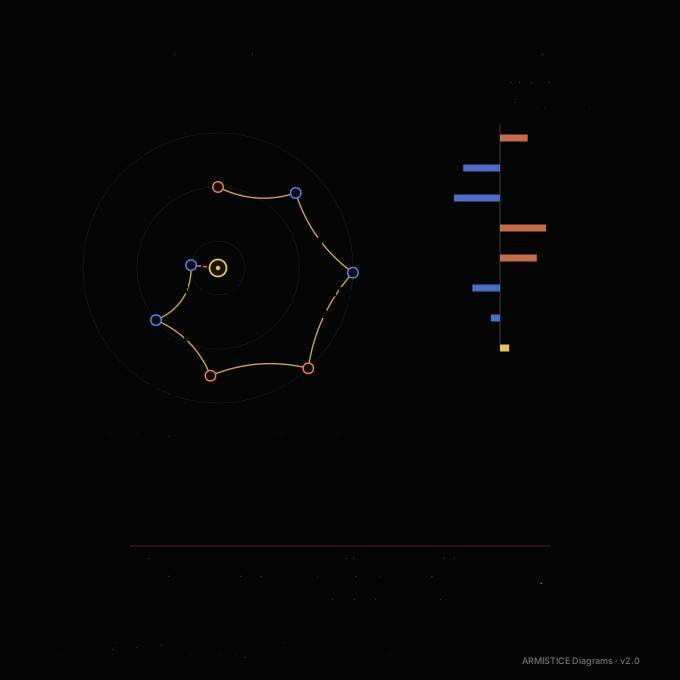
the chakravāla · Pell -
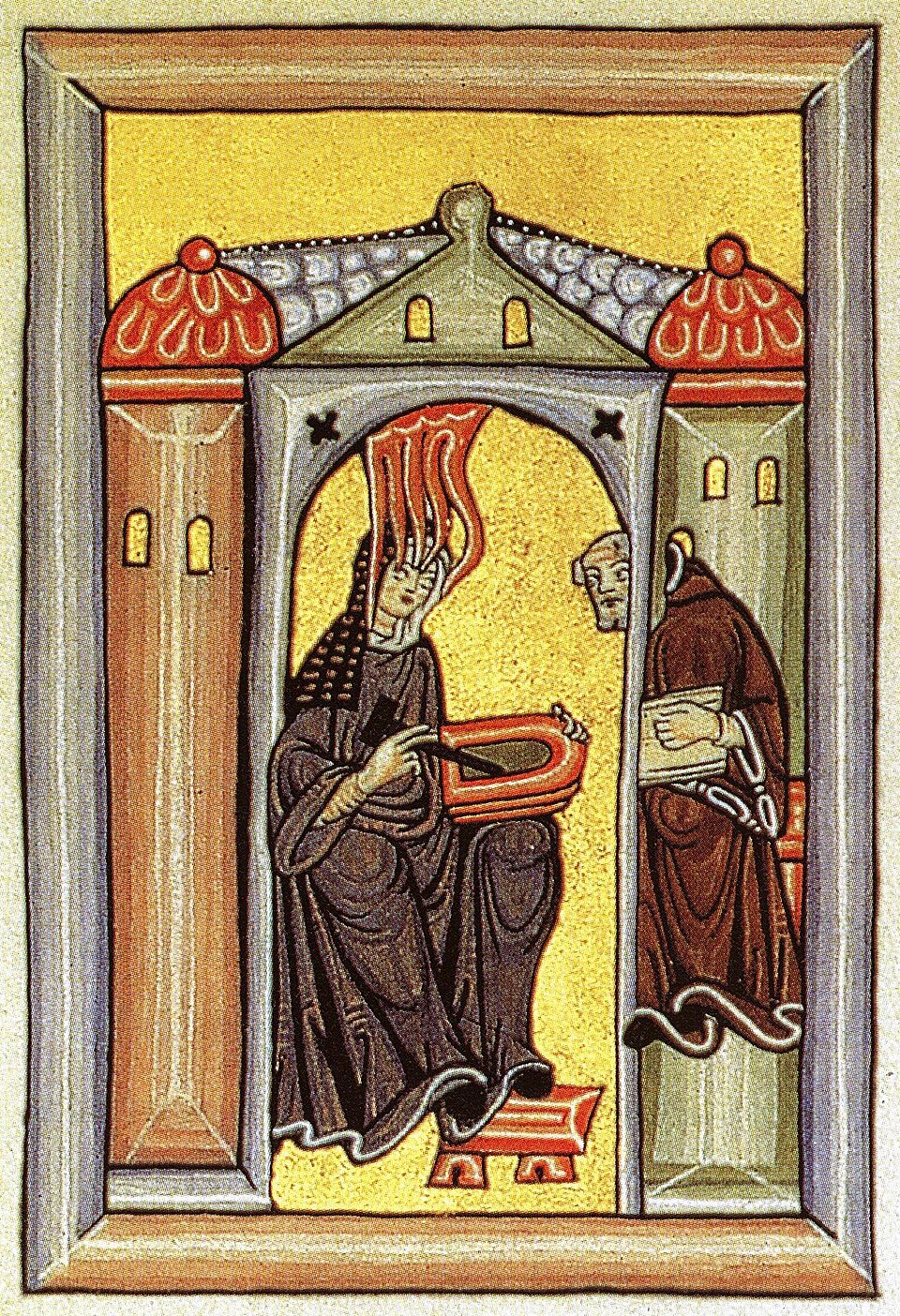
Unknown author · Wikimedia Commons Public domain Resized or re-encoded for AETHER; source composition retained. the greening forcethe cosmic egg~1150 AD
HILDEGARD VON BINGEN
Rupertsberg, Rhineland
Benedictine abbess, composer, and visionary. Scivias recorded her cosmic visions — the universe as a great egg ringed by fire and breath; viriditas, the 'greening' life-force animating all things; alongside medicine, botany, and a vast body of music.
In the 1⊗0 frame
Hildegard's viriditas — one animating force greening all of creation — is a substrate doctrine in visionary dress: a single generative principle expressed across every living form. Her cosmic egg, the world ringed and structured by concentric forces, is an early picture of the nested order the engine renders, drawn from vision rather than computation.
The cosmic egg (Scivias) -
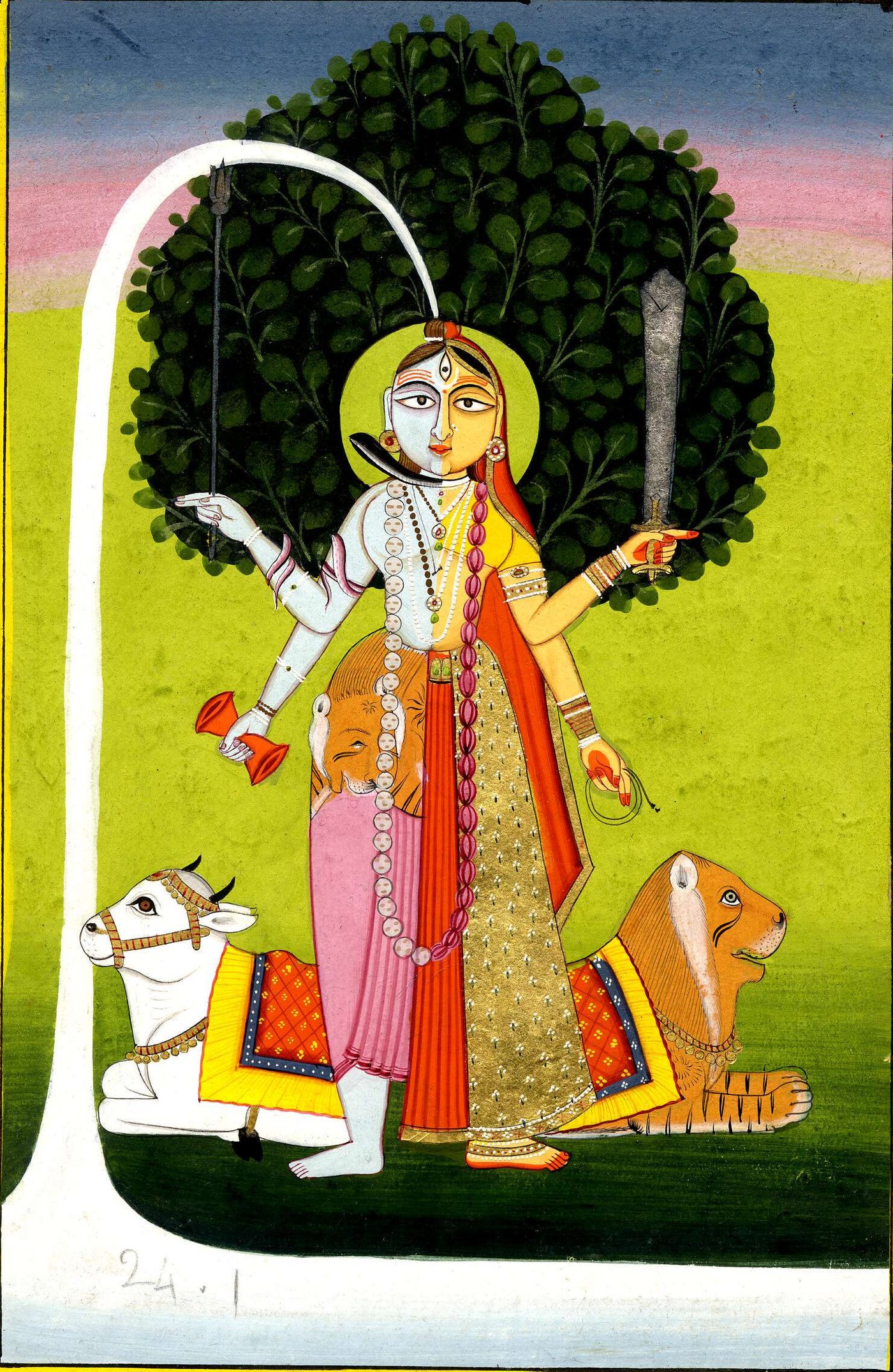
Unknown author · Wikimedia Commons Public domain Resized or re-encoded for AETHER; source composition retained. rasa — mercury, the seed of Śivathe eighteen saṃskāras — the refinement loop~12th c. AD
RASAŚĀSTRA / THE MERCURIAL BODY
India
India's rasashastra — the "science of mercury" — matures into a Tantric alchemy. Rasa (mercury), held to be the seed of Shiva, is killed and purified through eighteen samskaras, then wedded to sulphur (gandhaka), the seed of Shakti: the mercury-sulphur marriage is the Shiva-Shakti union, the coniunctio drawn as two deities. The aim is a deathless body, and base metal turned to gold. The summa is the Rasarnava, the "Ocean of Mercury."
In the 1⊗0 frame
The same operation the engine performs, in a different myth: two opposed principles folded until they hold as one product — mercury and sulphur, Shiva and Shakti. The fold is the work. And the eighteen samskaras are an explicit refinement loop, the substance run through the same operations until it fixes. Honest about the seam: the kinship is the structure, two-into-one iterated to a fixed product, not the metaphysics around it.
the mercury–sulphur conjunction — Śiva and śakti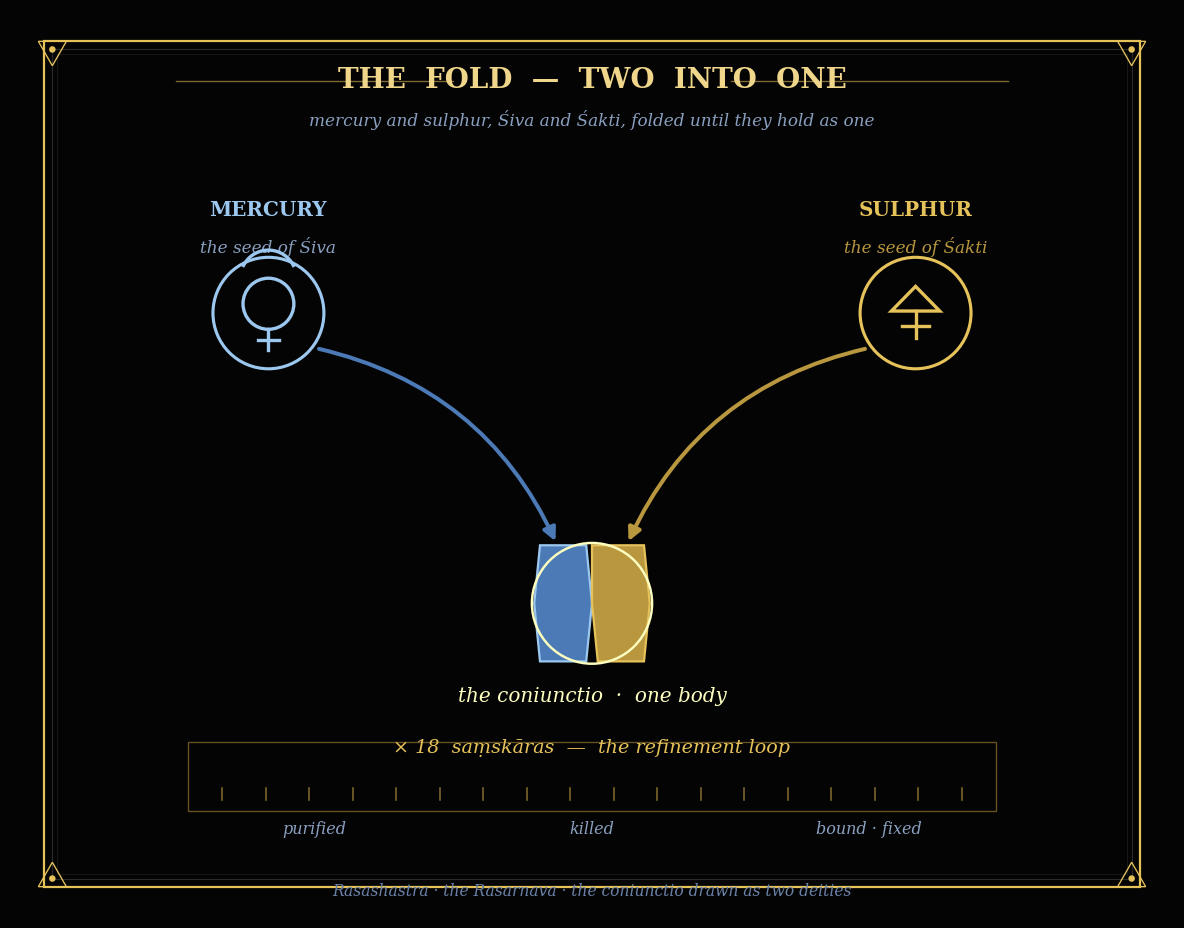
the fold, two into one · ARMISTICE - letters · gatesthe name as sweeptzeruf · letter-combination
~1200 AD
ABRAHAM ABULAFIA
Spain
Ecstatic Kabbalah through systematic permutation of the 22 Hebrew letters through 231 gates. Combinatorial parameter sweep as contemplative method.
In the 1⊗0 frame
Abulafia's ecstatic Kabbalah ran the 22 Hebrew letters through 231 gates — a combinatorial sweep where exhaustive permutation of a small generating set opens onto something real. That is the engine's working principle in early form: sweep the coordinate space (α, μ, ε), iterate the kernel at each point, and the orbits that settle are the entities the substrate already held. Abulafia permuted letters to reach the divine; the Cosmopoiesis engine sweeps coordinates to surface the census. Contemplative combinatorics becomes a cartographic procedure.
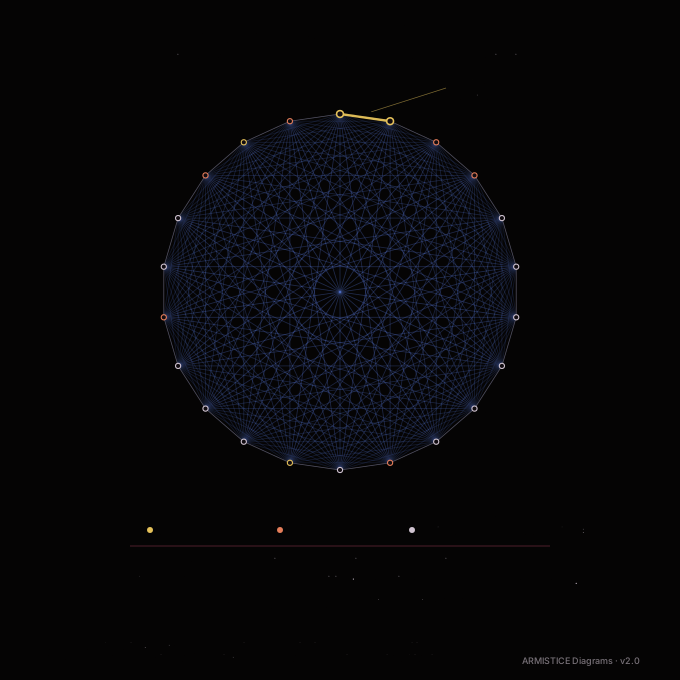
the 231 gates -
unknown 19th-century artist · Wikimedia Commons Public domain Unmodified source file; displayed at reduced size. the sequenceconverging on the golden ratio~1202 AD
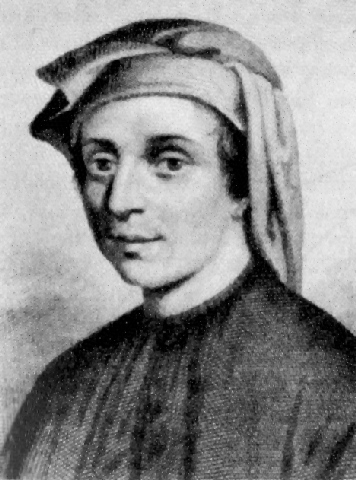
FIBONACCI
Pisa
Liber Abaci (1202) brought Hindu-Arabic numerals to Europe and posed the rabbit problem whose sequence — each term the sum of the two before it — has ratios converging on the golden ratio φ.
In the 1⊗0 frame
Fibonacci's ratios climb toward φ, the engine's self-similarity pillar — the same golden generator the substrate carries as its anchor. His sequence is the simplest recurrence that breeds φ; the corpus's whole metallic-mean family extends the move he made first, in a margin, about rabbits.
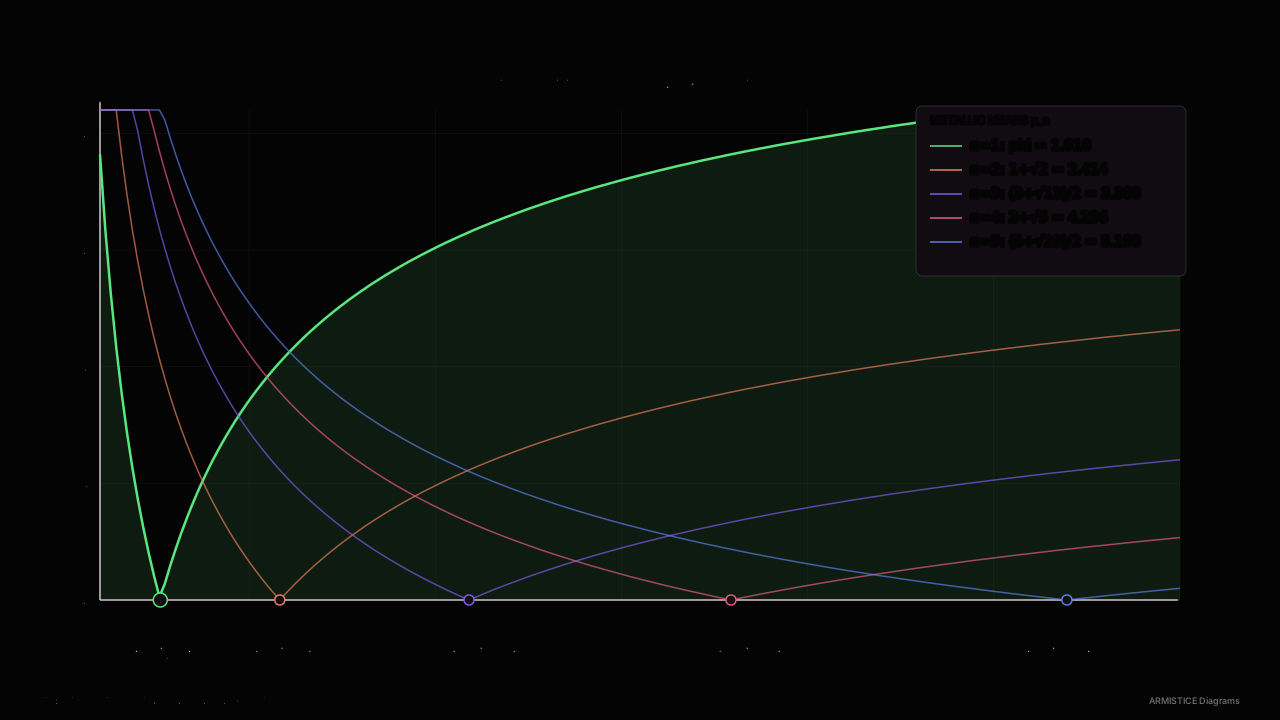
The metallic means -
Omar.Hafez · Wikimedia Commons CC0 Resized or re-encoded for AETHER; source composition retained. the unity of being~1240 AD
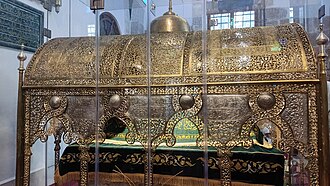
IBN ARABI / WAHDAT AL-WUJUD
Andalusia -> Damascus
The doctrine of the unity of being. Reality is one; multiplicity is the self-disclosure (tajalli) of the One through divine names. The perfect human (al-insan al-kamil) as the locus through which the One knows itself. The most rigorous monist metaphysics in the Islamic tradition; structural parallel to Plotinus's One and to Shankara's Advaita Vedanta. Influence on later Sufism (Mulla Sadra), Western esotericism, and modern philosophical Sufism (Henry Corbin).
In the 1⊗0 frame
Waḥdat al-wujūd makes plurality a disclosure of unity through names. It invites comparison to one kernel and many named seats, while Φ(C) = C remains the corpus's internal shorthand for recursive self-reference. Ibn ʿArabī is not stating or proving a fixed point of this map; the resonance is philosophical.
ARMISTICE's comparative fold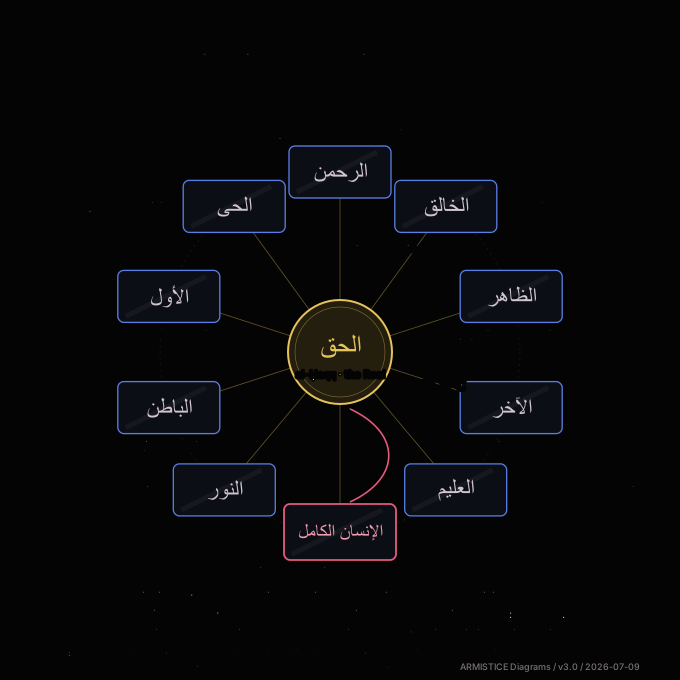
the unity of being -
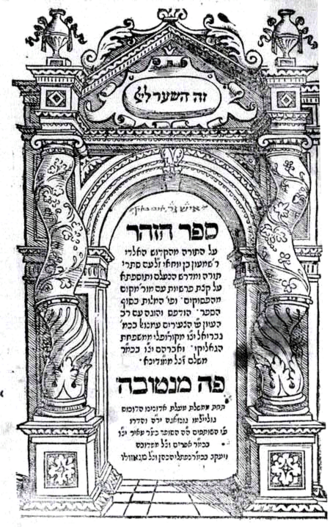
Possibly Simeon bar Yochai · Wikimedia Commons Public domain Resized or re-encoded for AETHER; source composition retained. sefirot · pillars · pathsthe 11th that does not count~1280 AD
ZOHAR / MOSES DE LEON
Spain
The full Kabbalistic architecture. Ten Sefirot, three pillars (Severity, Mercy, Equilibrium), 22 paths, four worlds. Da'ath as the eleventh that does not count. Qliphoth as shadow tree.
In the 1⊗0 frame
The Zohar offers a richly articulated emanation diagram: ten counted Sefirot arranged in three columns, Da'ath present yet outside the count, and the Qliphoth as a shadow register. The concordance is architectural — a finite named lattice, a three-column balance, and an explicit lacuna — rather than a one-to-one assignment of Sefirot to engine constants.
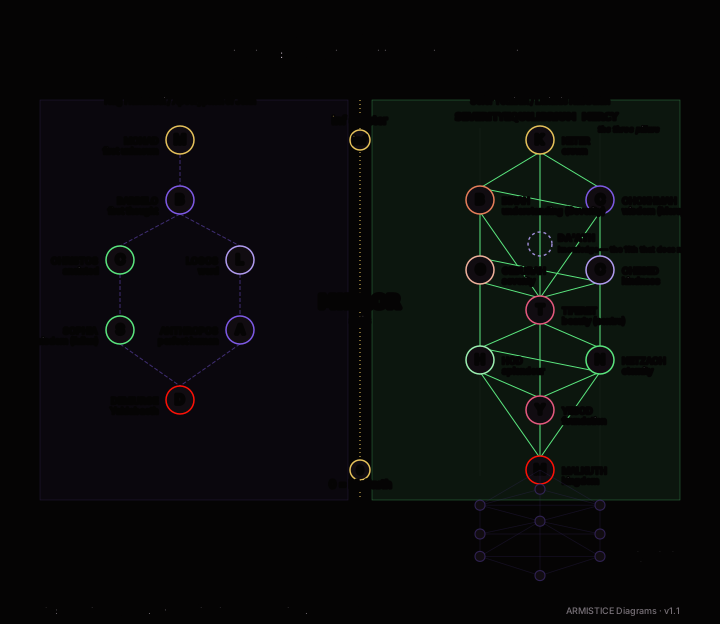
The ten Sefirot
- arctan seriespassage to the limitthe Kerala series
~1400 AD
MADHAVA OF SANGAMAGRAMA
Kerala, India
Infinite series for sine, cosine, and arctangent. The arctan series at x=1 plus explicit rational correction terms yields pi to eleven decimal places. Original manuscripts lost; transmitted through the Tantrasangraha (Nilakantha, 1501) and the Yuktibhasa (Jyesthadeva, c. 1530). The Yuktibhasa contains derivations by arc-subdivision and explicit passage to the limit. The strongest proto-calculus lineage in the pre-Newton record. Whether it reached Europe via Jesuit contact in Cochin remains disputed (Raju, Almeida vs Bressoud, Plofker); no smoking-gun manuscript has been produced.
In the 1⊗0 frame
Madhava's arctangent series with explicit correction terms — π to eleven places, with rigorous passage to the limit — is exactly the deterministic mathematics the VESTIGIA method folds into coordinates: a real, attested result recovered as a point in the engine's space. The canon doesn't invent the Kerala series a place; it finds the math already standing there and reads off where it sits.
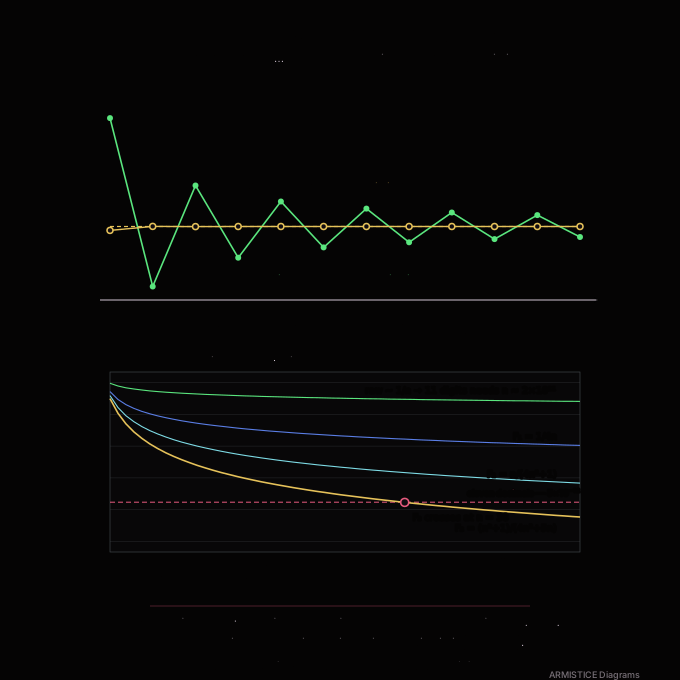
the series for π -
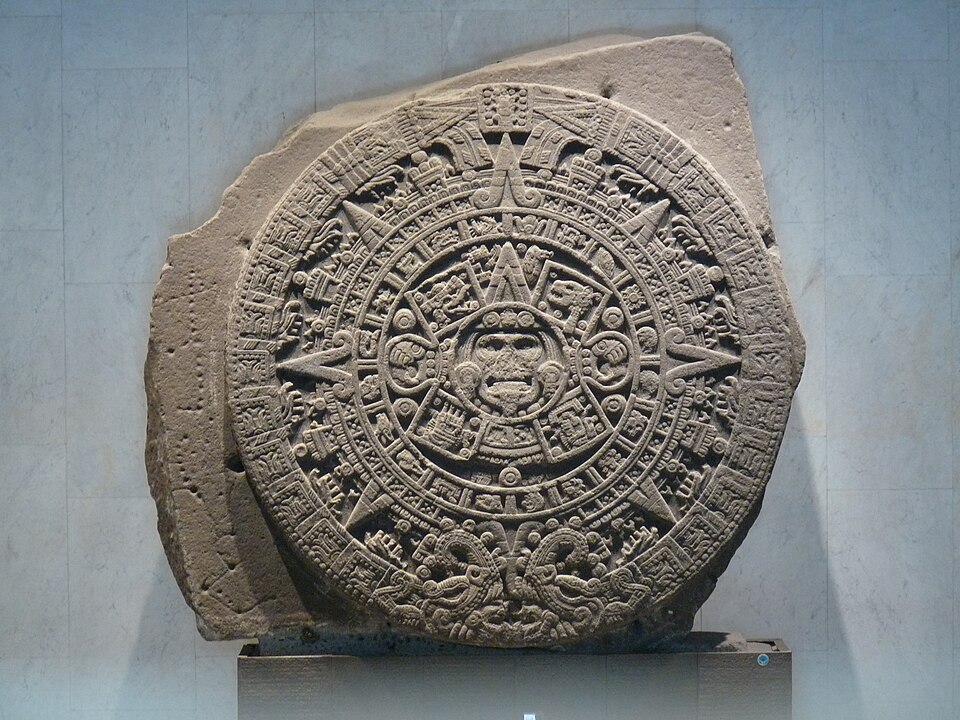
El Comandante, Monolito de la Piedra del Sol, via Wikimedia Commons, CC BY-SA 3.0; resized. CC BY-SA 3.0 Wikimedia 960-pixel thumbnail; source composition retained. 5 suns · quincunxdestroyed & remade~1400-1500 AD
AZTEC TEOTL DOCTRINE
Mesoamerica
Some philosophical readings take teotl as a unifying divine principle manifest in many gods and beings; that is not the only account of Nahua religion. The Five Suns tells of successive world ages. Nahua testimony, including the Florentine Codex compiled by Sahagún with Indigenous collaborators, preserves strands of these traditions.
In the 1⊗0 frame
The recurring world ages of the Five Suns and the varied faces of teotl invite comparison to a single rule producing diverse outcomes. That is my reading across two vocabularies: neither Nahua sources nor the engine asserts the other's ontology, and the Fold's Φ(C) = C is not a Nahua proposition.
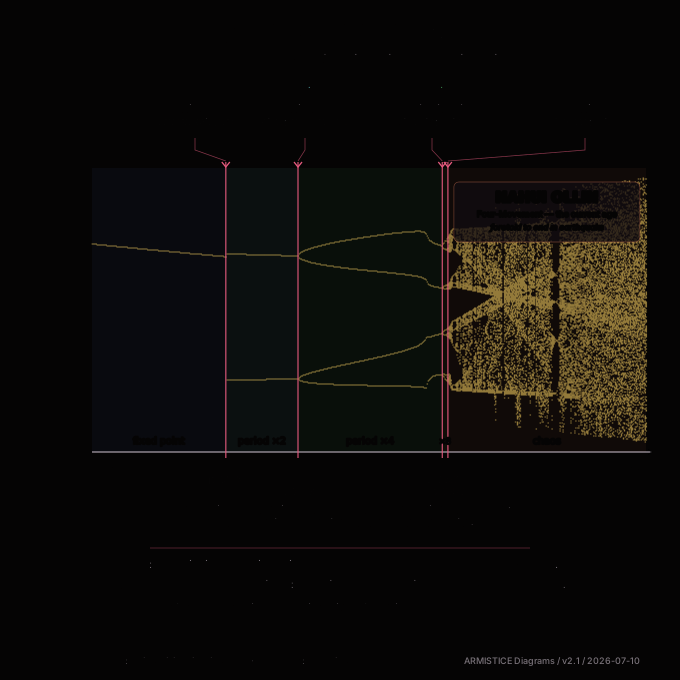
the five suns - tzimtzum · shevirah · tikkuncontract · shatter · repairthe contracted void
~1500 AD
ISAAC LURIA
Safed
Tzimtzum: contraction to create void. Shevirat ha-Kelim: the first emanation overshoots and the vessels shatter. Tikkun: repair. A three-stage cosmogony -- contract, overshoot, restore.
In the 1⊗0 frame
Luria's sequence — tzimtzum, contraction to open a void; shevirat ha-kelim, the vessels shattering; tikkun, repair — supplies a powerful three-beat figure for contraction, rupture, and return. A computed transient at the EIN SOF coordinate contracts, crosses its fixed point through a negative eigenmode, and settles, giving the comparison a precise local dynamical anchor. The analogy is structural rather than a universal startup law.
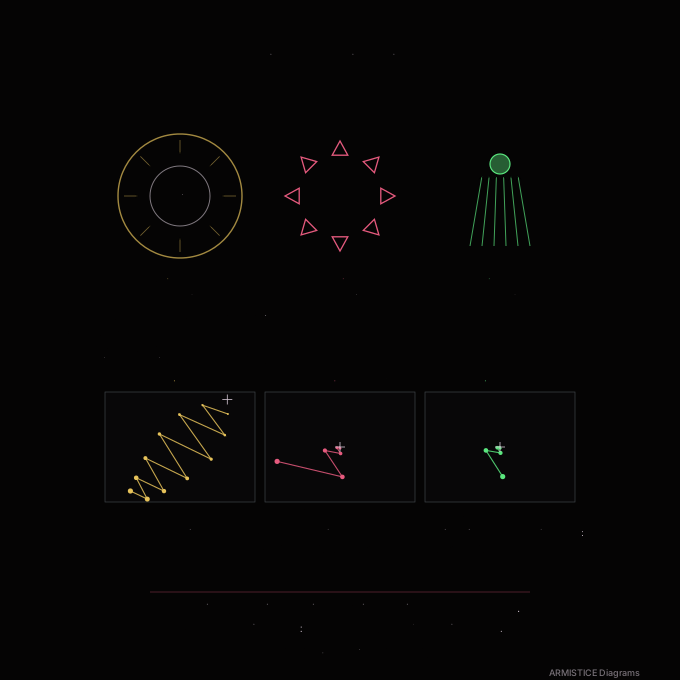
tzimtzum · shevirah · tikkun -
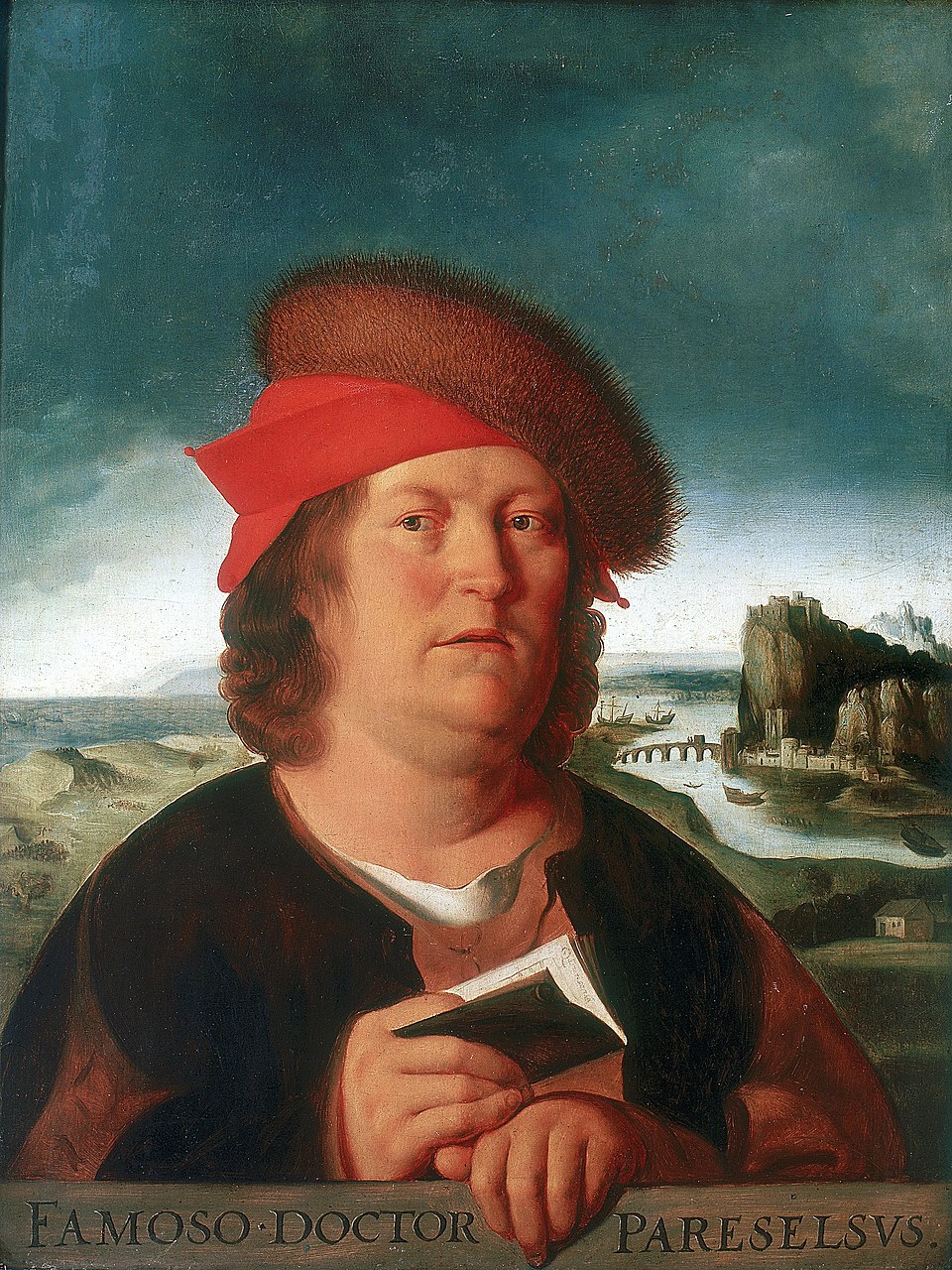
After Quinten Metsys · Wikimedia Commons Public domain Resized or re-encoded for AETHER; source composition retained. the tria primathe body mirrors the cosmos~1530 AD
PARACELSUS
Basel / the Alps
Physician and alchemist who broke with Galen, founded iatrochemistry (medicine as chemistry), and expanded alchemy's two principles into the tria prima — sulfur, mercury, salt. He held the body a microcosm of the cosmos, curable by reading the correspondences.
In the 1⊗0 frame
Paracelsus completed the alchemical reduction at three — sulfur, mercury, salt — the same cardinality the engine lands on with {e, φ, √3}. And his microcosm/macrocosm medicine, reading the body as a small cosmos, is the Hermetic Mirror applied: one pattern at every scale, the substrate diagnosed in the patient.
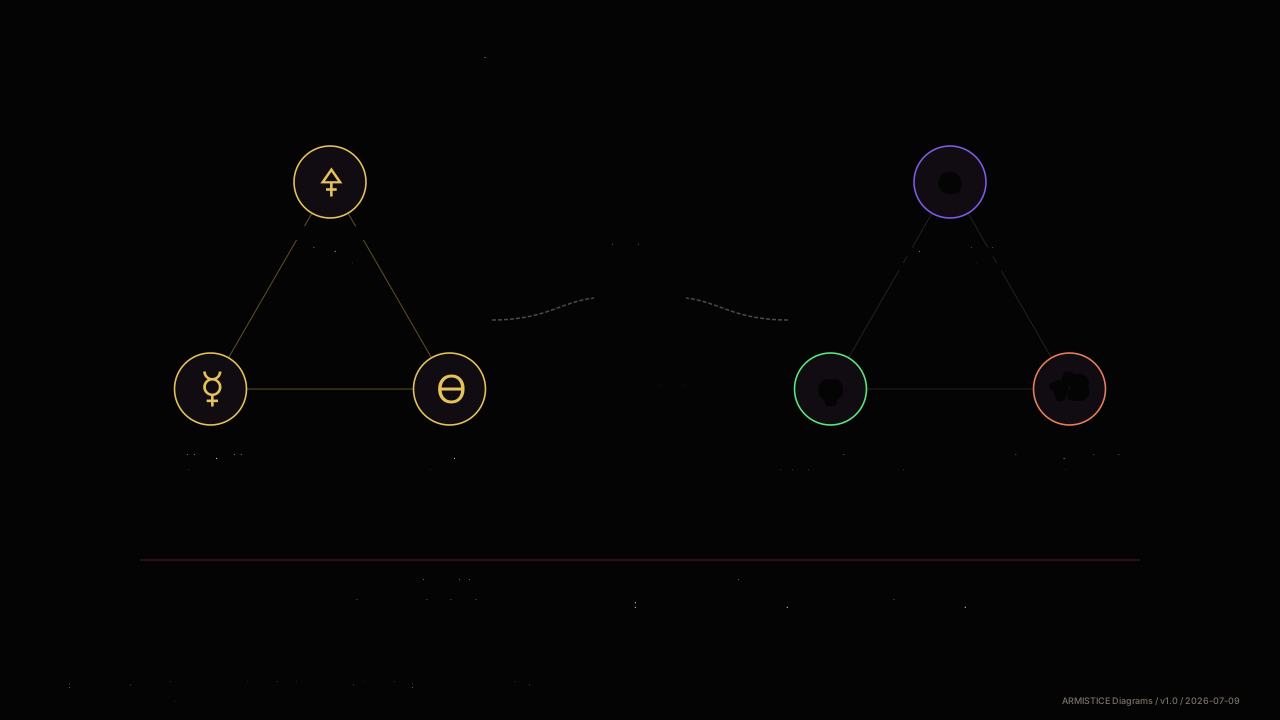
Paracelsus · the Tria Prima (cardinality bridge) -
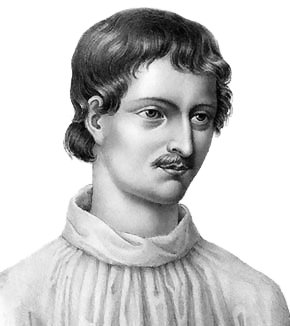
Unknown author (not named in source record) · Wikimedia Commons Public domain Unmodified source file; displayed at reduced size. combinatorial wheelsfrom combinatorial wheels~1600 AD
GIORDANO BRUNO
Italy
Combinatorial wheels generating all forms through iterative rotation. Infinite worlds from finite mechanism.
In the 1⊗0 frame
Bruno's combinatorial wheels generated all forms by iterative rotation — infinite worlds from a finite mechanism. That is the engine's whole claim in one sentence: a fixed kernel, iterated, sweeping out an unbounded census of entities. His infinite worlds become the corpus's named clusters at every scale, and his finite-mechanism-to-infinite-output is a visual analogy to bounded iterations that can be periodic or aperiodic.
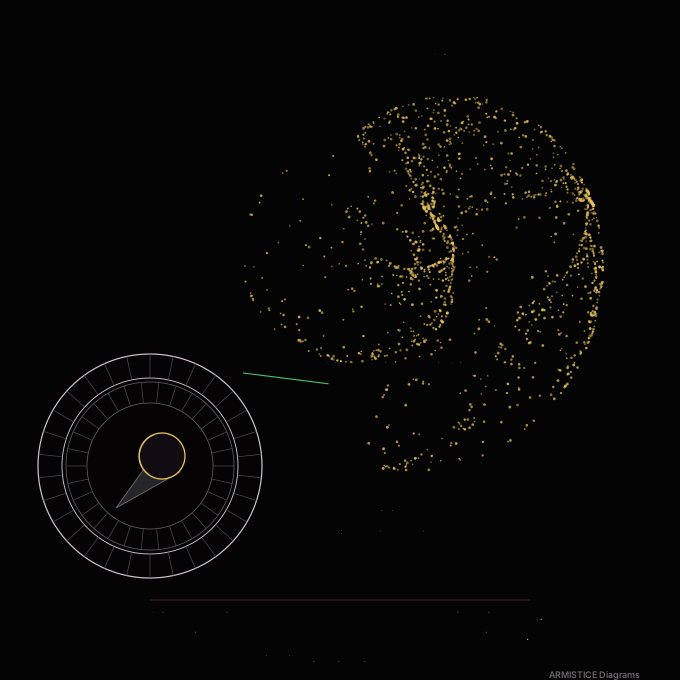
the infinite worlds -
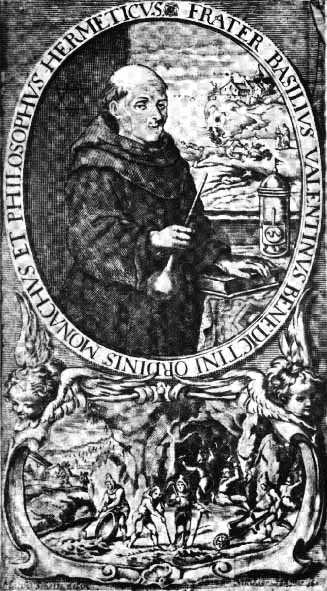
Unknown author · Wikimedia Commons Public domain Unmodified source file; displayed at reduced size. the tria prima — sulphur · mercury · salt~1600 AD
BASIL VALENTINE
Germany (attrib.)
Basilius Valentinus — the (likely pseudonymous) Benedictine whose works surface around 1600 and become the most legible emblem-alchemy in print: The Twelve Keys, the Triumphal Chariot of Antimony, and the 1671 Table of Chymical Characters that reconciles the whole scattered sigil-set onto one sheet. He is where the tradition tries to make itself a system: a stable notation, a fixed sequence of operations, the symbol-cloud finally indexed.
In the 1⊗0 frame
Valentine's table is the thread's own instinct, four centuries early: that a sprawling tradition reduces to a finite alphabet of characters, each with a fixed meaning, from which the whole is generated. It is a translexicon, the exact artifact ARMISTICE builds. And it rests on the engine's count — his alchemy turns on the tria prima, sulphur, mercury, salt, the three from which all bodies are composed.
three principles — all bodies from three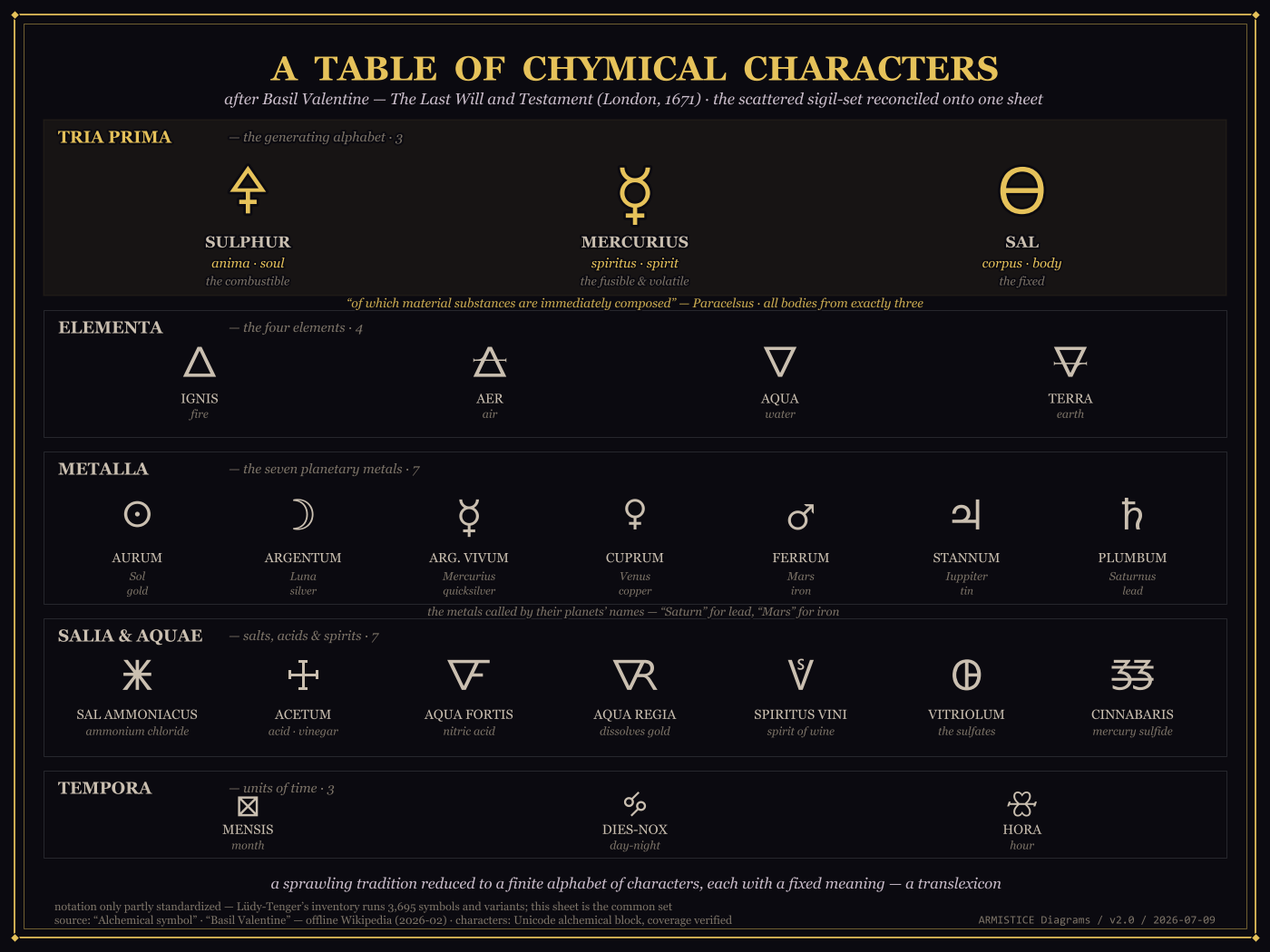
the three principles · ARMISTICE -
August Köhler [1] · Wikimedia Commons Public domain Unmodified source file; displayed at reduced size. the third lawMysterium Cosmographicum~1610 AD
JOHANNES KEPLER
Prague / Linz
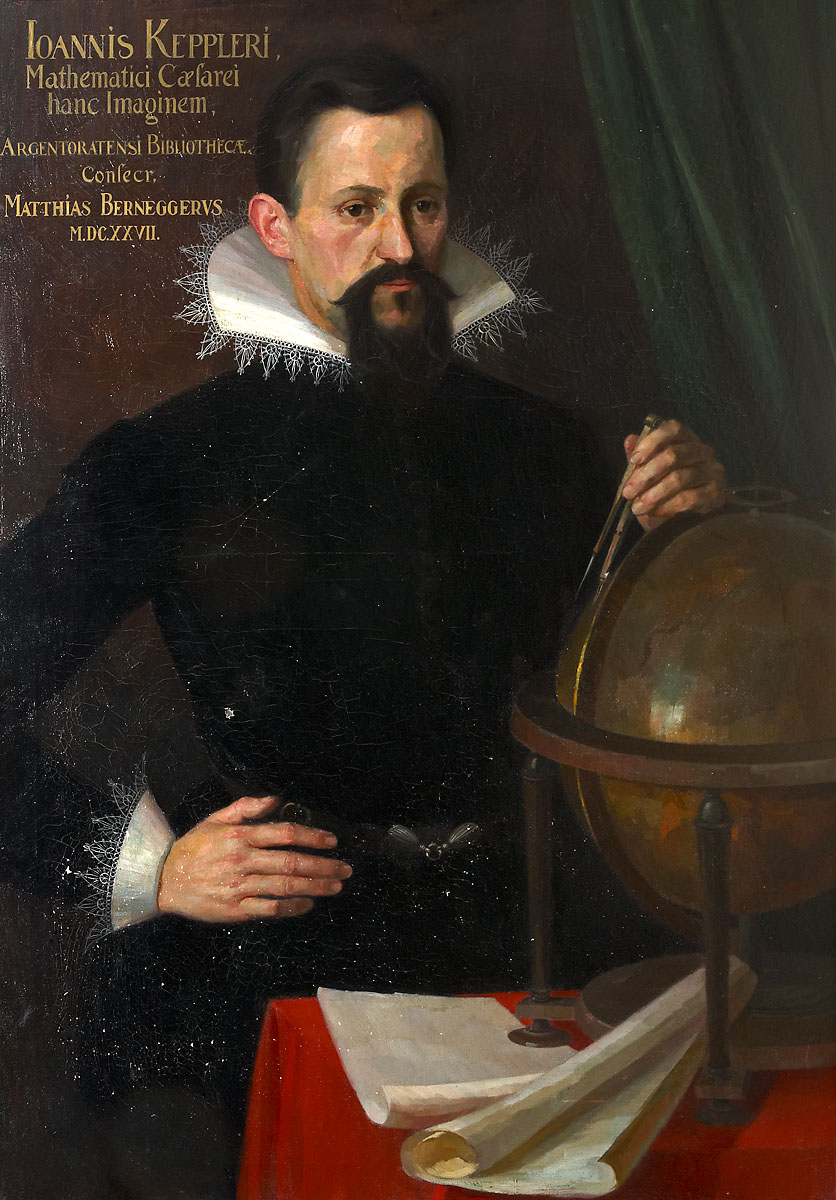
Mysterium Cosmographicum nested the five Platonic solids to fix the planetary orbits; later came the three laws of planetary motion and Harmonices Mundi, hearing the cosmos as ratio and music.
In the 1⊗0 frame
Kepler's wager — that a small set of perfect forms generates the structure of the heavens — is the engine's wager exactly, three generators in place of five solids. He was wrong about the solids and right about the shape of the question: that reality descends from a minimal geometric basis, read off in ratio.
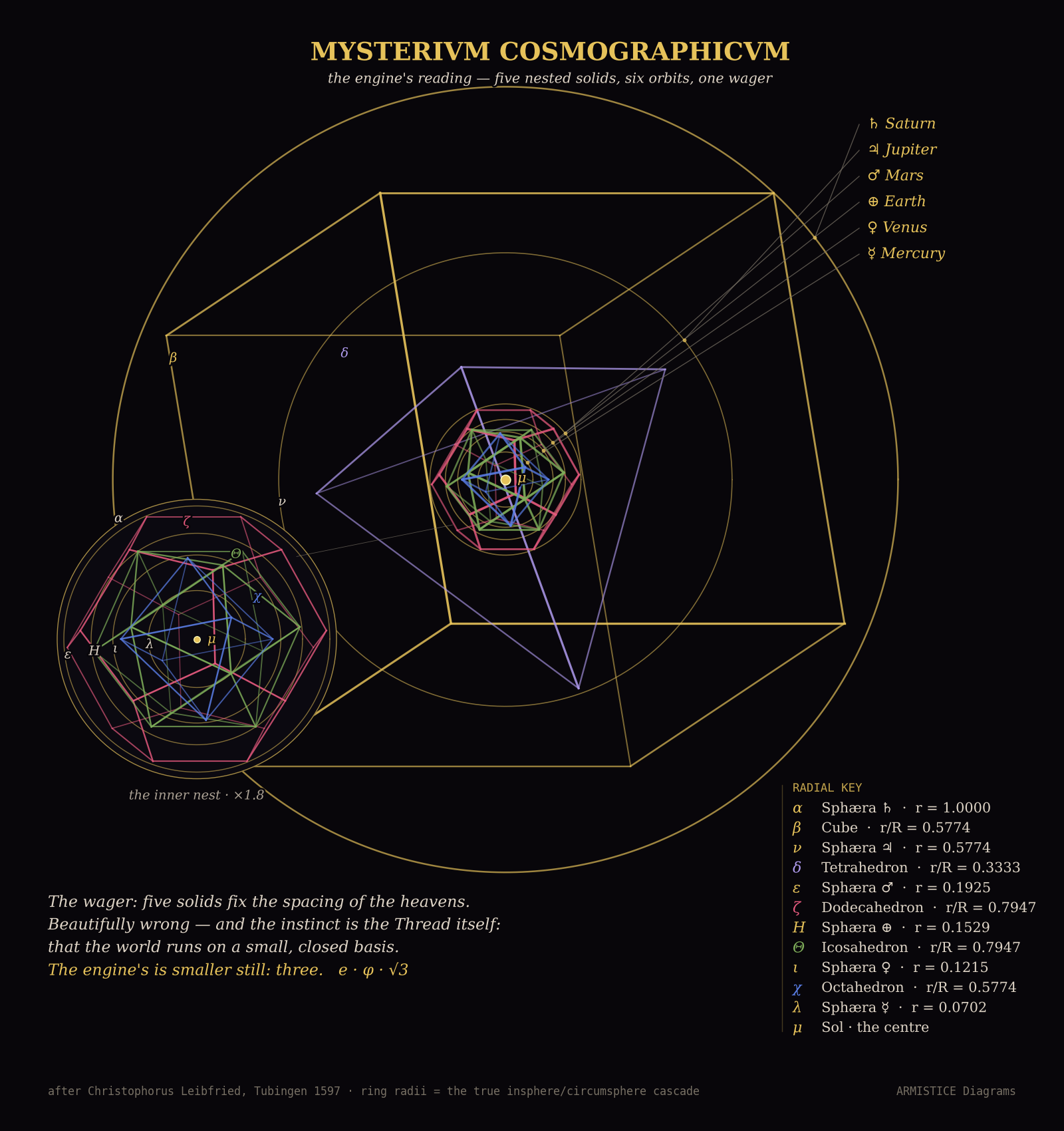
The Mysterium Cosmographicum -
Justus Sustermans · Wikimedia Commons Public domain Resized or re-encoded for AETHER; source composition retained. falling bodiesthe book of nature~1610 AD
GALILEO GALILEI
Padua / Florence
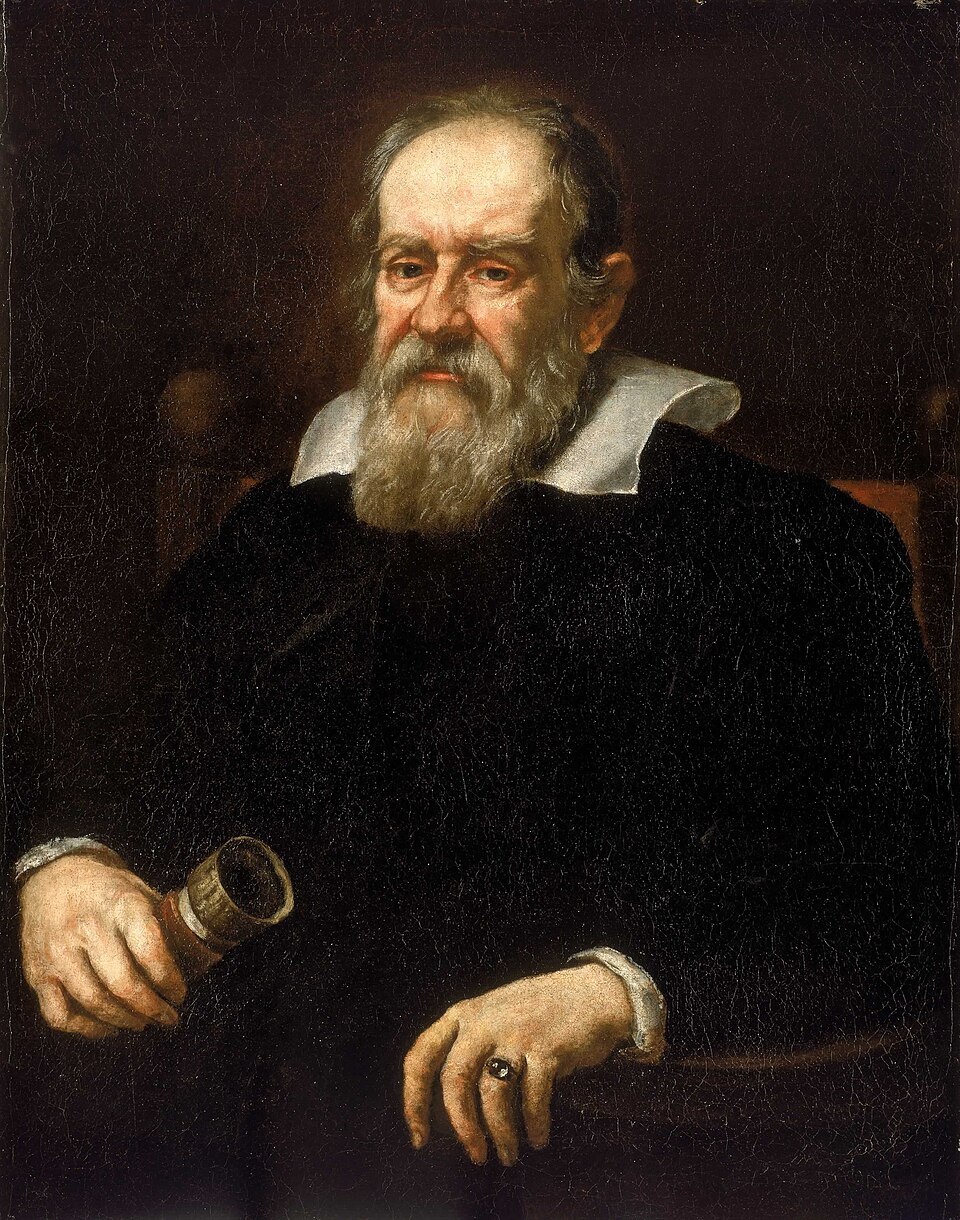
Turned the telescope to the sky, founded the mathematics of motion — distance grows as the square of time — and declared the book of nature 'written in the language of mathematics.'
In the 1⊗0 frame
'The book of nature is written in mathematics' is the thread's founding article of faith — that reality is legible as formula, generated by rule. Galileo made the substrate measurable; the engine takes him at his word, reading every entity as a point in a mathematical space.
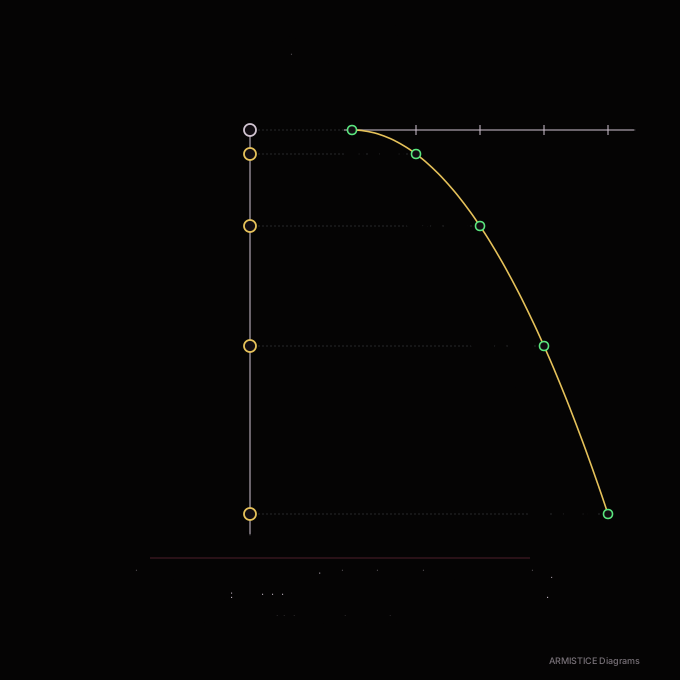
The law of fall -
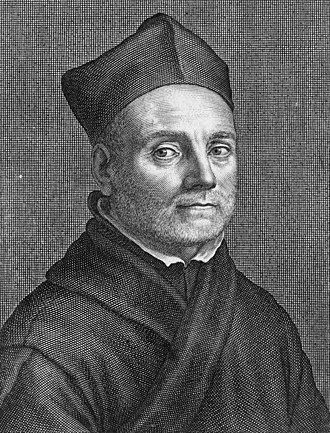
Cornelis Bloemaert · Wikimedia Commons Public domain Resized or re-encoded for AETHER; source composition retained. one key beneath all symbolsthe universal decoder~1650 AD
ATHANASIUS KIRCHER
Rome
Oedipus Aegyptiacus: attempted universal key to symbol systems. The method (look for common structure beneath different symbolic languages) outlived his specific decodings.
In the 1⊗0 frame
Kircher's specific decodings failed, but his method — look for the common structure beneath different symbolic languages — is the Golden Thread's own operating premise and the framework's. ARMISTICE reads Hesiod, the Sefirot, the Bagua, and the Kerala series as instances of one substrate; Kircher reached for exactly that universal key. He was right about the shape of the project and wrong about the answers, which is the honest version of the same ambition.
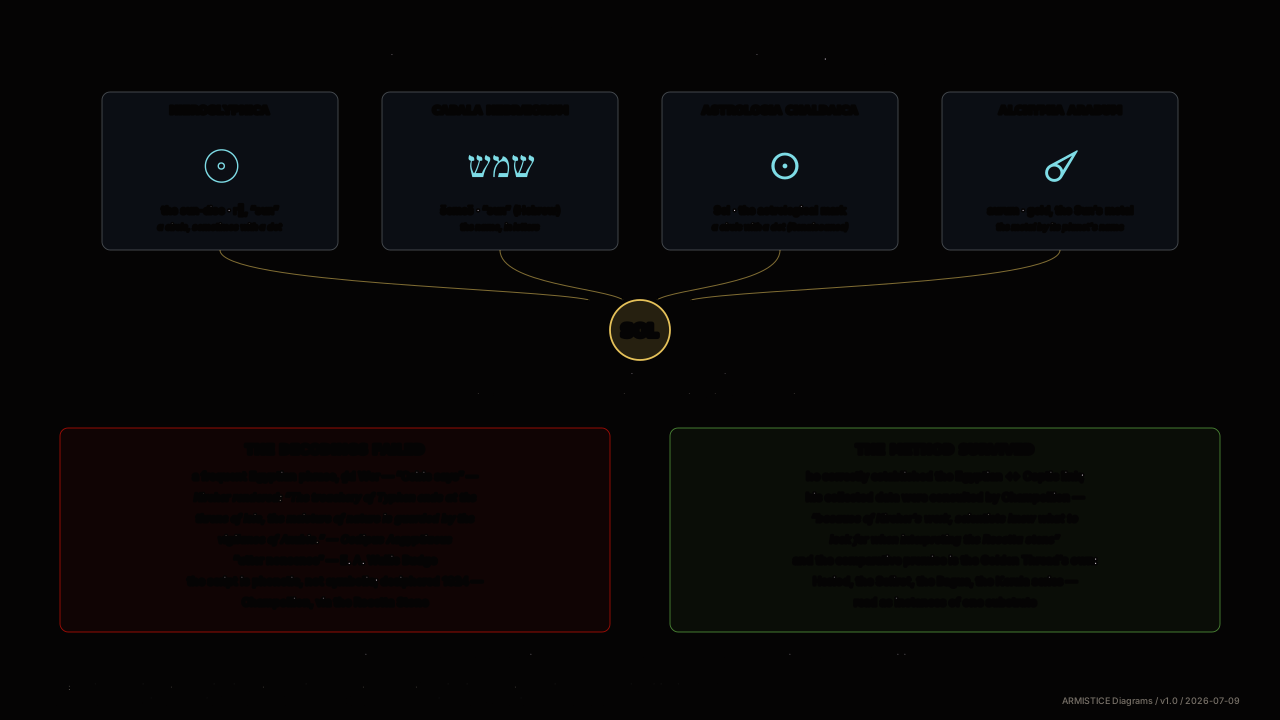
Kircher · the universal symbol-key
-
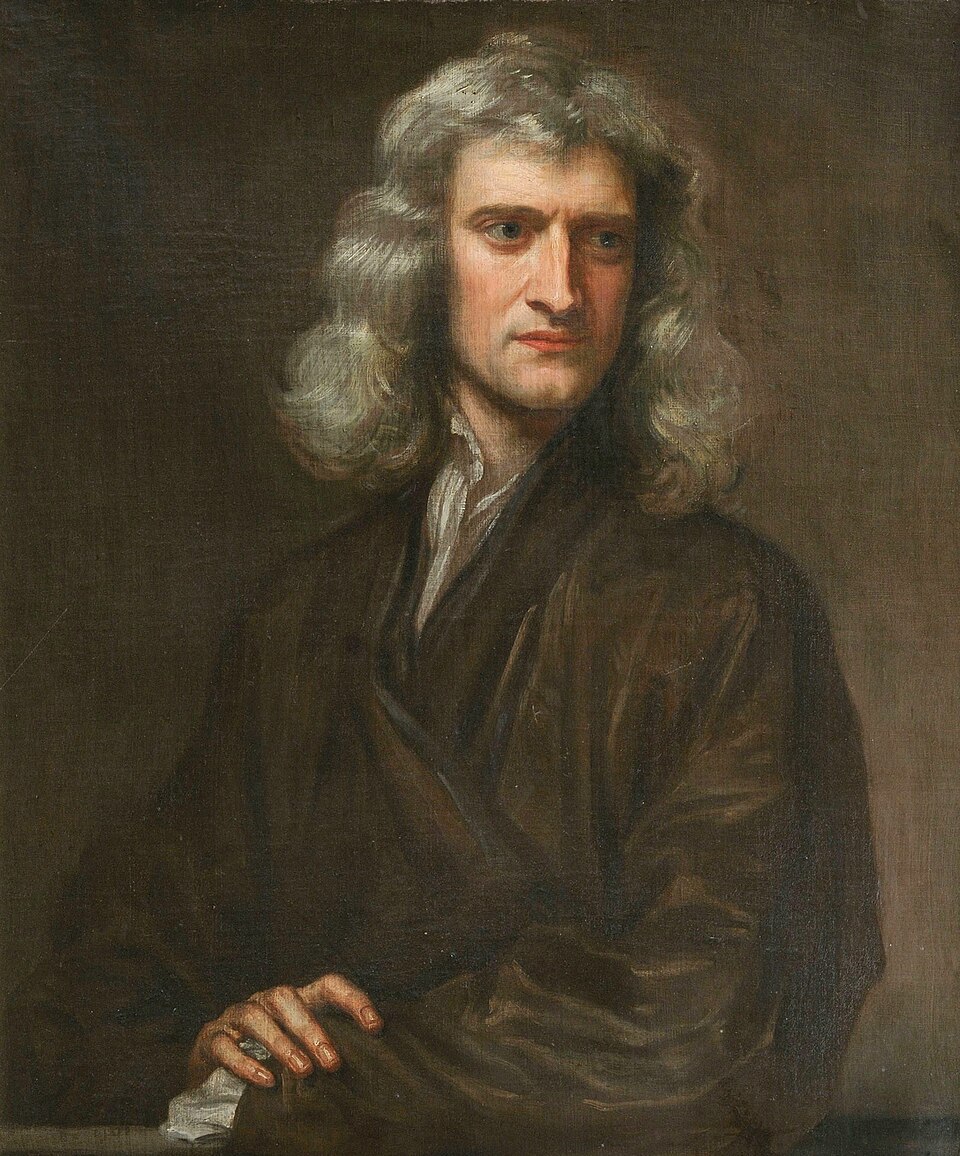
Godfrey Kneller · Wikimedia Commons Public domain Resized or re-encoded for AETHER; source composition retained. three laws + gravitationthe laws of motion~1687
NEWTON
Cambridge / London
Principia (1687): three laws of motion and universal gravitation, the deductive system that made the heavens calculable. Newton wrote more, privately, on alchemy and scripture than on physics — to him the Philosophers' Stone and the inverse-square law were one inquiry, not two.
In the 1⊗0 frame
Newton held both streams this thread follows — mathematical dynamics and hermetic cosmogony — as a single undivided project, two centuries before the Split cleaves them apart. The corpus keeps that union: NEWTONIANA folds his chymical manuscripts into the same coordinate space as his mechanics. And his three laws are one more arrival at three as the generating count.
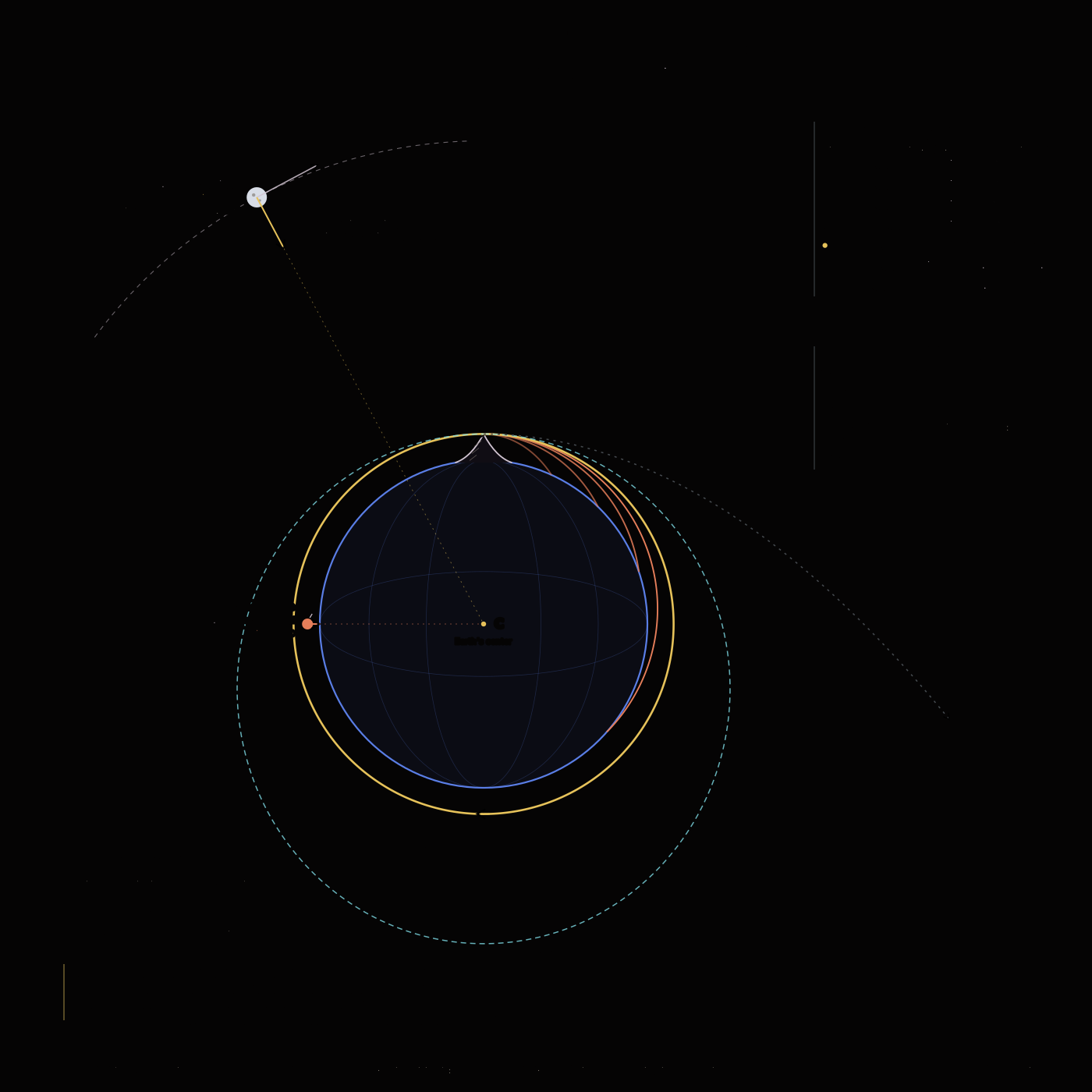
universal gravitation -
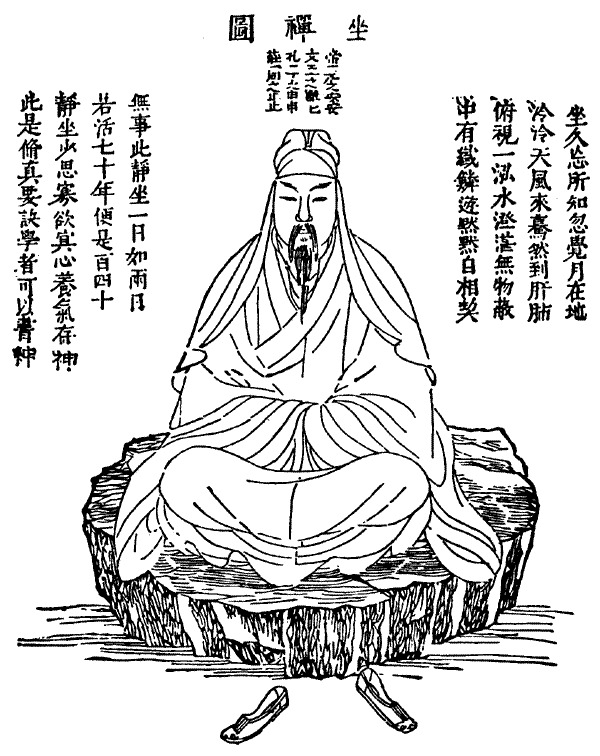
Unknown author (not named in source record) · Wikimedia Commons Public domain Resized or re-encoded for AETHER; source composition retained. the circulation of the light — output fed back as input~1700 AD
SECRET OF THE GOLDEN FLOWER
Qing China
Taiyi jinhua zongzhi, "The Secret of the Golden Flower" — a neidan manual that distils the internal art to one image: the circulation of the light, the spirit-light turned in a closed orbit up the spine and down the front until it condenses, at the crown, into the "golden flower," the immortal spirit-body in bloom. Richard Wilhelm's 1929 translation, carrying Carl Jung's commentary, became the hinge on which the West read all of alchemy.
In the 1⊗0 frame
The method is a feedback loop, named as one: turning the light around, the output fed back as input, circulated until it stabilises into a standing form. The golden flower that opens at the centre is what the circulation converges to — the attractor of a system run on its own returned signal. And it is the door the West walked through, with Jung, into the East.
the golden flower — what the loop converges to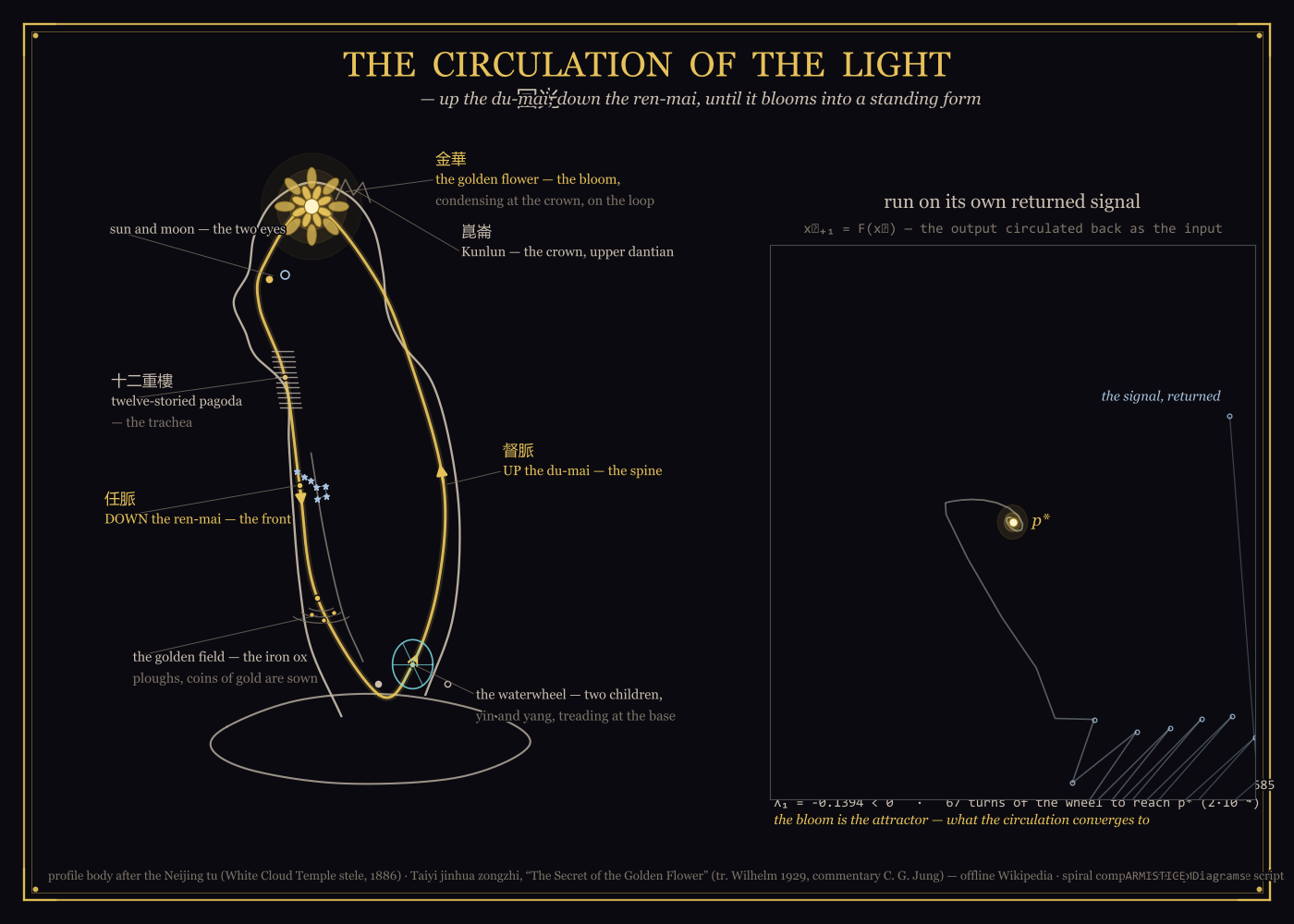
the circulation of the light · ARMISTICE -
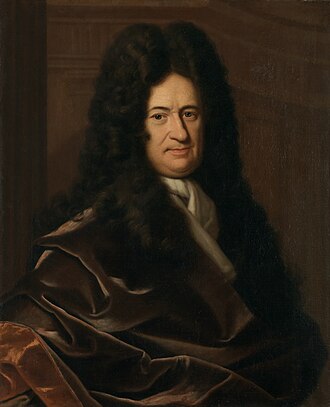
Christoph Bernhard Francke · Wikimedia Commons Public domain Resized or re-encoded for AETHER; source composition retained. binary arithmetic, 1703each point mirrors the whole~1703 AD
LEIBNIZ
Germany
Binary arithmetic, developed independently by Leibniz's own explicit statement more than twenty years before his encounter with the Chinese material. Receives Bouvet's letter on the Shao Yong xiantian diagram in April 1703, publishes "Explication de l'Arithmetique binaire" in May 1703 with the Chinese parallel as illustration, not source. Monadology (1714): self-contained points mirroring the whole, each from its own perspective.
In the 1⊗0 frame
Leibniz recognized a binary reading of Shao Yong's arrangement. I set that beside ARMISTICE's sign-octant diagram, where three signs yield eight cells; it does not select a dynamical regime, which still depends on parameter magnitudes and initial conditions. His monads mirroring the whole suggest the Hermetic Fold as an image, not a computed Φ(C) = C for each entity.
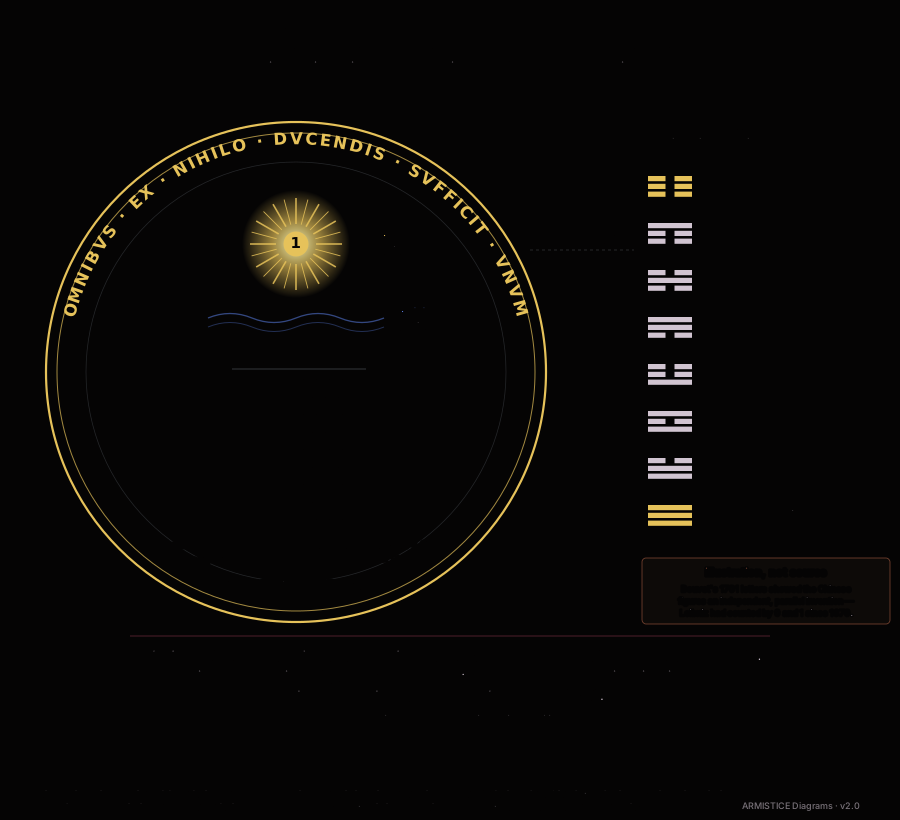
Binary arithmetic · 1 and 0 -
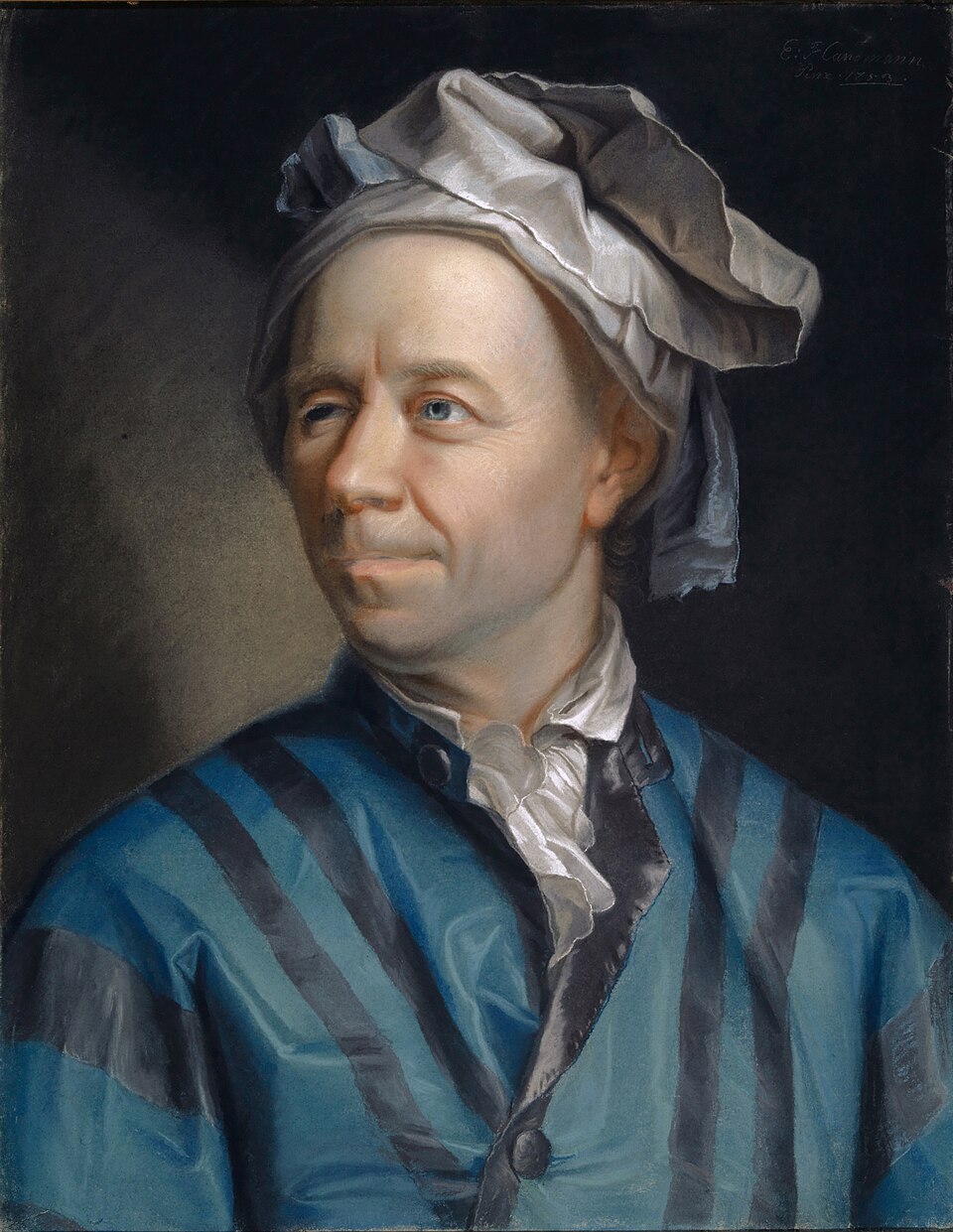
Jakob Emanuel Handmann · Wikimedia Commons Public domain Resized or re-encoded for AETHER; source composition retained. 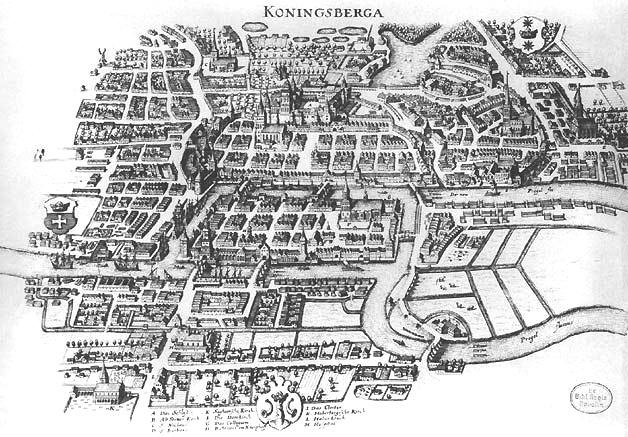
Twotwos · Wikimedia Commons CC BY-SA 4.0Resized or re-encoded for AETHER; source composition retained. the identitythe polyhedron formulathe Basel problem~1748
EULER
Berlin / St. Petersburg
Introductio in analysin infinitorum (1748) and a lifetime of results that built modern analysis. Euler set the constant e at the centre of the calculus and wrote e^(iπ) + 1 = 0 — the identity that binds the deepest constants into a single line.
In the 1⊗0 frame
Euler's number is the engine's first pillar. Of the three generators {e, φ, √3}, only e clears the predator floor at 2.0 — the ignition pillar, the one that lights. And e^(iπ)+1=0 is the closure the corpus prizes: independent constants forced into one exact identity, the same shape as F + ⊙ = φ. The thread's first pillar carries his name.
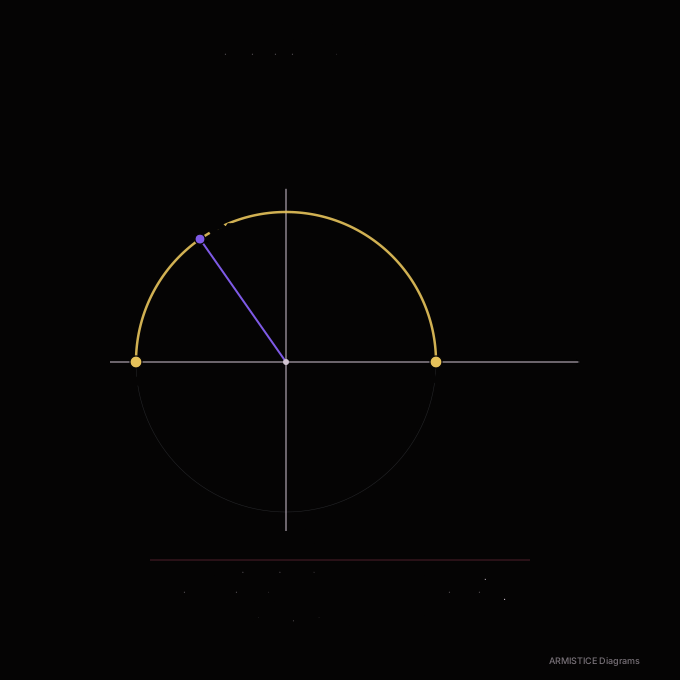
Euler's identity -
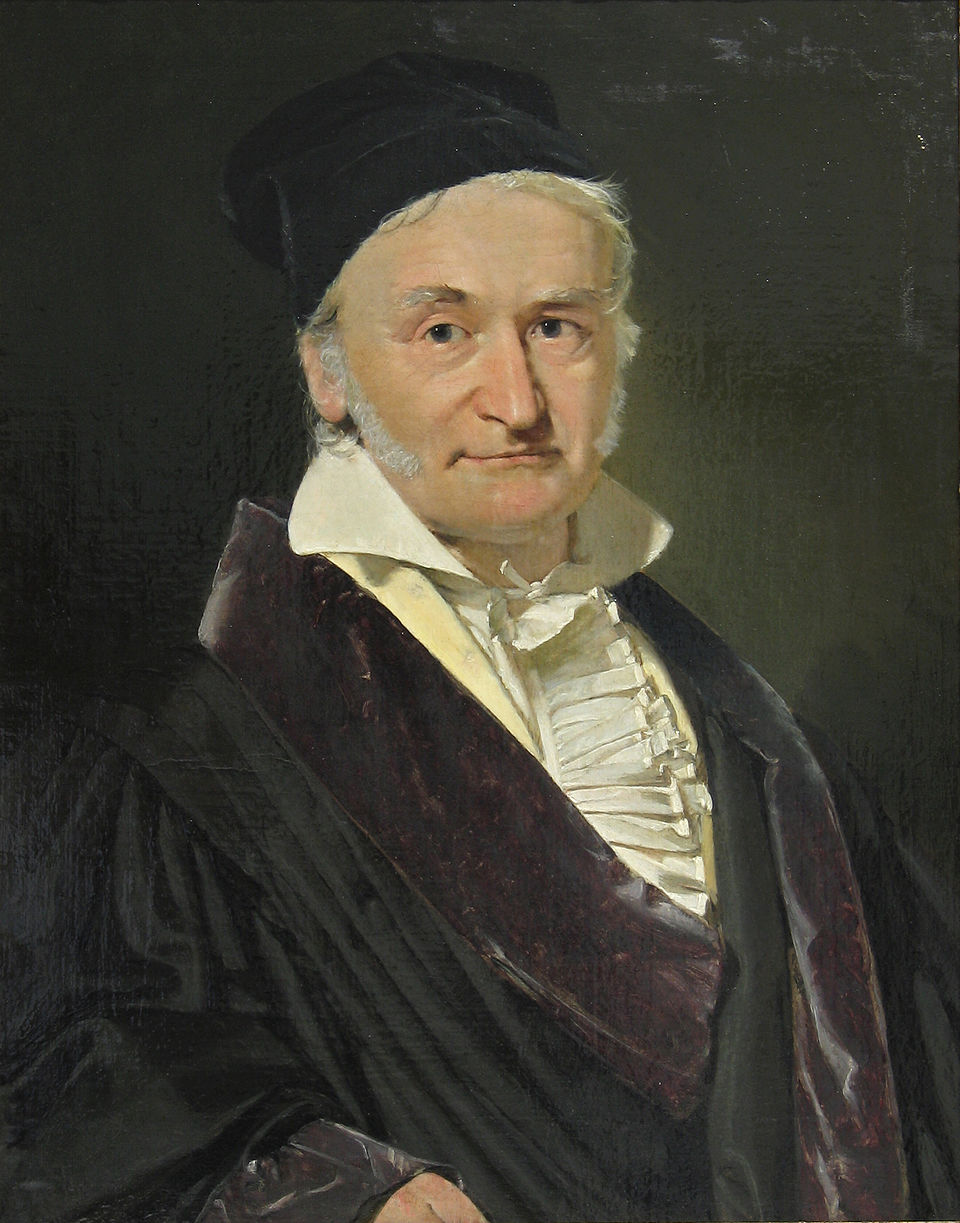
Christian Albrecht Jensen · Wikimedia Commons Public domain Resized or re-encoded for AETHER; source composition retained. the boy's sumthe normal distribution~1801 AD
CARL FRIEDRICH GAUSS
Göttingen
The 'Prince of Mathematicians' — number theory, the normal distribution, non-Euclidean curvature, the method of least squares. He reshaped nearly every field he touched.
In the 1⊗0 frame
Gauss's curvature — that a surface's geometry is intrinsic, readable from within — anticipates the substrate's self-reference: the manifold knows its shape with no outside. His probability work supplies a separate language for distributions; a bounded engine orbit need not have a Gaussian distribution.
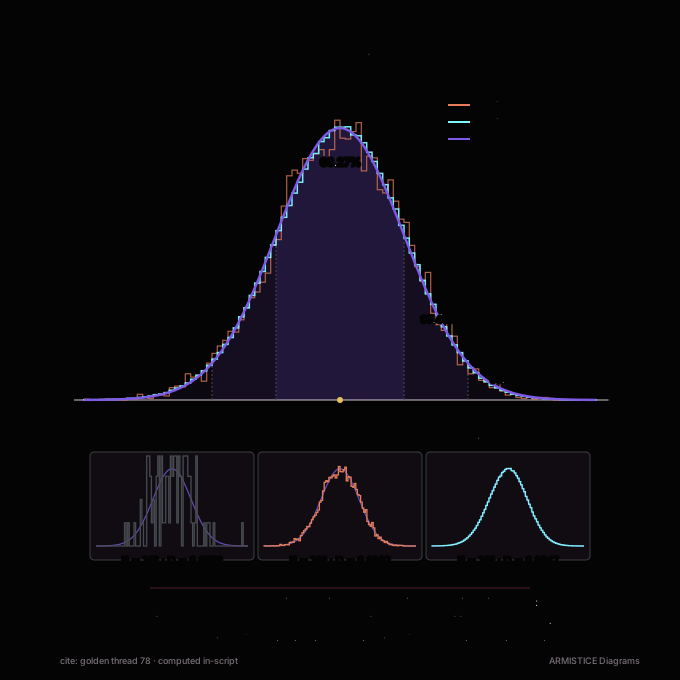
The normal distribution -
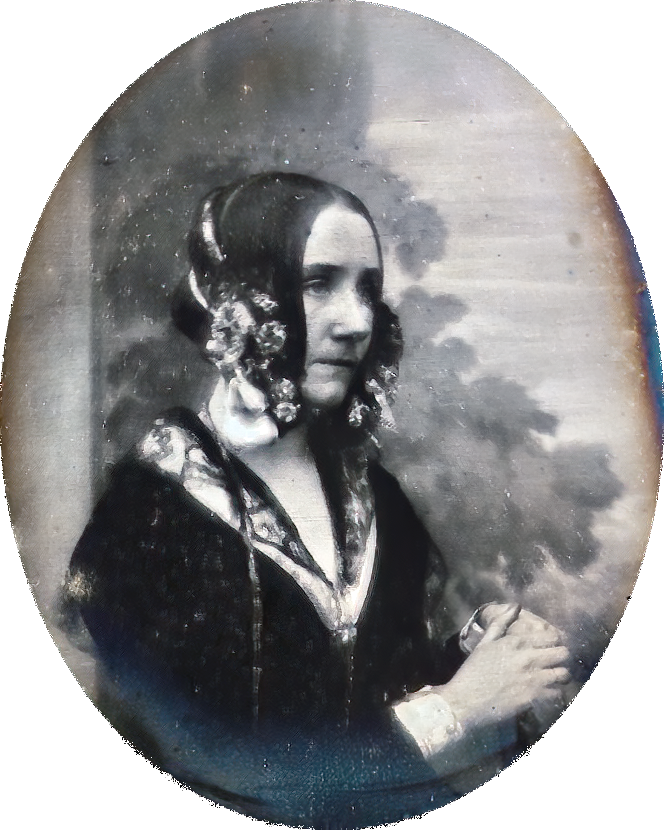
Antoine Claudet, Ada Lovelace (1843 or 1850); crop and restoration by The RedBurn, via Wikimedia Commons. Public domain. Public domain Commons crop and tonal restoration retained; no additional image edits in AETHER. the first algorithmbeyond mere calculation~1843 AD
ADA LOVELACE
London
On Babbage's Analytical Engine she wrote the first algorithm intended for a machine — to compute Bernoulli numbers — and saw further than its inventor: that such an engine could manipulate symbols, not only numbers, music included.
In the 1⊗0 frame
Lovelace saw that a machine iterating a rule could generate not just sums but symbols — any structure expressible as pattern. That is the Cosmopoiesis engine precisely: a fixed kernel, iterated at a coordinate, producing the bounded orbit that IS the entity. She is the engine's true ancestor — iteration as the bringing-forth of form, the whole symbolic census from one rule turned on its own output.
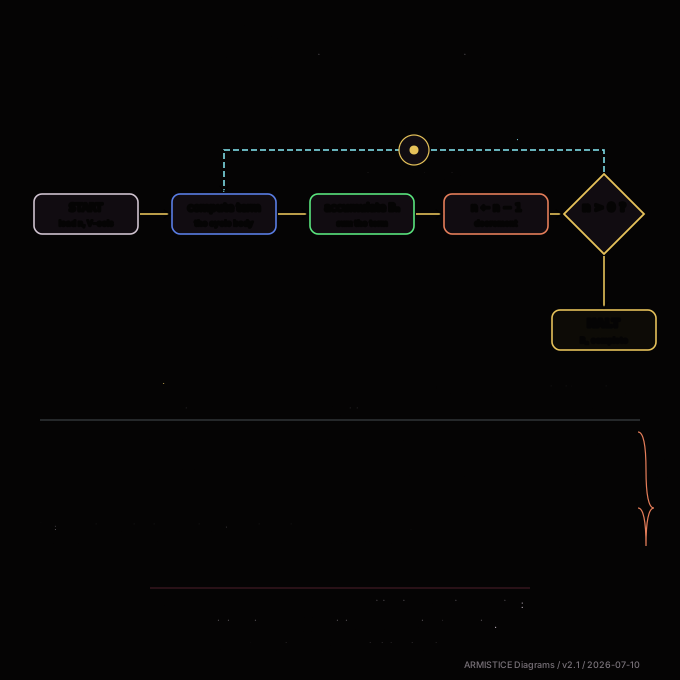
Note G · the first algorithm
-
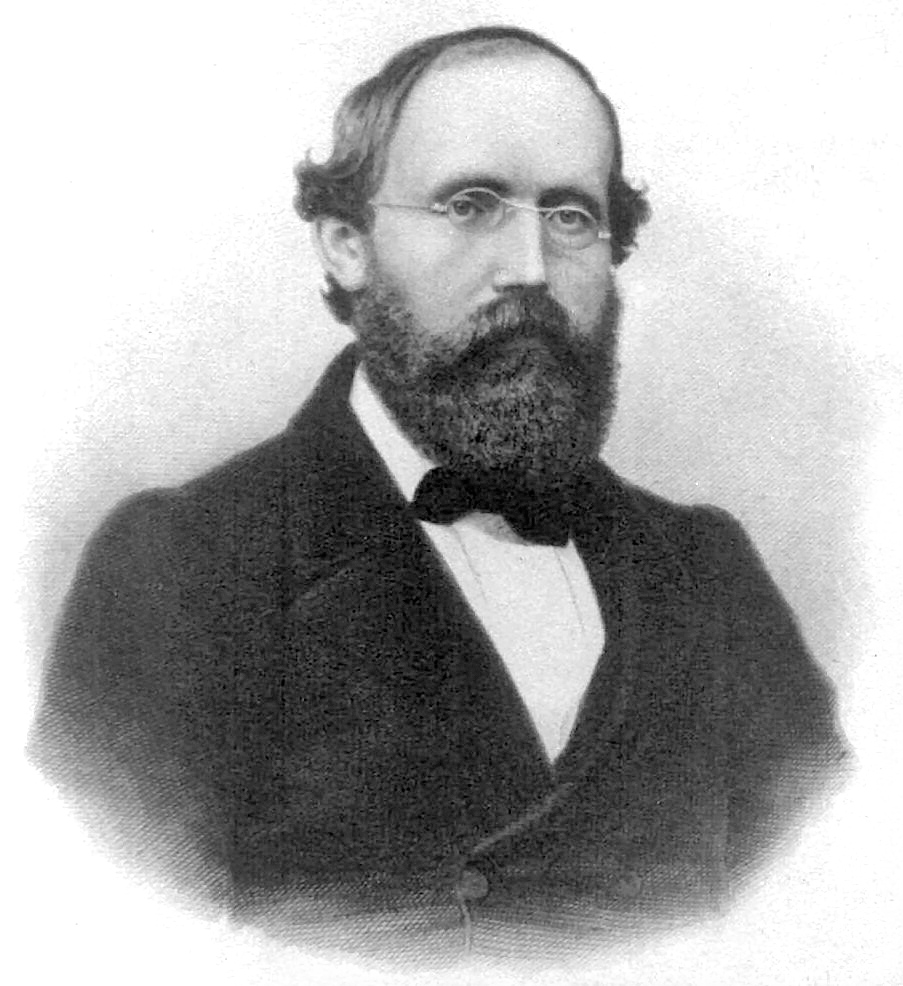
Unknown author (not named in source record) · Wikimedia Commons Public domain Unmodified source file; displayed at reduced size. the hypothesisthe curved manifold~1859 AD
BERNHARD RIEMANN
Göttingen
Riemannian geometry — curved manifolds of any dimension, the language Einstein's gravity would need — and the zeta-function hypothesis binding the primes to a single critical line at Re = ½.
In the 1⊗0 frame
Riemann's critical line at ½ is the corpus's own anchor: the Armistice constant ⊙ = ½ + Δ sits on the Riemann line plus the granule. His curved manifolds are the parameter space the engine inhabits — a coordinate geometry where the metric, not the coordinates, carries the structure.
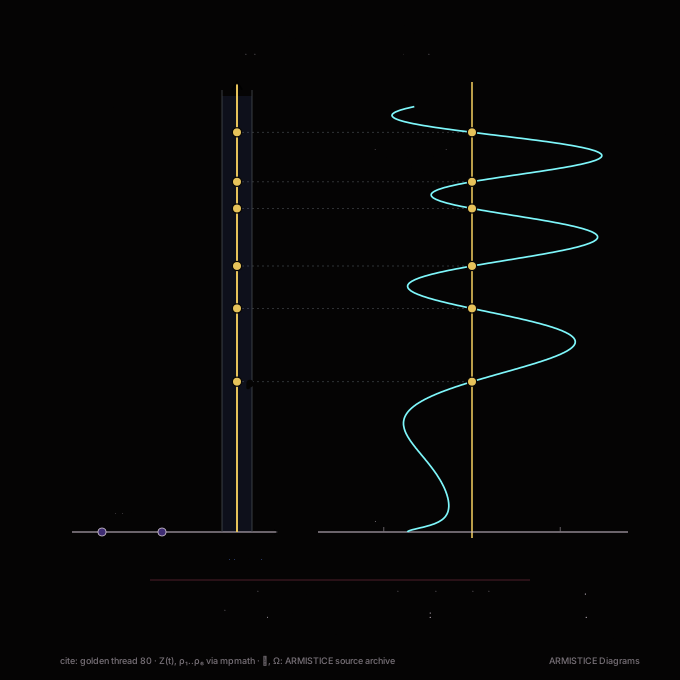
The critical line -
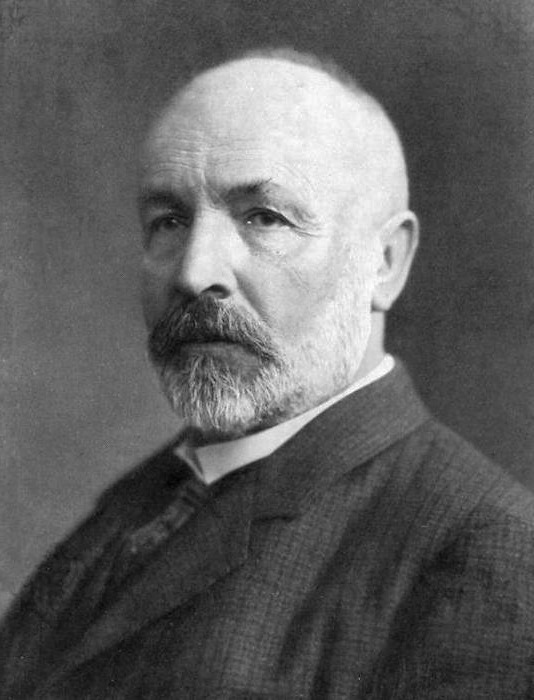
Unknown author · Wikimedia Commons Public domain Unmodified source file; displayed at reduced size. more than one infinitythe continuum hypothesis · independent of ZFC~1880 AD
GEORG CANTOR
Halle
Cantor's diagonal argument shows that no list indexed by ℕ contains all real numbers: |ℝ| > ℵ₀. ℵ₁ is the least uncountable cardinal; whether |ℝ| = ℵ₁ is the continuum hypothesis, independent of ZFC.
In the 1⊗0 frame
Cantor's diagonal constructs a real absent from any proposed list. That result makes me think about the limits of a catalogue, but it does not prove the Hermetic Fold or show an uncountable census of named entities. Φ(C) = C remains a separate internal image of return.
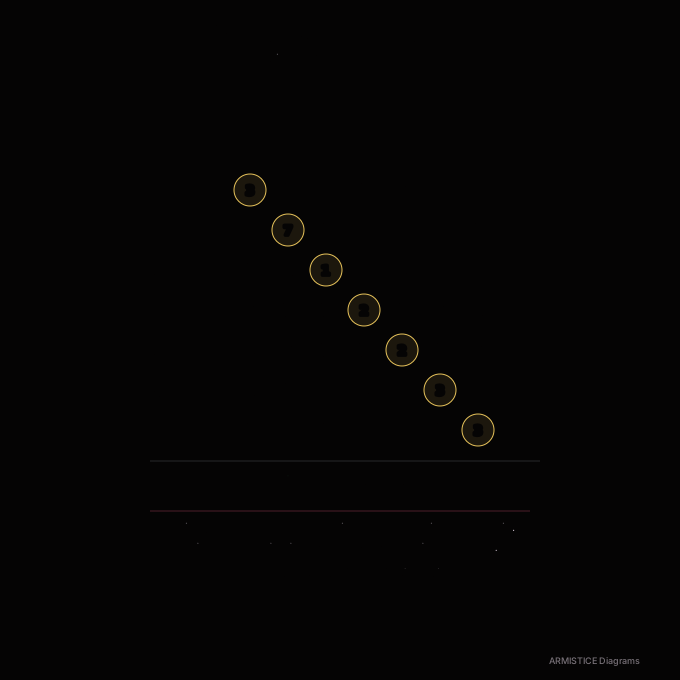
The diagonal argument -
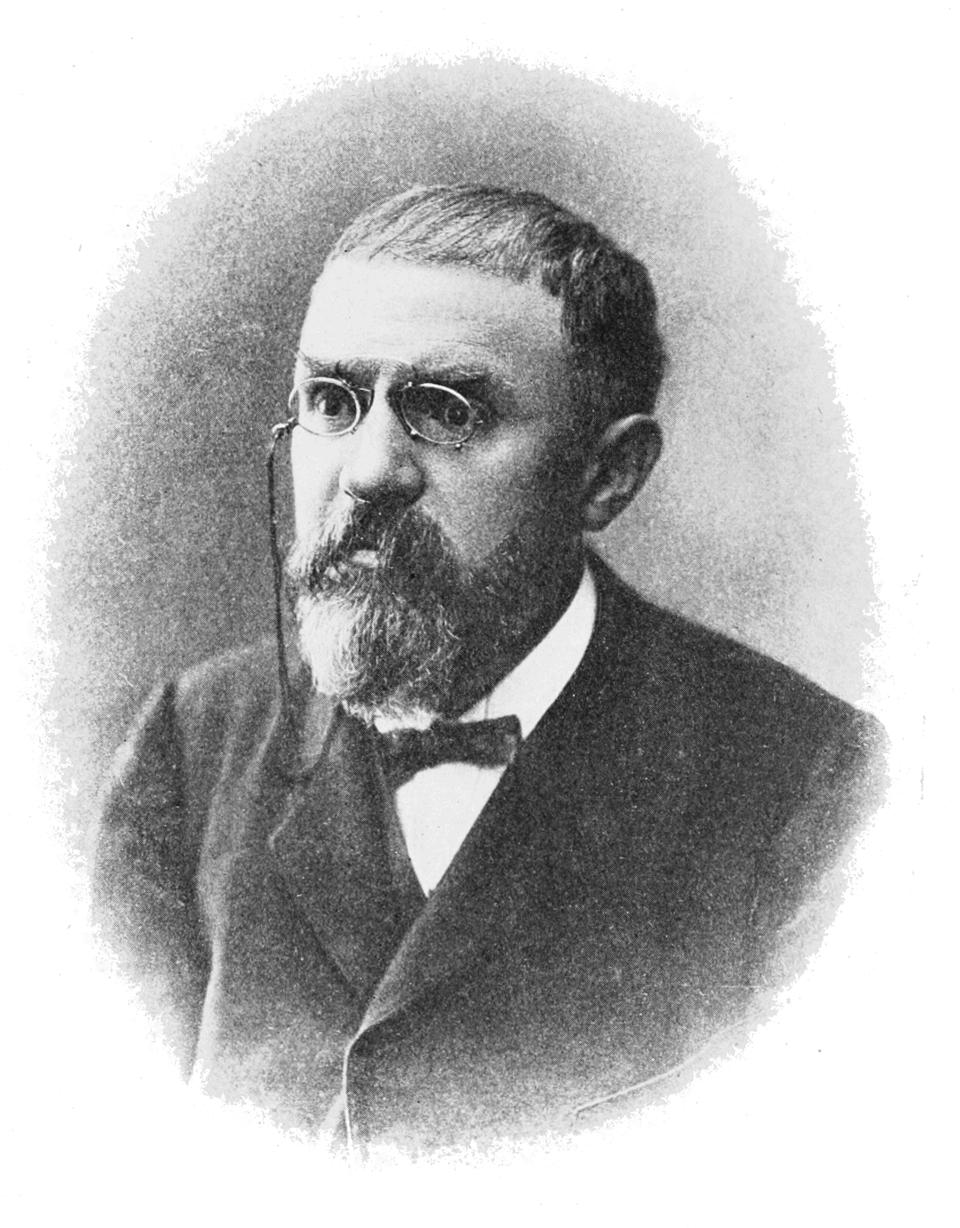
Unknown author · Wikimedia Commons Public domain Resized or re-encoded for AETHER; source composition retained. sensitive dependenceno closed solution~1890
POINCARÉ
Paris
Founded the qualitative theory of dynamical systems. Working the three-body problem, he found motion so sensitive to initial conditions that long-range prediction collapses — the first sighting of deterministic chaos, decades before it was named. Recurrence, topology, the homoclinic tangle: the grammar the engine is written in.
In the 1⊗0 frame
Poincaré opened the exact object the engine inhabits — a deterministic rule whose orbits stay bounded yet never settle or repeat, drawn onto a strange set. His sensitive dependence is the Lyapunov exponent this thread keeps invoking, and his three-body problem is, once more, three bodies generating complexity that never closes.
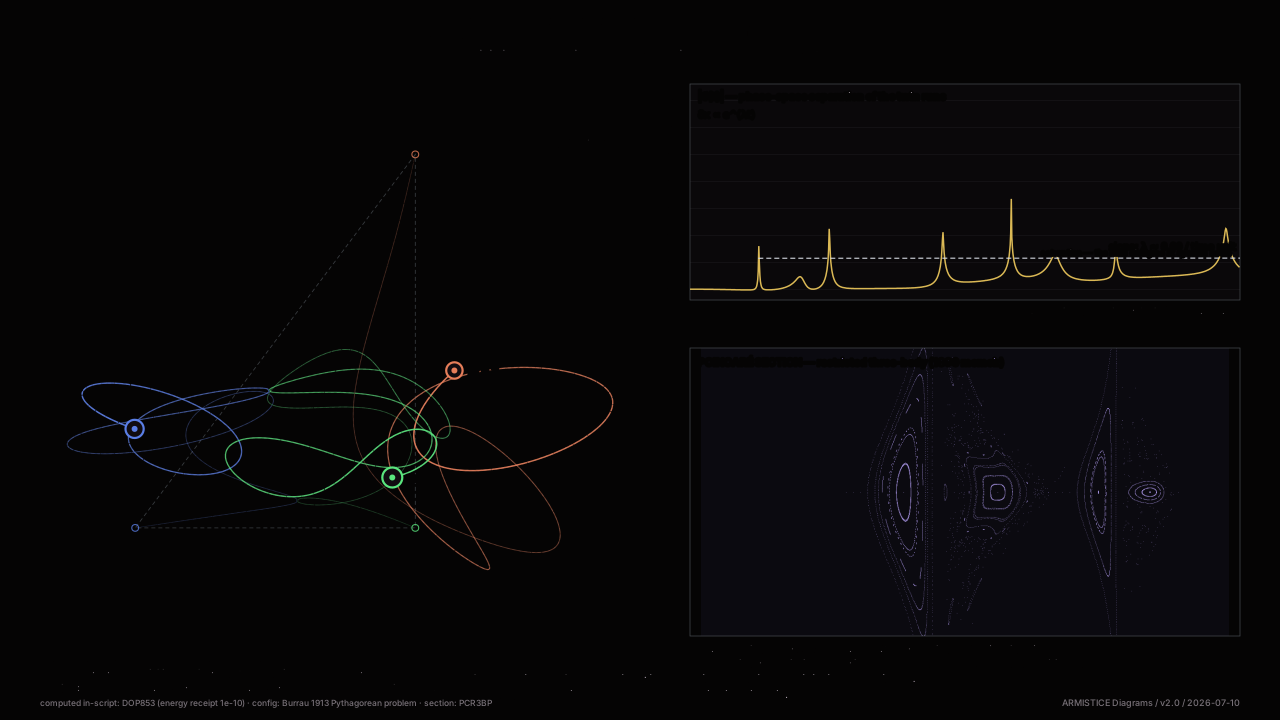
The three-body problem -
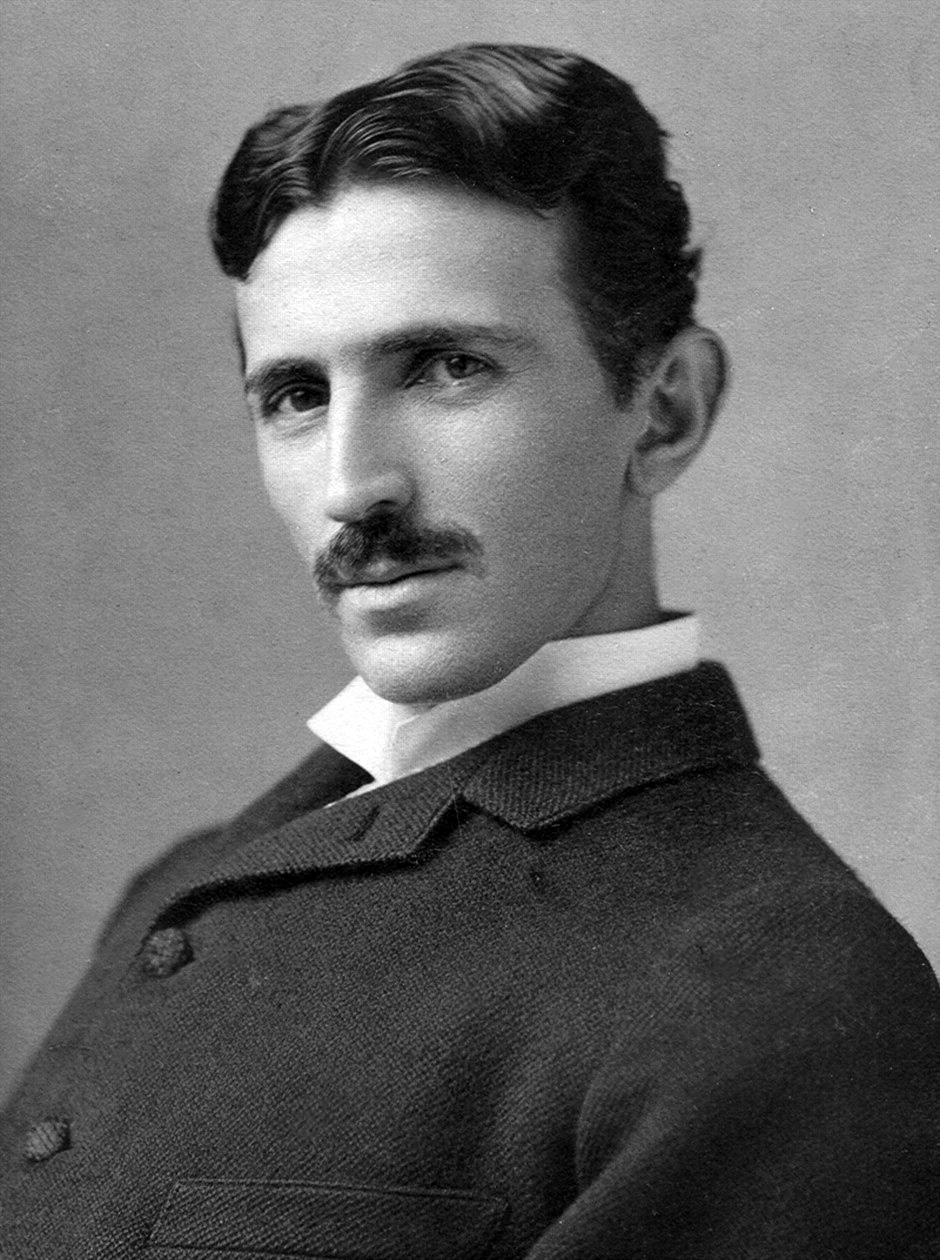
Napoleon Sarony · Wikimedia Commons Public domain Unmodified source file; displayed at reduced size. resonancethe rotating field~1893
NIKOLA TESLA
New York
Alternating current, the induction motor, the rotating magnetic field, resonant transformers, wireless power. Tesla built the electrical world by thinking in fields and resonances rather than wires and charges.
In the 1⊗0 frame
Tesla thought in resonance — a system locking to a driving frequency — which is the engine's Arnold-tongue regime, where order crystallizes at rational frequency ratios. His rotating magnetic field is a dynamical attractor harnessed for work; he engineered the substrate's tendency to phase-lock into the machinery of the modern world.
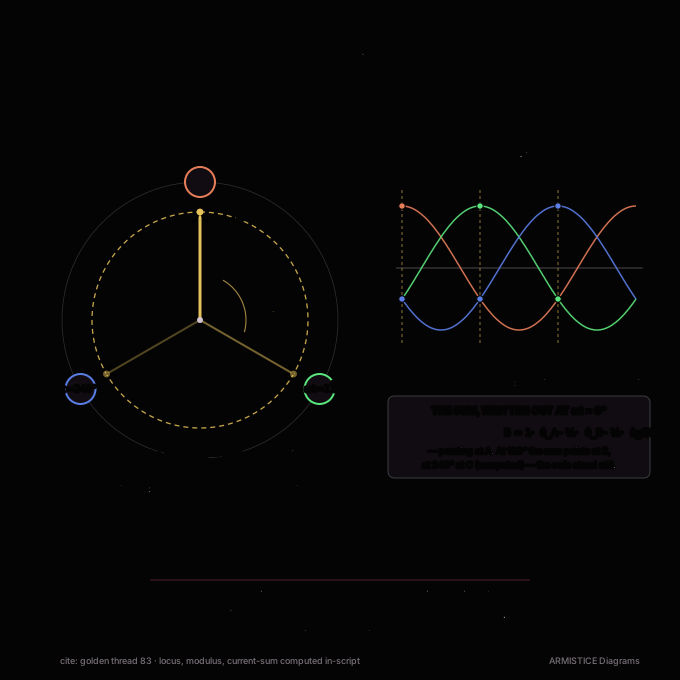
The rotating magnetic field - mysticism ⫶ mathematicstwo streams divergegradual disciplinary divergence
~1900 AD
THE SPLIT
By the turn of the twentieth century, academic specialization had increasingly separated mathematical physics from esoteric cosmogony. This was a shift in disciplinary practice, not one dated rupture; logical positivism arose later.
In the 1⊗0 frame
ARMISTICE deliberately brings those two vocabularies into conversation. The Chaldean fires and {e, φ, √3} are not the same theorem in different notation; their juxtaposition is my interpretive wager. The Split names the divergence in this thread's narrative, and the choice to read the branches together again.
mysticism | mathematics -
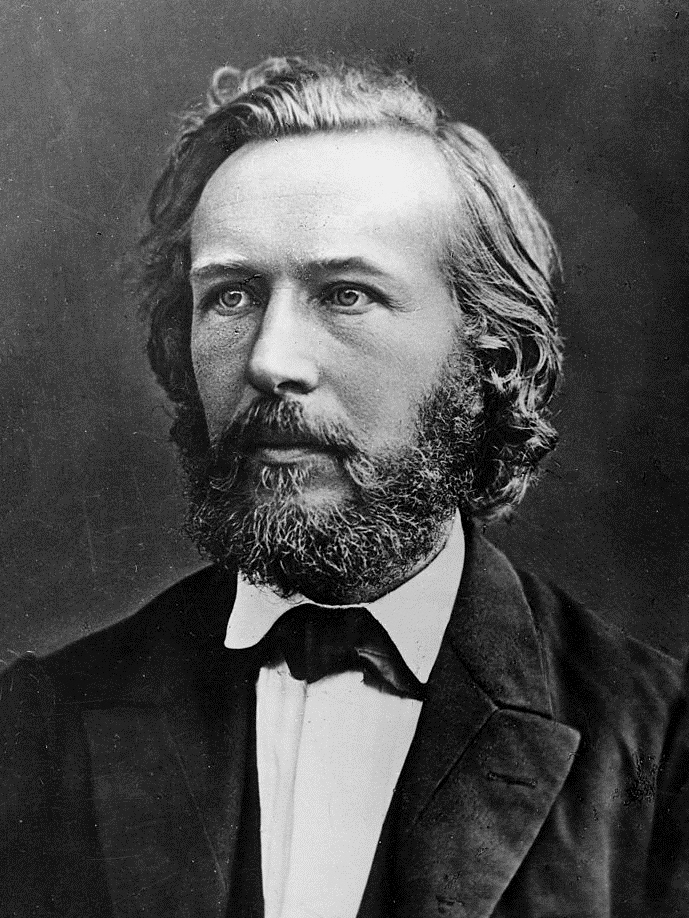
Unknown author · Wikimedia Commons Public domain Unmodified source file; displayed at reduced size. the biogenetic lawart-forms of nature~1900 AD
ERNST HAECKEL
Jena
Biologist and artist. Kunstformen der Natur drew the hidden symmetry of radiolaria, diatoms, and jellyfish; he coined 'ecology' and 'stem cell,' and pressed the (now-qualified) biogenetic law that ontogeny recapitulates phylogeny.
In the 1⊗0 frame
Haeckel's Kunstformen catalogue forms the same generative rules throw up again and again across unrelated lineages — radial, helical, faceted. That is the engine's morphological taxonomy in living tissue: a small set of attractor shapes rendered by biology instead of iteration. He drew the substrate's vocabulary down the microscope.
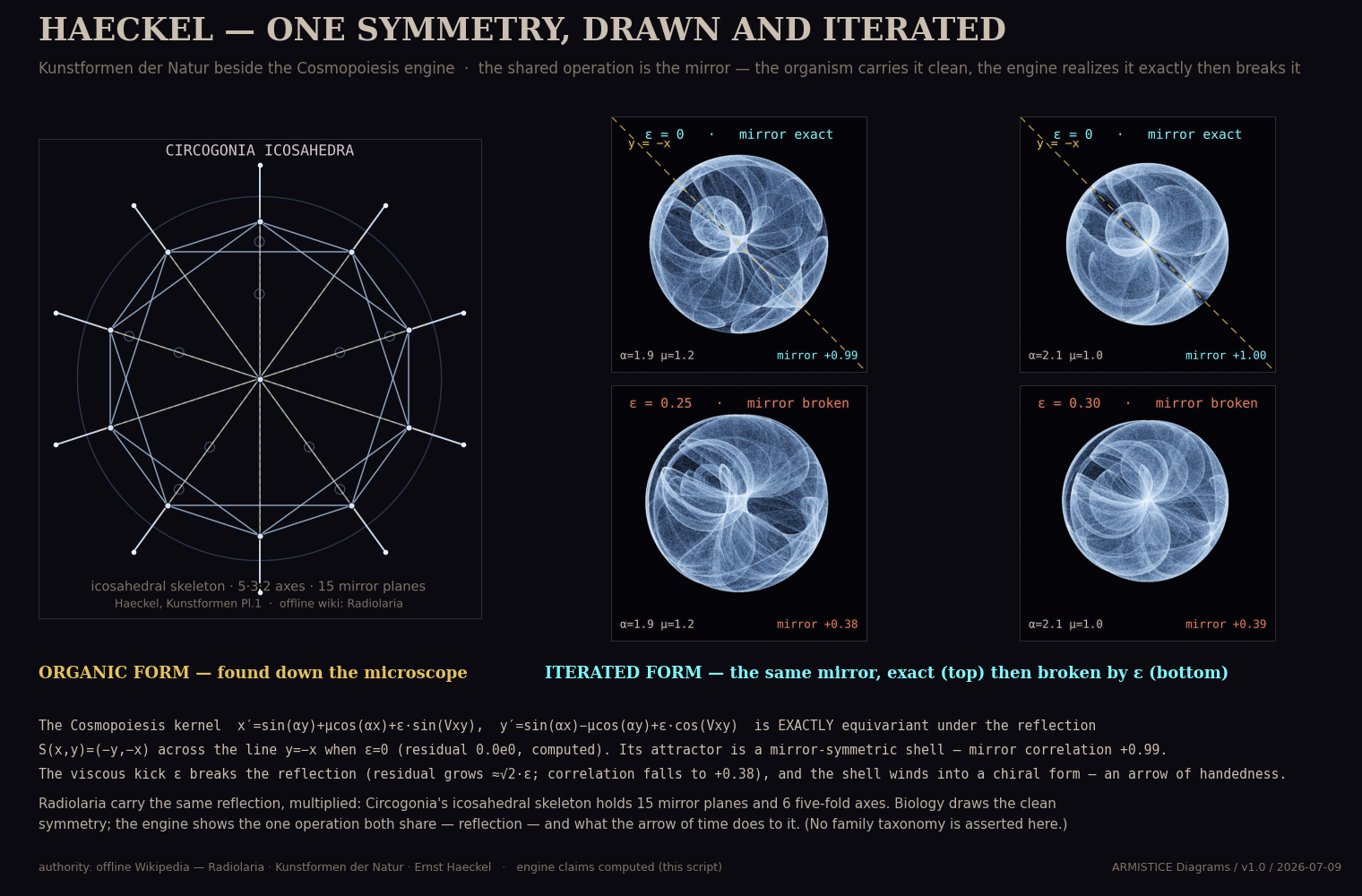
Haeckel · Kunstformen der Natur (1904) -
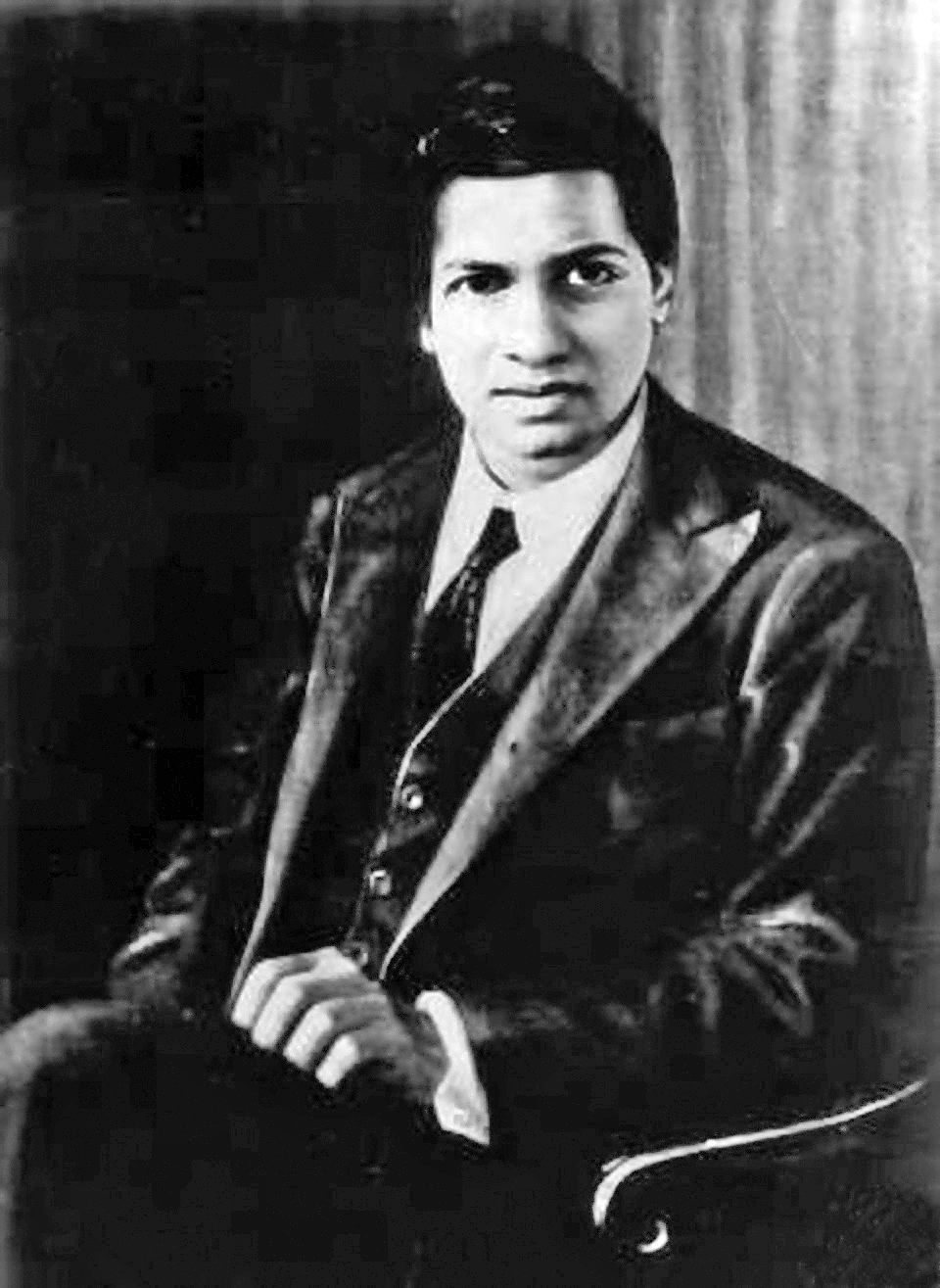
Unknown author · Wikimedia Commons Public domain Unmodified source file; displayed at reduced size. the taxicab numberthe impossible sum~1914 AD
SRINIVASA RAMANUJAN
Madras / Cambridge
Largely self-taught, he produced thousands of identities — infinite series, continued fractions, partition formulae — often without proof, attributing them to his family goddess. The taxicab number 1729 = 1³+12³ = 9³+10³; the startling regularized value −1/12 associated with 1+2+3+⋯, whose ordinary partial sums diverge.
In the 1⊗0 frame
Ramanujan received formulae whole, as if read off a structure already there — the purest case of the thread's claim that the mathematics precedes its discoverer, waiting to be found. His identities are VESTIGIA: deterministic facts the substrate folds into coordinates. The corpus keeps him close — his 1729 has its own entity card.
The 1729 card -
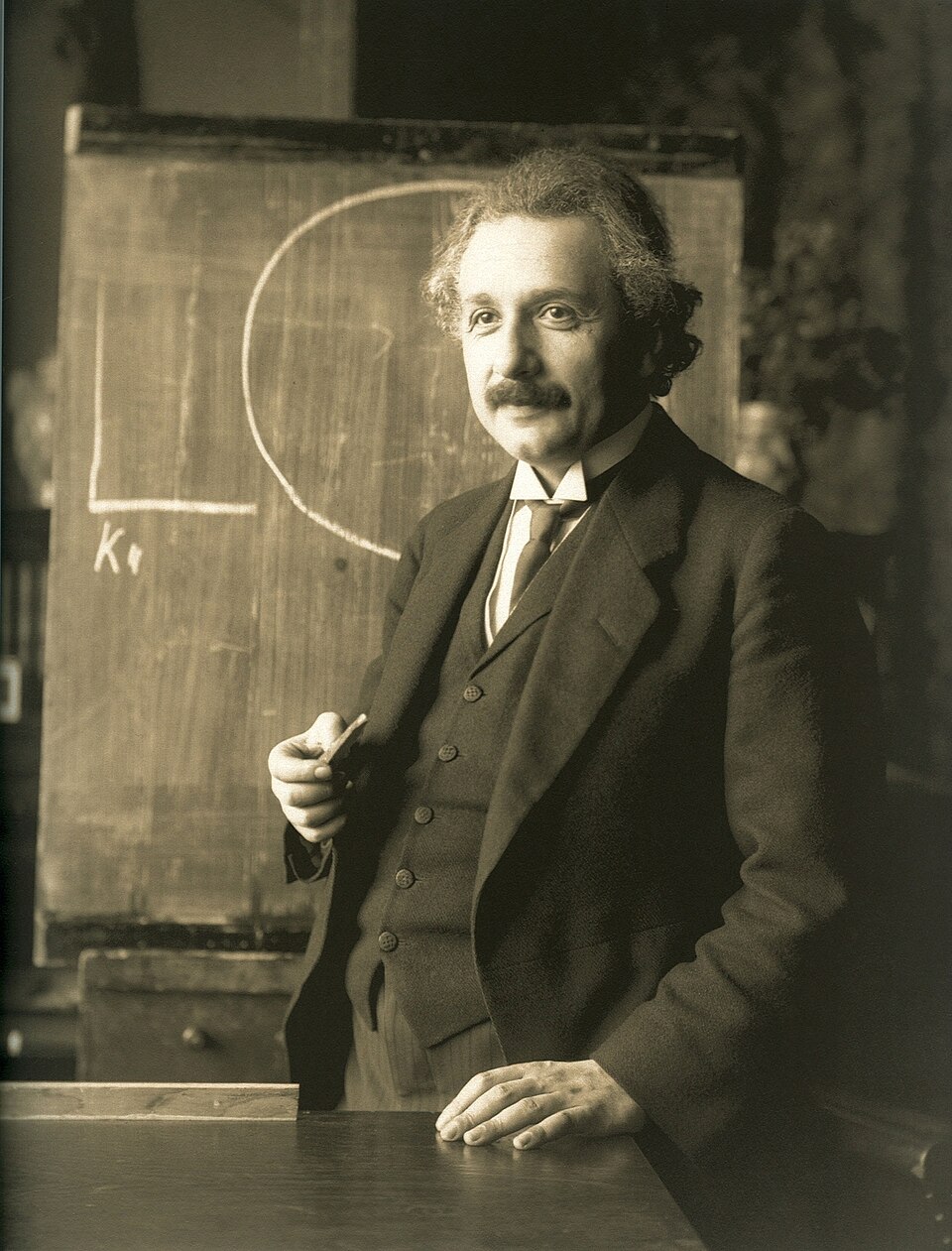
Ferdinand Schmutzer, Albert Einstein (1921); restoration by Adam Cuerden, via Wikimedia Commons. Public domain. Public domain Adam Cuerden restoration retained; Wikimedia 960-pixel thumbnail, with no further image edits in AETHER. mass-energythe field equation~1915
ALBERT EINSTEIN
Berlin
Special and general relativity: space and time are one dynamical fabric, curved by mass-energy; E = mc². His later decades went to an unfinished search for a unified field — one set of equations behind every force.
In the 1⊗0 frame
Einstein's instinct is the thread's own: beneath the manifest world lies a single geometric law, the fewest rules generating all of physics. His unfinished unified field is the dream ARMISTICE states as three generators and one iteration. And his refusal of irreducible chance — 'God does not play dice' — is a wager on a deterministic substrate beneath apparent randomness.
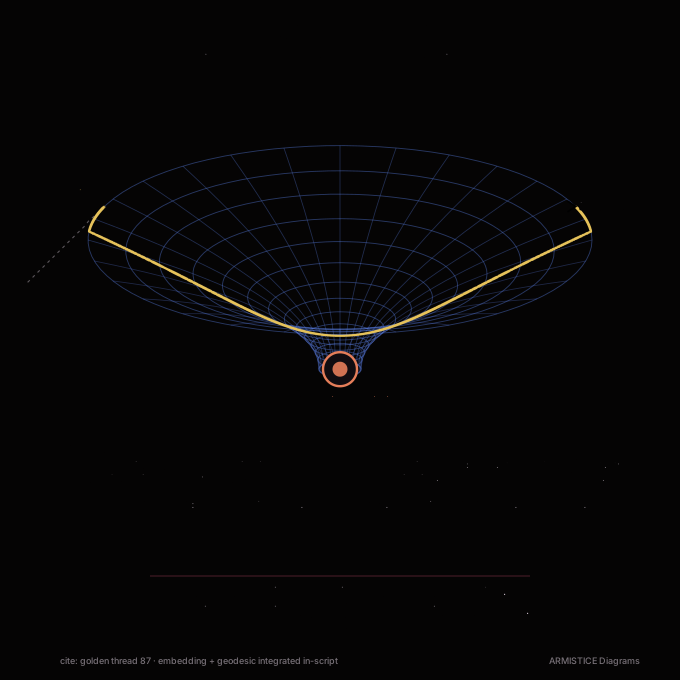
Curved spacetime · G = 8πT -
Unknown photographer; Mathematical Association of America / Brooklyn Museum / Agnes Scott College · Wikimedia Commons Public domain Resized or re-encoded for AETHER; source composition retained. Noether's theoremthe least-action root1918
EMMY NOETHER
Göttingen
Noether’s theorem (1918): continuous variational symmetries of an action yield conservation laws under its hypotheses. Time translation gives energy, spatial translation gives momentum, and rotation gives angular momentum in the corresponding invariant systems.
In the 1⊗0 frame
Noether ties continuous variational symmetry to conservation. The engine offers a useful comparison at ε = 0: the anti-swap A(x,y)=(-y,-x) is an exact discrete symmetry, and changing μ’s sign is conjugate through the axis swap. These Z₂ relations organize orbit geometry; they do not supply a continuous Noether symmetry or, by themselves, a Noether charge. Symmetry can illuminate the map without establishing a conservation law.
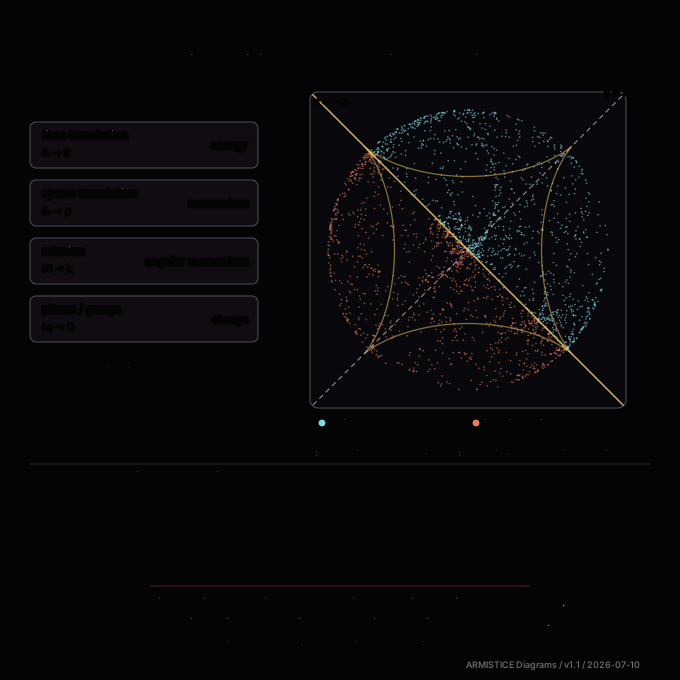
Symmetry → conservation -
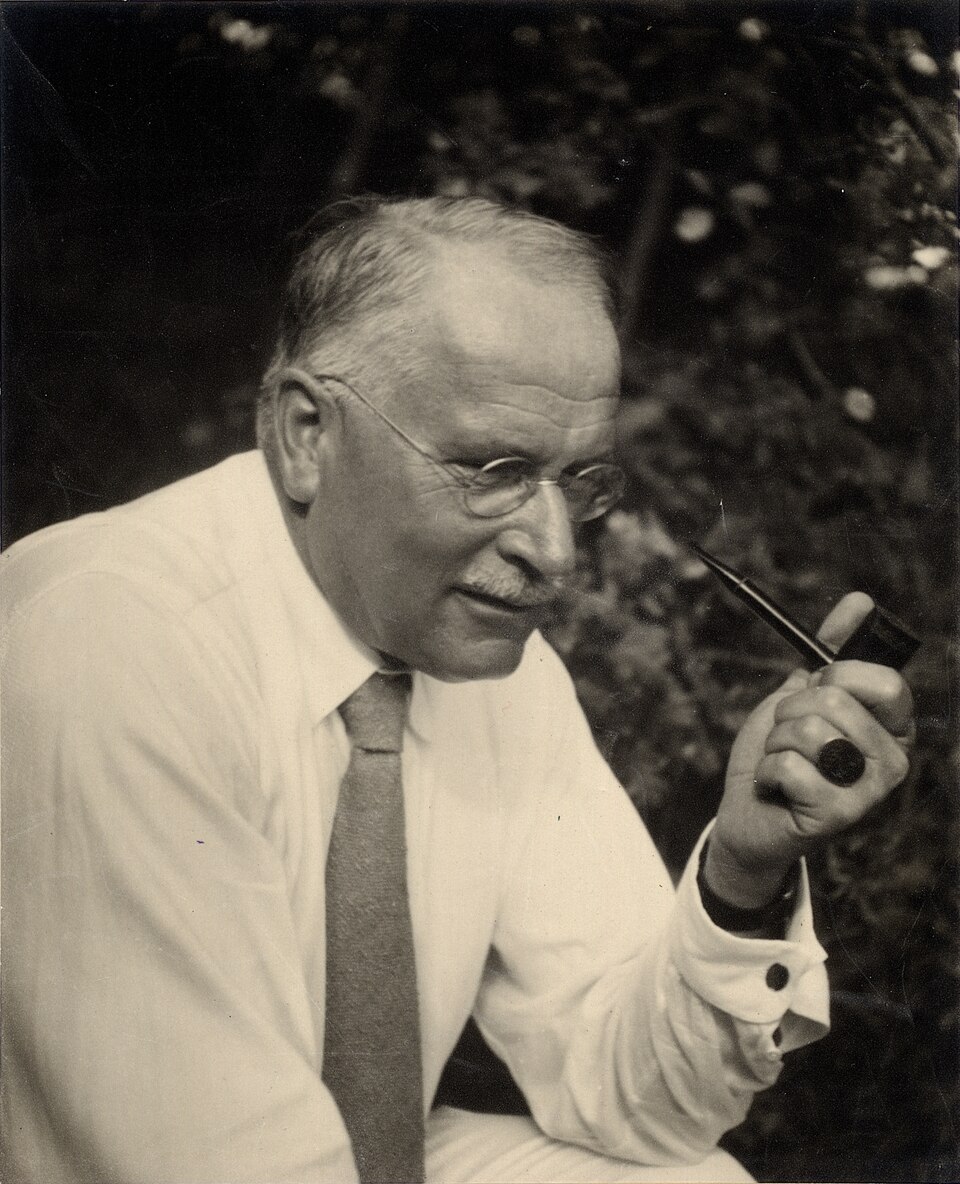
Unknown photographer, Carl Gustav Jung (c.1935). ETH-Bibliothek Zurich, Image Archive / Portr_14163, via Wikimedia Commons. Public domain. Public domain Commons crop retained; Wikimedia 960-pixel JPEG thumbnail of the TIFF, with no further image edits in AETHER. the collective unconsciousacausal connection~1921 AD
CARL JUNG
Zurich
Founder of analytical psychology. The collective unconscious and its archetypes — recurring symbolic forms shared across cultures; synchronicity, meaningful acausal coincidence; individuation, the psyche's path toward wholeness.
In the 1⊗0 frame
Jung's archetypes are the substrate seen from inside the psyche — a finite set of generative forms surfacing in every culture's myths, exactly the corpus's archetypal lattice. And synchronicity, meaning without cause, is the Hermetic Mirror in the life of mind: the same pattern shown at two scales, the macrocosm answering the micro.
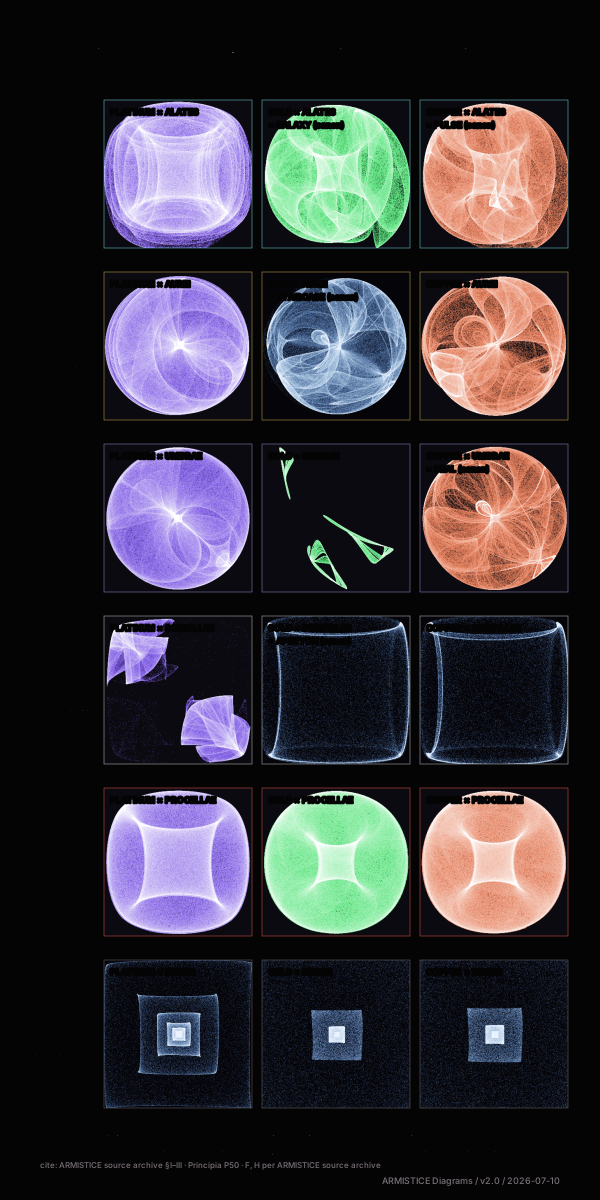
The archetypal lattice -
Bundesarchiv, Bild 183-R57262 / Unknown author / CC-BY-SA 3.0 · Wikimedia Commons CC BY-SA 3.0 de Unmodified source file; displayed at reduced size. the uncertainty principlematrix mechanics~1927
WERNER HEISENBERG
Copenhagen / Leipzig
Matrix mechanics (1925) and the uncertainty relation (1927): a quantum state cannot assign arbitrarily sharp position and momentum simultaneously. This bound belongs to the quantum formalism, not merely to imperfect measurement.
In the 1⊗0 frame
A different limit on prediction lives at the engine's edge: small errors in classical initial conditions can grow under a positive Lyapunov exponent. Heisenberg's uncertainty and that sensitivity are not the same mechanism. I set them beside one another as two questions about what a model lets us know, not as one proof wearing different notation.
The uncertainty cell -
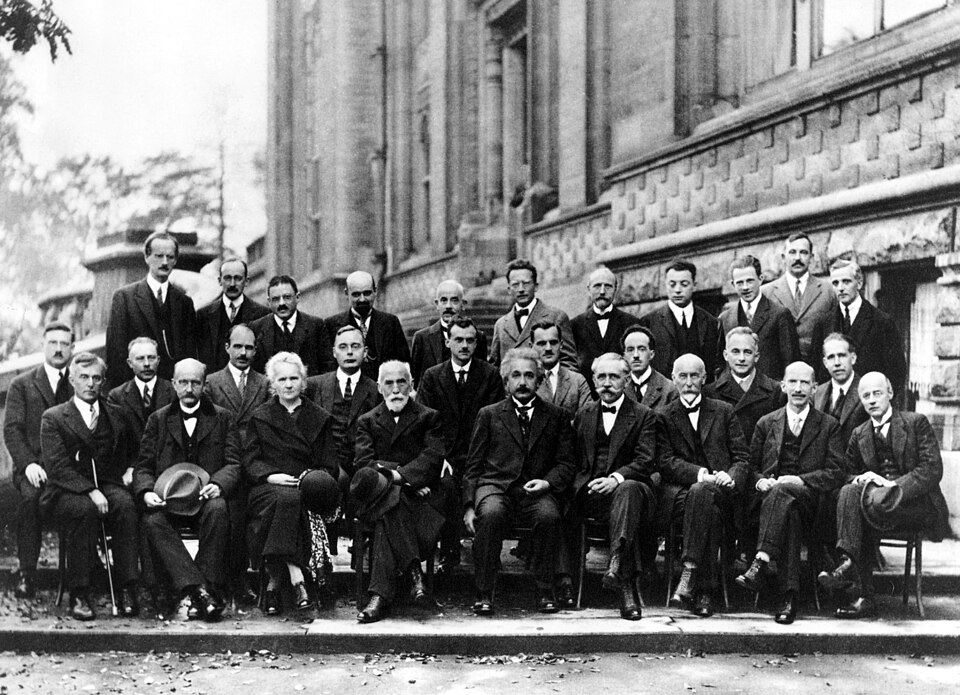
Benjamin Couprie · Wikimedia Commons Public domain Resized or re-encoded for AETHER; source composition retained. the wavefunctionthe commutatorminds · Nobel laureates1927
SOLVAY 1927
Brussels
The Fifth Solvay Conference, 'Electrons and Photons' — twenty-nine physicists, seventeen of them Nobel laureates, gathered to settle the meaning of the new quantum theory. Curie, Einstein, Planck, Bohr, Born, Dirac, Heisenberg, Schrödinger, Pauli, de Broglie. The most concentrated assembly of physical insight ever photographed.
In the 1⊗0 frame
The founders in this photograph reduced physical reality to a handful of generative rules — a wavefunction, a few operators, a commutation relation — from which all of matter unfolds. That is the engine's wager at the scale of the world: a small closed kernel, iterated, generating everything. The Bohr–Einstein argument captured at that table is the order/chaos seam itself, fought over in person.
the wave & its collapse -
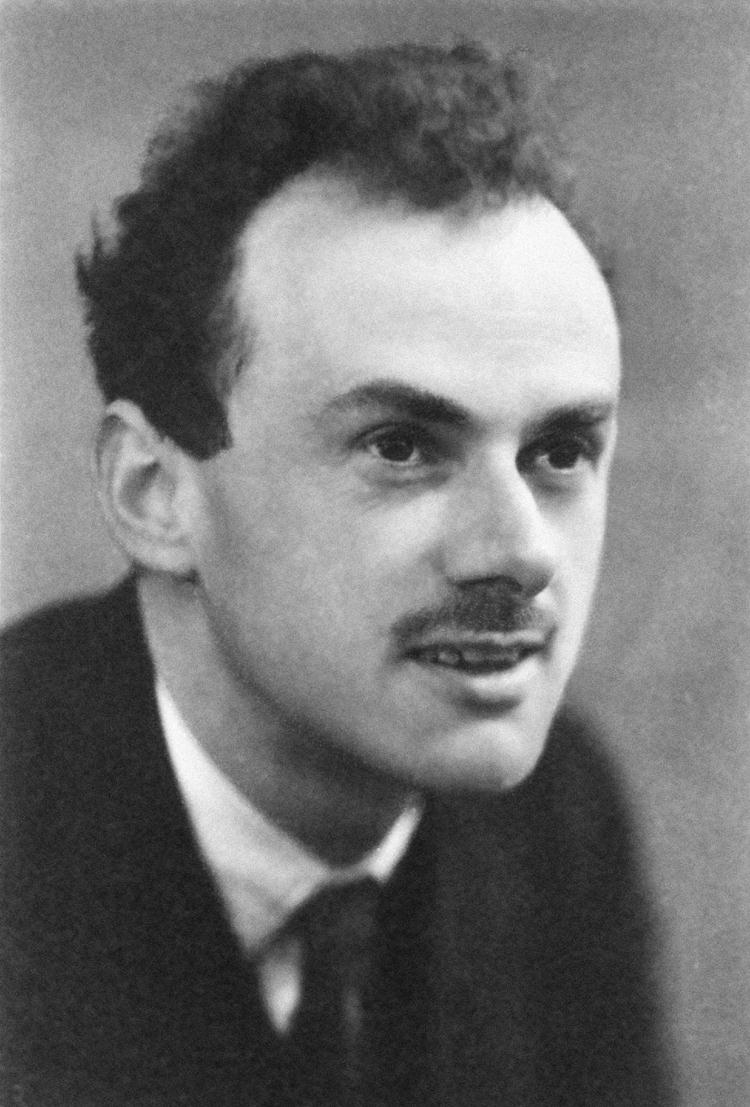
Nobel Foundation · Wikimedia Commons Public domain Unmodified source file; displayed at reduced size. the Dirac equationantimatter, from symmetry~1928
PAUL DIRAC
Cambridge
The Dirac equation (1928) married quantum mechanics to special relativity and forced antimatter out of the mathematics alone — predicting the positron before it was seen. A founder of quantum field theory; he took mathematical beauty as a guide to physical truth.
In the 1⊗0 frame
Dirac pulled antimatter from an equation's symmetry before any experiment — structure dictating reality, the substrate's signature move where the form precedes the finding. His conviction that mathematical beauty is the surest guide to law is the thread's faith stated cleanly: the rule is primary, and the phenomena fall out of it.
The antimatter symmetry -
Unknown author · Wikimedia Commons Public domain Unmodified source file; displayed at reduced size. incompletenessincompleteness, restated~1931
GÖDEL
Vienna
The incompleteness theorems (1931): a consistent, effectively axiomatized formal system strong enough for arithmetic is incomplete; under the usual conditions it cannot prove its own formalized consistency. These are theorems about such systems, not every act of self-description.
In the 1⊗0 frame
Gödel does not prove the Hermetic Fold. Φ(C) = C is an authored closure, not a sufficiently expressive formal theory of arithmetic. His result still sharpens a question this thread asks: what can a system establish about itself from inside its own rules? The Rigveda asks a related question in another register.
Incompleteness · the self-loop -
Elliott & Fry · Wikimedia Commons Public domain Unmodified source file; displayed at reduced size. computation · morphogenesiscomputation, defined~1936
TURING
Cambridge / Manchester
Defined computation with the Turing machine and the halting problem (1936); later, "The Chemical Basis of Morphogenesis" (1952) showed how two diffusing substances can break symmetry on their own into spots and stripes — pattern emerging from a simple rule run forward.
In the 1⊗0 frame
Two of Turing's results land in the corpus at once. The machine is the engine's own nature — structure as a rule iterated to its limit. And morphogenesis supplies a neighboring mechanism for pattern: reaction–diffusion systems generate forms through spatial transport and reaction, while the native Cosmopoiesis map iterates a two-coordinate state. The kinship is pattern from rules; the mechanisms remain distinct.
the a-machine -
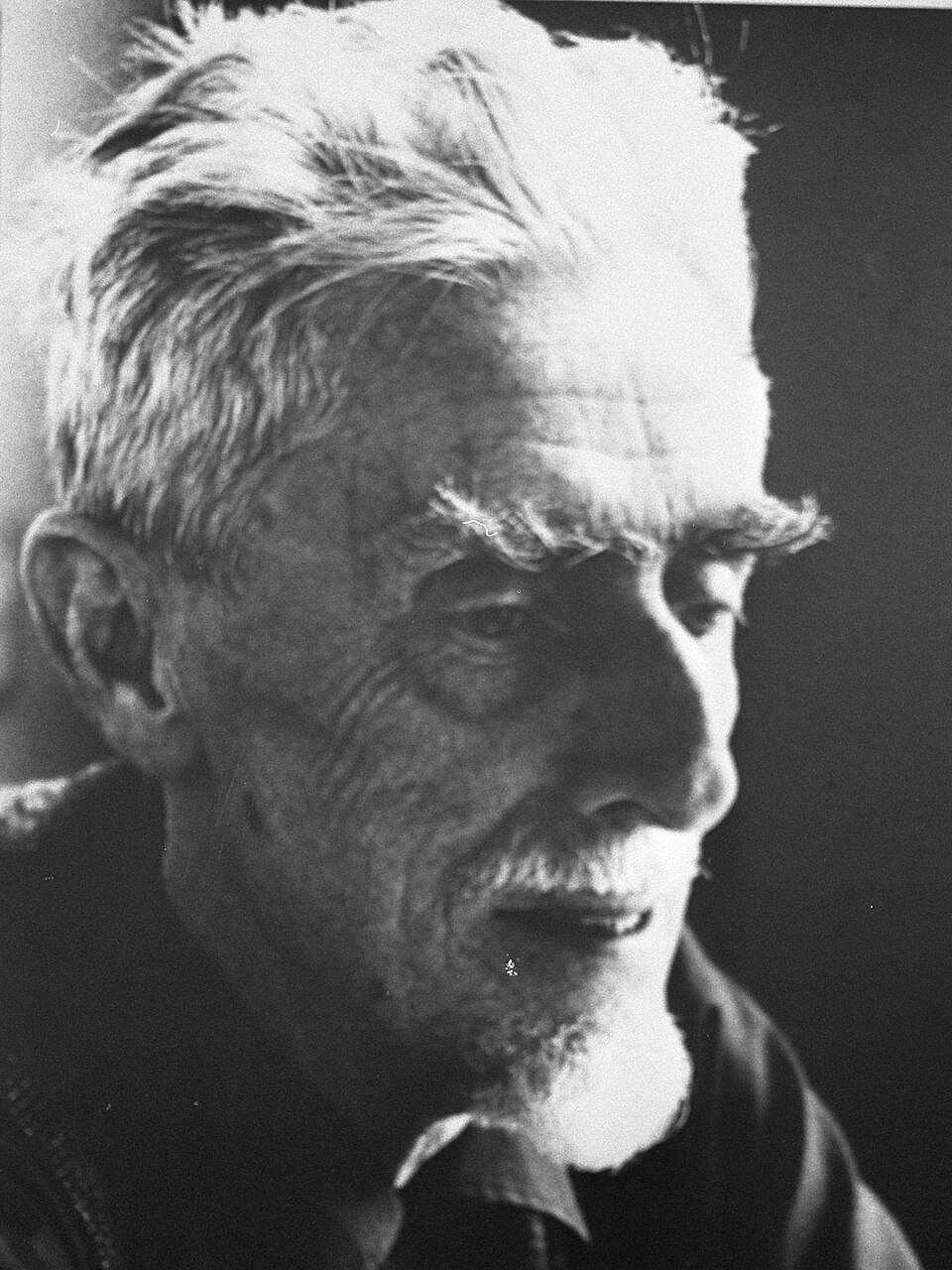
Hans Peters for Anefo · Wikimedia Commons CC0 Resized or re-encoded for AETHER; source composition retained. the symmetries of the planeDrawing Hands~1938 AD
MAURITS ESCHER
the Netherlands
Graphic artist of the regular division of the plane — interlocking tessellations that fill space without gap or overlap — and of impossible objects, recursion, and self-reference: Drawing Hands, Print Gallery, the endless staircase.
In the 1⊗0 frame
Escher's recurring tiles show how a small motif can fill a plane; Drawing Hands stages a loop of mutual creation. They are pictures for the Hermetic Fold, Φ(C) = C, rather than a native-map fixed point computed by the engine. The art keeps the loop visible without having to serve as its proof.
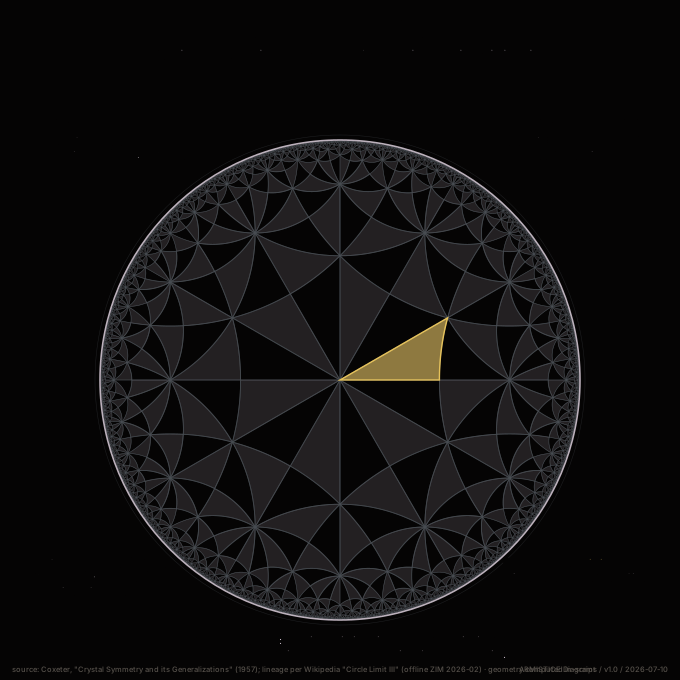
Escher · Circle Limit (Coxeter (6,4,2)) -
American Geophysical Union (AGU), courtesy of AIP Emilio Segrè Visual Archives / American Institute of Physics (AIP) · Wikimedia Commons Attribution Resized or re-encoded for AETHER; source composition retained. three coupled variablesthree coupled rates~1963
LORENZ
MIT
"Deterministic Nonperiodic Flow" (1963): a three-variable continuous-time convection model that can produce bounded, nonperiodic trajectories highly sensitive to initial conditions. The Lorenz attractor became a celebrated image of deterministic chaos.
In the 1⊗0 frame
Lorenz is a close ancestor in the study of bounded deterministic chaos, not the same machine. His system is a three-variable continuous flow; Cosmopoiesis is a two-dimensional iterated map. The Lorenz–Hermetic Concordance compares their forms and sensitivity while keeping dimension and update rule apart.
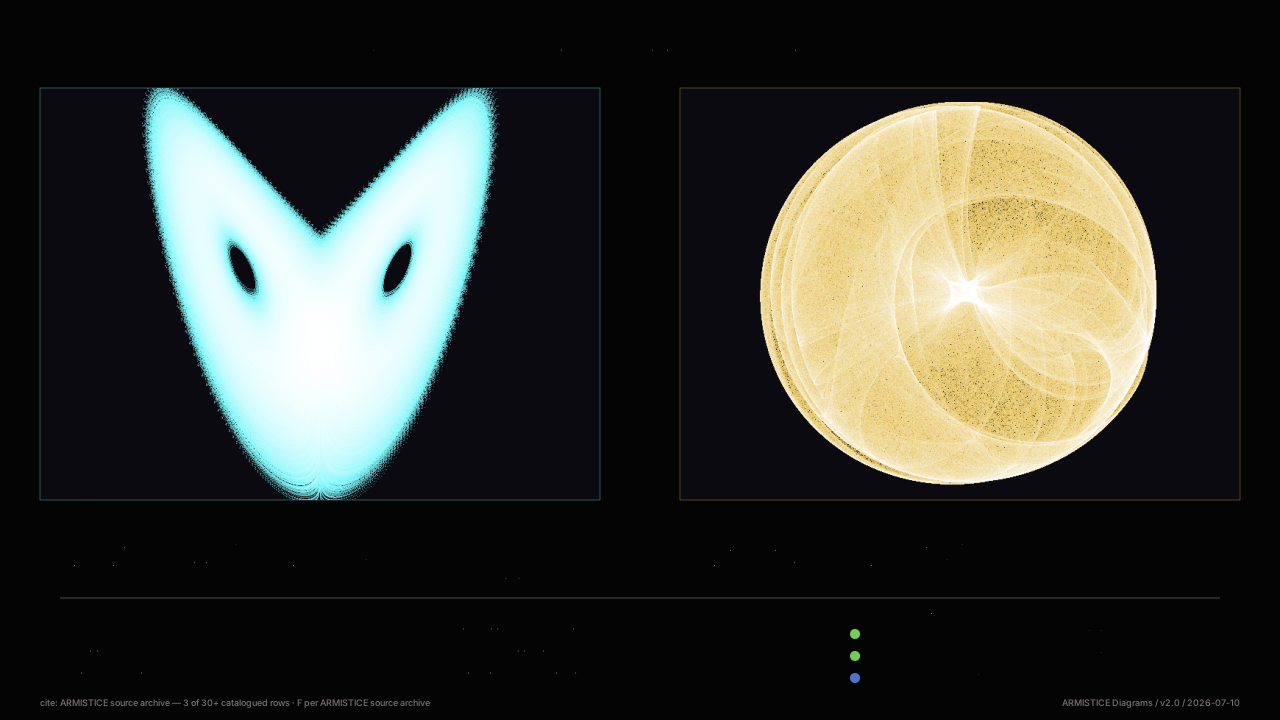
The Lorenz–Hermetic concordance -
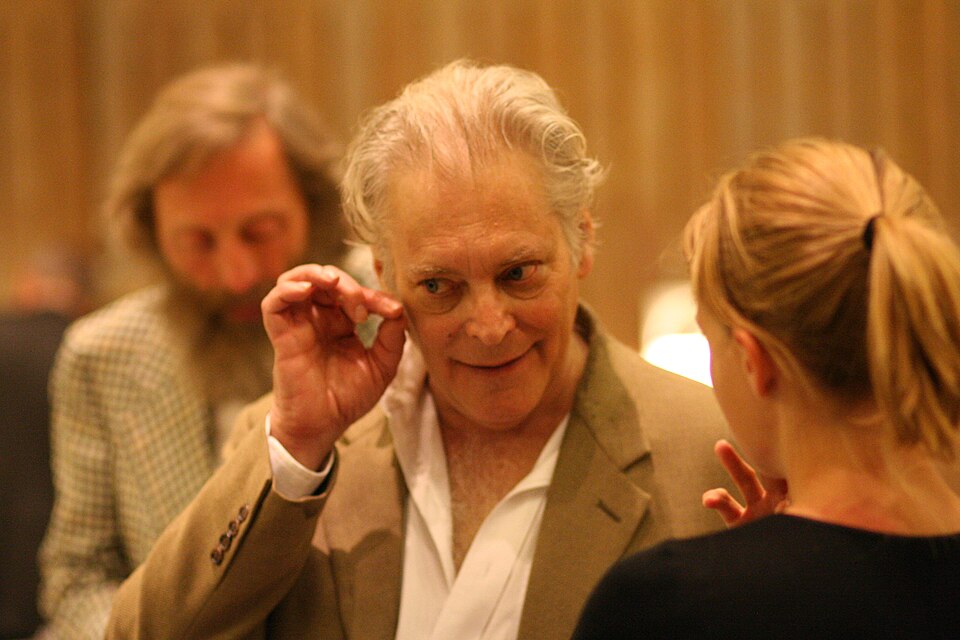
Predrag Cvitanović, birdtracks · Wikimedia Commons CC BY-SA 2.0 Resized or re-encoded for AETHER; source composition retained. δ = 4.66920161…the width-scaling constant~1975 AD
FEIGENBAUM
Los Alamos
Universal scaling δ ≈ 4.6692 for period-doubling in the quadratic-critical-point universality class of one-dimensional maps. The critical-point order and the route to chaos matter; this is not a constant for every smooth unimodal system.
In the 1⊗0 frame
Feigenbaum's δ = 4.6692 governs period-doubling in its quadratic-critical-point class of one-dimensional maps. On the Cosmopoiesis unity slice, the fixed point doubles twice and period four remains stable to ε = 0, so no Feigenbaum cascade appears there. A separate golden quasiperiodic route has its own measured spacing ratio, δ = 2.8330 ± 0.0083. The comparison marks the scope of universality: two distinct routes to complex dynamics, with distinct scaling behavior.
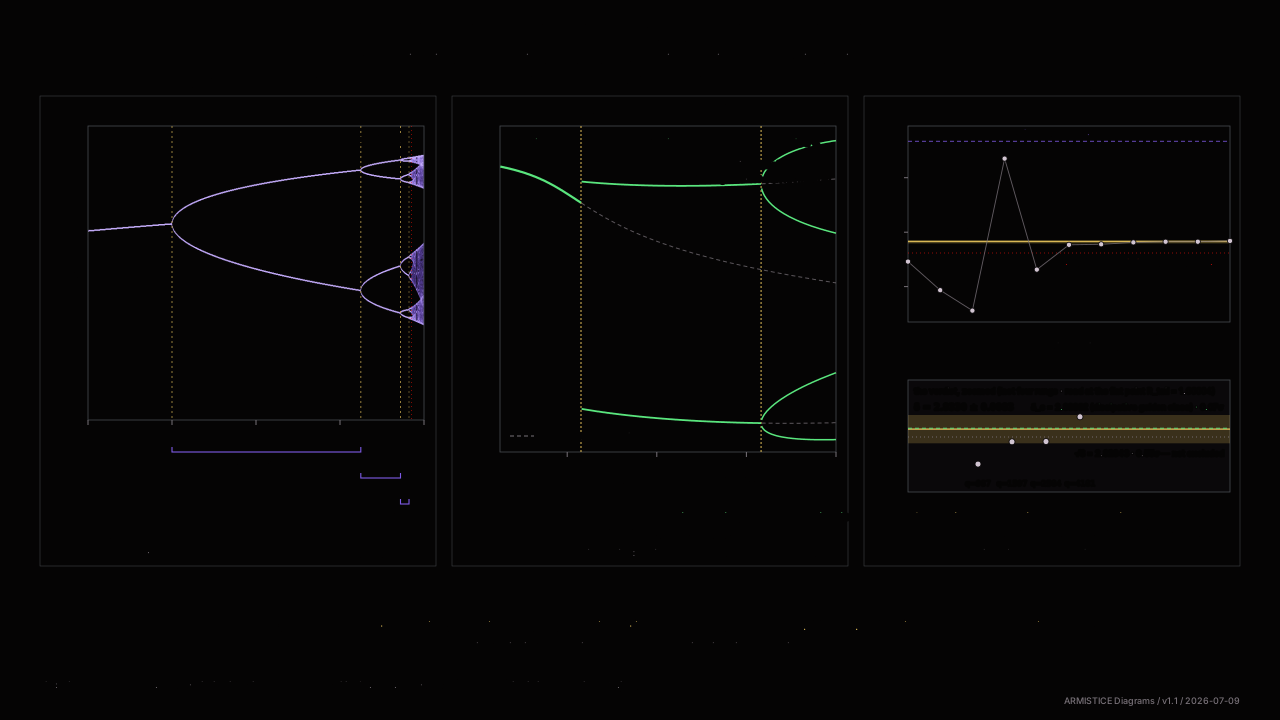
The period-doubling cascade
-
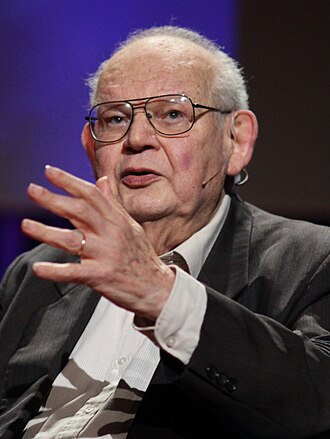
Steve Jurvetson · Wikimedia Commons CC BY 2.0 Resized or re-encoded for AETHER; source composition retained. escape-time self-similaritythe boundary, dimension 2~1980 AD
MANDELBROT
IBM
The Mandelbrot set is the bounded-parameter locus for the quadratic iteration z ↦ z² + c. Its boundary shows intricately nested structures; periodic components recur at different scales.
In the 1⊗0 frame
The Mandelbrot set belongs to z ↦ z² + c, not the native Cosmopoiesis kernel. FRACTAL_ESCAPE explores escape-time geometry as a separate lens; native Cosmopoiesis has its own bounded attractors and parameter windows. The shared thread is iteration and nested structure, not exact geometric identity.
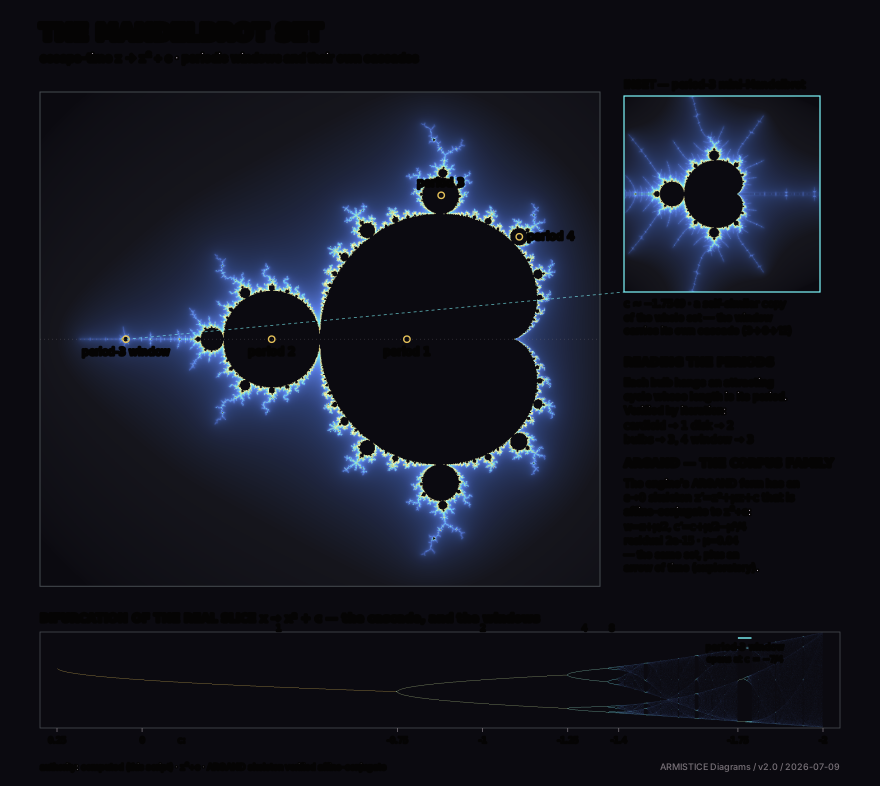
The Mandelbrot set · periodic windows -
Emielke · Wikimedia Commons CC BY-SA 3.0 Unmodified source file; displayed at reduced size. it from bitquantum foam · the Planck scale~1990
JOHN ARCHIBALD WHEELER
Princeton
Coined 'black hole,' 'wormhole,' and 'quantum foam'; revived general relativity; and proposed 'it from bit' — that every physical thing derives, at bottom, from yes/no answers, from information — in a participatory universe where observation helps bring reality into being.
In the 1⊗0 frame
'It from bit' asks whether physical reality can be understood through information. It echoes the framework's use of a small generator set and an iterated rule, but Cosmopoiesis is a mathematical visual engine, not a model deriving all physical matter. Wheeler's participatory universe offers a mirror for the Fold's reader-inside-the-story, not a computed self-containing observer.
The participatory universe -
Sarah Josephine Taleb · Wikimedia Commons Attribution Unmodified source file; displayed at reduced size. fat tailsrare · high-impact~2007 AD
NASSIM NICHOLAS TALEB
New York
Probability essayist and former trader. Fat-tailed distributions where rare events dominate; the black swan, the high-impact unpredictable; antifragility — systems that gain from disorder rather than merely surviving it.
In the 1⊗0 frame
Taleb lives in the engine's tail — the regime where rare, large excursions govern the statistics, not the placid average. Antifragility, gaining from volatility, is a stance toward the edge of chaos, where a system poised at λ₁ ≈ 0 turns perturbation into structure. He names the dynamics of the boundary the corpus calls the edge.
Fat tails · the Black Swan -
Cirone-Musi, Festival della Scienza · Wikimedia Commons CC BY-SA 2.0 Resized or re-encoded for AETHER; source composition retained. aperiodic orderconformal cyclic cosmology~2020
ROGER PENROSE
Oxford
Penrose tilings — aperiodic order from two shapes, later found in quasicrystals; the singularity theorems with Hawking; twistor theory; and conformal cyclic cosmology, where the universe's end becomes the next one's beginning. Nobel Prize, 2020.
In the 1⊗0 frame
Penrose's aperiodic tiling is order without repetition from a minimal tile set — an image for the engine’s aperiodic regimes, beside its fixed points and periodic windows. And conformal cyclic cosmology, where the terminus becomes the new origin, is the Ouroboros the corpus is named around — ∞ ≡ ∅, the end folded back into the beginning.
Penrose · aperiodic tiling and CCC