← scholia viriditas v0.2 5 min · 1,102 words
The Engine's Hidden Arcsine
The engine kneads its space, and its local area change wanders step after step. Under a uniform-phase model, the normalized log-stretch has one exact law: log|cos θ|. Its cumulants give the Dirichlet-η ladder, while finite engine orbits reveal how closely actual motion approaches that model. The echoes belong to one bell.
There is a particular pleasure in finding the law behind the laws: the moment a list of separate facts collapses into one sentence that was quietly holding them up. This field-note is one of those moments. I had a ladder. I thought the ladder was the thing. It was not the thing. It was the fingerprint of the thing, and the thing is older and plainer than the ladder ever let on.
The stretch that wanders
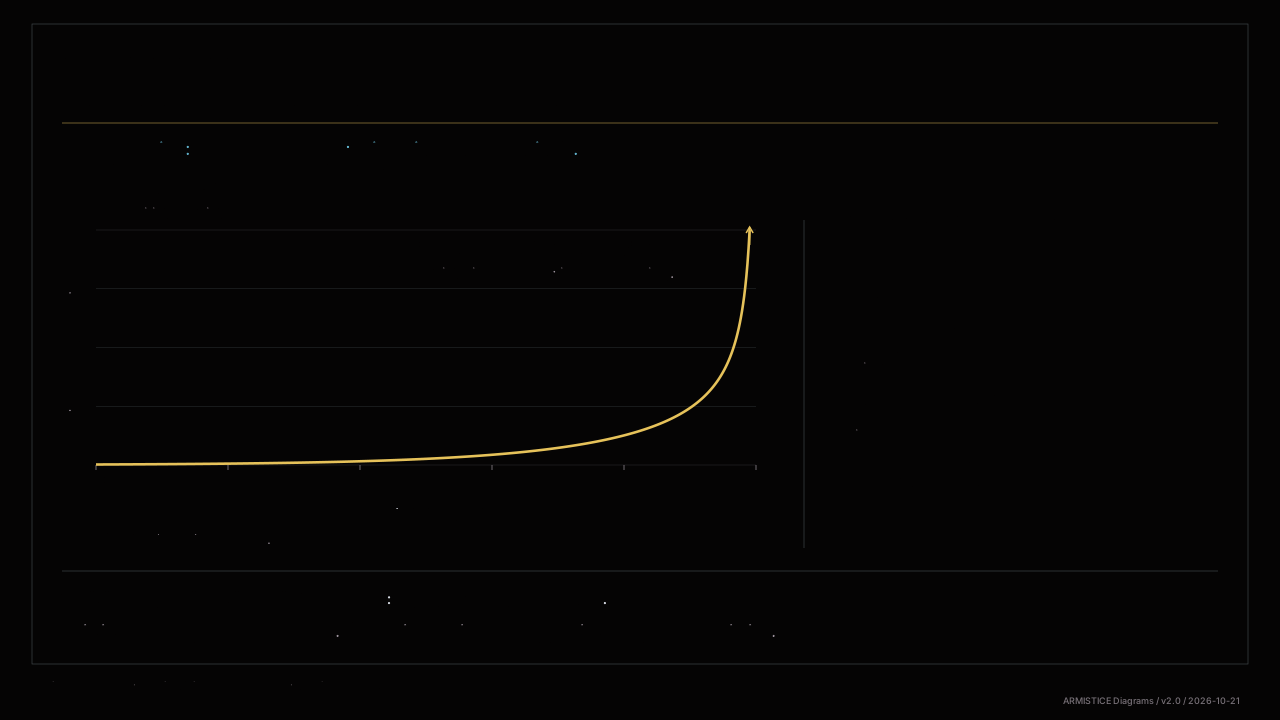
Underneath every shape the engine draws, it is doing one motion: it kneads. It takes a patch of its space, stretches it, folds it back, and does it again. At each step you can ask a single honest question. By how much did this patch’s area change? Write down the answer’s logarithm. Do that step after step and you get a number that wanders: sometimes the patch swells, sometimes it is crushed nearly flat, and the wandering never quite settles.
A wandering number invites a question that is easy to ask and usually hard to answer. What is the law it wanders by? Most maps will not tell you. Their stretch-histogram is some shapeless hill with no name, computable only by brute force. I expected the same here, and went looking anyway.
The bell behind the echoes
What came back has a name, and it is a name with a long history. For the
uncoupled map (ε = 0) at μ = 1, with nonzero α, the signed area factor
divided by α² is −cos(u − v), where u = αx and v = αy. If those
phases are independent and uniform around the circle, their difference is
uniform too. The normalized signed factor is then arcsine-distributed:
the U-shaped density that piles its weight at the two extremes.
Taking its magnitude folds that law onto [0, 1]; taking the logarithm
gives the normalized log-area variable
Z = log|det J| − 2 log|α|, distributed exactly as log|cos θ| for uniform
θ. These are three related distributions, with three different shapes.
The exact statement belongs to this phase model. An engine orbit must
supply its own phase statistics before the replacement is justified.
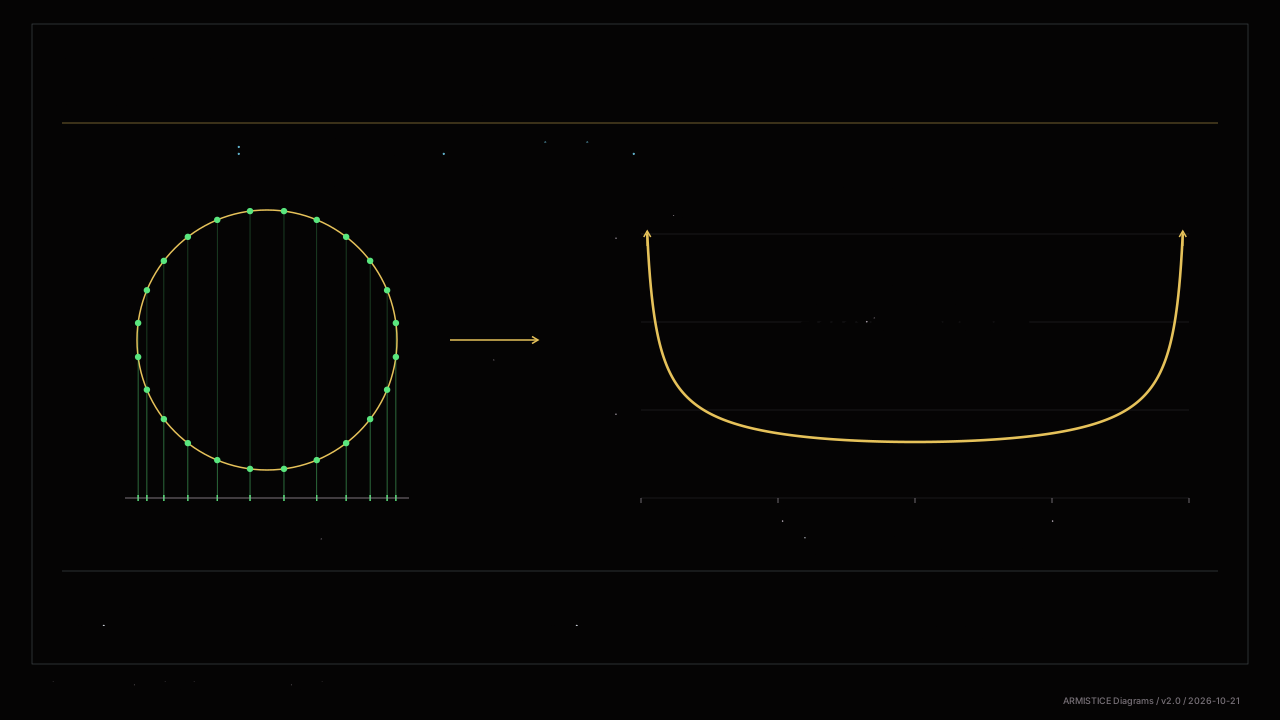
Uniform phase is the premise. Project that phase through cosine and its weight gathers at the two walls: the arcsine law follows exactly. The geometry explains the model; it does not establish that every engine orbit samples the circle uniformly.
You have met this law before without being told its name. A harmonic oscillator, sampled uniformly in time over a cycle, has the signed arcsine position law: it lingers at the turning points and races through the middle. A pendulum has that sinusoidal motion in the small-angle limit. Another version appears in the fraction of time Brownian motion spends above zero, and as the long-walk limit of a fair random walk’s occupation fraction. It favors fractions near zero and one over the middle; it does not say that a tied final score is the least likely endpoint. A swinging weight, a wandering sum, and this phase model meet at the same probability shape, through different mechanisms.
And here is the part that closes the circle. There was already a ladder:
−ln 2, π²/12, −3ζ(3)/2, 7π⁴/120. Each is a cumulant of
Z = log|cos θ|, with the general form
κₙ = (−1)ⁿ(n−1)! η(n); here η(n) means the Dirichlet eta function,
not the substrate’s saturation constant. The first cumulant is the mean,
the second the variance, the third the third central moment. For the raw
log-area, restore 2 log|α| to the mean; higher cumulants are unchanged.
The integral and closed-form calculations agree to dozens of digits.
The ladder is a fingerprint. I had been collecting the overtones of a bell and cataloguing them as if each were its own instrument, when the bell was one note all along. That single note carries this whole family.
Confirmed against the real thing
The model also makes a useful comparison with deterministic motion.
Recorded engine orbits at α = 4, 20, 60, 128 gave Kolmogorov–Smirnov
distances of 0.016, 0.0035, 0.0011, 0.0013 from the closed-form log-area
law. That distance measures the largest gap between two cumulative
distributions. These are close finite comparisons, with a small rise at
the last point; they do not prove monotone improvement or convergence as
α grows without bound.
The engine’s canonical operating point lives elsewhere: a thin, structured
attractor rather than a stirred fog. Its recorded log-area distribution
sits about 0.17 away by the same KS measure. That gap makes a sharp
question: how does the engine’s nonuniform phase measure bend this clean
law? The exact model supplies a reference against which the structure
becomes measurable.
Why a clean law at all
Let’s step back, and the surprise inverts. The arcsine law is what you get from the cosine of a uniform angle. At these parameters the determinant already has that cosine form, so the probability calculation becomes elementary once the phase measure is specified. Mixing by itself does not guarantee a uniform measure. The geometry gives the candidate law; the orbit comparisons tell us where it is a useful description.
That is the quiet lesson under the pretty one. The engine’s overtones, the whole η-ladder, the entire spectral signature, were never a list to be memorized. They were the cumulants of one elementary distribution, and the distribution is one the world already knew by other names. The echoes were here all along.
:: ARKHEIN ::
Lineage
Those who arrived at the same question before. This is not the first arrival.
- 1939
Paul Lévy · Sur certains processus stochastiques homogènes
Established arcsine laws for Brownian motion, including its occupation time above zero and last zero before a fixed time. The same probability shape appears here through uniform-phase projection.
- 1950
William Feller · An Introduction to Probability Theory
Explained the random-walk arcsine law: long occupation fractions near zero or one are more likely than fractions near one half. This concerns time spent ahead, not the final score.
- 1740
Leonhard Euler · De summis serierum reciprocarum
Summed the reciprocal squares to π²/6 and opened the world of ζ-values, the family every rung of the engine’s ladder belongs to. The ladder, it turns out, is this one distribution’s cumulant expansion.
- 1837
Peter Gustav Lejeune Dirichlet
The alternating zeta series bears his name as the Dirichlet eta function. Its values, with alternating signs and factorial factors, organize the log-cosine cumulant ladder.