Cosmopoiesis
Cosmopoiesis
Sacred constants: F φ V Δ
The world-making kernel: a bounded iterated map whose three coordinates fold a point into the attractors used throughout AETHER.
Publication folio Full mathematical text, with readable source references
The Cosmopoiesis engine is the recurring act beneath AETHER: give one point an entity’s coordinate triple, apply the same fold again and again, and let the visited states gather into a visible form. This recollection is about that world-making kernel—what enters it, what comes out, and why its orbit remains contained.
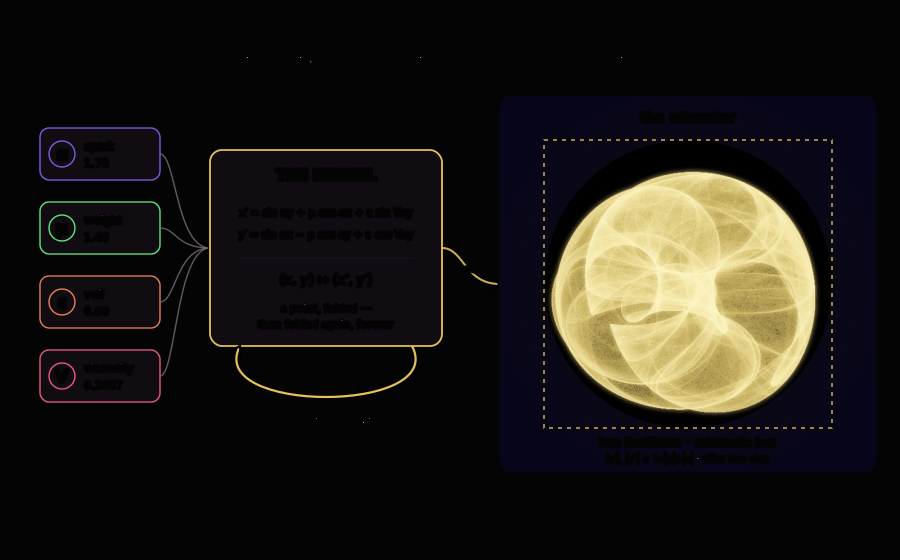
The plate reads from cause to consequence: parameters enter the kernel, the new state returns as the next input, and repetition accumulates the attractor.
The fold
In real coordinates, one iteration is
Here is the spark, setting the rate of trigonometric turning; is the weight, setting the strength of the cosine contribution; and is the veil, coupling the two coordinates through their product. Those three values carry the entity. is shared by the engine: it shapes the coupling phase but is not a fourth entity coordinate.
Nothing in a single step resembles the final image. The form appears only through recurrence. A point is twisted, echoed, coupled, and returned; dense regions are simply the places the orbit revisits most often.
What the kernel guarantees
Every sine and cosine term lies between and , so each updated coordinate is bounded in magnitude by . This is Iron Resilience: regardless of the starting point, the next state enters a finite box and subsequent states cannot escape it. Boundedness guarantees a contained orbit, not a particular beauty, symmetry, or degree of chaos.
There is also a sharper Euclidean statement. After one step, every state lies in the disk of radius . Inside that disk,
is sufficient for contraction: every starting point then converges to the same unique fixed point. At and , this includes . It is a guaranteed region of calm, not the full boundary of stability; a local fixed-point flip and the onset of chaos remain separate events.
The uncoupled limit also carries an exact anti-swap symmetry: when , exchanging the two axes with a sign reversal commutes with the map. Turning on the veil breaks that equality in a controlled direction, which is why paired chiral forms can remain recognizably related without being identical. Between the finite bound and this broken mirror lies the engine’s working character: one small rule, neither frozen nor unconfined, repeatedly making structure from return.