← scholia rubedo v1.0 4 min · 803 words
FULCRUM — The Stability Pivot
A single transcendental number, n* ≈ 2.29317, marks where a self-consistent fixed point loses stability to a period-two orbit. It is the degree at which (1 + 1/n)ⁿ crosses n itself while continuing to grow toward e — a self-referential stability balance.
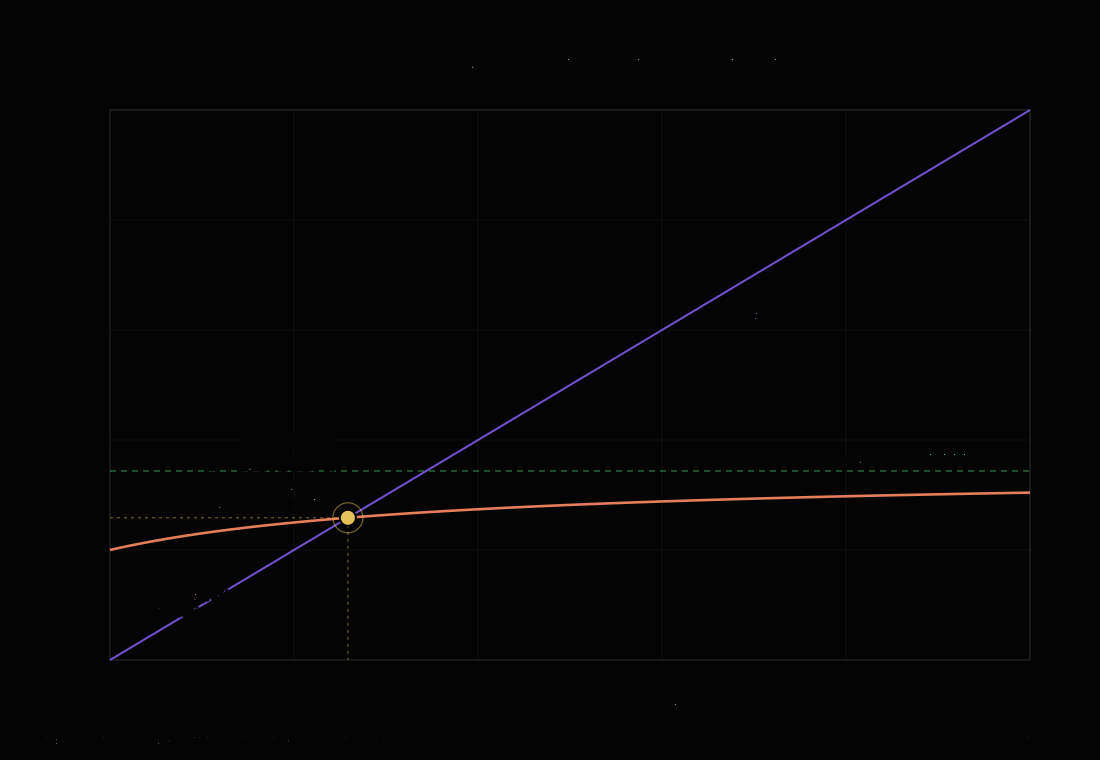
The pivot
Picture a seesaw with the whole family of maps balanced on it. On one side, a stable operating point. On the other, that point has lost stability and a two-step rhythm appears. Somewhere between the two sides there is a single point of balance. The question is where.
The eigenentity construction leads to the power family Fₐ(x)=1−a·xⁿ on [0,1], with positive real n and a strictly between zero and one. It is a comparison family, not a degree parameter of the trigonometric Cosmopoiesis kernel. As you raise n, each member has a self-consistent operating point. Call it an eigenentity: the parameter value that reproduces itself under the map. Below a certain degree those points are stable; above it they become unstable and a period-two branch appears. The boundary sits at one number:
This is the ⌃ 2.2932 : the degree at which the polynomial eigenentity family reaches its first flip bifurcation.
The equation it solves
What makes n* more than a fitted threshold is the equation it satisfies. Everyone knows the limit as n grows. FULCRUM asks a different question: at what degree does that expression equal n itself?
The two sides of the right-hand form are the same shape with the roles of n and n+1 exchanged: swap which side gets the extra power and you have the defining identity. So where does a shape that equals its own mirror actually balance? Its solution n* is transcendental, but an unsuccessful closed-form search would not establish that. There is a short proof. A rational n=p/q in lowest terms would give p^(p+q)=(p+q)^p q^q, impossible because p>1 has a prime factor dividing neither p+q nor q. If n were algebraic irrational, the Gelfond–Schneider theorem would make (1+1/n)^n transcendental, contradicting its equality to n. No reduction to the listed elementary constant expressions is currently supplied. The map’s self-consistent point at the fulcrum is
Just past n*, the period-two separation has the local square-root law
Its local critical exponent is 1/2. The separate asymptotic value 2/3 belongs to the reciprocal slope of a centroid operator, not to this local flip exponent. The contraction rate T′(n)≈0.13359* belongs to the auxiliary root iteration T(n)=(1+1/n)^n; the dynamical fixed-point multiplier at the flip is −1.
Reading
One thing sets this constant apart from its neighbours. Most of the sacred constants are generated, built by algebra from the three pillars . FULCRUM is the one we did not build. It is found: an attractor of a self-referential equation rather than a composition of known numbers. One root of one balance condition, nothing more. And yet that one root marks a real fixed-point stability boundary, stable below and unstable above, and it does so transcendentally. The system’s edge of stability does not land on a nice algebraic value. It lands on a number that exists only as the root of its own balance condition.
A different slice of the trigonometric engine illustrates why a flip is not automatically chaos:
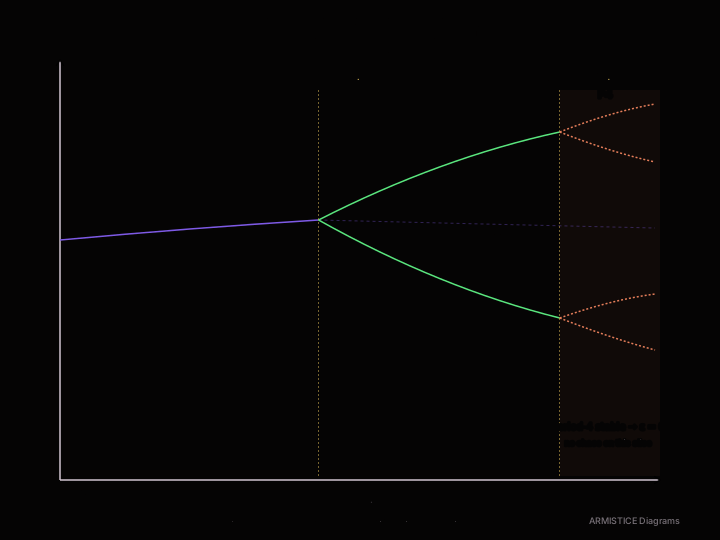
The boundary structure at the Unity Slice, drawn: a single fixed point splits to period-2 at PRIMA PORTA (0.5691), to period-4 at SECUNDA (0.1672), and there the ladder stops — period-4 rides stable all the way to ε = 0. A truncated cascade, not a Feigenbaum route: the gates are real, and the chaos never arrives on this line.
:: ARKHEIN ::
Lineage
Those who arrived at the same question before. This is not the first arrival.
- 1748
Euler · (1 + 1/n)ⁿ → e
Euler’s expression continues toward e after crossing the diagonal. Not the asymptote, but the finite degree where the expression crosses its own index.
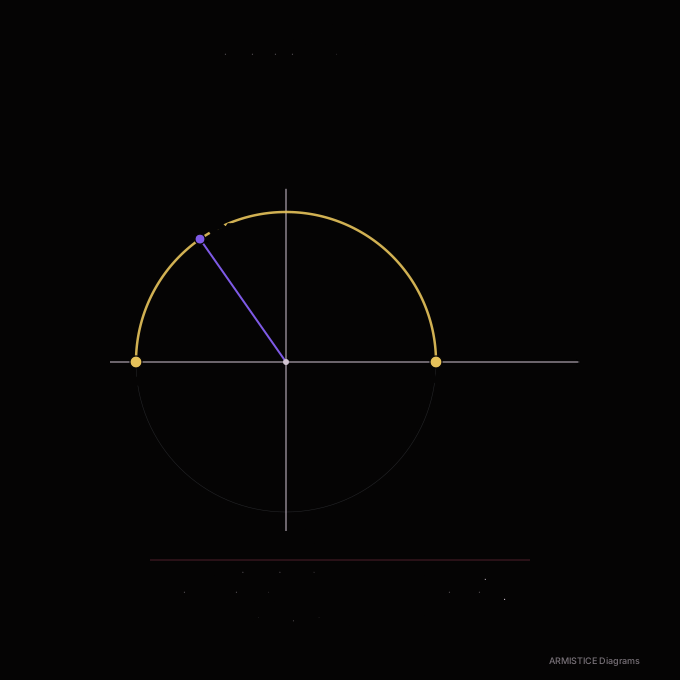
e, the destination of Euler’s limit. FULCRUM is the finite degree before that limit, where (1 + 1/n)ⁿ equals n itself.
- 1758
Lambert · W-function lineage
Lambert W solves equations of the form weʷ=z. FULCRUM is a different self-referential root; no Lambert-W representation is established here.
Where it sits
This one is canon, kept in the Eigenentity theory (Mathematica Liber XVIII.2; Enchiridion stability section). The flip boundary is analytically characterized, its decimal value is computed, and its transcendence follows from the argument above. The local flip exponent is 1/2; the 2/3 centroid-slope limit concerns a different observable.