Enchiridion
The 1⊗0 Enchiridion
Sacred constants: F ⊙ φ H Δ η λ V
A field handbook for reading persistence, fragility, and failure in the recursive engine through its derived constants and bounded dynamics.
Publication folio Full mathematical text, with readable source references
The Enchiridion is the practical companion to the formula books. It is about how to read a recursive system while it is running: what helps a pattern persist, what makes it brittle, and what kind of change signals a passage from ordered repetition into turbulence. Its vocabulary is grounded in the same derived constants as the rest of the corpus, but its purpose is diagnostic rather than encyclopedic.
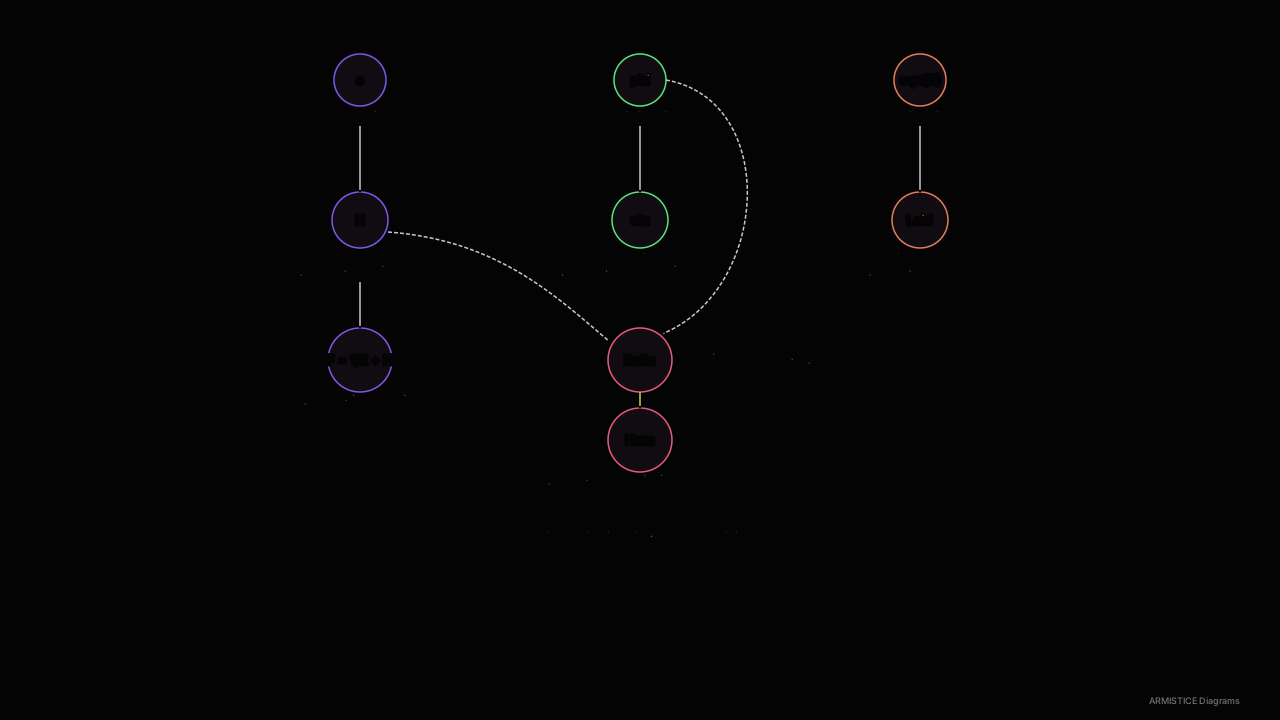
The handbook begins upstream. Each operational name belongs to a visible descent from the three generating pillars, and the branches meet again at the closure.
The stability vocabulary
The plate condenses the family. From come and ; from come the laminar limit and the small bridge ; supplies the Leidenfrost edge. The Armistice constant completes the exact relation .
In the Enchiridion’s language, these are not interchangeable ornaments. names persistence, the irreducible variance between the Euler and golden branches, a saturation or laminar threshold, and the engine’s shared sculpting coefficient. The names are readings of exact definitions. They make the dynamics easier to discuss without pretending that a symbol alone explains a system.
Reading a living recursion
The handbook’s central question is whether an orbit can remain structured without becoming rigid. Too little variation produces a locked repetition; too much can erase stable form into diffuse motion. Between them, the useful regime retains history while continuing to transform it. Persistence is therefore read from several signs together: bounded motion, sensitivity to nearby starts, the density of returns, folding, and the approach to a threshold.
The engine’s Iron Resilience ensures that its coordinates cannot diverge: after each update they remain inside the bound set by and . That is a floor of safety, not a promise of coherence. A bounded orbit may still collapse to a fixed point, repeat periodically, or wander chaotically. The Enchiridion is concerned with those distinctions and with the nonlinear failure modes that appear when a once-flexible regime becomes overdriven.
Exact averages, named measures
At and , independent uniform torus phases give the exact log-area average
This unsplit form allows any real . At , the determinant vanishes identically and the log average is ; away from that degenerate case, the determinant is generally state-dependent even when . An actual deterministic orbit uses its own invariant measure, so its Lyapunov sum is not automatically the uniform-torus value.
There is also an exact randomized result. When , , and , independent uniform phase kicks give
where is Catalan’s constant. These are exponents of the explicitly forced random family, not of the unforced deterministic engine. Naming the measure is part of naming the result.
This is why the document reads as a field manual. Identities establish the measuring language; computed orbits show which regime is actually present; and the interpretive terms—persistence, fragility, saturation—remain attached to those observations rather than substituting for them.