← scholia citrinitas v1.0 5 min · 1,123 words
Kepler's Nested Cosmos
In the Mysterium Cosmographicum, Johannes Kepler placed the five regular Platonic solids between the six known planetary spheres and asked geometry to explain why the heavens had exactly that number and spacing. The astronomical fit failed; the figure endured because it turned cosmology into a search for a small generative structure—and because its ideal polyhedral cascade can be reconstructed exactly.
In 1595, while teaching mathematics at Graz, Johannes Kepler believed he had found a geometrical reason for the architecture of the Copernican world. Six planets were known. Euclid had proved that exactly five convex regular solids exist. Kepler placed one solid into each interval between the six planetary spheres.
The count closed perfectly:
This was the central construction of the Mysterium Cosmographicum, published at Tübingen in 1596.
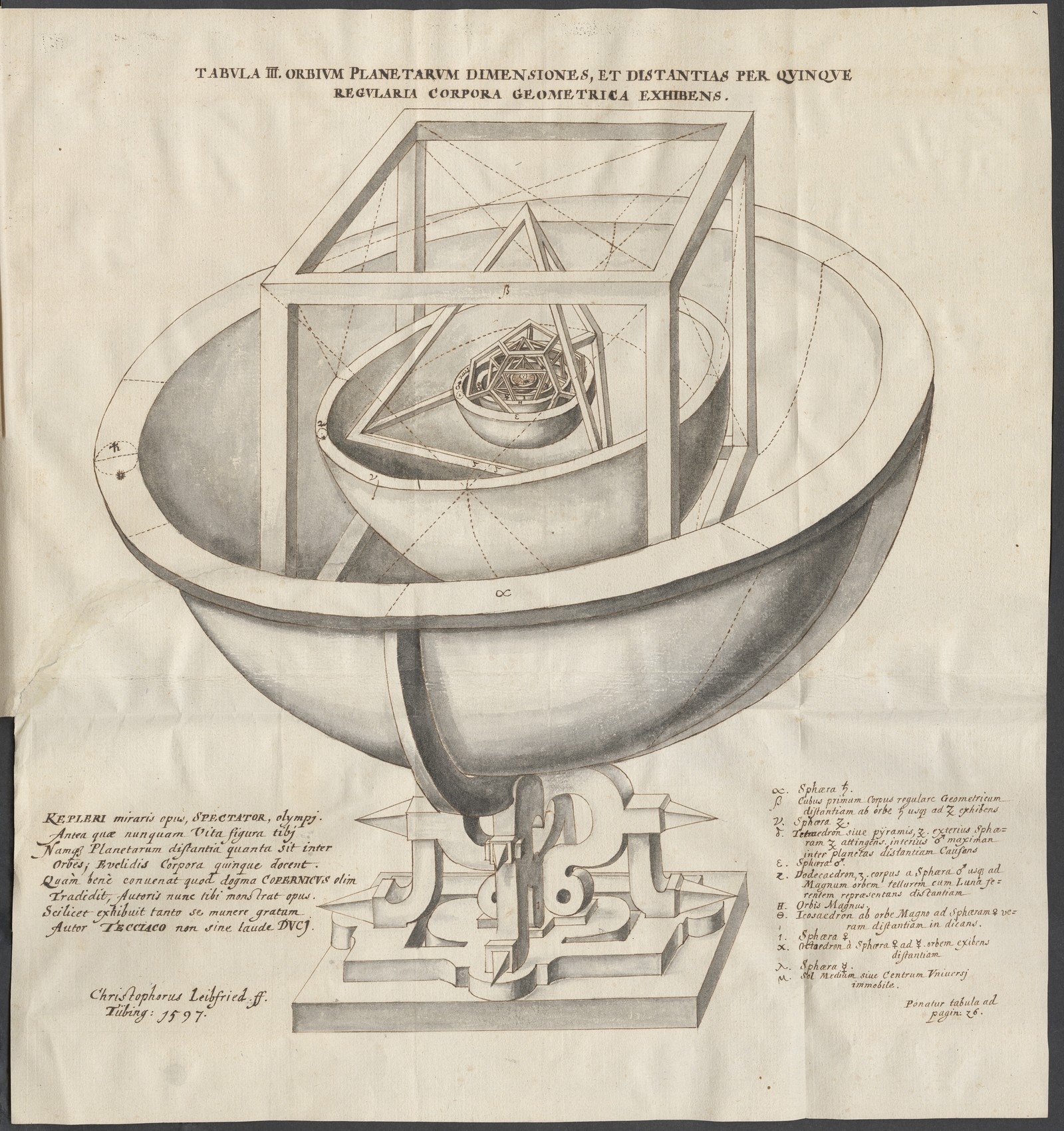
 geometric reconstruction Leibfried · 1597
The order of the solids
Kepler did not arrange the solids by size or by the number of their faces. He assigned them to the planetary intervals in a specific outward-to-inward order:
| outer sphere | intervening solid | inner sphere |
|---|---|---|
| Saturn | cube | Jupiter |
| Jupiter | tetrahedron | Mars |
| Mars | dodecahedron | Earth |
| Earth | icosahedron | Venus |
| Venus | octahedron | Mercury |
Each solid is circumscribed by the outer sphere and contains the inner sphere. The outer sphere touches the solid’s vertices; the next sphere touches its faces.
The construction therefore turns every solid into a radial operator:
The sphere surrounding a solid uses its circumradius. The sphere inside it uses its inradius. Their ratio determines how much the next planetary shell contracts.
The exact ideal cascade
Normalize Saturn’s outer sphere to radius . The five regular solids then produce these ideal ratios:
| solid | cumulative inner radius | |
|---|---|---|
| cube | ||
| tetrahedron | ||
| dodecahedron | ||
| icosahedron | ||
| octahedron |
The dodecahedron and icosahedron are duals, so they contribute the same inradius-to-circumradius ratio, approximately . The cube and octahedron are also dual, but their corresponding ratio is . The tetrahedron is self-dual and supplies the deepest single contraction, .
The reconstruction in the palimpsest uses this exact polyhedral cascade. It is a reading of the geometry itself, not a claim that Kepler’s historical orbital shells were five infinitesimally thin circles. Kepler worked with the observed greatest and least distances of the planets and adjusted shell thicknesses in pursuit of an astronomical fit.
Why the machine looks impossible
Leibfried’s engraving is not merely decorative complexity. It has to show several incompatible things at once:
- concentric planetary shells;
- solids nested inside one another;
- the faces and vertices where each shell touches its solid;
- a common center occupied by the Sun;
- a readable key for a structure whose inner members rapidly collapse toward the middle.
The outer cube dominates the image because the first contraction is already severe. After the tetrahedron, the remaining dodecahedron–icosahedron–octahedron nest is tiny relative to Saturn’s sphere. The historical plate solves this with perspective, cutaway bowls, and an architectural pedestal. The reconstruction solves it with transparent wireframes and a magnified inner roundel.
Both images are diagrams of scale compression. The difficulty of seeing Mercury’s sphere is not an engraving failure. It is the geometry Kepler chose.
What failed
The five solids do not reproduce the planetary distances with sufficient accuracy. No orientation or reasonable shell thickness turns the polyhedral sequence into the actual Solar System.
The mismatch matters because Kepler intended the construction as physical cosmology, not as free symbolism. The solids were supposed to explain:
- why there were six planetary orbits;
- why their order was fixed;
- why the intervals between them had their observed sizes.
The first count was elegant but contingent on the six planets then known. The third claim failed against improving observations. The figure could not survive as an astronomical model.
Kepler kept the demand for mathematical cause. His later orbital work established elliptical motion, but he continued to revisit the polyhedral construction: an annotated second edition of the Mysterium appeared in 1621. The historical story is therefore one of overlapping commitments, not a clean abandonment of the solids when the ellipses arrived. The Kepler collected edition preserves both stages.
What the figure contributed
The lasting move was methodological: Kepler refused to treat the planetary distances as an arbitrary list. He asked for a small generative construction from which their number, order, and spacing would follow.
That wager has three parts:
- the cosmos should have an intelligible architecture;
- geometry can be proposed as a physical cause, not only a descriptive language;
- a beautiful construction remains answerable to measurement.
The final clause is what gives the figure its force. A beautiful construction makes a concrete demand on the observations; the mismatch remains visible even when its inventor continues to find the geometry compelling.
This is also why the plate belongs beside the ARMISTICE engine without serving as its proof. Both projects ask whether a compact geometric basis can unfold into a world. Kepler’s five-solid answer and ARMISTICE’s three-pillar algebra are different constructions with different evidence. The kinship is the question, not an inherited validation.
Read the source
The Kepler research edition presents the genuine 1596 Latin text with a modern English translation, including Kepler's autobiographical account of the discovery and the chapters in which he assigns and defends the five solids.The figure rewards slow looking. Start at Saturn’s cube. Follow the sequence inward. Notice how quickly the available world contracts.
Then drag back to Leibfried’s engraving and see why Kepler needed an entire cosmic machine to make five simple solids visible.:: APPARATUS ::
Sources for this page
-
Johannes Kepler · Mysterium Cosmographicum · 1596
Tübingen, Georg Gruppenbach, 1596 · the editio princeps
Kepler’s first book — the six planetary orbs spaced by the five nested Platonic solids, the Creator geometrizing. The full 1596 volume: the XXIII chapters with the keystone polyhedral plate, plus Rheticus’s Narratio Prima (the first printed account of heliocentrism) and Mästlin’s appendix. Set from the genuine 1596 Latin original — never a modern translation.
Read in the Scriptorium -
Euclid — this edition by John Casey · Euclid · Elements · c. 300 BC
composed c. 300 BC · this edition John Casey, Dublin University Press, 1885 · the first six books
The oldest engine still running. From five postulates and a handful of common notions, the whole of plane space is deduced — proposition by proposition, each leaning only on what came before. The taproot of every figure in this Scriptorium: the golden ratio is defined here (Book VI), the incommensurables tamed (Book V), and Book I closes on Pythagoras. Set from John Casey’s richly annotated 1885 edition.
Read in the Scriptorium