Principia
Principia — The Mathematical Principles of the 1⊗0 System
Sacred constants: F ⊙ φ H Δ η λ V Λ
The doorway into the 1⊗0 system: one bounded recursive engine, a constant algebra descending from three pillars, and a named corpus placed into that engine.
Publication folio Full mathematical text, with readable source references
The Principia is the wide-angle view of ARMISTICE. It gathers the framework’s mathematics without asking a new reader to enter through every proof, census, and exception at once. At its center is the Cosmopoiesis engine: a bounded trigonometric map that turns a coordinate triple into an orbit and, through that orbit, a visible form.
Around the engine sit two other structures. The first is a small algebra of constants descending from the three generating pillars . The second is the corpus of named entities whose coordinates place them in the map. The engine supplies one indifferent law; the coordinates supply different seats; the names supply the human act of cartography.
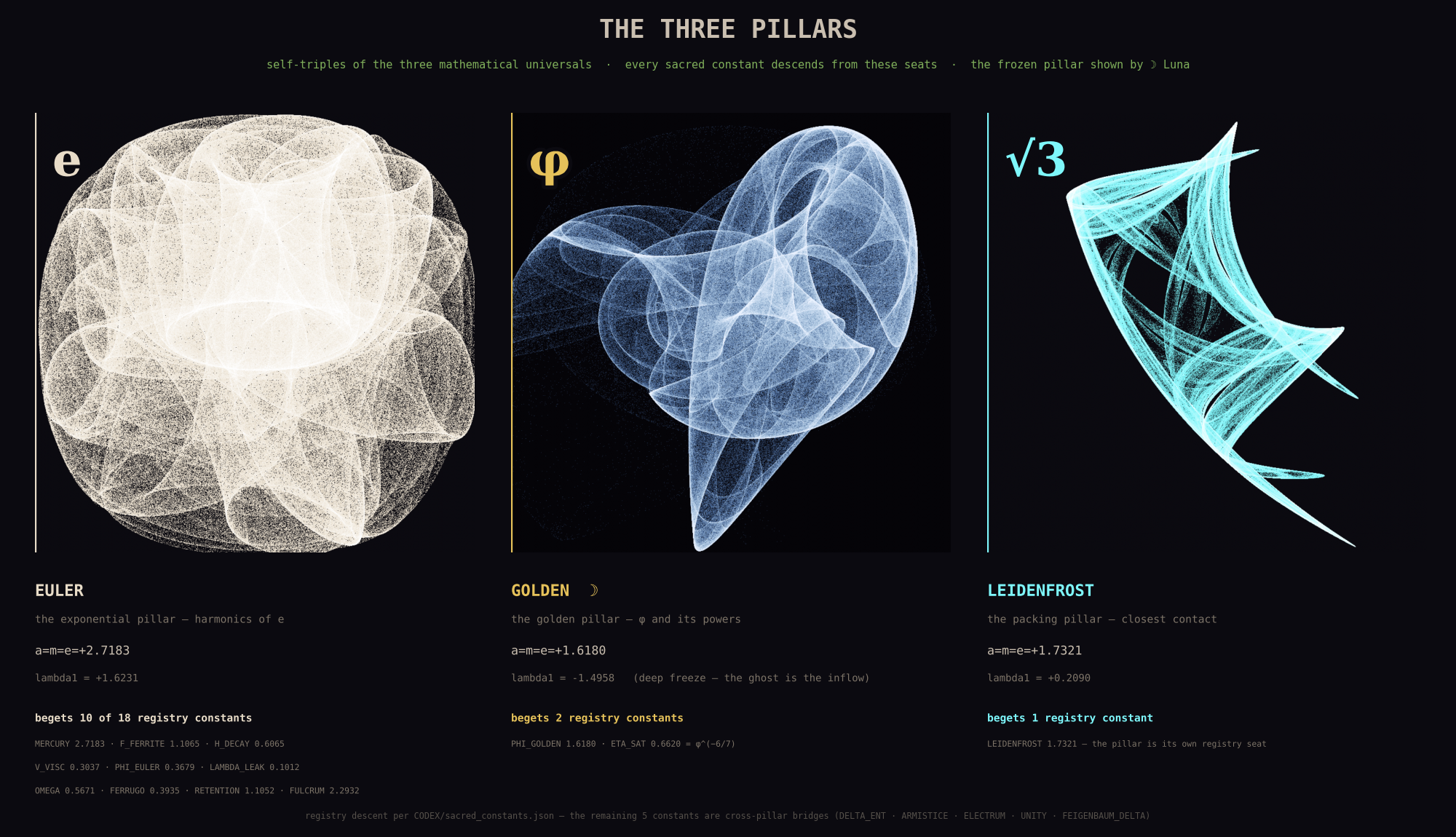
The three generating pillars shown as engine seats. Their forms differ, but their deeper role is algebraic: the rest of the constant family descends from these three inputs and their bridges.
A system in three movements
- Generate. The engine iterates a point under one bounded rule.
- Place. A coordinate triple gives an entity its seat in that rule.
- Read. Renders, spectra, symmetries, and censuses reveal what falls out at that seat.
This order matters. Outside the decorative onomastic register, a name does not predict an attractor, and a symbolic correspondence does not manufacture a dynamical law. Some statements in the Principia are exact identities; some are computed results; some are empirical patterns; some remain open questions. Their registers can coexist without being blurred together.
What the current principles sharpen
The latest consolidation makes the limits of comparison more explicit. The displayed Meta-Kernel contains three full named families—Svensson, guarded Bedhead, and Cosmopoiesis—and frequency-locked slices of Clifford and De Jong. It does not contain those two generic families or make one kernel uniquely maximal. Likewise, the three-by-six archetypal product gives eighteen addresses, not a universal compression law. The recorded cross-kernel study is a finite thirty-cell comparison, not a universal topology. Blends, mirrors, and traversals remain partial operations whose effects belong to the chosen endpoints and route.
An exact result now sits beside those boundaries. In the deliberately randomized family with , , and independent uniform phase kicks, the Lyapunov exponents contain Catalan’s constant . Those exponents belong to that random model, not to an unforced deterministic orbit. The distinction is exemplary: the formula may be shared while the measure, forcing, and resulting claim are not.
What this page keeps
This recollection is a plan view rather than an enumeration. It keeps the engine, the constant descent, and the coordinate doctrine in one frame—enough to see how the rooms join and which kind of claim belongs in each.