← scholia citrinitas v1.5 6 min · 1,354 words
Mirror Frame Theorem
Rotate the engine's coordinates by 45° and its mirror structure becomes explicit: an anti-swap symmetry, a parameter-flip conjugacy, and an indefinite quadratic coupling. In a sampled band with zero coupling, two mirror-related attractors separate. An exact local sign rule explains how an orbit can retain its side and provides a strong measured phase predictor.

Statement
Tilt the page forty-five degrees and the kernel stops hiding. What was a tangle of permutations and cross-terms falls open into clean axes, so let us rotate the frame and look. A change of variables adds nothing: the page just turns. So what can one rotation possibly buy? Cosmopoiesis, the iterative map that draws the engine’s orbits, admits a canonical coordinate frame along the two 45° diagonals:
u = (x + y) / √2
v = (x − y) / √2
in which four structural features become simultaneously manifest. Its parameters are frequency α, fold shape μ, and coupling ε; V is the fixed coefficient inside the bilinear coupling phase.
With this sign choice for v, the orthogonal change of variables has determinant −1: a rotation followed by reversal of one axis. The diagonal frame is the useful structure; orientation reversal does not change the conjugate dynamics.
The four manifestations
(M1) Anti-swap is axis reflection.
The anti-swap involution A(x, y) = (−y, −x) reduces, in (u, v)
coordinates, to the coordinate-axis reflection u → −u. The hidden Z₂
symmetry of the (x, y) kernel at ε=0 is staring you in the face once you
rotate the frame.
(M2) ε=0 base map separates. Each rotated component is a product of a u-only function and a v-only function. This is product factorization, not two independent one-dimensional maps: each update still depends on both coordinates.
With β = α/√2, the uncoupled equations are
u′ = √2 sin(βu) [cos(βv) − μ sin(βv)]
v′ = √2 cos(βu) [μ cos(βv) − sin(βv)]
(M3) ε-coupling becomes Lorentzian.
The coupling argument V·x·y becomes V·(u² − v²)/2: the Lorentzian
quadratic form on (u, v), the indefinite one. Equivalently (V/2)·Re(w²)
for the rotated complex coordinate w = u + i·v. The substrate’s
ε-interaction phase has the algebraic signature of a two-dimensional Minkowski
quadratic form. No spacetime or causal dynamics is implied by this identity.
(M4) The REBIS pair. The Mirror Frame exposes two distinct Z₂ relations on perpendicular coordinate directions: a symmetry of one map and a conjugacy between two parameter choices.
- u changes sign under
A : (x,y) → (−y,−x), the anti-swap. Its fixed mirror isu=0, the v-axis. It commutes with the map F at ε=0. - v changes sign under
σ : (x,y) → (y,x), the swap. Its fixed mirror isv=0, the u-axis. The μ-flip conjugacy axis at ε=0:F_{−μ}(u,v) = R_v ∘ F_μ ∘ R_v(u,v).
Both are exact at ε=0, and both break linearly the moment ε wakes. In the Mirror Frame the break vectors are exactly perpendicular:
Anti-swap break F(Az) − A(Fz):  on u-axis (v-component = 0)
                               = 2ε · sin(V·xy + π/4)
μ-flip break:     on v-axis (u-component = 0)
                  = −2ε · cos(V·xy + π/4)
Their individual magnitudes vary with phase, each bounded by 2|ε|; the sum of their squared magnitudes is exactly 4ε². Two natures, one body, at right angles. This scholion borrows an alchemical name for the paired reading: REBIS.
:: ARKHEIN ::
Lineage
Those who arrived at the same question before. This is not the first arrival.
- 1550
Rosarium · Rosarium philosophorum
Its coniunctio imagery joins opposed figures. This scholion borrows the union-of-opposites motif to name an independently computed pair of perpendicular symmetries; it does not assign that mathematics to the historical text.
- 1665
Kircher · Mundus subterraneus
Kircher’s layered cosmography offers a historical visual comparison. The following plate composes that comparison with modern mirror-frame axes.
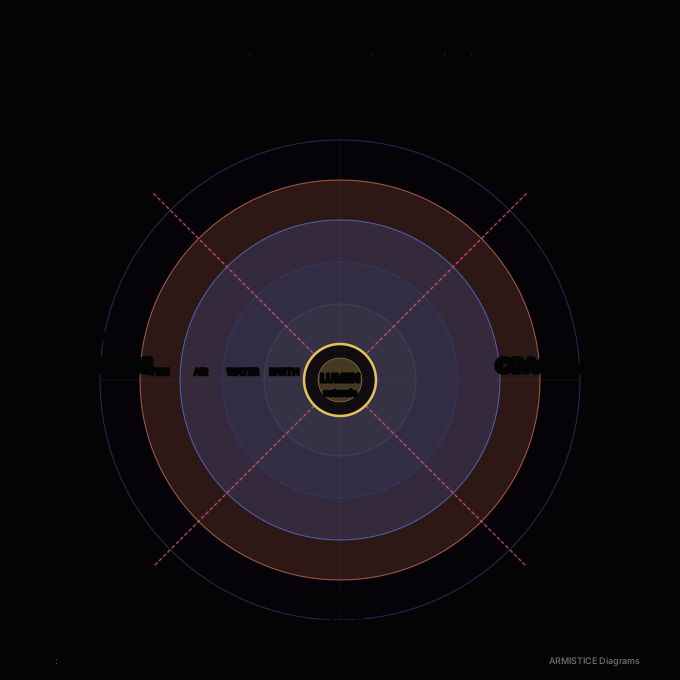
The elemental shells are a historical comparison; the 45° REBIS axis-pair and SOLVENS/COAGULANS compass are the ARMISTICE overlay.
- 1908
Minkowski
The Lorentzian indefinite quadratic form
u² − v². The substrate’s ε-coupling argument has this same algebraic signature after rotation. Its zero set gives two null directions; a physical causal cone would require additional structure.
When the twins divide
Set ε to zero. No field, no bias, no thumb on the scale — the anti-swap A is an exact symmetry of the map, for every (α, μ). And yet: turn the dials into a certain band and the kernel quietly picks a side. The single mirror-symmetric attractor splits into two, mirror images of one another, and an orbit drops into one or the other and stays. Symmetric law, asymmetric outcome, two of them — the textbook fingerprint of spontaneous symmetry breaking. So what decides it, if not ε?
The factored form (M2) gives an exact sign rule:
sign(u′) = sign(sin(βu)) · sign(f(βv)), f(t) = cos(t) − μ·sin(t)For α>0 in the strip |βu|<π, sin(βu) has the same sign as u. If an orbit
stays in that strip and f(βv)>0 at every step, it retains its side of the
mirror. That is the local mechanism behind the observed pair. For positive
μ, the first positive zero is βv₀ = arctan(1/μ); crossing into a negative-f
region permits a side change while the local-strip condition holds.
Inside the local strip, positive f preserves an orbit’s hand. A change in its sign opens a route across the mirror.
Across the recorded 110 × 110 grid on (α, μ) ∈ [1.0, 1.85]², the sampled
minimum of f predicted the broken phase with 99.7% agreement, with no
false positive in that grid. This is a finite-grid phase classifier, not an
if-and-only-if theorem about all attractors. In the observed band the
cos(βu) factor reduces the v-update’s magnitude and helps confine it to
positive f. The borrowed rebis image finds a sharper use here: the pair
comes apart under the map and, in those measured runs, holds.
A transverse Lyapunov exponent measures average growth away from the mirror, using absolute values of derivatives. It discards the sign of f. Growth away from the mirror and retention of a hand are therefore different questions; the sign rule supplies information that the exponent alone loses.
:: ARKHEIN ::
Lineage
Those who arrived at the same question before. This is not the first arrival.
- 1848
Pasteur
Under the lens, sodium ammonium paratartrate had crystallized into two mirror-image forms; Pasteur sorted them by hand and found the two solutions rotated light in opposite directions. That experiment is a historical example of resolving a mixture into opposite hands. The kernel’s symmetry breaking is a separate mathematical result.
In this band a symmetric rule supports asymmetric outcomes with no chemical model attached. Switching ε back on explicitly breaks the symmetry and can bias or deform the pair. The comparison with handedness is the reading; the paired attractors and the local sign mechanism are the dynamical content.
Reading
And yet, what did the rotation actually change? The kernel is the same, the dynamics are the same, not one number moved. So where did four manifest structures come from? They were there all along; we were just holding the page at the wrong angle. A frame chosen badly hides structure, a frame chosen well reveals it, and this is the well-chosen one:
- The anti-swap symmetry comes out of hiding: a permutation operator in (x, y), a plain axis-reflection in (u, v).
- Separability of the ε=0 base map stops being a theorem to prove; you read it off the rotated form.
- The ε-coupling stops being a bare
x·ycross-term and becomes the Lorentzian quadratic on (u, v). - The anti-swap symmetry and μ-flip conjugacy use perpendicular directions, forming the REBIS pair.
The Mirror Frame is the kernel’s native frame in the same sense that spherical coordinates are the hydrogen atom’s: the choice of coordinates does not change the physics, but the right choice makes the structure legible.
:: APPARATUS ::
Sources for this page
-
Anonymous · Rosarium philosophorum · 1550
Frankfurt: Cyriacus Jacobus · ETH-Bibliothek Zürich, Rar 8230
The illustrated second part of De alchimia, preserving the Rosarium’s sequence of emblematic operations.
View the 1550 facsimile -
Athanasius Kircher · Mundus subterraneus · 1665
Amsterdam: Joannem Janssonium · Science History Institute, Roy G. Neville Historical Chemical Library, Q155 .K573 1665
Historical reference for layered elemental cosmography. The Mirror Frame scholion uses an original schematic inspired by this register, not a reproduction of a specific plate.
View the public-domain 1665 volume -
Louis Pasteur · Crystal Form and Optical Rotation · 1848
Annales de chimie et de physique, third series, 24, 442–459 · University of Illinois historical-source record
Source for Pasteur’s separation of opposite-handed paratartrate crystals and their optical activity; no source text or image is reproduced.
View the historical-source record