← scholia nigredo v0.2 4 min · 876 words
The Wada Question — Three Attractors and Uncertain Boundaries
Some engine coordinates send nearby starting points toward different final states. Newton's three-basin example calibrates a finite-resolution boundary measurement; sampled engine cases with three or more outcomes show near-area-filling boundaries and Wada-compatible numerical diagnostics. Three attractors alone do not establish Wada topology, and a finite grid cannot prove that every boundary point touches every basin.
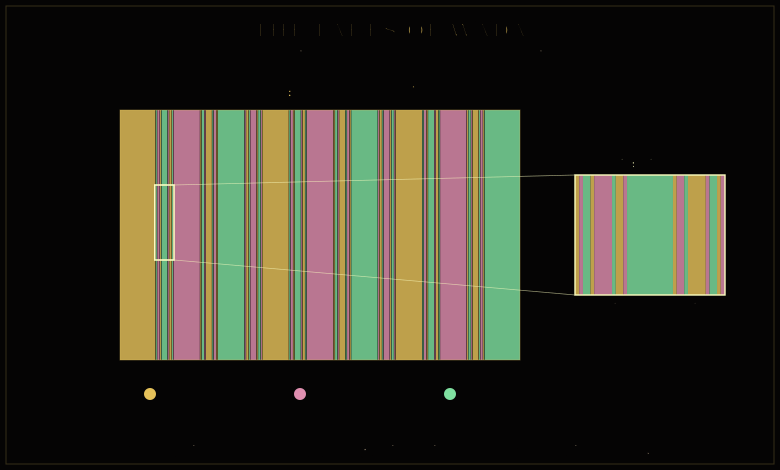
Run the engine at some coordinates and you meet its ghost. Two nearby starting points can settle into different final states. In the measured cases, resolving a finer grid reveals more boundary structure. That is a question about basin geometry: how the initial conditions leading to different outcomes meet. Wada is one especially strong possible geometry, and it needs its own test.
A boundary you cannot stand on
Where two possible fates meet, there is a boundary between their basins. A smooth boundary has a comparatively simple local shape; a fractal boundary can reveal more structure as the viewing scale shrinks. Near a sampled fractal boundary, a small uncertainty in the starting point can become an uncertainty in its eventual destination.
The engine samples include boundaries with estimated dimension near two, almost filling the sampled plane at the scales tested. The uncertainty-exponent method estimates boundary dimension from how the fraction of uncertain initial conditions changes with perturbation size. This is a measured geometric feature of particular coordinates, not a guarantee for every engine setting or every finer scale.
Calibrated on Newton’s own basins
Before interpreting the engine measurements, I checked the measuring stick against Newton’s method applied to z³ = 1. Its three root basins provide a familiar fractal example. The uncertainty-exponent calculation returned D = 1.465, close to the literature value of about 1.4. That control supports the numerical method over its tested scale range; it does not turn the engine results into a theorem about every boundary point.
The sampled change at three
For each sampled setting, count the distinct final states (k) and estimate the boundary dimension (D). Across 110 tested multistable coordinates, the measurements showed a pronounced change in the sampled cases with k at least three:
- One fate. With only one observed basin, this comparison has no inter-basin boundary.
- Two fates. The measured dimensions vary widely. In this sample the chaotic subset averaged D ≈ 1.86, and the periodic subset D ≈ 1.39. Chaos is a strong correlate here, not an if-and-only-if classifier.
- Three or more fates. The tested cases had D ≈ 2 at the resolved scales. Increasing the averaging horizon twelvefold at four k = 3 coordinates left the estimates near two. This supports a sample-specific near-area-filling pattern, not a general implication from the number of attractors.
The sampled data therefore look more like a change of regime than a gradual rise. The count alone does not establish a universal threshold: new coordinates, longer horizons and finer scales remain ways to challenge the pattern.
What the Wada test says
A collection of basins has the Wada property when every boundary point of each basin is also on the boundary of every other basin. Three or more basins are necessary for this property, but their coexistence is not sufficient. A dimension estimate near two is also not sufficient: dimension and the shared-boundary topology ask different questions.
The numerical refinement diagnostic used a non-Wada striped control (score 0) and Newton’s three-root basins (scores approaching 1). One engine k = 3 case rose from 0.81 to 1.00 over the tested resolutions, tracking the Newton control. That makes this engine sample Wada-compatible at those resolutions. A finite grid cannot show that every boundary point touches every basin at arbitrarily small scales. Published numerical Wada tests make the same resolution issue explicit: see Daza and colleagues’ 2015 test and their 2018 merging method.
The ghost, dispelled and kept
The ghost is a useful name for the observed final-state sensitivity near these measured boundaries. Newton calibration, boundary-dimension estimates and controlled refinement tests each support a different part of that account. The engine’s tested k ≥ 3 cases show an unusually strong pattern; whether their boundaries are Wada at every scale remains an open topological question.
The next discriminating test is to repeat the basin comparison on finer grids and additional coordinates, and to look for any boundary segment shared by only a subset of the basins. Such a segment would disprove Wada for that case.
:: ARKHEIN ::
Lineage
Those who arrived at the same question before. This is not the first arrival.
- 1669
Isaac Newton · De analysi
His 1669 account of root-finding is the historical source of the method. Applied here to z³ = 1, it supplies the three-basin numerical control for the boundary-dimension estimate.
- 1917
Kunizo Yoneyama · Theory of Continuous Sets
Recorded the lakes of Wada: a construction in which three regions share one boundary. He credited the construction to his teacher Takeo Wada.
- 1983
Celso Grebogi, Edward Ott & James Yorke · Fractal Basin Boundaries
Developed the account of fractal basin boundaries and final-state uncertainty that frames the engine measurements.
- 2015
Alvar Daza, Alexandre Wagemakers, Miguel A. F. Sanjuán & James A. Yorke · Testing for Basins of Wada
Developed a numerical test for Wada basins. The engine comparison uses finite grids and is reported here as a diagnostic, with its resolution limit intact.
:: APPARATUS ::
Sources for this page
-
Celso Grebogi, Edward Ott & James A. Yorke · Fractal Basin Boundaries · 1983
Physical Review Letters 50, 935–938
A foundational account of fractal basin boundaries and their consequences for final-state predictability.
Open the journal record -
Judy Kennedy & James A. Yorke · Basins of Wada · 1991
Physica D 51, 213–225
The defining dynamical-systems treatment of several basins sharing the same boundary at every boundary point.
Open the journal record -
Cosmopoiesis · living edition
The public kernel definition, parameter meanings, iteration protocol, and dynamical vocabulary used throughout the scholia.
Read the live canon