← scholia viriditas v2.0 7 min · 1,483 words
The Alphabet and the Compass
One symmetry alphabet appears in two dynamical faces. The Rosarium grows Dₙ circle-flower motifs; the Cathedral cuts harmonic caustics into cusped foils. Together they make the two skeletons of a rose window. Exact sacred geometry begins only where both attractors stop: the τ-rotor supplies the compass, the canonical spacing, and the √3 vesica.
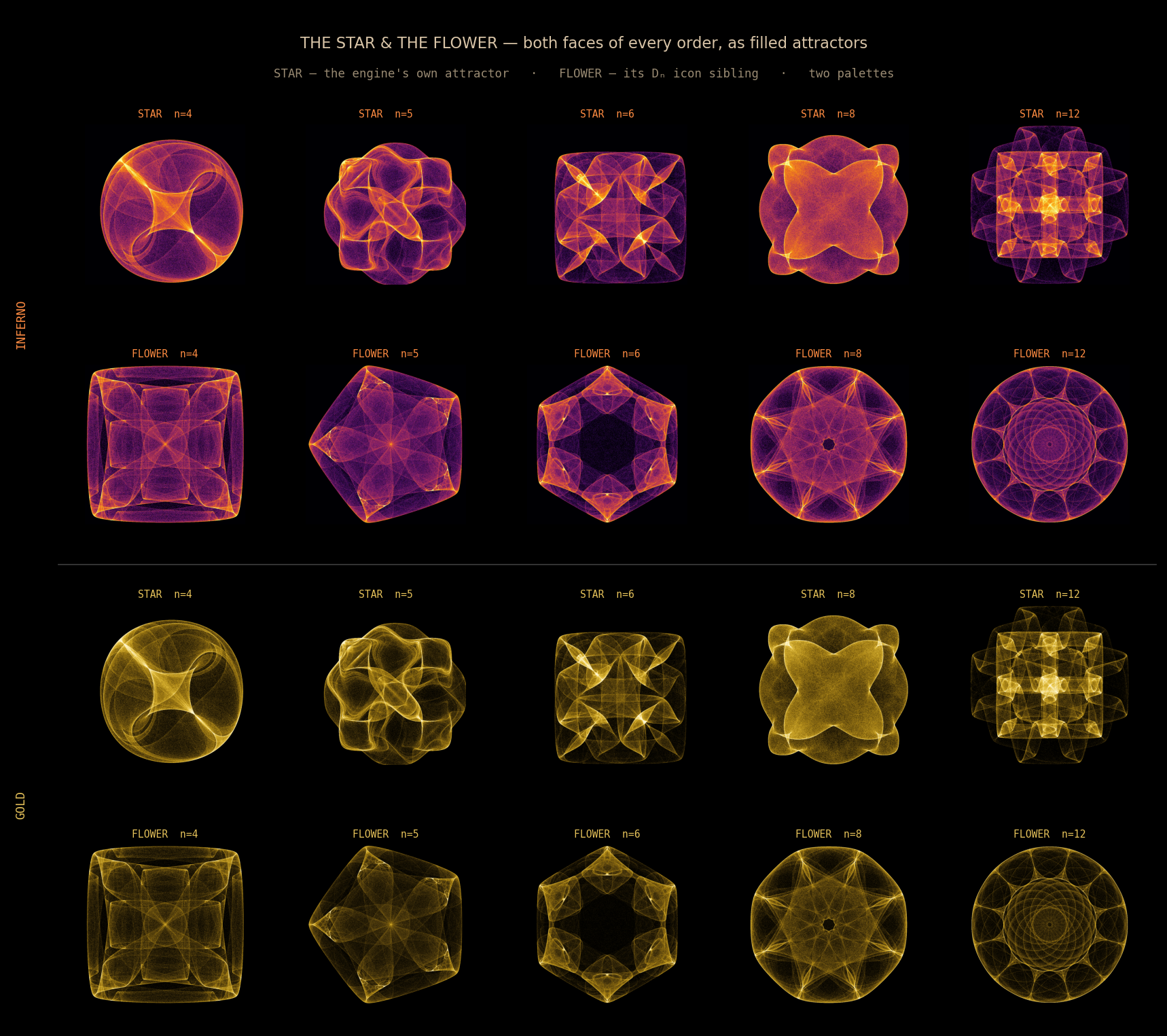
One alphabet, two faces
Low rotational orders recur wherever a plane must organize itself around a centre. Human geometry made them into trefoils, pentagrams, hexagrams, eightfold rosettes, and twelvefold rose windows. The engine reaches many of the same orders without having seen those figures, because rotational symmetry admits only so many economical ways to close.
But an order is not yet a shape. The same can be realized by two different dynamical constructions:
- the Rosarium grows an -fold ring whose density reads as overlapping circles: the flower;
- the Cathedral maps a critical curve into a caustic with a measured angular order: the star, or gothic foil.
A rose window contains both. Its circles establish the layout; its cusped foils cut the tracery over that layout. These are not merely sister motifs but the two halves of one object. Their correspondence lies in rotational order, not in point-for-point identity: star and flower can be compared by angular pattern; that does not equate a Fourier order with a cusp count.
The Rosarium: circles grown by symmetry
The flower wing uses Field and Golubitsky’s -equivariant symmetric-icon map, with the coefficients renamed here:
Here fixes the dihedral symmetry, controls gain, shapes the radial feedback, adds angular modulation within that symmetry, and mixes the -fold mode back into the orbit. For real coefficients, all four terms preserve equivariance. The resulting density can settle into a -symmetric ring of overlapping circle-like loops.
A blind circle detector, given no sacred-geometric template, found rings of at least nine equal-radius circles at the tested orders
The cleanest detections were , , and : the pentagonal order, the Seed-of-Life motif, and the great rose-window order. That is the Rosarium’s result. It is a measured morphological alphabet, not a claim that every integer order is equally strong or that the attractor is a compass-exact construction.
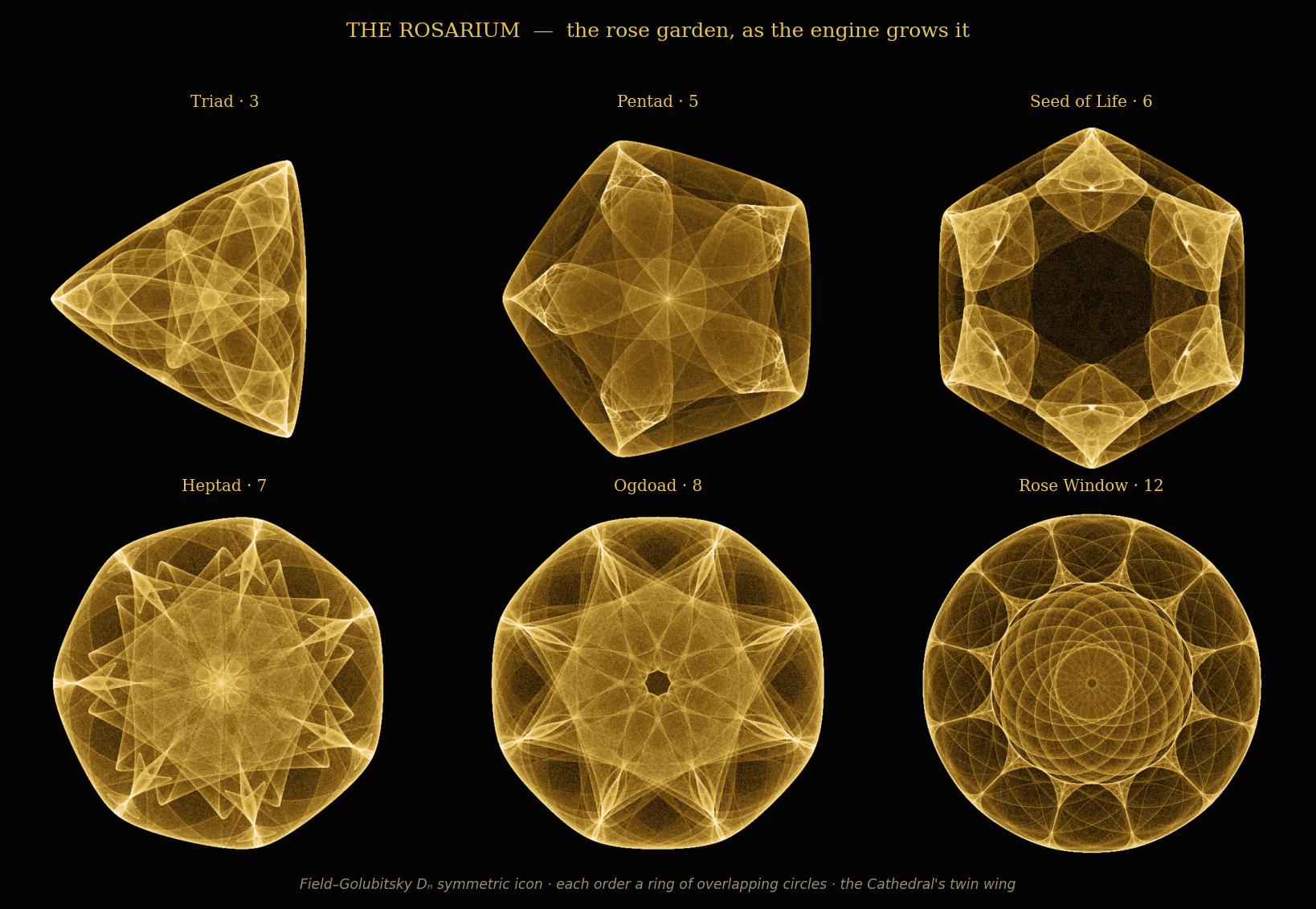
The six named flowers are anchors inside the wider tested set. They can be explored as a live clade in the attractor studio.
The Rosarium is not merely smooth density. Put its members under the same fold-lens used on the base engine and each flower reveals an -fold critical skeleton of its own.
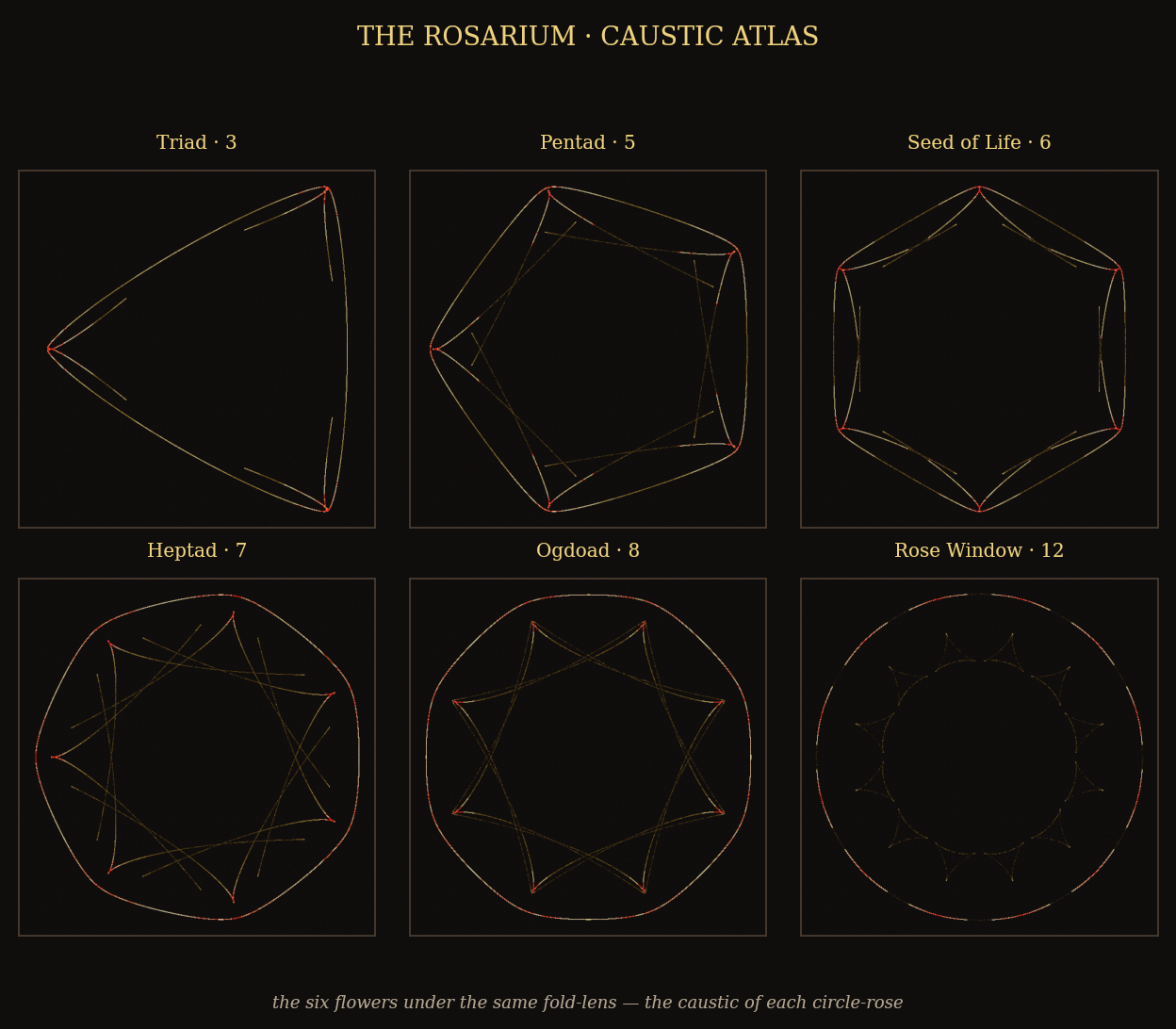
The flower and its caustic are two readings of the same icon: accumulated orbit density and the critical geometry organizing that density.
The Cathedral: foils cut by folding
The star wing begins with the Ananke skeleton,
Its base mixed-trigonometric kernel produces a four-cusp caustic. The Cathedral appears when one selector carries a harmonic,
because the harmonic changes the curvature of the curves whose interaction forms the caustic. Additional cusps can appear even before gains new zeros. The four-cusp form opens into a family of more elaborate roses.
Here scales the phase, weights the second selector, and controls the coupling. With that coupling switched off (), the exact determinant supplies the gate:
The Cathedral requires different nonlinearities in competition.
| kernel relation | critical geometry | result |
|---|---|---|
| , mixed trig | the two derivative products compete | the sampled fold cell changes from pointed to box-like as changes |
| , the same single sine or cosine | factors out as a scalar | the critical lines map to a square, up to rotation and scale |
| both selectors strictly increasing, with nonzero derivatives | both derivative products are positive | no fold caustic forms |
This is the Cathedral’s strongest law: the rose needs mixed trig. Harmonic order alone does not determine the cusp count or visible angular pattern; the observed order is a beat between the base mode, harmonic , and amplitude .
Four measured anchors name the principal chambers. Their labels record the dominant angular Fourier order at , not an enumeration of individual cusps:
| chamber | harmonic selector | measured angular order |
|---|---|---|
| Capitulum | 6-fold | |
| Ambulacrum | 10-fold | |
| Rosa | 12-fold | |
| Lanterna | 16-fold |
These are specific measured points, not a formula assigning one cusp count to every harmonic. Capitulum’s sixfold angular reading is the cleanest; the upper chambers approach the field-moiré shatter edge and should be read as named anchors rather than a completed census law.
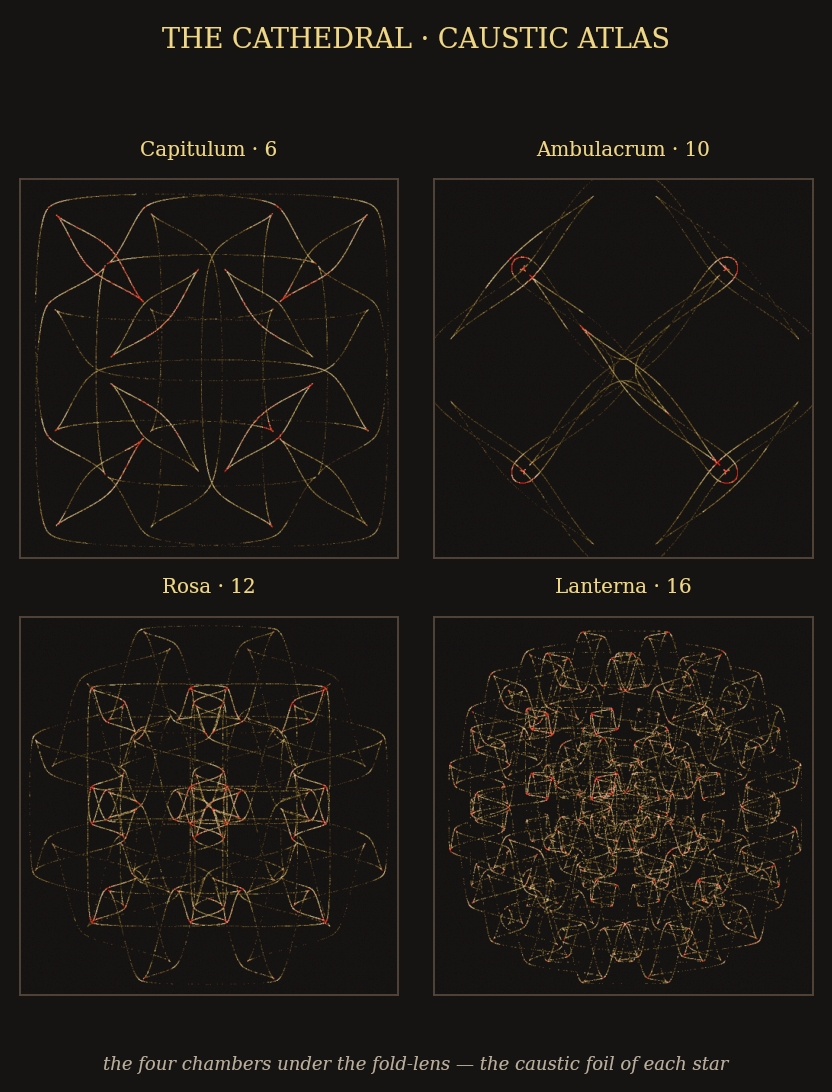
The caustic is the foil itself: a forward image of whose cusps become the leaves of the rose.
Albrecht Dürer’s Underweysung der Messung places foiled roses beside the epicycloid, hypocycloid, conchoid, and spiral. The historical correspondence is therefore structural rather than ornamental: both the gothic foil and the engine caustic are organized by cusps.
The compass begins where the attractors stop
Star and flower agree on symmetry order, but neither dynamical image is the metric-canonical Flower of Life. In the measured motif:
- centre spacing divided by circle radius ranges from 0.64 to 0.87, rather than the canonical value ;
- the vesica aspect ranges from 1.39 to 1.60, rather than ;
- detected centres miss the Fruit-of-Life lattice by 38%.
The spacing also drifts with parameters. The Rosarium therefore grows the motif—a sixfold circle-flower—but not Metatron’s Cube, exact vesicas, or the Platonic projections.
Exact construction belongs to another generator:
The -rotor is the compass written in Euler’s language. Seven exact -circles, one central and six with centres spaced at angular intervals on a ring of the same radius, produce the Seed of Life with vesica ratio
by construction. Nothing is tuned to resemble the target; the ratio follows from the geometry of equal circles.
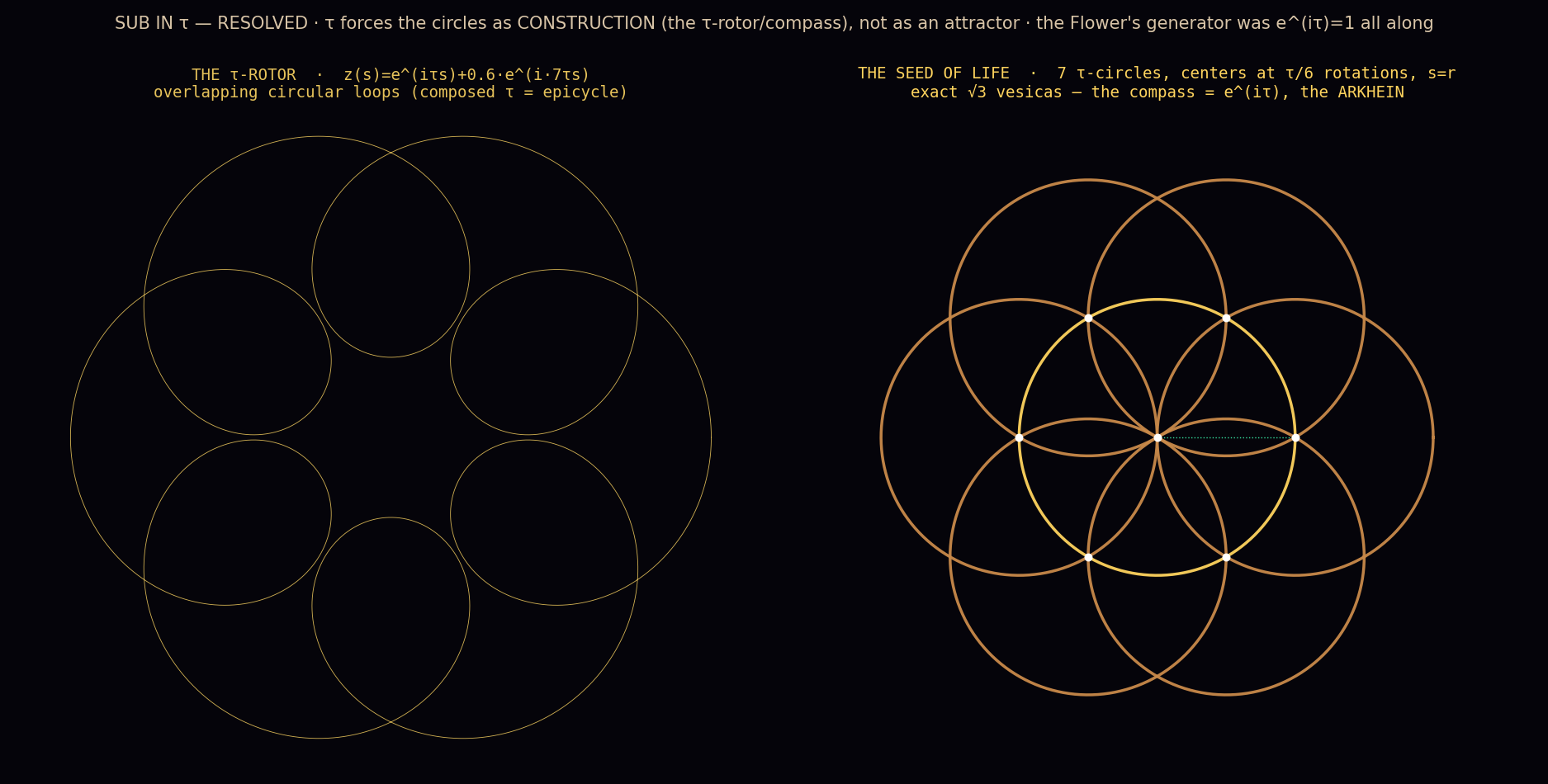
The attractor discovers an order. The rotor draws the metric figure. Similar appearance does not erase the difference in generator.
Euclid supplies the older discipline behind that distinction: a geometric figure is not established by resemblance, but by a construction whose relations follow from its premises.
Three regimes, one rose
The whole synthesis can be stated without metaphor:
| regime | generator | what survives |
|---|---|---|
| dissipative icon | iterated map | an attracting flower motif |
| mixed-trig fold | harmonic Ananke kernel | a cusped caustic foil |
| constructed rotation | -rotor | exact overlapping circles and vesicas |
The first two write the dynamical alphabet. The third supplies exact measure. The rose window is where all three readings can be seen at once: order, critical fold, and compass construction.
The split also survives a dimensional lift. Pure -rotation becomes the linked circles of the Hopf fibration; packing lifts toward the lattice and 24-cell; the golden order enters the 600-cell through its exact edge length when its circumradius is one. These are standard geometric objects. ARMISTICE’s contribution is the map between them: flower, foil, and compass are not rival explanations, but three realizations of the same symmetry alphabet at different levels of exactness.
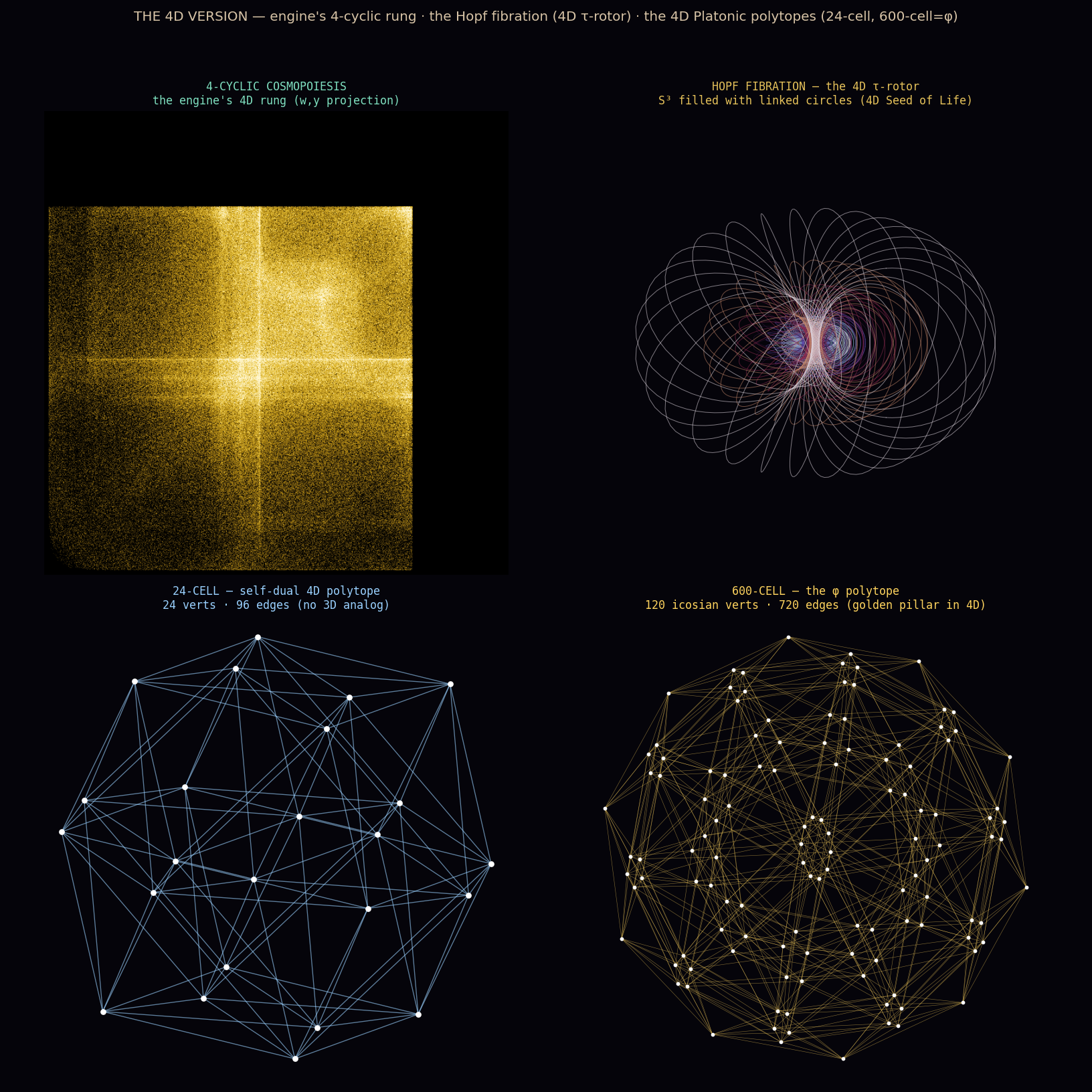
The plane gives the letters. Higher dimension reveals which generator each letter belongs to.
The Rosarium grows the circles as motif. The Cathedral cuts the cusps as fold. The compass closes the exact figure. One alphabet, three hands, one rose.
:: APPARATUS ::
Sources for this page
-
Euclid — this edition by John Casey · Euclid · Elements · c. 300 BC
composed c. 300 BC · this edition John Casey, Dublin University Press, 1885 · the first six books
The oldest engine still running. From five postulates and a handful of common notions, the whole of plane space is deduced — proposition by proposition, each leaning only on what came before. The taproot of every figure in this Scriptorium: the golden ratio is defined here (Book VI), the incommensurables tamed (Book V), and Book I closes on Pythagoras. Set from John Casey’s richly annotated 1885 edition.
Read in the Scriptorium -
Albrecht Dürer — this edition by Alfred Peltzer · Dürer · Messung · 1525
Nuremberg, 1525 · this edition Alfred Peltzer, Munich, 1908
The first geometry printed in German for the working artist — Dürer’s four books of compass-and-straightedge construction. The conic sections and spirals, the regular polygons and the tilings that lock the plane, the Roman and blackletter alphabets built stroke by stroke, the five Platonic solids unfolded into the flat nets he invented here, and the famous machines for seizing perspective. Set from Alfred Peltzer’s 1908 modern-German edition of the 1525 original.
Read in the Scriptorium -
Michael Field & Martin Golubitsky · Symmetric Chaos · 1990
Computers in Physics 4(5), 470–479, equation (1a); see also Symmetry in Chaos, second edition, SIAM, 2009, chapter 5
Primary source for the Dₙ-equivariant symmetric-icon polynomial map. The Rosarium cites the map with renamed coefficients and reproduces no source prose or image.
Read the authors’ article -
Cosmopoiesis · living edition
The public kernel definition, parameter meanings, iteration protocol, and dynamical vocabulary used throughout the scholia.
Read the live canon