← scholia viriditas v1.0 4 min · 983 words
Caustica
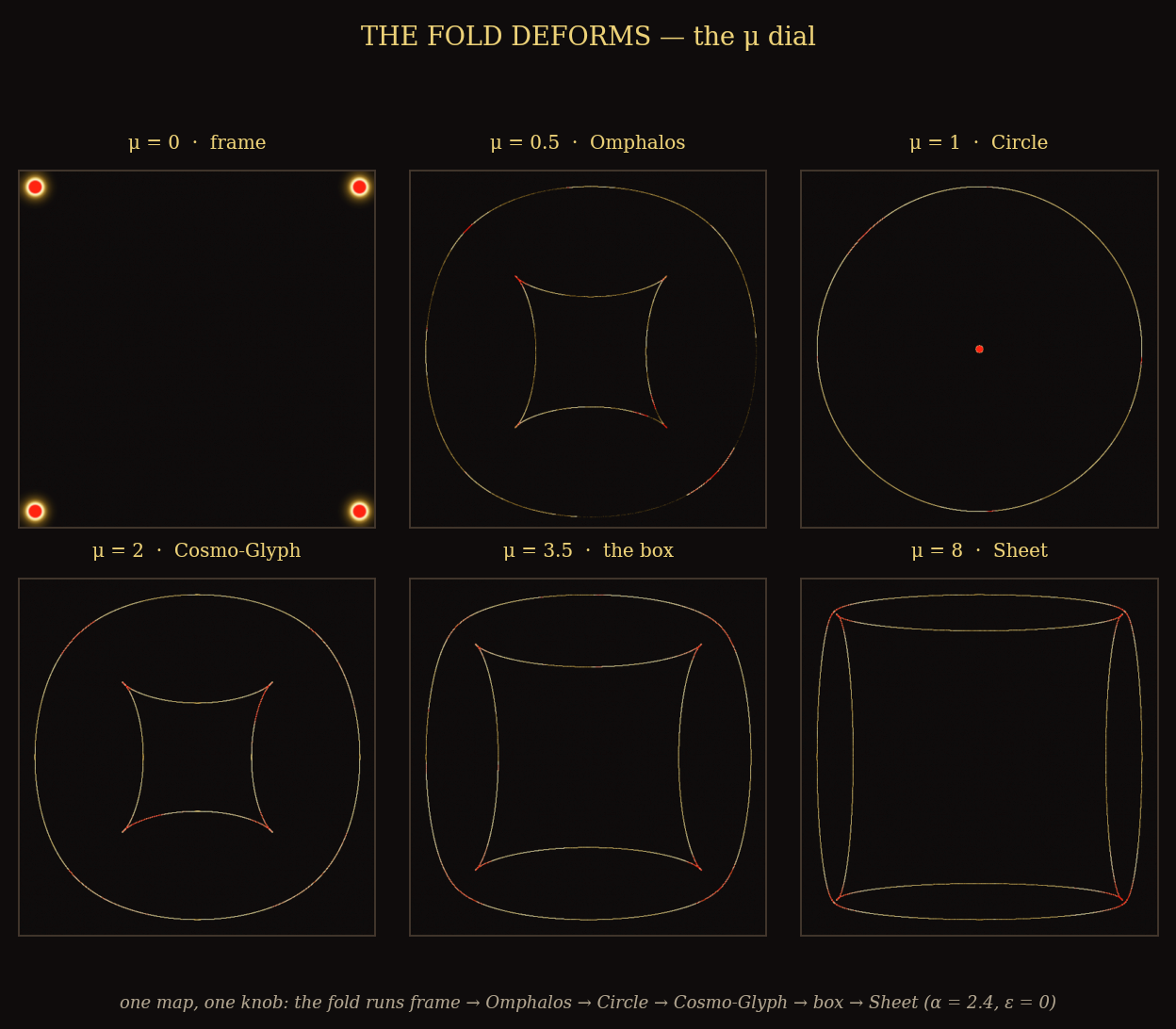
Render where a map folds: the forward image of its singular set det J=0. On the uncoupled Cosmopoiesis slice, a nonzero α rescales the phases while μ changes the caustic: an exact square at μ=0, a point and circle at μ=1, and curved inner and outer branches between. The named atlas records those forms without identifying visible fold order with the map's symmetry group.
Two caustics, one word
The engine’s usual portrait is its density, where an orbit spends its time. Caustica asks a different question: where does the map fold? A 2D map creases the plane along its singular set, the curve where the Jacobian vanishes (det J = 0); push that curve forward one step and you have a caustic, the same bright cusp light throws on the bottom of a cup, where rays pile up because the fold squeezes a whole neighbourhood onto a line. Render the caustic instead of the density and the engine’s hidden skeleton steps forward.
The word is overloaded, and ARMISTICE holds two caustic instruments. The older one, the Caustic forge (Lucerna, the lamp), renders optical caustics: it treats the density as a sheet of glass and traces refracted light, the swimming-pool-floor shimmer. This scholion is the other one: the mathematical fold-caustic, drawn by Ptyx (Plicator, the folder; Greek πτύξ, “a fold”). They share a word and nothing else; one bends rays, one finds where det J = 0.
The fold deforms
For the engine at ε = 0 and α≠0 the determinant is exact:
det J = −α²·[ μ²·sin(αx)·sin(αy) + cos(αx)·cos(αy) ]
and it hides a single dial. Hold α, sweep μ, and the fold runs continuously through a family of caustic curves; the figure above is that sweep. Two of its stations have exact analytic forms, also checked numerically:
- μ = 0 → the square of side 2. The singular set is the grid cos(αx)·cos(αy) = 0; every line maps onto an edge of [−1, 1]². Boundary deviation: 0.000.
- μ = 1 → a point and a circle of radius 2. The inner cell pinches to the origin (max radius 1.7 × 10⁻¹⁴) while the outer envelope rounds to a perfect circle, 2.000000 ± 10⁻¹⁶, and that radius holds from α = 0.1 to α = 10⁸.
Between them are an astroid-like inner branch and a rounded outer envelope. “Astroid” and “squircle” are visual descriptions here, not exact identifications with those standard curves. The atlas calls the low-μ portrait Omphalos, and the more square-like portrait Cosmo-Glyph. At larger μ the branches approach a box-like appearance. The reported crossover near μ≈2.87 is a visual classification threshold, not a proved cusp bifurcation.
For ε=0 over the full phase plane, α only rescales the domain and μ determines this caustic geometry. A bounded sampling window or a nonzero coupling can reintroduce α-dependence.
The glyph taxonomy
The atlas supplies a descriptive taxonomy of folds at selected parameter settings. Its names identify portraits; they are not a proof that every parameter value belongs to a distinct mathematical class. Five groups organize the comparison:
The astroid-like family (mixed-trig, sin·cos; ε = 0), dialled by μ alone:
- Square: μ = 0, the frame
- Omphalos: an astroid-like cell in a rounded envelope
- Cosmo-Glyph: an inner cell in a more square-like envelope
- Circle: μ = 1, the point and envelope
The Merkaba (box-like high-μ portraits), using the atlas’s visual crossover near μ≈2.87:
- square box: the plain eversion, no veil
- Puris: the box wearing its veil, corner-tori around an iron cross
- Standard: higher μ with veil, a square re-centred between four split rings
- Sheet: the limit box (extreme μ, the fold saturates)
The veil’s reach (crank ε on the box), the Mercury veil painting the box:
- Horns: the clean four-armed iron cross (α-robust: identical at α = 10 or α = 1000)
- Annulus: crank ε higher and the circular term overpowers the cross into a ring
- Crux: too strong a veil on a sparsely-folded box shatters it
- Bridge: the μ = 0 cell bent into an arch
The fold-cell law (the kernel decides):
- Concordia: sin·sin freezes into a square
- Aequitas: cos·cos, the same square tilted
- Resonantia: even a Lorentz kernel squares
- Saturatio: a monotone tanh never folds; no caustic at all
The harmonic roses (the Cathedral lift), whose reported labels are dominant angular Fourier orders at the sampled settings, not enumerated cusp counts:
- Capitulum: 6-fold
- Ambulacrum: 10-fold
- Rosa: 12-fold
- Lanterna: 16-fold
The rows compare mixed-trig curves, coupled box-like portraits, same-selector straight-edged images, and harmonic rose windows. For the uncoupled selector map, equal single-sine or single-cosine selectors give a square up to rotation and scale; two strictly increasing selectors with nonzero derivatives give no fold. More complicated selectors require their own calculation.
Density, caustic geometry, and persistent homology inspect different objects. Agreement between their labels is a measured comparison, not an automatic equivalence. The harmonic wings are collected in The Alphabet and the Compass.
What the lens reads, and what it does not
The fold is a geometric fingerprint, but a caustic’s visible rotational order need not be the symmetry group of the dynamical map. A map symmetry requires an operator S satisfying F∘S=S∘F. The uncoupled engine has the exact anti-swap reflection S(x,y)=(-y,-x); a fourfold caustic does not upgrade that involution to a four-element orbit-symmetry group.
The recorded caustic-feature classification scores were 0.71–0.74; a separate human-label comparison gave Spearman correlation 0.51, and a blind visual exercise scored 33% against 71% for its feature classifier. These are different metrics and comparisons. They do not establish a common accuracy ceiling. They do show why measuring folds can be more useful than classifying them by eye alone.
The fold made visible
The engine does not know it draws pointed cells and circles; it only folds the plane with sin and cos. And the lens itself is one trick: differentiate, find the zeros, push them forward. But the fold has a shape, with exact square and circle stations and a richer family between. Ask a map the most basic geometric question there is, where do you fold?, and the answer comes back as geometry. The lens does not invent the forms. It recognises them.