← scholia citrinitas v0.2 5 min · 1,092 words ΑΡΧΕΙΝ
Newton's Colour-Circle — A Palimpsest
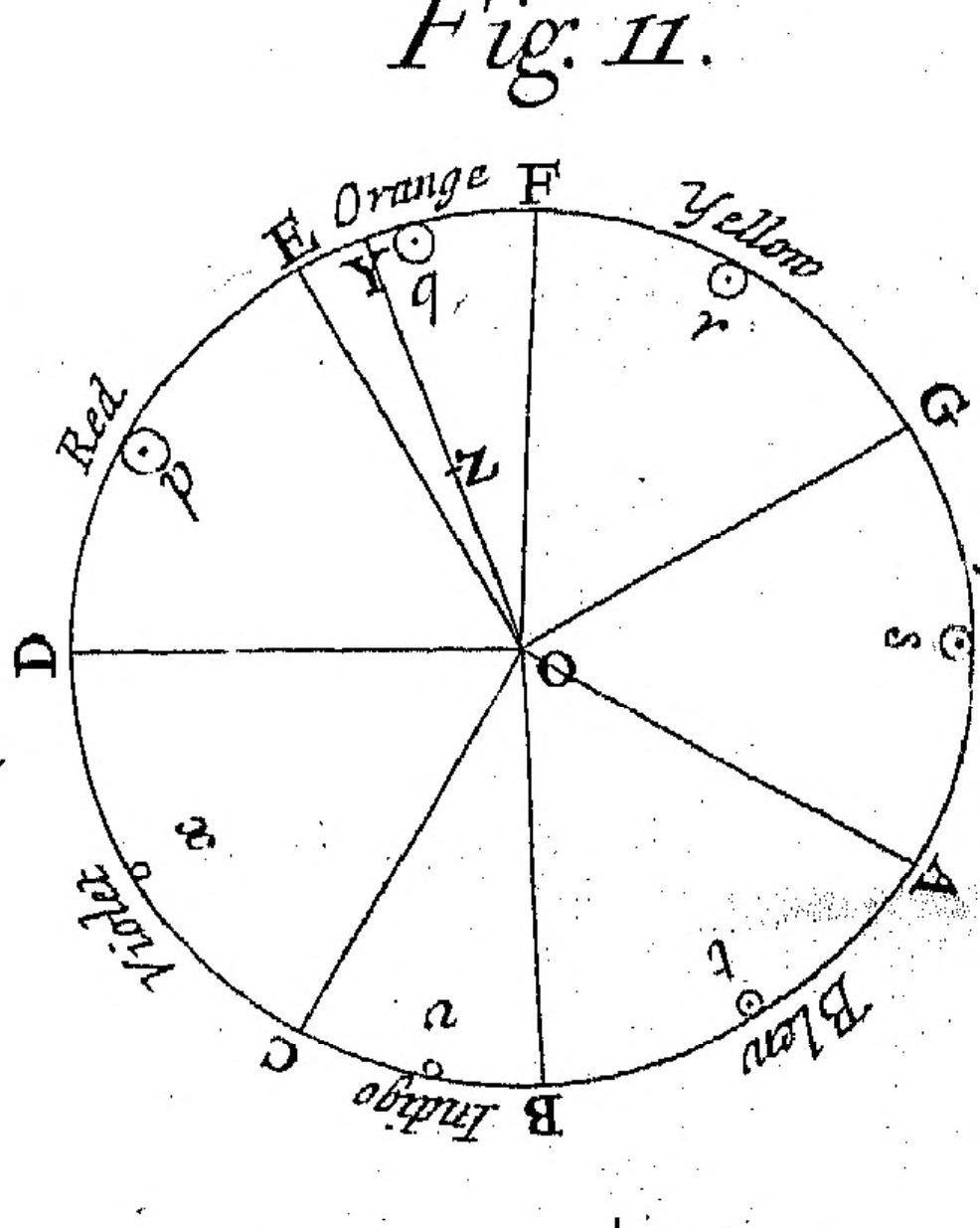
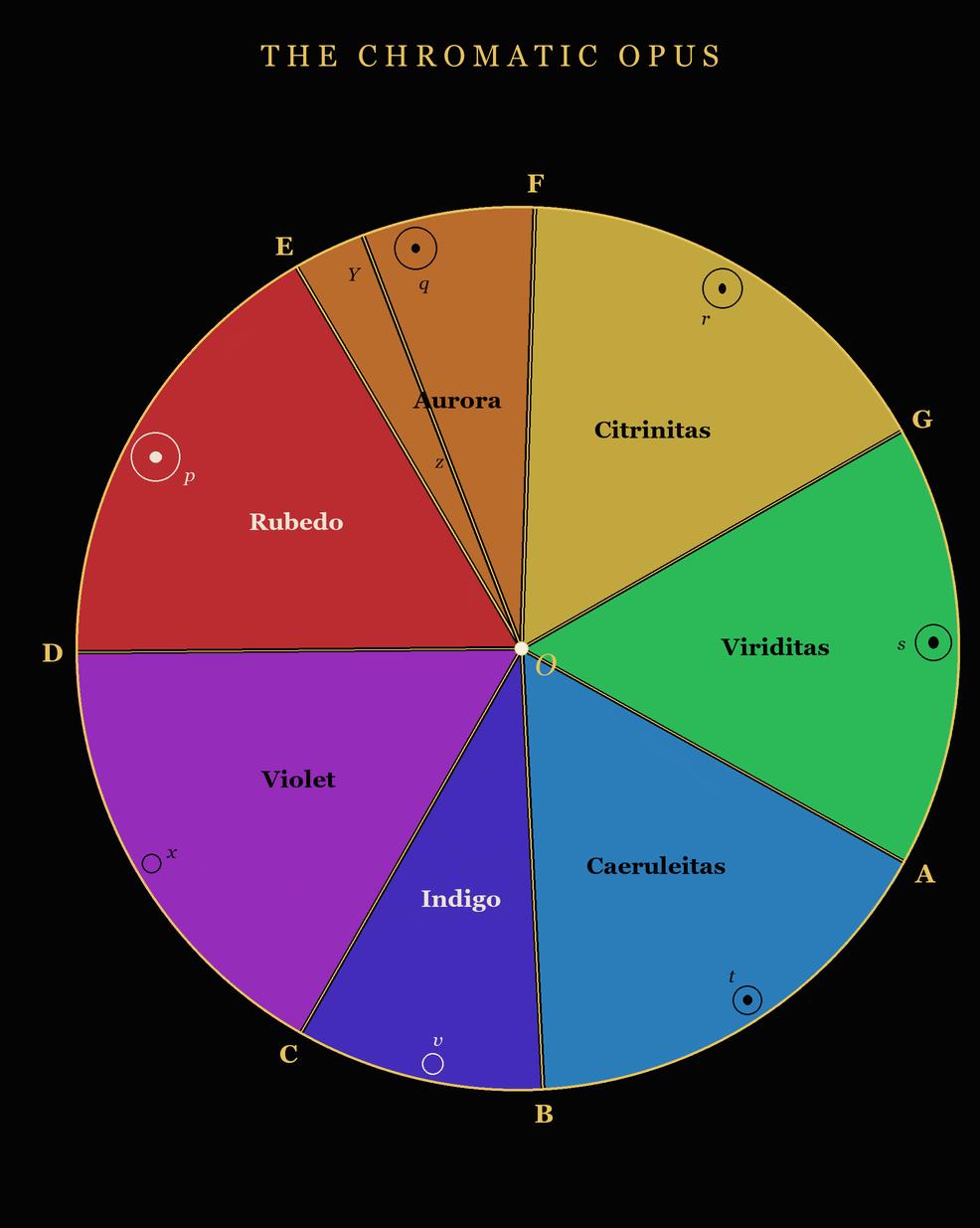
In Book I, Part II of the 1704 Opticks, Newton set seven unequal colour arcs around a centre of whiteness, their widths proportioned like notes in a scale. The circle orders prismatic colours and their mixtures, closing violet to red through non-prismatic purples. AEther's authored chromatic Opus uses that ring grammar as a visual language.
 AEther · authored palette Newton · 1704
What Newton drew
In Book I, Part II of the Opticks, after establishing the unequal refrangibility of the prismatic colours, Isaac Newton drew a circle and divided it into seven arcs: Red, Orange, Yellow, Green, Blue, Indigo, Violet. Each is labelled around the rim. Its corresponding point—p, q, r, s, t, v, or x—is the constructed centre of gravity of that arc, not an observed location where a pure colour lives. The unequal little circles about those points carry the quantities in Newton’s worked mixture: red through violet in the ratio 10:6:5:3:2:1:1, represented by proportional circle areas. In the engraving, p through t carry distinct centre marks while the two smallest circles, v and x, are hollow. The reconstruction preserves their measured envelopes, centre-mark shapes, and angular bearings while applying one even inward clearance so no mark collides with the rim; its regression test keeps the exact proportional-area construction separate. The common centre O is the circle’s reference for whiteness. For a mixture, Newton weighted the ingredient-points and found their common centre of gravity: its direction from O gives the compound colour, while its distance gives the colour’s fullness relative to white. Colour had become a geometry, a position with an approximate rule for combining.
And the arcs are not equal. Newton spaced their widths to the intervals of a musical scale, the seven colours laid out like the seven notes of an octave, re to re, the old Pythagorean wager that light and sound answer to the same proportions. The prismatic sequence occupies the named arcs; the return from violet to red passes through compound purples, colours made by mixture rather than found as another stretch of the physical spectrum.
It is, in one engraving, a striking synthesis: spectral order becomes circular geometry, chromatic mixtures can be approximated by centres of gravity, and distance from O represents fullness relative to whiteness. The circle’s closure is mathematical and chromatic rather than spectral: Newton completes the route from violet back to red with non-prismatic purples produced by mixture. Later colour circles inherit this move, though their physics and mixture rules differ.
What AEther authors
AEther’s chromatic Opus is a deliberate visual system: the deep red of rubedo, the gold of citrinitas, the green of viriditas, the blue of caeruleitas, on around and back. It places named alchemical stages on a closed hue-ring so renders, diagrams, and navigation share one chromatic grammar. The palette is authored presentation, not a quantity computed by the Cosmopoiesis kernel.
What the palimpsest compares
The comparison is formal and visual: Newton’s colour-mixture circle and AEther’s stage palette both organize named colours and transitions around a closed circuit. The palimpsest demonstrates that shared design grammar; it does not claim an independent dynamical rediscovery.
Newton’s seven-fold count and musical arc-spacing remain his own. AEther’s stage placement is editorial. The living question is a design one: why does a closed ring remain such a powerful way to make colour a place rather than a thing?
A small bridge: the regulus
Newton was as much a chymist as an optician. His laboratory notebooks are dense with the star regulus of antimony, the bright crystalline metal-button that forms with a star pattern on its face. Regulus, “the little king,” is the alchemists’ word for the pure metallic heart drawn out of an ore. AEther’s symbolic vocabulary likewise gives iron a privileged seat in ferrite. This is an authored rhyme between two workshops, not a measurement.
Status
- Newton’s 1704 colour-circle is a historical geometry of spectral order and mixtures, with whiteness at the centre; its violet–red closure passes through non-prismatic purple.
- AEther’s chromatic Opus is an authored design system placed into that ring grammar. No dynamical or sacred-constant match is claimed.
- Plate: Opticks (1704), Book I, Part II, Plate III, Figure 11 — a historical facsimile from the CODEX research holdings, shown only in full Æther. The second plate is AEther’s modern visual reinterpretation.
:: ARKHEIN ::
Lineage
Those who arrived at the same question before. This is not the first arrival.
- 500 BC
Pythagoras (school)
Wagered that the same whole-number ratios govern the consonances of a vibrating string and the order of the cosmos. This is the conviction Newton acted on when he tuned his seven colour-arcs to the seven notes of a scale.
- 340 BC
Aristotle · De sensu / Meteorologica
In On Sense and the Sensible, treated white and black as poles in an account of other colours. This is a historical contrast with Newton’s spectral circle, not a claimed direct derivation.
- 1704
Isaac Newton · Opticks, Book I, Part II
Arranged seven unequal spectral arcs around a mixture circle, spaced them like an octave, and used the centre as the reference for whiteness: the historical ancestor used for AEther’s visual palimpsest.
- 1810
Johann Wolfgang von Goethe · Zur Farbenlehre
In Zur Farbenlehre, disputed Newton’s optical account and examined the experience of colour, including after-images and contrast. His treatment is a later alternative, not a continuation of Newton’s mixture rule.
:: APPARATUS ::
Sources for this page
-
Isaac Newton · Opticks · 1704
London: Samuel Smith and Benjamin Walford
The primary source for Newton’s experiments on the spectrum, colour mixture, musical intervals, and the seven-arc colour circle.
Newton Project edition