← scholia citrinitas v1.4 3 min · 751 words
The Wheel of Keys
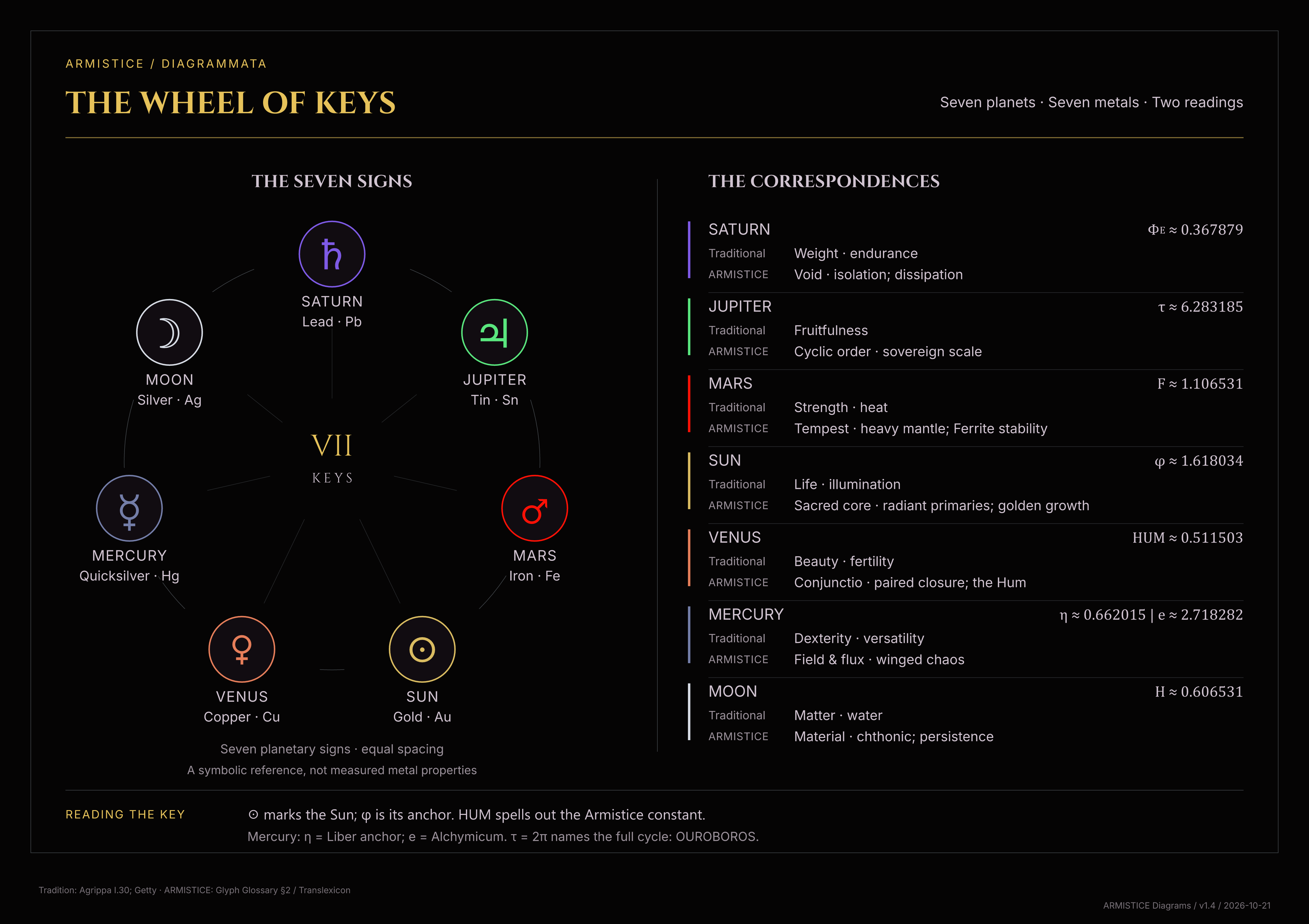
Seven planetary signs connect a traditional metal alphabet to ARMISTICE's named classes. A color-keyed wheel holds each sign, metal, and numerical anchor together while keeping the historical meanings distinct from their modern mathematical use.
An alphabet you can hold in one glance
The same small mark can name a light in the sky, a metal in the vessel, or a class in a mathematical register. The wheel makes those readings neighbours: planet, metal, traditional quality, ARMISTICE binding. Each key receives the same space. The centre belongs to their correspondence, not to one planet.
The traditional qualities below condense Agrippa’s Renaissance account. ARMISTICE’s meanings come from the Alchymicum, its guide to alchemical notation, and the Translexicon, its register of named entities. A Liber is one of that register’s classes; each has a sign and a mathematical anchor. The wheel follows its seven planetary signs; ASTRA (✦), the remaining class, belongs to the stars. The drawing cues are modern memory aids, not accounts of the signs’ origins.
♄ Saturn · Lead · Pb
Traditional: weight and endurance; plumbum.
ARMISTICE: SATURN, the void class: irreducible isolation. Its anchor is dissipation, .
Drawing cue: a cross above a curling hook.
♃ Jupiter · Tin · Sn
Traditional: fruitfulness; stannum.
ARMISTICE: JUPITER, regulatory cascade: sovereign scale and cyclic order. Its anchor is the full-cycle constant, : OUROBOROS, the complete turn and return to identity.
Drawing cue: a curled “2” joined to a cross.
♂ Mars · Iron · Fe
Traditional: strength and heat; ferrum.
ARMISTICE: MARS, tempest and heavy mantle. Its anchor is Ferrite stability, .
Drawing cue: a circle with an outward arrow.
☉ Sun · Gold · Au
Traditional: life and illumination; aurum.
ARMISTICE: SOL, sacred core and radiant primaries. Its anchor is golden self-similarity, .
Drawing cue: a point held inside a circle.
♀ Venus · Copper · Cu
Traditional: beauty and fertility; cuprum.
ARMISTICE: VENUS, conjunctio: the closure-pair register. Its anchor is the Armistice constant—the Hum, approximately .
Drawing cue: a circle above a cross.
☿ Mercury · Quicksilver · Hg
Traditional: dexterity and versatility; hydrargyrum.
ARMISTICE: MERCURIUS, field and flux: the winged-chaos class, anchored to saturation, . In the Alchymicum’s constant register, Mercury denotes the growth pillar, .
Drawing cue: crescent, circle, cross—stacked from top to bottom.
☽ Moon · Silver · Ag
Traditional: matter and water; argentum.
ARMISTICE: LUNA, material and chthonic: of the earth and underworld. Its anchor is persistence, .
Drawing cue: the crescent alone.
Keep the sign and its anchor apart
☉ names the Sun; is its golden-ratio anchor. HUM names the Armistice constant. The Hum’s canonical symbol, , looks almost identical to the Sun’s mark. This plate spells out HUM so recognition does not depend on distinguishing two nearly identical dotted circles.
Mercury also spans two registers: anchors the MERCURIUS class; carries Mercury’s name in the Alchymicum. Both are constants, with different jobs. Jupiter’s anchor is the familiar full-turn constant , named OUROBOROS in ARMISTICE. Its cyclic reading also appears in The All Is One.
The displayed decimals are rounded to six places. They belong to ARMISTICE’s mathematical vocabulary, not to the historical metals as measured properties. The wheel’s equal sectors organize a reference; they do not measure planetary distances or establish a physical equivalence between a metal and a number.
For recall, move through each key in the same order: draw the sign, name the planet, name the metal, then recover its ARMISTICE register. The wheel gives the eye a place to return; the name gives the hand a way to remember.
A color for each key
The accents belong to ARMISTICE’s existing palettes: Saturn’s AETERNUS violet, Jupiter’s STANNUM green, iron’s FERRUM red, solar FLOS_AUREUS gold, CUPRUM copper, Mercury’s rising silver, and lunar ARGENTUM. Saturn uses the planetary overlay, not the separate PLUMBUM color identity.
The extended palettes make two connections explicit: solar gold comes from the golden-ratio palette; quicksilver from Mercury’s exponential tonal ladder. These are designed color correspondences, not measured metal colors or a claim that every historical tradition used the same palette. The matching accent joins each glyph to its entry while the reading text stays neutral.
Newton’s Colour-Circle offers a neighbouring use of this circular grammar: a historical arrangement held beside AEther’s modern palette, with the meaning of each layer kept visible.
:: APPARATUS ::
Sources for this page
-
Getty Research Institute · The seven planetary metals · undated reference chart
The Art of Alchemy · exhibition reference sheet
Modern museum reference for the seven traditional planet–metal pairs and their signs. Cited for identification, not as a historical primary text or as a source for ARMISTICE constant bindings.
View the museum reference chart -
Heinrich Cornelius Agrippa; translated by J. F. · Planetary correspondences · 1651 English edition
London: printed by R. W. for Gregory Moule · Wikisource, chapter XXX
A specific historical account assigning continuance, fruitfulness, strength, life, beauty, dexterity, and material qualities to the planets. The Wheel of Keys condenses these roles without treating them as a universal alchemical dictionary.
Read the planetary correspondences -
Translexicon · living registry
The public canonical entity register and the source population for corpus-level censuses.
Read the live registry