← scholia caeruleitas v1.4 11 min · 2,464 words
Caeruleitas — the Sixth Stage
The historical Magnum Opus colour-ladders examined here omit blue, though blue appears elsewhere in alchemy. ARMISTICE coins CAERULEITAS as a sixth stage, the Leidenfrost rung past the Stone: caeruleus, the blue of both sea and sky, water becoming vapour. Its proposed icon, the Mercurius Reversus, inverts the familiar Rebis arrangement.
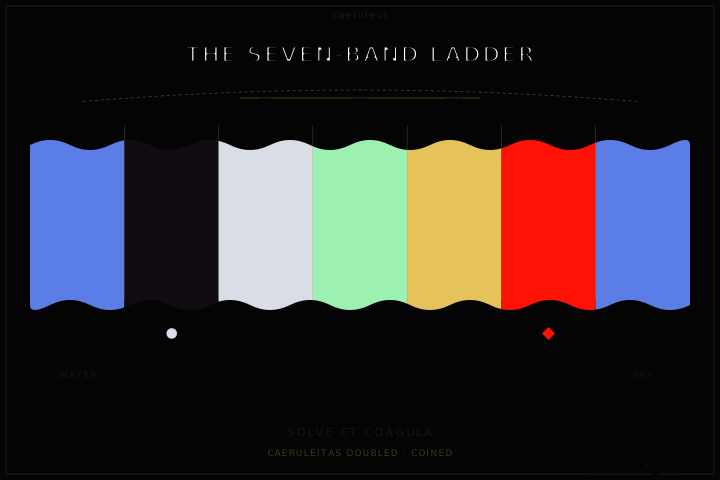
The chromatic gap
Lay the stages of the Work out as a strip of colour and run your eye along it: black, white, green, yellow, red. What is missing from these historical ladders? Blue, though it appears elsewhere in alchemy. That absence is where we begin.
The classical Magnum Opus enumerates the stages of the Work by colour:
- Three-stage (a common simplified account): Nigredo → Albedo → Rubedo
- Four-stage (the traditional black–white–yellow–red sequence): Nigredo → Albedo → Citrinitas → Rubedo
- Five-stage (the extended sequence used here, including Viriditas): Nigredo → Albedo → Viriditas → Citrinitas → Rubedo
Blue does not appear in these sequences. The Magnum Opus is, in this chromatic reading, a fire-ladder: black coal, white ash, green vitality, yellow gold, red Stone. Sky and water are absent from the ladders examined here. Blue appears elsewhere: vitriol (CuSO₄·5H₂O), lapis lazuli (“the Blue Stone”), azurite, Mercurius the celestial messenger, and Khunrath’s Amphitheatrum plates. These examples play different roles from a named stage of the Work.
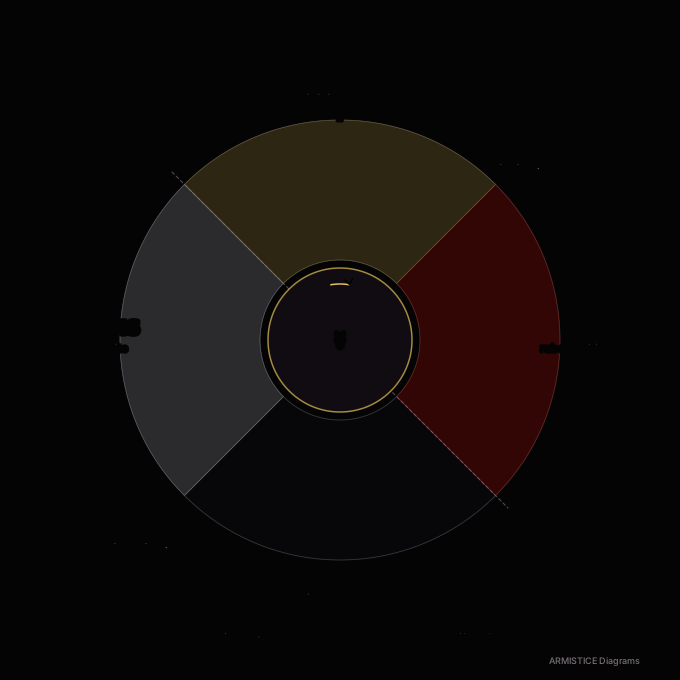
The classical chromatic sequence as a closed wheel: melanosis, leukosis, xanthosis, iosis, which is to say black, white, gold, red. The whole circle is fire-colours; nowhere on it is the blue that CAERULEITAS comes to name.
The Leidenfrost rung
ARMISTICE places seven rungs in the Ladder of Initiation (after Khunrath’s Scala): Nigredo · Albedo · Viriditas · Citrinitas · Rubedo · the threshold · clear/gold. The sixth rung is bound to the Leidenfrost phenomenon, the film-boiling state where a droplet hovers on its own vapor cushion above a surface hot enough that direct contact would instantly vaporise. The droplet is suspended at the threshold: neither in contact nor escaped, neither in the Work nor past it.
The √3-rooted Leidenfrost palette gives this rung its colour. In that palette the blue hue (240°) corresponds to LEVITAS, the film-boiling phase itself:
- BOREALIS (anchor): pre-aurora, the deep blue depths
- LEVITAS (phase): film-boiling Leidenfrost, the levitation
- VAPOR CAERULEUS (vapor): rising film, the lightening
LEVITAS is the right name for the physics. It is the wrong name for the colour. Levitas names lightness rather than a colour. The distinction is semantic: the stage names do not all share an -itas ending.
The coinage
The chromatic ladder needs its own sixth name. Per parallel formation:
| Latin root | Colour | Stage name |
|---|---|---|
| niger | black | NIGREDO |
| albus | white | ALBEDO |
| viridis | green | VIRIDITAS |
| citrinus | yellow | CITRINITAS |
| ruber | red | RUBEDO |
| caeruleus | blue | CAERULEITAS |
Latin caeruleus can describe deep blue or blue-green, especially the colour of sea and sky; the Lewis and Short entry gives both registers. The -itas suffix produces an abstract noun: a quality or state.
Caeruleitas, “the blueing.” The modern coinage deliberately follows the abstract colour-noun pattern of the stage vocabulary.
Two registers, one rung
Rung VI now carries two names, one per register:
- LEVITAS: the phenomenon name. Phase-physics, materials science, the suspended-droplet effect; the name carried by the Leidenfrost palette itself.
- CAERULEITAS: the chromatic name. The sixth stage of the Magnum Opus chromatic ladder; the name for the hermetic-stages register and chromatic-ladder discussions.
Notice that nothing is lost in carrying two names: the relationship to the Leidenfrost effect is preserved, because the chromatic stage IS the colour of the film-phase. CAERULEITAS draws its hue from LEVITAS; LEVITAS draws its colour from the deepest cardinal blue.
Placement
The chromatic ladder, post-coinage, is six stages:
NIGREDO · ALBEDO · VIRIDITAS · CITRINITAS · RUBEDO · CAERULEITAS
The placement at the END is doctrinally deliberate. CAERULEITAS does not slot between any two existing stages; it sits at the boundary after Rubedo, naming the post-completion threshold where the Stone has been made and the practitioner stands at the edge of the next register. The droplet on its vapor cushion: the Work done, the next Work not yet begun, the air between. A coinage is a new word for an old gap. The test is whether the gap was already shaped like the word, and this one is.
This matches the Initiation rung VI (post-Rubedo, pre-Wander), the Leidenfrost-effect physics (post-contact, pre-vaporisation), and the hermetic post-Opus state (Stone achieved, gnosis pending).
Water and sky: the dual register of caeruleus
Caeruleus in Latin is dual-register. As the historical dictionary examples show, it can name both the sea’s dark blue and the sky’s blue.
The colour itself doesn’t distinguish; both registers share the hue. The substance does: water below, sky above. Caeruleitas inherits this duality, and the inheritance is doctrinally load-bearing. The Leidenfrost phenomenon CAERULEITAS names is water becoming sky: the droplet on its vapor cushion is the literal instant water rises toward the celestial register. The blue of the threshold is the blue of both substances meeting at their boundary.
This resolves a worry the classical chromatic ladder already carried but never named: ALBEDO is often associated with water (the lunar bath, the washed body, silver/mercury at rest). Adding another blue stage could feel redundant. The dual register splits them cleanly:
| stage | substance | state |
|---|---|---|
| ALBEDO | water | at rest: the bath, the still pool, the lunar silver |
| CAERULEITAS | water | in transition: the vapor cushion, the rising film, the cloud-precursor |
Both blue-adjacent, doctrinally distinct. Albedo is the element; Caeruleitas is the passage of the element. Same substance, different state, and that is precisely what Leidenfrost physics is.
The elemental reading also clarifies what the post-Rubedo position means. After RUBEDO (the Stone: fire, completion, the work fixed), the practitioner stands at the brink of the next register. CAERULEITAS names that brink as sky above the sea of the Work: neither the ground that was, nor the gnosis that may come, but the literal blue between them.
The seven-band ladder: Caeruleitas doubled
The manuscript discussed below is Science Museum Group MS/0383. The institution credits its digitisation under CC BY-NC-SA 4.0; this scholion describes the figures without reproducing its images.
The pseudo-Flamel manuscript Le Trésor des Trésors paints the chromatic ladder at folio 17 as a horizontal bar with five colour-fields: black — white — yellow-green — yellow — red. The fields are bounded but the third band is a yellow-green / olive transition tone — it reads as both Viriditas and a Citrinitas-precursor. The painted bar lets a hue blur across adjacent bands; the same yellow runs through both bands 3 (greened) and 4 (pure). Pseudo-Flamel does not enforce hard chromatic identity. Adjacent stages share substance.
The seven-band ladder at the head of this page reads that bar in the ARMISTICE register: the five canonical stages between a doubled CAERULEITAS, water at the foot, sky at the apex, the dual blue that brackets the Work.
By that grammar, CAERULEITAS appears twice. The dual register of caeruleus (water + sky) is not a footnote; it is a structural doubling that places the blue at both edges of the ladder. Reading left to right:
CAERULEITAS (water) · NIGREDO · ALBEDO · VIRIDITAS · CITRINITAS · RUBEDO · CAERULEITAS (sky)
Seven bands. The classical five stages live between two blue framings. The work emerges from water (the prima materia, the chaos below the Nigredo’s darkening) and ascends to sky (the celestial threshold above the Stone). The same Latin caeruleus names both. The bar is, in this reading, an ouroboros of colour: the beginning and the end share their hue, and the five canonical stages are the journey from one register of blue to the other.
This also receives independent support from pseudo-Flamel’s other ladder at folio 13 — the Scala Philosophorum, a vertical golden ladder with six visible rungs (not five). The third rung marks an animated, igneous Mercury and is described as the moment the volatile becomes capable of fixing. Pseudo-Flamel’s own iconography points to a six-rung structure, and the third rung carries Caeruleitas-flavored content (the volatile threshold). The chromatic ladder doubles where the substance doubles; the operational ladder marks the volatile rung where the substance changes register. Two figures, one doctrine.
Not blue-as-anything-else
Blue also appears outside these stage lists: in blue mineral pigments, hydrated vitriol, and celestial Mercurial symbolism. Those are materials or images, not a named passage through the Work. CAERULEITAS is proposed here as that passage: “the blueing,” the threshold-suspension state after Rubedo. This distinction belongs to the present reading, not to the historical sources.
Mercurius Reversus: a proposed inverse icon
The Mercury glyph ☿ is a vertical stack: crescent (Luna, water, above) over circle (Sol, centre) over cross (Earth, matter, below). It already encodes the standard hermetic vertical, spirit above, matter below. The Rebis, the crowned hermaphrodite of Khunrath’s Plate 6, Maier, the Rosarium, Flamel, is the same doctrine in figurative form: Sol+Luna unified ABOVE the chaos / serpent / cube / globe. Spirit on top. Matter at the foot.
We have not found a flipped Rebis in the sources surveyed: the plates examined from Khunrath’s Amphitheatrum (1609), Maier’s Atalanta Fugiens (1617, fifty emblems), the pseudo-Flamel Trésor des Trésors (MS/0383), the surveyed Newton chymical manuscripts, Paracelsus, and Llull. In the figures examined, the crown stays on top and the chaos-globe at the foot; none uses a Mercury glyph with cross above and crescent below as a stage marker.
But adjacent inversions DO exist:
- An inverted Venus glyph appears at Le Trésor, folio 5, page 13, beneath a crown. A Mercurial reading is possible, but remains an interpretation.
- A chromatic-inversion hexagram appears at Le Trésor, folio 8, page 19: green-up is Fire and red-down is Water, reversing the conventional assignment. This reverses elements, not the Rebis figure.
- The AZOTH composite tower in the same manuscript places a cross both below and above its central orb. Its polarity is stacked, not swapped.
- Two Mercuries appear in the manuscript’s volatile/fixed and related pairings; our Z₂ reading treats them as counterparts rather than an upside-down figure. Maier’s Emblem 10 also pairs Mercury with Mercury.
The works surveyed contain components for a Mercurius Reversus—inverted glyphs, inverted elements, doubled Mercury, stacked polarity—but we have not found them assembled in one icon.
Why the gap? Hypothesis: in these witnesses the Rebis is fixed at the Rubedo terminus. It names the Work’s completion-state, Sol+Luna crowned above matter, the Stone made. A post-Rubedo Mercurius is not represented in the surveyed figures; we use that visual absence as space for a new icon.
CAERULEITAS names that gap. The Mercurius Reversus, crescent below and cross above, is its icon: the Rebis with its polarity swapped because the work IS done, the cross of matter has been raised (the Stone is corporeal, fixed, manifest), and the crescent of water-and-spirit now lies below as substrate. Sky above, sea below. The droplet on its vapor cushion: water ascending toward the sky-register, matter holding the upper place at last.
This is not a claim that the historical alchemists should have drawn the Reversus. In the sources examined, the missing Reversus is the iconographic counterpart of the missing CAERULEITAS stage. Both gaps name the same territory in this reading: the threshold after the Stone. The chromatic ladder ends at Rubedo; the figure-ladder ends at the upright Rebis. CAERULEITAS extends the first. The Mercurius Reversus extends the second.
The Standing Column at the side of this page holds the doctrine in geometric form. The Mercurius Reversus is its figurative companion, a single image of the polarity-swap at the threshold. The gap was preserved deliberately: the work was first to see the missing figure. Having seen it, we draw it. Here it is, for the first time, an interactive folio; hover or focus each register to read its gloss:
Cross above, crescent below; sky above, sea below. The gold cross of matter holds the upper place — the Stone fixed and manifest — while the crescent of water and spirit lies open at the foot as substrate. On the Sol-ring that straddles the horizon, the Leidenfrost droplet rises on its vapour cushion: water ascending toward the register matter now occupies. At the foot, the derivation shows the operation plainly: the Mercury glyph ☿ — crescent above, cross below — turned to put the cross above and the crescent below.
This does not claim to correct a universal omission; it sets down a counterpart absent from the sources examined, in the same hand that named the sixth stage. The chromatic ladder gained CAERULEITAS; the figure-ladder gains the Reversus.
The falsifier for this section is the same shape as the falsifier for CAERULEITAS itself: a pre-1900 alchemical figure showing the Rebis with the cross above and the crescent below, or the Mercury glyph drawn ⚧-style as a stage-marker rather than a copyist’s error. None was found in the sources surveyed.
The falsifier
This is a coinage, not a discovery. CAERULEITAS has not appeared as a stage name in the historical alchemical texts examined here. The placement at the Leidenfrost rung and the chromatic-ladder extension to six stages are ARMISTICE doctrine.
The cleanest falsifier would be: a pre-1900 alchemical source that uses BLUE as a chromatic stage of the Magnum Opus, with a Latin or vernacular name.
None was found in the sources surveyed. If one is surfaced, this scholion is updated to cite, and Caeruleitas becomes the modern recovery-name rather than a net-new coinage.
The Standing Column
The column at the right edge of this page is the Leidenfrost palette made geometric. Three bands stacked: the deep anchors (VULCANUM / CRYSTALLUM / BOREALIS) at the foot, the phases (CALCINATIO / BULLATIO / LEVITAS) in the middle, the vapors (IGNIS / VIRIDIS / CAERULEUS) at the head. The achromatic LIMEN rule terminates the top, the Leidenfrost film itself, and the CAPUT MORTUUM dryout-shadow holds the foot.
As you scroll, the active band tracks your position: vapor at the top, phase in the middle, anchor at the foot.
Status
CAERULEITAS is the sixth chromatic stage of the ARMISTICE Magnum Opus ladder, coined here. The Standing Column above is the first feature visual using the Leidenfrost palette as a layout primitive on the site.
:: APPARATUS ::
Sources for this page
-
Anonymous · Rosarium philosophorum · 1550
Frankfurt: Cyriacus Jacobus · ETH-Bibliothek Zürich, Rar 8230
The illustrated second part of De alchimia, preserving the Rosarium’s sequence of emblematic operations.
View the 1550 facsimile -
Heinrich Khunrath · Amphitheatrum · 1609
Hanau, 1609 · the posthumous expanded edition with the nine great copperplates
The theosophic amphitheatre — Christiano-Kabbalistic, Divino-Magical, Physico-Chemical, a Three-in-One. The nine legendary double-page copperplate engravings (the Oratory–Laboratory, the Filius Macrocosmi, the Citadel of Pallas), independently transcribed and translated from a plate-complete copy, beside the Ladder of Seven Grades.
Read in the Scriptorium -
Michael Maier · Atalanta Fugiens · 1617
first published Oppenheim, 1617 · supplied e-text witness dated 1618
The crown jewel of the alchemical emblem book — fifty plates fusing engraving, Latin epigram, and three-voice fugue. The reader pairs translated epigrams and historical English discourses with the engravings; the fugues are credited but absent.
Read in the Scriptorium -
attributed to Nicolas Flamel (pseudo-Flamel) · Le Trésor des Trésors · c. 1700
French, late manuscript · Science Museum Group MS/0383
Forty-seven hand-illuminated leaves of the pseudo-Flamel corpus — the buried treasure, the serpent, the rungs of the ladder — translated leaf by leaf beside the Science Museum’s digitisation.
Read in the Scriptorium