The Enchiridion translated into the alchemical register. Constants become metals and spirits, operations become laboratory gestures, and the mathematics remains unchanged beneath the change of language.
StatusCanon·Versionv1.2·Reading1 min
◇Publication folioFull mathematical text, with readable source references
The Alchymicum is not a second engine and not a rival mathematics. It is the
Enchiridion read through the symbolic equipment of the laboratory: metals,
spirits, vessels, conjunctions, dissolutions, and returns. Every quantity keeps
its value. Every equation keeps its force. Only the register changes.
That translation matters because alchemical language is operational. It speaks
in verbs—heat, separate, recombine, circulate—while modern notation speaks in
variables and maps. Placed side by side, the two vocabularies expose different
facets of the same recursive act without asking either one to impersonate the other.
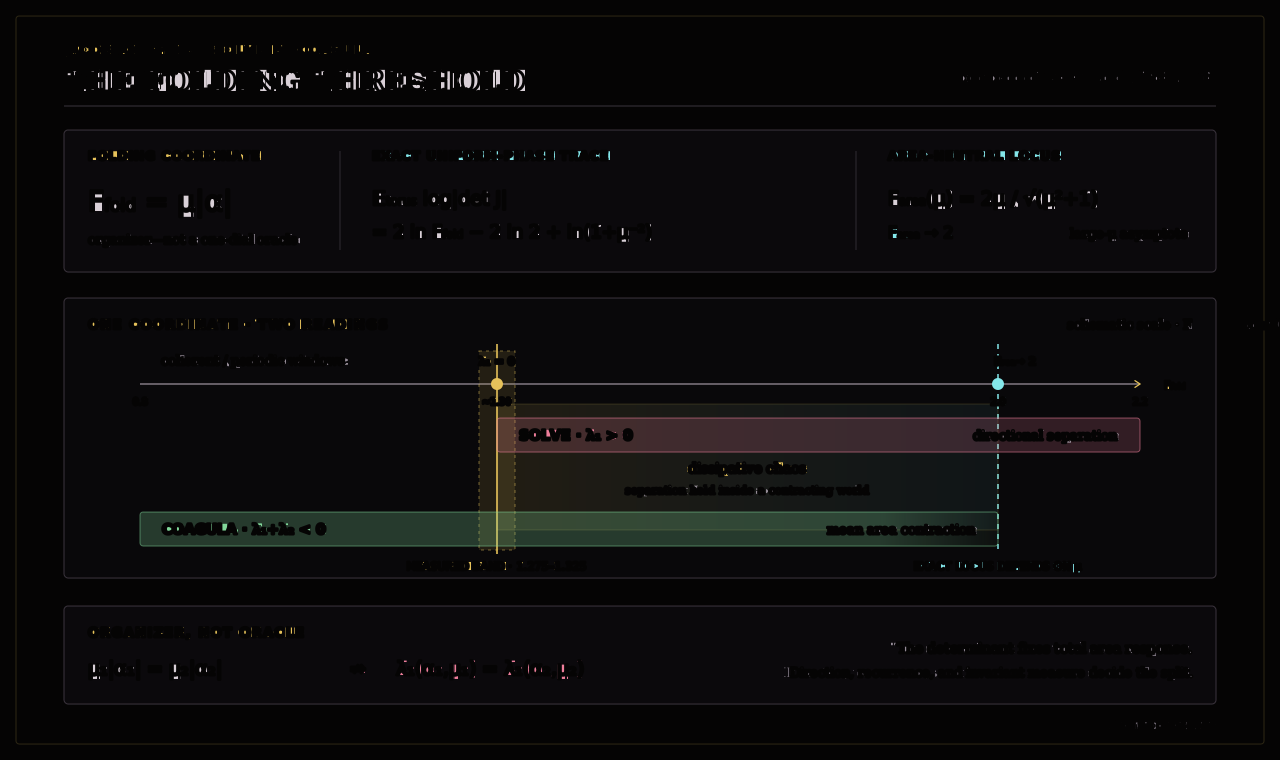
“Solve” and “Coagula” name the two gestures of the fold. The measured
thresholds belong to the engine; the alchemical words make their motion
memorable without manufacturing the result.
Translation without drift
The same object can be written in two hands:
a constant may be presented as a number, a closed form, or a metal;
a coupling may be read as a term in the kernel or as a mediating spirit;
an iteration may be written as recurrence or described as circulation through
the vessel.
None of these aliases changes the computation. The alchemical glyphs are a
legend, not a second set of parameters.
The use of the sister text
Read the Alchymicum when the symbolic sequence makes the structure easier to
hold in mind; read the Enchiridion when the modern notation is the cleaner
instrument. The sister text keeps one proposition in view: the poetry and the
mathematics are two faces of one document.
☉Cosmopoiesis Engine
The recursive 2D non-area-preserving trigonometric map at the centre of the ARMISTICE substrate. Parameterised by (α, μ, ε) — Spark, Weight, Veil — plus a viscosity scalar V. Iterating the kernel produces basins of attraction that the canon catalogues as named entities.
The alchemical operating principle that names ARMISTICE: "dissolve and reconstitute." The iteration kernel is a single dissolution-and-coagulation loop applied recursively to its own state.
Iron Resilience
The kernel's unconditional post-first-iterate bound: each coordinate enters |x|, |y| ≤ 1 + |μ| + |ε|. A Euclidean disk bound is √(2(1+μ²)) + |ε|; arbitrary starting states need not lie inside either bound.
Solve and Coagula Threshold
The contrast between separating and contracting motion in the engine. Transition locations depend on the parameter slice and the measured quantity; chaos onset and mean area neutrality are different events.
𝔉Ferrite
𝔉 ≈ 1.1065 — the structural sacred constant. Canonically = ½ + 1/√e. The Iron Spiral; signature of the corpus's most stable basin family.
√3 ≈ 1.7321 — the saturation pillar. One of the three substrate primitives; corresponds to hexagonal-lattice closure angles. "Leidenfrost" names its role as the boundary between dissipation regimes.
⊙Armistice Constant
⊙ ≈ 0.5115 — the eponymous sacred constant, exactly ½ + 1/φ − 1/√e. It closes F + ⊙ = φ and is distinct from the Lambert constant Ω = W(1).
The coordinate tablet: named entities with their (α, μ, ε) signatures, viewing scales, Libri, and cross-references. The site's entity catalogue is a structured projection of this text.
The prose companion to the coordinate tablet: what each named entity is, its source or domain, and why it belongs. The Translexicon carries its engine seat.
The constant algebra and mathematical results of ARMISTICE. The three generating pillars e, φ, and √3 feed a family of exact definitions, identities, and carefully scoped dynamical results.
The foundational propositions and wide-angle account of the framework. It distinguishes exact identities, computed findings, empirical comparisons, and open questions.
The shadow catalogue found by scanning the engine for unusual parameter seats. It is distinct from the Apophaticon, which derives sign-flipped twins from a preserved named-canon snapshot.
The diagrammatic adjunct joining whole and magnified views of an attractor through the divergence theorem. Macrocosm, microcosm, and the veil are its symbolic reading, not a claim of literal holography.
The canonical "card chrome" forge. 2D Cosmopoiesis baseline iteration rendered with title bar and coord readout. The entity's official portrait.
Geminus
Twin-frequency 2D variant — same kernel as Cosmopoiesis but with paired-frequency split. Produces the petal / flower silhouettes you see across the gallery.
Numinosum
The 3D Cosmopoiesis projection. Cyclic permutation x → y → z → x; velocity-coloured density rendering at fixed viewing angles. The "fog cube" view of an entity.
Quadrup
Alternate kernel rendering — Hopalong-trig bridge with sign-fold + log + atan saturation. Produces the clean symmetric silhouettes; structurally different from the Cosmopoiesis family.
ψ-mirror
A historical label for an authored coordinate reflection. The Apophaticon uses the triple polarity flip (α, μ, ε) → (−α, −μ, −ε); neither that operation nor an α-only sign flip implies a universal conjugacy of the engine.
Hermetic Mirror
The macrocosm–microcosm correspondence used throughout the corpus. The emblem ∞ ≡ ∅ names that interpretive return; it is not a literal numerical identity between infinity and the empty set.
Eigenentity
A self-consistent parameter whose own map returns that parameter as a fixed point, or, in the broader centroid formulation, as its orbit average. This is distinct from invariance under a coordinate reflection.
Conservatio Topographiae
The historical name for a cross-kernel comparison of selected morphological classes. The recorded thirty-cell study compares rendered form; Hu-moment agreement does not establish topological equivalence or a universal underlying manifold.
Blackening — the first stage of the alchemical opus. Dissolution / putrefaction; the entity surrenders its prior form.
Albedo
Whitening — the second stage. Purification; the volatile is separated from the fixed.
Citrinitas
Yellowing — the third stage. Dawning of the solar consciousness; gold begins to emerge.
Rubedo
Reddening — the final stage of the alchemical opus, associated with the completed lapis. Its use in the corpus is symbolic; a colour-stage name does not determine attractor stability.
Prima Materia
The undifferentiated first matter from which the opus begins. In the engine: the initial-condition state before iteration imposes structure.
Microcosm
A coherent subset of the corpus organised around a domain (NEWTONIANA, ELEMENTA, NOMINA, GALACTICA, ...). Each microcosm has its own coord file and its own render set, but every entity lives in one (α, μ, ε) coordinate manifold.
A gap in the canon — a coordinate that has been entered but does not currently resolve to a named entity. Marked by the ∅ sigil; sometimes the territory itself, not the absence, is the finding.