← scholia viriditas v2.0 6 min · 1,378 words
The Engine's Three Roads to Chaos
The engine reaches chaos by three distinct passages: a period-doubling cascade, quasiperiodic circle breakup, and an engine-native folding threshold where stretch overtakes contraction. Folding is both the third road and the geometry beneath the other two; the distinction is between having a fold and crossing its measured chaos-onset band.

Three roads should name three complete passages through parameter space. Circle birth and mode-locking are successive stages of the same quasiperiodic road. Folding therefore belongs in the taxonomy explicitly, just as the corpus repeatedly identifies it as the engine’s native organizer of chaos.
The corrected taxonomy is:
- period-doubling: a stable rhythm splits;
- quasiperiodicity: an invariant circle is born, locks, and breaks;
- folding: the engine’s own stretch–fold balance crosses into positive maximal Lyapunov growth.
These roads are distinct parameter passages, not distinct machines. All three are made by the same bounded operation: stretch, fold, contract.
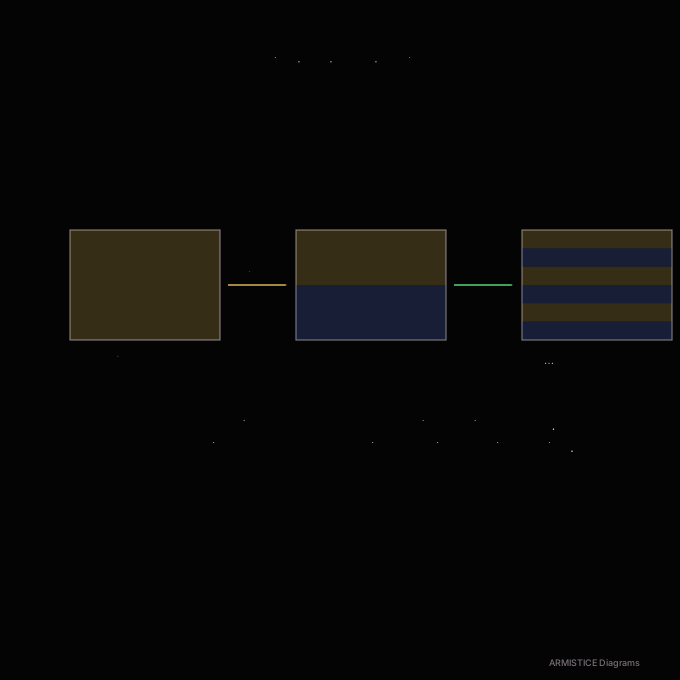
Stretch separates nearby states. Folding returns the stretched image to the bounded arena. Contraction keeps the iterates on a thin attractor. The fold is therefore both a geometric operation beneath every route and, when its measured rate crosses the chaos-onset band, a route in its own right.
Road I — Doubling: a rhythm splits
A stable rhythm can lose stability by splitting into period two, then four, then eight. Feigenbaum showed that broad classes of one-dimensional maps with a single smooth maximum share an asymptotic parameter-scaling constant, δ ≈ 4.669.
The engine’s documented doubling ladder appears after truncation in a bounded four-dimensional lift. One component carries the action, while the real, complex, and quaternion housings share the same thresholds. The result is a one-dimensional cascade expressed through three housings, not a new autonomous four-dimensional universality.
This road is read temporally: one beat becomes two, two become four, and the return time accumulates toward chaos.
Road II — Quasiperiodicity: a circle is born, locks, and breaks
The corpus follows two different continuations after circle birth: one enters a rational locking tongue; the other follows a fixed irrational rotation number toward breakup.
Birth
A fixed point loses stability through a Neimark–Sacker bifurcation: a complex-conjugate eigenvalue pair crosses the unit circle and an attracting invariant circle is born. The orbit no longer closes after a finite number of steps. It winds.
On a two-parameter continuation, the engine has an exact golden birth point at
The golden value is the linearized rotation number at this located two-parameter birth point, not a constant winding number along every nearby sweep. A separate two-parameter continuation follows the noble irrational targeted by dissipative circle-map renormalization.
Locking
An invariant circle is ordered, not chaotic. As a control parameter changes, its rotation number can catch on rational values and remain there across finite intervals. Those plateaus are cross-sections of Arnold tongues; together they form the devil’s staircase of mode-locking.
In the recorded ordinary parameter sweep, the rotation number changes and the circle enters the broad 1/3 tongue. Chaos appears at the tongue edge. This mode-locking path is distinct from the fixed-golden-rotation continuation used for the scaling measurement below.
Breakup by fold-tangency
For the separate two-parameter continuation that holds ρ=φ⁻², let
be the engine’s fold critical curve. The golden circle crosses this curve before breakup and survives; contact alone is not enough. At the critical parameter, however, the circle’s tangent aligns with the kernel of the Jacobian. The two directions close like scissors—from 38.4° below criticality to 0.14° at the measured breakup.
At that same locus,
The breakup is therefore not merely adjacent to a fold. It is a fold-tangency event: the invariant circle meets the critical curve in the direction the map collapses.
The sampled quasiperiodic branch is dissipative:
Those measured orbits contract area on average. This is not a claim that every engine regime has a negative Lyapunov sum. The relevant comparison is the dissipative quasiperiodic universality studied by Rand, Ostlund, Sethna, and Siggia.
A self-consistent Fibonacci-tongue reconstruction at the corrected breakup gives
consistent with the dissipative class value δ ≈ 2.83362. This supports phenomenological class membership. It does not establish a conjugacy between the Cosmopoiesis Engine and the sine-circle map.
Road III — Folding: stretch overtakes contraction
The third road is native to the engine. It is not another named local bifurcation. It is a global passage measured by the competition between stretching, folding, and dissipation.
For μ>0 and α≠0, define the folding coordinate
At , the independent uniform-torus average closes exactly:
This trace law measures the engine’s net local area change. It also exposes two different thresholds that must not be collapsed into one:
| event | criterion | folding coordinate | meaning |
|---|---|---|---|
| chaos onset | nearby trajectories begin to separate exponentially | ||
| uniform-phase area neutrality | the phase-model mean is neutral; orbit agreement requires its own measure check |
The chaos boundary is a soft band, measured at for , and near for . The area-neutral asymptote is not the onset of chaos.
Nor is a perfect one-number control for : frequency leads, and the maximal exponent still spreads at fixed product. The exact statement is the trace law above; the chaos-onset band is empirical.
This is what makes folding a road rather than scenery. The map always folds, but along this passage the folding coordinate itself is the control: increasing the engine’s stretch–fold intensity carries the maximal Lyapunov exponent through zero. The fuller derivation lives in The Folding Threshold.
One operation, three roads
The distinction is now clean:
| road | order that fails | diagnostic |
|---|---|---|
| period-doubling | finite temporal rhythm | |
| quasiperiodicity | smooth irrational winding | circle birth; locking sweep or fixed-rotation breakup continuation |
| folding | net local stability | crosses zero near |
Folding has a double role. It is the roadbed beneath doubling and circle breakup, because this bounded engine returns stretched states into its arena by folding them. It is also the third road, because ARMISTICE has measured a direct folding-rate passage into positive Lyapunov growth.
Where the claim stops
Four boundaries keep the result exact:
- The doubling sequence belongs to the truncated, effectively one-dimensional lift; it is not an independent four-dimensional Feigenbaum discovery.
- The golden rotation occurs at the solved two-parameter birth point, not along every nearby sweep.
- The measured breakup scaling agrees with the dissipative class; at current precision it does not distinguish that value from .
- The folding coordinate organizes the transition, but is not a dial-independent function of alone.
Within those boundaries, the conclusion is stronger than the former catalogue: the engine has three roads to chaos, and folding is both one of them and the operation that makes all three possible.
:: ARKHEIN ::
Lineage
Those who arrived at the same question before. This is not the first arrival.
- 1978
Mitchell Feigenbaum · Quantitative Universality
Established the universal scaling structure of period-doubling cascades for classes of one-dimensional maps. It supplies the comparison class for the truncated doubling sequence, not a new engine-owned constant.
- 1982
David Rand, Stellan Ostlund, James Sethna & Eric Siggia · Universal transition from quasiperiodicity to chaos
Developed the dissipative renormalization account for a fixed irrational rotation number—the correct external family for the engine’s golden-circle scaling comparison.
- 1983
M. Høgh Jensen, Per Bak & Tomas Bohr · Complete Devil's Staircase
Computed the complete mode-locking staircase at the circle map’s onset of chaos. Their result anchors the distinction between irrational winding, rational capture, and breakup within one quasiperiodic road.
:: APPARATUS ::
Sources for this page
-
Cosmopoiesis · living edition
The public kernel definition, parameter meanings, iteration protocol, and dynamical vocabulary used throughout the scholia.
Read the live canon -
Mathematica · living edition
The canonical constants, algebraic identities, and computed closures used by the engine and its derived findings.
Read the live canon -
Mitchell J. Feigenbaum · Quantitative Universality · 1978
Journal of Statistical Physics 19, 25–52
The primary account of universal period-doubling scaling for classes of one-dimensional maps with a single differentiable maximum.
Open the journal record -
David Rand, Stellan Ostlund, James Sethna & Eric D. Siggia · Universal Transition from Quasiperiodicity · 1982
Physical Review Letters 49, 132–135
The primary renormalization-group treatment of a universal quasiperiodic transition to chaos in dissipative systems at fixed irrational rotation number.
Open the journal record -
M. Høgh Jensen, Per Bak & Tomas Bohr · Complete Devil’s Staircase · 1983
Physical Review Letters 50, 1637–1639
The primary numerical account of the complete devil’s staircase and universal mode-locking structure at the circle map’s onset of chaos.
Open the journal record