Mathematica
The 1⊗0 Mathematica Codex
Sacred constants: F ⊙ φ H Δ η λ V Λ
The framework's formula atlas: three generating pillars, their derived constant web, the Cosmopoiesis kernel, and the methods used to read its dynamics.
Publication folio Full mathematical text, with readable source references
The Mathematica is AETHER’s formula atlas. It is about the framework’s mathematical vocabulary—where the constants come from, how the Cosmopoiesis map uses them, and which exact identities or measured results support the larger architecture. It is a reference rather than a linear argument: the full codex can be entered through constants, coordinates, dynamics, or structural theorems and still return to the same small spine.
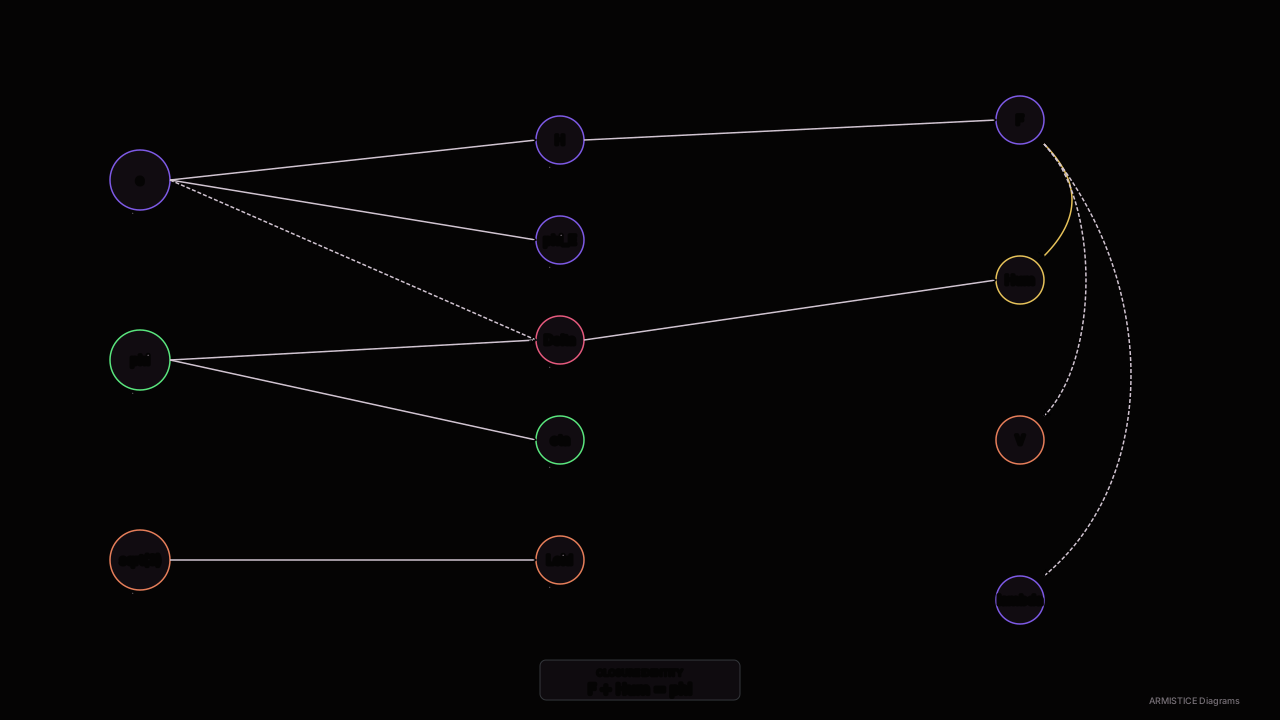
Three pillars generate the primary branches; the derived constants then close back across them. The web is meant to be read downward as descent and sideways as relation.
From pillars to closure
The generating set is . The Euler branch gives and its companions; the golden branch gives and the cross-branch difference ; the packing branch contributes itself as the Leidenfrost edge. From these come the shared engine coefficients , , and .
The most compact seal on the web is
It is exact by definition: , while . The Euler terms cancel, leaving . Its companion says that and close at . Together they show why the pool is better understood as a related algebra than as a cabinet of favored decimals.
Exact results, bounded claims
The Ferrite constant now has an all-index proof for its changing eight-term continued-fraction block; the pattern is structured but not eventually periodic. Its logarithm , and therefore , are transcendental. The rational span of the displayed sacred pool has dimension six or seven: a six-element independent set is known, while the remaining membership question involving stays open.
The engine’s analytic formulas carry equally explicit domains. At and , independent uniform torus phases give
At the determinant is identically zero; and along an actual orbit, the relevant average belongs to that orbit’s invariant measure rather than to the uniform torus by default. In the explicitly randomized , family, a separate exact Lyapunov result introduces Catalan’s constant. It does not supply a threshold theorem for the unforced deterministic map.
Coordinates also have information limits. The current crystallographic point-group roster places thirty-two rows into only thirty distinct triples: two pairs collide while differing in their polar flags. The resulting coordinate-only polar ceiling is therefore . A useful anchoring can be predictive without being a lossless encoding.
What the codex holds
Downstream, the Mathematica records the same Cosmopoiesis kernel in real and complex form, its unconditional coordinate bound, and the coordinate methods used for physical entities, sacred compositions, discovered forms, canonical folds, and decorative onomastic entries. It also gathers exact torus laws, fold geometry, resonance identities, and finite computational surveys of the engine’s regimes.
Those kinds of statement are kept distinct. An algebraic identity is something the definitions force. A theorem follows from the map. A computational finding belongs to the tested domain and resolution that produced it. An expository lens may illuminate the constants without becoming their derivation. That separation is the Mathematica’s real work: not making the system look larger, but making every route through it legible and letting the reader see which claims are exact, which are measured, and how all of them return to one engine.