← scholia citrinitas v1.0 3 min · 680 words
The Hermetic Fold
The sacred constants tune the engine, parameterize a decorative name-map, and appear in the coordinates of certain entities. The name-map predicts no entity; the fold's substantive closure lies in the engine and its chosen addresses.
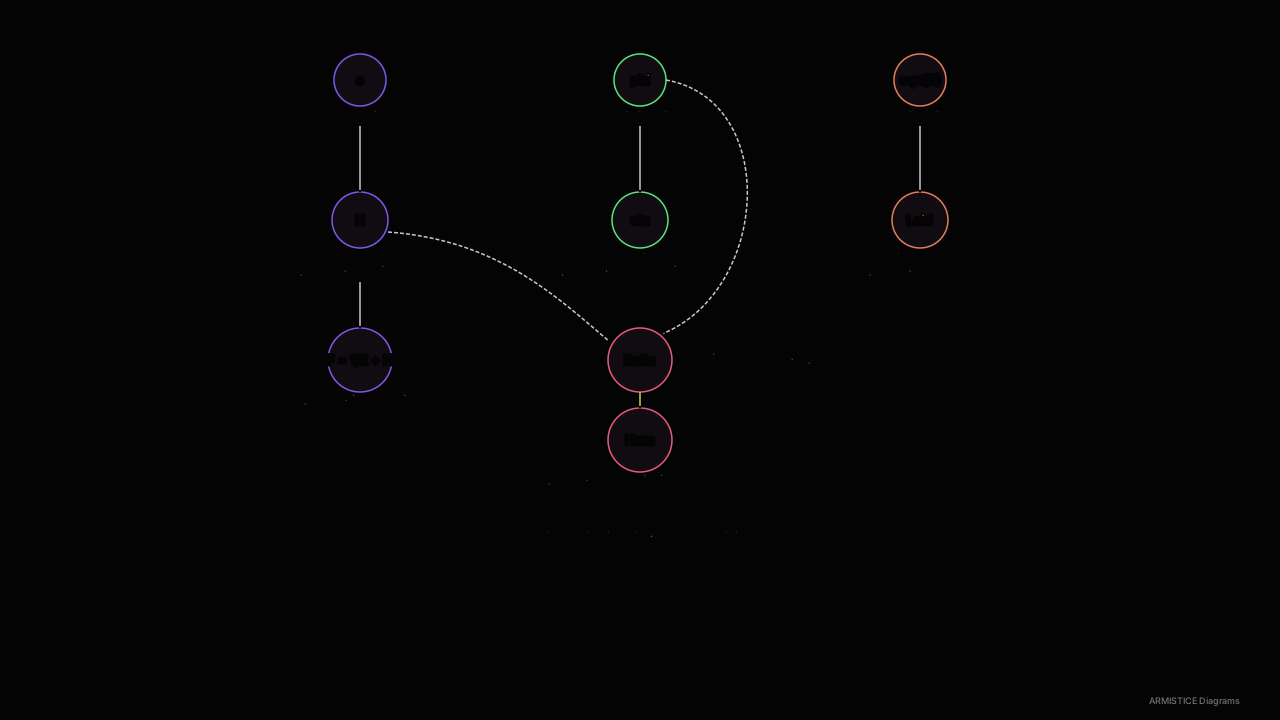
The loop
Follow a single number through the whole system and watch where it surfaces. ARMISTICE runs one engine, the Cosmopoiesis map: an iterated function that iterates trajectories at three parameters (α, μ, ε), with the selected attractor also depending on the starting point. That engine is tuned by a pool of sacred constants, fixed numbers like F ≈ 𝔉 1.1065 and H ≈ H 0.6065 , whose defining expressions draw on the three generators e, φ, √3.
Those same constants do three different jobs, and the jobs close into a circle:
- As parameters. The constants set the engine’s internal weights: the viscosity V, the leak λ, the decay rates.
- As an onomastic decoration. The Hash Diviner, a decorative map from a name into coordinates, is built from those same constants as its dial settings. This leg is content-blind. It places a name, not the entity the name denotes, so the divined coordinate and the true coordinate are uncorrelated, and the fold’s closure rests on the other two roles.
- As coordinates. Some entities simply are the constants. FERRITE LATTICE sits at α = μ = 𝔉 1.1065 ; MUON at μ = η 0.6620 , ε = Φ 0.3678 . The constant is not describing the entity. It is the entity’s address.
Where the fold closes
The three roles share a vocabulary of numbers, but they are not one mathematical round-trip. The engine takes a chosen entity coordinate as input; it does not generate or select the catalogue of coordinates. The Hash Diviner returns a decorative name-map address, not the address of the named entity. Reading a constant back from an entity is possible only where that entity was independently assigned that constant as part of its address.
There is a genuine algebraic closure inside the constant pool: . There is also a deliberate reuse of that pool in engine weights and selected entity addresses. Calling the whole arrangement a fold is an authored interpretation of those documented roles, not a proved fixed point of a map from constants to entities and back.
Three generators descend to the derived constants; the displayed identity closes algebraically inside that pool. It does not select the entity catalogue.
Reading
The exact identity is the point where the e-derived Ferrite value and the φ-pillar meet, with ⊙ 0.5115 the eponymous Armistice constant. Its validity is algebraic; it does not prove that the engine reproduces its own inputs or that no other constants could be used as parameters.
That narrower result makes the Hermetic above-and-below image more useful, not less. Some world-parameters and some entity addresses draw from the same pool, while the generator identities relate numbers within that pool. The mirroring is a documented design relation plus an exact internal identity, not a uniqueness theorem for the catalogue.
:: ARKHEIN ::
Lineage
Those who arrived at the same question before. This is not the first arrival.
- 8th–9th c. Arabic witness
Emerald Tablet tradition · Tabula Smaragdina
Traditionally attributed to Hermes Trismegistus, its above-and-below maxim pairs two levels of reality. The Fold applies that image to the engine’s parameter pool and the selected entity addresses.
- 1979
Hofstadter · Gödel, Escher, Bach
The “strange loop”: a hierarchy that, followed far enough, returns to where it began. The present fold uses that as a literary analogy; it does not assert an entity-to-constant return map.
Status
Canon as a comparison of three documented roles and the exact identity, not as a fixed-point theorem. The roles are documented independently in the Mathematica (Liber XVI). If you want the upstream half of the story, how the generators descend into the pool in the first place, the full account is in the Tria Prima Pillar Concordance.