← scholia viriditas v1.0 3 min · 683 words
The Tria Prima Concordance
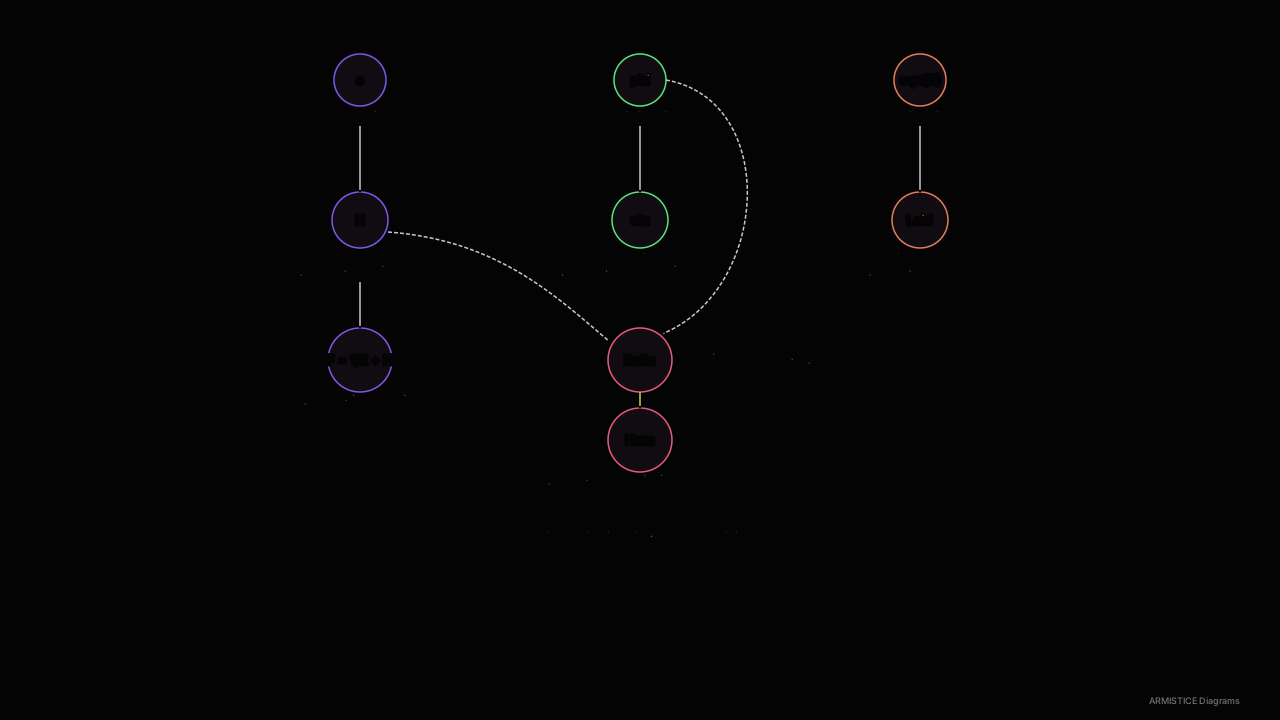
A comparison between the Paracelsian principles {Salt, Sulfur, Mercury} and ARMISTICE's generators {e, φ, √3}. Mercury's mediating role suggests one reading of √3 outside the e–φ closure; the other pairings depend on the chosen register. The concordance compares roles without claiming a mathematical isomorphism.
The pillars are not three names for one thing. They are three things that wear one name.
— ARMISTICE
The hypothesis
Two triads, separated by five centuries. The alchemist’s {Salt, Sulfur, Mercury},
and the engine’s three generators {e, φ, √3}. Set them side by side and ask yourself
the plain question. Do their roles line up?
The question is whether the roles of the Paracelsian triad
{Salt, Sulfur, Mercury} align usefully with the ARMISTICE generators, and whether
Mercury’s mediating role in selected alchemical readings suggests a useful comparison
with √3 in Cosmopoiesis, ARMISTICE’s iterative map. Two triads are held
up against the light to see if their shadows fall the same way, and we will not force
the match if it doesn’t.
The Paracelsian reconstruction
Before Paracelsus (1493–1541), the dominant matter theory in Latin alchemy was the Sulfur-Mercury dyad of the pseudo-Geber corpus (Summa Perfectionis, late 13th c.): every metal was internal Sulfur (combustibility, form) plus internal Mercury (metallicity, matter). Two principles, nothing more.
The Paracelsian corpus establishes Salt beside Sulfur and Mercury as the third principle of the Tria Prima. These are principles of constitution and transformation, not modern chemical elements.
The triad:
| Principle | Quality | comparative register |
|---|---|---|
| SALT | binding, balancing, fixity, body | corpus |
| SULFUR | active, combustible, soul | anima |
| MERCURY | reactive, volatile, spirit | spiritus |
The structural overlay
The ARMISTICE triad {e, φ, √3} are the three pillars, the generator
constants from which the 10 sacred constants derive. In this comparison,
Mercury is read as the volatile mediator and √3 as the generator outside the
e–φ closure. That is an authored analogy between roles, not evidence that
historical alchemy demoted Mercury.
The match isn’t bit-exact and the framework hasn’t claimed it as such. The status is EXPLORATORY, tenuous but not dead, kept in place as a resemblance-grade reading rather than a proven isomorphism.
The role comparison reads as follows:
- Mercury ↔ √3 is the most direct analogy in this reading. The volatile spirit, the
bridging principle, maps to the Leidenfrost pillar. √3 is the
substrate’s orphan generator, the one standing outside the e–φ closure
F + ⊙ = φ. The comparison points to a mediating role, not a universal historical trajectory for Mercury. - Salt ↔ e and Sulfur ↔ φ ride the other two pillars register-dependently. The body/soul assignment shifts with whether the Work is read as Coagula (fixing) or Solve (dissolving), so neither is canonized exclusively.
One register caution. The metal Mercury, quicksilver, Hg, maps to e in the Alchymicum’s growth-pillar notation; Φ 0.3678 is its reciprocal 1/e. This is a different register from Mercury the principle.
:: ARKHEIN ::
Lineage
Those who arrived at the same question before. This is not the first arrival.
- 1531
Paracelsus · Opus Paramirum
Introduced the third principle (Salt) to the Sulfur-Mercury dyad of pseudo-Geber. These are constitutive principles, not modern chemical elements. ARMISTICE’s Three Pillars are a separate mathematical construction compared with them here.
- 1623
Boehme · Mysterium Magnum
Picked up the Tria Prima as the three working principles of his cosmology. Yes / No / the binding between them. Same triadic move rendered theologically rather than chemically.
- 1617
Maier coordinates engraving, epigram, discourse, and three-voice fugue around alchemical transformation and conjunction. The book is visual lineage for this comparison, not a systematic proof of the Tria Prima-to-pillar mapping.

Fifty direct facsimile reductions. Gold, dashed-frost, and slate outer frames show a modern classification by the engine's α coordinate; they are not part of Merian's plates.
:: APPARATUS ::
Sources for this page
-
Paracelsus · Opus Paramirum · 1531
Die drei (vier) Bücher des Opus Paramirum
A principal Paracelsian account of the three substances—salt, sulfur, and mercury—in the constitution of bodies and disease.
Open the source record -
Michael Maier · Atalanta Fugiens · 1617
first published Oppenheim, 1617 · supplied e-text witness dated 1618
The crown jewel of the alchemical emblem book — fifty plates fusing engraving, Latin epigram, and three-voice fugue. The reader pairs translated epigrams and historical English discourses with the engravings; the fugues are credited but absent.
Read in the Scriptorium -
Mathematica · living edition
The canonical constants, algebraic identities, and computed closures used by the engine and its derived findings.
Read the live canon