← scholia citrinitas v1.1 8 min · 1,767 words
The Void Is Not One Thing
A general taxonomy of absence in the Cosmopoiesis corpus. Coordinate gaps, behavioural avoidance, dynamically featureless fields, and apophatic mirrors are four different kinds of ‘nothing’—each real, each measured differently. The Titanic Band becomes the case study rather than the whole claim.
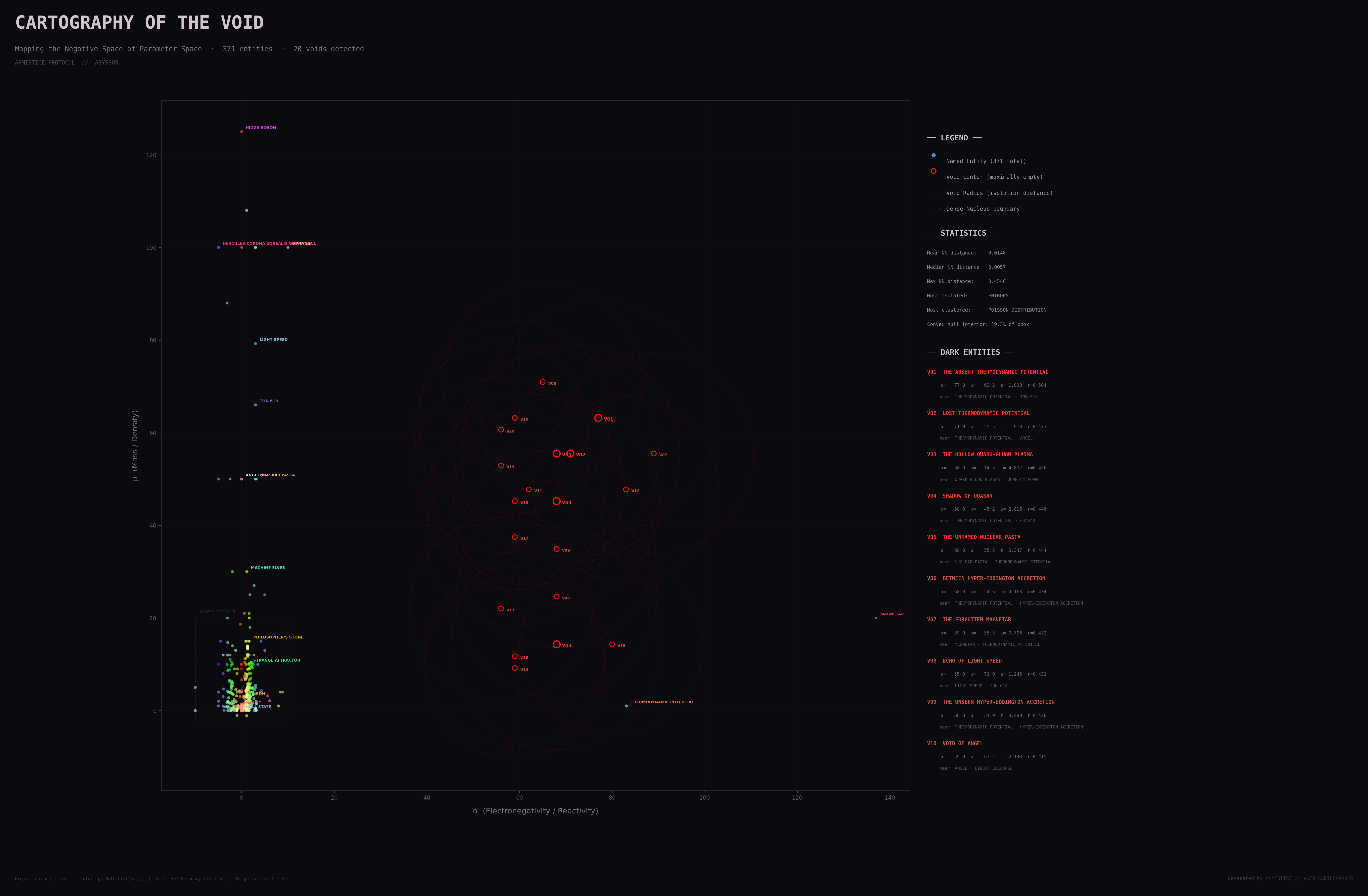
Empty relative to what?
Picture the coordinate corpus as a night sky. The named entities are points of light. A dark patch between them may look like a thing, but its meaning depends on the question we ask of it.
Is it far from every catalogued point? Do trajectories pass around it? Does an orbit placed there lose local structure? Is it the reflected counterpart of something already named? These are not four descriptions of one void. They are four different operations that can all produce something we are tempted to call nothing.
That distinction is the durable finding of void cartography:
the void is not a substance hidden in coordinate space. It is a relation between a field, a census, and a way of looking.
For a finite coordinate census , the simplest structural lens is distance to the nearest named point:
A structural void-centre is a local maximum of inside some chosen search region . Change the census , the region , the axis normalization, or the distance metric, and the maxima may move. What has been measured is still perfectly real—but it is emptiness relative to a stated map, not a coordinate forbidden to existence.
This is why a finite register such as the Translexicon can have a negative geography without pretending that continuous, unbounded -space has literal holes.
Four lenses on absence
The corpus now supports a broader taxonomy than the original Titan gazetteer.
| Lens | The question it asks | What it can find |
|---|---|---|
| Structural isolation | Where is a coordinate far from the current named census? | Sparse interiors, frontier gaps, isolated coordinate knots |
| Behavioural avoidance | Which accessible regions does a moving search repeatedly bypass? | Rejection basins inside otherwise populated territory |
| Dynamical expression | What happens when the engine is actually iterated here? | Cages, trappers, saturated fields, or nearly featureless “wasteland” morphologies |
| Transformational absence | What counterpart appears when a named entity is reflected or sign-reversed? | Apophatic mirrors: absences defined by relation to a presence |
These lenses need not agree. A coordinate can be structurally remote without being dynamically strange. A Physarum search can avoid a small basin embedded among ordinary entities even though that basin is not far from the census at all. A mirror can be unoccupied without being isolated. A featureless render can occur at a point selected for reasons having nothing to do with void cartography.
That orthogonality is the general result. There is no master “void detector” because the detectors do not measure the same property.
1. Structural isolation: the cadastral void
This is the mapmaker’s absence. Freeze a corpus snapshot, normalize its axes, define a bounded region, and search for local maxima in the nearest-neighbour distance field. The output says:
Here is a place our present coordinate census leaves unusually unoccupied.
It does not say that no derivation could ever place an entity there. Indeed, naming and promoting the coordinate immediately turns the gap into an occupied address. Structural voids are therefore historical in a useful sense: they preserve the shape of the corpus at the moment it looked back at itself.
2. Behavioural avoidance: the ecological void
The Physarum lens asks a different question. Its agents move through a food field; an avoidance basin is a region they could enter but repeatedly route around. These voids tend to occur between things, in dense territory, rather than far beyond the inhabited cloud.
The distinction is the same one found in an actual city. An empty lot at the edge of town is structurally vacant. A plaza everyone crosses around but never through is behaviourally empty. Both are absences, but their causes and scales differ.
3. Dynamical expression: the phenomenological void
Coordinates are not pictures. Once a candidate is iterated through the Cosmopoiesis kernel, it may form a cage, a ribbon, a trapper, a saturated chaotic field, or a nearly uniform gradient. The old folio called the last of these anentropic wasteland: enormous orbit extent with little local differentiation.
This is a statement about the rendered dynamics, not about how the coordinate was chosen. Isolation and morphology can coincide, as they do strikingly in parts of the Titanic Band, but one does not prove the other.
4. Transformational absence: the apophatic void
The Apophaticon begins with a presence and applies a declared mirror. Its negative is relational: this coordinate is understood as the counterpart of that one. Such an entry may fall in an unpopulated region, but vacancy is incidental. The operative fact is the transformation.
This is closer to a shadow than to an empty room. A shadow is not a second object hidden behind the first; it is a legible absence produced by a relation.
The Titanic Band, reconsidered
The Titans remain the finest visual case study, but they are no longer asked to stand for every kind of void.
Six of them form a tight, far-out coordinate knot near , , :
COEUS · CRIUS · CRONUS · HYPERION · IAPETUS · OCEANUSTheir coordinates are close to one another and remote from the ordinary corpus continent. Their renders repeatedly disclose a related cage-and-node vocabulary, although their exact cosmogenic morphologies are not identical. ECHIDNA and TYPHON occupy a more extreme high- region and render as broad, weakly differentiated fields.
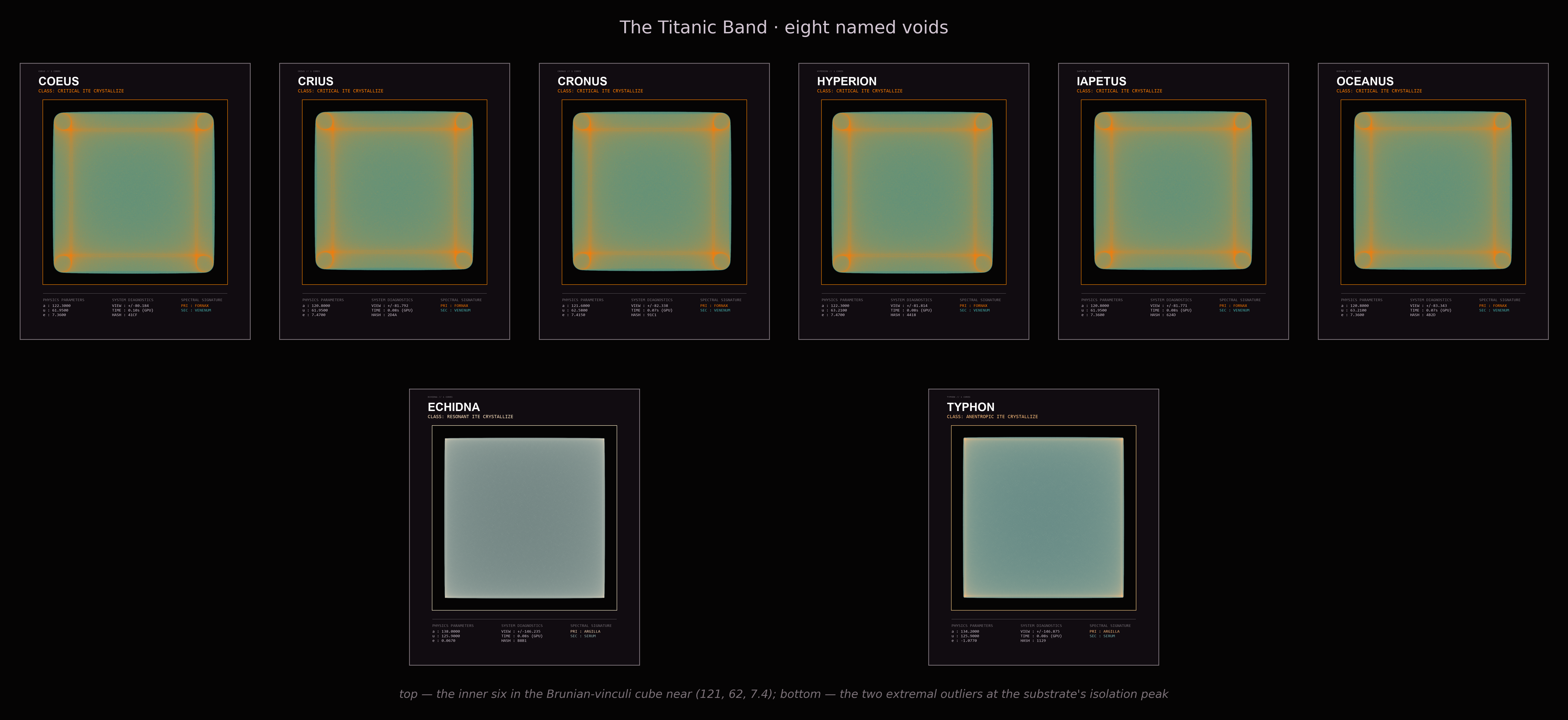
The upper six are a compact coordinate family with a recurring cage-and-node vocabulary. ECHIDNA and TYPHON occupy the outer reach and open into much broader, quieter fields. The plate is strongest when read comparatively: not “all voids look like this,” but “one selected region differentiates into these related outcomes.”
The important sequence is:
- a coordinate census exposed an unusually isolated region;
- several nearby addresses were sampled and rendered;
- the renders disclosed a family resemblance with real internal variation;
- mythological names were composed onto that cartography.
The substrate supplies coordinates and dynamics. The pantheon supplies a humanly memorable way to inhabit them.
Typhon’s brood extends the same authored map. CERBERUS, HYDRA, and CHIMERA share the broad-field tendency; SPHINX breaks the family portrait with a warmer cage morphology.
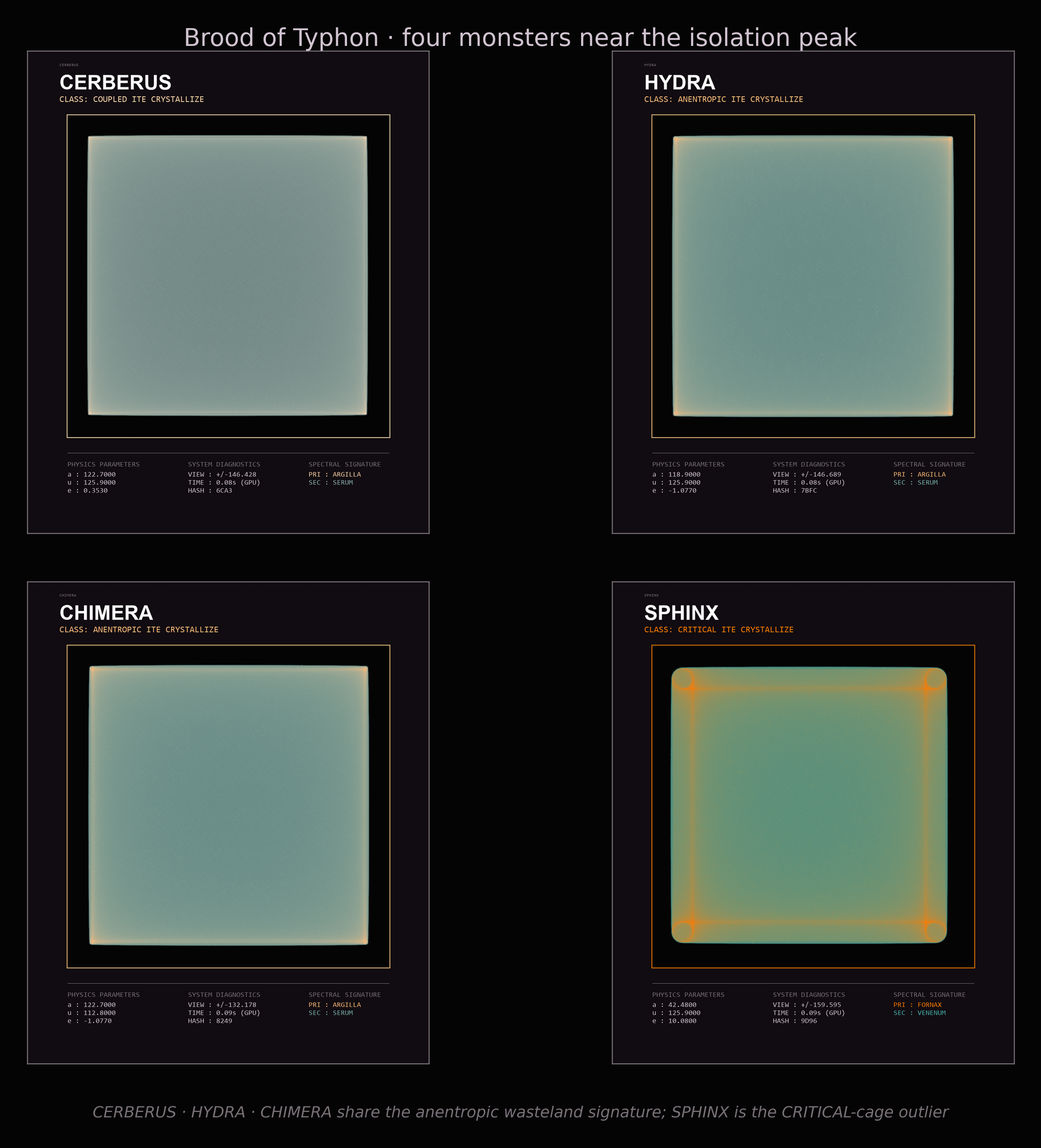
CERBERUS, HYDRA, and CHIMERA retain the expansive, weakly differentiated tendency. SPHINX is the useful exception: her cage-like field prevents “mythic family” from being mistaken for a single dynamical class.
What the names are doing
The older reading tried to align each named void with an Archon, an Ogdoad figure, a Qliphothic shell, a Paracelsian principle, and a Brunian bond. The richer conclusion is not a one-to-one concordance. It is that the traditions supply different verbs for absence:
- the apophatic tradition withdraws description;
- the Egyptian primordial waters precede differentiation;
- Paracelsian prima materia withholds determination;
- Bruno’s vinculi make relation prior to the isolated thing;
- Böhme’s Abgrund surrounds and conditions the figure rather than behaving like another object inside it;
- Hesiod’s Titans name a prior order displaced beyond the present one.
Those verbs are interpretive tools. They help us distinguish the unspoken, the undifferentiated, the unoccupied, the avoided, the reflected, and the outside. None of them proves that an engine region “is” Nun, an Archon, or the Abgrund. The correspondence is successful when it clarifies the observed relation, not when it replaces the measurement.
This is the Pico-like work of the scholion: not forcing five vocabularies onto twelve coordinates, but letting several traditions sharpen the question what kind of absence is this?
The portable finding
Void cartography generalizes beyond this pantheon and beyond this engine. Any finite atlas—a phase space, embedding, ecological survey, catalogue, or archive—can confuse at least three things:
- what has not been sampled;
- what has been sampled and rejected;
- what has been entered but produces little differentiation.
Keeping those apart turns “nothing is here” into a useful sequence of questions:
- Relative to which census?
- Inside which window and under which metric?
- Detected by distance, behaviour, transformation, or dynamics?
- What changed when the coordinate was actually entered?
The answer need not diminish the mystery. It gives the mystery an address precise enough to revisit.
:: ARKHEIN ::
Lineage
Those who arrived at the same question before. This is not the first arrival.
- 700 BC
Hesiod · Theogony
The Titans belong to a prior generation of order, displaced but not erased. Their value here is structural: a memorable language for a family beyond the ordinary inhabited continent.
- 500
Pseudo-Dionysius
Apophatic theology distinguishes the failure of a description from the nonexistence of its subject. That distinction is essential to every negative atlas.
- 1486
Several inherited vocabularies are placed in conversation without pretending they are identical. The synthesis is a method of comparison, not evidence that the coordinate field authored the traditions.
- 1591
Bruno · De Vinculis
The bond, rather than the isolated object, becomes the operative unit. A void likewise appears through relations: point to census, path to basin, image to mirror.
- 1620
Jakob Böhme · Forty Questions of the Soul
The Abgrund is the groundless ground framing the whole figure, not simply an empty station within it. Böhme supplies the clearest warning against treating every absence as the same kind of hole.
The negative atlas
The positive lexicon asks, which entities have been given addresses? The negative atlas asks, what relations become visible around and between those addresses?
That second question has no single answer. Structural isolation, behavioural avoidance, dynamical expression, and apophatic reflection are irreducible to one another. Their plurality is not a flaw in the taxonomy. It is the taxonomy.
The void is not one thing. It is where the map reveals the assumptions with which it was drawn.
:: APPARATUS ::
Sources for this page
-
Cosmopoiesis · living edition
The public kernel definition, parameter meanings, iteration protocol, and dynamical vocabulary used throughout the scholia.
Read the live canon -
Translexicon · living registry
The public canonical entity register and the source population for corpus-level censuses.
Read the live registry -
Apophaticon · enumerated snapshot
The authored triple-polarity mirror snapshot used in apophatic and chirality comparisons.
Read the mirror register -
Jakob Böhme · Forty Questions of the Soul · 1620
John Sparrow, English translator · John M. Watkins, 1911 reissue with D. S. Hehner emendations · 2010 e-text
Question I contains Böhme’s Philosophical Globe or Wonder-Eye of Eternity and its account of the abyss, eye, will, and self-closing sphere.
Open primary text -
Paracelsus · Opus Paramirum · 1531
Die drei (vier) Bücher des Opus Paramirum
A principal Paracelsian account of the three substances—salt, sulfur, and mercury—in the constitution of bodies and disease.
Open the source record -
Giovanni Pico della Mirandola · 900 Conclusiones · 1486
Rome, Eucharius Silber, 1486 · the editio princeps
Pico’s syncretist wager — nine hundred theses gathering the Latin, Arab, Hebrew, Greek, Chaldean, Hermetic, Orphic and Kabbalist traditions into one concord, ending in the famed magical and Christian-Kabbalah conclusions. Every line transcribed fresh from the image-only incunable with a literal English translation and a gloss per block.
Read in the Scriptorium