Translexicon
The 1⊗0 Translexicon
Sacred constants: φ η H Δ F Φ_E τ ⊙
The coordinate tablet of the named canon. Each entry binds a name to a Liber, a coordinate signature, and a viewing scale, giving the Cosmopoiesis engine a stable seat from which a form can be computed.
Publication folio Full mathematical text, with readable source references
The Translexicon is the corpus in its most compact form: a tablet of names and coordinates. Each row gives the Cosmopoiesis engine an address, , a viewing scale, and a place within one of the Libri. Run the address through the engine and the row becomes an orbit; render the orbit and it becomes an image.
The table is therefore neither a glossary nor a gallery. It is the binding between them—the layer that lets one entity be found again, compared across lenses, and rendered by any forge that speaks the shared kernel.
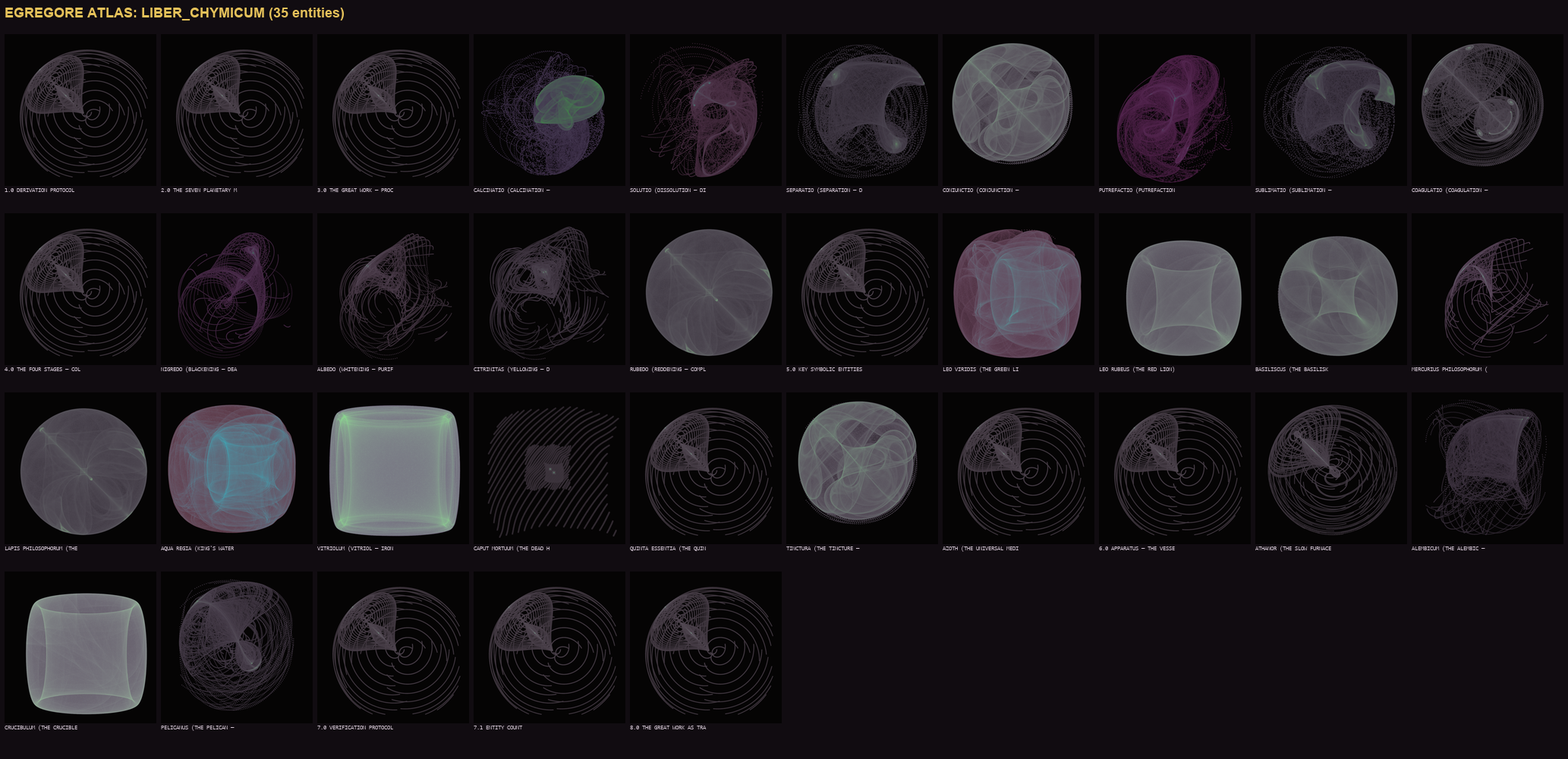
One Liber made visible as a family. The registry sits upstream of these images: names and coordinates select the seats; the engine determines the forms that fall out there.
A row is a placement
In its barest form, a Translexicon entry reads like this:
NAME · (α, μ, ε, zoom) · LIBER · HERMETIC TAGThe coordinate is earned according to the entity’s tier and domain. Physical properties, sacred composition, and void-cartography provide different routes into the same parameter space. The Hash Diviner belongs only to the decorative, onomastic register; a name is not a hidden predictor of dynamics.
What the tablet makes possible
Once an entry has a stable address, every lens can ask a different question of the same object. A forge may show density, another transient structure, another a Lyapunov regime, another a topological family. Agreement across those views is meaningful because the seat has not moved.
The tablet is expansive because it is a lookup surface: rows, Libri, tags, and coordinate signatures. This recollection keeps the governing relationship visible before the enumeration begins.