← scholia citrinitas v2.0 5 min · 1,174 words
The Meta-Kernel — One Basis, Several Maps
The five named trigonometric maps share a compact vocabulary of sine, cosine, linear, and bilinear channels. The original 25-parameter scaffold exposes that family, but its shared frequencies do not contain fully general Clifford or De Jong. An independent-frequency extension does—and turns the Meta-Kernel from a slogan into a testable coordinate system.
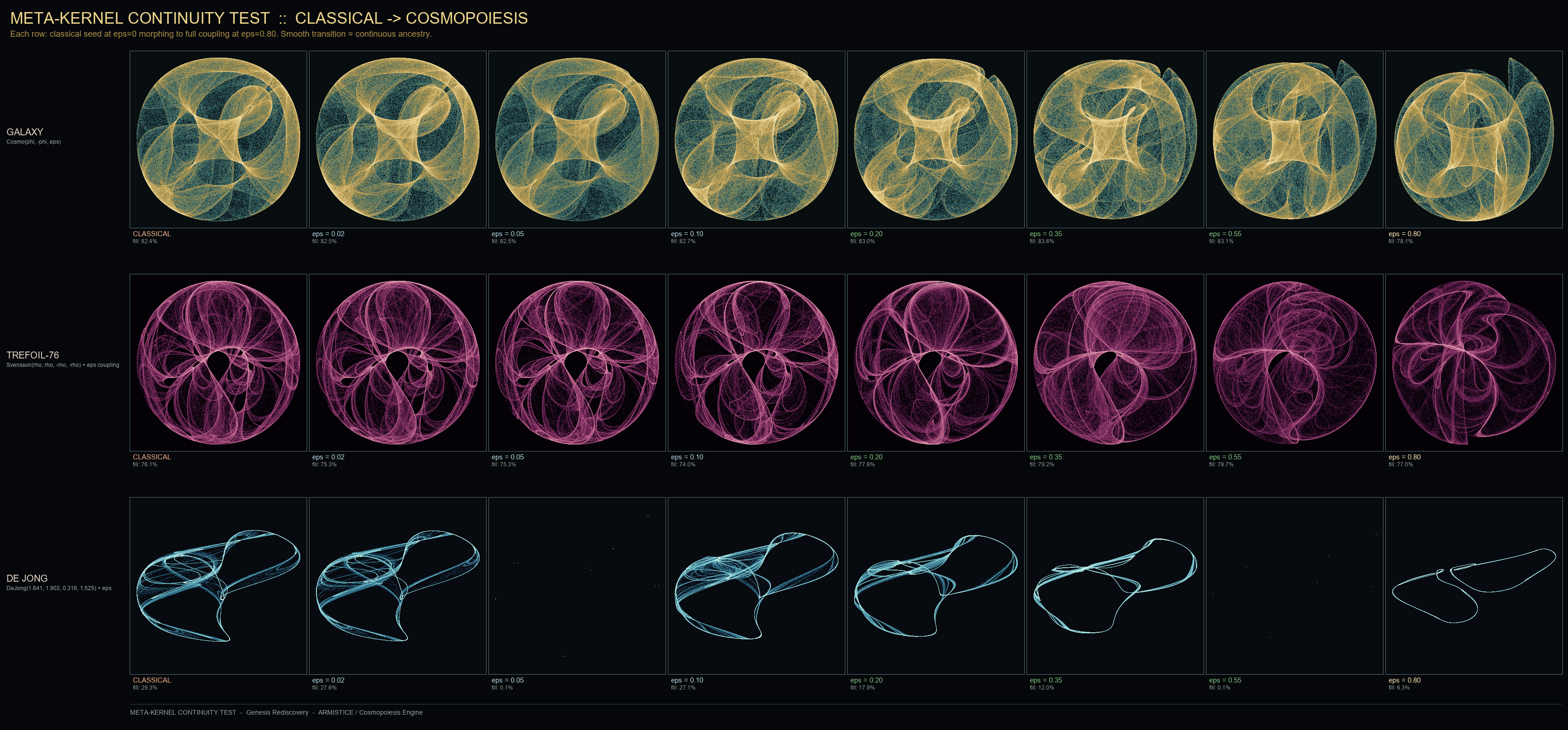
Five iterative maps—rules that repeatedly turn one point into the next—look unrelated when written in their customary forms. Clifford, De Jong, Svensson, Bedhead, and ARMISTICE’s Cosmopoiesis nevertheless draw their terms from a small common vocabulary:
The Meta-Kernel places those channels in one coefficient space. Its durable claim is not that five historical maps were secretly one invention. It is that they can be compared as different sparse selections from one basis.
The continuity atlas above is an empirical morph experiment inside that family. It is not the algebraic proof of containment: a smooth-looking image sequence can cross a dynamical bifurcation, and a blank frame can be a periodic collapse rather than a failed render.
The 25-parameter scaffold
Write the two update equations as:
x' = A1 sin(w1 y) + A2 sin(w2 x)
   + B1 cos(w1 x) + B2 cos(w2 y)
   + C1 sin(Vxy)  + C2 cos(Vxy)
   + D1 y sin(xy / b) + D2 cos(w3 x - y)
   + E1 x + E2 y

y' = A1' sin(w1 x) + A2' sin(w2 y)
   + B1' cos(w1 y) + B2' cos(w2 x)
   + C1' sin(Vxy)  + C2' cos(Vxy)
   + D1' sin(y) / b + D2' cos(w3 y - x)
   + E1' x + E2' y
There are twenty amplitude coefficients, four frequency-like parameters , and one protected divisor : twenty-five parameters in all.
This equation is valuable because the coefficient letters expose the support mask of a map—which channels are lit and which are zero. But its frequencies are shared between the two output equations. That economy creates a real seam.
The frequency seam
Consider the general Clifford map:
In the 25-parameter scaffold, the matching sine and cosine channels in both rows use the same . Clifford is therefore an exact restriction only on the diagonal . This is precisely the equal-frequency slice already proved by direct substitution in the Principia.
General De Jong exposes the seam more strongly:
Its four frequencies are independent. No assignment of the shared channels can produce arbitrary . The 25-parameter equation contains the equal-frequency De Jong subfamily, not the full map.
That does not undo the Meta-Kernel idea. It tells us exactly how to finish it.
The independent-frequency closure
Give each ordinary sine and cosine channel its own frequency:
| output | channel | frequency |
|---|---|---|
Keep separate affine-cosine frequencies , the bilinear frequency , and the protected divisor . With the same twenty amplitudes, this gives one sufficient 32-parameter extension:
This extension is not asserted to be minimal. It is simply large enough to embed all five named maps without pretending that independent frequencies are shared.
Restriction audit
| kernel | 25-parameter scaffold | independent-frequency extension |
|---|---|---|
| Clifford | exact when | exact for arbitrary |
| De Jong | exact on the equal-frequency subfamily | exact for arbitrary |
| Svensson | exact | exact |
| Bedhead | exact through the , affine-cosine, and linear channels | exact |
| Cosmopoiesis | exact | exact |
The audit gives the Meta-Kernel two levels:
- , a compact shared-frequency scaffold useful for comparing support masks;
- , an independent-frequency closure that contains the five maps in their general forms.
The first is the elegant compression. The second is the exact containment statement.
The Cosmopoiesis slice
Cosmopoiesis activates
with one shared frequency and the bilinear phase :
Among these five named kernels, it is the one that activates the paired / channel. This distinguishes its slice; it does not prove maximal expressiveness, uniqueness among all coefficient subsets, or a global “Goldilocks” optimum. Many untested support masks can use the same number of coefficients.
The axis is therefore an additional deformation channel in Cosmopoiesis. It should not be credited with every symmetry of the map. In particular, the exact anti-swap and -flip relations live on , where the bilinear coupling is switched off.
Coefficient distance is not dynamical distance
A support mask permits a simple Hamming distance: count which channels must switch on or off to move from one kernel to another. That can describe algebraic sparsity, but it does not by itself measure similarity between attractors.
A dynamical comparison must also specify:
- how coefficient magnitudes are normalized;
- how frequencies are scaled;
- the interpolation path;
- the initial-condition and observer contract;
- the orbit descriptors used to judge continuity.
For parameter vectors and , the straight path
is continuous as an equation when stays away from zero. Its attractor need not change continuously. A small coefficient move can cross a bifurcation; a large support change can preserve a coarse morphology.
This is why the atlas at the head of the page is evidence about one chosen path, not a universal metric on kernel space.
What the unification enables
1. Restriction tests
For each named kernel, substitute its parameter vector and compare both update equations symbolically. This catches frequency-sharing and channel-placement errors before any render is consulted.
2. Path atlases
Choose two exact restrictions, state the interpolation, and render a dense sequence while measuring Lyapunov behavior, fill, dimension, and component count. The resulting atlas shows where algebraic motion becomes dynamical folding.
3. Support-mask exploration
Activate untested but symmetric channel pairs, then ask whether they create a stable new family or merely reproduce an existing one. A novel equation is cheap; a reproducible dynamical regime is the actual discovery.
Relation to the Archetypal Lattice
The two factorization ideas act on different objects:
| construction | factors | output |
|---|---|---|
| Meta-Kernel | basis channels × coefficients and frequencies | an update rule |
| Archetypal Lattice | sacred constant × morphology recipe | an idealized seed |
They meet only when a selected kernel iterates a selected seed under a stated observer. Kernel choice does not automatically determine morphology class, and a lattice address does not determine which kernel must render it.
The useful unity is therefore operational: one coordinate system for maps, one address system for seeds, and a measured dynamical passage between them. That is enough to turn five named formulas from a cabinet of curiosities into an explorable family.
:: APPARATUS ::
Sources for this page
-
Principia · living edition
The proposition-level canon, including the Archetypal Lattice, its address generator, morphology classes, and parameter-space discontinuity surfaces.
Read the live canon -
Cosmopoiesis · living edition
The public kernel definition, parameter meanings, iteration protocol, and dynamical vocabulary used throughout the scholia.
Read the live canon