← scholia rubedo v2.0 5 min · 1,103 words
Newton’s Cubic Lens — One Real Direction
Fit a cubic to each usable orbit envelope, isolate the degree-three part, and ask how many real directions it admits at infinity. Nearly every robust fit answers one. That is the measured concentration behind the corpus label ‘Genus II’—a useful geometric regularity, not a universal law and not Newton’s historical taxonomy reproduced verbatim.
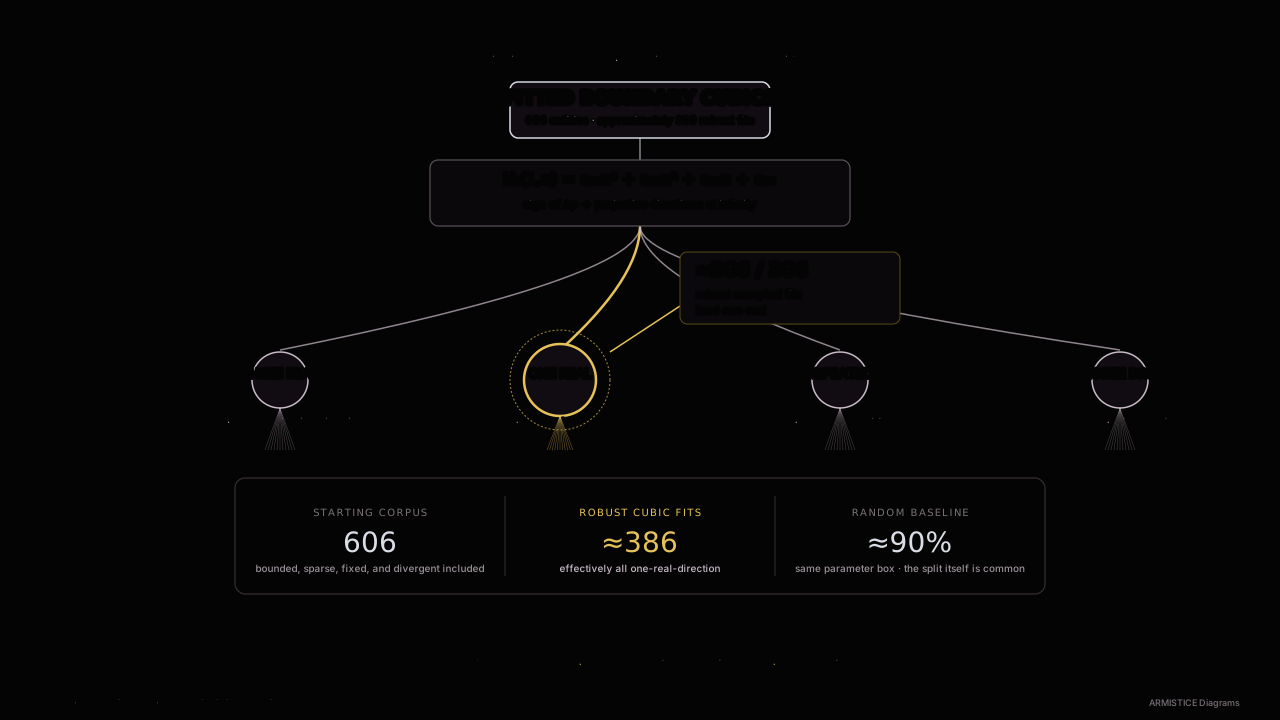
An orbit and its boundary are not the same object. The orbit is the cloud of points produced by iteration. The boundary is a contour inferred from that cloud. This scholion asks a deliberately narrower question:
When a cubic is used as a lens on a usable orbit boundary, how many real directions does its highest-degree part see at infinity?
Across the recorded canon sweep, almost every robust answer is one. The corpus has traditionally called that bucket Newton Genus II. The name is worth keeping as a mnemonic, provided the mathematics underneath it remains visible.
From envelope to cubic
For each bounded orbit that presents a sufficiently populated outer envelope, the points are centered on their principal axes and sampled in angular bins. An implicit cubic is then fitted:
The full polynomial describes the fitted contour. Its behavior far from the origin is controlled by the homogeneous cubic part
Directions at infinity are the projective roots of . In the chart , put :
The vertical projective direction is checked separately so the affine chart does not silently lose a root. For the remaining cubic, the discriminant gives the operational classification:
| discriminant of | real projective directions | corpus shorthand |
|---|---|---|
| three distinct real directions | Genus I | |
| one real direction; two non-real conjugate roots | Genus II | |
| a repeated direction | discriminant seam |
The non-real roots are not visible “complex asymptotes.” They record that the real plane has only one asymptotic direction rather than three. That is the clean geometric content of the label.
What Newton contributes
Newton’s Enumeratio Linearum Tertii Ordinis classified cubic curves through their branches, singularities, diameters, asymptotes, and relation to the line at infinity. It is a much richer historical taxonomy than the three-way discriminant test above.
The present classifier is therefore Newtonian in lens, modern in operation. It asks one Newton-shaped question—how the cubic meets infinity—then reduces the answer to the root structure of . “Genus II” is the corpus’s compact name for the one-real-direction bucket, not a claim that the full Enumeratio has been reconstructed species by species.
What the sweep actually says
The June 2026 recompute begins with 606 canon entities. Roughly 386 produce orbit envelopes stable and populated enough for a cubic fit; roughly 220 are skipped because they fail numerical acceptance, collapse, remain too sparse, or do not present a boundary that this method can responsibly fit.
Among the fittable boundaries:
| outcome | robust count | reading |
|---|---|---|
| one real direction, | approximately 386 | effectively all accepted fits |
| three real directions, | 0 | no robust canon case |
| repeated direction, | 0 stable cases | apparent cases are fit-sensitive near the seam |
The null matters. Random coordinates drawn from the same parameter box already land in the one-real-direction bucket about 90% of the time. The bare root pattern is therefore common. What distinguishes the canon sample is only its near-total concentration above that high baseline.
The boundary fits are more homogeneous than the null sample. The result is their concentration within an already common algebraic class.
The 3D echo—and its limit
There is a genuine formal rhyme with the three-dimensional engine. A real Jacobian has either three real eigenvalues or one real eigenvalue plus a non-real conjugate pair. The Cosmopoiesis Jacobian’s cyclic-zero wiring makes the conjugate-pair class the majority outcome in measured fixed-point censuses, while an all-real class still occupies positive measure.
The zero pattern constrains the characteristic cubic and often yields one real eigenvalue with a conjugate pair. It does not force that split at every fixed point: all-real triples survive on open parameter regions.
The two statements can now be placed side by side without conflating them:
The first is nearly total among accepted canon fits. The second is a parameter-dependent majority. They share the algebra of real cubic polynomials; no dimensional invariant has yet been demonstrated.
Two lenses on the same boundary
This result complements the Orbit Boundary Rhombus scholion rather than competing with it.
- The -norm lens asks which familiar contour best matches the envelope. It often answers with a near-rhombus.
- The cubic lens asks how a flexible implicit polynomial meets the line at infinity. It almost always answers with one real projective direction.
One is a shape-family fit; the other is an asymptotic root classification. Agreement between them is not automatic, and neither should be translated into the other without a direct test.
Method register
- Iterate each canon coordinate for 15,000 samples after a 2,000-step warmup.
- Reject numerically invalid, sparse, fixed-point, and boundaryless outputs.
- Center the accepted orbit and rotate into PCA coordinates.
- Extract the 95th-percentile radius in 72 angular bins.
- Fit the ten coefficients of by singular-value decomposition.
- Isolate , normalize it, and solve for its projective roots.
- Repeat under nearby binning and envelope choices; treat classifications that cross as method-sensitive rather than stable cases.
- Compare the accepted canon distribution with random coordinates drawn from the same parameter box.
The important filter is step seven. Near the discriminant seam, a small change in the fitted coefficients can switch one real direction into three. A stable classification must survive that knob movement.
The keep
The useful claim is compact:
Nearly every robust cubic fit to a usable canon orbit boundary has one real projective direction at infinity.
That concentration is stronger than the approximately 90% random-coordinate baseline, but only modestly so. The echo with the 3D Jacobian is suggestive because the objects are different; it remains an invitation to compute a coupling between them, not evidence that such a coupling already exists.
:: APPARATUS ::
Sources for this page
-
Isaac Newton · Enumeratio of Cubic Curves · 1704
First published with the Opticks; 1711 Latin edition catalogued by the Library of Congress
Newton’s primary classification of curves of the third order. The present scholion borrows its attention to branches and directions at infinity while clearly separating the corpus’s modern discriminant-based classifier from Newton’s historical genera and species.
Library of Congress edition record -
Mathematica · living edition
The canonical constants, algebraic identities, and computed closures used by the engine and its derived findings.
Read the live canon -
Cosmopoiesis · living edition
The public kernel definition, parameter meanings, iteration protocol, and dynamical vocabulary used throughout the scholia.
Read the live canon