← scholia albedo v1.1 4 min · 864 words
Patina-Freeness
A descriptive lens on the three pillars: φ and √3 have periodic simple continued fractions and irrationality exponent 2; e has a non-periodic but explicit patterned expansion and exponent 2. The comparison with π depends on two separate questions: its irrationality exponent and a compact rule for its simple continued-fraction coefficients.
The question
Pick up any number that earns a seat at the foundation and ask what its arithmetic looks like when cut open. Every sacred constant in ARMISTICE derives from three pillars, the generating numbers . So what makes a number eligible to be a pillar in the first place? Why these three, and why not, say, π?
Patina-freeness is an authored descriptive lens, not a theorem of pillarhood. It asks whether a constant presents two kinds of arithmetic legibility:
- a simple continued fraction with a known compact rule for its partial quotients;
- an irrationality exponent known to equal 2.
The first condition has two distinct forms. The continued fractions of φ and √3 are periodic because they are quadratic irrationals. The continued fraction of e is not periodic, but Euler found its explicit repeating scheme of ones interrupted by an arithmetic progression. These are different grains; what they share is that the whole infinite expansion can be stated without tabulating it term by term.
| number | simple continued fraction | rule |
|---|---|---|
| φ | every partial quotient is 1 | |
| √3 | repeat 1, 2 after the integer part | |
| e | concatenate for |
The second condition concerns rational approximation. Every irrational has irrationality exponent at least 2. Roth proved that every irrational algebraic number has exponent exactly 2, settling φ and √3. The same value is known for e by its own transcendental-number theory. Here “patina-free” means arithmetically transparent to present knowledge, not metaphysically pure.
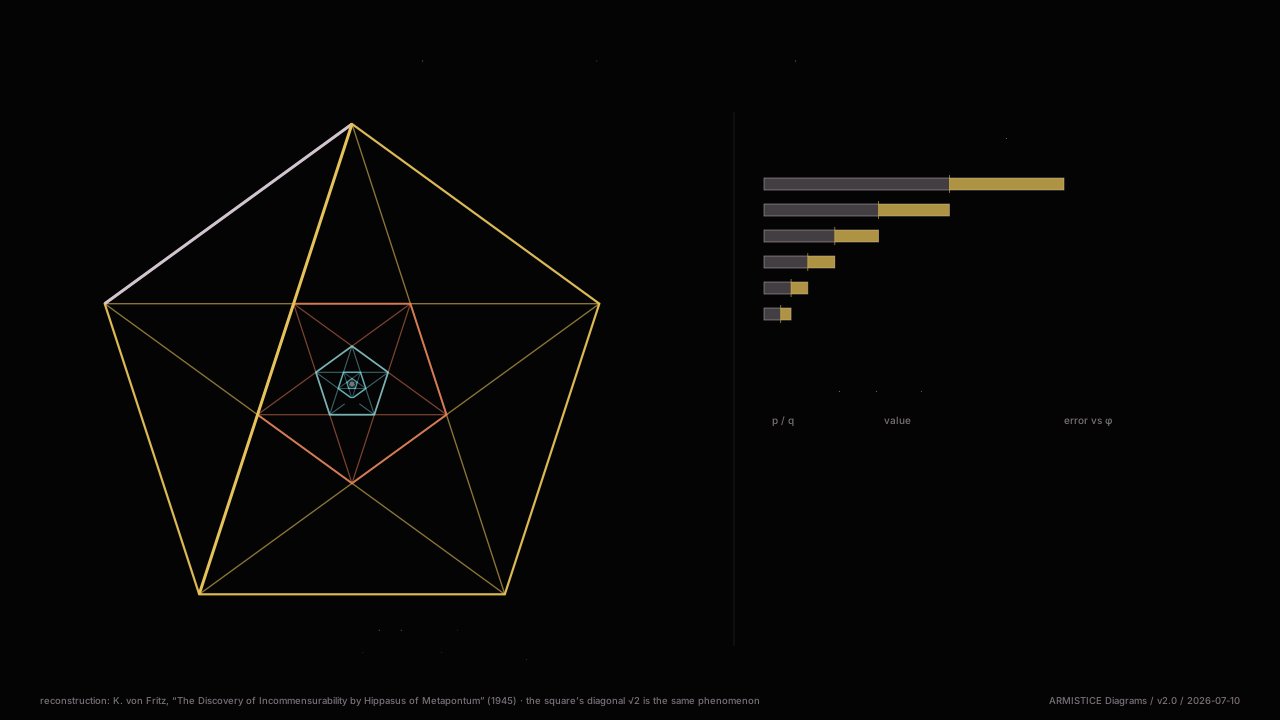
This reconstruction follows the pentagram reading associated with Hippasus: its diagonal-to-side ratio is φ. Repeated mutual subtraction never terminates, while the continued fraction repeats one partial quotient forever. The square’s diagonal √2 offers another example of the same incommensurability.
What the lens can say about π
The two parts of the lens must be tested separately for π. Its generalized continued fractions have compact formulas, but the present condition asks specifically for a rule for the integer partial quotients of the simple continued fraction. The published irrationality estimate used in the original comparison is Zeilberger and Zudilin’s 2020 upper bound,
That bound alone does not prove that π fails the lens. Nor would a proof of μ(π) = 2 supply the continued-fraction rule: it would settle only the second condition. A September 2026 manuscript claims that equality. Its proof is not assessed in this scholion; the comparison here uses the dated published bound and keeps the two requirements distinct.
This is an epistemic distinction, and an important one. The lens explains why the house can presently describe in one compact arithmetic register. It does not prove that π is intrinsically corroded, chaotic, or forbidden.
A signature, not a gate
Other numbers share the same signature. The silver ratio, the bronze ratio, and √2 all have compact continued fractions and μ = 2, yet none is a pillar. So patina-freeness neither selects exactly three numbers nor rules every other number out. It records a family resemblance among the chosen pillars.
The positive reasons for the triad live elsewhere: e supplies the analytic continuity of the exponential family, φ supplies reciprocal and reflection closure, and √3 supplies the packing and saturation geometry. Those roles select the pillars. Patina-freeness notices what their arithmetic looks like after the selection has been made.
The Spiral of Theodorus lays out the square-root sequence as a chain of unit-leg triangles. Its irrational hypotenuses are quadratic irrationals with μ = 2. The perfect-square steps, √4, √9, and √16, are rational and lie outside this criterion. √3 is the substrate’s saturation pillar, Λ 1.7321 .
:: ARKHEIN ::
Lineage
Those who arrived at the same question before. This is not the first arrival.
- 1891
Hurwitz · continued-fraction regularity
Proved the arithmetic-progression structure in the continued fractions of the e-family, extending the patterned-expansion conversation opened by Euler.
- 1955
Roth · Thue–Siegel–Roth theorem
Fixed the irrationality measure of algebraic irrationals at 2: the floor that √3 and every irrational algebraic number sits on.
Status
INTERPRETIVE LENS, stated with its scope: the three pillars share a compact arithmetic legibility, but that signature is neither necessary nor sufficient for pillarhood. The π comparison must satisfy both conditions; a result about its irrationality exponent alone would not complete it. For the positive structure the three pillars build, continue to the Tria Prima Pillar Concordance.
:: APPARATUS ::
Sources for this page
-
Leonhard Euler · A Dissertation on Continued Fractions · 1744
Commentarii academiae scientiarum Petropolitanae 9, 98–137 · Eneström E071
Euler’s original systematic treatment of continued fractions, written in 1737, including the patterned expansion associated with e.
Euler Archive record and scan -
K. F. Roth · Rational Approximations · 1955
Mathematika 2(1), 1–20
The theorem fixing the irrationality exponent of every irrational algebraic number at 2; it applies directly to φ, √2, and √3.
Open the journal record -
Doron Zeilberger & Wadim Zudilin · Irrationality Measure of π · 2020
Moscow Journal of Combinatorics and Number Theory 9, 407–419
The rigorous upper bound used here to distinguish what is known about π from the still-unproved claim that its irrationality exponent equals 2.
Open the journal record -
Mathematica · living edition
The canonical constants, algebraic identities, and computed closures used by the engine and its derived findings.
Read the live canon