← scholia viriditas v1.0 7 min · 1,561 words
What the Fold Remembers
Give every particle a permanent color before the engine moves it. Twenty-four witnesses reveal how the same square can interleave, keep its partitions, or gather into a point. PLICA carries the experiment further: a brilliant early fabric resolves into a long, staggered arrival.
The Folding Table
Starting square
PLICA · full field
PLICA · around the sink
Color it before it moves
A luminous attractor tells you where points have gathered. It can hide where they came from.
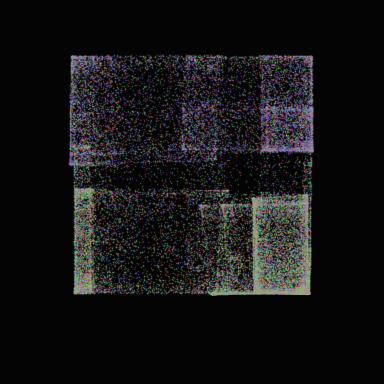
This experiment begins one step earlier. Take a square of particles, divide it into six regions, and give each region a color. Then let the engine move every particle while its color stays attached. Green can stretch across pink; blue can enter a place that belonged to orange. The image now carries a visible relation between origin and destination.
The original study used 36,864 particles, a 192 × 192 grid of cell-centered starts inside a square extending from −1.5 to 1.5 on each axis. Three columns and two rows supplied the six permanent labels. Each of twenty-four selected witnesses received that same starting arrangement. Its coordinates stayed fixed while the Cosmopoiesis map advanced the particles through sixteen synchronous updates.
The instrument places those histories beside one another. Return to step zero to see their shared beginning. Isolate an origin region, then follow it through the changing body. Select an individual particle to recover a route that the crowded image makes difficult to see.
This is the first meaning of memory here: the experiment keeps a particle’s identity while its position changes. The color is an observer’s tag, not a force acting on the map.
The same square, different lives
Start with MONAD. The colors spread and interleave across a broad body. At step sixteen its centered root-mean-square radius—the typical distance of a particle from the population’s center—is 1.183 times the starting radius. Much of the square’s initial color partition has become difficult to read, yet the population still occupies an extended region.
Now compare JELLYFISH or QUADRAD. Their particles also travel, but stronger origin partitions remain visible. DYAD and STARFIELD offer related contrasts: the material has changed its arrangement without becoming equally interleaved everywhere.
Finally, select EVENT HORIZON or PRIMITIVE. Their origins also become difficult to separate, for a very different reason. By step sixteen, each population occupies a single cell in the study’s spatial readout. The square has gathered into a tiny neighborhood.
The recorded measurements make that difference explicit:
| Witness | Radius relative to its start | Spatial origin readability |
|---|---|---|
| MONAD | 1.183 | 0.028 |
| JELLYFISH | 1.265 | 0.305 |
| QUADRAD | 1.292 | 0.379 |
| PLICA | 0.732 | 0.030 |
| EVENT HORIZON | 3.68 × 10⁻¹³ | 0 |
| PRIMITIVE | 6.52 × 10⁻¹⁰ | 0 |
These are step-sixteen measurements from the full original grid. The readability score asks how much knowing a particle’s coarse location tells us about its starting color. It uses a 32 × 32 grid across each witness’s fixed camera and normalizes the mutual information by the starting color entropy. One would mean the location identifies the color; zero means this spatial readout supplies no such information.
It is a resolution-dependent measurement, not a percentage of identities remaining. A separate comparison with shuffled-label references retained the contrast between broad interleaving and stronger partitions at both 32 × 32 and 48 × 48 readout grids. The radius column supplies something the color score alone cannot: whether the population has spread through a body or contracted below the readout’s reach.
A mingled body and a gathered point can both conceal their origins. Looking only at the final colors would miss the difference.
PLICA is the passage
PLICA makes the early image particularly seductive. At sixteen updates it is still a broad, worked fabric. The original measurement gives a median finite-time logarithmic tangent stretch of +0.548 per update across those first sixteen steps: nearby displacements have, on that measure, been amplified.
That number describes the observed opening passage. It does not settle the long-term fate of the particles.
For PLICA, the experiment continues with the same population and the same coordinates:
Nothing turns a parameter dial to make the motion end. The map that kneads the square eventually gathers this sampled population around the fixed point near
The long run follows every original particle through 5,000 updates. Its first seventeen states, including the initial square, agree with the earlier material experiment bit for bit. The spectacular opening and the eventual point belong to one uninterrupted history.
The word fold here follows that visible transport. The precise critical geometry of a map is another instrument: Caustica locates singular sets and their images. A colored crease alone does not establish where such a singularity lies, and early stretching alone does not establish sustained chaos.
Arrival has a tail
The population does not settle at one collective instant. Some particles have arrived while others continue to roam through the broad folded region.
The long run measures persistent arrival into a radius of 0.001 around the final point: the first step after a particle’s last exit, with no later exit through the step-5,000 check. A brief visit followed by another excursion does not count as arrival.
| Share of the original population persistently arrived | Step |
|---|---|
| 50% | 89 |
| 90% | 186 |
| 99% | 310 |
| 100% | 652 |
By step 128, about 73.48% are already inside that neighborhood; at step 256, about 97.26% are inside. The shrinking remainder keeps the earlier movement alive long after most particles have gathered. At stricter radii, all particles remain within 10⁻⁶ from step 694 and 10⁻¹² from step 796, through the same recorded horizon.
The arrival map returns those times to the original square. Its colors answer a new question: which starting places settle early, and which supply the last wandering particles? This view uses arrival time as its color key, rather than the six original labels. Select a start and follow its recorded path to connect the two readings.
These timings belong to this finite starting grid and numerical run. An independent check of 832 additional starts through 10,000 updates also found capture; neither experiment amounts to a proof that every point in the plane must reach this sink.
Even the last motion has a structure
Close to the destination, the approach alternates. The measured local eigenvalues are approximately −0.874153 and +0.813114. Their magnitudes are below one; the negative sign makes the slower mode change direction on successive updates as it decays. The destination is a fixed point, while the approach can seem to rock across it.
There is a further twist. The largest singular value of the one-step linearization is 2.44242, so a suitably directed small displacement can grow in one step. For the two-step linearization, the largest singular value is 0.79909: the paired linear action contracts every direction. Local amplification and eventual gathering can coexist in the same mechanism. The Folding Threshold develops the broader distinction between directional stretching and contraction.
The second camera stays centered on the sink. Its field is wide while particles are still wandering, then tightens as the last ones come in. The first camera keeps the original scale throughout. The changing magnification belongs to the observer; the coordinates remain fixed. The inset stops at a half-span of 10⁻⁹, above the final binary64 fluctuations, rather than turning numerical resolution into an apparent new world.
Cloth gathered into a knot
ARMISTICE distinguishes an appearance worn—vesture—from the conduct that moves it, and from its ordered passage through appearances. The permanent colors give that distinction something immediate to hold onto. A recognizable body can keep exchanging which origins inhabit its parts. A rich early fabric can also be one chapter in a history that ends in a point.
PLICA earns the image of cloth gathered into a knot. Different regions arrive at different times. The center thickens while the last threads continue to travel. Coagula becomes visible as an accumulating population, and solve remains active in the wandering remainder. These are readings of the recorded motion, without assigning a symbolic destiny to any particular color.
What the fold remembers depends on what we preserve. The final speck cannot show the routes that made it. The labels, trajectories, and arrival map can. Keeping those relations changes a finished shape into a history that can be read.
Reading the reconstruction
The browser shows a deterministic 9,216-particle subset of the original grid, selecting every even row and column. These are original particles with their identities retained, not a newly seeded 96 × 96 experiment. The measurements above use all 36,864 starts. Display positions are compressed for delivery; the contraction measurements come from the original binary64 records.
The early comparison visits native steps 0–16. The long PLICA view uses selected native snapshots; a jump in its step counter means the intervening updates were computed but are not separately displayed. In the early comparison, a dashed line connects a selected particle’s recorded positions as a tracing guide, not a continuous-time trajectory between map updates. The long view marks the particle at its sampled positions without drawing across skipped steps. Restart returns to the initial square.
The recorded measurements and replay manifest preserve the full-population statistics alongside the browser’s sampling and camera conventions. The twenty-four names identify selected witnesses, including PLICA’s candidate appearance; they do not turn every intermediate arrangement into a new species. Their shared starting square is what makes the comparison speak.
:: APPARATUS ::
Sources for this page
-
Cosmopoiesis · living edition
The public kernel definition, parameter meanings, iteration protocol, and dynamical vocabulary used throughout the scholia.
Read the live canon