← scholia viriditas v1.0 4 min · 842 words
The Aranea-Eigenentity Concordance
The orb-weaver offers a biological analogue for three geometries studied by the Cosmopoiesis map: angular partitioning, linear radial growth, and spectral separation. The correspondence is parameter-level—the spider and engine share a neighbourhood of questions, not one trajectory.
Warning: photo of a spider Click or press Enter to reveal Hide photo
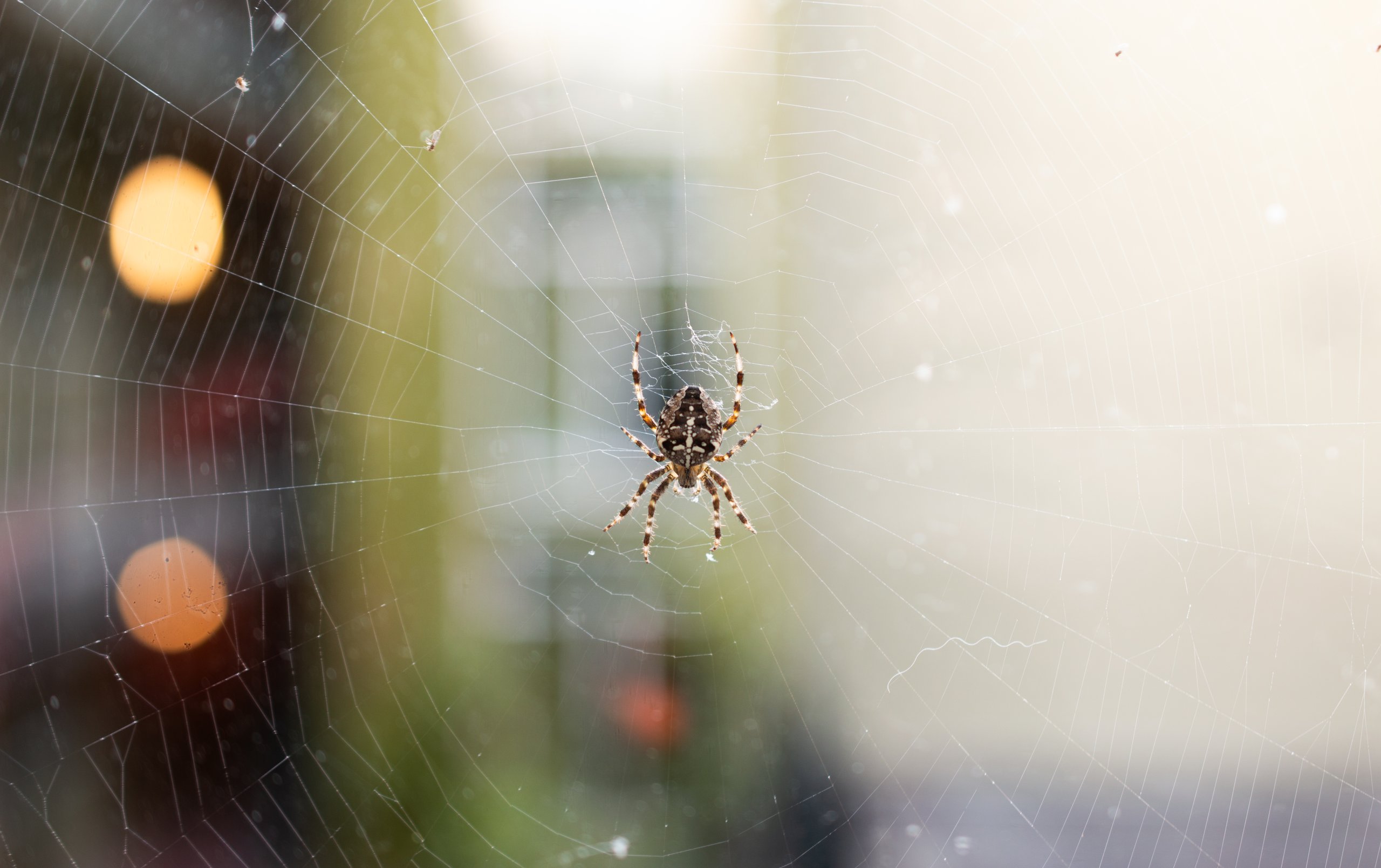
The observation
Walk into a garden at dawn and you will find one stretched taut between two stems, beaded with dew. An orb-weaver’s web, built overnight by a creature with a small nervous system and a remarkable construction repertoire. Look closely at how it is laid out and a comparable geometric problem appears in silk.
ARMISTICE runs one engine: the Cosmopoiesis map, an iterated function that iterates trajectories at a chosen triple (α, μ, ε), with the resulting attractor also depending on the starting point. The orb-weaving spider (ARANEA) is its biological analogue in the Translexicon, the named-entity coordinate catalogue: not an implementation of the map, but a natural structure that can be read along three comparable axes:
- a parameter governing angular partitioning (radii spacing)
- a parameter governing radial growth (spiral spacing)
- a parameter governing dissipation / leak (wind-vs-prey decoupling)
Peters’ 1937 monograph on Aranea diadema supplies a rigorous measurement program for web geometry. His spoke-count analysis includes 152 webs and records variation with the spider’s size. Those measurements support a comparison of angular spacing and construction geometry; they do not locate the spider at an engine parameter value.
Warning: photo of a spider Click or press Enter to reveal Hide photo
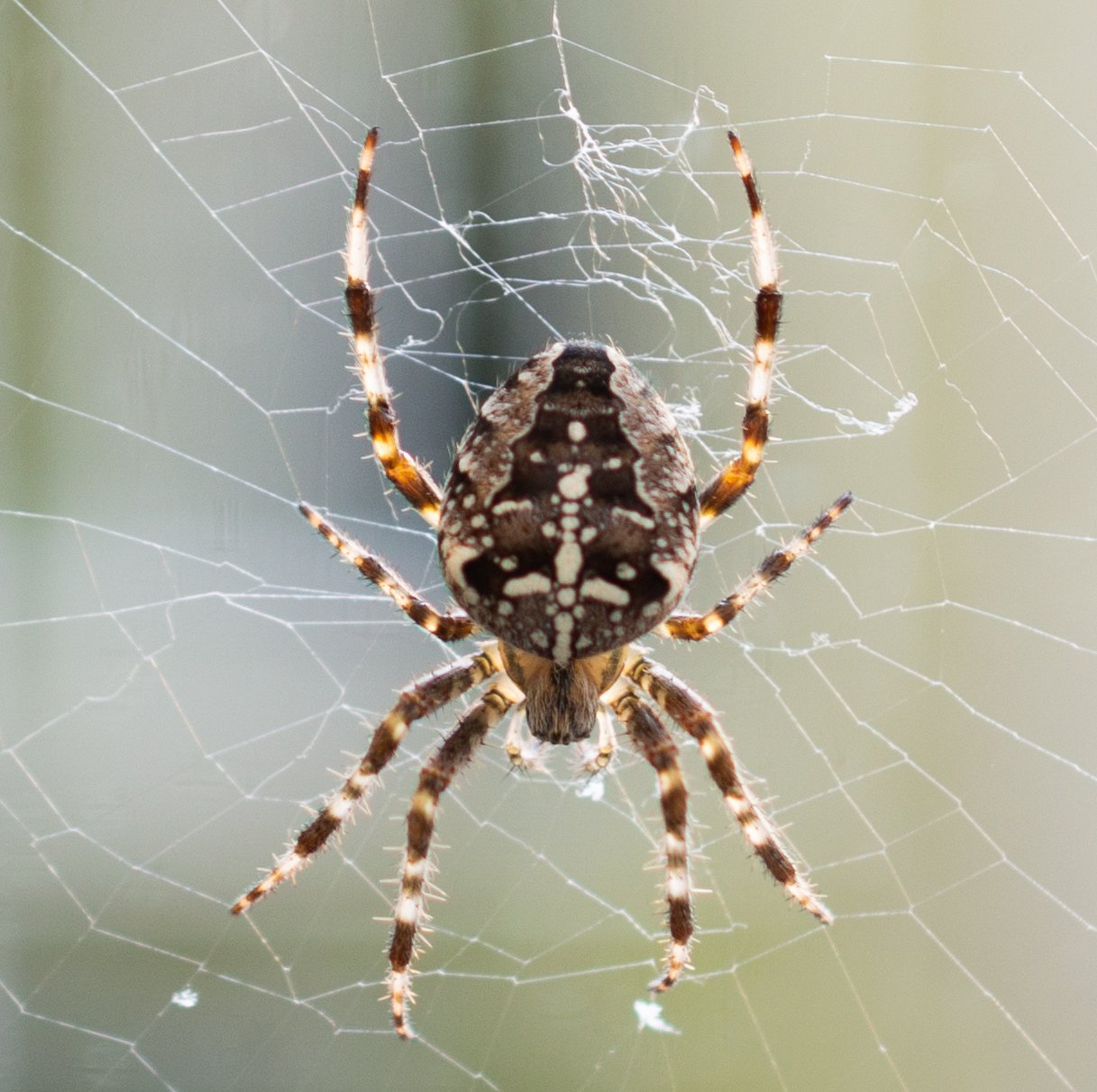
Araneus diadematus at the hub — photographed by Star Seeker. The radii partition the web into sectors. An Archimedean spiral is a useful model for the capture spiral; it is a different curve from the Cornu spiral.
The linear spiral correspondence
Dal Poggetto and colleagues model the capture spiral by
R(θ) = a·θ (Archimedean model — Dal Poggetto et al., 2022)with a = R_max / (n_s · τ). Radius is linear in polar angle, so successive turns have equal radial spacing. This geometric relation does not establish the spider’s angular velocity in time, and the dimensional slope a is not the engine’s parameter α.
The F_FERRITE emblem is the Cornu/Euler spiral, whose curvature, rather than radius, is linear in arc length. In the normalization κ(s)=s, its tangent angle is θ(s)=θ(0)+s²/2. The two spirals therefore illustrate different linear laws. Placing F on the Cornu curve is the house’s chosen geometric comparison; neither construction derives F from a web measurement.
Angular partitioning
Peters’ Table 5 records spoke counts that vary with body size. For illustrative counts near those measurements, the mean sector angles are:
360 / 27 = 13.33°
360 / 29 = 12.41°
360 / 31 = 11.61°
Every count in that list gives a rational fraction of a turn. A spatial division into spokes is not a dynamical rotation number, so these counts do not establish non-resonance or KAM stability. The useful comparison is the simpler one: both web geometry and the engine invite questions about how angular structure is distributed.
Spectral separation as an analogue
The engine uses V = 3·ln(F_FERRITE) ≈ V 0.3037 inside the coupling phase Vxy. V is a phase coefficient, not itself a measured loss rate per iteration. Contraction is diagnosed by the Jacobian and orbit statistics.
The web offers a separate example of mechanical filtering in the frequency domain. Dal Poggetto and colleagues’ simplified finite-element web has:
Wind excitation:    below 10 Hz   (reported disturbance band)
Transverse mode 1:    15.8 Hz      (first structural mode)
Prey mass:          above 20 Hz   (local resonances in the model)
Bending / torsion:  61.9 / 62.0 Hz (detection-relevant modes)
These frequencies belong to the paper’s stated geometry, material properties, and prestress. They support a mechanism for separating wind response from prey localization in that model. They do not measure V or establish a golden-ratio relation. The analogy is the broader question of how structure separates signals, not an equality between a vibration frequency and an engine coefficient.
:: ARKHEIN ::
Lineage
Those who arrived at the same question before. This is not the first arrival.
- 1937
Peters · Architectural memory & web geometry
A measurement program on Aranea diadema, including a spoke-count study of 152 webs and variation with body size.
- 2022
Dal Poggetto
Modern spectral analysis of orb-web vibration modes, documenting the spectral-gap decoupling between prey and wind.
Reading
The web’s modeled Archimedean growth, measured sector counts, and spectral separation offer three questions to bring back to the engine. They do not make the spider an implementation of the kernel. The spider and the engine share geometric questions; their parameters have different meanings.
Walk into a garden at dawn and count the radii. Was the awkward number you find put there by anything that knows it is counting?
:: APPARATUS ::
Sources for this page
-
Hans M. Peters · Studies of the Cross-Spider Web I · 1937
Zeitschrift für Morphologie und Ökologie der Tiere 32, 613–649
The historical measurement study of web structure, auxiliary and capture spirals, and their relationship to the garden orb-weaver’s body plan.
Open the journal record -
Vinícius F. Dal Poggetto, Federico Bosia, Gabriele Greco & Nicola M. Pugno · Prey Impact Localization in Orb Webs · 2022
Advanced Theory and Simulations 5, 2100282
The modal and spectral analysis supporting the scholion’s discussion of vibration bands, localization, and separation between disturbance and prey signals.
Open the open-access paper -
Cosmopoiesis · living edition
The public kernel definition, parameter meanings, iteration protocol, and dynamical vocabulary used throughout the scholia.
Read the live canon -
Translexicon · living registry
The public canonical entity register and the source population for corpus-level censuses.
Read the live registry