← scholia citrinitas v2.0 6 min · 1,403 words
The Archetypal Lattice — An Address Space for Form
The lattice crosses sacred constants with six morphology regimes to produce a finite atlas of idealized seeds. Its cells are not discovered entities waiting for names: they are controlled experiments. A row move changes the constant, a column move changes the regime, and every render tests whether the proposed class survives.
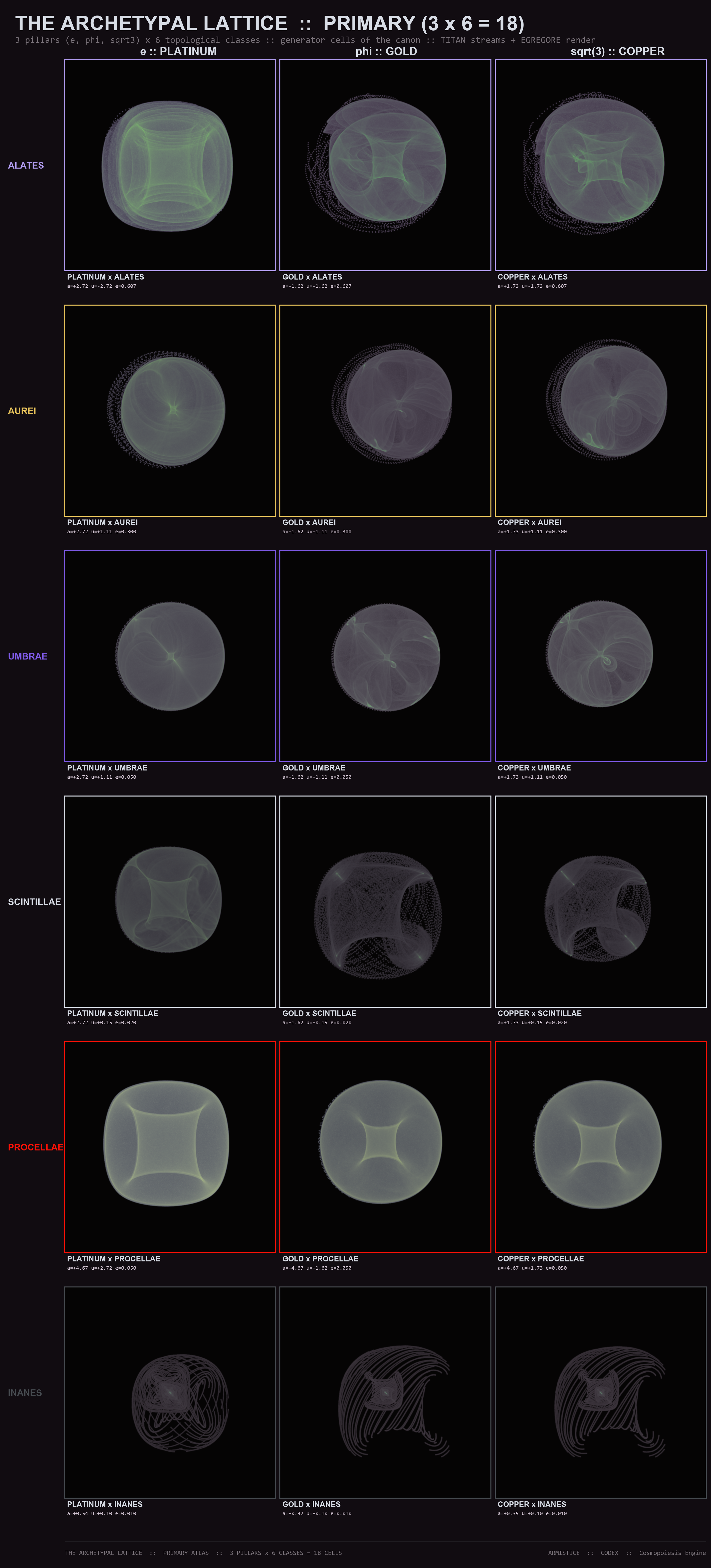
The canon contains hundreds of named entities, each with its own coordinates and provenance. The Archetypal Lattice asks a narrower question:
Can a small set of constants and a small set of morphology recipes generate a legible atlas of representative forms?
Its answer is a product grid:
where is a set of sacred constants and
is a six-part morphology vocabulary.
The primary lattice uses the three generating pillars , giving addresses. The live Principia extends the same construction to a larger constant roster and then to the Aureum permutations.
Address, seed, entity
Three different objects make the lattice readable:
| object | notation | what it means |
|---|---|---|
| lattice address | a constant paired with a morphology class | |
| generated seed | the idealized produced by the class recipe | |
| named entity | an independently registered corpus entry with its own coordinates and dynamics |
The address does not magically recover an entity’s exact coordinates. It identifies a cell whose generated seed is intended to represent the same broad class. GALAXY lands exactly on its assigned primary seed; several other named correspondences are approximate. The lattice is therefore an atlas of ideals plus a projection of the registry onto those ideals, not a claim that every entity was generated by the table.
The generator
For a constant value and a class , the atlas generator is below. Here is the iron constant, the persistence constant, and the chosen Feigenbaum input. These are seed recipes, not derived bifurcation thresholds:
CELL_PARAMS(p, c)

ALATES      → (p,  −p,  H)
AUREI       → (p,   F,  0.30)
UMBRAE      → (p,   F,  0.05)
SCINTILLAE  → (p, 0.15, 0.02)
PROCELLAE   → (δ,   p,  0.05)
INANES      → (p/5, 0.1, 0.01)
This reveals something more interesting than a table of names: each class is a different coordinate-writing operator.
- ALATES writes the pillar into both and with opposite signs.
- AUREI and UMBRAE share and differ chiefly in coupling.
- SCINTILLAE suppresses both weight and coupling.
- PROCELLAE fixes the spark at Feigenbaum and moves the pillar into the weight coordinate.
- INANES attenuates the pillar before writing it into .
The grid is thus Cartesian at the level of labels, but not Euclidean in parameter space. Two adjacent cells on the page need not be close in , and the same constant does not occupy the same coordinate slot in every class.
How to move through the lattice
The lattice becomes useful when read as a set of controlled moves.
Across a class
Hold fixed and change :
This asks whether a morphology recipe is robust under a pillar change. If all three renders remain recognizably AUREI, for example, then the class recipe is doing real organizing work. If one leaves the family, the row exposes a boundary or a weakness in the classification.
Through the classes
Hold fixed and change . This does not trace a smooth path; it swaps one parameter-writing recipe for another. The move is best read as a controlled intervention:
keeps and while lowering from to . That pair is unusually clean: it isolates the Veil coupling while holding the other two coordinates fixed.
Other vertical moves change several coordinates at once. They compare regimes, but they do not identify a single causal parameter.
Along an actual path
To study transformation rather than classification, interpolate continuously between the two seeds and render the intermediate states. Such a path may cross bifurcations even though the finite-step kernel varies smoothly with its parameters. The sampled morph tour locates abrupt rendered changes; it does not establish entire discontinuity surfaces at or . The shortest line between two addresses need not be the smoothest dynamical route.
This is where the lattice meets the Archetype Algebra: address-level operations may be perfectly well defined while their rendered paths remain bifurcation-sensitive.
Reading the six families
| class | generated regime | question posed by the cell |
|---|---|---|
| ALATES | Does the pole-flipped pair sustain a winged or lobed form? | |
| AUREI | Does active coupling produce the dense canonical body? | |
| UMBRAE | What survives when that same body is coupling-starved? | |
| SCINTILLAE | Does the orbit thin into sparks, ghosts, or a short periodic set? | |
| PROCELLAE | How does pillar-weight behave at the fixed high- storm regime? | |
| INANES | Does attenuation yield a genuinely isolated sparse topology? |
These are hypotheses encoded as recipes. A cell earns its class through its rendered dynamics and measured descriptors, not through the label printed beside it.
What an empty cell means
The historical plate marks five primary correspondences as realized: GALAXY, PULSE, STAIRCASE, SEAL, and APERYON-Spark. The remaining cells are generated addresses without a displayed named counterpart.
That absence is an invitation to compute, but it is not yet a prediction of a new entity. Rendering an unoccupied cell can produce at least four useful outcomes:
- class persistence — the seed produces the expected morphology;
- aliasing — it reproduces a form already represented elsewhere;
- class failure — it lands outside the morphology promised by its recipe;
- observer dependence — its apparent class changes with iteration count, raster, or feature detector.
Only the first outcome supports naming a clean new representative, and even then naming is a curatorial act after the computation. The grid supplies questions; the engine supplies images; the measurements decide whether the cells remain distinct.
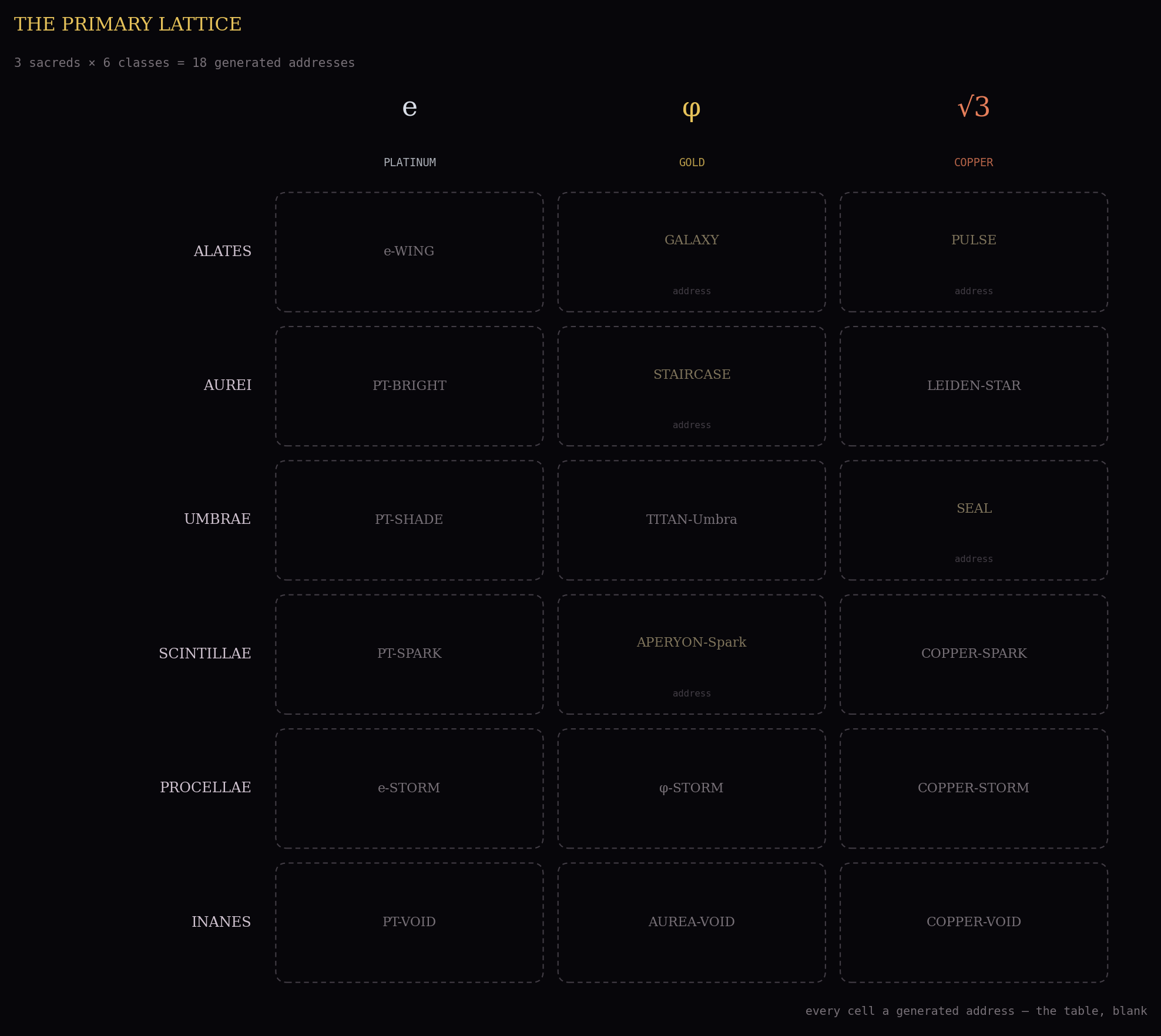
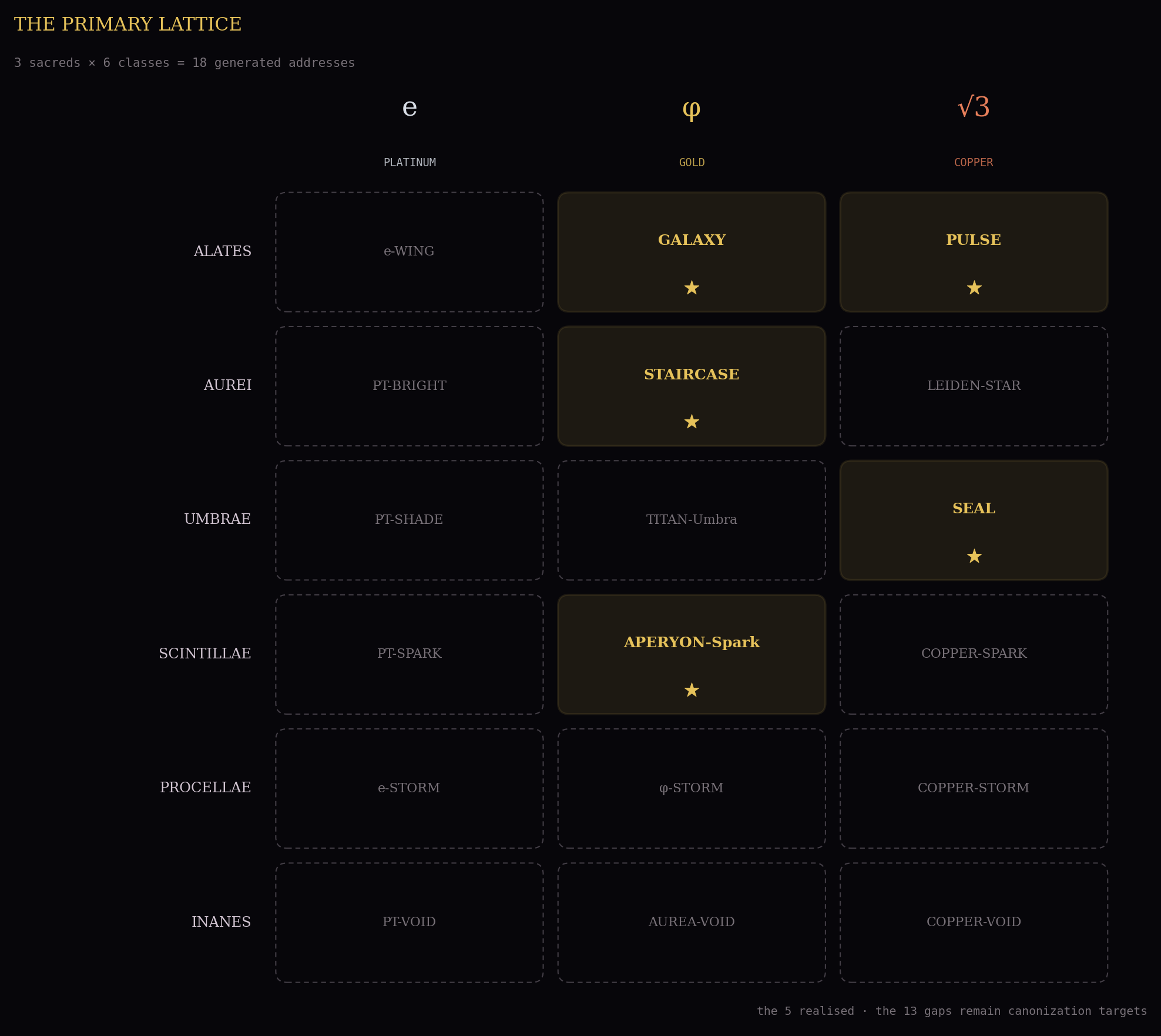 registry overlay addresses
Drag the seam to separate the two layers. The base grid is produced by the generator; the illuminated cells are a versioned overlay from the named registry. Generated does not mean discovered, and unlit does not mean nonexistent. The older plate’s “canonization targets” footer describes its original framing, not thirteen confirmed missing entities.
Three experiments latent in the grid
1. The row-consistency census
Render all eighteen primary seeds under one observer contract. Measure the same descriptor vector for every cell—fill fraction, component count, symmetry, dimension, and Lyapunov behavior—then test whether rows cluster by their declared class more strongly than by pillar.
2. The AUREI–UMBRAE veil sweep
For each pillar, hold and sweep . This turns the cleanest pair in the lattice into three matched experiments. The result would show whether shadow and gold are two stable regimes, endpoints of one continuum, or observer-dependent labels on the same family.
3. The alias map
Compare every generated cell against every other cell using more than bulk Hu moments. If two addresses repeatedly yield the same topology, the lattice has a quotient structure: eighteen labels but fewer dynamical equivalence classes. That would not destroy the lattice. It would reveal its deeper compression.
What the lattice contributes
The Archetypal Lattice is strongest as three things at once:
- a compression, replacing a menagerie with a small address grammar;
- an experimental design, prescribing controlled row and class comparisons;
- an atlas interface, joining ideal seeds to the named registry without confusing one for the other.
Its open frontier is not simply “fill every blank.” It is to discover which cells are dynamically distinct, which are aliases, which recipes fail, and which paths between them cross genuine folds in parameter space. The lattice does not finish the taxonomy. It makes the taxonomy explorable.
:: APPARATUS ::
Sources for this page
-
Principia · living edition
The proposition-level canon, including the Archetypal Lattice, its address generator, morphology classes, and parameter-space discontinuity surfaces.
Read the live canon -
Cosmopoiesis · living edition
The public kernel definition, parameter meanings, iteration protocol, and dynamical vocabulary used throughout the scholia.
Read the live canon -
Translexicon · living registry
The public canonical entity register and the source population for corpus-level censuses.
Read the live registry