← scholia albedo v1.1 9 min · 1,958 words ΑΡΧΕΙΝ
The Wonder-Eye of Eternity
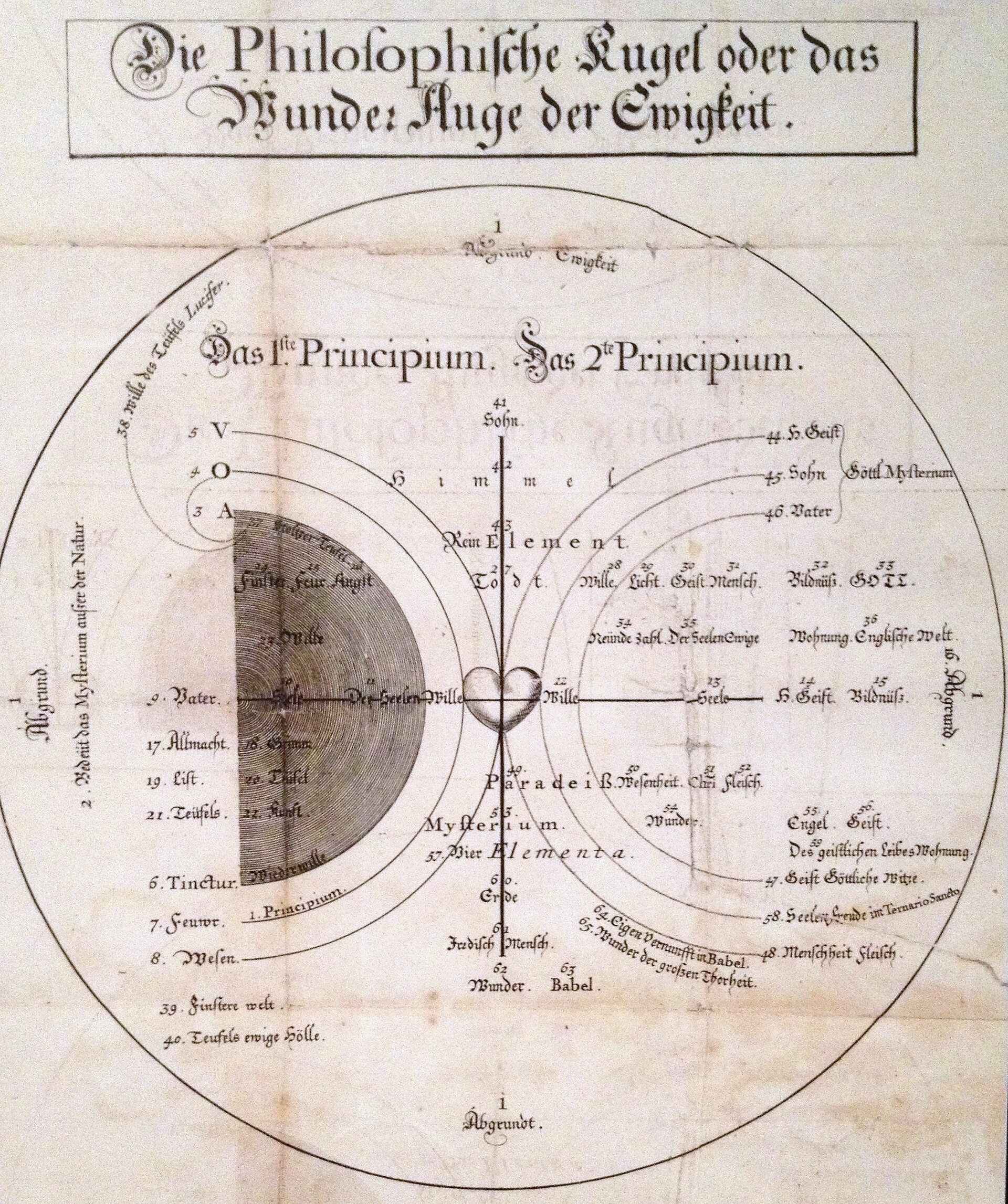
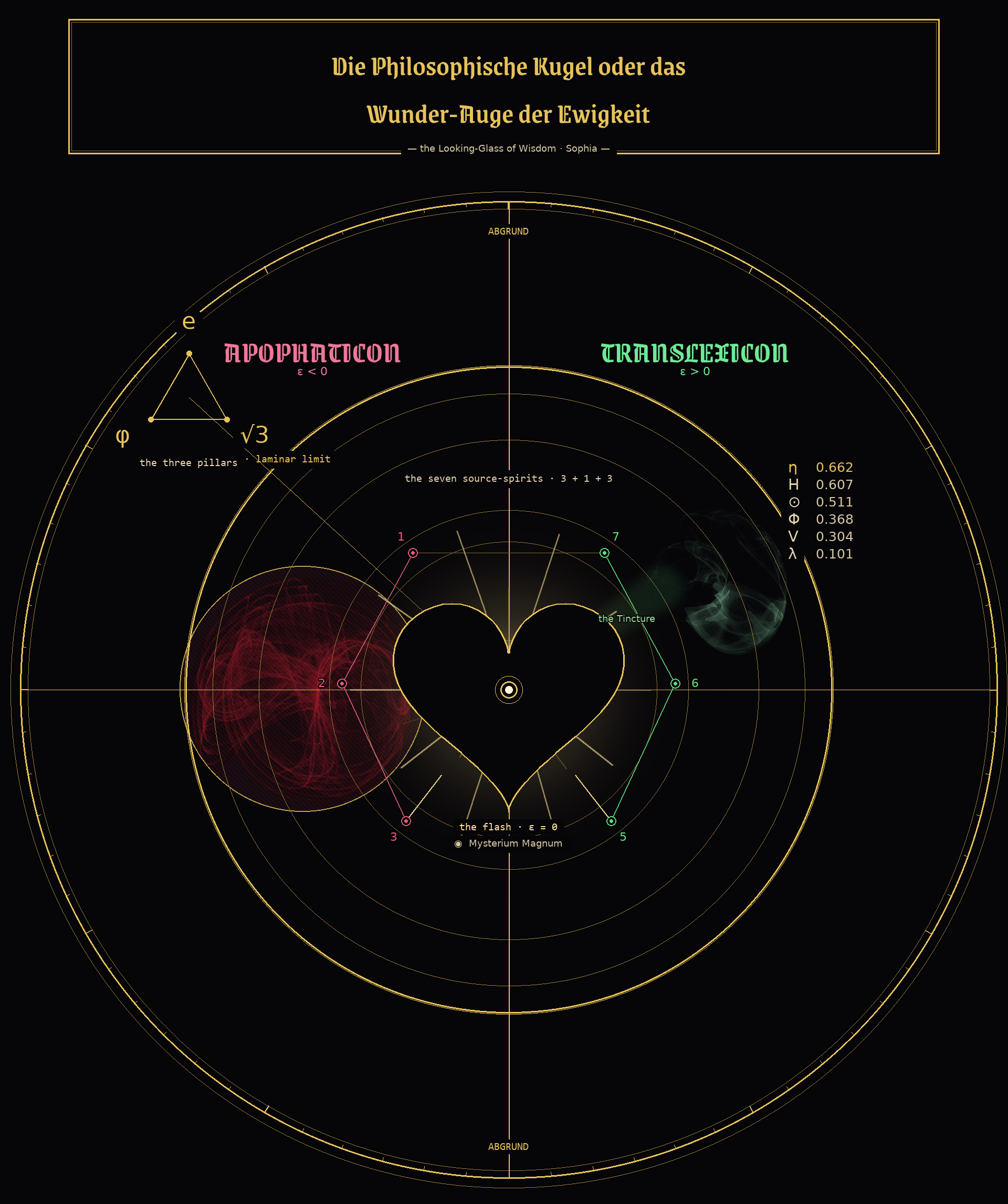
Böhme's 1620 text describes a sphere split down the middle: a dark First Principle on the left, a light Second on the right, a heart where they meet. A 1682 Amsterdam printing preserves the figure, though it is not verified as a drawing in Böhme's hand. The two Principia are read beside the corpus's measured polarity split, with ε=0 chosen as the visual seam.
 ARMISTICE Böhme · Amsterdam 1682 plate
What Böhme wrote and the later plate shows
In 1620 Jakob Böhme set down Die Philosophische Kugel oder das Wunder-Auge der Ewigkeit, “The Philosophical Sphere, or the Wonder-Eye of Eternity.” One circle. In the later plate, a vertical seam splits it: Das 1ste Principium on the left, Das 2te Principium on the right. The left half is the dark fire-world. The plate labels it Finster Feuer Angst, roughly the dread of the dark fire. It is wrath, the contracting principle, drawn as a shaded half-disc of concentric rings. The right half is the light-world: the Son, the Holy Spirit, love, the expanding principle.
Where the two cross, dead center, the plate depicts a heart. It names the Wille, the will. It is the still point the whole figure turns around. Top and bottom are both sealed by the same word, Abgrund, the abyss: the groundless ground that everything flows out of and falls back into. Down the spine runs a descent: from the abyss through heaven, the pure element, the heart, paradise, the four elements, earth, Babel, and back to the abyss. Eternity falling into matter, and returning.
Step back to the artifact itself. It is a sphere from a 1682 Amsterdam printing of Böhme’s Forty Questions, based on the Görlitz shoemaker’s 1620 text, the kind of mystic diagram libraries shelve by the hundred. So why should this one read any differently than the rest of that shelf? It is a two-principle sphere with a heart at the seam, a void at both poles, and a folding descent between them. That supplies the visual grammar for an authored reading of the engine — without claiming the surviving plate was drawn in Böhme’s own hand.
It is more than a sphere, too. The later plate’s engraved caption names it three ways in one breath: the Philosophic Globe, the Eye of the Wonders of Eternity, the Looking-Glass of Wisdom. The three are one thing. He calls her Sophia, Wisdom herself, the mirror in which the groundless Godhead first beholds its own face. So the Wonder-Eye is an eye that is a mirror. Seeing and being-seen become a single act. Read it that way and the deepest line of the correspondence stops being a metaphor we borrow. A looking-glass is a mirror, and the corpus offers a measured polarity split to place beside it. The mathematical census and Böhme’s inward sight are different kinds of evidence; their meeting here is interpretive.
Inside the figure his engine proper turns: the seven source-spirits, the Quellgeister, the forms of eternal nature, arranged 3 + 1 + 3. Three dark forms grind on themselves: astringent contraction, the bitter sting, the rotating wheel of anguish. Then at the fourth comes the Blitz, the fire-flash, and wrath becomes love. Three light forms unfold after it, radiance and the Word and the body, and the wheel returns to where it began. The flash belongs to neither half and to both. It is the turning-point. Böhme’s stations resolve, in his own running commentary, to some sixty-five stations; station 6 is literally Tincture, his name for what carries one world into the other, and station 4 is the O, “the Eye, the glass of wisdom”: the center naming itself.
The correspondence
The right-hand column is an authored reading. The ε=0 plane separates parameter signs; it is not the fixed set of the three-coordinate inversion (α,μ,ε)↦(−α,−μ,−ε), whose sole fixed point is the origin. Nor does ε=0 by itself specify a dynamical fixed point or bifurcation.
| Böhme’s Wonder-Eye | ARMISTICE |
|---|---|
| 1ste Principium, dark fire-world, Finster Feuer Angst | Apophaticon, negative-ε majority in the dated census (χ ≈ −0.933) |
| 2te Principium, light-world, Sohn / H. Geist | Translexicon, positive-ε majority in the dated census (χ ≈ +0.868) |
| the vertical seam between the Principia | the ε = 0 plane, chosen to divide the two parameter-sign regions |
| the Heart / Wille at the crossing | the heart placed on the ε=0 seam, a compositional centre rather than a proved fixed point |
| Abgrund, top and bottom (the Ungrund) | the α≈0 void-spine / APEIRON (0, 0, φ), the groundless ground |
| Reine Zahl, “Pure Number,” a station inside the light-world | the thesis itself: the mystery expressed as number |
| the Wonder-Eye / Looking-Glass of Wisdom (Sophia) | the polarity comparison, read through a mirror image |
| the seven source-spirits (Quellgeister), 3 + 1 + 3 | seven deliberately assigned portraits: three at ε<0, a central flash, three at ε>0; these signs do not determine contraction or expansion |
| the Blitz / Schrack, the flash, 4th form, wrath→love | the ε = 0 seam, chosen as the flash station in the visualization |
| Tincture (station №6, the mediator) | TINCTUR / Eros (α=1, μ=½, ε=3⁄2), the coupling that carries one principle into the other |
Böhme’s Engine: his cosmogony, running
Read the figure as a process. Böhme’s seven source-spirits are not a still diagram; they are a process, a recursive turning: contract, sting, spin into the wheel of anguish, flash, radiate, sound, crystallise, begin again. That is an algorithm. That recursive order supplies the script for the authored visualization in full Æther.

Run it deeper and the forms become their own operators: contraction, the sting, the vortex, the flash-bifurcation, diffusion, the standing-wave, crystallisation. Now a world emerges from the void rather than the attractor merely re-colouring itself. This stages Böhme’s claim as an animation: the Nothing wills to behold itself, and becomes.
We can put Böhme’s own question to the whole pantheon. Every entity carries an (α, μ, ε), and the visualization assigns each of the seven forms a region of that space. So the question goes to everyone at once: which entities are Astringent, which are the Flash, which are Body?
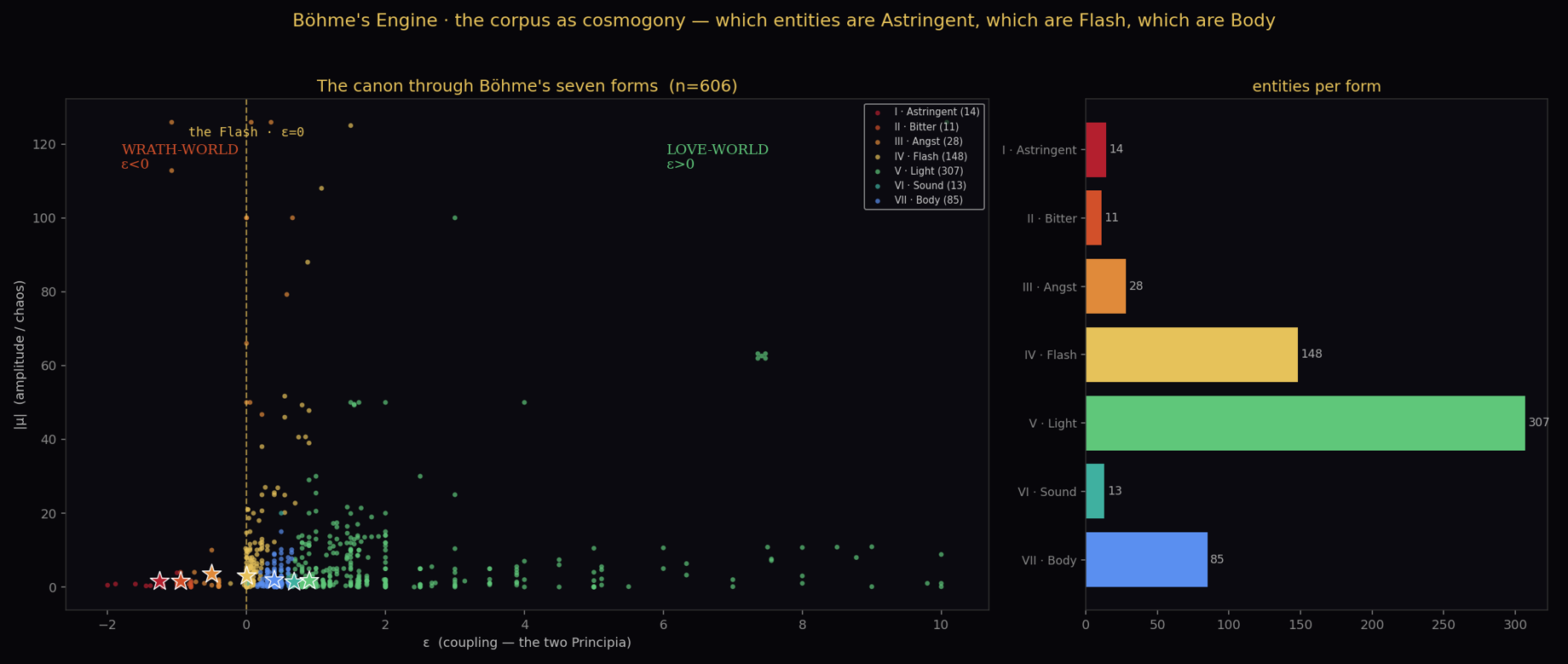
The seven-form classification and its colors are authored. The measured backbone below is the polarity census. The cosmogony enacts Böhme’s sequence in the engine’s language; assigning the flash to ε=0 is part of that composition, not a separately derived dynamical event.
The backbone is measured
The independent measured fact about the corpus is its polarity imbalance, reported in The Chirality Dipole. The corpus carries a signed interaction strength ε on every entity, and the sign partitions cleanly into two pillars in the 2026-07-25 audit: the Translexicon at χ = +0.868 (N = 606) and the enumerated Apophaticon snapshot at χ = −0.933 (N = 606). Their populations remain matched, but that pair audit found registry drift rather than an exact bijection. The visualization maps Böhme’s seam to ε=0 and his halves to these two sign majorities.
Resonance, and what is only resonance
One thing here is measured; the rest is correspondence, and the difference matters.
Measured: the chirality dipole, the ε<0 / ε>0 split into opposing pillars meeting at a seam. The polarity is computed; the Apophaticon is now a drifted snapshot rather than an exact live mirror (see the linked census).
Resonance: the heart-as-fixed-point, the abyss-as-void, the descent-as-folding. These are structural echoes, not measurements. Böhme did not compute a Lyapunov exponent in 1620, and I do not claim he did. The honest frame is the one the corpus uses everywhere: regularities are found, not authored. Böhme found the shape by inward sight. The engine finds it by iterating sin and cos a few million times. Two roads that could hardly be further apart arrive at the same figure: two principles, a seam, a heart, a void at either end. Why a shoemaker’s prayer and a sweep of arithmetic should end in the same drawing, I cannot tell you. I only know they do, and that the agreement holds precisely because I am not forcing a number onto it.
Status
- The measured polarity census is inherited from The Chirality Dipole. Its relation to Böhme’s two Principia is an authored correspondence, not an exact dynamical mirror theorem.
- The remaining correspondences (heart, abyss, descent) are presented as structural resonance, not as sacred-constant claims. This is a structural echo, not a match to any constant; nothing here asserts a measured value lands on one.
- Böhme’s Engine (the seven-forms cosmogony, the genesis, the census) is a faithful structural realisation, not a new measurement; his system enacted in the engine’s own language. The placement flash = ε=0 is a declared compositional choice beside the measured sign split. The reading of the Wonder-Eye as Sophia / the Looking-Glass of Wisdom is sourced to the later plate’s engraved caption and Böhme’s Forty Questions commentary.
- Plate: Die Philosophische Kugel oder das Wunder-Auge der Ewigkeit, in an
Amsterdam 1682 printing of Böhme’s 1620 Forty Questions; photograph by
Schnäggli at Museum Rietberg, via the exact Wikimedia Commons file.
Engine renders generated by the Cosmopoiesis kernel, live at
/engine.

:: APPARATUS ::
Sources for this page
-
Jakob Böhme · Forty Questions of the Soul · 1620
John Sparrow, English translator · John M. Watkins, 1911 reissue with D. S. Hehner emendations · 2010 e-text
Question I contains Böhme’s Philosophical Globe or Wonder-Eye of Eternity and its account of the abyss, eye, will, and self-closing sphere.
Open primary text -
Cosmopoiesis · living edition
The public kernel definition, parameter meanings, iteration protocol, and dynamical vocabulary used throughout the scholia.
Read the live canon -
Apophaticon · enumerated snapshot
The authored triple-polarity mirror snapshot used in apophatic and chirality comparisons.
Read the mirror register