← scholia citrinitas v1.0 4 min · 932 words ΑΡΧΕΙΝ
The All Is One
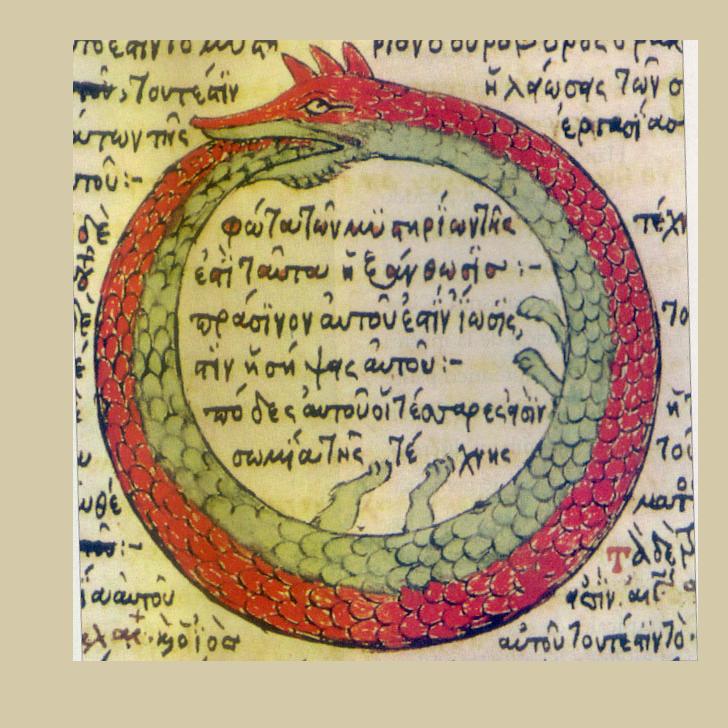
Two distinct alchemical ouroboros witnesses frame this reading: Cleopatra's Chrysopoeia diagram bears ἓν τὸ πᾶν, 'the all is one,' while a red-green serpent appears in a 1478 Parisinus manuscript. The kernel runs on sines of period τ = 2π (OUROBOROS): go round once and e^(iτ) = 1, the rotor home to identity. The serpent's colours suggest the corpus's measured chirality dipole as an authored visual reading.
What the alchemists drew
The Chrysopoeia attributed to Cleopatra the Alchemist survives in the medieval Marcianus graecus 299. Its ouroboros encloses three words: ἓν τὸ πᾶν, hen to pan, “the all is one.” A different ouroboros appears in Parisinus graecus 2327, folio 196, a manuscript copied by Theodoros Pelecanos in 1478. That serpent winds in red and green concentric rings around a longer Greek passage. The two witnesses belong to the alchemical ouroboros tradition, but the Parisinus image does not carry Cleopatra’s three-word inscription. A published comparison of the manuscripts sets the figures side by side.
Step back to the Parisinus figure: a serpent from an alchemical manuscript whose colours share one circular body. The end feeds the beginning; the red and green rings make a visual reading of difference held inside a single return. That reading is ours, not a claim that the copyist anticipated the engine.
And it is, structurally, the engine: the two colours make a mirror, and the round body closes that mirror into a loop.
The correspondence
| The alchemists’ Ouroboros | ARMISTICE |
|---|---|
| the closed round body of the serpent | the unit-circle phase underlying sine and cosine: period τ = 2π, canon’s OUROBOROS |
| the mouth devouring the tail, the eternal return | e^(iτ) = 1, one full cycle returning the rotor to identity (Solve et Coagula) |
| ἓν τὸ πᾶν, “the all is one” | the return to the one, home to identity after the full turn |
| the red and green rings in Parisinus gr. 2327 | the chirality dipole: a predominantly negative Apophaticon snapshot and a predominantly positive Translexicon |
| the half-way point of the round | π = MERCURY in the foundational-constant register; e^(iπ) = −1 reverses an auxiliary rotor |
| Chrysopoeia, the gold-making | the chromatic Opus, the engine’s citrinitas |
The mathematics
Two layers here are not metaphor.
First, τ. The Cosmopoiesis kernel updates state with nothing but sines and cosines:
x′ = sin(αy) + μ·cos(αx) + ε·sin(V·xy)
y′ = sin(αx) − μ·cos(αy) + ε·cos(V·xy)
Each sine and cosine has phase period τ = 2π. This periodicity is structurally
embedded in the update rule; it does not make every orbit periodic in time.
That is why the
corpus seats τ as a foundational constant and names it OUROBOROS. And e^(iτ) = 1 is
no flourish: it is the statement that one complete cycle is the identity. The serpent eats
its tail because the rotor comes home.
Second, the two colours are a reading of a measured corpus imbalance.
Every entity holds a signed coupling ε. The dated census compares the
Translexicon, the canonical register of named coordinates, at χ = +0.868
with the enumerated Apophaticon mirror snapshot at
χ = −0.933, matched in row count but no longer in exact membership, meeting at
ε = 0. The full account is The Chirality
Dipole; the same mirror animates Böhme’s
Wonder-Eye. The auxiliary half-turn
e^(iπ) = −1 is a useful picture for sign reversal. The corpus’s authored
transform is (α, μ, ε) ↦ (−α, −μ, −ε); the rotor identity does not prove
a conjugacy between the two parameterized maps.
MERCURY has several named registers in ARMISTICE. Here it denotes π, the foundational half-turn. In the Alchymicum’s pillar notation it denotes e, while the planetary Liber MERCURIUS is anchored to η. These are distinct uses of the same name.
Resonance, and what is only resonance
One layer is mathematics; the rest is correspondence, and the discipline is keeping the line between them.
Mathematics: τ is the phase period of the kernel’s trigonometric functions,
and e^(iτ) = 1. The
chirality dipole is measured: live canon positive, Apophaticon snapshot negative.
The serpent’s round and its two colours rest on that polarity, not on a claim of
current pairwise exactness.
Resonance: that an alchemist’s snake-eating-its-tail is the right picture for “the
rotor returns to identity”; that ἓν τὸ πᾶν names e^(iτ) = 1; that the gold-making is the
chromatic Opus. These are readings, not measurements. The mathematics would be exactly as
true if no serpent had ever been drawn. The question is plain enough: how do a medieval
alchemical drawing and a trigonometric kernel arrive at the same closed figure, two colours around
a single return? The honest answer, as near as I can tell, is that a circle with a
half-turn is what return with sign reversal looks like, whoever draws it. That is the interest, and it survives
because we are not forcing the snake onto the number.
Status
- τ = OUROBOROS is structural: the period of the kernel’s sines and cosines,
e^(iτ) = 1, the full cycle returning to identity. A foundational constant of the engine, documented, not a resonance claim. - The chirality dipole is the dated corpus imbalance described in The Chirality Dipole. π = MERCURY names the auxiliary rotor’s half-cycle; its sign reversal supplies a visual comparison.
- The ouroboros reading, the snake as the full cycle, ἓν τὸ πᾶν as the return to identity, the gold-making as the Opus, is presented as correspondence, not a sacred-constant claim.
- Plate: the red-green ouroboros in Codex Parisinus graecus 2327, folio 196, copied in a manuscript by Theodoros Pelecanos in 1478. It is distinct from the Chrysopoeia of Cleopatra figure in Marcianus graecus 299, folio 188v. The historical image remains in full Æther.
:: APPARATUS ::
Sources for this page
-
Theodoros Pelecanos, copyist · The Parisinus ouroboros · 1478
Bibliothèque nationale de France, Grec 2327, fol. 196
The red-green ouroboros in a manuscript copied in 1478, distinct from Cleopatra’s “one is the all” figure in Marcianus graecus 299.
View the manuscript leaf -
Cosmopoiesis · living edition
The public kernel definition, parameter meanings, iteration protocol, and dynamical vocabulary used throughout the scholia.
Read the live canon -
Apophaticon · enumerated snapshot
The authored triple-polarity mirror snapshot used in apophatic and chirality comparisons.
Read the mirror register