← scholia viriditas v1.0 5 min · 1,081 words
Kindred at a Distance
Across the Æther corpus, entities from different domains sometimes occupy nearby coordinates and emerge wearing related forms. A comparison of 734,202 cross-domain pairs detects a shallow coordinate–form association; a 392-entity real-domain subset finds nearest neighbours 24.5% tighter in form than random neighbours. A regime-conditioned refinement points to shared dynamics. They are strangers living under the same weather.
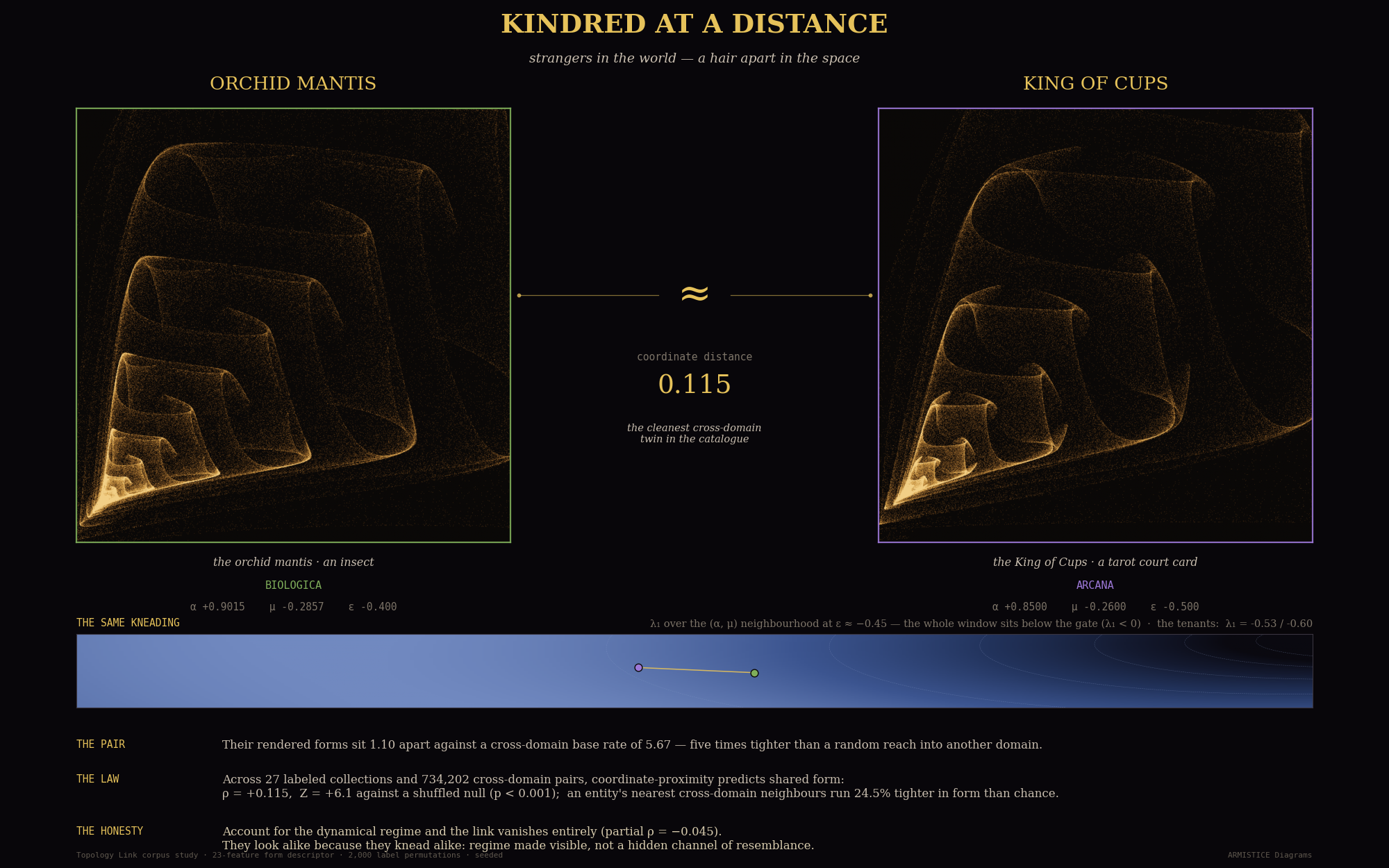
Two things can be unrelated in the world and still become neighbours inside the engine. An insect and a tarot court have no common ancestry, material, or history. Give each a coordinate, however, and Cosmopoiesis—the shared iterative map that draws their orbits—asks neither what the entity means nor where its name came from. It applies the same map.
That makes the real question sharper than do these two pictures resemble one another? Near coordinates ought to feel related: they submit the map to similar conditions. The question worth measuring is whether that local continuity survives across independently assembled domains, across the whole uneven corpus, strongly enough to be found above its base rate.
It does.
The pair that opened the door
The orchid mantis belongs to BIOLOGICA, the biological collection. The King of Cups belongs to ARCANA, the tarot collection. In the three engine parameters—frequency α, fold shape μ, and coupling ε—their coordinates sit only 0.115 apart in Euclidean distance, and both produce the same cloth-like rendered form: diagonal reflection, nested drapery, the bright fold gathering at one corner. Their largest Lyapunov exponents are likewise close, −0.527 and −0.600. In the 23-feature form descriptor used for the study, the pair lies 1.10 apart against a cross-domain median of 5.67.
They are an excellent illustration. They are not the proof.
What was measured
Each corpus render was reduced to a common geometric description: spread, extent, occupancy, convexity, rotational and reflective symmetry, eccentricity, components, holes, skeleton structure, and persistent-homology summaries. Coordinate distance and form distance were then compared across every pair drawn from different labeled collections.
| Receipt | Result |
|---|---|
| Corpus slice | N = 1,364 across 27 labeled collections |
| Cross-domain comparison | 734,202 pairs |
| Coordinate distance → form distance | Spearman ρ = +0.115 |
| Shuffled-label null | Z = +6.1, permutation p < 0.001 |
| Nearest-neighbour test | Within the 392-entity real-domain subset, the five nearest cross-domain neighbours are 24.5% tighter in form than random cross-domain neighbours. |
| Real-domain subset | N = 392, tested without the four curated macro tiers. |
The global relation is shallow because the corpus contains many different local morphologies, dense coordinate shelves, and repeated addresses. Yet the nearest-neighbour result is strong enough to use: if an entity has a close cross-domain neighbour, that neighbour is substantially more likely to share its form than a random stranger from another domain.
The effect is not uniform. Dyads, cradles, cloths, event horizons, primitive glyphs, and cosmo-glyphs transfer cleanly across domains. Generic sheets and some high-chaos fields do not. Kindredness belongs to localized forms, not to every visual coincidence the atlas can produce.
The hidden common cause
The coordinates are not a semantic telegraph between mantis and king. They are a dynamical address.
In the 392-entity real-domain refinement, the pairwise test controls for distance in largest Lyapunov exponent. On that comparison, the coordinate–form relation falls from ρ = +0.111 to partial ρ = −0.045. The residual is small and reverses direction. This supports shared regime as the main explanation for the association: contraction with contraction, fold with fold, chaos with chaos.
A later study examined the same joined data through dimension estimators. In its June 2026 snapshot (N = 1,353), three nonlinear estimates for the coordinate cloud averaged 1.83, ranging from 0.90 to 2.80. The joint block—three coordinates, 23 form features, and two Lyapunov values—averaged 3.91, with a wider 2.07 to 6.10 range. Those estimates suggest compact structure, with substantial method dependence; they do not establish one exact manifold dimension.
The second principal component of that joint block correlated with the largest Lyapunov exponent at r = 0.82. Since the Lyapunov values were included in the block, that correlation describes the fitted component; it is not an independent prediction of the regime. In a separate held-domain reconstruction test, ten of thirteen sufficiently populated real domains had error ratios below the study’s 1.5 comparison threshold.
The fitted polynomial coordinate-to-form models did not transfer well from one domain to the next: held-out prediction was worse than baseline. This tests those fitted models, not the existence of every possible function. The domains share a country, not one compulsory route through it. They encounter the same stable valleys, folding seams, and chaotic weather while retaining their local placement grammars.
That is the stronger finding. The corpus is not secretly saying that a mantis means the King of Cups. It is demonstrating that heterogeneous collections remain legible inside one dynamical geography.
Placement first, manifestation second
There are two operations here, and confusing them makes the result sound more mystical than it is.
- Placement assigns an entity its coordinates. Different collections use different provenance: physical anchors, sacred composition, mathematical extraction, void-cartography, or other declared methods.
- Manifestation sends that coordinate through the shared Cosmopoiesis kernel and renders the resulting orbit.
This study begins after placement. It does not show that unrelated worldly things independently discover the same address. It shows that once the corpus has placed them, the engine treats nearby addresses coherently across domain boundaries.
That coherence is the achievement. A coordinate in Æther is not merely three numbers in a registry. It is a compact description of dynamical weather, and the render makes that weather visible.
What “kindred” means
Call two entities kindred when three conditions meet:
- they come from different source domains;
- their coordinates and dynamical regimes are close;
- their shared morphology is localized rather than generic to a crowded region.
The name is relational, not metaphysical. It identifies a reproducible cross-domain echo in the engine’s own language of form.
The orchid mantis and the King of Cups are therefore neither coincidence nor occult correspondence. They are two tenants of the same calm fold. Strangers in the world, neighbours in the weather.
Receipts and neighbouring results
The numerical receipts above come from the corpus-wide Topology Link descriptor study and its regime-conditioned refinement. The dimension estimates come from the subsequent study of the same joined coordinate, form, and Lyapunov data.
For the engine-side explanation, continue to
The Morphological Phase Law,The Folding Threshold, and the exact fold-cell relation in Cosmopoiesis.
:: APPARATUS ::
Sources for this page
-
Cosmopoiesis · living edition
The public kernel definition, parameter meanings, iteration protocol, and dynamical vocabulary used throughout the scholia.
Read the live canon -
Mathematica · living edition
The canonical constants, algebraic identities, and computed closures used by the engine and its derived findings.
Read the live canon