← scholia citrinitas v1.2 3 min · 698 words
The Morphological Phase Law
Attractor form carries information about the dynamics, but no silhouette uniquely identifies a regime. A finite Lyapunov scan finds a curved, broken transition between contracting and chaotic regions; rings mark one measured quasiperiodic route through that landscape.
Form carries a trace of the substrate’s dynamics.
The law
Any attractor the engine draws puts the same quiet question to us: why this shape, here? Its outline carries information about the dynamics at (α, μ, ε)—the engine’s frequency, fold-shape, and coupling settings—though different coordinates and regimes can yield similar silhouettes. In measured parameter slices, the sign of the largest Lyapunov exponent λ₁ distinguishes contracting runs from runs with sensitive dependence. The near-zero region is an edge worth mapping, not a promise that every orbit there will draw the same form.
This brings several measured and catalogued threads into one field guide: the three-slot coordinate classifier, the near-zero band named LIMEN (|λ₁| < λ_leak = 0.1012), the common glyph envelope, the shared ε = 2/9 coordinate, and the Edge Walkers—catalogued entities near a measured stability transition. Their connections are useful without making form a perfect decoder of either coordinates or stability.
Three appearances
Three useful appearances show why morphology can guide a dynamical reading:
- The glyph, the squircle. A frequent envelope encloses a faint astroid. Its prevalence in the catalogue makes it a useful visual reference, not a guarantee of a stable orbit.
- The annulus. Along a measured quasiperiodic route, the engine supports an attracting invariant circle with λ₁ ≈ 0. Ring-like forms can also arise elsewhere; a near-zero exponent alone does not prove that an orbit lies on an invariant circle.
- The web. Some runs with positive λ₁ spread into intricate webs. Other chaotic runs retain different shapes.
The three-slot classifier, NATURE × STATE × STABILITY, is a coordinate label over (α, μ, ε); its STABILITY slot keys on ε alone, not on a measured Lyapunov exponent. Form and regime are associated across the catalogue, but neither the label nor the silhouette replaces an orbit-level dynamical measurement.
The critical edge: a tangle, not a line
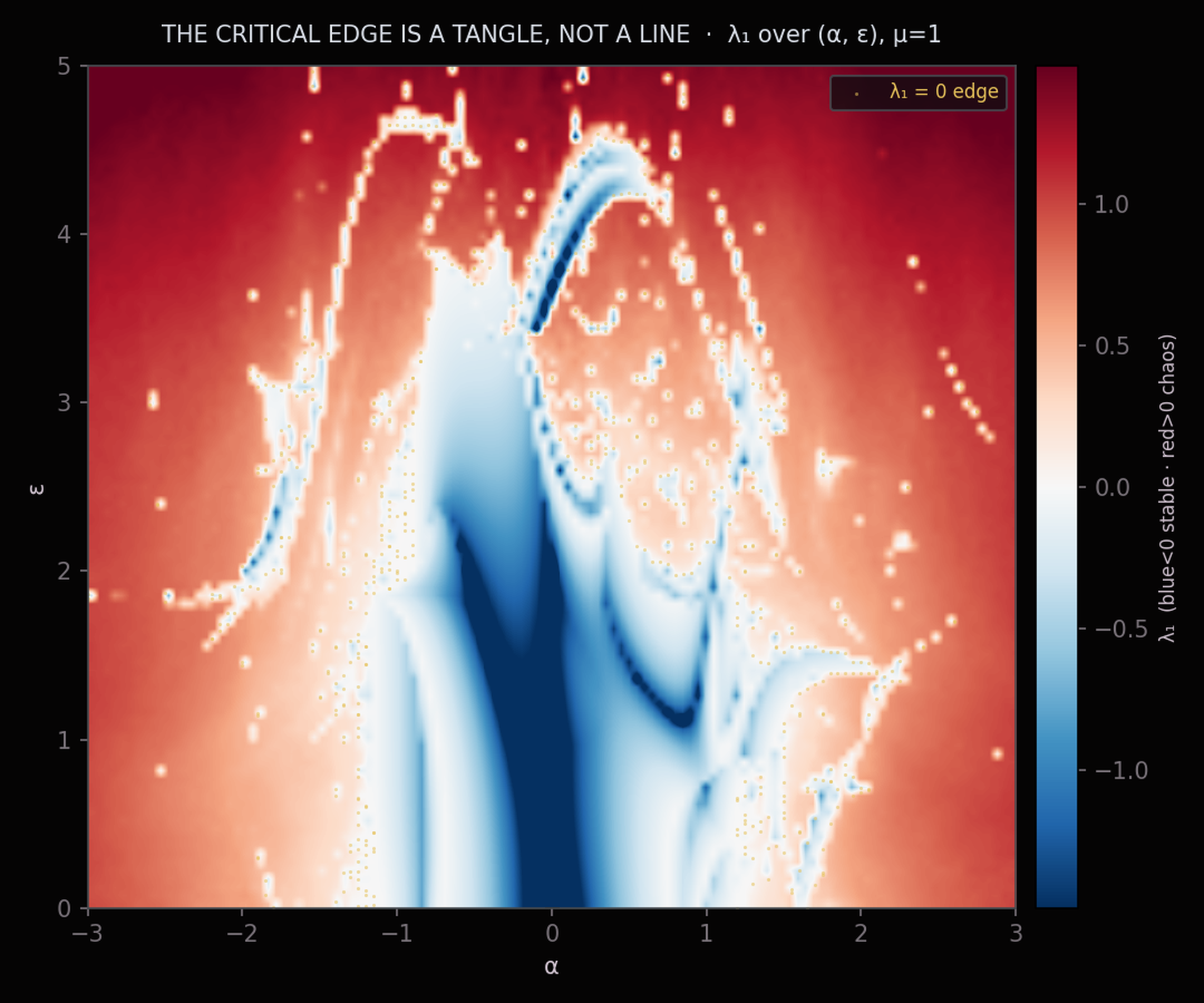
In a 121 × 101 finite scan of (α, ε) at μ = 1, near-zero λ₁ samples trace a curved, broken transition around contracting regions. A straight diagonal does not fit this sampled edge. Its finer topology needs resolution and convergence tests; the plotted points do not establish an exact zero set or a fractal dimension.
A shared coordinate: ε = 2/9
Nineteen catalogued entities share ε = 2/9 exactly while their (α, μ) coordinates vary. Names such as ghost, remnant, decay, and fossil make this a memorable catalogue motif. Six selected renders at that ε span different shapes and classes, including MERCURY and SALT. This shows that ε = 2/9 does not select one visual morphology. The name “fossil coefficient” is an interpretation of the catalogue; the shared ε and themed names do not by themselves establish a temporal invariant or mode-locking mechanism.
What it consolidates
The morphological reading joins five threads: the coordinate classifier; the sampled near-zero Lyapunov transition; the common glyph envelope; the ε = 2/9 catalogue motif; and the Edge-Walker locus. Together they make form a useful clue to dynamics, with room for overlapping silhouettes and more than one route to chaos.
The field guide remains valuable: match a silhouette to a measured regime and ask what the orbit is doing. The shape is part of the message; the Lyapunov measurement completes the reading.
:: APPARATUS ::
Sources for this page
-
Cosmopoiesis · living edition
The public kernel definition, parameter meanings, iteration protocol, and dynamical vocabulary used throughout the scholia.
Read the live canon -
Principia · living edition
The proposition-level canon, including the Archetypal Lattice, its address generator, morphology classes, and parameter-space discontinuity surfaces.
Read the live canon -
Mathematica · living edition
The canonical constants, algebraic identities, and computed closures used by the engine and its derived findings.
Read the live canon