← scholia viriditas v1.0 5 min · 1,114 words
Topology of the Elements
Before the galleries and the larger coordinate books, a periodic table became a field of luminous forms. Revisit ARMISTICE's original elemental catalogue through its three-dimensional GLSL particle engine: 118 preserved addresses, one changing mathematical landscape.
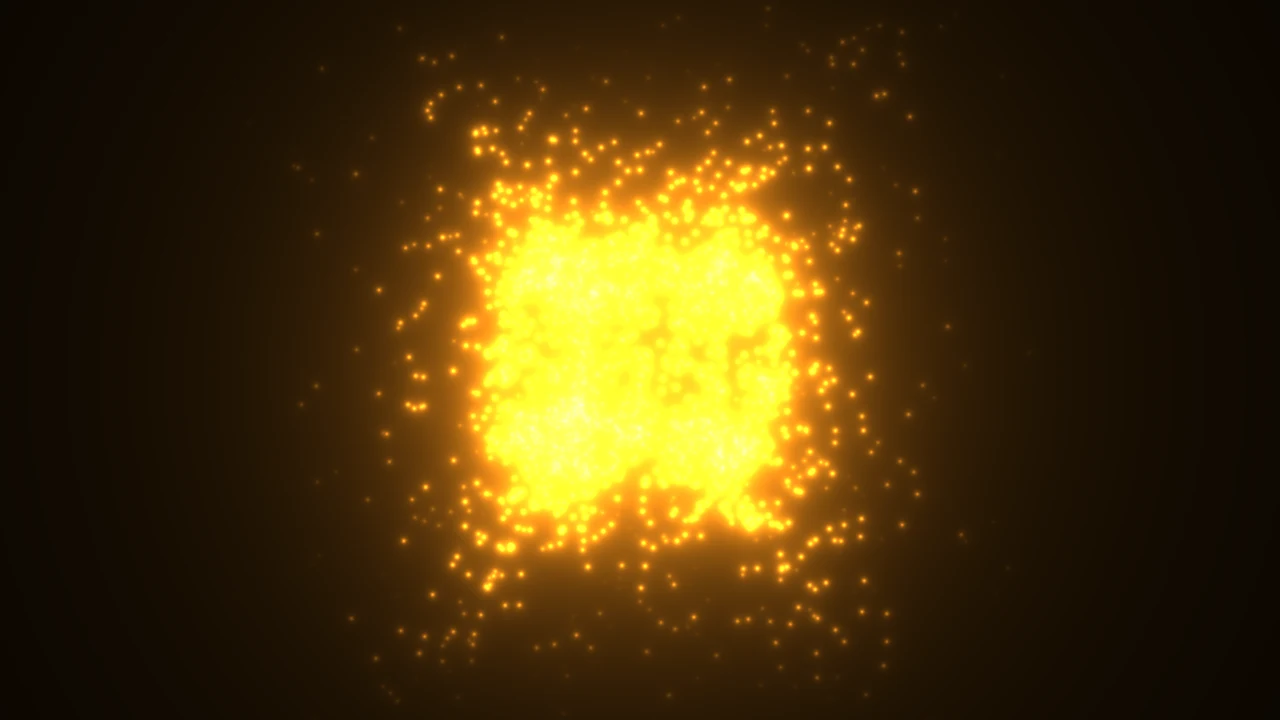
2,500 orbit points · a rotating view
118 elements. One family of rules.
LANTHANIDES
ACTINIDES
A live reconstruction of the original particle shader, using the preserved 118-element catalogue. These are mathematical portraits, not simulations of atomic orbitals. Intermediate forms trace a path between the selected coordinates.
When the table became a landscape
An element could be more than a square containing a name, a number, and a few properties. Give those properties to an iterative equation, let each point generate the next, and the square could open into a form.
That was one of ARMISTICE’s early, consequential experiments. The Topology of the Elements turned the periodic table into a catalogue of mathematical addresses. Hydrogen, carbon, iron, and gold each supplied a small set of numbers; the same machinery unfolded them into clouds of light. Their forms emerged from the rules and inputs, rather than being drawn separately for each element.
The table above returns to that original catalogue and its three-dimensional GLSL particle engine. Choose an element to visit its address. The journey between selections interpolates the parameters; the destination restores the recorded values. These are the archival coordinates, including their particular choices and exceptions.
One family of rules
The early Generative Topology of Chemical Elements text begins with a practical difficulty. Different attractor recipes offered different visual possibilities: folded curves, contained rings, jagged interference. Assigning a separate recipe to each kind of element would produce a collection, but moving between recipes would require changing the machinery itself.
The text proposed a shared trigonometric map with additional coupling terms. Its stated aim was a “smooth transition from Crystalline (Noble) to Volatile (Alkali).” Those were the experiment’s visual and chemical analogies. The underlying decision was concrete: hold the rule family together and let its parameters carry the differences.
That early sketch used two spatial variables and six coefficients. The recovered particle shader is a three-dimensional development, using the compact catalogue’s three coefficients. The surviving versions let us follow the experiment as its rules and visual language developed.
How an element became an address
The founding text explicitly described its starting translation. Pauling electronegativity supplied a frequency parameter. Atomic mass, divided by twenty, supplied an amplitude or “anchor.” Further coupling values expressed the experiment’s group-based ideas about reactivity and stability.
The complete catalogue records how those ideas were instantiated, with different sign conventions, special assignments, and changes of scale. Gold has μ = 3.95 in this catalogue, while the earlier six-parameter text used 9.85 for its gold example. Both records belong to the history; this table preserves the catalogue’s values.
| Element | α | μ | ε |
|---|---|---|---|
| Hydrogen | −2.20 | 0.05 | 0.80 |
| Carbon | −2.55 | 0.60 | 0.10 |
| Iron | 1.83 | 2.79 | 0.02 |
| Gold | −2.54 | 3.95 | 0.00 |
Here α sets the trigonometric frequency, μ weights the cosine terms, and ε weights the cross-coupling terms. The catalogue also records a zoom for each element: a framing choice that changes how the form fills the window. The old labels—frequency, anchor, entropy—retain the language in which the experiment was conceived.
This is mathematical art built from a chemical vocabulary. Its clouds are not computed electron orbitals, and their colors are not measured emission spectra. Chemistry supplies the subject and part of the numerical material; the equation supplies a world in which to explore it.
What makes the light
The original particle shader advances a point through three coordinates:
It starts at (0.1, 0.1, 0.1) and records the sequence of resulting points. A rotating view projects that sequence onto the screen. Each point contributes a soft glow; their contributions accumulate, so concentrated regions become bright and scattered regions remain faint.
The palette belongs to that original presentation. The sign of α selects between warm orange and cool blue, while ε draws the tint toward red. Color makes the numerical choices visible alongside the changing geometry.
There are two movements to notice. Rotation reveals the depth of a form whose coefficients stay fixed. Choosing another element changes the coefficients themselves. A turning cloud and a transforming cloud may look equally alive, but they show different operations.
The distance between two squares
The printed table gives its entries clean borders. The engine allows us to travel between them. During a transition, the coefficients pass through addresses that have no element assigned to them at all.
This intervening space is part of the appeal. The catalogue supplies recognizable destinations, while the connecting paths make room for forms outside its names. Smoothly changing numbers can meet sudden changes in an orbit’s behavior. The journey follows the mathematical landscape; it does not simulate a chemical reaction.
In ARMISTICE’s hermetic language, this suggests a reading of solve et coagula: release the fixed entry into an operation, then watch a new arrangement gather. The numerical address and rule are retained; the image arises from their repeated encounter. The metaphor earns its place through that visible procedure.
What the beginning carried forward
The archive retains both glowing particle portraits and a separate series of elemental mandala plates. They show the same early ambition expressed through more than one visual treatment. The plate view preserves those particular historical images beside an engine that can be explored again.
The elemental catalogue preceded the larger Translexicon. Later work placed many more kinds of subject into coordinate books, and Cosmopoiesis became a different, two-dimensional engine with its own equations and investigations. This early shader has its own identity within that lineage.
The story of the later iron constant continues in The Iron Spiral. Here iron still stands among its neighbors at its original elemental address.
The seed of the larger project is already recognizable: a name leads to numbers, numbers enter a repeatable procedure, and a form arrives that invites a closer look. Before AETHER became a place to wander, the table had begun to open.
Source notes
The complete elemental catalogue and original particle shader are available alongside a contextualized excerpt of the founding note. The catalogue’s historical “Period 8” heading is preserved in that source; elements 104–118 occupy period 7 in the interactive table. The live reconstruction follows the original recipe; the archived plates preserve the individual historical captures.
:: APPARATUS ::
Sources for this page
-
Nicholas Ostella · Original elemental catalogue · 2026 · original archive
The original 118 element entries, copied unchanged with alpha, mu, epsilon, and zoom. Its historical Period 8 heading is retained as source text; elements 104–118 belong to period 7 in the interactive table.
Read the preserved catalogue -
Nicholas Ostella · Original particle shader · 2026 · original archive
The preserved three-dimensional particle recurrence, projection, glow, and palette. Original shader lines are retained with a short editorial header; this is distinct from the later two-dimensional Cosmopoiesis engine.
Read the original GLSL -
Nicholas Ostella · Founding topology note · 2026 · original archive
Selected original passages on the motivation, six-parameter ancestor, and property mapping, with clearly separated editorial context. The historical chemical analogies describe an artistic mathematical construction, not a validated model of atomic physics.
Read the contextualized excerpt -
Translexicon · living registry
The public canonical entity register and the source population for corpus-level censuses.
Read the live registry -
Cosmopoiesis · living edition
The public kernel definition, parameter meanings, iteration protocol, and dynamical vocabulary used throughout the scholia.
Read the live canon