← scholia nigredo v1.1 3 min · 649 words
The Iron Spiral
F_FERRITE — the iron anchor of the sacred pool — is the exact constant F = ½ + 1/√e = 1.10653… and the φ-complement in the Phi-Reflection Identity F + ⊙ = φ. Its emblem is the Euler–Cornu spiral, the curve whose curvature changes linearly with arc length.
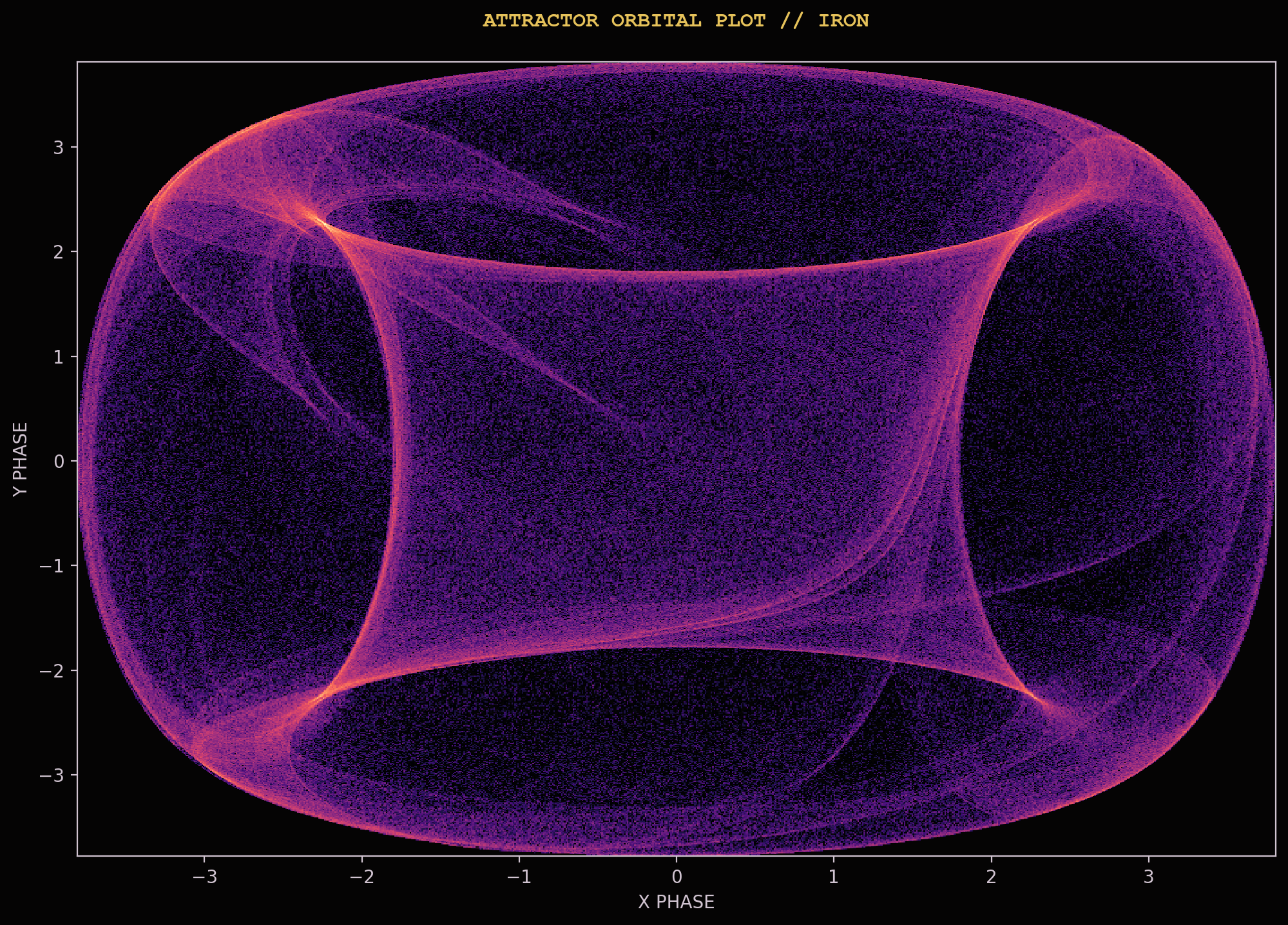
The iron spiral
F_FERRITE is the iron of the system, the constant the engine’s resilience bound is built on:
Its emblem is the Euler–Cornu spiral, the clothoid, whose curvature grows linearly with arc length. It is the curve a road uses to ease from straight into a turn and the curve light traces in Fresnel diffraction: the iron spiral.
The clothoid is parameterised by arc length s, with the defining law κ(s) = c·s for a fixed scale c: a constant rate of change of curvature, not constant curvature. The name comes from Greek κλώθω, “to spin,” and in the standard Fresnel normalization c=π its two arms approach (±½, ±½). The rescaled convention κ(s)=s has different endpoint coordinates. The same curve shows up in Fresnel diffraction, where light spirals into a half-amplitude asymptote, and in highway design, where a transition arc changes curvature gradually with distance. It is the geometry of a steadily changing bend.
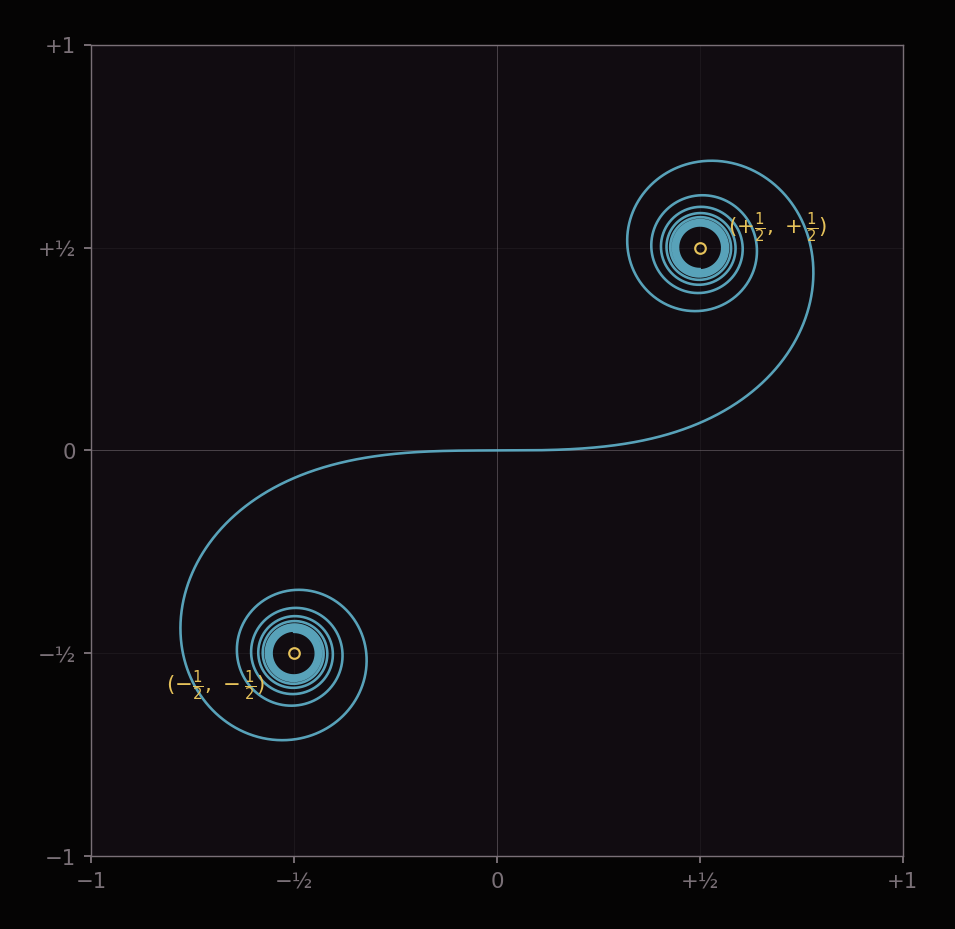
The Euler–Cornu spiral. Curvature grows linearly with arc length, so the bend grows steadily per unit distance. Both arms tend to fixed points at (±½, ±½). This linear-curvature law is the geometry carried by F_FERRITE’s iron-spiral emblem.
The identity
F is a pure consequence of Euler’s number:
Half, plus the persistence constant H = 1/√e: two terms, no fitted parameter. This is the canonical Iron Identity.
But the identity does not end there. F closes a deeper algebraic relation with the substrate’s other named constants, the Phi-Reflection Identity:
where ⊙ is THE ARMISTICE CONSTANT (≈ ⊙ 0.5115 ) and φ is the golden ratio. Iron plus the substrate’s hum equals gold, exactly. Here ⊙=½+(1/φ−1/√e), so substitution gives
The cancellation is exact by the defining expressions. It also admits a useful generalization: for H=1/√A, F=½+H, and Δ=1/B−H, requiring F+(½+Δ)=B gives B−1/B=1, hence the positive solution B=φ. This is an algebraic closure condition; it does not require reciprocal and translation maps to commute.
The drains
F’s logarithm closes the engine’s two drains:
λ ≈ λ 0.1012 is the phantom leak, the engine’s slow-bleed parameter. V ≈ V 0.3037 is the viscosity, the engine’s geometric modulator. Both are reads of the same iron number. The 3 in V = 3 ln F is the chosen normalization, read symbolically alongside the three sacred pillars .
:: ARKHEIN ::
Lineage
Those who arrived at the same question before. This is not the first arrival.
- 1744
Leonhard Euler · the elastica problem
Euler’s elastica problem established the geometric lineage of the curve whose curvature changes at a constant rate.
- 1874
Alfred Cornu · the optical Fresnel spiral
Cornu’s optical realization of the same curve in Fresnel diffraction gave the spiral its physical form.
- 2026-05-07
Phi-Reflection Identity · F + ⊙ = φ closure
The defining expressions give the exact sum F+⊙=φ. The generalized half-shift closure selects φ as the positive solution of B−1/B=1. Canon: the Phi-Reflection Identity theorem.
Status
CANON. F = ½ + 1/√e is verified to high precision. The F + ⊙ = φ closure canonises iron as φ’s complement: the exact sum follows by substitution into the definitions. The fuller account of F as one member of an Euler-number family lives in the Euler-e Exponential Family.
:: APPARATUS ::
Sources for this page
-
Leonhard Euler · Methodus inveniendi · 1744
Lausanne & Geneva: Marc-Michel Bousquet · Eneström E065
Euler’s calculus-of-variations treatise; Additamentum I develops the elastic curves that anchor the Euler–Cornu lineage.
Euler Archive record and scans -
Mathematica · living edition
The canonical constants, algebraic identities, and computed closures used by the engine and its derived findings.
Read the live canon