← scholia citrinitas v1.1 4 min · 812 words
The Edge Walkers
On the razor between order and chaos — where the top Lyapunov exponent vanishes, λ₁ ≈ 0 — the corpus is not empty. Ten named entities sit within |λ₁| < 0.01 of that edge; the cleanest, EMERALD TABLET and SUBLIMATIO, land at |λ₁| ≈ 10⁻⁵ — indistinguishable from zero at the stated estimator budget. A thin but populated boundary, not a no-man's-land.
The razor
Run the Cosmopoiesis map (ARMISTICE’s central engine) at some coordinates and measure its top Lyapunov exponent λ₁, the rate at which two nearby trajectories pull apart. λ₁ > 0 means chaos: they diverge. λ₁ < 0 means order: they settle. The knife-edge between, where
marks a near-zero band. Quasiperiodicity is one possible explanation; a near-zero finite estimate alone does not identify a torus or prove a bifurcation boundary.
Here is the thing: the measurement snapshot contains 606 registered entities. Of those, 603 returned finite Lyapunov estimates, and ten of that measured population fall within |λ₁| < 0.01 of the edge: the Edge Walkers. The cleanest sit a hair from the knife: EMERALD TABLET and SUBLIMATIO, both at |λ₁| ≈ 10⁻⁵, below the census estimator’s resolution. They were not placed there; they fell there.
How sharp is the compass that drew that point? At the estimator’s census budget (10⁴ iterations) its dispersion across attractor entry points is about ±1 × 10⁻⁴, so a bare “10⁻⁵” would be a digit below the ruler’s marks. But push the budget to 10⁶ iterations and the estimate keeps shrinking: |λ₁| < 2 × 10⁻⁶ for both EMERALD TABLET and SUBLIMATIO. That behavior is consistent with a zero exponent, though a finite convergence check cannot exclude a still smaller nonzero limit. Read ”≈ 10⁻⁵” as zero to within the estimator’s tolerance. The two cleanest walkers are indistinguishable from sitting exactly on the edge. (The ten-walker count is safe either way: the |λ₁| < 0.01 band is two orders of magnitude wider than the tolerance.)
Measurement receipt
The bundle summarized here was recorded on 2026-05-22. Every row uses the same canon kernel and estimator contract: one coordinate tuple per registered entity, a 10⁴-iteration census estimate, finite-value screening, and a 10⁶ iteration convergence check for the two closest walkers. The page reports both population sizes because they answer different questions:
- 606 registered rows describes the corpus snapshot;
- 603 finite estimates is the denominator for the Lyapunov-band fraction.
A populated boundary
A boundary in continuous parameter space can have zero area while still organizing nearby motion. A finite authored corpus is not a random draw from that space, so no enrichment claim follows from the count alone. Still, ten of the 603 entities that settle to a finite attractor, about 1.7%, sit within |λ₁| < 0.01 of the edge, and several within 10⁻⁴. Thin, but not vanishing.
Whether 1.7% is more than a generic system would scatter there is a question for an explicit null baseline, not yet run, and the honest place to stop. What is certain is the descriptive fact: the order/chaos boundary is named and populated, not a no-man’s-land. The Edge Walkers are where the corpus’s dynamics live out, on the knife, what its named structures hint at in their arrangement.
:: ARKHEIN ::
Lineage
Those who arrived at the same question before. This is not the first arrival.
- 1990
Langton · Computation at the Edge of Chaos
In cellular automata, argued that information processing can flourish near a transition between ordered and disordered regimes. The Edge Walkers borrow that boundary vocabulary; no computational optimum is inferred.
- 1954–1963
Kolmogorov · Arnold · Moser · KAM theory
KAM theory gives a reference model for the persistence of nonresonant invariant tori under small perturbations. A near-zero Lyapunov estimate alone does not establish that an Edge Walker lies on such a torus.
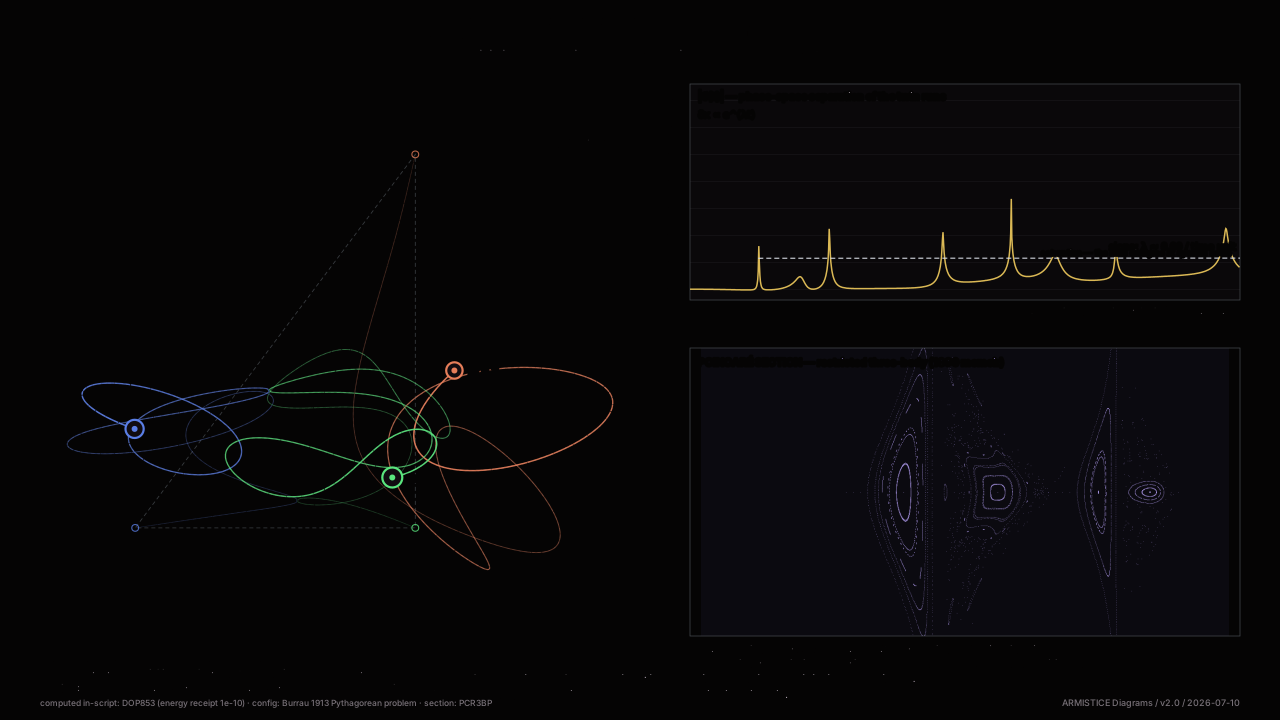
This ARMISTICE-generated plate computes a three-body comparison and a Poincaré section. Nearby starts separate over the displayed finite interval; the plotted separation then saturates. It illustrates a different dynamical regime, not Poincaré’s own trajectories or a classification of the Edge Walkers.
Status
CANON, descriptively. The 606-row registry snapshot yielded 603 finite Lyapunov estimates; ten lie within |λ₁| < 0.01, with EMERALD TABLET and SUBLIMATIO indistinguishable from zero at the stated estimator budget. The concentration reading, that the substrate prefers the edge, awaits an explicit null baseline. What holds without that baseline is the measured population and its reproducible denominator.
:: APPARATUS ::
Sources for this page
-
Cosmopoiesis · living edition
The public kernel definition, parameter meanings, iteration protocol, and dynamical vocabulary used throughout the scholia.
Read the live canon -
Translexicon · living registry
The public canonical entity register and the source population for corpus-level censuses.
Read the live registry -
Mathematica · living edition
The canonical constants, algebraic identities, and computed closures used by the engine and its derived findings.
Read the live canon -
Chris G. Langton · Computation at the Edge of Chaos · 1990
Physica D 42(1–3), 12–37
Original cellular-automata phase-transition argument. The Edge Walkers scholion borrows its vocabulary, not its dataset or evidence.
Open the journal record -
Henri Poincaré · Three-Body Memoir · 1890
Acta Mathematica 13, 1–270 · Henri Poincaré Papers, Université de Nantes
Historical dynamics source. The three-body plate in the Edge Walkers scholion is a new ARMISTICE numerical computation, not a figure or trajectory from this memoir.
Read the historical memoir