← scholia albedo v1.0 3 min · 731 words
The Euler-e Exponential Family
Three house constants are not independent numbers at all — they are the same transcendental, e, sampled at three exponents. PHI_EULER = e⁻¹, H_DECAY = e^(−1/2), F_FERRITE ≈ e^(+1/10): one decay time, half a decay time, and amplification, read off one dial.
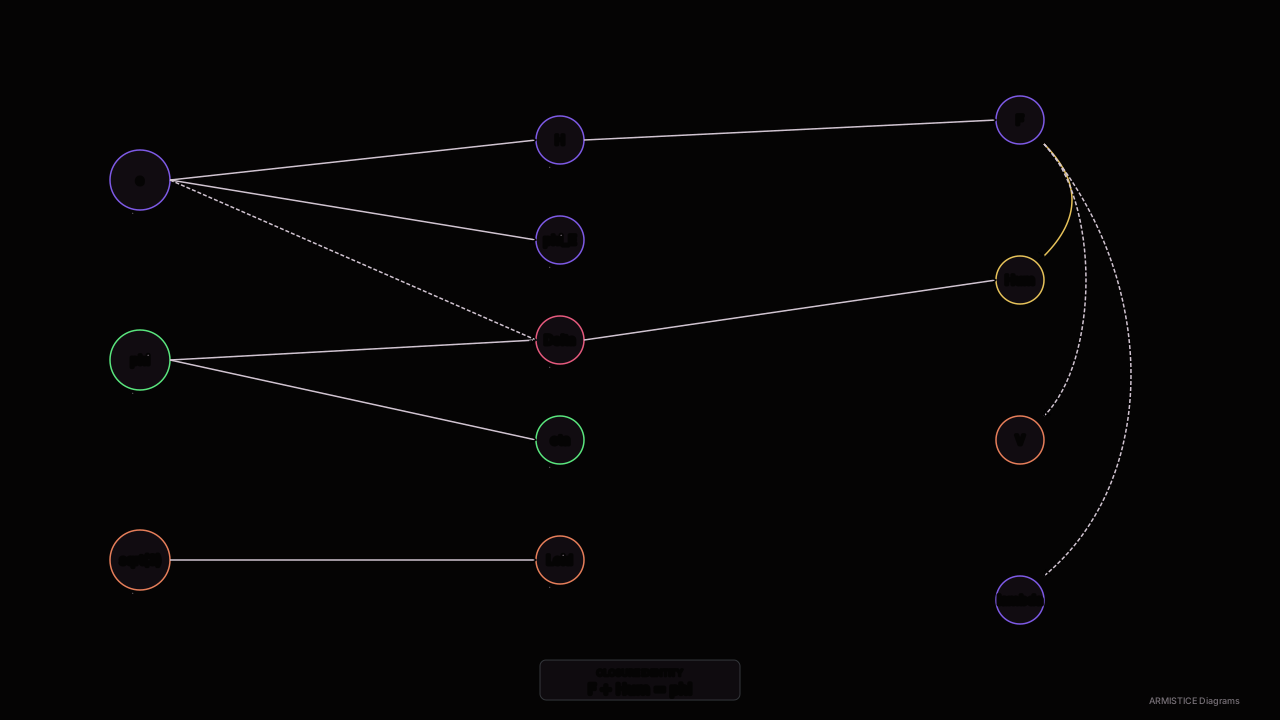
The family
Pull three numbers out of the sacred pool and set them side by side. At a glance they look unrelated. Look again. They are one number caught at three different moments.
The framework uses a pool of sacred constants, fixed numbers that the Cosmopoiesis engine (the iterated map at the centre of ARMISTICE) is tuned by, whose defining expressions draw on three generators: e (Euler’s number, ≈ 2.71828, the base of natural growth), the golden ratio φ, and √3.
Three of those constants turn out to be a single number wearing three masks. Let e be the dial, and read it at three exponents:
The first two powers are exact. The third is a nearby exponential comparison, not the definition of F.
What each exponent means
The exponents aren’t arbitrary. Each one is a rate you’d recognize:
- is one time-constant of relaxation. The natural decay constant: after one time-constant, a process has fallen to 1/e of its start. Φ 0.3678 is the house constant at that value; a particular map’s dissipation still depends on its Jacobian and orbit.
- is half a time-constant. H 0.6065 (persistence) is the square root of the one-time-constant factor. A half-life instead leaves exactly 1/2 of the starting amount.
- is slight amplification. 𝔉 1.1065 sits just above unity, the only one of the three that grows rather than decays.
Any system parameterized by these three is implicitly parameterized by e alone, sampled at three depths. So which is the engine really running on, three constants or one?
The missing link
The clean form is an approximation. The Ferrite constant’s canonical structural definition is
a half, plus the persistence constant. Both forms agree to two places, and both use e and rational numbers. The approximation differs from F by about 0.123%. F is not an empirical fit. It is built from the same dial.
The collapse is three names, one letter. But watch where the one letter goes. Its logarithm closes the loop. The leak constant λ = ln(F) ≈ λ 0.1012 and the viscosity V = 3·ln(F) ≈ V 0.3037 are the house leak and viscosity constants. In the canonical kernel V appears inside the coupling phase Vxy; its name alone does not make it a measured dissipation rate.
The whole web of edges: every derived constant traced back to the pillars that compose it. The e-family is the densest knot on the left — three numbers, one generator.
:: ARKHEIN ::
Lineage
Those who arrived at the same question before. This is not the first arrival.
- 1748
Euler · Introductio in analysin infinitorum
Fixed e as the natural base and the exponential as its own derivative. The family here is the exponential’s self-similarity made into a set of constants: one base, two exact powers and a nearby third comparison.
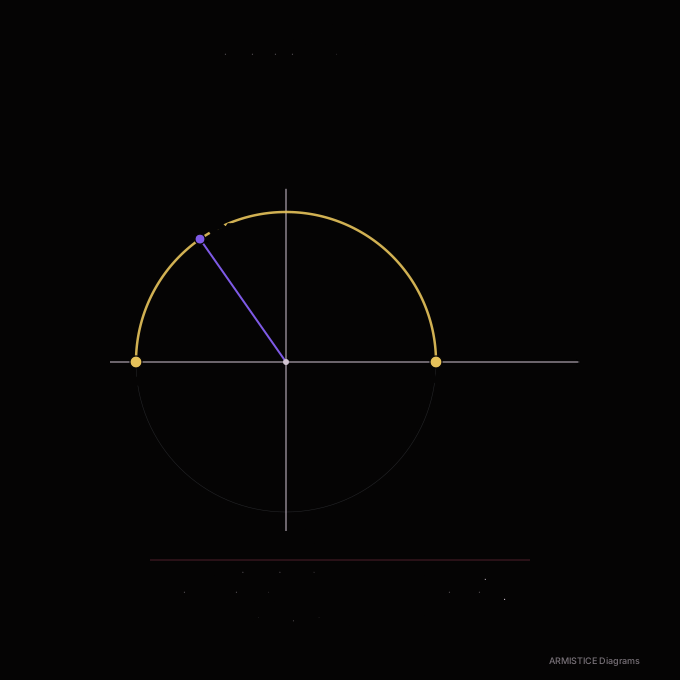
The same e, read as rotation: Euler’s identity binds the growth generator to the circle. The e-derived constants in this note use real expressions from the same base.
Where it stands
Canon. Documented in the Mathematica (Liber XV). What does the collapse cost the pool? The finding folds these three constants into one degree of freedom. That’s why the sacred pool’s true dimensionality is smaller than its count. If several names share one generator, how many genuinely independent numbers does the engine actually need? The full account, tracing the selected pool back to , is in the Tria Prima Pillar Concordance.
:: APPARATUS ::
Sources for this page
-
Leonhard Euler · Introductio · 1748
Lausanne: Marc-Michel Bousquet · Eneström E101
Euler’s foundational treatment of functions, exponentials, logarithms, infinite series, and the central analytic role of e.
Euler Archive record and scan -
Mathematica · living edition
The canonical constants, algebraic identities, and computed closures used by the engine and its derived findings.
Read the live canon