Mathematica
Phi-Reflection Identity
Sacred constants: F ⊙ φ H Δ
An exact closure identity: the Ferrite and Armistice constants meet at phi, while a companion pair closes at its reciprocal.
Publication folio Full mathematical text, with readable source references
The Phi-Reflection Identity is about one exact interval in the sacred constant web. Ferrite rises from the Euler branch; the Armistice constant fills the remaining distance to the golden ratio. Their meeting is not a numerical fit or a pattern noticed after rounding. It follows directly from their definitions.
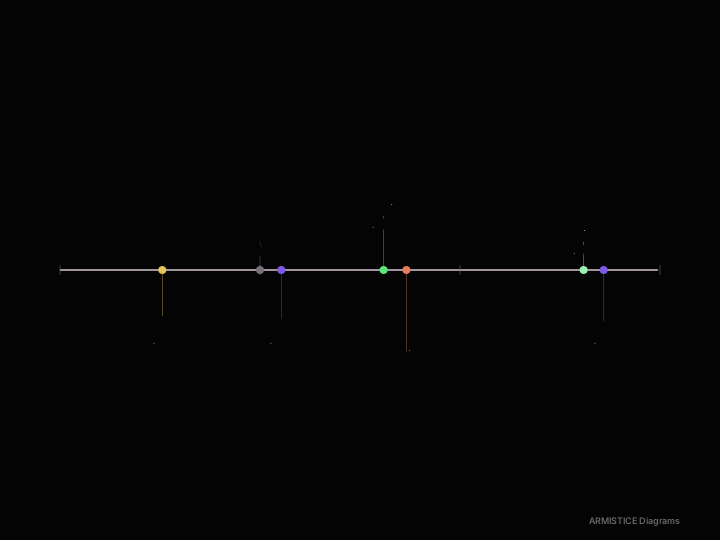
The lower interval is exact: . Farther right, and sit near one another, but that proximity is an orienting coincidence, not part of the proof.
The exact reflection
The central relation is
Substitute and . The two Euler terms cancel, leaving , which is precisely . The decimal values are useful labels—approximately —but the closure lives in the symbolic cancellation.
The reciprocal side has the same architecture. and meet at . The two closures are paired by a half-step: and both equal . This is the reflection named by the page: an upper golden sum and a lower reciprocal sum assembled from the same Euler contribution and its complements.
Because the cancellation is symbolic, no numerical search is needed to recover it. Additional decimal places only sharpen the labels; they do not make the relation more or less true. The identity is therefore a compact consistency check whenever these constants appear together.
What the line is showing
The plate places the closure among neighboring landmarks so its scale can be felt. lies just above one half; lies just above unity; their span ends exactly at . Beyond it sit , , and .
The closeness of and is deliberately marked as a Lucas-adjacent coincidence. It does not derive either pillar, prove a hidden equivalence, or strengthen the clausura. The exact content is smaller and cleaner: definitions from two branches cancel into the golden ratio, giving the constant pool an algebraic hinge. In the wider framework, that hinge is useful because it lets Ferrite, persistence, variance, and the Armistice constant be read as related coordinates of one web rather than independent numerology.
:: APPARATUS ::
Sources for this page
-
Euclid — this edition by John Casey · Euclid · Elements · c. 300 BC
composed c. 300 BC · this edition John Casey, Dublin University Press, 1885 · the first six books
The oldest engine still running. From five postulates and a handful of common notions, the whole of plane space is deduced — proposition by proposition, each leaning only on what came before. The taproot of every figure in this Scriptorium: the golden ratio is defined here (Book VI), the incommensurables tamed (Book V), and Book I closes on Pythagoras. Set from John Casey’s richly annotated 1885 edition.
Read in the Scriptorium -
Leonhard Euler · Introductio · 1748
Lausanne: Marc-Michel Bousquet · Eneström E101
Euler’s foundational treatment of functions, exponentials, logarithms, infinite series, and the central analytic role of e.
Euler Archive record and scan -
Mathematica · living edition
The canonical constants, algebraic identities, and computed closures used by the engine and its derived findings.
Read the live canon